Buyer Fit Snapshot
| Best fit | Wholesale Eco Retail Boxes for Sustainable Brand Growth projects where brand print, material claims, artwork control, MOQ, and repeat-order consistency need to be specified before quoting. |
|---|---|
| Quote inputs | Share finished size, material target, print colors, finish, packing count, annual reorder estimate, ship-to region, and any compliance wording. |
| Proofing check | Approve dieline scale, logo placement, barcode or warning zones, color tolerance, closure strength, and carton packing before bulk production. |
| Main risk | Vague material claims, crowded artwork, missing packing details, or unclear freight terms can make a low unit price expensive after revisions. |
Fast answer: Wholesale Eco Retail Boxes for Sustainable Brand Growth should be specified like a repeatable production item. The safest quote records material, print method, finish, artwork proof, packing count, and reorder notes in one written spec.
Production checks before approval
Compare the actual filled-product size with the drawing, then confirm tolerance on folds, seals, hang holes, label areas, and retail display edges. Reserve space for logos, QR codes, warning copy, and material claims before decorative graphics fill the panel.
Quote comparison points
Review material grade, print process, finish, sampling route, tooling charges, carton quantity, and freight assumptions side by side. A quote is only useful when the supplier can repeat the same color, closure quality, and packing count on the next order.
Wholesale eco retail boxes get judged fast. A buyer on a buying trip, a picker in a warehouse, and a customer at the register all notice different things, yet the verdict lands in the same place. The box either looks credible and protects the product, or it does not. That split matters. The right structure can trim unit cost through wholesale volume, clean up shelf presentation, and cut down on damage-related reorders without turning the whole project into a circus.
Treating sustainability like a sticker on the surface is the lazy move. Real wholesale eco retail boxes need more than recycled content on the spec sheet. They need the right board grade, the right print coverage, and a structure that fits the product without wasting material. That is the difference between packaging that supports margin and packaging that quietly eats it every time the box ships, stacks, or gets opened by a retailer with no patience.
Wholesale Eco Retail Boxes: What Buyers Notice First
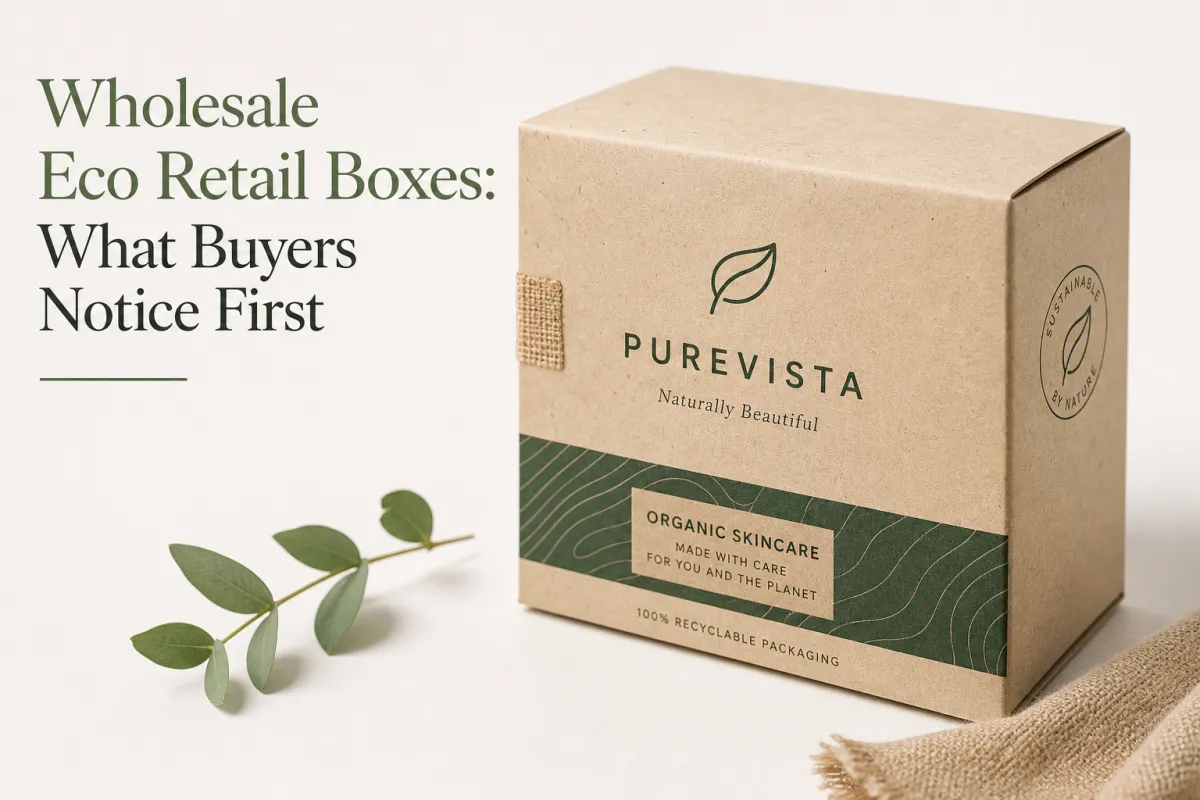
The first thing most buyers notice is not the recycling note. It is whether the box feels steady in the hand, reads clearly from a few feet away, and protects what is inside without looking like it was built in a panic. Wholesale eco retail boxes work when they clear those three checks at once. If the carton sags, scuffs, or prints too lightly, the eco message loses weight before anyone bothers to read the copy.
Here is the commercial reality: wholesale eco retail boxes are a supply chain decision, not just a material choice. Brands buy in volume because volume usually lowers the cost per unit, cuts down on last-minute packaging buys, and keeps shelf presentation consistent across stores. A cleaner box also helps the retailer. It looks more deliberate. It stacks better. It is less likely to arrive crushed, which matters more than plenty of teams want to admit.
Most problems start when a brand picks an eco material first and the structure second. A box can be made from recycled paperboard and still fail if the caliper is too light, the glue joint is weak, or the artwork blocks the barcode and key claims. Wholesale eco retail boxes only work when the packaging supports the product and the retail environment at the same time. Shelf fit, transit resistance, and print clarity all need to be in the room together.
- Lower unit cost: Buying wholesale usually spreads setup costs across more boxes, which is why a launch run and a replenishment run should never be priced like the same job.
- Cleaner shelf presentation: A carton with strong panels, crisp folds, and clear front-of-pack hierarchy tends to beat a box that looks recycled in the wrong way, meaning rough instead of responsible.
- Fewer transit losses: Better-fit wholesale eco retail boxes reduce movement in shipping cartons and help avoid damage claims, returns, and emergency reorders.
There is a hidden conversion effect too. If the box feels flimsy, retail staff are less likely to face it forward. If the graphics are muddy, the product gets less attention. If the structure looks overbuilt, buyers may assume the brand spent on packaging instead of the product. Those judgments happen quickly, and they are not easy to reverse. That is why wholesale eco retail boxes should read as efficient, not cheap.
A good retail box should earn shelf space by doing three jobs at once: protect, present, and survive the supply chain without drama.
One more practical point: wholesale eco retail boxes do not have to be the lightest option on the table, and they should not be. The best package uses enough board to stay intact, enough print to sell the product, and no extra material the application does not need. That balance is where margin hides.
Product Details: Materials, Finishes, and Retail Fit
Material choice should start with the product, not with a preference for a certain look. For lighter goods, wholesale eco retail boxes often perform well in recycled paperboard or kraft paperboard because those materials give a clean retail face without unnecessary thickness. For products that ship and display in the same pack, corrugated retail boxes can make more sense because they add compression strength and better edge protection. For brands chasing a natural look, kraft structures still get used a lot, but the texture has to be paired with disciplined print design or the box starts to look unfinished instead of sustainable.
Finishes deserve the same scrutiny. Soy-based or water-based inks are common choices for wholesale eco retail boxes because they keep the print story aligned with the material story. A matte aqueous coating can protect the surface while staying practical for recycling streams in many markets. Soft-touch lamination can look premium, but it should be used carefully because not every luxury finish helps an eco claim. Sometimes the smarter move is a low-coverage design with strong typography and one controlled spot color. Less ink often means less cost and less visual clutter.
That is where retail fit matters. A box can be sustainable and still miss the mark on the shelf. A sleeve-and-tray structure can add a premium feel without dumping extra material into the pack. A tuck-end carton works well for many lightweight products because it is efficient to store and easy to assemble. Window cutouts can help when the product itself needs to do some of the selling, but the cutout size should be deliberate; too much exposure can weaken the board and reduce recyclability depending on the film choice. Crash-lock bottoms make sense when the product weight or pack-out speed needs more support.
For buyers comparing wholesale eco retail boxes, the real question is not “Which finish looks best?” It is “Which finish carries the brand without creating a cost penalty?” Smart contrast, tight dielines, and clear hierarchy usually beat heavy embellishment. A strong label area, a clean logo lockup, and restrained color often produce a better retail result than foil, embossing, and dense coverage piled on top of each other. In practice, the box has to work under fluorescent store lighting, during courier handling, and in warehouse storage. That is a tough brief.
What Works by Product Type
Small cosmetics, candles, supplements, and accessories often do well with paperboard-based wholesale eco retail boxes because the product weight is manageable and the front-of-pack message matters more than brute strength. Heavier items, multipacks, and glass containers usually need corrugated support or an insert that locks the product in place. If a package must survive parcel movement as well as retail display, ask whether the structure should be tested against ISTA protocols or a similar transit profile before production gets the green light. I have seen brands skip that step and then spend more fixing damage claims than they would have spent on a proper test. Not fun. Definitely avoidable.
For sourcing teams that need traceable paper inputs, FSC-certified board is worth discussing early. It is not magic, and it does not replace fit or performance, but it does give procurement a cleaner paper trail. You can review the standards through the FSC website. That becomes especially useful when wholesale eco retail boxes sit inside a wider ESG or retailer compliance program.
| Material / Structure | Best For | Strength Point | Watch-Out |
|---|---|---|---|
| Recycled paperboard | Lightweight retail goods, cosmetics, accessories | Clean print surface, efficient for volume runs | May need an insert for fragile items |
| Kraft board | Natural-look brands, minimalist retail lines | Strong eco signal and simple visual language | Can look dull if artwork is not planned well |
| Corrugated retail box | Heavier products, ship-and-display packs | Better compression and transit resistance | Uses more board, so dimensions matter more |
| Sleeve-and-tray format | Premium launches, product sets, gifting | Good shelf presence without excess bulk | Needs precise tolerances to avoid sliding |
When the structure is right, wholesale eco retail boxes do not need to shout sustainability. They prove it through material choice, print restraint, and fit. That is a stronger signal than a box that talks a big eco story and shows up with crushed corners or loose product movement.
Specifications That Protect Product and Margin
Good wholesale eco retail boxes start with a specification sheet that leaves little room for guesswork. The minimum set should include external and internal dimensions, board caliper or GSM, print side, color count, coating or varnish choice, insert requirements, and shipping format. If the product is small, even a 1 mm to 2 mm internal variance can affect movement in the box. If the item is heavier, the board caliper becomes more than a print choice; it becomes a protection decision.
Fit has a direct economic effect. Oversized wholesale eco retail boxes waste money in two ways: they use more material than needed, and they increase freight volume. Boxes that are too tight create the opposite problem. They can scuff the product, split a panel, or slow pack-out on the line. Either way, the cost shows up later as returns, rework, or a tense email from a buyer who expected the packaging to hold up better.
Before ordering, buyers should confirm the following details and keep them on file for every reorder:
- Product dimensions: Final packed size, not just the naked product size.
- Board specification: GSM, caliper, flute type, and any recycled content requirement.
- Print layout: Color count, front and back content, barcode location, and legal copy.
- Finish: Matte, gloss, aqueous coat, or no coating at all.
- Insert need: Paperboard, molded pulp, or no insert if the product already sits securely.
- Master carton pack-out: How many retail boxes per shipper, because this affects freight and handling.
- Storage conditions: Flat-packed inventory behaves differently in humid warehouses than in climate-controlled storage.
One spec error can snowball across a wholesale run. If a dieline is off by even a fraction, the sample may look fine while the production run behaves differently under pressure or folding. That is why sample approval and production approval are not the same thing. A sample confirms the concept. A production approval confirms how wholesale eco retail boxes will behave at scale. If you only approve the sample visually, you can miss a measurement issue that turns expensive later.
A box that fits the product and survives the truck is usually cheaper than the box that only looks inexpensive on paper.
Another area buyers overlook is barcode and regulatory placement. A clean front panel is not enough if the barcode sits too close to a fold or if legal copy gets shoved into a corner where it becomes hard to read. For retail programs, wholesale eco retail boxes should be mapped with scanner behavior in mind. That is not a design nicety. It is an operational requirement.
For reorders, lock the approved artwork files, the approved dieline version, and the approved quantity tier into one record. Teams change jobs, product lines expand, and a file name that makes sense today can trigger a mistake six months from now. The most efficient wholesale eco retail boxes are the ones that can be reordered without a long argument over what was actually approved.
Wholesale Eco Retail Boxes Pricing and MOQ
Pricing for wholesale eco retail boxes is usually built from a few core inputs: board grade, box size, print coverage, finish complexity, quantity, and freight. There is no honest flat rate that fits every project. A plain kraft carton and a full-color retail box with coating, inserts, and a window cutout are not the same purchase, even if the outside dimensions are close.
MOQ, or minimum order quantity, changes the economics fast. Lower quantities are useful for launches, seasonal tests, or pilot retail placements. Higher quantities usually bring down the per-box cost because setup, proofing, and tooling are spread over more units. That is why wholesale eco retail boxes often make more sense in tiered pricing than in a single quote. The buyer needs to see the break point before deciding whether to order 1,000, 5,000, or 10,000 units.
For standard carton-style wholesale eco retail boxes, these directional ranges are a realistic starting point. They are not promises, and the final quote still depends on structure and artwork, but they help buyers compare options before they commit:
| Quantity | Typical Use | Indicative Unit Price | What Usually Changes |
|---|---|---|---|
| 500-1,000 | Launch runs, test markets, limited promotions | $0.55-$1.20 | Setup cost is spread across fewer units |
| 2,500 | Early retail rollout, regional replenishment | $0.32-$0.78 | Better balance between cost and flexibility |
| 5,000 | Steady wholesale demand, multi-store supply | $0.22-$0.48 | Setup becomes more efficient, freight planning improves |
| 10,000+ | National distribution, stable SKUs | $0.16-$0.36 | Lowest cost per unit if specs stay fixed |
Buyers should also compare quote line items side by side. Tooling fees, plate charges, sample charges, finishing surcharges, and palletizing or packaging of finished goods can move the total more than expected. A quote that looks cheaper may exclude freight, while a quote that appears higher may include more of the real landed cost. That is why wholesale eco retail boxes should be compared on identical terms: same dimensions, same artwork coverage, same finish, same shipping destination.
Here is a simple rule that saves money: request pricing at three quantities, not one. A 1,000-piece quote tells you what a launch costs. A 5,000-piece quote shows whether scale creates real savings. A 10,000-piece quote reveals whether the structure is worth standardizing across more than one product line. Without those tiers, it is easy to underbuy, then rush a second run at a higher cost.
Freight matters too. A box that nests efficiently in shipper cartons and stacks neatly on pallets can cut shipping expense more than a prettier but awkward structure. For wholesale eco retail boxes, smart dimensions often matter more than marketing language. A few millimeters saved on width or height can change how many units fit per master carton, which affects the whole landed price.
Process and Timeline: From Dieline to Delivery
A disciplined process keeps wholesale eco retail boxes on time and on budget. The sequence should stay simple: discovery, spec confirmation, dieline setup, artwork review, proof or sample approval, production, finishing, and shipment. Each step exists for a reason. If one gets skipped, the project usually pays later with a delay, a reprint, or a box that does not fit the product quite right.
Timing depends on the project, but realistic planning usually looks like this: one business day for discovery and quotation, one to two business days for dieline confirmation, one to two business days for artwork review, one to three business days for proof approval, and roughly 10 to 15 business days for production after approval. Shipping can add another three to seven business days depending on the destination. Wholesale eco retail boxes move faster when the brand files are clean and the approval chain is short.
Where do delays usually happen? Late artwork revisions are the big one. Missing barcode files are another. Indecision on coating or window style can also stall the job because the production team cannot lock the material spec until the finish is approved. The most expensive delay is often not the box itself; it is the missed launch window. A packaging change that slips past a sales reset can cost more than the box order.
There is also a sequencing issue many teams miss. If you are launching a product with retail compliance requirements, the packaging copy and the barcode should be finalized before the box layout gets locked. That saves a second proof round. It also reduces the chance that wholesale eco retail boxes need a last-minute redesign because the legal text moved or a retailer asked for a different label placement.
Packaging teams sometimes ask whether a faster turnaround means lower quality. Not automatically. Speed is usually a function of clarity. If the dimensions are approved, the artwork is press-ready, and the shipping destination is known, then the production team can move without guessing. That is why wholesale eco retail boxes are easier to produce well when the buyer treats specification work as part of the schedule, not as an optional pre-step.
For products that ship through parcel networks or cross-dock operations, transit testing deserves a line in the timeline. It does not need to be elaborate, but it should be real. A carton that fails a drop or compression check in development is much cheaper to fix than one that fails after it is in the market. That is not theory. It is basic arithmetic.
Why Choose Us for Wholesale Eco Retail Boxes
Custom Logo Things approaches wholesale eco retail boxes as a packaging problem first and a branding exercise second. That order matters. A pretty box that cannot hold its shape, protect the product, or ship at a sensible cost is not a good buy. Buyers need a supplier that can balance sustainability goals with retail performance, and that balance is where the strongest orders usually come from.
One advantage worth calling out is control over the details that most often create rework. Consistent board sourcing helps keep repeat orders stable. Clear print checks reduce artwork surprises. Short communication loops make it easier to resolve dieline questions before they turn into production errors. For brands that reorder often, repeatable specs matter as much as the first quote. Wholesale eco retail boxes are cheaper to manage when the supplier understands that reorders should behave like reorders, not like brand-new projects every time.
Compare that with a fragmented supply chain. One team handles structure, another handles print, and a third handles freight. Errors multiply in the gaps between those teams. A board spec gets read one way in prepress and another way on the floor. A barcode file gets updated after the dieline is locked. A freight decision gets made before the pallet count is fixed. The result is predictable: confusion, delays, and extra cost. Wholesale eco retail boxes do better when structure, art, and logistics are handled in one conversation.
That is also where our Wholesale Programs make the buying process easier. The focus is on practical volume planning, not on pushing the largest possible order. If a brand needs a launch run first and a larger reorder later, that can be planned around the product calendar. For broader packaging rollouts, our Custom Packaging Products range helps keep the line consistent across related items, which matters when the shelf story needs to look unified.
From a packaging buyer's point of view, the value is measurable. Fewer approval loops. Less scrap. More predictable reorders. Better fit around actual product dimensions. Those are the benefits that show up in purchase orders and warehouse reports, not just in marketing copy. When wholesale eco retail boxes are built around those numbers, the sustainability message becomes believable because the package behaves like a well-managed product, not a label slapped on at the end.
Packaging should reduce surprises. If the supplier makes the run harder to manage, the box is costing more than the invoice says.
Honestly, that is what most teams get wrong. They compare samples by appearance, but the real test is how the box behaves in production, on a pallet, and on the shelf. Custom Logo Things keeps that sequence in view because wholesale eco retail boxes are only useful if they stay consistent across every step of the journey.
Next Steps for Ordering Wholesale Eco Retail Boxes
If you are ready to move from concept to quote, start with the facts. Gather the packed product dimensions, target quantity, preferred material, artwork files, and delivery date before you request pricing. That information makes wholesale eco retail boxes easier to quote accurately and much easier to approve without a long back-and-forth. It also gives the supplier the data needed to flag fit or freight issues early.
- Define the product: Give the exact dimensions, weight, and any fragile points that need support.
- Choose the structure: Paperboard, kraft, corrugated, sleeve-and-tray, or another format that fits the use case.
- Prepare artwork: Send editable files, barcode placement, and any compliance copy together.
- Ask for tiered pricing: Compare at least three quantities so you can see where wholesale savings begin.
- Request a proof or sample: This is especially useful when fit, scanability, or shelf presentation matters.
If the box carries a barcode, a legal line, or a premium brand mark, ask for proof approval before production begins. That one step can prevent a reprint. It is also the easiest way to verify that the material, the print, and the structure are aligned. For many wholesale eco retail boxes, a proof is the cheapest insurance in the project.
For brands comparing launch versus scale, it helps to decide whether the order is a test batch, a seasonal buy, or a full wholesale run. Those are different decisions. A test batch can justify lower MOQ and a slightly higher unit cost. A full run can justify a more efficient structure and tighter freight planning. Wholesale eco retail boxes become easier to buy when that distinction is made early.
Once the specs are locked, move to pricing, then proof approval, then production. That order keeps the process clean and avoids the expensive habit of changing the box after the quote has already been built. If your goal is retail-ready packaging that supports margin rather than draining it, wholesale eco retail boxes are best handled as a defined project, not as a last-minute purchase.
What are wholesale eco retail boxes made from?
Most wholesale eco retail boxes are made from recycled paperboard, kraft board, or corrugated board, depending on product weight and display needs. Many projects also use soy-based or water-based inks, plus low-coverage coatings that keep the package practical for retail use. The best material is the one that fits the product, shipping method, and shelf presentation without adding unnecessary board thickness.
How do wholesale eco retail boxes affect unit cost?
Quantity is the biggest cost lever. As the run gets larger, setup and tooling costs are spread across more units, so the per-box price usually falls. Material grade, print coverage, inserts, and finish complexity can still raise cost even if the quantity stays the same, which is why wholesale eco retail boxes should always be quoted with full specs attached.
What is the typical MOQ for wholesale eco retail boxes?
MOQ varies by box style, size, and print method, but custom wholesale runs usually need a minimum to stay cost-effective. Simpler structures and fewer colors often allow lower starting quantities than more complex premium builds. If you are launching a product, ask for pricing at several MOQ levels so you can compare a test run with a larger scale-up.
How long does production take for eco retail boxes wholesale?
Timeline depends on artwork readiness, proof approval, material availability, and shipping distance. The fastest projects are the ones where dimensions, dielines, and brand files are approved early. Rush orders can be possible, but they usually cost more and leave less room for revisions, which is why wholesale eco retail boxes benefit from early planning.
Can wholesale eco retail boxes include custom branding and barcodes?
Yes, custom branding is standard, and barcodes or regulatory copy can be built into the artwork layout. The files should be checked carefully before approval because barcode placement and legibility affect retail use. A proof or sample is the safest way to confirm that branding, scanability, and fit all work together, especially when wholesale eco retail boxes need to carry both marketing and compliance information.
For brands that want the box to work as hard as the product, the path is simple: define the size, Choose the Right board, set the print rules, compare quantity tiers, and approve a proof before production starts. That is how wholesale eco retail boxes stay efficient, look credible on the shelf, and protect margin instead of draining it. If the brief is clear from the start, wholesale eco retail boxes become a practical buying decision rather than a packaging gamble. Skip the guesswork, nail the specs, and the box will do its job without making a mess of the budget.


