Buyer Fit Snapshot
| Best fit | Wholesale mailers for Amazon sellers and bulk packaging buyers comparing material specs, print proof, MOQ, unit cost, freight, and repeat-order risk. Brand print, material control, artwork approval, and repeat-order consistency matter most here. |
|---|---|
| Quote inputs | Share finished size, material target, print colors, finish, packing count, annual reorder estimate, and delivery region. |
| Proofing check | Approve dieline scale, logo placement, barcode or warning zones, color tolerance, and any recyclable or compostable wording before bulk production. |
| Main risk | Vague material claims, crowded artwork, or missing packing details can create delays even when the unit price looks attractive. |
Fast answer: Wholesale Mailers for Amazon Sellers Bulk Packaging: MOQ, Samples, Lead Time, and Quote Checks should be specified like a repeatable production item. The safest quote includes material, print method, finish, artwork proof, carton packing, and reorder notes in one written spec.
What to confirm before approving the packaging proof
Check the product dimensions against the actual filled item, not just the sales mockup. Ask for tolerance on folds, seals, hang holes, label areas, and retail display edges. If the package carries a logo, QR code, warning copy, or legal claim, reserve that space before decorative graphics fill the panel.
How to compare quotes without losing quality
Compare board or film grade, print process, finish, sampling route, tooling charges, carton quantity, and freight assumptions side by side. A lower quote only helps if the supplier can repeat the same color, closure quality, and packing count on the next order.
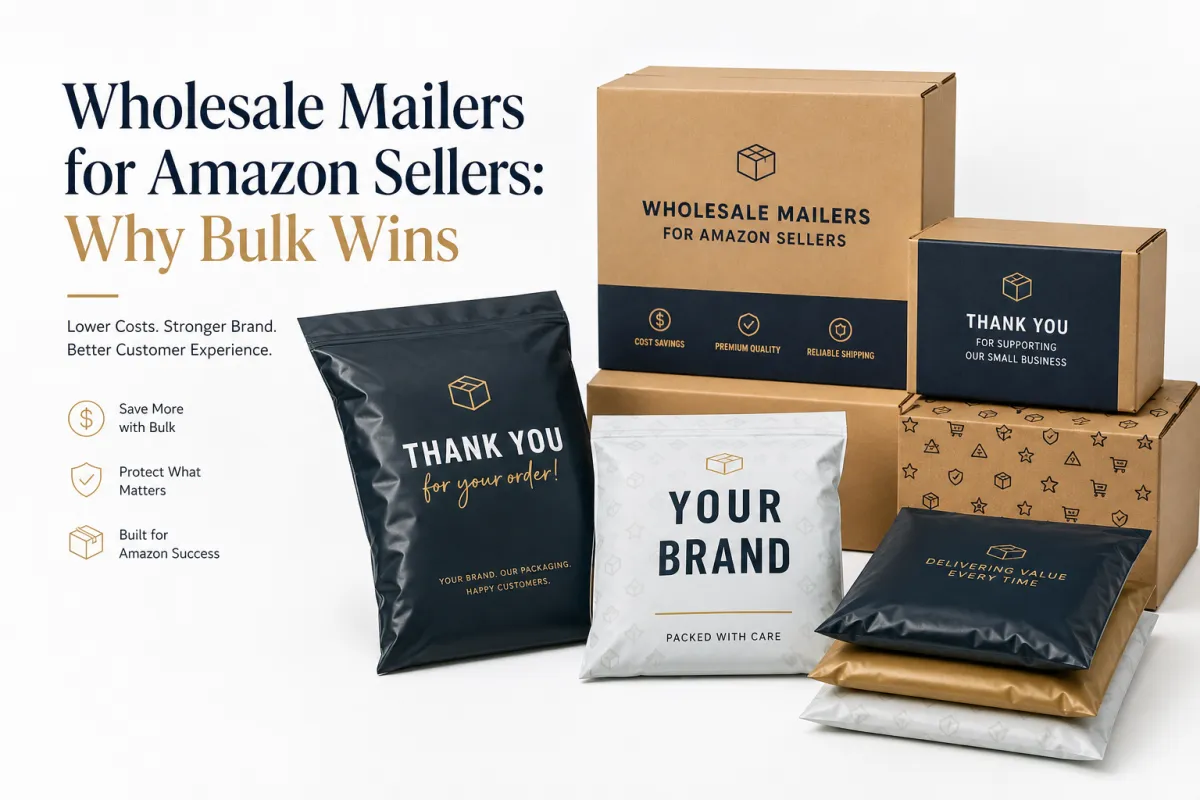
Wholesale Mailers for Amazon Sellers: Why Bulk Wins
If you sell on Amazon, packaging is not just a finishing touch. It affects shipping cost, item protection, returns, unboxing quality, and how smoothly your operation scales. That is why wholesale mailers for Amazon sellers are a practical option for brands that want consistent supply without constant small reorders.
Buying mailers in bulk usually gives you more control over unit cost, print consistency, inventory planning, and packaging standards across multiple SKUs. It can also reduce the risk of using mismatched materials that create a patchwork look in fulfillment. For Amazon sellers, that matters because packaging often has to do several jobs at once: protect the product, support speed at the packing table, and present the brand in a clean, professional way.
Wholesale does not mean one-size-fits-all. The right mailer depends on product weight, breakability, moisture sensitivity, shipping method, and whether you are using a warehouse, prep center, or in-house team. The sections below cover the main decision points so you can choose wholesale mailers with less guesswork and more practical planning.
Why Wholesale Mailers Work for Amazon Sellers
Wholesale ordering starts to make sense once packaging demand is steady enough to forecast with some confidence. A seller shipping the same catalog every week often benefits more from a bulk program than from repeated small purchases, because the administrative work and per-unit cost usually improve as volume rises.
One of the biggest advantages is cost stability. Smaller orders often come with higher unit prices, more frequent freight charges, and more touchpoints between reorders. By contrast, wholesale mailers for Amazon sellers are often priced in tiers, so the cost per mailer can drop as quantity increases. That does not always mean the lowest total spend, but it usually gives you better control over landed cost.
Bulk purchasing also helps with consistency. When you replenish packaging from the same production run, you are more likely to keep the same film thickness, adhesive behavior, color tone, and print placement. That consistency can be useful when you run multiple fulfillment channels or use the same packaging across Amazon, your own website, and wholesale accounts.
There is also an operational benefit. Packaging that arrives in predictable case counts and pallet quantities is easier to store and count. Many sellers find inventory simpler to manage when they know, for example, that a case may contain 250, 500, or 1,000 mailers depending on the format. Even when exact counts vary by style, a clear case pack structure makes replenishment easier to plan.
For Amazon sellers, speed matters. Mailers that are easy to load, seal, and stack can reduce packing friction. In a busy prep environment, a small improvement in workflow can matter more than a minor unit cost difference. If your team spends less time fighting with packaging, throughput often improves naturally.
For sellers building a packaging system from scratch, it can help to compare wholesale programs with other product-specific options. For example, a broader sourcing program like Wholesale Programs may work well if you want repeatable ordering and tiered volume pricing, while a narrower custom solution may be better if branding is a priority.
Mailer Types and Material Choices
Not all mailers perform the same way. The right choice depends on what you ship, how fragile it is, and how much presentation matters. Wholesale mailers for Amazon sellers often fall into a few common categories, each with its own tradeoffs.
Poly mailers are one of the most common choices for soft goods, apparel, accessories, and lightweight items. They are usually made from polyethylene film and can be plain, custom printed, or co-extruded for more durability. A typical range for general ecommerce poly mailers is often around 2.5 to 4 mil, though exact thickness depends on the supplier and product spec. Thicker films can improve puncture resistance, while lighter films may save weight and cost.
Padded mailers add a cushioning layer and are often used for items that need a little more protection without moving to a box. They may use kraft, bubble, or foam-style liners. These are common for small electronics accessories, jewelry, media, and similar products, though the best choice depends on fragility and expected transit conditions.
Kraft mailers can be a good fit when you want a more paper-forward presentation or a recyclable message, though claims about recyclability should always be checked against local systems and actual material construction. Many sellers like kraft mailers for their natural appearance and crisp print contrast. They can also hold up well for lightweight products that do not need heavy cushioning.
Barrier-style mailers are sometimes used for products that benefit from extra moisture resistance or a tighter protective envelope. The exact construction varies, and performance can depend on seal design, layer count, and storage conditions. If you ship in humid regions or through longer transit routes, this type can be worth evaluating.
Material choice also affects production. For example, a basic unprinted mailer may be easier to source quickly than a heavily customized structure with multiple colors, a matte finish, tear-strip features, or special closures. If your needs are more specific, a product-focused option like Custom Poly Mailers can be a practical place to compare sizes, finishes, and print styles.
When comparing materials, ask about the following common details:
- Film thickness and how it is measured
- Seal strength and seam construction
- Puncture and tear resistance
- Opener or closure type, such as peel-and-seal adhesive
- Whether the exterior surface accepts printing clearly
- How the mailer behaves in cold, hot, or humid storage
A seller shipping apparel may prioritize speed and print impact, while a seller shipping accessories may prioritize puncture resistance and a more secure closure. The best wholesale mailers for Amazon sellers are the ones that fit the product, not just the lowest per-unit quote.
Sizing, Printing, and Brand Presentation
Right-sizing is one of the easiest ways to improve packaging performance. A mailer that is too large can look sloppy and may waste material. A mailer that is too tight can stress seams, distort printing, or make packing more difficult. In practice, sellers often test a few sizes before settling on the one that fits both the product and the workflow.
Printing quality matters just as much as size. Clean graphics can make a private-label brand look more established, while blurry or off-register print can undermine confidence quickly. If your packaging includes logos, claims, barcodes, or handling instructions, ask how the supplier handles artwork setup and proof approval. A simple digital proof is helpful, but a physical sample is often better when color or placement is important.
Some sellers prefer a minimal design with a logo and a short message. Others want full coverage print, product cues, or seasonal variations. Either approach can work as long as it matches the brand and does not interfere with pack-out speed. Heavy artwork across every surface can look sharp, but it can also make proofing more complicated and raise the risk of production errors.
Color consistency deserves special attention. A brand that uses a specific red, black, or metallic accent may need tolerance guidance in writing. Without that, repeated orders can drift in appearance and create a noticeable mismatch between runs. If you plan to reorder often, ask the supplier how they handle repeat color matching and whether the same plates, files, or print settings will be used later.
Finish can affect both appearance and handling. Gloss, matte, and soft-touch surfaces each create a different impression. Gloss can sharpen contrast, matte can look more subdued, and soft-touch can feel premium but may show wear in different ways. The right finish depends on your category, your price point, and how the package will be handled after shipping.
For a brand that wants packaging to do more than just protect the product, it can help to connect the mailer choice to the broader presentation system. Matching the mailer with labels, inserts, and outer cartons keeps the unboxing experience coherent without making the process harder for the packing team.
Ordering, Inventory, and Fulfillment Operations
Ordering mailers in bulk works best when the process is built around actual usage, not rough guesses. A seller who ships 500 units a week may need a very different buying rhythm than a seller who peaks seasonally or launches products in waves. Forecasting based on SKU velocity, not just total store revenue, gives a clearer picture of packaging demand.
Lead time should be part of every buying decision. Custom printed mailers usually take longer than stock items, and freight can add extra time depending on the destination. If you run close to the edge on inventory, even a short delay can disrupt packing schedules. Building a cushion into the reorder point is usually safer than waiting until supplies are nearly gone.
Storage is another practical issue. Bulk mailers may ship in large cartons or on pallets, and they need dry, clean space with enough room to avoid crushing. If the packaging is sensitive to moisture, direct sun, or heat, that should be part of the storage plan. Even a strong mailer can lose performance if it sits in poor conditions for too long.
Case pack details matter more than many buyers expect. A clean case count can speed up receiving, counting, and replenishment. If the supplier uses mixed case quantities or loose packing, the savings at order time may be offset by extra labor later. Ask for pallet configuration, carton dimensions, and estimated carton weight so your warehouse or prep center can plan ahead.
Freight assumptions can change the true landed cost by a wide margin. A low unit price is not very helpful if the shipping method is expensive or if the cartons are oversized for the product. Compare landed cost, not just factory price, especially when you are deciding between lightweight film, padded material, and heavier protective options.
It also helps to think about fallback supply. If your main custom mailer runs out, do you have a secondary size or backup stock item that can bridge the gap without forcing a packaging redesign? A basic contingency plan can prevent rushed purchases and keep fulfillment moving during peak periods or supplier delays.
Quality Control and Testing Tips
Samples reveal details that a spec sheet can miss. A mailer can look fine on paper and still fail in practical use because the seal is weak, the adhesive is inconsistent, or the film tears too easily under load. Testing should reflect how the mailer will actually be used, not just how it looks in a product photo.
Start with fit. Pack the real product, not a placeholder. Check whether the item slides easily, whether the closure lines up cleanly, and whether the finished package stays within your shipping limits. If the package has corners, edges, or irregular shapes, test those too, since they are often the first points of failure.
Then test handling. Fold, seal, stack, and move the mailers the way a packer would during a normal shift. A mailer that looks strong but is awkward to seal can slow the line and increase waste. Small issues add up quickly when the same motion is repeated hundreds of times a day.
Print inspection should be part of the sample review. Look for color shift, banding, blurry text, and any misalignment near edges or seams. If the packaging includes a barcode or scannable code, test it before approving the full run. A code that looks readable may still scan poorly if the print is too light or stretched.
Environmental checks can matter more than expected. Leave samples in warm, cool, or humid conditions if your shipping route or storage area changes with the seasons. This helps reveal whether the adhesive stays stable and whether the material becomes brittle, soft, or slippery under real conditions.
Many buyers also use a simple approval checklist before placing the final order:
- Confirm finished size with the actual product inside
- Check seal strength after repeated handling
- Verify color, logo placement, and text clarity
- Test closure performance in normal packing speed
- Review carton count and pallet layout
- Save the approved sample and artwork file for reorders
Clear records help on the next run. When a supplier has the approved proof, sample, and order notes in hand, repeat orders are easier to match and less likely to drift from the original spec.
FAQ
What is the main advantage of wholesale mailers for Amazon sellers?
Bulk purchasing usually lowers per-unit cost, improves consistency, and makes inventory planning easier. It also reduces the hassle of frequent small reorders.
Are custom printed mailers worth it?
They can be, especially if brand presentation matters or if your packaging needs to look the same across multiple sales channels. The value depends on volume, design complexity, and how often you reorder.
How do I choose the right size?
Measure the actual filled product and allow enough room for closure without forcing the seams. A sample run is the best way to confirm fit before placing a full order.
What should I check before approving production?
Review the proof, material spec, print placement, case pack, and lead time. If the package includes claims, codes, or warnings, confirm that those elements are positioned correctly and printed clearly.
Can I mix packaging types across SKUs?
Yes, but it helps to keep the system organized. Sellers often use one mailer style for soft goods and another for fragile items so the packing team can work quickly without confusion.
If you want packaging to support both cost control and a more polished brand image, wholesale mailers for Amazon sellers are often the most practical place to start. The best results come from clear specs, sample testing, and a reorder plan that fits your actual fulfillment rhythm.