Buyer Fit Snapshot
| Best fit | Wholesale Mailers for Boutiques projects where brand print, material claims, artwork control, MOQ, and repeat-order consistency need to be specified before quoting. |
|---|---|
| Quote inputs | Share finished size, material target, print colors, finish, packing count, annual reorder estimate, ship-to region, and any compliance wording. |
| Proofing check | Approve dieline scale, logo placement, barcode or warning zones, color tolerance, closure strength, and carton packing before bulk production. |
| Main risk | Vague material claims, crowded artwork, missing packing details, or unclear freight terms can make a low unit price expensive after revisions. |
Fast answer: Wholesale Mailers for Boutiques: Bulk Pricing & Specs should be specified like a repeatable production item. The safest quote records material, print method, finish, artwork proof, packing count, and reorder notes in one written spec.
Production checks before approval
Compare the actual filled-product size with the drawing, then confirm tolerance on folds, seals, hang holes, label areas, and retail display edges. Reserve space for logos, QR codes, warning copy, and material claims before decorative graphics fill the panel.
Quote comparison points
Review material grade, print process, finish, sampling route, tooling charges, carton quantity, and freight assumptions side by side. A quote is only useful when the supplier can repeat the same color, closure quality, and packing count on the next order.
Wholesale Mailers for Boutiques: Bulk Pricing & Specs
Wholesale mailers for boutiques are never just a packing supply sitting quietly on a shelf in the back room. I remember standing on a dock in Los Angeles in July while a boutique owner held up a sample and told me it looked "elevated," which is a lovely word until the freight bill shows up at $642 for a pallet from Shenzhen. She had picked a mailer that photographed beautifully and cost her an extra $0.11 per shipment because the pack-out was loose enough to push parcels into a higher postage tier. That is not a charming story. That is $3,300 gone across 30,000 orders, and nobody was exactly toasting that invoice.
Here is the part most owners learn after the damage is already done: wholesale mailers for boutiques can shape margin, packing speed, and damage rates all at once. A few cents per unit sounds harmless until the monthly ship count reaches 2,000, 5,000, or 20,000 pieces. Then those pennies turn into rent money, payroll money, or the budget for the next ad test. I have watched that math play out on a factory floor in Dongguan while a converter tried to talk a buyer into a heavier film they did not need, quoted at $0.03 more per bag and a 14-day lead time instead of 12. The buyer thought the conversation was about packaging. It was really about profit.
The right wholesale mailers for boutiques do three jobs at once: they make the unboxing look clean, they keep postage under control, and they stop the pack station from turning into a bottleneck. That is the assignment. Not a design award. Not a one-off sample that looks gorgeous under studio lights. The job is to buy the right bag, at the right spec, in the right quantity, so your team can ship 200 orders without drama and your brand still feels deliberate. I sell packaging for a living, so I say this plainly: the prettiest sample on the table is not always the smartest bulk order, especially when the real run is 5,000 pieces or 10,000 pieces with a 12-15 business day production window.
If you are mapping out a full packaging line, begin with our Wholesale Programs, compare the options in Custom Packaging Products, and then narrow your mailer choices inside Custom Poly Mailers. That sequence keeps the conversation centered on volume, size, and landed cost instead of drifting into vague branding talk. I have watched too many buyers spend 45 minutes on color swatches and five minutes on whether the flap even closes around a folded hoodie, then discover the hoodie needs a 12 x 15.5 inch bag and a 2.5 mil film, not a prettier 10 x 13 sample.
Wholesale mailers for boutiques: the margin story
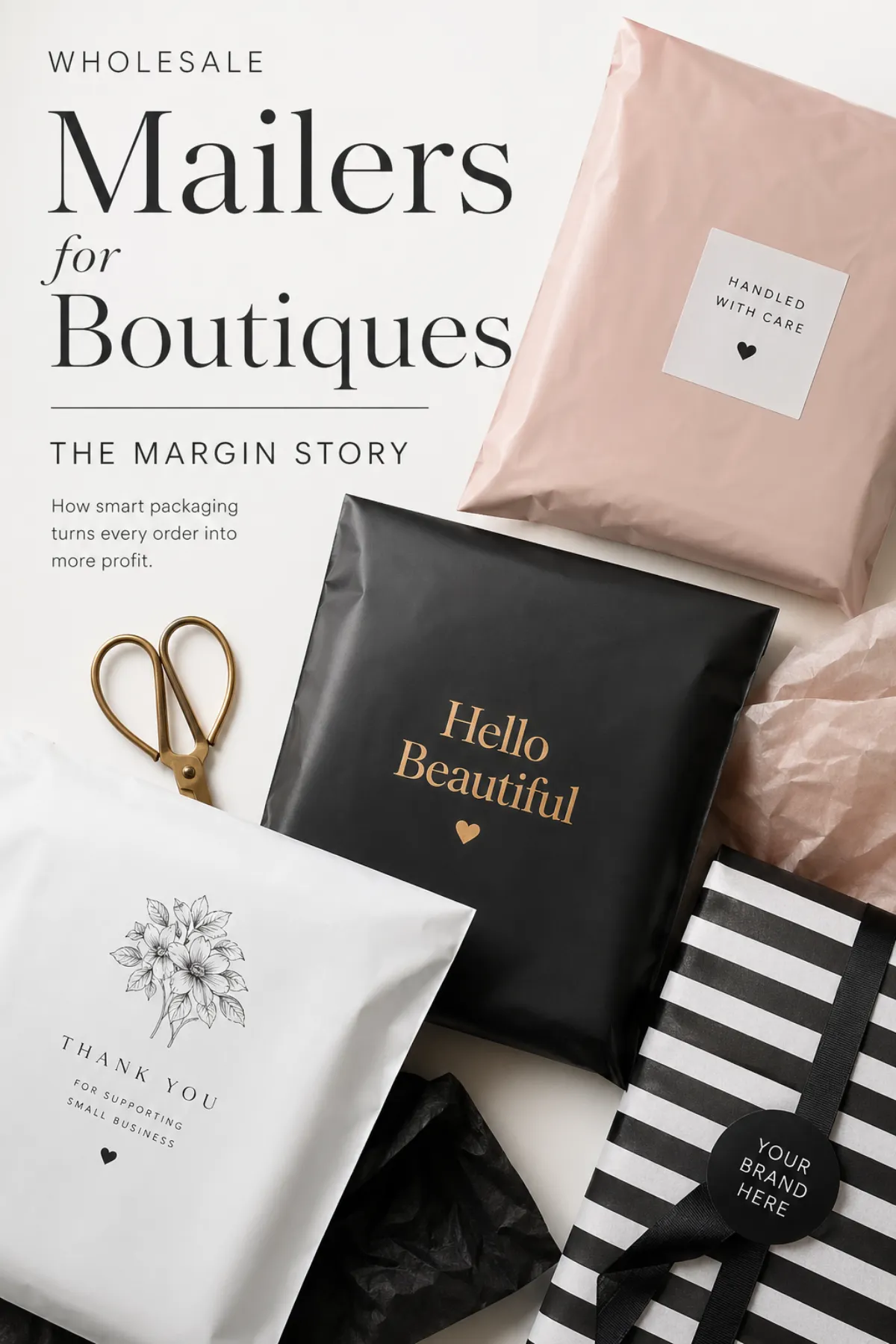
I still remember a factory visit in Ningbo where a boutique owner held up a 10 x 13 inch mailer and asked for "something more luxurious." The supplier nodded and quoted a thicker film, a larger format, and a double adhesive strip. All fine ideas. Poor math. The owner sold T-shirts at a $42 ticket, and the oversized mailer added nearly $0.14 in packaging and postage friction per order. On 8,000 shipments, that is more than $1,100. For a small fashion label, that is not pocket change. That is a photoshoot, a paid ad test, or a month of part-time help.
Wholesale mailers for boutiques matter because packaging sits right on the boundary between brand and cost center. A flimsy mailer leads to crushed corners, soaked cartons, and unhappy returns. An oversized one means paying for air. A heavily printed one means paying for decoration that disappears the moment the tape goes on. I have seen boutique buyers fall in love with a full-coverage metallic print and later realize the same money could have gone into a better adhesive and a more accurate size. Most customers never say, "I admire the seal strength." They do notice a ripped seam, though, and they will let you know about it in a very direct email at 11:47 p.m., usually after the parcel has already crossed two distribution centers.
The right wholesale mailers for boutiques should do three jobs: protect the product, hold the brand image, and keep the packing line moving. That means a strong seal, decent opacity, and a size that matches the folded product rather than the garment size tag. A lightweight tee can ride in a 2.0 mil poly mailer just fine. A pair of denim shorts, a knit set, or a boxed accessory often needs a stronger film or a different format. If your team spends an extra six seconds per order stuffing a bag that is too small or taping a seal that keeps lifting, that is labor cost. It shows up on the P&L. Packaging people talk about specs. Owners should talk about time.
Here is how I frame wholesale mailers for boutiques in a buying meeting: lower landed cost, better presentation, fewer packing errors. That is the real brief. Not "luxury vibes." Not brand story by itself. Your packer in a nine-foot shipping station does not need poetry. She needs a 12 x 15.5 inch mailer that opens cleanly, seals flat, and leaves 1 to 1.5 inches of breathing room around the folded item. That simple decision can shave 10 to 20 minutes off an 80-order shift, which is the kind of improvement you feel before you can explain it. In a warehouse near Atlanta, I watched that change reduce rework from 17 bags per day to 4, and the supervisor noticed the difference before lunch on day two.
One more honest point. A lot of boutiques think the packaging decision lives or dies on the sample they touch in a meeting. It does not. It lives in the 5,000-unit run, the freight bill, the insert process, and the warehouse staff who will use it 40 times a day. If you want brand polish without burning money, buy wholesale mailers for boutiques like a merchant, not like a mood board. I say that with affection, because I have seen more than one gorgeous mood board turn into a very grumpy accounts payable spreadsheet. A $0.15 mailer that is spec'd correctly in Jiangsu can save more than a $0.27 showpiece that looks better in a deck.
"The sample looked great, but the 11 x 14 bag forced us into a bigger mail class. We paid for it on every order." That was a buyer in Dallas, and she had every reason to be annoyed. A one-inch change can hit margin harder than a whole season of discounting, especially when the difference shows up as $0.09 to $0.13 per parcel across 6,500 shipments.
For buyers comparing categories, I also like to sanity-check the product mix with the packaging standards around it. The ISTA testing standards are useful when you want to think about drop resistance and shipment abuse, while the FSC system matters if you are mixing paper-based inserts or cartons into a wider sustainability claim. A mailer is not a carton, sure. The discipline around damage, certification, and sourcing still carries over, and it saves a lot of awkward apologizing later, especially if your inserts are printed on 350gsm C1S artboard in a plant near Foshan or Suzhou.
Product details that matter before you buy
Before you order wholesale mailers for boutiques, start with the film. Thickness is usually measured in mils, and that number tells you more than a glossy mockup ever will. A 2.0 mil mailer works for light apparel in many cases, but if you are shipping denim, sweaters, or a bundle with a hang-tag box, I would rather see 2.5 to 3.0 mil. Tear resistance, seal strength, and adhesive quality matter just as much as the print. I have watched a beautiful bag fail at the seam because the glue line was sloppy in a run out of Shenzhen. Pretty packaging that splits in transit is just expensive confetti, which is a fancy way of saying annoying waste.
Finish matters too. Matte feels more modern and hides fingerprints. Glossy catches retail lighting and usually prints a little louder. Frosted or semi-translucent finishes work for clean, minimal branding, but only if the product inside still looks tidy. I have seen fashion labels choose frosted mailers for a premium look, then discover the dark garment inside showed through in a way that cheapened the whole presentation. That is why wholesale mailers for boutiques should be matched to the product type, not just the brand mood. T-shirts and socks can live in lighter bags. Denim, knitwear, and layered sets usually need more body and a stronger seal. In one run from Dongguan, switching from a 2.0 mil gloss bag to a 2.5 mil matte bag cut seam complaints to zero across 3,200 parcels.
Print options are where budgets get out of hand. A one-color logo print on a stock-color mailer is usually the cleanest first move. Full-coverage branding looks sharper, but it can add setup costs, plate costs, and longer lead times. Interior print is fun for an unboxing surprise, yet it also eats margin if the outside design already does the job. If your budget is tight, I often recommend stock-color wholesale mailers for boutiques with a custom label, branded sticker, or insert card. That gives you most of the visual effect for less money and less risk. One of my clients in Austin saved about $0.06 per unit by moving from full-print to stock black mailers with a custom seal label. On 12,000 orders, that was a real $720 decision, not a theoretical one, and the labels were printed on 350gsm C1S artboard in a plant outside Guangzhou for $0.04 each.
Practical extras matter more than cute mockups. Tear strips help with returns. Dual adhesive strips are worth it if you want customers to reuse the same mailer. Water resistance matters if your customer base lives in rainy markets or you ship across coastal routes. I also look at opacity, because nobody wants a white sweater ghosting through a thin bag. For wholesale mailers for boutiques, the small features are often the ones that keep complaints down. The bag looks good in the photo. The tear strip keeps the brand from feeling cheap after the first return. I have a special dislike for a flimsy return seal that peels halfway open in transit; it feels like the mailer is betraying you on purpose, usually after five days in a courier network that handled three hub transfers.
One factory floor detail I never forget: the seal bar temperature and dwell time were off by two degrees on a run for a small apparel brand in Jiaxing, and the operator caught it because the edge looked slightly wrinkled. That tiny correction saved a 4,000-piece batch from weak seals. This is why I keep pushing buyers to ask about adhesive quality, seal testing, and inspection. The right wholesale mailers for boutiques should not only look good in a render. They should survive a real packing line, a real conveyor, and a real delivery route from Zhejiang to California without popping at the seam.
Quick product checklist for wholesale mailers for boutiques:
- Film thickness: 2.0, 2.5, or 3.0 mil depending on weight
- Seal style: single adhesive, dual adhesive, or tear strip
- Finish: matte, glossy, or frosted
- Print: 1-color logo, full coverage, or interior branding
- Protection: water resistance, opacity, and tear resistance
Wholesale mailers for boutiques: specifications to lock in
If you want a quote that means something, you need exact specs. For wholesale mailers for boutiques, that starts with width, height, flap allowance, and any gusset depth. Do not guess from a garment size chart. Measure the folded product in the real world, with packaging included if you already use tissue, a thank-you card, or a retail sleeve. I have seen buyers order based on "small, medium, large" and end up with bags that fit the label but not the fold. That mistake is tedious, predictable, and expensive, which is a frustrating combination because it is so easy to avoid. A 9 x 12 item can become a 10.5 x 13.5 pack-out once the tissue and card are inside.
Here is the rule I give people: leave enough room for easy insertion and a flat seal, but do not oversize so much that postage climbs. If the item needs 11 inches of usable length, I want a mailer that gives maybe 1 to 2 inches of working room, not five. Oversizing a mailer often adds dunnage, wasted film, and sometimes a worse dimensional weight class. That is why wholesale mailers for boutiques should be sized around the packed item, not the raw garment. A folded tee, a folded hoodie, and a boxed accessory are three different pack-outs. They deserve three different answers. In one Chicago-area fulfillment center, moving from a 14 x 17 bag to a 12 x 15.5 bag cut average billed weight by 2 ounces and saved $0.11 per shipment.
Print specs deserve the same discipline. Ask for logo placement in inches, not "centered nicely." Ask for bleed area, not "make it close." Ask how many ink colors the factory can run economically, because a one-color logo on a black bag is a different cost story than a four-color process print on white film. I also want PMS targets written down, even when I know perfect matching is not always possible on film. On flexographic runs, a delta of one to two shades can happen. That is normal. What is not normal is approving a black that should have been charcoal and then pretending the factory changed it by accident. They probably did not, and I have heard enough awkward color arguments to last several lifetimes, including one in Ho Chi Minh City that stalled a 7,500-piece order for two days.
For durability, I like to check three things: seal test, drop test, and moisture protection. The seal should survive a hand pull without splitting at the edge. A basic drop test from 3 to 4 feet catches weak closures and badly packed corners. Moisture protection matters if the shipment crosses humid routes or rides in a truck for two days. If you want a real standard to reference, ask your supplier how their bags compare to shipment abuse testing concepts used by organizations like ISTA. The point is not to pretend a mailer is a lab product. The point is to stop guessing and start testing, because guessing is how people end up reordering faster than they planned. On a route from Guangzhou to Phoenix, I have seen condensation turn a weak seal into a return problem before the delivery scan even hit.
One more detail gets ignored constantly: finished usable space. A bag can be listed as 10 x 13 inches, but after seam allowance and flap design, the real usable opening is a bit less. I have watched a brand reject 2,000 bags because the spec sheet looked right, but the usable space ate the last folded inch of their knit top. That is not a factory mystery. That is a measurement problem. For wholesale mailers for boutiques, I always tell buyers to confirm the outer size, the inner usable space, and the closure area before they approve artwork. I also want them to note the fold height in millimeters, because 25 mm can be the difference between a clean slide and a bag that fights back.
Spec sheet questions to ask before approval:
- What are the exact finished dimensions, in inches or millimeters?
- How much usable opening space remains after seal allowance?
- What film thickness and resin type are being used?
- How many print colors are included in the quoted price?
- What test method is used for seal strength and drop performance?
Wholesale mailers for boutiques: pricing, MOQ, and reorder math
People love to ask, "What do wholesale mailers for boutiques cost?" Fair question. The real answer is a range, because unit price depends on size, film thickness, print complexity, quantity, and freight. For a simple stock-color poly mailer with one-color logo print, I have seen landed costs land around $0.15 per unit at 5,000 pieces from a factory in Dongguan, plus about $120 in plate fees and $85 to $180 in inland freight depending on where the cartons are going. Go thicker, go custom size, or add a second adhesive strip and you can move that to $0.28 to $0.45 pretty fast. That spread matters. It is the difference between a packaging line item that feels manageable and one that forces a price increase somewhere else. Nobody likes that meeting, especially the one where you have to explain it with a straight face.
Always break the quote into buckets. Unit cost is only one bucket. Setup or plate charges are another. Freight is another. Duties, if applicable, are another. Storage or split-shipment fees can also show up if the supplier is holding inventory for phased release. I have seen a quote that looked $0.03 cheaper on unit price lose badly once a $180 setup charge and a worse freight class were added. That is why I push buyers to ask for landed cost, not factory fantasy pricing. Wholesale mailers for boutiques are a math problem before they are a branding problem, and the math is cleaner when the supplier names the destination port, the carton count, and the production city up front.
MOQ drivers are usually simple, even if sales reps try to make them sound mystical. Custom size raises MOQ. More print colors raise MOQ. Heavier film can raise MOQ if the supplier has to order a different resin or run a separate line. A stock-color base with a custom logo is often the lowest-friction path. If you want a low entry point, ask for a stock black, white, or pink mailer with a one-color print and a standard size. That is often the easiest way to test wholesale mailers for boutiques without getting stuck with 15,000 pieces nobody needs yet. I have seen first orders in Guangdong start at 1,000 pieces for stock bags and 3,000 pieces for custom sizes, which is a sane way to protect cash flow.
| Mailer option | Best use | Typical MOQ | Estimated landed cost per unit | Notes |
|---|---|---|---|---|
| Stock-color poly mailer with 1-color logo | Tees, socks, light accessories | 1,000 to 3,000 pcs | $0.15 to $0.28 | Lowest setup cost, fastest path for wholesale mailers for boutiques |
| Custom size poly mailer with 1-color logo | Branded apparel packs, tighter presentation | 3,000 to 5,000 pcs | $0.24 to $0.38 | Better fit, but tooling and setup can add $120 to $250 |
| Full-coverage printed mailer | High-brand-impact launches | 5,000 to 10,000 pcs | $0.30 to $0.45 | More visual impact, more print complexity, longer lead time |
| Dual-seal return mailer | Fashion labels with repeat returns | 3,000 to 5,000 pcs | $0.26 to $0.42 | Useful if return reuse matters for the brand promise |
The reorder advantage is real. Once artwork is approved, die lines are locked, and the color is set, repeat runs usually move faster because the prep work is already done. I have seen repeat orders shave 2 to 4 days off proofing and knock a small percentage off the unit rate when the factory knows the spec will not change. That is one reason I like buying wholesale mailers for boutiques in a disciplined way. The first order creates the system. The second order benefits from it. If you place the first run in April and the second in July with no spec changes, the factory in Ningbo or Zhongshan can usually hold the artwork and cut the prep time down to a single proof round.
One supplier negotiation still makes me smile. A converter tried to add a "premium handling" line item for a 6,000-piece mailer run, basically $75 for opening cartons and checking color. I told them to drop it, because that work should have been in the base quote. They did. This is why I tell boutique owners to ask direct questions. If you are buying wholesale mailers for boutiques, you do not need a speech. You need a clean quote sheet and the nerve to ask what each number actually buys. If the answer sounds foggy, I start looking for the missing cost right away, including plate fees, carton counts, and whether the price assumes export packing from a port city like Shenzhen or Ningbo.
Process and timeline from quote to delivery
The cleanest process for wholesale mailers for boutiques starts with one thing: a complete inquiry. I want size, quantity, print count, film thickness, destination, and target timing. If a buyer sends me "need mailers, send quote," I can answer, but the answer will be vague. If they send "12 x 15.5 inch poly mailer, 2.5 mil, 1-color white logo, 5,000 pcs, ship to Texas," I can work. That difference can save a full day of back-and-forth. Time stops feeling abstract when inventory is missing, especially if the next drop date is on a Friday and the warehouse only has 320 pieces left.
The normal flow is simple enough. Inquiry first. Then spec confirmation. Then quote. Then artwork proof. Then sample or digital approval. Then production, inspection, and shipment. Quotes can land in 24 hours if the spec is clean. Proofs usually take 1 to 3 days. Production is often 10 to 20 business days after approval, depending on print complexity and order size. Transit time is separate. A lot of buyers mix those up, then get irritated when "12 business days" turns into 18 calendar days because freight is still moving. Factory time is not truck time. Never has been, and it never will be, no matter how many follow-up emails people send. For a standard run from Guangdong to the West Coast, I usually plan 12-15 business days from proof approval before the cartons leave the port.
Delays usually show up in four places. Low-resolution logo files. Unclear sizing. Last-minute color changes. Waiting on sample approval from three different people who all want final say. I have seen a run for wholesale mailers for boutiques sit for five days because the buyer's logo came in as a screenshot instead of a vector file. That is not a factory problem. That is a file problem. The faster you send a clean AI, EPS, or print-ready PDF, the faster the plant can move. I know this sounds basic, but basic is exactly where a lot of production schedules fall apart, especially when the proof is being reviewed by a founder in New York, a merchandiser in Austin, and a warehouse manager in Phoenix.
Here is the milestone checklist I recommend:
- Approve the mailer size with a real folded product sample.
- Confirm the quote includes setup, freight, and any test fees.
- Approve artwork only after checking logo placement and PMS targets.
- Sign off on sample or digital proof before production starts.
- Plan inventory arrival with 5 to 7 extra days of cushion for freight.
I also like to separate first order and repeat order planning. A first run of wholesale mailers for boutiques should leave room for proofing and a bit of back-and-forth. A reorder, by contrast, should be measured against inventory turns. If the first run moved in 7 weeks, the second run should be scheduled before you hit the last 25% of stock. That keeps you from paying rush freight, which is the fastest way to turn a smart sourcing plan into a headache. I have seen a beautiful sourcing plan collapse because someone waited until the pallet was basically empty and then acted shocked that air freight cost more than they wanted, especially on a 2,500-piece reorder from Shenzhen to Chicago.
One more thing: ask for inspection notes. A good supplier should tell you what was checked, even if the answer is simple. Print registration. Seal strength. Color consistency across the run. Carton count. That is ordinary quality control, not fancy theater. If a supplier cannot explain the inspection process in one minute, I get cautious. Wholesale mailers for boutiques are too visible to buy on faith alone. If they also supply tissue or inserts, I want to know whether those are packed separately or inside the same export carton, because that changes damage risk and carton count.
Why choose us for boutique poly mailers
I have sat across the table from factories in Shenzhen while they tried to upsell a spec nobody asked for. "Thicker film." "Extra gloss." "Premium insert pouch." Nice ideas, all of them. Also unnecessary for the buyer in front of me. That is where hands-on sourcing matters. We do not just chase the cheapest number, and we do not just nod at every upgrade. We match the spec to the product. That is how wholesale mailers for boutiques should be bought if you care about margin and presentation at the same time, especially when a 5,000-piece run will sit in a warehouse for 60 days before the next collection drops.
Our value is simple: fewer middlemen, clearer quotes, and quality checks tied to real use, not showroom language. For wholesale mailers for boutiques, I care about print registration, film thickness, seal strength, and color consistency across the run. If a quote looks cheap but the adhesive fails on the first batch, that quote was not cheap. It was bait. A good buyer knows the difference. A good supplier should never pretend they are the same thing. I would rather quote a 2.5 mil bag at $0.17 with honest freight from Guangdong than a fuzzy $0.12 number that balloons after the cartons leave the dock.
I also like helping boutique owners avoid overbuying specs they do not need. If a light apparel brand is shipping 180 to 220 gram tees, I am not going to push a 3.0 mil heavy-duty mailer unless the route or packaging mix justifies it. If a client ships to 48 states and sees humid zones, I will talk about water resistance and dual adhesive strips. That is practical advice, not packaging poetry. It also keeps wholesale mailers for boutiques from turning into a vanity project. A clean 1-color logo on a stock-color bag often beats a full custom build that costs $0.09 more per unit and adds a week to the schedule.
Communication matters more than people admit. You Should Know what the quote includes, what the factory is doing, and what the timeline looks like without decoding jargon. That is why I like clear milestones, photos from production, and direct answers on any variance. If the team can tell you that a one-color logo run will ship in 15 business days from proof approval, you can plan around it. If they say "soon," you are already in trouble. I have never found "soon" to be a satisfying logistics metric, especially when the cartons are coming out of a plant in Zhongshan and the truck still has to clear customs and drayage.
For brands building a larger packaging system, it helps to think beyond mailers alone. A single line can include inserts, tissue, labels, and shipping cartons, all sourced with the same discipline. That is why our Custom Packaging Products page is useful for cross-checking the rest of the pack-out, and why the Wholesale Programs page helps teams map volumes before they ask for pricing. Then you can land back on Custom Poly Mailers with a real spec, not a wish list. If you need printed inserts, 350gsm C1S artboard is a solid starting point for a crisp card that holds up well in a 5 x 7 format.
Honestly, I trust buyers more when they ask hard questions. "What is the real MOQ?" "What is the landed cost?" "What happens if the proof changes?" Those are the right questions for wholesale mailers for boutiques. I would rather spend 10 minutes answering them than 10 weeks fixing a bad order. That has happened, and it is not fun. It is just expensive, noisy, and the kind of expensive that keeps appearing in every meeting until it is resolved. A clean answer today is cheaper than a rush remake next month.
What we check before a mailer run ships:
- Logo position and color against the approved proof
- Film thickness against the spec sheet
- Seal performance and opening consistency
- Carton count, labeling, and pack configuration
Next steps for ordering wholesale mailers for boutiques
If you are ready to buy wholesale mailers for boutiques, start with measurements. Fold your best-selling item the way your staff actually packs it, then measure the finished width, height, and thickness. Do not estimate. Do not rely on the manufacturer product page size alone. A folded knit top, a cropped jacket, and a packed accessory set can each need a different bag, even if the retail size tag says "medium." That is the sort of detail that saves a lot of grief later. I like to measure with the tissue and insert card already inside, because a 3 mm paper stack changes the fit more than most people expect.
Next, gather your artwork files, preferred colors, target quantity, and shipping destination. The first quote gets much better when the data is clean. If you want to test the market before committing, order a sample pack or a short pilot run of 500 to 1,000 units. I recommend that more often than people expect, especially for brands trying wholesale mailers for boutiques for the first time. A small pilot is cheap insurance when the print, size, or return style is new, and it gives you a real pack-out sample instead of a guessed one.
Compare landed cost, not just factory price. I know I sound like a broken record, but I have seen too many "cheap" quotes get wrecked by freight, setup, or split-shipment fees. A quote that saves $0.02 per unit but adds $150 in hidden charges is not saving anything. It is moving the bill around. Ask if the quote includes freight, setup, inspection, and any testing. Ask whether the factory can hold stock for a reorder. Ask whether the same die line can be reused. Those three questions matter more than a glossy mockup ever will for wholesale mailers for boutiques. If the supplier is in Ningbo, Dongguan, or Shenzhen, ask which port they will load from so the transit estimate is honest.
Then place a test order, approve the proof, and watch the first run closely. If the bags pack well, seal well, and survive the first 200 shipments, you have a working spec. That is the goal. Once the spec is stable, reorders get easier, faster, and usually cheaper because the guesswork is gone. That is how smart buyers handle wholesale mailers for boutiques: they turn packaging into a repeatable purchase, not a monthly debate. If the first run lands in 12 to 15 business days after proof approval, you can build a steady replenishment rhythm around it.
If you want a straightforward quote, send the size, artwork, quantity, and delivery city. We will tell you what is realistic, what is unnecessary, and what the real tradeoffs are. Then approve the proof, place the test order, and get the next reorder moving sooner. That is the practical path for wholesale mailers for boutiques, and it beats guessing every single time. A clear spec sent today can save a week of email threads and a pile of avoidable revisions.
FAQ
What size wholesale mailers for boutiques should I order for folded apparel?
Measure the folded product, not just the garment label size, because a 2-inch difference in thickness can change the fit a lot. Leave enough room for a clean seal and easy insertion, but do not oversize the mailer so far that postage creeps up by $0.05 to $0.12 per order. If possible, test the actual fold with a sample before you commit to a 3,000 or 5,000 piece run. I usually tell people to treat the sample like a tiny rehearsal, because that is exactly what it is, and a 12 x 15.5 inch bag often fits better than a 10 x 13 that looks nicer on paper.
Are wholesale mailers for boutiques strong enough for returns?
Standard poly mailers work well for light apparel if the film thickness and adhesive are correct, usually around 2.0 to 2.5 mil for lighter shipments. For return-friendly orders, choose a dual-seal mailer or add a second adhesive strip so customers can reuse the same bag. Heavier items may need a thicker film, a stronger seal, or a different mailer style altogether. If your returns desk keeps seeing ripped closures, the bag is telling you something, and it is not being shy about it. In my experience, the dual-seal version is worth it when the return rate runs above 12 percent.
How much do wholesale mailers for boutiques cost per unit?
At common quantities like 3,000 to 5,000 pieces, I usually see landed costs ranging from about $0.15 to $0.45 per unit depending on size, film thickness, and print complexity. A quote that looks cheap on unit price can still lose once setup fees, freight, and duties are added. Always ask for landed cost so you can compare suppliers on the same basis. That is the number that matters, not the pretty headline in the first email. A 5,000-piece stock-color order out of Dongguan can land at $0.15 per unit if the print is simple and the freight route is straightforward.
How long does it take to produce custom wholesale mailers for boutiques?
Artwork proofing is often the first checkpoint and can take 1 to 3 days if the files are clean. Production usually runs 10 to 20 business days after approval, depending on quantity and print style. Transit time is separate, so a 12-business-day production schedule can still land as a 3-week arrival if freight adds another 5 to 8 days. I always tell buyers to plan like the truck is going to be a little dramatic, because trucks often are. For a straightforward one-color run from Guangzhou, 12-15 business days from proof approval is a realistic planning window.
Can I order small runs of wholesale mailers for boutiques with my logo?
Yes, but the minimum order is usually higher for custom size and full-print runs. One-color print, stock colors, or label-ready mailers can help keep the MOQ lower, sometimes around 1,000 to 3,000 pieces. If you are testing a design, I would start with samples or a short pilot run first so you are not stuck with the wrong spec on a full bulk order. A small mistake is annoying; a warehouse full of the wrong mailer is a much less charming problem. For many first-time buyers, a 1,000-piece stock run from Ningbo is the safest place to start.
What should I send for the fastest quote on wholesale mailers for boutiques?
Send the exact size, film thickness, quantity, logo file, print color target, and delivery city in the first message. If you can add a photo of the folded product and one sample pack-out note, even better. That usually cuts a day or two of back-and-forth and gets you a quote that reflects the real order instead of a rough guess. Clear inputs save time for everyone, which is my polite way of saying they save everybody from unnecessary email chains. A clean PDF, a delivery zip code, and a target date are enough to move most quotes forward in under 24 hours.
One last practical takeaway: measure the folded item with tissue and inserts in place, decide the film thickness from the product weight and route, then send the exact size, quantity, print count, and delivery city in one shot. That single habit makes wholesale mailers for boutiques faster to quote, easier to compare, and a whole lot less expensive to get wrong.


