Buyer Fit Snapshot
| Best fit | Wholesale Padded Poly Mailer Bundles projects where brand print, material claims, artwork control, MOQ, and repeat-order consistency need to be specified before quoting. |
|---|---|
| Quote inputs | Share finished size, material target, print colors, finish, packing count, annual reorder estimate, ship-to region, and any compliance wording. |
| Proofing check | Approve dieline scale, logo placement, barcode or warning zones, color tolerance, closure strength, and carton packing before bulk production. |
| Main risk | Vague material claims, crowded artwork, missing packing details, or unclear freight terms can make a low unit price expensive after revisions. |
Fast answer: Wholesale Padded Poly Mailer Bundles: Cost, Specs, Timeline should be specified like a repeatable production item. The safest quote records material, print method, finish, artwork proof, packing count, and reorder notes in one written spec.
Production checks before approval
Compare the actual filled-product size with the drawing, then confirm tolerance on folds, seals, hang holes, label areas, and retail display edges. Reserve space for logos, QR codes, warning copy, and material claims before decorative graphics fill the panel.
Quote comparison points
Review material grade, print process, finish, sampling route, tooling charges, carton quantity, and freight assumptions side by side. A quote is only useful when the supplier can repeat the same color, closure quality, and packing count on the next order.
Wholesale padded poly mailer bundles matter because one preventable packaging failure can erase the savings from a tidy batch of clean orders. For fragile, premium, or oddly shaped products, the decision is rarely about a cheaper unit price alone. It is about whether wholesale padded poly mailer bundles give you a tighter specification, lower landed cost, and fewer carrier claims once parcels hit networks that move at their own pace and do not respect your margin assumptions.
From a packaging buyer’s seat, this is a logistics architecture problem, not a procurement side hobby. I have seen teams jump from 200 weekly orders to 1,200 and suddenly realize every small packaging variance gets amplified by labor, rejection, and customer dissatisfaction. A bundle that is sized correctly, printed cleanly, and replenished consistently can do more for margin than a headline discount by a mile.
The market looks crowded, especially when every supplier can publish a polished catalog of similar-looking mailers. In real operations, differentiation sits in the boring layers: film gauge, pad architecture, seam behavior, and whether the lot that arrives matches what was tested in your warehouse. If you already use Custom Poly Mailers, moving to wholesale padded poly mailer bundles is less about new branding and more about locking performance so the pack line does not become the testing lab.
There is a subtle but expensive comparison buyers often miss. Padded envelopes and bubble mailers get grouped together in spreadsheets, but they do not behave the same under pressure, humidity, or speed. A wholesale program built around wholesale padded poly mailer bundles lets you control those variables instead of trusting that two products with similar appearances will perform identically on a Tuesday at the dock and a Friday during rush fulfillment.
Why Wholesale Padded Poly Mailer Bundles Beat Retail Unit Buying
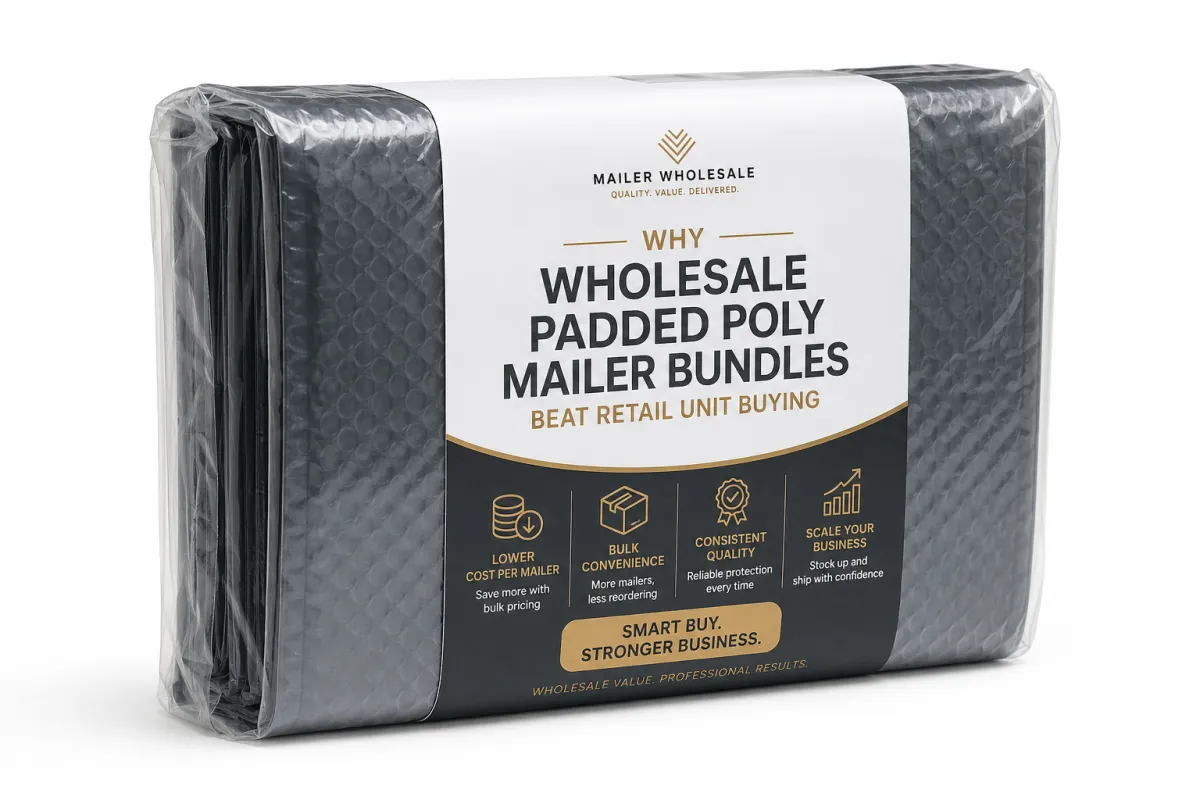
One damaged shipment can wipe out the savings from a surprising number of intact parcels. Buyers usually feel this in the return window, not at checkout. They compare unit prices, stop too early, then absorb the downstream cost of claims, replacements, and support calls. wholesale padded poly mailer bundles reduce that exposure by replacing random retail variants with a stable spec family.
The buyer-side math is simple enough to respect. Bulk bundling usually lowers cost per unit once volume reaches a few thousand pieces, because setup, carton packing, and freight allocation spread across larger production. It also saves handling time because staff are not switching between multiple closure behaviors and weights every day. In one fulfillment room, that feels like one less interruption per order; across 20 pickers, it becomes serious throughput recovery.
The bigger value is risk control. With wholesale padded poly mailer bundles, you can lock pad thickness, film gauge, closure style, and print coverage as repeatable requirements. That matters when your catalog swings from apparel to accessories or when subscriptions require the same protection profile every month. Supplier-switching by convenience can quietly alter seam memory, introduce fold fatigue, or change outer film elongation. Those defects rarely show up in a quote line and almost always show up after dispatch. You’re gonna want to avoid that cycle before it starts.
Operationally, bundling turns packaging into process. Instead of one-off ad hoc decisions, your team gets a replenishment model with documented lead times, reorder triggers, and incoming quality checks. Finance gets forecastable spend. The warehouse gets stackable pallet planning that is not dependent on which mailer variant lands on Monday. Predictability is not glamorous, but it is where reliability is won.
The margin effect is measurable. Suppose retail purchasing adds $0.08 per piece and extra handling adds $0.03; on 10,000 pieces that is $1,100 before claims are counted. A bundle-focused model can reduce setup waste, normalize freight, and keep rejection thresholds stable. The savings travel beyond packaging—they show up in your service levels, your touch costs, and eventually your cash conversion cycle.
Commercial pressure can punish weak programs fast. A DTC line that spikes during promotions cannot absorb a packaging surprise because someone accepted a substitute buy in an earlier quiet week. Buyers who run packaging as a controlled category usually reduce reruns, avoid reprints, and build cleaner vendor accountability. That stability is less dramatic than a one-time deal and far more durable.
The cheapest mailer is never cheap if it forces a relabel, a repack, or a return. In bulk programs, protection quality and labor speed sit on the same line item, even if the accounting system doesn’t show that connection well.
For mature teams, the sharper question is not, “Can I buy a bundle?” It is, “Can I buy a bundle that remains stable for six months without a spike in damage and without a messy reorder path?” wholesale padded poly mailer bundles are strongest when that question is answered in writing before procurement starts.
Product Details Buyers Actually Pay Attention To, Not the Brochures
Brochures love terms like “premium protection.” Buyers need measurable performance. In wholesale padded poly mailer bundles, spec discipline starts with outer film gauge, cushioning type, closure design, and seal response under load. Standardized language here is what protects you from vendor-to-vendor drift.
Film gauge alone is not a guarantee. Thicker film can resist puncture better, but if dimensions are off by a few millimeters, corners still tear and seams still fail. That is why outcome-based terms matter: puncture resistance, seam integrity, and closure retention after repeated handling. The best wholesale padded poly mailer bundles are often not the thickest option—they are the ones matched to your actual shape and transport path.
Different product categories need different priorities. Apparel usually benefits from smooth insertion and low scuff risk. Small electronics and accessories are usually more sensitive to corner crush and anti-static behavior. Nutraceuticals and cosmetics can fail at a different layer entirely: odor bleed, leakage stress, or tamper appearance. Good buying logic means selecting a packaging profile around the dominant failure mode, not around a generic sales narrative.
Interior build matters as much as the shell. Bubble film is common for predictable cushioning and usually good crush recovery, while foam-backed constructions can feel cleaner and handle better under fast conveyor speeds. Paper-hybrid or kraft-backed versions may help sustainability goals, but they still need abrasion, moisture, and fold-memory checks before approval. In live fulfillment, wholesale padded poly mailer bundles are judged by bounce, friction, and handling stress, not by static mockup photography.
Print is another operational variable, not just a brand choice. One-color printing can be stable and cost-efficient. Full process color increases visual control but can increase drift if prepress controls are weak. Matte finishes can look premium, yet in high-contact mail routes they can scuff early. Ask for artwork tolerance, color targets, and legibility after compression so you do not discover issues only after cartons stack high.
Secondary details often move the P&L more than expected. Pre-creased folds reduce assembly variance. Reinforced seal zones reduce weak-point failure during high-speed packing. Clear label windows reduce barcode scanning drift. Anti-slip zones reduce snag risk when throughput is hot. These are the little engineering choices that shape how wholesale padded poly mailer bundles perform under real labor pressure.
For brands using mixed packaging formats, it is useful to compare across families, not only within one category. You may already buy totes, mailers, and wraps through Wholesale Programs; the right decision is always by SKU behavior and handling profile. A premium-looking mailer that slows the line is expensive. A simpler option that reduces touch time and defects often makes the cleaner business case.
The final lens is this: a mailer that looks right in marketing assets can still fail at conveyor speed. wholesale padded poly mailer bundles should be selected by three standards together—protection, velocity, and total unit economics—because no single variable can hide weakness in the others.
What should buyers check before ordering wholesale padded poly mailer bundles?
Start with dimensions, film gauge, pad type, and closure style. Then verify fit against your product weight, carrier restrictions, and actual pack process. If a supplier cannot provide a locked spec sheet, batch traceability, and a final sample that mirrors production build, pause before ordering wholesale padded poly mailer bundles. That is often the shortest route to fewer surprises.
Test against your own failure mode. A rigid accessory package stresses edges differently from folded apparel. A glossy cosmetic set behaves differently from a matte textile order. One sample should not only look good; it should prove three things: protection, seal stability, and pack-flow speed. That triple test is often where good sourcing decisions start failing.
Wholesale Padded Poly Mailer Bundles: Specification Matrix Before You Place Any Purchase
Lock your spec before requesting final pricing. It sounds procedural, but it is where most buyers lose leverage. A specification matrix forces true apples-to-apples conversations and prevents hidden upgrades or substitutions across suppliers who are all describing a similar “padded mailer” category.
First, capture physical geometry: interior width, usable length, outside dimensions, and label area. Add pad profile, closure style, and target finished weight range to create a usable baseline. For most packaging teams, this is the mandatory minimum: size, thickness, closure, print boundaries, and packaging counts per carton. If a supplier cannot quote from that, production is not truly ready.
Next, define measurable performance criteria. Ask for burst, seam, compression, and puncture thresholds that match your dominant shipment class. A practical benchmark is a seam strength target above your internal line—around 18N is a useful anchor for many consumer categories, but you should treat it as starting range, not universal law. Heavier products usually need higher thresholds. In every case, test with your product geometry, not a generic sample panel.
Carrier compatibility belongs in the matrix too. Verify maximum dimensions relative to carrier dimensional-weight tiers and carton-size breaks. Confirm barcode real estate is not blocked by folds or seams. If you use semi-automatic insertion, check opening resistance and feed behavior before full release. A bundle that saves two seconds per order can pay for itself quickly at scale, and the reverse is equally true.
Material behavior shifts by season and weather. Cold zones can stiffen films and change fold behavior. Very dry air can increase static and handling drag for certain materials. High humidity may affect pressure-sensitive closures or adhesive response. These are not “special cases” in national fulfillment; they are routine conditions in multi-state or multi-region shipping.
Quality acceptance should be explicit before production. Ask for lot coding logic, traceability format, and a sampling plan with clear reject criteria. A practical incoming QA sequence often includes random tensile checks, edge integrity inspection, visual print verification, and periodic seal pull testing. If a supplier provides wholesale padded poly mailer bundles without lot traceability, you are betting on goodwill, not control.
Standards help keep conversation grounded. For transport-grade validation, ISTA test structures are a useful common language; many teams use them to align expectations for fragile products. See the current guidance on ISTA before writing requirements. For paper or hybrid materials where sourcing claims matter, ask for FSC-related evidence when applicable. The reference point is FSC.
For many teams, building a comparison table before pricing is the most useful move. It creates one objective framework per supplier, avoids emotional decisions, and shortens rerun loops later.
| Option | Typical MOQ | Unit Price at 5,000 | Lead Time | Best Fit | Main Watch-Out |
|---|---|---|---|---|---|
| Unprinted padded poly mailer bundle | 1,000-3,000 pieces | $0.12-$0.22 | 7-12 business days | Starter runs and internal testing | Lower brand presence and fewer control points |
| Single-color custom print | 3,000-5,000 pieces | $0.18-$0.32 | 12-18 business days | DTC apparel, accessories, subscription orders | Print setup accuracy and color consistency |
| Full-color custom print with reinforced seal | 5,000-10,000 pieces | $0.26-$0.48 | 15-25 business days | Premium packaging and higher claim-risk items | Higher prepress control and tighter QC needed |
The matrix is not a substitute for lab or live testing. It is the framework that keeps your team from accepting low numbers that are low on everything that matters. A good wholesale padded poly mailer bundles quote includes measurable specs, a lot control plan, and acceptance thresholds your receiving team can enforce quickly.
Pricing & MOQ for Wholesale Padded Poly Mailer Bundles
Price is never a single line. The right comparison includes base unit price, setup fees, prepress, packaging handling surcharges, freight assumptions, and inspection or rework charges. If any of these is missing, the quote may look low while hiding cost you will pay later.
MOQ strategy can either strengthen or destroy leverage. Higher combined volume across sizes or color families often lowers effective setup cost, even if each SKU has a minimum. That is why wholesale padded poly mailer bundles often beat piecemeal sourcing: you can aggregate demand while preserving control across product families.
Build a landed-cost model with labor and quality included. Add freight split, label application time, incoming inspection effort, and expected returns handling. Compare that total against current damage and return metrics. If your damage rate is 2.5% and a new bundle plan brings it to 1.0%, the margin effect can be meaningful even if per-unit price rises slightly. The same logic is why many buyers eventually prioritize reliability over the first number.
Use real negotiation levers, not soft ones. Complexity in artwork, stronger adhesive systems, tighter tolerances, and more accurate dimensional specs all add cost. But not all of them add value equally. If your failure mode is mostly seam stress, invest in closure quality before upgrading print colors you do not need for function.
In budgeting, think by demand pattern. A steady reorder cadence may favor lower unit cost even with slightly longer carrying impact. A campaign window with short velocity may accept higher MOQ to secure an approved lock-in image. A long-cycle model may justify lower unit pricing if the same spec is reused for future replenishments. One contract can be structured around predictable use, not one-off urgency.
Payment terms and cross-border details matter for working capital and schedule. Deposits, milestone timing, sample fees, and customs documentation should be explicit. If shipping origin, customs classification, or brokering cost is vague, the final cash impact changes after award. Vague terms are just another way of pushing risk downstream.
Use this cost-check list when comparing wholesale padded poly mailer bundles across suppliers.
- Unit price: compare at your actual run size, not hypothetical peak volume.
- Setup and prepress: verify whether charges repeat per reorder or are one-time.
- Freight: confirm EXW, FOB, or delivered terms before approving.
- Inspection: specify who pays for sampling, rework, and replacement lots.
- Storage: confirm overage policy and whether partial holding incurs carrying fees.
The better suppliers do not hide behind a single headline figure. They explain the cost stack, identify what drives variation, and help you choose between closure strength, film spec, or better print fidelity for your use case. That is the level of commercial clarity buyers should expect in a serious wholesale padded poly mailer bundles program.
Process & Timeline: From Approved Sample to Full Shipment
The fastest rollouts are not lucky; they are prepared. In wholesale padded poly mailer bundles, most rework risk is avoidable when the requirement brief is complete before production starts. That means finalizing artwork, dimensions, target weight window, and transport assumptions up front.
Stage one is technical intake. This is where the vendor should confirm SKU sizes, print layout, closure, and any operational constraints. Ask for a proof file, dimension sheet, and sample schedule before anything else. If that step is muddy, schedule drift is usually waiting around the corner.
Stage two is pre-production sampling. A serious sample pass must include your own product geometry and your real shipping path. Test fragile edges. Test easy-to-scratch surfaces. Test seal retention in warmer ambient conditions if summer outbound is part of your calendar. Photos are useful; physical inspection is still the standard for trust. This stage should lower uncertainty before full execution of wholesale padded poly mailer bundles.
Stage three is pilot release. Even a few hundred-piece pilot can validate fold alignment, print position, and pack-line compatibility. It is the only time corrections are cheap. A pilot fail is painful but recoverable; a 50,000-piece surprise failure is expensive and noisy.
Stage four is production monitoring. For stable runs, teams need first-off approval, in-process sampling, and documented mid-run checks. A transparent dashboard, photos, and acceptance metrics reduce dispute time. Buyer teams are not asking for theater—they need evidence that the run remains within agreed thresholds.
Stage five is logistics coordination. Pallet configuration, carton count, freight class, and receiving windows are operational details that often break schedules. A pallet that packs well but misses the receiving window triggers labor spikes and temporary storage risk. Delivery reliability is therefore both timing and integration with your inbound plan.
Typical timelines vary. A straightforward one-color, approved-artwork run is often ready in 10 to 15 business days after approval. Mixed sizes, tougher quality requirements, or additional color control can extend to 15 to 25 business days. Expedited lanes exist, but they usually increase freight and can increase variation risk, so they should be contingency pathways, not a default.
If a milestone slips, treat recovery as operational management, not apology theater. Ask for a revised ETA, an explicit correction plan, and internal communication ownership. If launch timing is at risk, the supplier should quantify impact, not just quote “we are working on it.” That distinction separates dependable wholesale padded poly mailer bundles from speculative sourcing.
Why Choose Us for Wholesale Padded Poly Mailer Bundles at Scale
Procurement teams do not just need a catalog. They need proof. For wholesale padded poly mailer bundles, tiny specification differences can create large downstream cost if line failure rates rise or print defects pass final inspection. Evidence is what matters: test data, correction logs, and checkpoint clarity.
Service depth often drives outcomes. A technically competent contact who understands film behavior, closure mechanics, and print constraints can remove days of back-and-forth. Consistency in account ownership matters too. The same team that reviews sample and validates launch often keeps issues from slipping into production.
Demand measurable reliability, not confident language. Ask for rerun response time, repeat-issue patterns, and on-time performance for jobs in your category. If the answer is “usually smooth” with no data, press for numbers. Procurement decisions should be traceable, not emotional.
Replacement policy influences behavior. A documented short-pay or replacement mechanism for nonconforming lots changes incentives faster than vague goodwill credits. If a lot fails and the supplier has clear correction paths, your operation can recover quickly without prolonged dispute time.
Sustainability claims should be tested, not accepted at face value. If your roadmap includes recycled content, low-VOC processes, or hybrid materials, ask for documentation and chain-of-evidence. If a paper component is involved, FSC records may become part of compliance. For environmental handling and claims language, EPA materials guidance is a useful frame for internal diligence. These checks reduce reputational and operational risk at once.
Technical design support is a real differentiator. File checks for bleed, barcode interference, and contrast can prevent avoidable waste before production. A supplier that helps optimize nesting and panel orientation is effectively reducing your scrap and your reprint load.
When teams expand across packaging categories, the value is not in purchasing more SKUs; it is in keeping the process stable. If you source mailers, envelopes, and kits through broader Custom Packaging Products, your real advantage is consistent behavior under volume and speed. In that context, wholesale padded poly mailer bundles remain a practical operational category.
Ask for sample logs, pre-ship photos, and lot traceability tied to departure date. When these are available, the odds of a clean rollout rise significantly. When they are not, risk stays unresolved in the receiving area and gets paid for through hidden costs.
A supplier is only as good as the last lot it can trace, inspect, and defend. Anything less is an assumption with a payment schedule.
Order Wholesale Padded Poly Mailer Bundles in 5 Practical Steps
Step one: define the protected weight class and failure mode. A folded tee is not the same as boxed skincare or metal accessories. If seasonal shape changes are common, keep one fallback size with around 10-15% dimensional headroom, because the line is never as tidy as the forecast.
Step two: rank priorities before pricing. In most programs, puncture resistance and seal integrity beat aesthetics. Label positioning comes next. Finish and brand details follow once core functionality is proven. This is the fastest way to avoid approving a beautiful mailer that cannot survive the pack floor.
Step three: build a cost grid. Model your expected mix across sizes and colorways, then calculate blended unit and landed cost. Do not lock in until you know expected cost at low, medium, and high demand; one scenario can make a quote look great, another can quietly lose margin.
Step four: align the timeline with your outbound calendar. Fixed launch dates need fixed internal cutoffs for design lock and PO release. Hold those deadlines even when someone from the team wants a late tweak. Late changes are expensive and often produce mixed lots, especially in wholesale padded poly mailer bundles runs.
Step five: write and execute a launch checklist. Include sample sign-off, inbound quality checks, pack-test outcomes, and first-lot performance criteria. The work is not glamorous, but the boring parts are what keep claims down and throughput up.
If you want benchmark confidence, request one to two comparable quotes only after every party is quoting the same locked specification. If the category is expanding, extend the spec outward through an established Wholesale Programs workflow rather than letting the first supplier define your requirements. That is how buyers avoid paying twice for the same correction cycle.
The final decision should be evidence-based: delivery reliability, defect containment, and supplier response quality once the lot enters receiving. If your brief is disciplined, the spec is locked, and acceptance is measurable, wholesale padded poly mailer bundles can reduce your true fulfillment cost and stabilize pack rhythm. The outcome is less breakage, cleaner labor flow, and a repeatable program that supports growth instead of creating bottlenecks.
What is a realistic MOQ for wholesale padded poly mailer bundles with custom print?
Most suppliers quote by size and color family with a typical minimum in the 1,000 to 5,000 piece range per SKU. Combining sizes under one artwork family can improve the effective MOQ because setup cost is shared. Unprinted starter programs may have a lower floor, while custom print usually raises both setup and minimum thresholds.
How should I compare wholesale padded poly mailer bundle pricing across suppliers?
Split each proposal into unit price, setup, print, freight, inspection, and potential rework. Compare all scenarios against your real volume, not an optimistic “ideal” order. Lock the same thickness, closure type, and print area before any comparison. If one offer is cheaper only because it changes material or hides freight, the comparison is not valid.
Can I adjust size and material specs after sample approval for wholesale padded poly mailer bundles?
Minor edits can sometimes be handled, but thickness, pad structure, closure method, and major material shifts usually need re-approval and may trigger rework charges. Keep revision control in place to prevent mixed lots and quality disputes. If your launch is date-critical, ask for the change-fee matrix before sample approval.
What is the fastest realistic timeline for a small-batch wholesale padded poly mailer bundles order?
For a simple one-size, one-color order with approved artwork, 10 to 15 business days is often realistic after proof approval. Mixed sizes, stronger inspection requirements, and additional design constraints can push this to 15 to 25 business days. Air or emergency handling can shorten transit, but usually adds cost and increases variation exposure.
How do I verify that wholesale padded poly mailer bundles will reduce damage costs, not just look good?
Use measurable checks: burst, seal pull, edge integrity, and drop tests aligned to your own weight band. Track claim rate, replacement labor, and chargebacks for 30 to 60 days post-rollout. If those metrics improve while fulfillment speed remains stable, the program is paying for itself rather than adding complexity.
wholesale padded poly mailer bundles are worth adopting when three conditions are true: the spec is locked, quality checks are enforceable, and total landed cost beats your current damage and labor profile. A practical way to act on that is simple: write one-page requirements, get matching samples, align your team on acceptance criteria, then compare suppliers by their measured performance, not marketing language. That is the post that survives scale.


