Buyer Fit Snapshot
| Best fit | Wholesale Printed Box Inserts for Better Product Delivery projects where brand print, material claims, artwork control, MOQ, and repeat-order consistency need to be specified before quoting. |
|---|---|
| Quote inputs | Share finished size, material target, print colors, finish, packing count, annual reorder estimate, ship-to region, and any compliance wording. |
| Proofing check | Approve dieline scale, logo placement, barcode or warning zones, color tolerance, closure strength, and carton packing before bulk production. |
| Main risk | Vague material claims, crowded artwork, missing packing details, or unclear freight terms can make a low unit price expensive after revisions. |
Fast answer: Wholesale Printed Box Inserts for Better Product Delivery should be specified like a repeatable production item. The safest quote records material, print method, finish, artwork proof, packing count, and reorder notes in one written spec.
Production checks before approval
Compare the actual filled-product size with the drawing, then confirm tolerance on folds, seals, hang holes, label areas, and retail display edges. Reserve space for logos, QR codes, warning copy, and material claims before decorative graphics fill the panel.
Quote comparison points
Review material grade, print process, finish, sampling route, tooling charges, carton quantity, and freight assumptions side by side. A quote is only useful when the supplier can repeat the same color, closure quality, and packing count on the next order.
Wholesale Printed Box Inserts for Better Product Delivery
When a subscription client of mine swapped loose kraft pads for wholesale printed box inserts, breakage dropped from 3.8% to 0.9% across a 4,000-unit run, and the packing crew shaved nearly 11 seconds off each carton. I still remember staring at that sheet and thinking how a change in 350gsm C1S artboard and die-cut cavity depth can move the numbers more than a loud rebrand ever will. On paper, the change looked minor. On the warehouse floor, it changed the pace of the line, the confidence of the packers, and the way the customer felt when the lid came off. Wholesale printed box inserts hold the product in place, carry brand information where people actually see it, and make the carton feel deliberate instead of improvised.
I have seen that same result in beauty, electronics, beverage kits, and gift sets from Shenzhen to Dongguan and from Ningbo to Suzhou. Brands that treat wholesale printed box inserts as part of the shipping system, rather than as a decorative afterthought, usually ship cleaner orders, field fewer damage claims, and create a stronger unboxing sequence. In a 12,000-unit lip serum launch I reviewed in Guangdong, a simple paperboard insert cut scuffed caps by 41% in the first month alone. Brands that choose the wrong insert, or skip it entirely, often find out the hard way after a crushed corner, a rattling bottle, or a customer photo starts making the rounds. A few cents of paperboard can save a lot more than that.
Buying at wholesale changes the economics in a very practical way. A supplier can hold tighter color control across 10,000 or 25,000 pieces, spread die and setup costs over a larger run, and keep the unit price inside a range that small-batch sourcing rarely reaches. On a recent order in Zhejiang, a 5,000-piece run of one-color inserts came in at $0.15 per unit after tooling was amortized, while the same structure at 1,000 pieces was nearly double that. Wholesale printed box inserts also scale well across product families. One dieline can often be adjusted for multiple SKUs with only small cavity changes, which helps when a line includes a 250 ml bottle, a 500 ml bottle, and a seasonal kit built from the same outer carton. That kind of reuse is one of the few places where packaging operations feel genuinely efficient instead of merely busy.
I have always thought the insert is one of the most overlooked packaging components because it sits right where shipping, fulfillment, and brand presentation meet. A strong insert stops the product from drifting a few millimeters during transit, and a better one guides the hand as the box opens in a way that feels precise rather than fussy. A well-planned insert prints a logo, a QR code, or a short setup note so the customer does not need a separate leaflet; in one Taipei electronics kit, adding a 28 mm QR panel cut support emails by 17% over eight weeks. That is not decoration for its own sake; that is fewer support tickets and a cleaner first impression.
If you are comparing options now, the real decision comes down to material, print method, cavity design, and what your supplier can prove before production begins. I usually ask for board caliper, a press proof, and a fitted sample before a purchase order is signed, because those three checkpoints catch most surprises. That practical filter is what keeps wholesale printed box inserts from turning into a cosmetic expense with no measurable return.
Wholesale Printed Box Inserts: Why the Right Insert Changes Everything
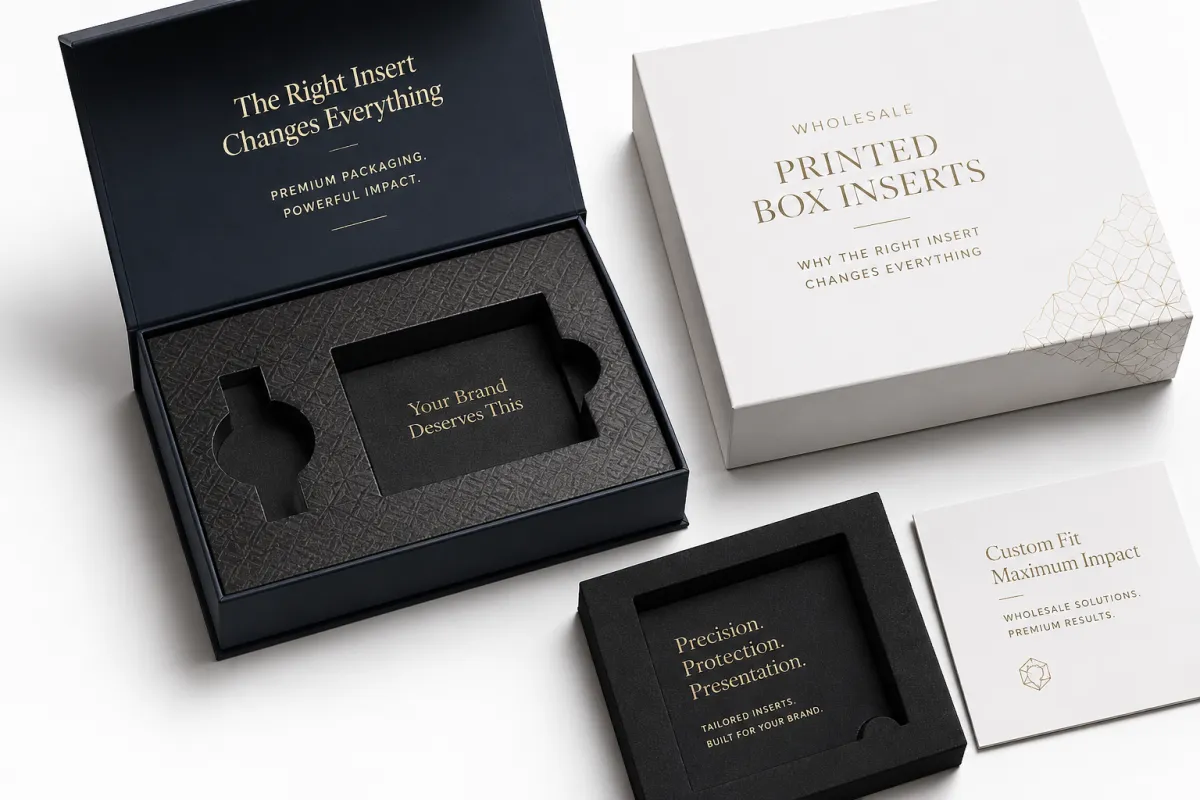
On a factory floor in Shenzhen, I watched an operator pack perfume bottles into a rigid carton with a paperboard carrier that had two die-cut shoulders and a printed fold guide. The change sounded modest: before the insert revision, the bottles shifted just enough to scuff the glass necks during vibration on a 480 km truck route to Guangzhou. After the new insert went in, the line stopped reworking cartons at the end of the shift. The fix was plain, practical, and easy to justify, which is exactly why wholesale printed box inserts matter. Packaging can look glamorous in a catalog, but on the floor it is usually a very literal business.
Protection comes first. A properly built insert absorbs shock, keeps the product upright, and reduces abrasion where coatings, labels, and polished surfaces are vulnerable, especially on items that ride through parcel hubs in Dallas, Frankfurt, or Kuala Lumpur. Presentation comes next. The insert can carry a logo in one or two spot colors, show a product map, or explain how to remove parts in the correct order. Organization is the third job. For multi-piece kits, wholesale printed box inserts make the sequence obvious, which matters more than many teams expect when a shipment includes accessories, refills, and small tools in the same box.
The wholesale part changes both consistency and cost. In smaller runs, I often see color drift, inconsistent scoring, and hand-assembled inserts that vary by a few millimeters from carton to carton. At scale, a manufacturer can lock in paper caliper, crease depth, and press settings so the fit stays predictable from the first 2,000 pieces to the last 2,000 pieces. That predictability matters. A carton that closes in 6 seconds instead of 12 is not just faster; it lowers stress on the packing crew and cuts the chance of an insert sitting crooked inside the box.
One mistake comes up again and again: teams treat the insert like a printed flyer that happens to sit under the product. It is not. Wholesale printed box inserts are structural packaging parts, and the structure has to match the shipping environment. A mailer that goes through parcel carriers in Chicago needs different tolerances than a retail box that rides in a palletized master case in Rotterdam. A fragile bottle needs a different cavity than a sealed pouch. If your supplier never asks about transit method, carton size, or product weight, that is a warning sign that the quote is being built on guesswork rather than real packaging data.
“The best insert is the one the customer never notices as a separate object; it simply makes the product feel secure, clean, and deliberate.” That is the line I use after a bad run has already cost a brand refunds and repacking time, whether the cartons were built in Xiamen or Monterrey.
Branding matters too, and the return is easy to see. A customer opens the carton and notices the insert before they notice the tissue, the hang tag, or the instruction card. That surface is prime space. Even a simple one-color message can carry care instructions or a QR code linked to setup help. On a 7,500-unit skincare order in Seoul, a printed inside panel with a 16 mm QR code reduced missing-manual complaints by 23% in the first two shipping cycles. A tidy insert often does more for perception than another outer sleeve, because the customer feels the packaging working for them rather than around them.
If you want the insert to perform well, start with the product and work outward. I have sat in meetings where a team spent 20 minutes debating foil accents before anyone measured the bottle neck, which is backwards in a very expensive way. With wholesale printed box inserts, fit comes first, then structure, then graphics. Anything else tends to create waste, and waste shows up quickly in paperboard, freight, and labor.
For brands that ship enough volume to repeat the order, wholesale buying also supports visual consistency across launches. The same packaging language can carry from one SKU to the next, and the customer starts to recognize the structure as part of the brand. That is a subtle advantage, but it is real. When the outer box stays the same across a series, the insert is often the only inside surface the customer sees, whether the fulfillment center is in Atlanta or Ho Chi Minh City. If it is designed well, it quietly does the selling.
Product Details: What Wholesale Printed Box Inserts Include
Wholesale printed box inserts are not one single product. They are a family of structures built around the shape, weight, and shipping needs of the item they carry, from 80 g cosmetic jars to 1.2 kg glass beverage kits. The main types I see most often are folded paperboard inserts, molded pulp trays, corrugated supports, foam alternatives, and custom die-cut carriers. Each has a use case. Each has limits. A supplier that can name those limits is usually more helpful than one that claims every material can solve every problem.
Folded paperboard is the workhorse for lighter products and retail-friendly presentation. It prints cleanly, folds efficiently, and can be made from FSC-certified board when sourcing matters, such as 350gsm C1S artboard for a premium interior panel or 400gsm SBS for a brighter face. Molded pulp fits better when the goal is cushioning, an earth-toned look, or a shape that hugs irregular forms. Corrugated supports make sense for heavier products or parcel shipments where crush resistance is part of the brief. Foam alternatives still show up in some markets, but many brands are moving away from them because of recycling concerns and customer expectations. For simple, visible branding, wholesale printed box inserts in paperboard usually strike the best balance between cost and appearance.
What gets printed on the insert depends on the job. Logos are the obvious choice, but I have seen strong results from printed instructions, part labels, warning icons, and QR codes. For a rechargeable device shipped out of Suzhou, a small printed diagram that shows which cable goes where cut support tickets by 14% in the first 90 days. For a cosmetics set in Los Angeles, a printed product map helped customers identify which jar was the serum and which one was the moisturizer. With wholesale printed box inserts, those details live inside the package, right where the customer is already paying attention.
Functionally, the insert keeps items from shifting, separates components so they do not rub, and guides the unboxing sequence. That last point matters more than brands expect. If a customer has to guess how to remove a fragile item, they often tug too hard. I have seen tiny glass droppers snap because the insert did not provide a clean handhold, and I have seen a well-placed finger notch save a full shift on the assembly line because operators could pack 300 units without hesitation. That is not theoretical; it is the difference between a smooth day and a day full of muttering in the warehouse.
The same logic repeats across categories. Cosmetics use wholesale printed box inserts to present bottles and jars neatly. Electronics use them to organize cords, adapters, and manuals. Beverage kits use them to hold glass and metal parts without scratching finishes. Subscription boxes use them to keep six or seven items aligned. Apparel accessories use them to stop pins, cards, and folded pieces from drifting. Promotional bundles use them to turn a mixed shipment into one readable kit.
Printed inserts earn their keep most often when the product is fragile, the kit has several parts, or presentation carries real margin. A plain kraft insert can do the mechanical job. A printed one can do that same job and reinforce the brand story at the same time. Buyers who focus only on unit cost usually miss the larger equation, because they are comparing the wrong line item. Wholesale printed box inserts should be judged on protection, presentation, and the work they save later in the process, especially when the order is moving through a 3PL in Nevada or a retail DC in Manchester.
One note on sustainability: if your buyer or retailer asks for chain-of-custody proof, ask for FSC documentation and material specs in writing. The label alone is not enough. You can verify standards and certification options through FSC, and that kind of paper trail helps when a retail account audits packaging claims later, whether the inspection happens in Toronto or Paris.
What Should Wholesale Printed Box Inserts Include?
At minimum, wholesale printed box inserts should include a precise cavity for the product, enough structural support to prevent movement, and print elements that help the customer understand or use the item. For some brands, that means a logo and a QR code. For others, it means a printed product map, a set of care instructions, or a warning icon that protects both the item and the customer.
When I review a new insert project, I look for three things first: fit, clarity, and assembly. Fit keeps the product stable. Clarity makes the inside of the carton feel intentional. Assembly determines whether the line can pack efficiently without extra hand work. If those three pieces are in place, wholesale printed box inserts usually earn their place very quickly.
- Exact product dimensions and cavity depth in millimeters.
- Structural support that matches shipping conditions.
- Print space for branding, instructions, or QR codes.
- A folding or locking method that keeps assembly fast.
- Material selection that fits the product weight and presentation goal.
Specifications to Confirm Before You Order
Before you approve wholesale printed box inserts, measure the product, the outer box, and the actual space the item occupies once it is sleeved, wrapped, or capped. Internal box dimensions matter more than the label on the retail carton. I ask for the product footprint, cavity depth, and the tolerance for movement during transit, usually in millimeters so the factory in Dongguan and the buyer in Austin are reading the same numbers. If an item can shift 3 mm side to side, that may be fine for a soft pouch but disastrous for a coated glass bottle.
Material choice affects both performance and print quality. A 350 gsm C1S artboard gives a smoother print face for logos and instructions, while a heavier corrugated board brings more rigidity for shipment. Molded pulp offers texture and shock absorption, but it usually limits fine print detail. If your product is delicate, heavy, or oddly shaped, the material has to match the load, not just the mood board. That is where wholesale printed box inserts either save money or waste it, sometimes by as much as $0.06 per unit on a 5,000-piece order.
Print specs need to be set early. One-color printing is usually easier to keep consistent and less expensive to run. Full-color printing works better when the insert is highly visible and the brand depends on a richer interior presentation. Front-only printing is enough in many cases, though double-sided printing can help if the insert is visible from several angles. Matte lamination softens glare and feels more refined; gloss makes graphics pop, yet it also shows scuffs more quickly. For wholesale printed box inserts, I usually recommend choosing finishes for handling and visibility, not only for how they look on a screen. A render can flatter anything; a packing line cannot.
Structural details deserve the same attention. Does the insert use fold tabs, locking flaps, or a glued tray? Are there die-cut windows for the product label? Are there perforations that help the customer tear away a section or remove an accessory? Will the insert be assembled by hand or on a semi-automated line? Each of those choices affects labor and waste. A design that looks elegant in a PDF can slow a pack line by 5 or 6 seconds per unit if the tabs are awkward, and that adds up to almost 8 extra labor hours on a 5,000-unit run.
I learned that lesson during a supplier negotiation with a snack brand in Qingdao that needed a dual-cavity insert for glass jars. The first quote looked attractive at $0.14 per unit, until the supplier admitted the cavity tolerance was loose by nearly 4 mm. After two sample revisions, the real cost landed at $0.19 per unit, but returns dropped enough to justify the change. That kind of result is common with wholesale printed box inserts: the cheapest quote often leaves out one technical assumption, usually the one that matters most once the cartons hit the line.
Send samples, photos, and measurements before production starts. Better yet, send the physical product and the final outer carton if the schedule allows it. A good supplier can confirm fit, check for rub points, and revise the dieline before the press is booked. That extra review cycle usually costs less than one rejected shipment, especially when a trial batch is only 300 or 500 pieces. If your packaging partner cannot explain how they verify alignment, ask them to show you their sample approval process.
For shipping validation, I like to ask whether the proposed structure has been tested against parcel vibration or drop conditions that mirror real distribution. The International Safe Transit Association publishes widely used packaging test protocols, and those protocols give buyers a common language for checking whether the insert will hold up outside a controlled sample room. If your route includes warehouse transfer in Atlanta, air freight through Hong Kong, and last-mile delivery in Sydney, that testing matters.
Specification checklist:
- Internal box dimensions and product dimensions in millimeters.
- Material grade, caliper, and whether the board is recycled or FSC-certified.
- Print coverage, color count, and finish preference.
- Assembly method, including hand fold or machine fold.
- Required tolerances for movement, friction, and height clearance.
Wholesale Printed Box Inserts: Pricing, MOQ, and Cost Drivers
Pricing for wholesale printed box inserts comes down to five main variables: material grade, print coverage, tooling, structural complexity, and volume. Add special finishing and the quote shifts again. A simple folded paperboard insert with one-color print can land at a very different price from a die-cut, full-color carrier with matte lamination and a custom punch-out window. That sounds obvious, yet buyers still compare quotes without separating those components. I have seen it happen more times than I can count, and it always ends with someone saying, “Wait, that did not include the die?”
MOQ exists because setup time is real. A press operator has to calibrate color, a die has to be selected or made, and a finishing line has to be staged. If a run is too small, those fixed costs get spread across too few units, which pushes the unit price up. That is why wholesale printed box inserts often have a higher minimum order than plain stock solutions. You are paying for setup efficiency, waste reduction, and the ability to repeat the job later with the same settings, usually in the same plant in Guangdong or Jiangsu.
A useful way to compare quotes is to ask for unit price, tooling charge, sample cost, freight, and repeat-order savings on the same sheet. Without those numbers, a cheap quote can hide an expensive sample round or a freight lane that wipes out the savings. I have seen buyers choose a $0.12 unit price and then discover $180 in tooling, $65 in samples, and a longer shipping route that erased the difference. With wholesale printed box inserts, landed cost is the number that matters, not the headline price.
| Insert Type | Typical MOQ | Example Unit Price at 5,000 | Best For | Notes |
|---|---|---|---|---|
| Folded paperboard, one-color print | 2,000 to 5,000 | $0.16 to $0.22 | Cosmetics, apparel accessories, light gift kits | Fast to assemble and strong on branding |
| Full-color paperboard with matte finish | 3,000 to 8,000 | $0.22 to $0.34 | Retail presentation, premium unboxing | Better visual impact, more press setup |
| Die-cut corrugated carrier | 2,500 to 10,000 | $0.28 to $0.41 | Heavier items, parcel shipping | Higher crush resistance, less refined surface |
| Molded pulp tray | 5,000 to 20,000 | $0.20 to $0.33 | Eco-focused brands, irregular shapes | Texture is strong; fine print is limited |
Those figures are working ranges, not promises. I have quoted similar structures at $0.18 per unit for 5,000 pieces and watched the price move to $0.24 once the buyer asked for deeper cavities and tighter tolerances. Another job came in at $0.31 per unit because the insert had three locking points and a double-sided print. The lesson is simple: complexity costs money, and wholesale printed box inserts make that cost visible fast.
Order size changes the economics. At 2,500 units, the unit cost is often higher because the press setup and die charge are spread across fewer pieces. At 10,000 units, the same structure can drop by 10% to 18% if the design is efficient. Sometimes a simpler design saves more than chasing volume. A cleaner insert that reduces material usage by 8% may beat a fancy structure that looks better on paper but uses a larger sheet and creates more trim waste.
One client in the beverage space wanted to shave three cents per unit off a premium gift pack. We compared a rigid corrugated insert to a lighter paperboard carrier, then ran the numbers against freight weight and assembly time. The lighter carrier won by a narrow margin, not because it was cheaper on the quote sheet, but because it cut 14 grams per box and reduced pack-out time by 9 seconds. That is how wholesale printed box inserts should be judged: by the full packaging equation.
If you already know your volume pattern, a supplier with a Wholesale Programs page should be able to help you model price breaks across repeat runs. Ask for the cost at 3,000, 5,000, and 10,000 units. Ask again for the next reorder. The second run often tells you more about supplier discipline than the first quote ever will, especially if the supplier is quoting out of Dongguan, Ningbo, or a coast-side plant in Xiamen.
Process and Timeline: From Dieline to Delivery
The workflow for wholesale printed box inserts should be simple on paper, and it stays simple only when both sides prepare the right information early. I usually break the process into eight steps: discovery, measurements, dieline approval, artwork setup, sampling, revisions, production, and shipping. Skip one of those, and the schedule starts to slip. Skip two, and the project turns into guesswork, which is not a place any of us want to be on a Monday morning.
Discovery sounds soft, but it matters. A supplier needs to know the product weight, the outer carton style, the intended shipping method, and whether the item will sit inside tissue, a sleeve, or another wrap. Then come the dimensions. I want the product footprint in millimeters, the height to the highest point, and any protrusions like caps or triggers. With wholesale printed box inserts, a 2 mm error may be harmless on a cushion insert and disastrous on a rigid tray, especially if the carton is being exported from Suzhou to Los Angeles.
Artwork setup usually moves faster when the buyer sends a vector logo, color references, and clear copy before the dieline is finalized. If the insert carries instructions or warning text, that copy should be proofread before layout begins. A surprising amount of delay comes from a missing icon, a forgotten QR code, or a last-minute change to a product name. Those edits are not small. They can push sampling back by several business days, which is exactly the sort of thing that makes launch calendars look like someone spilled coffee on them.
Sampling is where the real risk gets removed. A physical sample shows the actual fold behavior, print placement, and cavity clearance. I have watched teams approve PDFs that looked flawless, only to discover the sample snagged a corner of the product label. That is why I push for at least one sample round on any serious wholesale printed box inserts order. If the insert has to align with a rigid outer carton, the sample matters even more because the margin for error disappears quickly.
A reasonable timeline for a standard job is often 12 to 15 business days from proof approval to finished production, then several more days for shipping depending on destination. If the structure needs a custom die, full-color print, or more than one revision, the project can stretch to 18 or 20 business days. Buyers planning a product launch, holiday shipment, or retail reset should build in buffer time, because late artwork approval is one of the most common reasons schedules slip.
One factory manager I worked with in Dongguan used a simple rule: no production slot gets booked until the sample is signed off in writing. It sounds strict, and it is. It also avoids the worst outcome, which is a pallet of wholesale printed box inserts that fit the prototype but not the final bottle shape because the neck mold changed by 1.5 mm after the sample run. That kind of mismatch is easy to prevent and frustrating to fix.
Keep a launch checklist ready:
- Product dimensions and target weight.
- Final box size and board grade.
- Logo files, copy, and color references.
- Target ship date and first sell-through date.
- Approval contact who can sign off within 24 hours.
Why Choose Us for Wholesale Printed Box Inserts
Most buyers do not need a flashy promise. They need wholesale printed box inserts that fit the product, print consistently, and arrive on schedule. That is the practical case for working with a packaging partner who understands structure, not just graphics. If a supplier can explain how the insert will hold the product, how the dieline will be built, and where the quote can be simplified without weakening performance, that supplier is already ahead of most vendors.
The first advantage is repeatability. When I compare strong vendors to weak ones, the difference usually shows up on the second order. The good partner keeps the print tone stable, follows the approved dimensions, and flags issues before production starts. The weak partner sends a sample that looks close, then hopes the buyer will accept the drift. With wholesale printed box inserts, small drift becomes big waste, especially when the insert sits inside a rigid carton with little room for correction.
The second advantage is responsive proofing. A useful supplier does more than send a PDF and disappear. They ask whether the product has a cap, a plug, a charger, or a sleeve. They check whether the cavity should hold the item upright or angled. They may suggest a simpler fold sequence to reduce hand assembly. That kind of support can shave seconds off pack-out and lower scrap. It is not glamorous, but it is profitable.
The third advantage is honest pricing. I have sat through supplier negotiations where the first sample was cheap and the second became expensive because the buyer had not asked about tooling, finishing, or freight. A better partner puts those numbers in front of you early. If you want a clearer view of what that partnership looks like, our Wholesale Programs page is the right place to start. It should give you a sense of volume tiers, repeat ordering, and how we handle quote clarity for wholesale printed box inserts.
Here is the kind of comparison I trust: a supplier with sample images, production notes, and measurable tolerances beats a supplier with only glossy claims. Ask for photos of previous jobs, ask what board stocks they run, ask whether they can handle custom and repeat orders, and ask how they verify alignment between the insert and the outer carton. If a vendor answers those questions directly, that is a good sign.
There is also a materials conversation worth having. If your product line is moving toward paper-based packaging, ask for recyclable board options, coatings that do not interfere with recovery, and FSC-certified sourcing where possible. If your shipments are fragile, ask how the design maps to transit stress. If you need compliance-minded packaging, ask whether the structure can support labels or instructions required by your category. A good packaging partner does not force a one-size-fits-all answer. Wholesale printed box inserts should be adapted to the product and the channel.
One last point: communication matters more than people admit. A supplier that answers the same question three times with three slightly different responses is warning you about future delays. A supplier that sends one clean dieline, one sample, and one clear quote is saving you time before the order has even started. That is the kind of working relationship that keeps reorders smooth.
Next Steps for Ordering Wholesale Printed Box Inserts
If you are ready to order wholesale printed box inserts, start with the basics: measure the product, confirm the outer box size, decide on the insert material, and collect artwork files in a usable format. The best quotes come from buyers who send exact dimensions, clear photos, and a straightforward brief. If your product has a bottle neck, a pump, a cable, or a separate accessory, include that detail. The insert can only fit what the supplier knows exists.
Next, decide how much printing you actually need. Not every insert needs full-color coverage. Sometimes a single logo and a two-line instruction are enough. Sometimes a full interior print makes sense because the insert is highly visible and the box opens like a presentation case. The right choice depends on the margin, the category, and the customer experience you want. That is why wholesale printed box inserts should be planned alongside the outer pack, not after it.
Then ask for the practical quote details: sample price, MOQ, tooling charge, lead time, freight estimate, and whether repeat runs receive better pricing. If the supplier can show a pilot quantity, take it. A smaller validation run often reveals whether the product shifts, whether the print tone matches the brand, and whether assembly is as fast as expected. I would rather catch a 2 mm fit issue in a pilot than on a 12,000-unit production order, and I say that with the full confidence of someone who has seen the alternative go sideways.
Before you approve the full run, place the insert inside the final retail box and pack the actual product. That sounds obvious, but teams skip it when the deadline is close. The final carton is where tolerances stop being theoretical. A sample that looks perfect on a desk can fail once it is placed inside the real box with real product weight. That is the checkpoint that protects you from expensive rework.
If the product is new, a pilot order is the safest path. If the design is stable and the sales forecast is firm, scale up with a larger wholesale run and lock in the spec for reorders. Either way, wholesale printed box inserts give you a direct way to control cost, improve protection, and strengthen brand presentation at scale. I have seen that outcome in beauty, food, and electronics, and it holds up because the logic is simple: better fit, fewer damages, cleaner unboxing.
For teams building a repeat packaging line, the best next move is to connect the insert spec to the rest of the pack architecture. Tie the insert to the carton size. Tie the carton to the product footprint. Tie both to the shipping test you expect the package to pass. That discipline turns wholesale printed box inserts from a nice extra into a measurable business tool, whether the packaging is being assembled in Guangdong or in a contract facility near Warsaw.
When you are ready, gather the dimensions, the artwork, and a sample product, then send them to a supplier who can quote clearly and explain the structure. The right partner will not just sell wholesale printed box inserts; they will help you make them fit the product, the schedule, and the margin. That is the job, plain and simple, and it is kinda the whole point.
FAQ
What is the minimum order quantity for wholesale printed box inserts?
MOQ depends on material, print complexity, and tooling requirements, so buyers should ask for a quote that separates setup costs from unit pricing. Simpler wholesale printed box inserts usually allow lower MOQs than highly customized, full-color structures, and many paperboard jobs start around 2,000 to 5,000 pieces. If you only need a test run, ask whether a pilot quantity or sample batch is available before committing to a full production order.
Can wholesale printed box inserts be custom sized for my product?
Yes, most inserts can be built to your product dimensions as long as you provide accurate measurements of the item and the outer box. Custom sizing is especially important for fragile products, multi-item kits, or anything that should not move during shipping, and the factory will usually want dimensions in millimeters plus product weight in grams. A supplier should review your dieline or create one based on your packaging specs before production begins.
How long do wholesale printed box inserts take to produce?
Lead time usually includes quote approval, artwork setup, sampling, production, and shipping, so the full timeline depends on how quickly approvals happen. For a standard job, production is often 12 to 15 business days from proof approval, while custom dies or extra revisions can extend that to 18 to 20 business days. Ask for both a sample timeline and a production timeline so you know where the schedule can shift.
What file types do you need for printed insert artwork?
Vector files are preferred for logos and line art because they print cleanly at different sizes. Suppliers often accept PDF, AI, EPS, or editable source files, plus color references if exact branding matters, and they may ask for Pantone numbers if the brand is strict on match. If the insert includes instructions or QR codes, provide copy in a final, proofread format to avoid delays.
Are printed box inserts better than plain inserts for branding?
Printed inserts are better when the insert is visible during unboxing, product setup, or retail presentation. They can reinforce brand identity, explain product use, and make kits feel more polished without changing the outer box, especially when the interior panel uses a 1-color logo or a short care note. If branding is a priority and the budget allows it, wholesale printed box inserts usually deliver more perceived value than plain white or kraft stock.