Wine Club Belly Bands Cost: What the Numbers Really Buy
Wine club belly bands cost is not just a paper question. It shapes the first few seconds of the member experience, long before the cork comes out or the tasting notes are read. A printed band can turn a plain 750ml bottle into a shipment that feels chosen, timed, and tied to a specific club release, which is why wine club belly bands cost connects so closely to presentation value instead of the sheet of stock alone.
Buyers are paying for more than ink on paper. They are paying for shelf presence, a cleaner unboxing moment, tighter branding, and a simple way to mark a season, a tier, or a limited allocation. In real production terms, wine club belly bands cost moves with bottle shape, shipping conditions, and the level of finish the brand needs to carry. Lower unit pricing usually comes from sensible specs and larger quantities, not from shaving the piece until it feels thin and forgettable.
I have seen a lot of packaging decisions get made on instinct, and the ones that age best are usually the ones that respect the actual use case. A belly band that looks good in a render but curls in a cool cellar is not doing anyone any favors. The job has to survive handling, packing, storage, and the member opening it at home, which is kinda the whole point.
Wine Club Belly Bands Cost: What the Numbers Really Buy
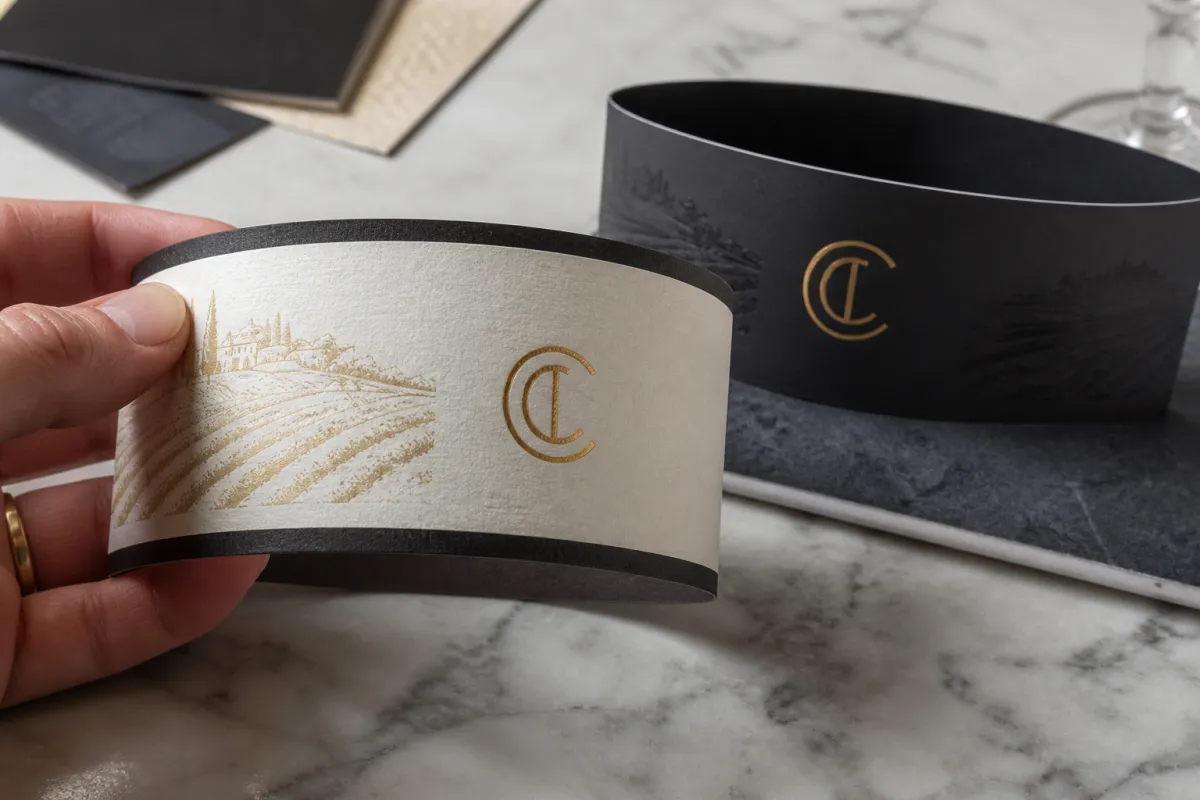
Wine club belly bands cost makes more sense once the piece is treated as a packaging surface instead of a narrow accessory. A belly band can carry the club message, hold a release name, and give each shipment a fresh identity without touching the main label. That flexibility has value because it protects the bottle’s core branding while still making each box feel like it belongs to a specific moment in the club calendar.
A standard bottle can read like a seasonal reserve, a members-only allocation, or a gift-ready presentation with one well-placed wrap. That is why wine club belly bands cost often tracks more closely with perceived value than with raw material weight. A well-set wrap on a premium bottle can do more for the unboxing experience than a louder package that feels cramped or overworked.
The real question for a packaging buyer is not, “How cheap can this be?” It is, “What does this package need to do in the club workflow?” If the band only needs to announce a release, a simple stock and one-color print can keep wine club belly bands cost lower. If the band has to survive refrigerated storage, humid receiving areas, or a rough shipping cycle, the spec needs more structure. That costs more, and pretending otherwise usually leads to a reprint.
Three things move the number quickest: bottle fit, finish complexity, and quantity. A band that has to work across several bottle shapes needs a tighter dieline. A band with foil, embossing, or spot UV needs extra setup and more handling. A larger run spreads press time and cutting work across more pieces, and that is the kind of math that actually brings wine club belly bands cost down.
The trick is not to make the piece look underbuilt. The trick is to Choose the Right stock weight, the right print method, and a finish that fits the brand instead of trying to use every option on the menu. Wine club belly bands cost should reward good spec decisions, not punish them.
If the goal is a bottle that feels curated, the budget needs room for the part members touch and see first. No one stays in a wine club because the packaging was technically the cheapest line item. They remember the bottle that felt considered the moment they opened the box. That is the job.
Why Wine Clubs Use Belly Bands Instead of Full Wrap Labels
Wine club belly bands cost starts to make more sense once you compare belly bands with full wrap labels. A full wrap can cover more space, but it also ties the design to a larger footprint and often a more rigid inventory plan. Belly bands work as the flexible layer. They wrap the bottle, carry the club story, and can hold tasting notes, membership details, QR codes, or a reserve release message without changing the main label underneath.
That flexibility is exactly why clubs keep using them. A spring shipment may need one design, while winter needs another. A reserve tier may call for a more elevated finish. A gift membership box may need a strip that feels closer to a small presentation sleeve. Wine club belly bands cost is easier to justify in those situations because the piece solves a problem a static label cannot solve as cleanly.
The planning advantage matters too. With belly bands, artwork updates are easier, inventory is simpler, and the club can respond to a vintage change or a different allocation without throwing old printed stock away. Buyers notice that because it lowers waste and keeps the team from sitting on the wrong design for half a year. Wine club belly bands cost may look modest on paper, but the real savings often show up in the inventory you do not have to store.
Belly bands are also strong at storytelling. If the club wants each bottle to feel like a chapter in a series, a belly band gives each release a fresh canvas. Members respond to that ritual. They do not just want wine; they want the feeling that the bottle was prepared for them. A good wrap delivers that without forcing a full packaging rebuild.
Where belly bands fall short is moisture abuse and heavy-duty tamper protection. If the pack sits in a wet chiller, if the bottle sweats heavily, or if the club needs a component that must stay intact through rough handling, a belly band is not automatically the right answer. In those cases, wine club belly bands cost should be judged against the actual performance requirement, not against an idealized version of the piece.
Clubs that ship mixed bottle formats can still use belly bands, but the dieline needs to respect the widest bottle in the set. A loose band looks careless. A tight band buckles. That is not a design flaw. It is a measurement issue, and it is usually the cheapest issue to catch before production starts.
Size, Stock, Ink, and Finish Specs That Matter
Wine club belly bands cost starts getting real once the specs are set. The first thing I ask for is bottle measurement, because “standard bottle” is too vague to quote with confidence. A 750ml Bordeaux bottle is often around 2.9 to 3.1 inches across the body, while Burgundy shapes flare differently at the shoulders. That changes the band width, the wrap length, and whether the piece sits flat or creases in the wrong place.
Before anyone quotes the job, these details should be clear: bottle diameter range, band width, finished length, fold style, and whether the band has to clear a neck label or shoulder label. If the club ships different bottle shapes, say so early. Wine club belly bands cost is much easier to keep under control when the dieline is built around the widest format instead of a guessed average.
Stock choice matters more than many buyers expect. Uncoated paper gives a natural, winery-friendly feel and usually fits a softer brand voice. Coated stock prints sharper and holds detail better when the artwork includes fine typography, photography, or dense color fields. Heavier paper adds stiffness, which helps the band hold its shape around the bottle, but it can also make folding and wrapping less forgiving. None of those choices is “best” in the abstract. Each one changes wine club belly bands cost in a different direction.
Finish options do their own damage to the budget. Matte is usually the least fussy and often the easiest path to a refined look. Gloss can brighten the artwork, though it can drift toward a more mass-market feel if the design is not handled carefully. Soft-touch brings a premium handfeel, but it is usually a poor match if the club is chasing the lowest possible unit cost. Foil, embossing, debossing, and spot UV all add setup charges and more handling. Those details can be worth it, but only if the design really needs the lift.
Some of the hidden spec choices move the quote faster than buyers expect. Variable data changes setup. Tight color matching means more proofing. Custom die cuts can bring tooling fees. Humid warehouse conditions may call for a stock or coating that resists curl and scuffing. Wine club belly bands cost climbs when the job has to survive real operations instead of just looking polished in a mockup.
If sourcing claims matter, ask for the paperwork before you commit. An FSC claim only means something if the supplier can document chain of custody correctly. For clubs that want to mention responsible sourcing, that detail matters more than a generic eco label pasted onto the spec sheet. You can check the standard at FSC, which is the kind of baseline that should support a real packaging claim.
Ink coverage matters too. Heavy solids can look rich, but they also increase the chance of scuffing on uncoated or lightly coated paper if the band is handled before it is fully set. Rich black, metallic inks, and tight registration all add risk in production, especially on short runs where there is less room to absorb a misprint. A buyer does not need to know every press detail, but it helps to know that not all “simple” artwork is simple on press.
Wine Club Belly Bands Cost, Pricing, and MOQ: What Changes Your Quote
Wine club belly bands cost comes down to a short list of factors, and none of them are mysterious. Quantity is the biggest one. Stock weight comes next, followed by the number of print colors, finish complexity, and whether the job runs digitally or offset. If a quote does not spell those out, it is not a quote. It is a guess with a logo on top.
MOQ matters because smaller runs carry more setup overhead per piece. That is normal. A lower MOQ gives you flexibility, though it often raises the unit price. A larger run lowers the cost per piece, but it also raises total spend and storage needs. Smart buyers look at both sides before they decide. Wine club belly bands cost should be planned as landed cost, not just print price.
| Run size | Typical unit cost | Common setup charges | Best fit |
|---|---|---|---|
| 250 units | $0.95-$1.55 | $45-$125 | Testing a new club release or seasonal design |
| 500 units | $0.70-$1.10 | $55-$140 | Small recurring drop with moderate customization |
| 1,000 units | $0.45-$0.85 | $75-$200 | Stable artwork and predictable monthly shipments |
| 2,500+ units | $0.24-$0.50 | $150-$400 for plates, dies, or tooling fees | Higher-volume programs with repeat use |
Those numbers are planning ranges, not promises. Wine club belly bands cost can fall outside them if the artwork is unusually complex, the finish is heavy, or the shipping destination adds friction. Even so, ranges like these help you compare vendors on the same basis instead of comparing one supplier’s low number with another supplier’s fully loaded price.
Bulk pricing starts to matter once the artwork is stable. If your club changes designs every month, the savings from a large run may not be worth the inventory risk. If the program repeats the same structure with different names or vintages, a higher quantity can make sense. Unit cost drops faster than many buyers expect once the press setup is spread across more pieces. That is where wine club belly bands cost starts behaving the way procurement teams want it to.
A clean quote includes stock, size, finish, proof type, packaging method, and freight assumptions. If those details are missing, the price is not low. It is incomplete.
The difference between print price and landed cost trips people up more often than it should. Shipping, inner packing, carton counts, and rework exposure all belong in the math. If the club runs monthly releases, even a small bump in setup charges can matter over the course of a year. That is why wine club belly bands cost should be checked against total program spend, not the one line that looks nicest on the invoice.
For clubs that send product through boxed shipments, transit conditions matter as well. If the belly bands are part of a larger packout, ask whether the component has been reviewed with shipping in mind. Packaging testing organizations like ISTA exist for a reason: parcels get dropped, vibrated, stacked, and dragged by people who do not care about your brand story. A band that looks good in a proof but fails in the box is just expensive confetti.
The practical rule is simple: if the quote is not comparing the same size, same stock, same finish, same proofing method, and same freight assumptions, you are not getting a fair comparison. You are getting a numbers circus. Wine club belly bands cost only becomes useful when every vendor is quoting the same job.
That is also why I tell buyers to request tiered pricing early. Ask for 250, 500, and 1,000 units at minimum. If the club is serious about recurring releases, ask for 2,500 too. The difference in unit cost often shows whether it is smarter to print smaller now or commit to bulk pricing that protects the budget later. Either way, wine club belly bands cost should come from planning, not hope.
The cheapest quote is not automatically the best value. If a vendor hides plate fees, avoids proof detail, or refuses to explain setup charges, expect surprises later. Surprises belong in birthday parties, not production invoices.
One more thing that can quietly change the number: pack configuration. If the belly band is applied by hand at fulfillment, labor time matters. If it is pre-applied before shipment, then folding tolerance and carton efficiency matter instead. The print quote might look fine, but the operational cost can still climb if the piece is fussy to assemble. That part rarely shows up on a pretty mockup.
Production Process and Turnaround: From Proof to Ship Date
Wine club belly bands cost is only part of the job. The production path matters just as much because time mistakes create expensive rush orders. A normal workflow should look like this: request quote, confirm dimensions, review dieline, approve digital proof, print, finish, pack, and ship. If a supplier cannot walk you through those steps in plain language, that is a warning sign.
Smaller quantities usually move faster with digital production. Larger quantities or more complex decoration often make offset a better fit because the unit economics improve once the job is stable. Typical turnaround after proof approval might be 5 to 8 business days for simple digital work, 8 to 12 business days for more involved runs, and 12 to 18 business days for offset jobs with special finishes. That is not a rule. It is a practical planning range. Wine club belly bands cost rises quickly when a club waits too long and then asks for urgent everything.
The common delay points are boring, which is exactly why they keep happening. Artwork revisions. Missing measurements. Late approvals. Special finishes that need extra setup. A team that changes its mind after proof approval will pay for it one way or another. In a recurring club program, that kind of delay can upset the shipping calendar for the whole month.
A good packaging schedule starts with the member ship date and works backward. If boxes need to leave on the 12th, the print file should not still be under review on the 10th. Wine club belly bands cost is easier to justify when the job lands cleanly the first time, with enough room for one proof cycle and no drama.
For clubs with mixed bottle formats or seasonal artwork changes, a master dieline saves time. Adjust the copy instead of rebuilding the structure every time. That keeps errors down and the order history cleaner. It also avoids the classic production problem where the band looks fine on screen and too tight on glass. That is a measurement failure, not a print failure.
If the shipment is part of a larger packout, the band should be tested in context. Fold it. Wrap it. Put it next to inserts and shippers. Check scuffing and panel alignment. In a high-volume club, a tiny tolerance issue turns into a large pile of rework very quickly. Wine club belly bands cost stays sane when the pack is verified before the full run is printed.
Ask for a clear approval window, too. A supplier should tell you how long the proof stays open, when plates or dies are released, and what happens if the artwork changes after approval. That sounds basic because it is basic. Basic is good. Basic keeps invoices boring, and boring invoices are usually the cheap ones.
If a reprint does happen, ask how the supplier handles it before you place the order. A straightforward partner will explain whether the issue came from file setup, production variation, or a spec change after approval. That honest conversation matters more than polished sales language because it keeps the next job from repeating the same mistake. It also tells you whether the number you are seeing reflects real production discipline or just a nice-looking estimate.
Why Choose Us for Wine Club Belly Bands
Wine club belly bands cost should be easy to understand, not buried under jargon. That is the main reason buyers work with a supplier that can explain stock, print, finish, and delivery without sounding mysterious. Custom Logo Things is built for that kind of buyer: the one who wants a straight answer, a practical spec recommendation, and a quote that does not need a decoding manual.
For club operators, speed matters, but clarity matters more. You need to know whether the piece can hold up in shipping, whether the sizing works for the widest bottle in the run, and whether the finish is worth the extra spend. If the answer is no, say no. A clean no saves more money than a vague yes that turns into a remake. Wine club belly bands cost gets messy only when the project starts hiding important details.
Quality control is not glamorous, but it is the difference between a neat wrap and a stack of crooked bands. We look for print consistency, clean folding, accurate sizing, and a delivery window that actually matches the club schedule. Buyers do not need poetry. They need packaging that shows up and works. That is the point.
The other reason to choose a practical packaging partner is flexibility. A boutique membership might need 300 bands with one finish. A larger recurring program might need 3,000 units with a more efficient layout and better bulk pricing. Both deserve a quote that reflects the real job. Wine club belly bands cost should adjust to the program, not force the program into an arbitrary template.
There is a lot of noise in packaging sales. Some vendors lead with the cheapest number and hope the buyer forgets to ask about setup charges, freight, or tooling fees. Others fill the quote with technical language and still do not answer the simple question: “What will this actually cost me to put on bottles and ship to members?” That is where a direct supplier earns trust.
We also pay attention to the small operational issues that save reprints. If you need a template, ask early. If you need multiple tiers for budgeting, ask early. If you have a hard ship date, say it early. The sooner the specs are locked, the less likely wine club belly bands cost will drift for reasons that had nothing to do with the design itself.
A good packaging partner should make the next order easier than the last one. That means consistent quoting, practical advice, and fewer surprises. Not flashy. Just useful. And useful is what keeps a club running smoothly.
We do not pretend every project needs premium finishes or a fancy build. Sometimes the right answer is a simple paper band with careful sizing and a clean one- or two-color print. Other times the club really does need a heavier stock and a more polished finish. The honest part is matching the piece to the use, not pushing the same answer every time.
Next Steps: Send Specs and Get an Accurate Quote
Wine club belly bands cost becomes much easier to control once you send the right information first. Start with bottle dimensions, estimated quantity, artwork files, target ship date, and any finish or stock preferences. If you only send a logo and a hope, the quote will stay fuzzy. If you send measurements and a deadline, the quote gets real.
The smartest next move is to ask for tiered pricing. Get 250, 500, and 1,000 unit numbers at a minimum, and add 2,500 if the program has repeat potential. That lets you compare unit cost, total spend, and bulk pricing without guessing. It also shows you where wine club belly bands cost drops enough to justify a larger run.
Request a dieline or template early, before design is locked. That one step prevents the usual mess: artwork built around the wrong width, the wrong seam placement, or a band that blocks part of the main label. In a recurring club, a day spent checking dimensions is a lot cheaper than a week spent reprinting because the wrap did not fit.
If the club needs a premium feel, say what premium means. Matte? Soft-touch? Foil? A heavier paper stock? If the club needs durability, say that too. The supplier should explain what each decision does to wine club belly bands cost, unit cost, and turnaround. Honest pricing is not complicated. It just needs enough information to price the actual job.
Then do the practical thing: line up the specs, request the quote, and confirm how wine club belly bands cost changes if quantity, finish, or turnaround changes. That is how you keep the budget from drifting on its own. Clear numbers. Clear files. Clear ship date. The rest is production.
My best advice is simple: do not approve the first number until you have compared the same job across every line item that can move. If the size is off, the stock is different, or the finish changes, the quote comparison is useless. Tighten the spec first, then choose the version that gives you the best mix of price, presentation, and shipping reliability.
How much do wine club belly bands cost per 100, 500, or 1,000 units?
Per-unit cost drops as quantity rises, but total spend goes up, so compare tiered Pricing Before You decide. Smaller digital runs usually make sense for testing, while larger runs often improve unit economics. Ask for the same specs at each tier so you are comparing real wine club belly bands cost, not a slightly different job dressed up as a bargain.
What affects wine club belly bands pricing the most?
Quantity, stock choice, number of print colors, and finishing options drive most of the price. Complex shapes, tight color matching, foil, embossing, and spot UV add setup charges and can extend production time. Shipping and packout requirements can also change the final number, which is why wine club belly bands cost should always be checked as a landed cost.
What is the MOQ for custom wine club belly bands?
MOQ depends on the print method, stock, and finish, but smaller digital runs usually start lower than offset production. A lower MOQ gives you flexibility, though it may increase unit cost. If you expect repeat orders, ask for pricing at multiple quantities so you can plan wine club belly bands cost without guessing.
How long does production take after proof approval?
Turnaround depends on quantity, finish, and print method, but proof approval is the point where the clock really starts. Simple runs move faster; jobs with special finishes or custom die cuts need more time. Build in extra time if the bands must arrive before a fixed member ship date, because wine club belly bands cost gets worse fast when you need a rush remake.
Can wine club belly bands fit different bottle shapes?
Yes, but the band has to be sized around the widest bottle in the set. If your club ships mixed formats, share all measurements up front so the band does not slip or buckle. A good dieline can handle variation, but it needs to be built for it from day one. That is usually the cheapest way to keep wine club belly bands cost under control.
The clearest takeaway is this: send real measurements, a quantity target, and the finish you actually want before you ask for price. That one step does more to control wine club belly bands cost than any amount of guesswork ever will. Once the specs are locked, the quote becomes useful, the timeline gets cleaner, and the finished piece has a much better shot at looking the way the club intended.