Wine Club Die Cut Stickers Cost: Why Small Runs Surprise Buyers
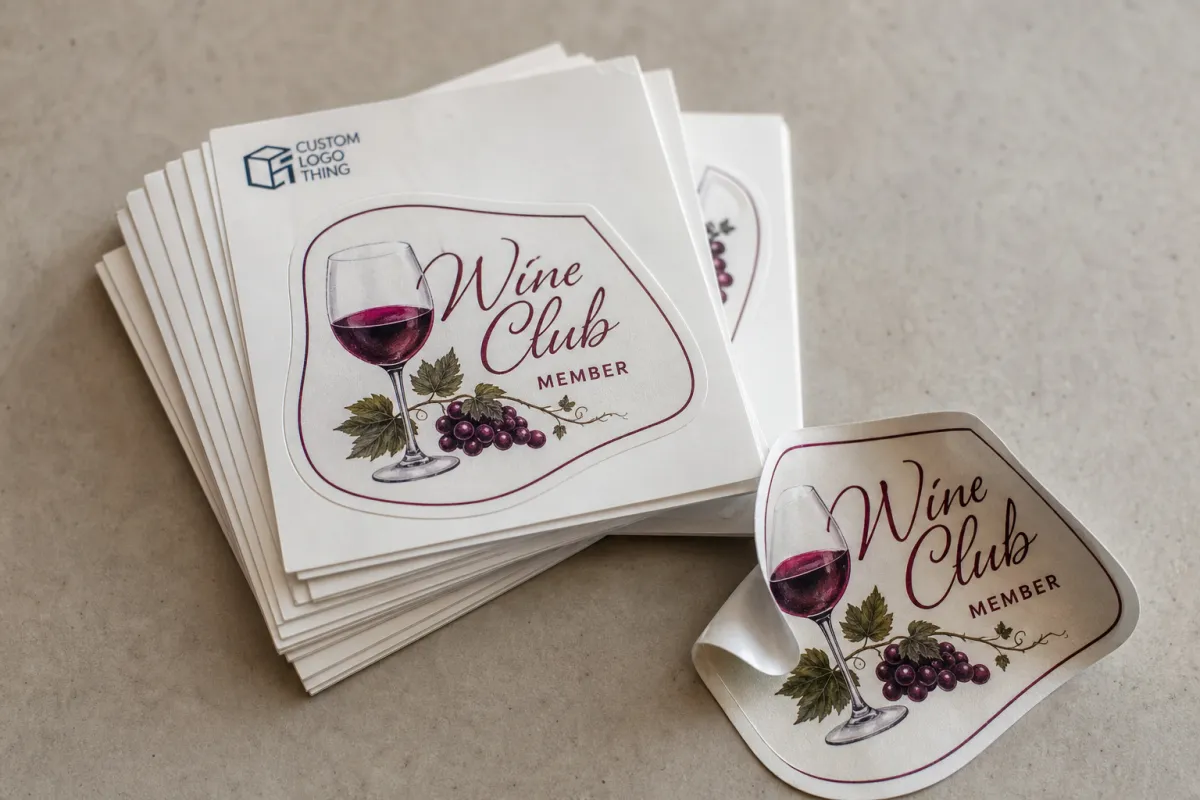
Wine club Die Cut Stickers cost more than many buyers expect the first time they ask for a quote, and the sticker itself is rarely the real culprit. Setup charges, proofing, cutting, and the simple fact that a short run still takes the same hands-on work as a larger one usually explain the price. If you are putting together a club launch, a renewal kit, or a tasting mailer, you need a usable number quickly, not a foggy answer dressed up as strategy.
These stickers do real work. They close tissue, brand bottle boxes, seal membership mailers, and make a renewal pack feel planned rather than assembled in a hurry. That is why wine club Die Cut Stickers cost matters to both the marketing side and the operations side. A weak sticker can make a strong kit feel unfinished. A sticker that peels cleanly, holds on glass, and survives shipping keeps the whole package looking organized.
The part buyers miss most often is that the sticker is seldom the expensive piece on its own. The biggest swing in wine club Die Cut Stickers cost comes from quantity, material, and finish. A run of 250 pieces can look pricey on a per-piece basis because the setup cost is divided across very few labels. Move to 1,000 or 5,000 pieces and the cost per piece drops, sometimes sharply. That is normal production math, not a trick.
For a wine club or retail program, the better question is not "How cheap can this be?" It is "What is the right spend for the job?" A monthly member mailer does not need the same build as a premium gift box. A bottle seal for a chilled shipment needs different adhesive than a paper insert sticker. Wine club die cut stickers cost only makes sense when it is tied to the actual application, not just the mockup.
For buyers who need a budget anchor, a simple custom die-cut run often lands around $120-$250 for 250 pieces, $160-$380 for 500 pieces, $220-$700 for 1,000 pieces, and $650-$2,200 for 5,000 pieces, depending on size, print coverage, material, and finish. Those ranges are practical, not promises. Heavy ink coverage, a complex shape, or waterproof stock with a premium finish will push wine club die cut stickers cost higher. Keep the spec simple and the number usually comes down.
The real goal is not the lowest sticker price in a vacuum. It is the lowest cost that still looks good, holds up, and arrives when you need it. That is the part that matters.
Wine Club Die Cut Stickers Cost Drivers That Actually Matter
Wine club die cut stickers cost comes down to a small set of variables that show up in nearly every quote. Artwork matters, but the cut path and the stock often move the number more than the design file does. A die-cut sticker follows a custom outline, so every change in shape can affect the die, cutting time, nesting efficiency, and spoilage risk. A clean oval is usually cheaper to produce than a tight crest with tiny cutouts and sharp interior corners.
Start with the use case. A bottle seal on chilled glass needs stronger adhesive and a stock that can handle condensation. A welcome-kit sticker on kraft paper can use a simpler build. An event handout might care more about appearance than durability. The use case changes the spec, and the spec changes wine club die cut stickers cost.
The main cost drivers are easy to track:
- Size: Larger stickers use more material and more press time.
- Ink coverage: Full-bleed art, dense coverage, and dark solids usually cost more than light artwork.
- Shape complexity: Tight corners, narrow bridges, and detailed outlines slow cutting and can increase spoilage.
- Material: Paper, BOPP, and vinyl do not price the same.
- Adhesive strength: Permanent adhesive usually costs more than light tack.
- Format: Sheets can work better for some jobs, while individual pieces may fit packing or hand application better.
Durability matters for clubs shipping through mixed conditions. If a package may sit in a cold room, a truck, or a damp tasting tote, choose the stock that matches that abuse. If the sticker is going on chilled glass, it is kinda asking the adhesive to do extra work, so the material has to be up to the job. That is where wine club die cut stickers cost gets misread: people focus on the shape and forget the environment.
For sustainability-minded programs, paper can still be the right answer if the use is dry and short-lived, and FSC-certified sourcing may fit the brand story. But paper is not a stand-in for everything. A beautiful box seal is one thing; a label on a cold bottle with condensation is another.
"A sticker that looks good in a mockup but fails on a chilled bottle is not a premium sticker. It is a reprint waiting to happen."
For mailers and club shipments that need more resilience, it helps to think about the same kind of distribution testing used in packaging. The International Safe Transit Association has established test methods for shipping distribution at ista.org. You do not need a full lab program for every insert, but the mindset is useful. If the pack will see temperature swings, rubbing, or stacking pressure, build the sticker for that reality.
If you are sourcing labels or tags for bottle necks, tasting notes, or shipping inserts at the same time, it often makes sense to keep the work inside one vendor family. That keeps reorders simpler and can reduce surprises when you compare Custom Labels & Tags with die-cut stickers. A lot of buyers save money by keeping the artwork and quantity plan consistent across the whole club kit.
Material, Finish, and Size Specifications for Wine Club Orders
If you want a useful estimate for wine club die cut stickers cost, you need the spec sheet before you ask for the quote. Size, stock, adhesive, and finish are not decorative details. They are the quote. A sticker that is 2 inches wide is not the same as a 4-inch seal, and the price change is rarely subtle once you multiply it across a production run.
Start with the basics. What is the sticker for? Bottle seal, box seal, insert piece, or event handout? Then decide where it will live: glass, coated board, kraft stock, poly mailer, or chilled packaging. That answer drives the material. The more clearly you define the use case, the fewer surprises you will get when wine club die cut stickers cost comes back from the printer.
Paper, BOPP, and Vinyl
Paper is usually the least expensive option. It works well for dry, short-term use and does the job for many insert stickers or box closures. It is not the best choice for moisture. If the sticker will touch condensation or cold bottles, paper can curl, wrinkle, or lose grip.
BOPP is the practical middle ground for many wine club jobs. It handles moisture better than paper, has a cleaner look, and usually prints well for logos, seals, and branded artwork. For most club shipping conditions, BOPP gives a better balance of durability and unit cost than high-spec vinyl.
Vinyl is usually the most durable and often the most expensive of the common options. It can make sense for outdoor events, chillers, or applications where the sticker may get handled more aggressively. If the goal is to close a box and look polished, vinyl may be more material than the job needs. That is how wine club die cut stickers cost climbs without helping the final package.
Finish Choices
Gloss gives the artwork more pop and can make saturated colors look deeper. It is common when a brand wants a bright, polished look. Matte feels more restrained and can read as premium on minimalist packaging. Soft-touch adds a velvety feel and often fits high-end presentation, but it raises cost and is not always the right move for a practical shipping sticker.
Do not choose a finish by instinct alone. Choose it based on what the sticker has to do. If it is a bottle seal that customers will touch at a tasting, matte or soft-touch can add a nice tactile cue. If it is a mailer seal that needs visual impact under mixed lighting, gloss may serve the artwork better. The goal is not to stack on every finish you can afford. The goal is to pick the one that earns its place and keeps wine club die cut stickers cost under control.
Size and Dieline
Exact dimensions matter more than most buyers think. Material use scales with area, so moving from a 2-inch sticker to a 3.5-inch sticker can change the quote quickly. The dieline matters too because tighter nesting improves efficiency. Simple, clean outlines fit better on press sheets, which lowers waste and can improve cost per piece.
The practical rule is simple: if your logo works at 2.25 inches wide, do not inflate the shape just because the art file looks empty. Use the smallest size that still reads clearly in the real application. That is the easiest way to manage wine club die cut stickers cost without making the branding look thin.
File prep matters as well. Send vector artwork, include bleed, keep critical text inside a safe area, and approve the dieline before production starts. A messy file can slow proofing and create back-and-forth nobody budgeted for. If the printer has to redraw or correct the cut path, that can add setup charges or delay the run. The same idea applies if you are ordering related pieces like bottle neckers or Custom Labels & Tags alongside the stickers. Clean files save time, and time is money.
For buyers comparing specs across vendors, ask these questions before you compare the headline quote:
- Is the stock paper, BOPP, or vinyl?
- Is the adhesive permanent, removable, or specialty?
- Is the finish gloss, matte, or soft-touch?
- Are the stickers sheeted or individually cut?
- Does the quote include proofing and dieline setup?
That checklist protects the budget and keeps wine club die cut stickers cost from being compared against a different product altogether.
Wine Club Die Cut Stickers Pricing, MOQ, and Quote Rules
This is the part most buyers want first. Wine club die cut stickers cost follows a predictable pattern once you know how printers build quotes. Lower quantity means higher unit cost. More complex material or shape means higher unit cost. More standard specs mean better bulk pricing. Nothing mysterious there.
MOQ matters because short runs cost more to set up. If a vendor has to make a die, align the print, run proofing, and cut a custom shape, that work has to be paid for somewhere. With a small order, all of that gets loaded into a few hundred pieces. That is why wine club die cut stickers cost can feel stubbornly high at 250 pieces and much more manageable at 1,000.
| Quantity | Typical Unit Cost | Common Use Case | Notes |
|---|---|---|---|
| 250 pieces | $0.48-$1.00+ | Club launch test, sample mailer, limited event | Highest setup burden per piece |
| 500 pieces | $0.32-$0.76 | Small club shipment, seasonal kit | Better balance of cost and flexibility |
| 1,000 pieces | $0.22-$0.48 | Recurring monthly or quarterly club use | Common sweet spot for many buyers |
| 5,000 pieces | $0.13-$0.34 | Multiple shipments, retail support, promo stock | Best bulk pricing if the design stays stable |
Those numbers are useful ranges, not a universal quote. A tiny paper sticker with a simple shape can land lower. A large waterproof premium piece can land higher. That is why comparing only the total job cost can be misleading. You need to look at cost per piece, the material spec, and what is included in the quote.
A real quote should clearly show:
- Printing cost
- Die cutting or contour cutting
- Proofing and artwork review
- Packaging and shipment
- Any special finish or coating
- Any setup charges or tooling fees
If a quote looks too cheap, read it again. Sometimes freight is missing. Sometimes the proof costs extra. Sometimes the sticker spec is thinner than expected, which can create trouble in use. A bargain number can turn into a more expensive order once the extras show up. That is not cynicism. That is how quoting works.
For standard wine club programs, the strongest value often shows up in the 500 to 1,000 piece range when the artwork is not changing every month. If the seal or label gets used repeatedly, a larger batch can spread the setup charges and pull the unit cost down enough to matter. If the design is seasonal or tied to a one-off event, do not order 5,000 pieces just because the bulk pricing looks attractive. Dead inventory costs money too.
Ask for a comparison between 500, 1,000, and 5,000 pieces. A good quote will show how wine club die cut stickers cost changes with scale, and the tradeoff should be obvious. If the unit cost barely changes after 1,000, something else is driving the job. If the jump is huge, the setup burden is probably dominating the run.
One more thing matters: compare landed cost, not just sticker price. Freight, taxes, handling, and packaging can change the final number. If a low quote hides expensive shipping, it may not be the bargain it appears to be. Buying packaging without checking landed cost is how budgets get chewed up by a thousand small cuts.
Wine Club Die Cut Stickers Process and Lead Time
Wine club die cut stickers cost is only half the story. Timing matters just as much. A sticker that arrives after the renewal boxes ship is not a sticker you can use; it is a problem. The production path is straightforward, but each step matters if you want the order to land on time and on budget.
The usual process looks like this:
- Request a quote with quantity, size, material, finish, and ship date.
- Send artwork in vector format, ideally with a clean dieline.
- Review the proof and approve the cut path.
- Print, cut, finish, and inspect the run.
- Pack the stickers and ship to the required location.
Simple orders often take 2-3 business days for quoting and proofing, 5-8 business days for production after approval, and 2-5 business days for transit depending on the destination. More complex jobs can run longer. Special coatings, difficult shapes, or large quantities can stretch the schedule, and a busy production queue can stretch it too. That is why wine club die cut stickers cost should always be discussed with lead time.
The delay points are usually plain and predictable:
- Artwork is not vector and needs cleanup.
- The dieline is not approved the first time.
- Color changes are requested after proof approval.
- The stock or finish needs special ordering.
- The buyer waits too long to approve the proof.
Rush service exists, but it is not magic. It usually raises the total quote and can reduce material choices. If speed is critical, say so early. If your club mailer goes out the first week of each month, do not place the order at the end of the previous week and hope for a miracle. Hope is not a production plan.
A simple planning rule helps: count backward from the ship date and build in at least one full week of buffer after proof approval. That buffer protects you from file issues, production hiccups, and freight delays. For seasonal launches or renewal campaigns, I would be even more conservative. Wine club die cut stickers cost is easier to manage when there is room for a normal schedule instead of a panic order.
If you need a repeat order every month or quarter, lock the spec early and keep the artwork stable. That saves time and usually reduces the friction on reorders. Reorders are where consistent suppliers earn their keep. They already know the material, the die, and the preferred finish. That consistency can reduce mistakes and keep wine club die cut stickers cost predictable over time.
One practical note: if your stickers will be bundled with bottle neck tags, inserts, or branded seal products, align the order timing where you can. It makes receiving and kitting easier. Less chaos in the fulfillment room helps more than people admit. Packaging operations reward boring systems.
Why Choose Us for Wine Club Die Cut Stickers
Buyers do not need a polished vendor speech. They need a sticker that arrives on spec, at a fair price, and on time. That is the standard. When someone asks about wine club die cut stickers cost, they are really asking whether the quote will hold up under real production conditions.
Custom Logo Things focuses on practical print decisions: the right size for the use case, the right stock for the environment, and the right finish for the brand. That matters because wine club packaging rarely asks for just one thing. Some stickers go on chilled bottles. Some close kraft mailers. Some sit inside a premium membership box where presentation matters more than abrasion resistance. A good vendor adjusts to the application instead of forcing one generic spec on every order.
Color control matters too. A deep merlot red that prints muddy does not feel premium. A sharp crest that loses line weight at small sizes is not usable. Cut accuracy matters just as much, because even a strong design looks sloppy if the contour is off. A vendor should also tell you when a requested size is too small for the artwork. That kind of honesty saves money and prevents reprints, which is the least pleasant way to spend money.
Compared with low-end vendors, the difference usually shows up in the details:
- Clear proofing instead of vague approval screenshots
- Transparent pricing instead of hidden setup charges
- Reliable die cutting instead of jagged edges
- Material recommendations based on the actual application
- Predictable reorders instead of re-explaining everything every month
That matters even more when a club program runs on a recurring shipping calendar. Small misses turn expensive fast when a member pack ships late or a seasonal kit needs a replacement run. The right supplier reduces those misses by keeping the process clear from the start. That is how wine club die cut stickers cost stays controlled over time instead of jumping every reorder.
We also know a lot of buyers need packaging pieces that work together. If you are building a kit rather than buying a single sticker, it makes sense to order related print components from the same source where possible. That can include bottle labels, carton seals, and Custom Labels & Tags. It is not flashy. It is just smart purchasing.
Good vendors also help you Choose the Right MOQ. They do not push the largest quantity just to inflate the order. They look at consumption rate, usage cycle, and waste risk. If you need 750 pieces for the next two shipments, a 1,000-piece run may be the cleanest choice. If the design changes every month, a smaller batch may be smarter even when the unit cost is slightly higher. That is how a real packaging buyer thinks.
The value argument stays simple. The right sticker vendor saves money by reducing reprints, cutting waste, and keeping the spec matched to the real shipping environment. That matters more than shaving a few cents off a quote that does not fit the job. Cheap is not the same as economical.
Next Steps to Lock In the Right Order
If you want a solid answer on wine club die cut stickers cost, do not start with the quote form and hope the numbers make sense later. Start with the use case. Decide what the sticker does, where it goes, and how long it needs to hold up. Once you have that, the price starts to mean something.
Use this order of operations:
- Confirm the application: bottle seal, box seal, insert, or event handout.
- Choose the material: paper for dry short-term use, BOPP for moisture resistance, vinyl for tougher environments.
- Set the size based on readable art and real packaging space.
- Decide the quantity from actual usage, not guesswork.
- Send the artwork and target ship date together.
- Ask for a proof and review the dieline before approval.
- Compare the total landed cost, not just the unit price.
That process sounds basic because it is. Basic is good. Basic keeps wine club die cut stickers cost under control and avoids the common buying mistake of comparing two quotes that are not the same product.
If the sticker will be used every month, build the reorder around consumption rate. A club shipping 600 members quarterly does not need a random 2,500-piece order unless the design is stable for a long stretch. If the artwork changes with vintages or promotions, smaller runs can be the smarter move even if the unit cost is a little higher. Inventory that sits around is not saving money. It is quietly taking it.
Ask for a sample if the sticker will touch bottles, mailers, or premium boxes. A sample tells you more than a spec sheet ever will. You can check color, peel behavior, finish, and shape accuracy before committing to a full run. That is especially useful when the brand presentation matters and there is no room for a sloppy seal on the front of a membership kit.
When you compare vendors, keep the conversation grounded in facts: size, material, finish, quantity, timeline, and landed cost. If a supplier answers those cleanly, you are in good shape. If they dodge those details, you already know what kind of quote that will be.
For most buyers, the smartest move is simple: choose the smallest practical size, pick the material that matches the environment, and order enough quantity to earn better bulk pricing without tying up cash in dead stock. That is the cleanest way to manage wine club die cut stickers cost without making the packaging look cheap or the schedule look desperate.
Do that, and the sticker stops being a budget problem. It becomes a reliable part of the club experience. That is exactly what it should be.
How much do wine club die cut stickers cost for 500 vs 1,000 pieces?
The unit price usually drops at 1,000 because setup gets spread across more pieces. In most jobs, 500 pieces can land in the middle range while 1,000 pieces gives noticeably better cost per piece. Material, finish, and size still matter more than the shape alone, so ask for both total cost and unit cost when you compare quotes.
What MOQ should I expect for wine club die cut stickers?
MOQ varies by printer, but small custom runs are common for proofing, club launches, and seasonal campaigns. A higher MOQ usually lowers the unit cost, especially on standard materials. If you need stickers for multiple club shipments, ordering a larger batch often makes more sense than placing tiny repeat runs.
Do waterproof materials raise wine club die cut stickers cost?
Yes, waterproof materials like vinyl or BOPP usually cost more than paper. They are worth it when the stickers need to survive condensation, chillers, or shipping moisture. For dry inserts or short-term use, paper may be enough and will keep wine club die cut stickers cost lower.
How long does production take for wine club die cut stickers?
Typical timelines depend on proof approval, production queue, and finish choice. Simple orders move faster than special coatings or complex shapes. Rush service is possible, but it usually increases the total quote, so plan early if the stickers need to arrive before a shipment window closes.
Can I order a sample before placing a larger wine club sticker run?
Yes, and it is smart when the sticker will be used on bottles, mailers, or box seals. A sample helps confirm cut shape, color, adhesive, and finish before a full order. It is a small step that can prevent a reprint, which is the fastest way to make wine club die cut stickers cost look worse than it should.

