wine club Kraft Paper Bags MOQ sounds like a narrow sourcing detail, but it shapes a lot more than the purchase order. I have seen clubs spend weeks perfecting tasting notes and member inserts, then miss the weak link entirely: the bag that member sees first. That first touch matters. A crooked logo, a handle that cuts into the hand, or a bag that slouches around the bottle can make a premium release feel a little improvised. And once members start photographing the unboxing, the bag is no longer a background item.
Most buyers start with the obvious question: does kraft look good? Sure, it does. The harder question is whether the bag can hold the same bottle count, print quality, and unit cost every time the club ships. That is where wine club Kraft Paper Bags MOQ becomes an operational variable instead of a pricing footnote. A sensible minimum helps absorb setup cost, steady the quote, and keep inventory aligned with release dates instead of forcing a rushed reorder at the worst possible moment.
The best bag program does not just look good once. It repeats cleanly on the tenth reorder, which is where wine club kraft paper bags MOQ really proves itself.
There is also a reason kraft keeps winning in this category. Kraft paper gives a natural, premium look without the bulk of a rigid presentation box. It prints cleanly, is generally lighter than a heavily built carton, and stays flexible enough for clubs that reorder on a monthly or quarterly rhythm. That mix is useful because wine programs do not live in a one-and-done world. They live in cycles, and the packaging has to keep up.
The strongest results usually start with a plain answer to a plain question: what is the bag doing? Is it for tasting-room pickup, member welcome kits, retail handoff, or bottles packed inside a secondary mailer? Is it carrying one bottle, two, or three? Does the club want raw kraft with a one-color mark, or a fuller branded treatment? Each choice shifts MOQ, lead time, print method, and unit cost. The conversation gets easier once those variables stop drifting around.
Why wine club kraft paper bags MOQ matters for recurring orders
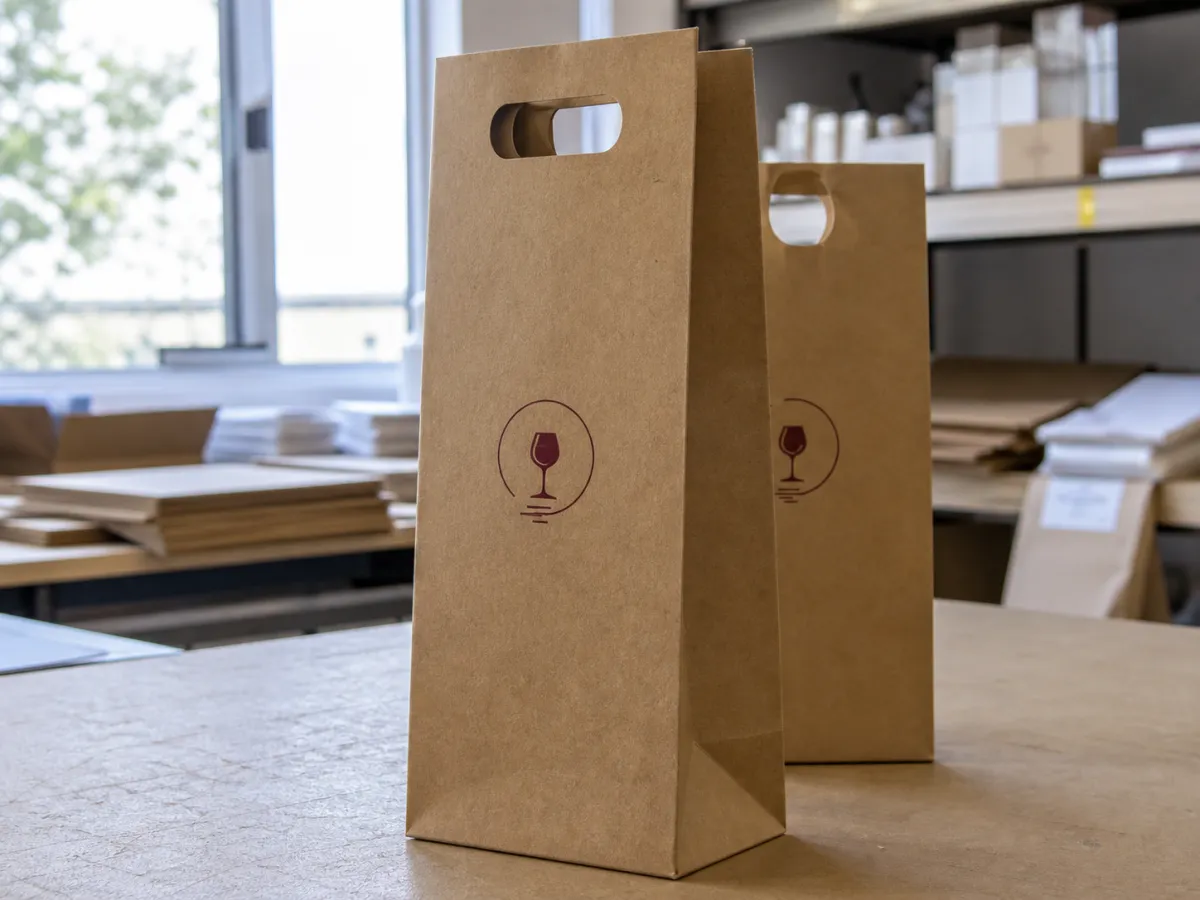
The common mistake is treating MOQ like a gatekeeper instead of a planning tool. A recurring wine program is not a novelty order with a one-time mood board attached. It is a repeatable packaging line item that has to survive reorders, stock holds, and seasonal spikes. wine club Kraft Paper Bags MOQ matters because a club that ships twelve times a year cannot afford a surprise swap in handle style, paper weight, or production window. Consistency is not a nice extra. It is the job.
That matters even more once the bag becomes part of the member experience. People photograph packaging. They carry it from the tasting room to the car. They reuse it as a gift bag. A print that fades, a handle that twists, or a bottom board that gives way under load changes how the brand feels. I have watched otherwise polished wine programs lose a little trust over something that small. It is kind of annoying, honestly, because the fix is usually in the spec sheet, not the marketing deck.
Inventory planning is the other half of the story. Wine programs run on calendars, not guesses. A club may need bags for quarterly releases, holiday gift packs, and tiered membership offers that shift by bottle count. Clear minimums make forecasting possible. Procurement can estimate how many cartons to hold, how much space is needed, and when the next purchase should land. That matters in packed facilities where corrugated cardboard shippers, tasting notes, and inserts are already competing for shelf space. The paper bag becomes one part of a larger system.
The right minimum also supports branding discipline. Lock the bag format once, reorder it again, and the visual language stays steady. A member who receives a two-bottle pack in spring and again in winter should see the same logo placement, same kraft tone, same handle feel. That repetition builds trust. The program looks deliberate instead of patched together at the last minute.
For sustainability-minded buyers, MOQ affects how cleanly the material story can be written. A controlled run can be specified with recycled materials, FSC certified paper, or a meaningful share of post-industrial fiber without forcing a custom structure that pushes cost beyond reason. If the bag is meant to support a green position, ask where the paper comes from, how much is from post-consumer waste, and whether the coating or print changes recyclability. The honest answer matters more than a polished label.
For a clear reference point on fiber sourcing, the Forest Stewardship Council explains certification standards at fsc.org. That matters because a club can say “sustainable” all day, but the paperwork and the supply chain have to back the claim.
Custom formats for wine clubs, memberships, and gift kits
The single-bottle bag is still the most common format, and for good reason. It works for tasting-room retail, member pickup, and gift purchases without creating excess structure. It is also the easiest way to keep wine club kraft paper bags MOQ under control. A one-bottle bag can use a modest footprint, a reinforced base, and a clean logo panel that does not inflate print cost. If the club uses it for add-on sales, the bag has to look sharp on the shelf and still move quickly at checkout.
Two-bottle bags push structure into the foreground. Weight increases. Bottle shoulders shift. The paper has to resist bowing at the gusset. A flat-bottom build may improve stability on a counter, while a deeper gusset can make packing easier if bottle diameters vary by varietal. Handle choice starts to matter too. Twisted paper handles are efficient and familiar. Rope handles feel more elevated. Reinforced die-cut handles keep the outside cleaner, though they need strong reinforcement if the bag carries dense glass.
Three-bottle formats appear less often, but they are useful for reserve tiers, holiday bundles, and member gifts. At that point, the bag behaves more like a carrying system than a paper sack. The base board, side panels, and handle anchors need to be specified with care. If the bag is carrying premium labels or heavier Bordeaux bottles, the paper weight often needs to climb. That is one reason wine club kraft paper bags MOQ should be discussed at the same time as bottle count, not after artwork gets approved and everyone has mentally moved on.
Brands also use larger presentation bags for membership kits. These packs may include a bottle, a welcome card, tasting notes, a QR code insert, or a small branded accessory. If the bag has to hold inserts without bulging, internal dimensions matter more than the face size alone. A good supplier will ask about stack height, not just bottle dimensions. That one question prevents a lot of rework and catches the classic mistake: the bottle fits, the kit does not.
Print strategy deserves the same level of attention. Some clubs keep it spare: one-color logo on kraft, maybe a strapline or vintage mark. Others want a more decorative front panel with spot-color print, a flood coat, or a premium finish. The smartest designs use branding where it adds value and leave the rest alone. That usually reduces waste, shortens lead times, and protects unit cost.
Common format choices include:
- Single-bottle bags for retail handoff and wine club pickup.
- Two-bottle bags for standard memberships and gift orders.
- Three-bottle bags for reserve tiers and seasonal bundles.
- Presentation bags with inserts, tasting cards, or QR-coded membership materials.
If the club also ships through mailers, the paper bag and the shipping shipper should not be treated as the same item. A kraft bag can handle the front-end presentation, while a separate carton or corrugated cardboard mailer takes on transit protection. That division keeps each layer doing the job it was designed for instead of asking one package to solve everything.
Wine club kraft paper bags MOQ: sizes, paper weights, and print specs
Size is the first hard number to settle. A standard 750 ml bottle needs space for the body, neck, and any closure or tag. Taller bottles, embossed labels, and neck collars all demand extra headroom. A one-bottle bag that looks generous on paper can still feel tight in hand if the shoulder is wide or the finish is irregular. For two bottles, internal width becomes even more sensitive because the bottles can press into each other during handling.
Paper weight should be chosen with the same discipline. Heavier paper gives the bag more stiffness, a better wall recovery, and a stronger feel when lifted. Mid-weight stock often offers the best balance of cost and performance, especially when the brand wants a kraft look without paying for a luxury box. For wine club kraft paper bags MOQ, the best fit is often found in the middle rather than at the edges. Too light and the bag reads as disposable. Too heavy and the budget rises without enough benefit to justify it.
Practical ordering works better when the team thinks in ranges instead of absolutes. Many one-bottle kraft bags sit in a paper range suited to daily retail use, while two-bottle and three-bottle builds often need heavier stock or reinforcement. The handle area deserves special attention. Reinforced punch-outs, glued patches, or rope handle anchors can affect the bag more than a simple thickness increase. A stronger bag is not always just a thicker bag. Sometimes it is a smarter one.
Print specs should be written tightly enough to prevent surprises. A useful quote request includes logo size, ink count, print placement, whether the design wraps to the side panels, and whether the kraft base stays visible. A minimal natural look may only need one-color printing. A brighter logo or seasonal promotion may justify a second color, but each added color creates a setup charge. That is one of the quickest ways wine club kraft paper bags MOQ changes the price.
Finishes need equal scrutiny. Aqueous coating can protect the surface without making the bag look plastic. Spot protection may help high-touch areas like the handle zone or bottom panel. Some buyers ask for matte or soft-touch effects, but that choice should be weighed carefully on kraft because it can mute the paper character that made the bag appealing in the first place. If the brief calls for premium but grounded, let the paper show through.
The sustainability conversation should stay specific. Kraft paper can be sourced from recycled materials, and some programs specify post-consumer waste content to strengthen the environmental story. That can help, but only if the build still performs. A coating or lamination may improve durability, yet it can change the recycling profile. Some buyers describe the result as biodegradable packaging, though that claim needs care; coatings, inks, and adhesives all influence what happens after use. A material statement is better than a slogan. Trust the spec, not the buzzword.
Logistics-sensitive buyers should also ask how the bags ship. Packed carton count, weight, and whether the bags ship flat or nested all affect storage and freight. If the club runs other packaging programs at the same time, the comparison should include how the paper bag stacks against rigid cartons, gift boxes, or corrugated cardboard shippers in both space and labor.
Pricing and MOQ for wine club packaging orders
MOQ is a cost structure, not just a threshold. Lower volumes usually carry more setup cost per bag because the plate, die, color matching, and press time are spread across fewer units. Larger runs reduce unit cost because the fixed cost gets diluted. That is why two quotes for the same wine club kraft paper bags MOQ can land in very different places depending on artwork coverage, handle style, and whether the supplier is building from a standard format or a custom die.
Here is a practical way to compare options without guessing. These are planning ranges, not promises, and they will move with artwork, freight, and material choice:
| Format | Typical MOQ | Typical unit cost | Best use | Cost driver to watch |
|---|---|---|---|---|
| Single-bottle kraft bag | 1,000-3,000 pieces | $0.18-$0.32 | Tasting room sales, pickup orders | Print colors and handle reinforcement |
| Two-bottle kraft bag | 1,000-3,000 pieces | $0.24-$0.46 | Standard club membership packs | Paper weight and bottom board support |
| Three-bottle kraft bag | 2,000-5,000 pieces | $0.34-$0.65 | Reserve tiers, holiday gifting | Load capacity and print coverage |
| Premium rope-handle presentation bag | 3,000-5,000 pieces | $0.45-$0.85 | Member welcome kits, elevated gifting | Handle hardware and finishing |
That table forces the buyer to compare more than the headline number. A low unit cost can hide a higher setup fee, a pricey sample process, or freight that wipes out the savings. A serious quote should show unit price, plate or die charge, proof cost, sample cost, and shipping separately. If those items are blurred together, the project is harder to manage than it should be.
Several straightforward moves can trim spend without weakening the bag. Standardize across club tiers where possible. Cut print coverage if the kraft surface already carries the brand well. Limit the color count. Order in forecasted waves rather than tiny emergency batches. If the same size works for both the core club and the gifting program, resist creating a second structure just to make the lineup feel varied. Fragmentation quietly raises costs.
The cheapest bag is not always the lowest-cost program. A light bag that tears, a handle that pulls out, or a color that shifts from batch to batch can trigger reprints, returns, and customer service work. That is why wine club kraft paper bags MOQ should be judged beside durability, not instead of it. The real program cost lives across sourcing, storage, freight, and brand consistency. The first invoice only tells part of the story.
For clubs that want to align packaging with testing discipline, shipment and transit decisions can be reviewed against protocols from the ISTA community. That becomes especially relevant if the bag sits inside a shipper that has to survive vibration, drops, and temperature swings before it reaches the member.
Packaging has long been a total-cost decision, not a decoration decision. That is the right way to think about wine club Kraft Paper Bags MOQ: compare the whole system, not only the printed shell.
Process and timeline: from quote to delivery
The sourcing process should be simple, but it has to be complete. Start with the quote request, confirm dimensions and print method, review artwork, approve the proof, sample if needed, then move into production. That sounds procedural because it is. The fastest projects remove ambiguity early. Missing measurements and vague print instructions are the main reasons wine club kraft paper bags MOQ orders slide off schedule.
A practical timeline gives the club room to plan release dates. A straightforward order with final artwork and a standard structure may move from proof approval to production in roughly 12 to 15 business days. If the order needs a custom die, a special handle build, or physical samples, the window often stretches to 18 to 25 business days. Freight adds its own timing, especially when the bags are headed into a warehouse before a membership cycle. Those ranges are normal, not worst-case.
Sample validation is where thoughtful teams save money. A flat proof can show color and layout, but it cannot show whether the bottle neck catches the opening, whether the handle feels right in the hand, or whether the bottom board shifts under load. A physical prototype catches those issues before the full run is committed. If the bag will live inside a broader packaging system, that sample is also the moment to check how it fits with tissue, inserts, or a corrugated cardboard outer shipper.
For direct-to-consumer fulfillment, it helps to test against transport requirements instead of assuming the bag will survive because it looks sturdy. The ISTA testing framework is a useful reference point for transit performance, especially when the club ships bottles with protective packaging. That does not mean every order needs lab testing. It does mean the buyer should think in terms of handling, vibration, and compression, not just shelf appearance.
Delays tend to show up in the same places. Artwork is not final. Dimensions come from an old order instead of the current bottle. The proof sits unread in someone’s inbox for four days. The team decides late that the bag should wrap the side panel after all. Each change may seem minor. Together, they push the calendar. For that reason, wine club kraft paper bags MOQ projects move best when the spec sheet is complete on day one.
What to send at the start:
- Bottle count per bag and exact bottle dimensions.
- Desired paper weight, handle style, and finish preference.
- Artwork files in vector format if possible.
- Target quantity and whether the order will repeat.
- Delivery destination, warehouse timing, or port details.
That list looks basic, yet it prevents the most common back-and-forth. It also makes the quote easier to compare across vendors. If one supplier gives a lower price but leaves out the proof schedule, freight estimate, or handle reinforcement, the quote is not really complete. It is just shorter.
For clubs that want a faster answer to common sourcing questions, the team’s FAQ is a useful place to check print, sample, and reorder basics before the production conversation starts.
Why Custom Logo Things is a fit for wine club programs
Custom Logo Things fits recurring packaging because wine clubs need repeatability more than novelty. A one-time promotion can tolerate a little drift. A member program cannot. When a club orders wine club kraft paper bags MOQ on a schedule, it needs the same dimensions, the same construction, and the same color behavior from reorder to reorder. A disciplined packaging partner matters here.
The strongest service model is operational, not flashy. Stable specs matter. Repeatable proofs matter. Clear MOQ and pricing breakdowns matter. The buyer should know what changes the unit cost, what changes the production window, and what can stay fixed from one release to the next. That clarity saves time for procurement and lowers friction for marketing, fulfillment, and store operations.
Sustainable sourcing belongs in the discussion too, but it should stay precise. Buyers increasingly ask about FSC certified paper, recycled content, and print discipline because those details affect perception and compliance. A club does not need vague green language. It needs documentation that matches the material spec. That makes for a cleaner conversation, and it holds up better with customers who know the difference between a glossy claim and a real paper statement.
Fit-to-program thinking is another advantage. A bag for a single-bottle retail sale should not be specified the same way as a three-bottle reserve pack. A holiday gift bag should not be treated like the core membership carrier. The best packaging partner helps align the format with membership tier, bottle count, and promotion schedule so each version stays recognizable without creating unnecessary SKUs.
If you are evaluating the brand itself, the Custom Logo Things packaging team is built around custom-logo work that has to perform in the hand as well as on the shelf. That matters more than a polished pitch. Wine club buyers do not need hype. They need a bag that fits, prints cleanly, ships predictably, and can be reordered without drama.
There is a commercial upside to consistency too. When the same wine club kraft paper bags MOQ specification is used across releases, reorder decisions get easier. The team knows what the bag costs, how long it takes, and how much inventory to keep on hand. That reduces rush orders and helps protect the launch calendar, which often matters more than shaving a little off the first quote.
If you want a packaging partner that keeps the conversation grounded, the Custom Logo Things quote team can help turn a membership concept into a working bag spec without losing the details that affect production.
Next steps to order wine club kraft paper bags MOQ
The fastest way to get a useful quote is to gather the right inputs before you send the request. Start with bottle count, dimensions, artwork, quantity, and destination. Add notes on whether the bag is for retail handoff, member pickup, or packaging inside a shipping shipper. Those five pieces of information are enough to produce a serious first pass on wine club kraft paper bags MOQ instead of a vague estimate that needs to be rebuilt later.
Then ask for two or three options. One can be a lean version with minimal print and standard handles. Another can show a stronger build or a more premium finish. A third can test a higher quantity so the unit cost shift is visible at scale. That comparison matters because it reveals which variable carries the most weight. In many cases, paper weight or handle style moves price more than the logo itself.
Sample fit should not be skipped. A bag can look perfect on screen and still fail with the bottle. The neck can ride too high, the handle can feel too short, or the bottom board can bow once the bottle is loaded. Even a simple physical test with the actual bottle and any insert material is enough to catch problems before production starts. That small delay beats a bad full run.
Thinking one release ahead helps too. If the club already knows the next quarter's bottle counts, it can tie the order timing to the calendar instead of reacting late. That reduces freight stress and keeps wine club kraft paper bags MOQ from turning into an emergency purchase. The cleanest programs reorder before the last carton is opened.
Final checklist:
- Confirm the bottle count and exact internal bag size.
- Choose the paper weight and handle style that match the load.
- Decide whether the branding is one-color, two-color, or more expansive.
- Review sample fit with the real bottle and any insert pieces.
- Lock lead time and reorder timing around the wine club calendar.
For clubs that want a direct path to the next order, the best move is to send the spec sheet, ask for a bulk quote, and compare options side by side instead of chasing the lowest headline number. That approach keeps the packaging honest and the budget controlled. If you are preparing a repeat run, wine club kraft paper bags MOQ should be treated as a planning metric, a pricing tool, and a quality checkpoint all at once. Send the dimensions, artwork, quantity, and timeline, and build the next shipment on a bag that can be reordered cleanly.
Frequently Asked Questions
What is the typical MOQ for wine club kraft paper bags?
MOQ usually depends on size, print complexity, and handle style rather than the wine category alone. Standard sizes with one- or two-color printing often support lower minimums than fully custom structures. For wine club kraft paper bags MOQ, it is smart to ask for the minimum and the unit price together so you can see how cost changes at different order levels.
Can wine club kraft paper bags be printed on both sides?
Yes, but both-side printing usually increases setup and decoration cost. If the bag will be handled in retail or at tasting events, dual-side branding can improve visibility. For tighter budgets, front-side print with a strong logo lockup often delivers the best value, especially when the club reorders wine club kraft paper bags MOQ on a regular schedule.
What size should wine club kraft paper bags be for two bottles?
The right size depends on bottle diameter, neck height, and whether the order includes inserts or tissue. A proper fit should allow easy loading without compressing labels or stressing the handle. Send the exact bottle dimensions and any insert details so the supplier can match the wine club kraft paper bags MOQ request to a bag that is neither too tight nor too tall.
How long does production take for custom wine club kraft paper bags?
Lead time depends on proof approval, sampling needs, quantity, and print method. Orders move faster when artwork is final and the specification sheet is complete at the start. Build extra time into seasonal club launches so shipping does not become the bottleneck. For recurring wine club kraft paper bags MOQ orders, keeping the spec stable usually shortens the next cycle.
How can I lower unit cost without changing the bag design?
Increase volume, simplify print colors, and standardize sizes across membership tiers. Consolidating orders across multiple club releases can reduce setup costs per bag. A clear quote should show which variables move price the most so you can trim cost intelligently while keeping wine club kraft paper bags MOQ aligned with the program’s branding and load requirements.

