For a recurring wine program, the outer mailer has a bigger job than people give it credit for. It has to fit the packed kit, protect the presentation, move through fulfillment without slowing the line, and land at the customer’s door without looking like it lost a fight with the carrier. That is why Wine Club Poly Mailers moq is not just a pricing question. It is a fit question, a production question, and a repeat-order question.
The wrong mailer causes small problems that keep multiplying. Too loose, and the contents shift, labels scuff, and the pack opens with a sloppy feel. Too tight, and the team wastes time forcing product into place, which usually means stressed seams and avoidable rejects. Cheap on paper is adorable until rework starts showing up on the labor sheet.
A mailer is only one layer in the shipping stack, but it affects everything around it. Inserts, labels, bottle shippers, outer cartons, and carrier handling all depend on the mailer behaving the same way every run. For teams that also need branded cartons or insert packaging, our Custom Packaging Products page is a useful place to compare formats before locking the spec.
Why the Right Mailer Keeps a Wine Club Pack on Schedule
Wine club mailers are usually part of a larger protected shipment, not the only defense around a fragile product. That means the mailer has to support the whole pack-out process instead of fighting it. If the dimensions are off, operators slow down and the bundle gets shoved, folded, or overfilled. If the closure is weak, the package may survive the warehouse and fail in transit. Neither outcome helps the monthly ship date.
The better the fit, the smoother the run. A correct mailer reduces movement inside the package, limits edge wear, and keeps the finished presentation clean. Those details sound minor until they repeat every month across hundreds or thousands of shipments. Subscription buyers notice consistency. They also notice when a box arrives with the corners rubbed through and the insert curled from moisture or pressure.
A mailer that fits the packed kit is doing quiet work from the packing table to the doorstep.
There is a practical side to this that gets missed in early sourcing. A sample can look fine on a desk, then fall apart once the pack table is moving and the operators are working against a ship cutoff. If the bundle includes tasting notes, a brochure, or a small accessory, the mailer needs enough give for the full loaded thickness, not just the bottle shipper or insert alone. That extra space should be intentional, not sloppy.
Flat poly mailers work for slim, uniform kits. Once the pack gets thicker, seasonal, or irregular, a gusseted or expanded construction usually handles it better. That is not about buying the heaviest film possible. It is about matching the structure to the way the team packs and the way the parcel travels. Heavier is not automatically better. Wrongly sized is just expensive.
- Best fit for: slim club packs, accessory bundles, printed inserts
- Watch for: movement, seam stress, label scuffing, and overstuffed closures
- Plan for: sortation, manual handling, and customer opening experience
For recurring programs, that fit discipline saves labor twice: once during pack-out and again during fewer customer complaints. The warehouse feels it immediately. The customer feels it later. Both matter.
Poly Mailer Construction That Holds Up in Wine Fulfillment
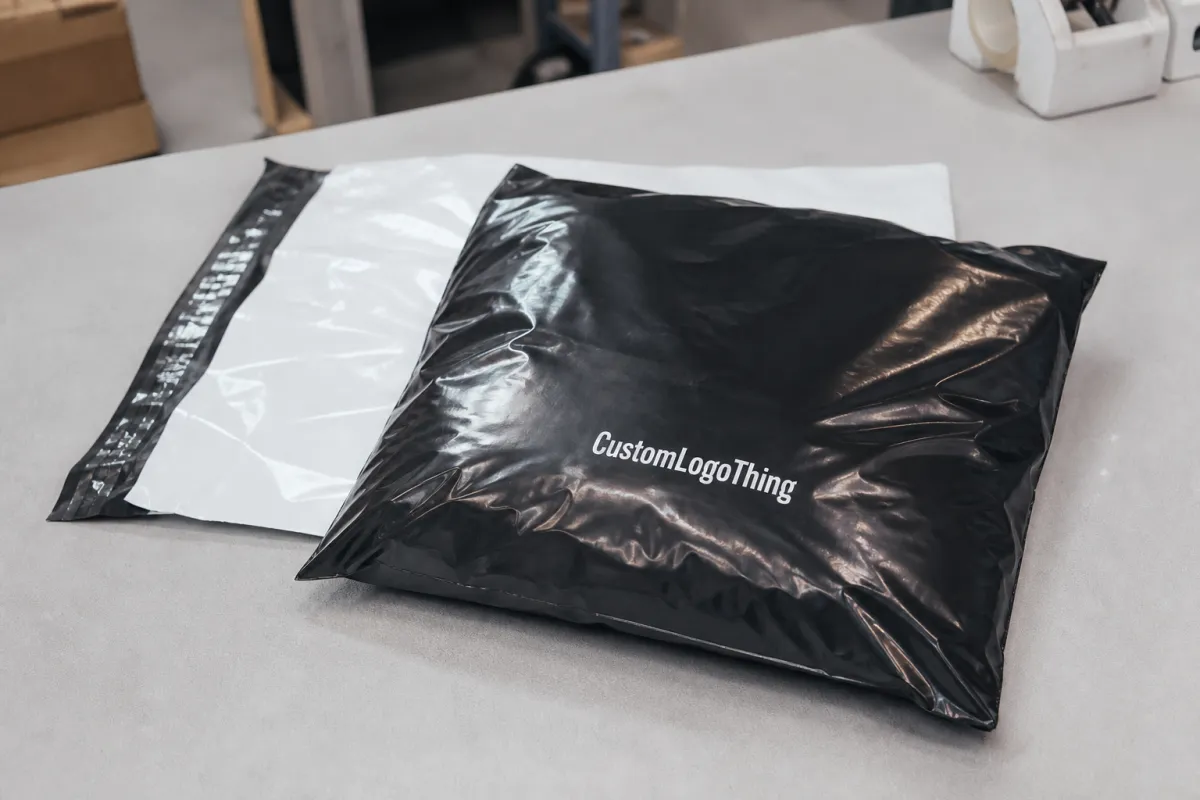
Most wine club poly mailers use co-extruded polyethylene films because they offer a workable balance of cost, flexibility, and moisture resistance. Opaque film is usually the better choice for branded shipments because it hides the contents and gives the pack a cleaner look. Clear or semi-clear film has its place for internal routing or temporary visibility, but it rarely gives the same presentation value on a consumer-facing shipment.
Closure style matters just as much as the film. Peel-and-seal closures are popular because they speed up pack-out, especially in recurring club programs where the same action is repeated all day. Tamper-evident adhesives add a visible layer of protection if the brand wants a clearer indication that the package has been opened. Reinforced seams help when the kit is heavy, dense, or likely to get knocked around before it reaches the customer.
None of those upgrades are free. That sounds obvious, yet it gets ignored all the time in quote comparisons. Buyers sometimes ask for every feature at once, then act surprised when the unit cost climbs. The smarter move is to decide which features actually solve a problem in the real pack. If the shipment is light and uniform, a simpler structure may be the better buy. If the order includes rigid inserts, multi-piece bundles, or thicker printed collateral, the construction needs more tolerance.
Flat mailers are fine for thin, predictable packs. Gusseted mailers give more room when the contents change from season to season or when the bundle includes a rigid insert stack. I usually think in terms of loaded thickness rather than product width. If the finished kit measures 0.75 inches on the bench, the mailer has to accept that thickness plus the fold, the seal area, and enough room for a clean insertion. A spec that looks fine in CAD can still be miserable in production if those realities are left out.
For teams that want a quality benchmark, it helps to ask whether the package design was checked against ISTA transit testing methods. That does not guarantee the shipment will never get damaged, but it does mean somebody evaluated the design against a recognized distribution framework instead of guessing from a flat sketch and a hopeful mood board.
In production terms, the best construction is the one that keeps the pack moving. If the film survives handling, the closure stays consistent, and the mailer does not create extra labor, it is doing its job. No drama required.
Size, Gauge, Print, and Closure Specifications
Size should be based on the finished packed dimensions, not the product width on a drawing. Measure the loaded bundle with inserts, sleeves, wrap, and anything else that changes thickness. Then leave enough room for the seal to close without stretching the seam. A lot of packaging problems start with someone sizing to the bottle shipper alone and calling it close enough. It is not close enough.
Film gauge affects puncture resistance, seam durability, and how the mailer behaves during handling. For recurring wine club shipments, many buyers start around 2.5 to 3 mil for standard packs and step up if the bundle is heavier or the carrier environment is rough. That is a useful starting point, not a rule. A thinner film in the correct size can outperform a thick one that is too tight or too floppy.
Print needs the same discipline. One-color branding can be enough for a clean, controlled look. Multi-color graphics can improve recognition, but they also increase setup complexity and can make reorders less forgiving. If the mailer needs a barcode, mailing instruction, or label-safe zone, those areas should be locked before the artwork is approved. Moving print around after proofing is a good way to burn time and test everyone’s patience.
For a solid spec sheet, I would want these details in writing before a run gets approved:
- Finished dimensions: flat width, length, and gusset depth if applicable
- Film gauge: target thickness and acceptable tolerance
- Closure: peel-and-seal, tamper-evident, or another closure style
- Print layout: colors, placement, bleed, and label-safe zones
- Material notes: opaque film, recycled content option, or moisture resistance
Some buyers also ask for film test methods such as tensile and seal performance checks. That is a fair request. If the mailers are moving through bulk distribution or getting handled by multiple facilities, the testing basis matters. A spec sheet should help compare suppliers without guesswork. Vague language helps nobody.
For teams planning reorder cycles, the print spec matters almost as much as the dimensions. A small shift in logo placement, film opacity, or label space can turn a repeat order into a fresh approval cycle. That is unnecessary friction, and it is easy to avoid if the artwork and build are documented properly the first time.
Wine Club Poly Mailers MOQ, Pricing, and Unit Cost
The MOQ for wine club poly mailers moq depends on whether the order is stock, custom-sized, or printed with branding. A plain stock mailer can often be ordered at a lower minimum than a custom-built program. Once the film size changes, the print count increases, or the closure needs a special feature, the minimum usually moves up with the complexity.
Buyers should separate the quote into actual cost buckets: material, print, setup, tooling, freight, and any warehousing or storage charges. A headline price can look solid until those extra pieces appear. The lowest number on the quote sheet is not always the lowest total cost. Sometimes it is just the least honest one.
Here is a practical range to use as a starting point for comparison:
| Mailer's Build | Typical MOQ | Cost Per Piece | Setup / Tooling | Best Use |
|---|---|---|---|---|
| Stock opaque poly mailer, unprinted | 500 to 1,000 | $0.08 to $0.15 | Minimal or none | Trial runs and short promotional shipments |
| Stock size with one-color print | 2,500 to 5,000 | $0.14 to $0.24 | $75 to $250 setup, plus possible plate fee | Core club shipments with simple branding |
| Custom size with printed branding | 5,000 to 10,000 | $0.18 to $0.32 | Higher tooling fees and art prep | Recurring programs that need an exact fit |
| Heavy-gauge, multi-color, tamper-evident | 10,000+ | $0.24 to $0.40+ | Most setup cost in the group | Large club runs and premium presentation packs |
Those numbers are directional. Film market swings, print coverage, seam requirements, and freight distance all move the final cost. But the pattern is stable: as quantity rises, unit cost usually falls, as long as the spec stays fixed. Change the size, the color count, or the closure style after quoting, and the savings can evaporate fast.
That is why quote comparison should always start from a written spec sheet. If one supplier is pricing a 2.5 mil stock format and another is quoting a custom 3 mil mailer with tamper evidence, those are not competing offers. They are different products wearing the same label.
For teams narrowing down constructions, our Custom Poly Mailers page is a good place to review common build options before requesting a formal quote.
Proofing, Production Steps, and Lead Time
Good production starts with a clean proofing process. After the quote is approved, the supplier should review the artwork, confirm the dimensions, issue a proof, and wait for approval before the job is scheduled. If sampling is needed, that should happen before the full run is locked. Skipping that step is how small mistakes become expensive ones.
The delays are usually predictable: missing artwork files, fuzzy dimensions, late approvals, and scope changes after the order is already in the queue. For a recurring club program, those delays hurt more than they first appear because they affect the next ship cycle, not just the mailer delivery. A one-week packaging delay can knock a full fulfillment plan out of rhythm.
Lead time depends on complexity. Stock mailers move faster. Printed custom runs need more coordination. A straightforward printed order often takes around 12 to 15 business days from proof approval, though multi-color graphics, specialty closures, or custom sizing can extend that. Freight time is separate, and in many cases freight is what actually determines whether the order is usable on time.
During production, the supplier should be checking print registration, seal consistency, and carton counts. When the order arrives, inspect it right away. Confirm the quantity, look for print defects, check the seal performance, and make sure the cartons were not crushed in transit. Damaged outer cartons do not always mean damaged mailers, but they should be documented immediately if a freight claim is likely.
That inspection step is boring. Good. Boring is better than discovering a run issue during pack-out.
If your team is also reviewing sustainability claims around the broader package, the EPA has public guidance on packaging and recycling practices at EPA recycling guidance. That is especially useful if the program includes paper inserts or if the brand needs to make packaging claims that hold up under scrutiny.
Once proofing, production, and freight are mapped out, wine club poly mailers moq stops being a guessing game. The team knows the lead time, the approval path, and the reorder cadence before the first purchase order goes out. That is what makes recurring packaging manageable.
What a Reliable Supplier Should Document Before You Buy
A reliable supplier should be able to document material consistency, print registration, and repeatable production from one run to the next. Broad promises do not help much. A buyer may not need an engineering report, but they do need enough information to confirm that month one and month six will match without a surprise change in film feel or closure behavior.
Before a purchase order goes out, ask for three things: a sample, a formal spec sheet, and a written MOQ. If the sample looks good but the spec sheet is vague, the risk is still there. If the MOQ is only discussed verbally, compare that against the written quote before you move forward. Paperwork is not glamorous. It saves money anyway.
A transparent supplier should also spell out freight assumptions, reorders, and change requests. If a quote does not explain whether setup charges are one-time, recurring, or tied to artwork revisions, the quote is incomplete. The same goes for tooling fees. Those details should be visible before approval, not hidden until the second invoice.
Here are the warning signs I would flag quickly:
- Vague thickness claims with no gauge or tolerance
- Unclear lead times that do not separate proofing from production
- Missing print details on color count, placement, or label zones
- Incomplete freight terms that leave shipping assumptions unclear
- No documented MOQ for the exact spec being quoted
For order terms and common packaging questions, our FAQ is a useful starting point before the next supplier conversation. A decent supplier makes the process feel orderly. A weak one makes everything feel optional. That difference matters a lot more than glossy sales language.
How to Gather Specs and Request a Quote
If you want a quote that reflects the real job, send finished pack dimensions, product weight or thickness, artwork files, quantity breaks, delivery ZIP code, and the target in-hands date. That is the minimum needed to quote responsibly. If the pack includes a bottle sleeve, insert card, tamper seal, or accessory item, mention it up front. Missing one of those details can throw off both the price and the lead time.
Ask for unit cost, MOQ, Lead Time, proofing steps, freight assumptions, and setup charges in the same document. That makes review easier for purchasing, operations, and fulfillment. It also reduces the chance that one team approves a price while another finds a hidden charge after the order starts. Shared visibility beats cleanup every time.
For recurring wine club poly mailers moq planning, include seasonality and reorder expectations. Holiday peaks, special club releases, and member growth all affect run size. Sometimes a slightly larger order lowers the unit cost enough to justify storage. Other times the smarter move is a shorter run that protects cash and keeps inventory from sitting around too long. The right answer depends on the program, not a generic rule.
Before you commit, review one sample, confirm the spec sheet, and decide how often the order will repeat. Once those three points are clear, the rest gets simpler. The best packaging choice is the one that fits the packed product, the production schedule, and the reorder rhythm without forcing constant exceptions. That is the whole point.
For a wine program that ships on schedule, the real win is consistency: the right fit, the right print, the right unit cost, and a supplier who can repeat the same result on the next run without drama. That is how wine club poly mailers moq supports the operation instead of creating another monthly fire drill.
What MOQ should I expect for wine club poly mailers?
MOQ usually depends on whether the mailer is stock, custom-sized, or printed with multiple colors. Custom dimensions and custom print usually raise the minimum compared with plain stock mailers. Ask for MOQ tied to the written spec sheet, not a verbal estimate, so quotes can be compared cleanly.
Can wine club poly mailers be custom printed?
Yes. Most can be printed with a logo, brand colors, reorder information, or shipping instructions. Print area, color count, and film color all affect pricing and lead time. Get artwork requirements early so the proof reflects the final layout instead of a rough placeholder.
What thickness works best for recurring club shipments?
The right gauge depends on pack weight, handling conditions, and whether the mailer is used alone or as an outer layer. Heavier or more frequently handled packs usually need a stronger film and better seam control. Match thickness to the finished packed item, not just the product name.
How do pricing and MOQ change with print colors?
More print colors usually increase setup cost and can raise the minimum run size. Single-color print is often the most efficient choice for a first order or a recurring program. Ask for pricing at multiple quantity breaks so you can see where the unit cost actually starts to improve.
What do you need for an accurate wine club poly mailers quote?
Provide finished dimensions, print details, quantity, delivery location, and your target timeline. Include any special needs such as tamper evidence, opaque film, or barcode placement. The more complete the spec sheet, the fewer surprises in proofing, production, and freight.