Woven Labels Material Guide for Soap Makers
Soap packaging gets handled more than many makers expect. A bar can cure on racks, move into a paper wrap, rub against tissue or kraft sleeves, pick up moisture near a sink, then spend weeks in shipping, storage, and retail display before a customer actually opens it. That is why a Woven Labels Material guide for soap makers has to be practical, not decorative.
Paper stickers can look polished on a mockup. On the bench, they tell a different story. Edges lift, inks scuff, and adhesive weakens when humidity rises or hands are slightly damp. Woven labels behave differently because the design is built into interlaced thread rather than sitting on the surface. The result is a small piece of branding that usually holds up better to friction and handling.
That matters in soap, where packaging often does quiet brand work. A 1.25-inch woven tab on a cotton pouch, a 2-by-1-inch patch on a fabric wrap, or a narrow fold-over label on a sleeve can make the pack feel finished without making it feel overworked. The point is not luxury for its own sake. The point is that the package still looks deliberate after it has been touched a dozen times.
Different soap formats ask for different label behavior. A wrapped bar gives you little visible area. A pouch gives you stitching surface but also a soft, shifting substrate. Boxed sets can accept a cleaner label face, but the label has to sit well with the carton stock, the print finish, and any ingredient or weight panel already on the pack. A label that reads beautifully on screen can fail once it is folded, sewn, or placed against real packaging.
That is the lens for the rest of this guide: choose the label material and construction that still reads clearly after curing, packing, shipping, display, and use. Pretty is not enough. It has to survive contact.
How Woven Labels Fit Into Soap Packaging
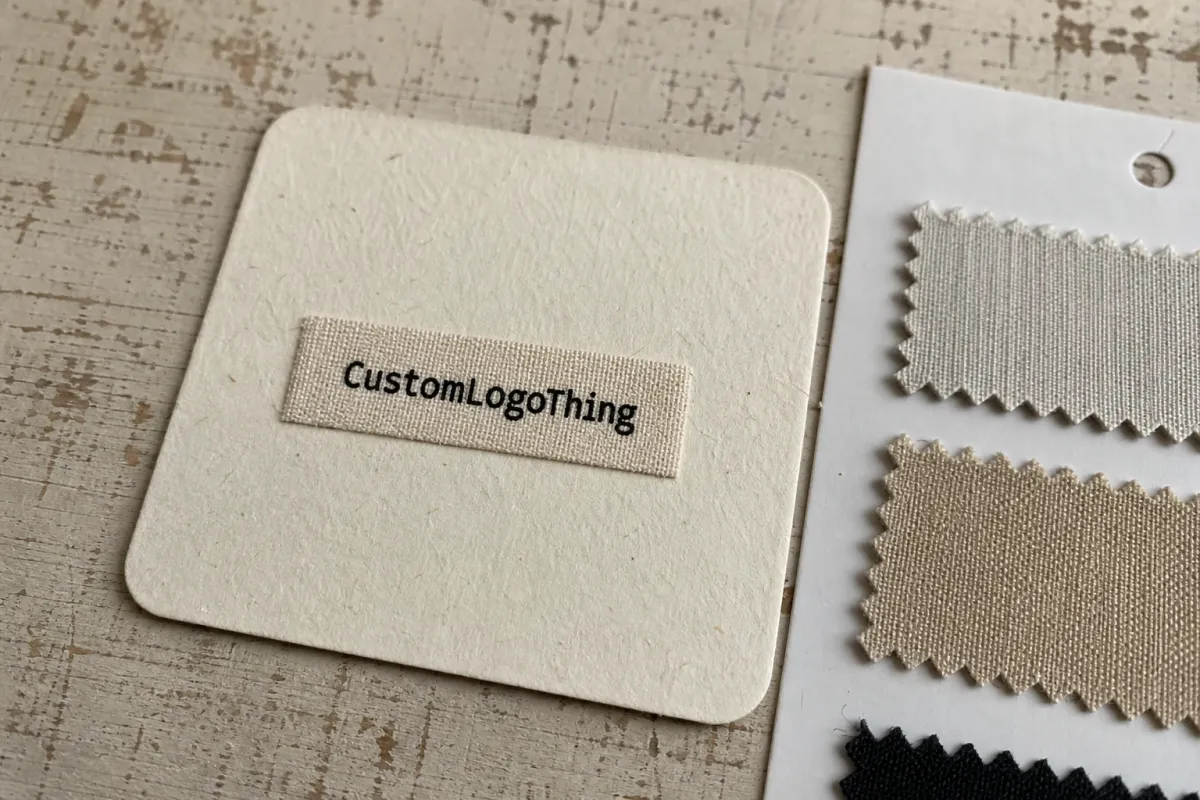
A woven label is made from thread, usually polyester-based yarns, arranged to form the logo, border, text, and background. Instead of printing a mark on top of fabric, the supplier programs the design into the weave. That is why edges stay cleaner after abrasion and why the label keeps detail longer than many surface-printed pieces.
Weave density is one of the first things to check. Higher density supports smaller curves, tighter letters, and cleaner line work, but it can raise cost and make the label feel a bit firmer. Lower density works well for bold marks and simple wordmarks. It starts to struggle when a logo depends on thin scripts, tiny serif type, or ingredient-style text that should probably live on a printed component anyway.
The common constructions are straightforward: straight cut, center fold, end fold, and sew-in patch styles. Straight cut labels suit patches or mountable pieces on boxes and pouches. Center fold labels make tidy tabs for wraps or seams, with the folded edge hidden inside the stitch line. End fold labels give a neat finish when the edges tuck under on flat applications. Patches create a more visible brand moment, though they need enough room to sit without buckling.
Attachment method matters as much as the construction. Soap brands usually sew woven labels into cotton pouches, stitch them into seams, tack them onto fabric wraps, or mount them on a belly band. For carton-based packs, the woven piece may appear on a sleeve or hang tag system rather than on the box itself. Adhesive-backed approaches can work in some cases, but they need testing because oil, texture, dust, and humidity all change how well a bond lasts.
If the pack needs both tactile branding and variable product information, it often helps to split the job. A woven label can carry the core mark while a printed component handles scent, ingredient copy, batch number, and barcode. That division keeps the woven piece stable and leaves the changing details to a format that is easier to update.
Materials That Affect Feel, Color, and Durability
Material choice changes three things immediately: feel, color clarity, and durability. Most custom woven labels use polyester threads because they hold color well, resist moisture, and stay stable through cutting, folding, and sewing. For soap, that stability is useful. Fragrance oils, handling, and variable humidity expose weak materials faster than a dry shelf product would.
Within that polyester category, finish still matters. A matte woven label feels quieter and often suits handmade, apothecary, or botanical lines. A satin-like surface reflects more light and can make a gift set or premium bar look more refined. I usually find matte easier to pair with kraft paper, recycled wraps, and natural fibers because it does not fight the rest of the pack for attention.
Color contrast is not a cosmetic detail. It is a readability issue. Cream on kraft may look warm in a mockup and nearly disappear under retail lighting. Pale green on ivory has the same problem. Small woven labels need a clear light-dark relationship: charcoal on natural cotton, deep green on white, navy on cream, black on warm kraft. If the packaging itself is dark, reverse the logic and use a lighter thread on a darker ground.
The practical test is simple: if the shopper has to tilt the package or squint at arm’s length, the contrast is too weak. Soap labels do not live in perfect studio light. They sit near bathroom steam, on market tables, in drawers, and under fluorescent store fixtures. The chosen thread should still read in those places.
Durability issues show up in ordinary use. Bars can rest near sinks where moisture lingers. Pouches rub against corrugated cartons during shipping. Fragrance oils can transfer from hands or wraps. Bright window displays can fade weak color over time. Transit testing standards from organizations such as the International Safe Transit Association are useful even for smaller brands because they frame the real stresses: vibration, compression, and repeated handling.
| Label Material or Finish | Best Fit | Practical Watch-Out | Typical Use Case |
|---|---|---|---|
| Matte polyester woven | Rustic, handmade, apothecary looks | Needs strong contrast for small type | Fabric wraps, cotton pouches, sleeve tabs |
| Satin-look woven | Gift sets and premium collections | Reflective surface can reduce legibility under glare | Boxed sets, holiday bundles, luxury bars |
| High-density woven | Small logos and finer artwork | Usually costs more and may feel slightly firmer | Brand patches, detailed icons, narrow labels |
| Lower-detail woven | Bold marks and simple wordmarks | Not suited for tiny taglines or fine scripts | Core line labels, simple tabs, pouch branding |
Brand position should guide the finish as much as packaging mechanics do. A natural line with raw paper, cotton, and low-gloss print can feel right with a matte woven tab. A rigid carton with crisp typography and a tighter color palette may call for a smoother woven face. Neither is inherently better. The better choice is the one that matches the price point and the customer’s expectation before they even open the box.
Cost, Pricing, and MOQ Basics
Pricing for woven labels is shaped by size, weave complexity, number of thread colors, fold style, edge finishing, and quantity. A simple 1-by-1.5-inch center fold label with two thread colors will not price like a 2.5-inch patch with a detailed border and four colors. More thread changes, more loom time, and more finishing steps all add cost somewhere along the line.
For planning, small custom woven label runs often start in the low hundreds of pieces, while stronger unit pricing tends to appear at 1,000, 2,500, or 5,000 pieces. Exact pricing varies by supplier and construction, but many soap makers should expect woven labels to cost more than a basic printed sticker. A rough budgeting range of $0.10 to $0.35 per piece is a reasonable starting point at moderate quantities, with smaller orders and complex builds landing higher once setup and freight are included.
MOQ can be awkward for soap brands because scent lines move fast. Lavender, charcoal, citrus, and seasonal runs may each need different packaging cues, but separate woven labels for every scent can create inventory you do not want sitting in a drawer. A cleaner approach is to keep the woven label brand-focused and let a printed label or tag carry scent name, weight, ingredients, batch code, and compliance text. That keeps the woven piece constant while the variable information stays flexible.
Woven labels make the most sense when the pack is expected to feel reusable, giftable, or permanent in the customer’s mind. Sewn wraps, pouches, subscription packs, and premium retail bars benefit from that kind of detail. Very small test batches or rapidly changing scent trials may be better served by printed labels until the format stabilizes. There is nothing weak about choosing the cheaper path for a product that is still being validated.
Always ask for landed cost, not just headline price. Setup fee, sample charge, proof charge if any, shipping, duties where relevant, and reorder pricing all matter. The quote that looks lowest at first can stop being the lowest once freight and revision rounds are added. A good Woven Labels Material guide for soap makers should keep the math honest.
Production Steps and Lead Time
A normal woven label order starts with a brief. That brief should include finished size, fold type, artwork file, color direction, quantity, packaging format, and target delivery date. Vector artwork is the cleanest starting point because it gives the production team a better file for translating the design into a weave map.
After the brief, the supplier prepares a proof. The artwork is then converted into a woven production file that maps thread colors, density, borders, and fold or cut marks. A physical sample may follow, or a photographed proof if the supplier works that way. Once approved, the order moves into weaving, cutting, folding, inspection, bundling, and packing.
Lead time usually stretches in familiar places. Tiny text gets revised. A script logo needs simplification. A cream thread does not contrast enough against a natural ground. Special folds add another finishing pass. Rush jobs can happen, but they are rarely free, and last-minute quantity changes may force the supplier to reorder materials or reset the loom.
For ordinary custom woven label orders, many buyers should plan around 12 to 20 business days after final proof approval. Add more time for sampling, dense artwork, unusual fold structures, or freight uncertainty. Soap launches need even more breathing room because the label is only one piece of the pack. Boxes, tissue, shippers, and any printed compliance elements often have their own schedules.
Seasonal drops deserve the same caution. If a holiday bundle needs to ship in early November, approving woven labels in late October is a bad bet. Build the calendar backward from the retail date, then add one extra week for proofing and one for assembly. Reorders are usually quicker once size, density, fold, and thread colors are fixed, so the first run is the one that deserves the most attention.
Packaging floor rule: approve the label against the actual wrap, pouch, or carton, not against a clean screen. Thread color, fold depth, and logo scale change once the label sits on real material.
Step-by-Step Label Selection for a Soap Line
Start with the packaging format. A naked bar with a belly band needs a different label plan than a wrapped bar, a drawstring pouch, or a boxed three-bar set. The visible area tells you what the woven piece can honestly do. If the label is meant to act as the main brand marker, it needs enough space to read at a glance. If it is only a small tab, it should stay simple and restrained.
- Measure the visible area. Leave room for required product information, scent name, net weight, and any barcode or retail label.
- Choose the viewing distance. A shelf label needs clear brand recognition from 2 to 3 feet away, while a pouch tab can be read closer in hand.
- Simplify the artwork. Remove hairline strokes, tiny taglines, and low-contrast details before proofing.
- Pick the fold style. Use center fold for tabs, end fold for neat flat sewing, and straight cut for patches or mountable pieces.
- Test with real packaging. Place the sample on the actual wrap, pouch, or carton under normal lighting.
The viewing-distance question is often the one that saves the most trouble. Many makers try to put the full brand story into a label that is only an inch wide. Thread has limits. Let the woven label carry the logo and brand name, then use a printed wrap, hang tag, or custom label and tag program for ingredients, scent notes, curing date, and batch code.
Match the attachment method to the packing workflow. A hand-assembled line can tolerate a few extra stitches per unit. A fulfillment team packing hundreds of pouches a day will care about repeatability, placement marks, and whether the label arrives pre-folded. Details as small as a 1/4-inch seam allowance can decide whether the work feels smooth or awkward on the bench.
Always request a sample or mockup before full production. A digital proof shows the idea. A physical sample shows how it behaves. Check whether the label curls, whether the border sits straight, whether the color competes with the scent artwork, and whether the brand name is readable without effort.
Common Mistakes Soap Brands Make
The biggest mistake is asking thread to act like ink. Thin scripts, tiny icons, fine botanical line work, and stacked taglines can lose clarity once they are translated into weave. If a logo depends on delicate detail, simplify the mark, increase density, or move some of the information onto a printed component.
Color creates the second set of problems. Natural soap brands often love ivory, beige, pale sage, dusty rose, and kraft paper. Those combinations can be beautiful together and still fail in a small woven label. A label that works on a white lavender wrap may disappear on a charcoal bar or a clay-toned sleeve. Test the full line, not just the prettiest scent.
Fold and edge placement deserve real attention. Check seam allowance, fold direction, orientation, and how much artwork stays visible after sewing. For center folds, confirm whether both sides carry the same art or whether one side is blank. For end folds, confirm how much material tucks under. A 2-inch proof can shrink to a much smaller visible area once folded and stitched.
Under-ordering is another quiet problem. If a soap line sells better than expected, a maker may reorder in a hurry and accept a slightly different thread color or finish. That is how shelves start to look uneven. If the first production run is strong, it is often better to order a stable core quantity and use printed scent labels for variation.
Environmental claims need care too. FSC certified board, recycled content, post-consumer waste, and recyclable packaging are only meaningful when the supplier can document them and the claim fits the actual component. The EPA recycling resources are a useful reference, but local recycling rules still vary. A polyester woven label on a paper wrap can affect how the whole package should be described, so keep claims specific.
Expert Tips and Next Steps for Ordering
Keep one core woven label spec for the main line. That might be a 1.25-inch center fold tab, two thread colors, matte finish, and the same brand mark across every scent. Then create a simpler variation for seasonal runs if needed. This keeps the brand recognizable and avoids turning every launch into a fresh production puzzle.
Before requesting quotes, build a short approval checklist. Include finished size, visible logo area, fold type, thread colors, quantity, pack format, delivery date, and whether the label will be sewn, tacked, tied, or mounted. Add artwork format too. Vector files such as AI, EPS, or a clean PDF usually make quoting and proofing less messy.
- For wrapped bars: confirm label width against the band and leave room for scent and compliance copy.
- For pouches: test stitch placement so the label does not distort when the pouch is filled.
- For boxed sets: compare matte and satin finishes under retail lighting before approving the final look.
- For subscription packs: order enough core labels to cover several cycles, then vary the printed scent insert.
Check a proof against real soap, real wrap stock, and real packing motions. Rub it lightly against the carton, handle it with slightly damp hands, and look at it from the distance a shopper would. That small test catches contrast problems, awkward folds, and size issues before the full run is woven.
For teams that need both woven brand pieces and printed information labels, the same supplier category often handles both sides of the job through a product tag and label program such as Custom Labels & Tags. Use the woven label for the stable brand mark and let the printed component do the changing work. That split is usually cleaner, cheaper, and easier to reorder.
FAQ
What is the best woven label material for soap makers?
The safest choice for most soap brands is a durable polyester-based woven label with enough weave density to keep the logo readable and enough contrast to stand out from the wrap or pouch. For small type, detailed artwork, or darker packaging, ask for a proof that shows the actual thread colors and finished size.
Are woven labels better than printed labels for handmade soap packaging?
Woven labels usually look more premium and stay crisp longer because the design is built into the label structure rather than printed on the surface. Printed labels can still be the better choice for very small runs, scent-specific details, ingredients, batch codes, or any information that changes often.
How much do woven labels for soap makers usually cost?
Cost depends on size, quantity, thread color count, fold style, finishing method, and setup charges. As a planning range, moderate custom runs may land around $0.10 to $0.35 per piece, while smaller or more complex orders can cost more once samples, setup, and shipping are included.
How long does a custom woven label order take?
Most orders move through artwork proofing, weave file setup, sample approval, production, finishing, and packing. A practical planning range is often 12 to 20 business days after proof approval, with extra time for complex artwork, special folds, freight delays, or revision cycles.
Can woven labels work on wrapped bars, pouches, and boxed soap sets?
Yes. Woven labels can be sewn into fabric wraps, attached to cotton pouches, used as branded tabs on sleeve bands, or mounted as a premium detail on boxed soap sets. The right fold, size, and attachment method depends on how the soap is packed and how much visible space the packaging allows.