If you are searching for a Woven Neck Labels Supplier wholesale, you already understand the small piece of fabric at the back of a shirt can do outsized work. It gets rubbed, washed, stretched, and read more often than most garment details. When it feels cheap or looks off, customers notice quickly, even if they never mention it directly.
Custom Logo Things works with brands that care about that level of detail. Woven neck labels are not complicated once the construction, artwork limits, and price drivers are clear. The trouble starts when buyers approve a proof without checking weave density, fold type, or actual sewing location. Then the label arrives looking different from what was imagined, and the correction costs time rather than cents.
Why woven neck labels still outperform printed tags
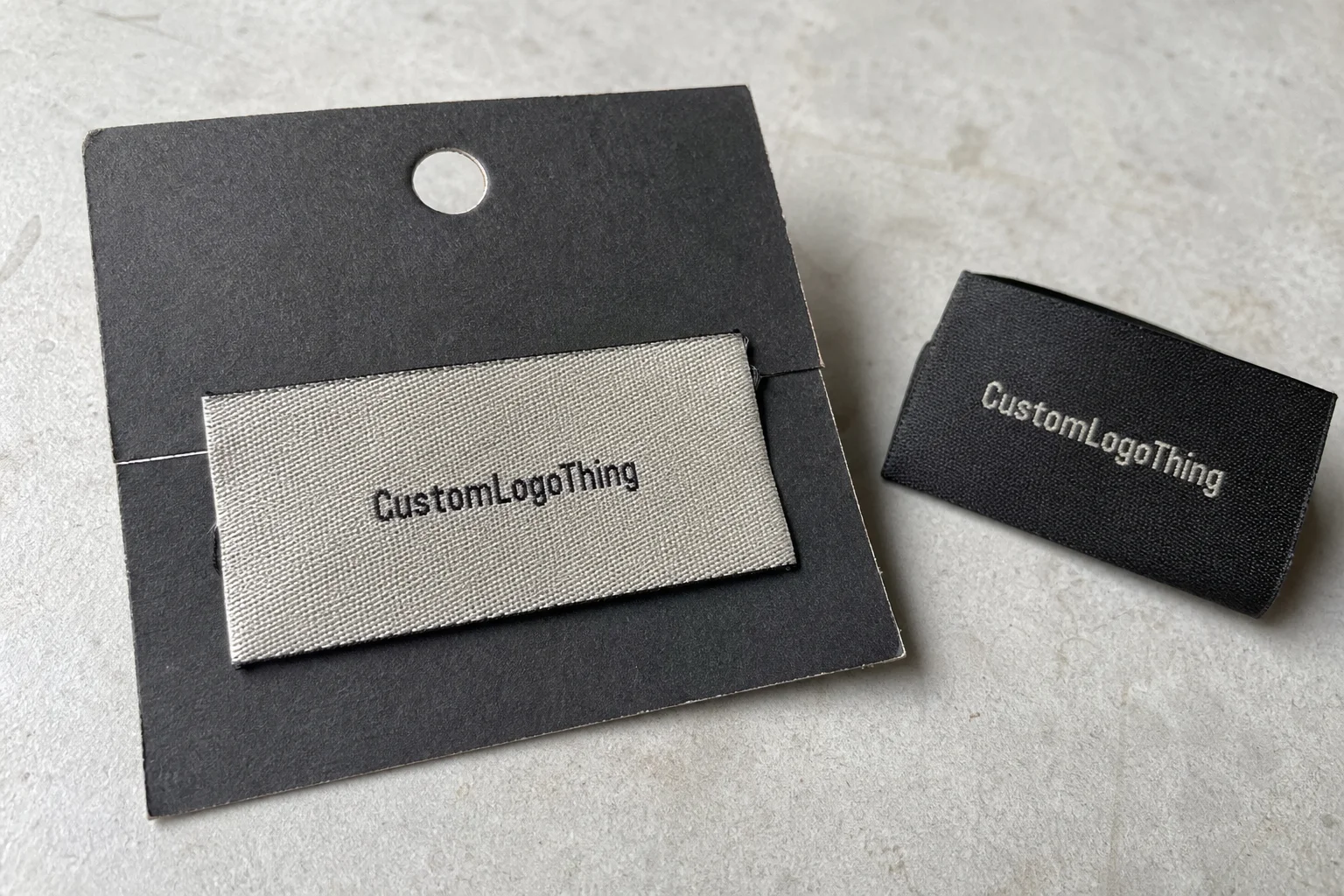
Neck labels are one of the few branding elements that customers physically touch every time they put on the garment. That makes the material choice more important than it sounds. Printed tags can work for basic or disposable products, but woven labels usually create a more finished impression and tend to hold up better through repeated laundering.
From a buyer’s perspective, that durability matters because labels are not judged in a showroom. They are judged after wear, after wash cycles, and after the garment has been folded, packed, and shipped. A woven label does not peel, crack, or fade in the same way some printed options do. If a brand is selling basics, private label tees, hoodies, knitwear, or uniforms, the difference shows up in customer perception very fast.
“The neck label is small, but it carries a lot of the product’s first impression. If it feels scratchy or looks rushed, the garment starts on the back foot.”
There is a cost tradeoff, of course. Woven labels usually cost more than simple printed tags, especially at low quantities, and the setup process is more involved. That is not a flaw in the product. It is the price of getting a cleaner hand feel, better wash resistance, and a more consistent brand presentation across reorders.
Woven labels are especially practical for:
- Tees and long-sleeve basics
- Hoodies and fleece
- Babywear and children’s apparel
- Uniforms and workwear
- Knitwear and premium casualwear
- Private label launch collections
They also help when the label spec needs to stay the same for months or seasons. Once the size, fold, weave, and color count are fixed, a reorder becomes a production repeat instead of a fresh design decision. That saves more friction than most brands expect.
Woven label styles, folds, and finish options
Most wholesale woven labels fall into a handful of standard constructions. The right format depends on where the label will be sewn, how much it needs to show, and whether comfort is a priority. The most common styles are straight cut, end fold, center fold, and loop fold.
Straight cut labels are flat rectangles that are usually sewn on both sides. They are useful when the label sits inside a seam or when the brand wants a simple, clean panel. End fold labels have folded ends that hide the raw edges and make sewing easier on side seams or neck seams. Center fold labels are folded in the middle and are common for neck branding because they hang cleanly from the seam. Loop fold labels behave more like a looped tab and can be useful when the sewing method needs flexibility.
Material choice changes both look and feel. The usual options are damask, satin, and taggera or taffeta, depending on how a supplier names the weave. Damask is the most common premium option because it handles fine details better and usually feels softer against the skin. Satin has a smoother surface and more sheen, which can work well for fashion brands, but it is not always the best choice for small text. Taffeta is more economical and suitable for simpler logos, though it is firmer and offers less detail resolution.
For designs with thin lines, small letters, or a logo that relies on exact edges, damask usually earns its higher price. For a simple mark and size callout, taffeta can keep the order within budget. Satin sits between the two in appearance, but sheen does not solve poor artwork or overly dense copy.
Size and placement matter just as much as material. A common neck label might be 1 to 2 inches wide and 0.5 to 1.5 inches tall, though that changes if the design includes logo, size, and origin details in one line. Many brands place the logo on the front and use the back of the fold for size or regulatory details. Common additions include care symbols, sizing, and country-of-origin text.
Sewing location affects the construction choice. A center-fold label sewn into the neck seam works well for tees and hoodies because it stays aligned and looks familiar to shoppers. Side seam branding is sometimes better for fashion cuts or women’s apparel, where the main label is meant to stay quieter. Babywear needs softer edges and less bulk because comfort matters more than a visible brand statement.
The finish details are where many orders go wrong. A label can be technically correct and still feel wrong if the edge is stiff, the fold is too thick, or the weave is dense enough to irritate the skin. For garments worn next to the body, ask about soft-edge finishing and request a sample before locking in production quantity. A label that looks good on screen can feel entirely different once it is sewn into the garment.
Woven label specifications that matter before you approve artwork
This is the section buyers often skip, then regret later. Before approving artwork, confirm the actual production specification, not just the logo itself. That means width, height, fold type, weave density, backing, and color count. Those details determine whether the label comes out crisp or softened, and whether the factory can quote accurately without adding revision charges after the fact.
Detail level and weave density are closely linked. Tighter weaving allows cleaner edges and better reproduction of small text, but it can raise the price and sometimes the minimum order quantity. If the logo contains hairline strokes, thin serif type, or tiny symbols, do not assume every woven construction will reproduce it well. Some will. Others will make the design look condensed and muddy.
It also helps to separate woven information from information that belongs elsewhere. A brand logo and size can often sit comfortably on the woven neck label, while care instructions, barcodes, or long legal copy may fit better on a printed care label or heat-transfer label. Trying to cram everything into one tag usually produces poor legibility and a design that feels overcrowded.
Softness deserves attention, especially for products that sit directly against skin. Babywear, loungewear, and athletic apparel are the usual trouble spots. Ask the supplier what backing is used, how the edges are finished, and whether the label can be made with a softer hand feel. If the answer is vague, request a sample or pre-production proof rather than trusting a screen rendering.
Artwork quality makes a measurable difference. Vector files in AI, EPS, or editable PDF format are usually the safest route because the supplier can define line weight, spacing, and color boundaries more accurately. Low-resolution JPGs and screenshots often create avoidable corrections. Every correction slows proofing, and proofing delays tend to spread into production dates.
Regulatory details should be checked before release, especially if the label includes origin information or fiber content. Requirements can vary by market and product category, so the label should be reviewed alongside the garment’s broader compliance plan. For broader handling and packaging expectations, references such as ISTA can help frame durability testing, even though label construction itself is a separate issue.
Woven neck labels supplier wholesale: cost, MOQ, and unit price
If you are comparing a woven neck labels supplier wholesale, asking only “What is the price per piece?” is too narrow. Unit cost depends on material, weave density, fold style, color count, finishing method, and order volume. A simple one-color damask label at 5,000 pieces will not price the same as a four-color label with a custom fold and soft finish at 500 pieces. The difference is not cosmetic; it reflects setup time and production complexity.
For practical buying, the following wholesale ranges are common:
| Order Type | Typical MOQ | Approx. Unit Price | Notes |
|---|---|---|---|
| Simple woven label, standard fold | 300-1,000 pcs | $0.06-$0.16 | Best for basic logos and repeat SKUs |
| Damask label, higher detail | 500-2,000 pcs | $0.10-$0.24 | Better detail, softer hand feel |
| Satin or specialty finish | 500-3,000 pcs | $0.12-$0.28 | Pricing rises with sheen and finish complexity |
| Low-volume sample or pilot run | 50-200 pcs | $0.25-$0.80 | Useful for launch testing, not ideal for margin |
Those ranges shift with artwork complexity and supplier capacity. A larger number of colors, tighter weave, special backing, or unusual fold pushes the price higher. Small orders cost more per piece because setup, loom programming, and finishing labor do not shrink in proportion to the quantity. That is why very low quantities often look expensive in the first quote.
Sample pricing is separate from production pricing. A pre-production sample may cost $20 to $60 depending on the supplier, construction, and whether new tooling is needed. That is normal and should not be treated as the wholesale unit benchmark. The useful comparison is the production price at the quantity you plan to reorder.
Bundling helps some brands. If you need woven neck labels, care labels, and size tabs at the same time, a supplier may be able to keep the specification consistent across the whole label system and reduce some administrative cost. It does not always produce a dramatic price cut, but it usually makes the reorder process cleaner.
For brands that prefer to keep garment labeling and hangtag planning in one place, it can help to review Custom Labels & Tags or check a supplier’s Wholesale Programs page for quantity breaks across multiple SKUs.
Production process and turnaround from proof to delivery
A reliable supplier should be able to explain the production flow without jargon. The usual sequence is inquiry and spec confirmation, artwork proofing, sample or proof approval, production, finishing, inspection, and shipping. If that sequence is unclear, the order process will probably be unclear too.
Proofing is often the quickest stage, usually 1 to 3 business days if the artwork is clean and the label details are complete. Delays tend to come from low-resolution files, missing fold instructions, vague color references, or repeated changes to size and layout after the proof is already in motion. Those changes are not rare. They are just expensive in time.
Production after proof approval commonly takes about 7 to 15 business days for standard woven label orders, depending on quantity, weave complexity, and factory workload. Larger orders or tighter weaves can take longer. Shipping sits outside that timeline, and transit time depends on whether the order moves by air or sea. Air freight is faster and more expensive; sea freight is more economical for bulk replenishment but less useful when the launch date is close.
Rush service exists at some suppliers, but it should be treated as a contingency, not a plan. A rush fee can make sense when the launch date is real and the margins allow it. If the order is late because the design changed repeatedly, the issue is planning rather than manufacturing. A supplier can only compress so much.
Quality checkpoints matter before shipment. The basics include color match, weave accuracy, fold consistency, cut quality, and stitch-ready finishing. For brands with retailer requirements or strict fulfillment rules, ask how the supplier inspects against spec and whether they can provide photos or approval samples from the batch. A label can look fine in isolation and still be wrong in a pack-out context.
“A label order is not finished when the proof looks good. It is finished when the labels arrive, sew cleanly, and match the same spec on the next reorder.”
It also helps to think about the broader handling chain. Labels pass through cutting, bundling, packing, transit, warehouse sorting, and sewing, so small defects can multiply. If the edge is weak or the fold is inconsistent, the problem shows up later as sewing waste rather than as a neat complaint at the proof stage.
What to compare before choosing a label manufacturer
Not every supplier who says they are a woven neck labels supplier wholesale can support repeat production reliably. Some can make one attractive sample and then become vague once you ask for batch consistency or reorder continuity. Price matters, but it should not be the only filter.
Start with consistency. A first sample can look strong while later runs drift in color, texture, or edge finish. That is usually a process control issue, not a design issue. Ask whether the supplier retains repeat specs, keeps color references on file, and can match a prior run without rebuilding everything from scratch.
Then review the full label system, not only the neck label itself. If you need woven care labels, size tabs, or matching packaging inserts, the supplier should be able to keep the visual language aligned across items. A fragmented label system makes a brand look less organized than it may actually be.
Communication quality is a practical test. A serious supplier gives a written spec sheet, explains revision limits, and can show production examples that match the category you are buying for. Vague promises are common. Clear answers are less common and more useful.
- Material consistency: Ask for repeat-run examples or color-matched samples.
- Spec sheet clarity: Confirm size, fold, weave, and backing in writing.
- Revision policy: Know whether proof changes are included or billed separately.
- Production support: Check whether reorders can follow the original spec without rebuilding artwork.
- Category fit: Make sure the supplier understands tees, babywear, uniforms, and knitwear.
Brands that care about packaging and presentation usually need a supplier that can stay boring in the best sense: predictable timing, repeatable quality, and a stable spec file. That is what protects margin over a season. A flashy sample photo does not.
Next steps to place a wholesale woven neck label order
Before requesting a quote, organize the inputs that most directly affect price and timing. Have the logo file, intended label size, fold style, color count, target quantity, and sewing method ready. If you already know where the label will sit on the garment, include that as well. Neck seam, side seam, and external placement can call for different constructions.
It helps to request two quote versions: one economical and one upgraded. The lower-cost option might use a simpler weave or fewer colors, while the premium version may offer a softer finish or finer detail. That comparison makes the tradeoff visible in cents, not in vague opinions. Sometimes the difference is small enough to justify the better spec. Sometimes it is not.
For premium garments, ask for a sample or pre-production proof before mass production. That matters most for babywear, athletic apparel, and fashion basics where the hand feel is as important as the visual result. A small test batch is far cheaper than reworking a full run of labels that do not sit correctly in the garment.
- Finalize the artwork.
- Confirm size, fold, and material.
- Approve the proof or sample.
- Lock production and shipping terms.
- Save the spec sheet for reorders.
Ask about reorder lead times before committing to the launch calendar. If the next season depends on steady label supply, that answer matters early. The goal is not just to place one order; it is to make the next reorder routine enough that it does not become a production emergency.
If you need a dependable woven neck labels supplier wholesale, the real filters are straightforward: clear specs, repeatable quality, and pricing that matches your actual quantity. The label itself is small, but its effect on the garment is not. Customers notice the difference, even if they never name it.
FAQ
What should I ask a woven neck labels supplier wholesale before ordering?
Ask about material, fold type, color limits, MOQ, sample cost, turnaround, and whether revision rounds are included. Request a written spec sheet and examples from a production run before approving the first batch. If the supplier cannot answer those questions clearly, that tells you something useful about the working relationship.
How much do wholesale woven neck labels usually cost per piece?
Unit price depends on size, weave density, color count, finish, and quantity. Smaller runs usually cost more per label because setup costs are spread over fewer pieces. Ask for pricing at multiple quantities so you can see where the real break points are.
What is a normal MOQ for woven neck labels wholesale?
MOQ varies by factory and design complexity, but many Custom Woven Labels start at a few hundred pieces. More detailed weaves, specialty folds, or complex color work may require higher minimums or setup fees. Confirm MOQ before you finalize artwork, not after.
How long does production usually take for woven neck labels?
After proof approval, production commonly takes about 1 to 3 weeks depending on quantity and finish details. Shipping time is separate, so confirm both production and transit before you commit to launch dates. If a supplier promises a faster turnaround, ask what conditions make that possible.
Can I use woven neck labels for babywear or sensitive skin products?
Yes, but the label should use a softer weave, smoother edges, and a fold that reduces irritation. Request a sample first so you can check hand feel before placing the full order. Babywear is not the place to gamble on scratchiness.


