Woven Neck Labels Supplier low moq searches usually come from a buyer with a practical problem, not a branding theory problem. The order is small, the launch is uncertain, and the last thing anyone wants is a box of obsolete labels sitting in storage after a fit change or artwork update. That is the real appeal of low minimums: they keep the trim order close to the actual product risk.
The label is tiny, but the consequences of getting it wrong are not. It touches the skin every time the garment is worn, it carries the brand mark at close range, and it can make a shirt feel premium or cheap before the customer has formed any other opinion. If the label is off, the fix is rarely elegant. You either relabel finished goods, absorb scrap, or live with a defect that shows up in customer photos.
Buyers often focus on the unit price and stop there. That is a narrow way to read the quote. Setup, sampling, freight, rework, and dead stock usually matter more than the raw per-piece number, especially on a short run. A lower headline price can become the more expensive option if the MOQ is too high or the proofing process is sloppy.
The cheapest label quote is not cheap if it forces you to buy inventory you cannot use. On small apparel runs, risk management is part of pricing.
Woven neck labels supplier low MOQ: what buyers actually save
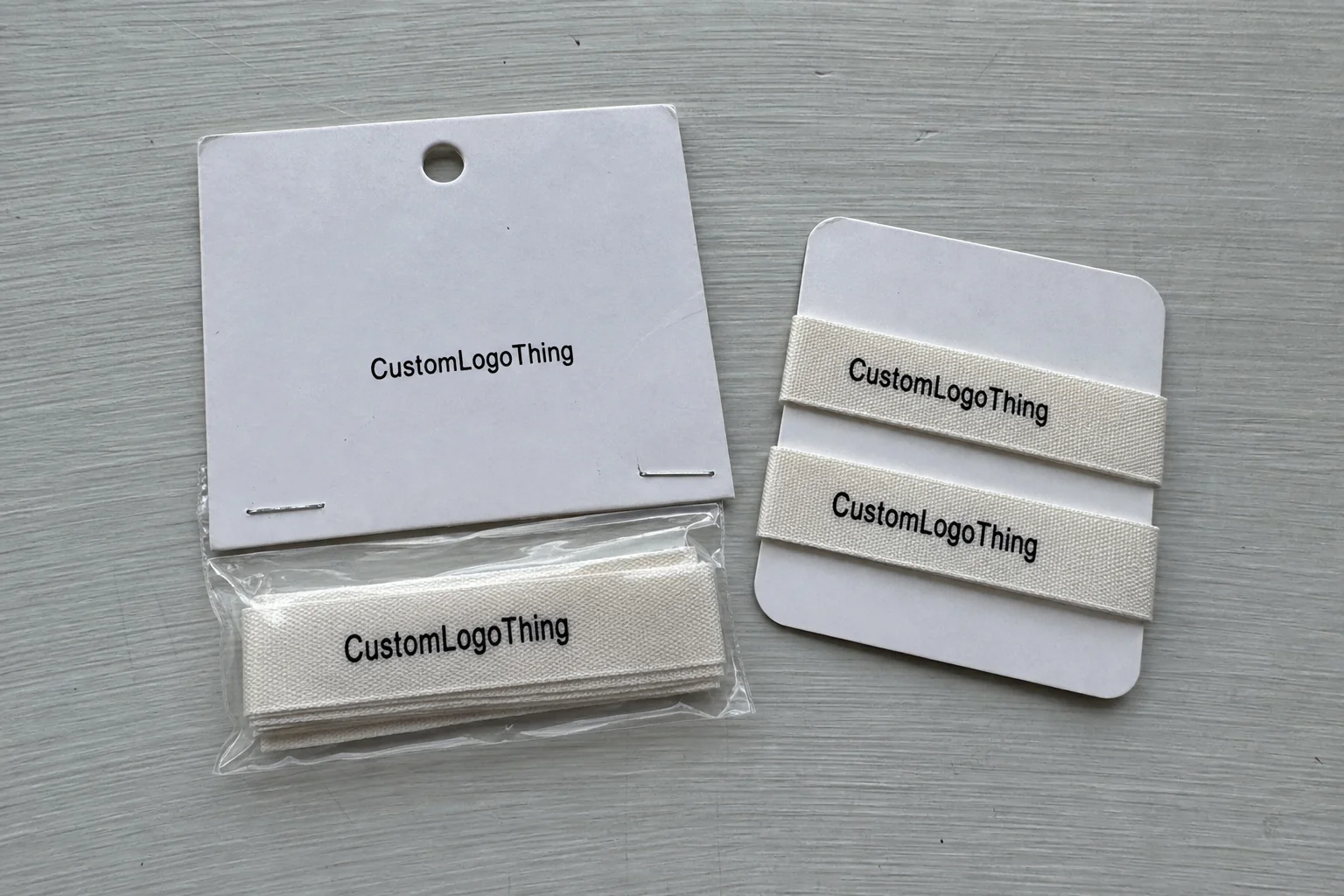
A woven neck labels Supplier Low MOQ program saves more than cash. It preserves flexibility. Apparel teams use low minimums when the product is still moving: a new silhouette is being tested, a colorway is unproven, or retail feedback may trigger a brand refresh before replenishment. In that situation, a large trim commitment is a liability disguised as a discount.
There is a simple comparison worth making. A 300-piece pilot and a 10,000-piece replenishment do not carry the same label risk. The pilot should be able to absorb change. The larger order can justify better economies of scale, but only after the design has survived a real market test. If the first run exposes a spacing issue, a fold problem, or a logo that reads too tightly in the weave, you want to find that out before mass production.
Low MOQ also matters because labels sit close to the brand promise. The consumer may never inspect the stitch density, but they will feel the edge and see whether the mark looks crisp or muddy. The trim needs to hold up under repeated washing and repeated handling, which is why buyers should care about weave quality, fold stability, and edge finish even when the order is small.
On paper, a quote with a slightly higher unit cost can still be the better purchase if it includes clearer proofing, fewer revision cycles, and less excess inventory. That is common in apparel sourcing. The invoice is only one part of the cost. Storage, replacement, and the cost of carrying a bad spec into the next season matter just as much.
For small launches, the best use of low MOQ sourcing is simple: buy only what you can actually place, validate the design in production, then reorder from real data instead of assumptions. That approach keeps cash in the line, not in a box of unused labels.
Label constructions, folds, and finish options that change the result
Woven labels are not interchangeable. The construction changes the look, the hand feel, and the amount of detail the weave can hold. Two labels can share the same logo and still perform differently because one uses a tighter damask weave, another uses a softer satin finish, and a third uses a fold that changes how much of the mark remains visible after sewing.
Damask is usually the first place buyers land when they need detail. It handles small type and thin lines better than a looser weave, which makes it a sensible choice for logos that must stay legible at narrow widths. Satin woven labels feel smoother and can be more comfortable against the skin, although the softer surface does not always reproduce fine detail as cleanly. That trade-off matters most on neck labels, where comfort and clarity compete for the same small space.
Fold style changes the final appearance just as much as weave choice. A center fold is practical when the label sits in a seam and needs to show on both sides. An end fold is useful when the label is sewn at one edge or mounted visibly. A Manhattan fold gives the neck area a cleaner finish because the folded end tucks into the seam. A loop fold is less common, but it can make sense in specialty presentation work.
Then there is the question most first-time buyers underestimate: how the label reads under real garment conditions. A heavy fleece can tolerate a slightly more substantial label. A lightweight tee cannot. A kidswear neckline usually needs softer edges and clearer size marking. A workwear program may prioritize durability over softness. The label has to fit the garment category, not just the logo.
Material behavior also has limits. Thicker yarns can improve softness or visual contrast, but they can reduce the clarity of small text. Very fine threads sharpen detail, yet they require tighter control in proofing and weaving. A responsible supplier will say where the line is instead of promising that every design can be compressed to every width. That is one of the useful signals when choosing a Woven Neck Labels Supplier Low MOQ: whether the supplier tells you what will not work.
For teams comparing trim styles across a broader line, a consistent label family matters more than one perfect sample. The label should feel like part of the same system as the garment, hangtag, and care label. If the line includes multiple product categories, keep the visual language aligned through the broader Custom Labels & Tags range.
Spec sheet essentials: size, density, and attachment method
Most quote delays start with incomplete specs. A supplier cannot price a woven neck label accurately if the buyer only sends a logo and a quantity. The finished size, fold type, attachment method, and artwork layout all affect the production route. The more precise the brief, the fewer rounds of clarification later.
- Finished size: the visible dimensions after folding.
- Fold type: center fold, end fold, Manhattan fold, or another construction.
- Artwork format: vector file preferred, with text outlined when possible.
- Color count: number of yarn colors, not just screen colors.
- Attachment method: seam insert, topstitch, or another garment-specific placement.
- Care or size line: whether the reverse side needs additional information.
Weave density is the hidden variable that affects how much detail survives. Buyers sometimes call this thread count, though suppliers may describe it as density or resolution. Whatever the term, the meaning is the same: tighter weaving supports finer text and more precise logo edges, while a looser weave is easier to produce but less forgiving on detail. If the artwork includes a tagline, a small icon, and a size line, the label may need to be wider than the buyer expected.
That is where design discipline matters. A crowded mark can look fine on screen and fail in production because the label is too narrow to hold it cleanly. The fix is usually not complicated, but it has to happen early. Simplify the artwork, widen the label, or remove low-value text. Trying to force too much into a small woven area is a common way to create unreadable trim.
Attachment details matter on the garment side as well. Rib knits stretch differently from woven shirts. Heavy fleece sits differently from jersey. If the label is too stiff or too wide, it can cause bunching, curling, or irritation at the neck. A good supplier should ask about fabric weight and intended placement, because those details affect both the label construction and the sewing method.
For buyers trying to move quickly, a spec sheet should do two things at once: define the label clearly and remove guesswork from the quote. That is also why it helps to keep standard buying inputs visible in the team workflow and verify them through the FAQ before the order is sent.
Adjacent standards can be useful references too. If the trim package includes inserts, backing cards, or outer packaging, testing and material sourcing expectations from ISTA and FSC give a useful benchmark for handling and responsible material choices.
Cost, pricing, MOQ, and quote drivers for small runs
The price of woven neck labels is driven by a small set of variables. Size, number of colors, weave complexity, fold style, backing finish, and sampling requirements all move the number. If a quote looks unusually cheap, the missing item is often one of those details.
| Order profile | Typical MOQ | Indicative unit cost | What usually drives the price |
|---|---|---|---|
| Simple damask neck label, 1-2 colors | 250-500 pieces | $0.08-$0.18 | Standard fold, clean artwork, no rush handling |
| Detailed woven logo with fine text | 500-1,000 pieces | $0.12-$0.28 | Higher weave density, proofing time, color matching |
| Premium finish with special fold or backing | 500-1,500 pieces | $0.15-$0.35 | Extra setup, finishing steps, sample approval |
Those numbers are directional, not fixed. A compact label can still cost more if the artwork is dense or the text is unusually small. A larger label can stay affordable if the design is simple and the process is standard. The real issue is how much setup has to be spread across the run. That is why MOQ affects the economics so sharply: the smaller the run, the less room there is to amortize setup costs.
Buyers should separate setup fees from tooling fees. In some programs, tooling is tied to loom preparation or a special finishing requirement. In others, the main charge is proofing and production prep. If a supplier bundles everything into one line, ask for a split. Clarity matters here, because the cheapest quote on paper is often the one with the least disclosure.
Another point that gets missed is shipping. A label order may be light, but that does not mean freight is trivial if the timeline is tight. Express handling, sample delivery, and split shipments can change the economics fast. The quote should say whether revisions are included, whether sampling is charged separately, and whether the listed price assumes standard shipping or only factory pickup.
For small runs, bulk pricing only helps if the inventory can move. A buyer who orders 2,000 labels to save a fraction of a cent per piece can end up paying more in storage and obsolescence if the design changes. A smaller first run is often the cleaner decision. Reorder after the line has proven itself.
A Woven Neck Labels Supplier low MOQ quote should therefore be read as a package, not as a single unit number. Unit cost matters. So do sample fees, shipping, revision scope, and the risk of ending up with unused stock.
Process and lead time: from artwork to approved sample
The production path is straightforward. The timing is not always. A clean order moves through inquiry, proofing, sample approval, weaving, finishing, inspection, and dispatch without much friction. If the buyer changes the artwork halfway through or the measurements are vague, the schedule slows down immediately.
- Inquiry: send the logo file, size, quantity, fold type, and garment context.
- Proofing: the supplier converts the artwork into a weave-ready proof.
- Sample or strike-off: confirm legibility, color balance, and fold behavior.
- Approval: lock the proof before mass weaving begins.
- Production: weaving, cutting, folding, and finishing.
- Inspection and dispatch: check quality, then pack and ship.
The fastest jobs are the ones where the buyer is specific early. Vector files help. Stable color references help. Standard fold types help. Decisive approvals help most of all. The slowest jobs are usually the ones where the buyer keeps refining the label after the proof is already close. That is a process problem, not a manufacturing problem.
Most delays come from the same handful of errors: missing dimensions, vague placement instructions, unclear Pantone references, and repeat revisions after proofing. If the supplier has to guess how much of the logo sits inside the fold, the job becomes a conversation instead of a production order. That adds time and usually adds cost.
A realistic lead time for a clean low-MOQ order is often around 7 to 15 business days after proof approval, with more detailed constructions or special finishes taking longer. Shipping has its own timeline. Buyers planning a launch should ask for milestone timing, not just a single promised delivery date. That is the only way to align trim arrival with garment sewing, packing, and release dates.
If the line uses more than one trim component, keep the visual standard consistent across the package. Comparing neck labels against the broader Custom Labels & Tags range can prevent a mismatch between the branding on the garment and the branding on the packaging.
Why low-MOQ sourcing reduces launch risk
Low minimums are not simply a budgeting convenience. They are a way to reduce launch risk. If the style is new, the fit is unproven, or the retail channel is changing, there is no reason to commit to a large label run before the product has shown traction. Smaller orders keep the trim spec close to the product lifecycle instead of locking it in too early.
That matters more than many teams admit. A label order can be the easiest thing to overbuy because the per-piece cost looks small. But the cost of being wrong is cumulative: inventory ties up cash, the old spec becomes a liability, and a mid-season revision creates a mismatch between garments already in the warehouse and garments still in production. Once the stock exists, the market does not care that the label was cheap.
Low MOQ also gives brands room to handle channel differences. A wholesale line may need one presentation. Direct-to-consumer packaging may need another. Regional versions, special editions, and short drops all become easier to manage when the label order is sized to real demand. The same applies to launches that may pivot after retailer feedback or early customer response.
Reliability still matters more than a bargain headline. A supplier that keeps color consistent, folds labels cleanly, and repeats the same output on reorder is worth more than one that quotes slightly less but creates uncertainty every time a new batch is needed. The second order is where many sourcing relationships reveal their quality. If it does not match the first, the original savings disappear.
There is also a planning advantage. Smaller label runs make it easier to correct design issues, manage SKU splits, and avoid stale inventory. That is why disciplined brands treat low MOQ sourcing as a control mechanism. It helps them validate the product before scaling, instead of scaling the label before the product proves itself.
That is the core use case for a woven neck Labels Supplier Low MOQ relationship: not just lower commitment, but better timing. Order small, verify the result, then scale only if the line justifies it.
What to send for a fast quote and first order
Fast quotes come from complete inputs. The most useful package is not complicated: logo file, finished size, fold type, quantity, garment type, target date, and any special finishing notes. If the artwork is not final, send the best available version and the exact wording. That gives the supplier enough information to flag legibility problems before the proof stage.
- Logo artwork in vector format if possible.
- Finished size and visible area after folding.
- Fold style and placement inside the garment.
- Quantity by colorway or style, if the order is split.
- Garment type, such as tee, fleece, shirt, or kidswear.
- Delivery target with any hard cutoff dates.
- Extra notes for size line, care line, or special finish.
Ask for the quote in a format that separates unit price, sampling, shipping, and revision fees. That makes comparison easier and prevents false savings. A lower headline price can hide a higher sample charge or an expensive revision policy. Transparent pricing is easier to evaluate than a low number with missing context.
The next step should be low-friction: request a proof or sample first, then approve only after checking legibility, color balance, and fold behavior. If the label sits too stiffly, the construction is wrong. If the logo blurs, the weave is too coarse. If the spacing looks cramped, the artwork needs to be reworked before production begins.
For teams that need a starting point on standard questions, the FAQ helps reduce the back-and-forth before quoting. That saves time on both sides and shortens the path to a clean order.
If you are buying for a new line, send specs first and quantity second. A good woven neck labels supplier low MOQ can help balance look, durability, and budget, but only if the order starts with enough detail to be quoted correctly. That is how you avoid excess stock, protect unit cost, and keep the label aligned with the garment it will live in.
What is the usual MOQ for custom woven neck labels from a low MOQ supplier?
MOQ varies by size, weave density, and fold style, but low-MOQ programs are built for test runs and smaller launches. Ask whether the minimum applies per design, per colorway, or per total order, because that changes the real buying threshold.
How does low MOQ woven neck label pricing change with size and fold?
Smaller labels can still cost more per piece if they need dense weaving, fine text, or multiple colors that slow production. Fold style, back finish, and setup work can add cost even when the label itself is small, so compare full quote breakdowns.
Can I order a sample before a full run of custom woven neck labels?
Yes, and for small runs it is often the smartest way to confirm legibility, color balance, and fold behavior before committing. Ask whether the sample is a strike-off, a pre-production proof, or a finished sample, because each one serves a different purpose.
What artwork files should I send for a woven neck labels quote?
Send a clean vector file when possible, plus any brand color references, size notes, and placement instructions. If the artwork is not finalized, provide the best available logo file and exact text so the supplier can flag legibility issues early.
How long does production take after approval for low MOQ woven labels?
Timing depends on proof speed, weave complexity, and current factory capacity, but clear artwork and standard specs usually move faster. Ask for milestone timing, including proof approval, weaving, finishing, and shipping, so the order aligns with your garment schedule.