Custom Woven Labels for Clothing Supplier: Buyer's Guide
Custom Woven Labels for clothing supplier orders often get treated like trim, but they function more like a durability test for the brand. A customer may never study the label on day one, yet they will touch it every time they wear the garment, and they will notice quickly if it scratches, frays, fades, or twists out of shape after a few washes.
That is why the label deserves the same discipline buyers give to cartons, inserts, and hang tags. A jacket can arrive in polished packaging and still feel underdeveloped if the neck label looks fuzzy or the side-seam label curls after laundering. The product story is only as coherent as its weakest physical detail.
If your apparel program already includes Custom Packaging Products or a broader set of Custom Labels & Tags, the woven label spec should sit in the same decision stack. Guessing on the weave, fold, or backing can cost more than the label itself, because a bad trim choice tends to show up late, after the rest of the order is already committed.
Why woven labels still matter more than most apparel buyers expect
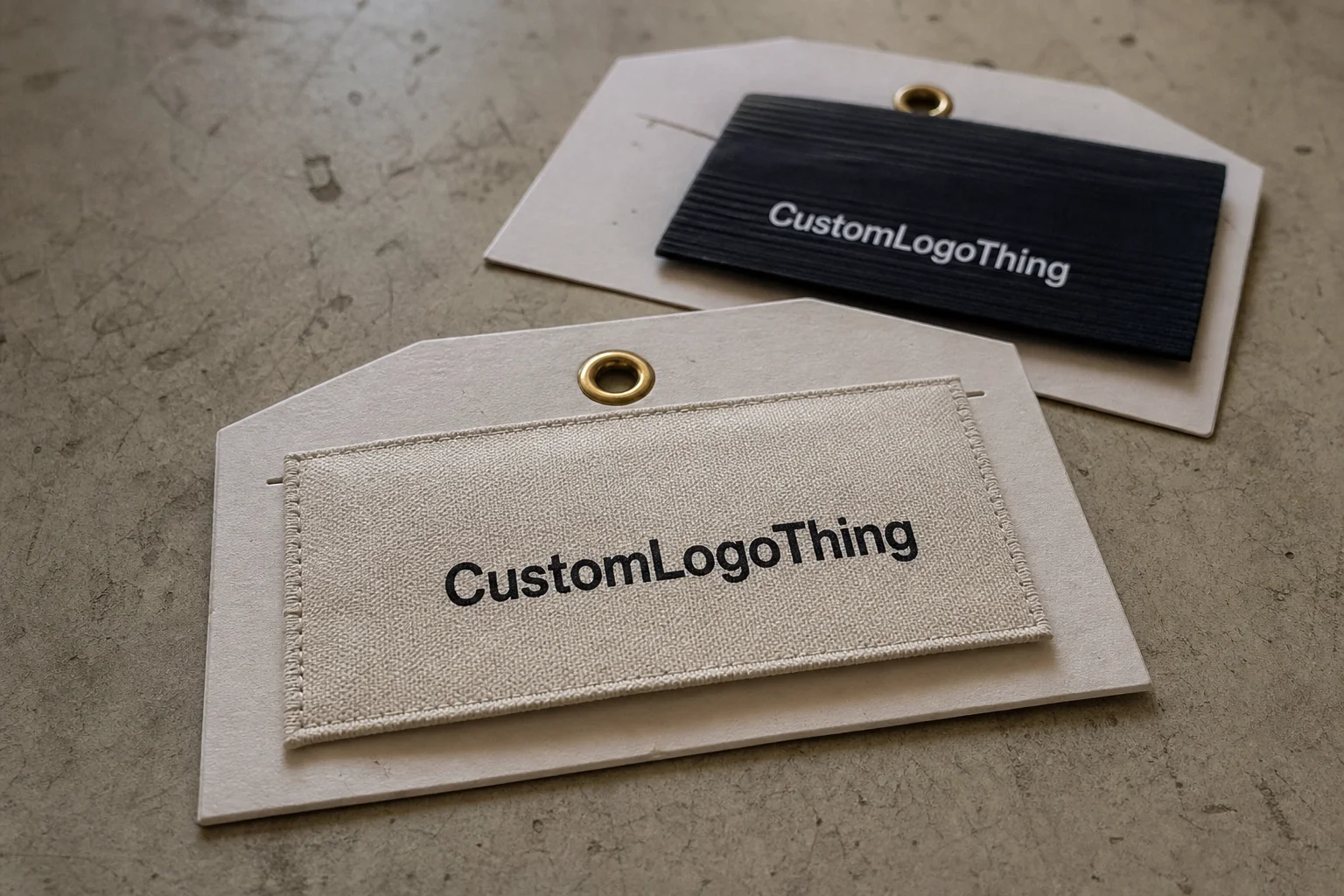
A woven label does three jobs at once. It identifies the brand, it survives wear, and it signals how carefully the garment was made. That sounds simple, but the tradeoff between appearance and durability is where buyers either get value or pay for the same job twice.
Printed satin labels can be the right answer for some products, especially when softness matters more than abrasion resistance. Yet woven labels hold up differently because the artwork is built into the structure of the fabric. The logo is not sitting on top of the material waiting to crack. It is part of the material itself. On products that get washed repeatedly, rubbed against skin, or packed and unpacked often, that difference is visible.
The contrast is easiest to see on tees, hoodies, knitwear, workwear, hats, bags, and children's garments. Those items get touched, stretched, and washed more often than a buyer usually imagines. A label that looks acceptable in a mockup can still fail in real use if the weave is too open, the yarn choice is weak, or the type is too small for the available surface area. If a garment is expected to survive 20 washes, and the label starts to blur after 5, that is not character. That is a defect.
Placement changes the function as well as the look. A neck label is usually about identity and comfort. A side-seam label behaves more like a signature. A label on a bag or cap can act like exterior branding, almost like a badge. The same woven label construction may work across these categories, but the fold, size, and edge treatment usually should not be identical.
One pattern shows up often in buyer reviews: too much effort goes into packaging, too little into the trim spec. The package may be sharp, the branding system may be consistent, and then the product is let down by a flimsy label that pills, scratches, or flips awkwardly inside the garment. That mismatch is expensive because it breaks the customer's sense that the brand made careful decisions everywhere else.
A woven label that survives washing becomes part of the brand memory. A label that frays or blurs does the opposite, even if the customer never says so out loud.
How woven labels are made, from artwork to loom
The production chain starts with artwork, but the artwork is not the final language the factory uses. It has to be converted into a weave file that tells the loom how to place threads, change colors, and hold detail at a workable scale. That digitizing step is where many first orders succeed or fail. Clean art makes the process straightforward. Busy art, tiny text, and thin linework make it risky.
After digitizing, the supplier sends a proof. Buyers sometimes treat this as the finished product. It is not. It is a production checkpoint that confirms layout, spelling, size, fold style, and the rough relationship between colors. The proof is useful, but it cannot fully show how thread density will handle microtype or how a sheen will shift under light. A well-made proof can still look different from the final label once woven.
There are a few common constructions, and the choice matters more than many quote sheets suggest. Damask is usually the best all-around option for detail because it can support tighter weave density and cleaner edges. Satin has a smoother, more lustrous face, which makes it a good fit for softer or more premium-feeling garments. Taffeta is generally the lower-cost route and can work for simpler branding or internal labels where crispness matters more than a refined hand feel.
Finishing is where the label becomes usable in production. The most common options are:
- End fold, often used for side seams and exterior branding
- Center fold, common for neck labels because it sits neatly over a seam
- Mitre fold, used when a cleaner angled finish is preferred
- Loop fold, useful when the label needs to be readable from both sides
Cut method also matters. Heat cut, ultrasonic cut, and sewn finishes behave differently at the edges, and that changes both appearance and comfort. A label intended for a T-shirt neckline should not be specified the same way as a patch-style label on a jacket or a cap. The garment construction should drive the trim spec, not the catalog.
Most suppliers also work from thread charts rather than direct print matches. That is where color expectations need to be realistic. Woven labels use yarn colors, not ink. A deep navy can shift slightly cooler or warmer depending on the thread stock. A beige, olive, or charcoal often looks different in yarn than it does on screen. If a brand has strict color rules, ask for the nearest thread match and expect a small visual delta. That is normal in textile production, not a mistake.
For buyers who already understand packaging workflows, the comparison is useful. Artwork gets translated into a production language, proofed, then executed under controlled parameters. The difference is that woven labels give you far less forgiveness on tiny details. A package can tolerate a broad set of readable choices. A label with 5-point text and a crowded icon usually cannot.
Custom woven labels for clothing supplier: specs that change quality
This is where quotes begin to separate. Two suppliers can say they offer the same woven label, but one may be using higher weave density, better finishing control, or tighter inspection standards. The phrase Custom Woven Labels for clothing supplier only becomes useful when it is tied to a real spec.
Size is the first variable buyers underestimate. A 12 mm label with dense artwork can become unreadable fast. The same design on a 30 mm label may look clean and balanced. Small labels are not automatically cheaper in the long run if they force the supplier to simplify the art or if the final piece becomes hard to read at arm's length. Detail density matters just as much. Thin strokes, tiny counters, and crowded text can collapse into visual noise when the loom cannot support them cleanly.
Weave density is usually the practical measure behind that readability. Higher density generally produces sharper edges and more legible logos, but it can raise cost. Lower density can be acceptable on simple marks, yet it tends to feel more utilitarian. The right level depends on where the label sits. A neck label touching bare skin has different comfort requirements than a jacket label hidden in a lining or a badge-like patch on an exterior panel.
Backing changes both application and price. Iron-on backing can help with positioning in certain workflows, adhesive options may be used for temporary placement, and plain sew-in labels remain the most common for standard apparel production. The wrong backing slows down sewing and increases waste. The right one saves time on the line and keeps the label from twisting, puckering, or peeling during use.
Here is a practical comparison of common woven label options:
| Construction | Best For | Look and Feel | Typical Cost at 5,000 pcs |
|---|---|---|---|
| Damask | Detailed logos, premium apparel, most neck labels | Sharp detail, balanced sheen, softer hand feel | $0.10-$0.22 each |
| Satin | Dresswear, lingerie, softer-touch interiors | Smoother surface, more reflective finish | $0.12-$0.25 each |
| Taffeta | Utility labels, basic branding, lower-cost programs | Crisper, less refined, functional | $0.08-$0.18 each |
| Woven patch-style label | Exterior branding on hats, bags, jackets | Thicker profile, more visible on the product | $0.18-$0.35 each |
The real comparison is not the headline unit price. It is whether the supplier can hold detail, finish edges cleanly, and keep the order within tolerance after sewing, folding, cutting, and packing are added. A label that looks inexpensive on a quote sheet can get expensive once the hidden extras appear.
That is especially true for brands that need more than one branded component. The same discipline used for custom printed boxes and broader branded packaging should apply here. If a vendor cannot clearly state what is included, the order is not fully priced yet.
Process and timeline: what happens after you request a quote
A supplier can only quote accurately if the brief is complete. At minimum, they need artwork, dimensions, quantity, fold style, backing preference, intended placement, and delivery target. Leaving out any of those creates a sloppy comparison. Some vendors will quote low and fill in the gaps later with add-ons. Others will pad the price to protect themselves. Either way, the buyer loses clarity.
Once the order is submitted, the supplier usually digitizes the art and sends a proof. This stage is where delays happen if the file is messy. A vector file with controlled text and clear shape boundaries moves quickly. A low-resolution image with six words squeezed into a narrow panel slows everything down, because the artwork has to be interpreted and sometimes rebuilt. Buyers often blame the factory for delays that started in the design file.
The production flow usually looks like this:
- Artwork review and digitizing
- Digital proof approval
- Loom setup and weaving
- Cutting, folding, or heat sealing
- Inspection and packing
- Shipment
For standard woven labels, a realistic production window is often 7 to 15 business days after proof approval. Simple repeat orders can move faster. Complex artwork, special finishing, peak-season demand, and larger quantities can push the schedule longer. Rush service is possible with some vendors, but it usually narrows your options and increases the price. If the timeline matters more than the price, ask about it early. Late-stage urgency is where budgets start to bend.
Inspection is not just a checkbox. Good suppliers look for broken threads, skewed folds, loose edges, shade drift, and miscuts. Those defects can be subtle at first glance and obvious once the label is sewn into a garment. If a supplier cannot explain their inspection points, that is a warning sign. You do not need a lecture on textile science, but you do need to know that they are checking more than spelling.
If your label order is being packed alongside hang tags, inserts, or other paper components, ask how those items are handled in transit. Some brands use shipping cartons that should be evaluated against transport testing expectations such as those described by ISTA testing standards. For paper-based elements, FSC-certified stock may matter for procurement or sustainability claims, and the Forest Stewardship Council remains the standard reference point there.
Cost and pricing: what drives unit cost and MOQ
MOQ is often more important than unit price for smaller brands. A quote that looks attractive at 10,000 pieces may be useless if the line only needs 300 labels for a test run. The better question is not, "What does one label cost?" It is, "What does the order cost once setup, proofing, shipping, and finishing are included?"
Most suppliers split pricing into setup and per-piece cost. Setup usually covers digitizing, loom preparation, and proof work. For small projects, that fixed cost lands hard. A setup fee in the $25 to $85 range is common, depending on complexity and vendor structure. Some suppliers waive it on larger orders, but that cost does not disappear. It gets absorbed elsewhere, usually in the unit price.
Quantity is the biggest lever. A 300-piece run will almost always cost more per label than a 5,000-piece run because the fixed setup is spread over fewer units. That is not a penalty. It is production arithmetic. Size, thread count, and color count all matter too. More complex artwork requires more attention at the loom and more inspection after finishing.
Here is a buyer-oriented pricing view for common order shapes:
| Order Profile | Typical MOQ | Likely Price Range | Notes |
|---|---|---|---|
| Simple interior neck label | 100-500 pcs | $0.18-$0.40 each | Setup cost has a strong impact at low quantity |
| Mid-size damask label | 1,000-5,000 pcs | $0.10-$0.22 each | Often the best balance of detail and value |
| Premium woven patch label | 500-5,000 pcs | $0.18-$0.35 each | More visible branding, thicker build, more finishing labor |
| Large bulk run with simple art | 10,000+ pcs | $0.05-$0.14 each | Lowest cost only when the artwork is straightforward |
If a quote is unusually low, check what is missing. Folding, cutting, special backing, sampling, or split shipping can move the final number faster than buyers expect. The cheapest line item on paper is not always the cheapest landed order. That is as true for woven labels as it is for cartons or other branded components.
Common mistakes that make labels look cheap or fail in wash testing
The most common mistake is overcrowding. Buyers try to fit a logo, slogan, website, care note, and legal mark onto a label that was only ever meant to carry a simple identity. The result is unreadable. The second mistake is using type that is too small. What looks elegant on screen can turn into a blot when translated into thread. Thin strokes, delicate serif fonts, and tight spacing need more room than most first-time buyers give them.
Size errors are just as damaging. A label designed for a structured jacket may look oversized on a lightweight knit, while a narrow neck label can make a bold logo unreadable. Placement should be decided before the artwork is finalized. Too many buyers reverse the order and then force a design into a space that was never suitable.
Wash testing should be treated as part of the buying process, not an afterthought. Labels need to hold up against detergent, heat, abrasion, and repeated laundering. A label that survives one wash means very little. The useful question is whether it still looks acceptable after multiple cycles, because that is what customers experience over time.
Skipping a sample is another avoidable problem. A digital proof cannot tell you how the thread will feel against skin, how the fold will sit in a seam, or whether the label will curl when stitched into a lightweight fabric. If a supplier offers a sample or short pilot run, use it. A few extra days now can prevent a full production correction later.
Color mismatch is also more common than many teams admit. Thread charts are precise, but they are not magic. Two labels using the same nominal navy can still look different under warm light, cool light, or on different fabric colors. That is why buyers should judge samples in the real garment context, not just against a monitor.
A label is small, but the failure is not small. If it scratches, twists, or fades, the customer experiences the whole garment as less finished.
Finally, do not assume every supplier works to the same standard. One quote may allow tighter detail and cleaner finishing than another, even if the descriptions sound interchangeable. Side-by-side samples tell the truth faster than a sales sheet.
Expert tips and next steps for a cleaner supplier comparison
Use one spec sheet across every supplier. That sounds basic because it is basic, and it is still the best way to compare quotes fairly. Keep the artwork, dimensions, fold, backing, quantity, and delivery date identical. If one supplier gets a looser brief, the quote may look better only because they priced a different job.
When samples arrive, judge them on three things first: readability, comfort, and wash behavior. Readability means the logo and text can be understood at arm's length. Comfort means the label does not irritate the skin or add unnecessary bulk. Wash behavior means the edges stay neat and the weave does not distort after laundering. If those three fail, the rest of the conversation does not matter much.
A simple scorecard keeps the comparison honest:
- Durability: does the label hold up through washing and abrasion?
- Hand feel: is it soft enough for the intended garment?
- Color accuracy: is the thread match acceptable against the brand palette?
- Lead time: can the supplier meet the launch date?
- Total landed cost: what is the full cost after setup, shipping, and extras?
Brands that think carefully about packaging usually already understand this logic. A label, a hang tag, and a carton should speak the same visual language. If they do, the product feels deliberate rather than assembled from unrelated pieces. That kind of consistency is often what separates a one-off purchase from a repeatable retail system.
If you are sourcing Custom Woven Labels for clothing supplier programs, the practical move is simple: send the same complete brief to each vendor, ask for a proof, and request a sample if the design is dense, small, or likely to sit against skin. The fastest way to separate a strong supplier from a weak one is not the polished pitch. It is the sample that still looks right after the garment has been handled, worn, and washed.
FAQ
What information should I send to get an accurate woven label quote?
Send the label size, artwork file, quantity, fold type, backing preference, placement, and target delivery date. If you already have a reference sample, include a photo or physical spec so the supplier can estimate weave density and finishing more accurately. The cleaner the brief, the less room there is for price surprises later.
How much do custom woven labels for clothing supplier orders usually cost?
Pricing depends on quantity, size, thread count, color count, and finishing. Small runs usually carry a higher per-piece cost because setup is spread across fewer labels. Larger runs lower the unit price, but only if the artwork is simple enough to run efficiently.
How long does production usually take for woven clothing labels?
Standard orders often move through proofing, weaving, finishing, inspection, and shipping in roughly 7 to 15 business days after proof approval. Complex artwork, larger quantities, or peak-season schedules can stretch that longer. Rush options exist, but they typically cost more and reduce flexibility.
Which fold works best for neck labels versus side-seam labels?
Center fold is common for neck labels because it sits neatly across a seam and reads cleanly. End fold and straight-cut styles are often better for side seams or external branding applications. The right choice depends on the garment thickness, placement, and how visible you want the label to be.
Can I order a small MOQ if I am testing a new clothing line?
Yes. Many suppliers support lower minimums, though the unit price will usually be higher than on bulk orders. Small MOQs are useful for testing artwork, fit, comfort, and wash performance before committing to a larger run. If possible, compare a pilot run against your production spec so the numbers stay realistic when you scale.