Buyer Fit Snapshot
| Best fit | Minimalist Packaging for Luxury Goods projects where brand print, material claims, artwork control, MOQ, and repeat-order consistency need to be specified before quoting. |
|---|---|
| Quote inputs | Share finished size, material target, print colors, finish, packing count, annual reorder estimate, ship-to region, and any compliance wording. |
| Proofing check | Approve dieline scale, logo placement, barcode or warning zones, color tolerance, closure strength, and carton packing before bulk production. |
| Main risk | Vague material claims, crowded artwork, missing packing details, or unclear freight terms can make a low unit price expensive after revisions. |
Fast answer: Minimalist Packaging for Luxury Goods: Material, Print, Proofing, and Reorder Risk should be specified like a repeatable production item. The safest quote records material, print method, finish, artwork proof, packing count, and reorder notes in one written spec.
Production checks before approval
Compare the actual filled-product size with the drawing, then confirm tolerance on folds, seals, hang holes, label areas, and retail display edges. Reserve space for logos, QR codes, warning copy, and material claims before decorative graphics fill the panel.
Quote comparison points
Review material grade, print process, finish, sampling route, tooling charges, carton quantity, and freight assumptions side by side. A quote is only useful when the supplier can repeat the same color, closure quality, and packing count on the next order.
Minimalist packaging for luxury goods can look almost too simple from a clean conference table, but the moment you stand beside a converting line in Dongguan and watch a technician hold a rigid lid to a 0.5 mm tolerance while a buyer runs a thumb along the corner wrap, the whole thing gets real. I still remember a late afternoon in a factory outside Shenzhen’s Bao'an district where a jewelry box with fewer printed elements, a lighter board stack, and one beautifully tuned closure beat a much heavier sample that had twice the decoration. The winner felt more deliberate in the hand. The opening had just enough resistance. The corners stayed square. The whole pack whispered confidence instead of shouting for attention, and the sample was approved that same week on a 1.2 mm reveal.
That is the real promise of minimalist packaging for luxury goods: not emptiness, not a bare carton pretending to be sophisticated, but disciplined reduction. Fewer layers. Cleaner graphics. Better materials. Sharper finishing. A stronger product story told with fewer marks and less noise. For brands building branded packaging, product packaging, or retail packaging that needs to feel premium and believable, the challenge is to remove anything that does not earn its place while still protecting the product and supporting sustainable packaging goals. In one run from a supplier in Quanzhou, Fujian, we replaced a three-layer insert with a single molded pulp tray and cut material weight by 18%, which was the difference between a shipping carton that felt engineered and one that felt overbuilt.
At Custom Logo Things, I have seen brands spend more money trying to signal luxury with extra inserts and oversized cartons than they would have spent on a well-built minimal structure using a 157 gsm wrap, FSC-certified board, and a single hot-foil mark. The difference is rarely some dramatic budget leap. It is usually clarity in the brief, clarity in the structure, and clarity in the finish schedule. That is what makes minimalist packaging for luxury goods feel honest instead of theatrical. On a recent skincare run for a client shipping from Guangzhou to Dubai, a 350 gsm C1S artboard folding carton with one matte varnish pass outperformed a six-color premium mockup because the print stayed crisp at 2,000 units and the line finish added only $0.07 per box instead of $0.21.
What Minimalist Packaging for Luxury Goods Really Means
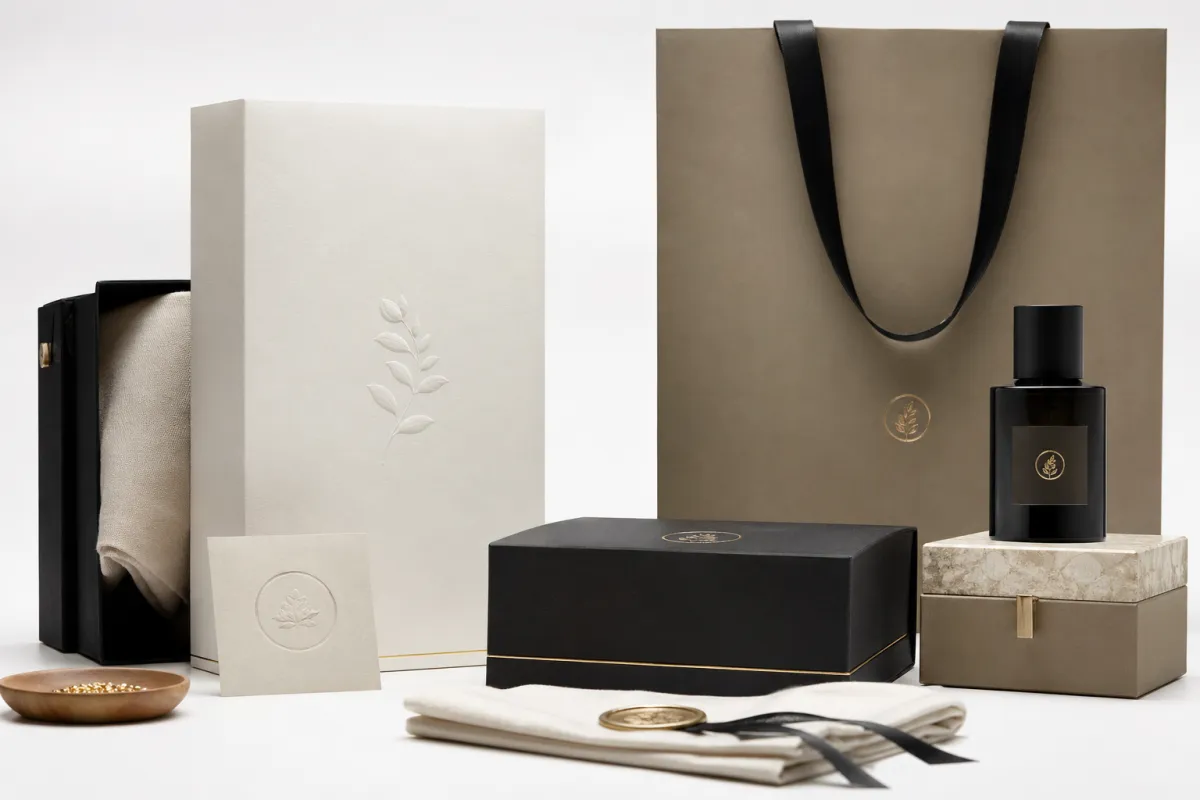
Plain packaging and minimalist packaging for luxury goods are not the same thing. Plain packaging can look underdeveloped: thin board, weak corners, sloppy registration, too much empty space, and a finish that says cost was cut everywhere possible. Minimalist luxury packaging does the opposite. It uses restraint as a design choice, not as a budget accident. The box may carry one logo, a tight color palette, and a small amount of copy, but every element has a reason for being there, from a 1-color Pantone 432 C logo to a 2 mm text margin on the front panel.
I remember a client meeting in Milan where a watch brand set three samples on the table, each built by a different converter from a specification based on 1200 gsm greyboard and specialty paper sourced through northern Italy. The heaviest box had the most decoration, the most layers, and the loudest sales pitch. The sample that won was the quietest one: a rigid setup box with a soft-touch wrap, blind deboss, and a precise 1.8 mm lid reveal. It used less board than the others, yet everyone in the room described it as more expensive. That is classic minimalist packaging for luxury goods at work, and the fact that it won after a 14-minute comparison still makes me smile.
The reason it works is simple. Luxury buyers often notice precision before decoration. They notice whether the lid closes with a clean stop, whether the corners stay square, and whether the typography has room to breathe. In minimalist packaging for luxury goods, negative space matters as much as the logo. Board caliper matters. Edge wrap matters. Even the way ink sits on specialty paper matters, because every surface detail carries part of the message. If the box feels a bit rushed, people can sense it in about two seconds flat, especially under retail lighting at 3,000 to 4,000 kelvin.
That matters even more now, because sustainability has become part of the luxury conversation. Buyers still want elegance, but they also want packaging that does not feel wasteful. A reduced design can communicate confidence while using fewer materials, which is why minimalist packaging for luxury goods is often a better fit for modern premium brands than ornate, layered packs that are harder to recycle and more expensive to ship from factories in Shenzhen, Dongguan, or Ningbo. In a recent fragrance program, cutting one foam insert and one magnetic accessory sleeve reduced total pack weight by 220 grams per unit, which changed the freight class for a full pallet.
Here is the line I use with clients: minimalist does not mean invisible. It means the box has to earn every millimeter. If the structure, material, and finish are all doing useful work, minimalist packaging for luxury goods can feel bespoke without looking overworked. A 0.8 mm foil line, a 157 gsm wrap, and a 1.5 mm deboss are usually enough if the proportions are right and the converter in Foshan holds tolerance within 0.3 mm.
“A luxury pack should feel like it was edited, not stripped bare.” That was the note I gave a cosmetics buyer after we replaced three decorative elements with one satin wrap and a debossed mark, and the final sample looked calmer, richer, and far more expensive on the worktable in Dongguan.
How Minimalist Packaging for Luxury Goods Works in Production
Production is where minimalist packaging for luxury goods either becomes something elegant or falls apart under its own tolerances. The structure usually starts with sturdy paperboard or rigid greyboard, then moves through die-cutting, precise wrapping, tight registration, and a finishing schedule that stays intentionally restrained. If the box is a folding carton, the challenge is keeping the board crisp and the print clean on a 350 gsm C1S artboard or equivalent sheet from a mill in Zhejiang. If it is a rigid setup box, the challenge is getting the wrap, corners, and lid fit to behave like a far more expensive item than the material stack suggests. That second part is where people start sweating, because a tiny misalignment suddenly looks huge on a clean, minimal surface.
The strongest minimal packs usually rely on a single decisive surface choice. That might be a 1,500 gsm rigid board wrapped in 157 gsm specialty paper, a folding carton with soft-touch lamination, or a paper sleeve with one hot-foil logo. I have seen a simple tuck-end carton become a premium retail packaging solution because the registration was exact and the matte varnish showed no streaking after a 4-color press run in Shenzhen. No one asked how many colors had been on press; they only noticed that the box felt calm and expensive. That is the whole point, really. The best compliment is usually silence, especially from a buyer who normally comments on everything.
Small details carry a lot of weight in minimalist packaging for luxury goods. A blind deboss can create depth without visual clutter. Edge painting can add a quiet accent on a drawer box. A paper wrap can disguise the mass of the board and make the pack feel more refined in the hand. Even a narrow magnetic closure can turn a basic opening into a slow, controlled reveal. The luxury often hides in the mechanics, not the surface message. I have a soft spot for that kind of engineering because it feels like the factory is doing the work most people never see, from the glue station in Dongguan to the hand-assembly table where corners are squared by eye.
Sustainability fits into this build through material choice and disciplined specification. FSC-certified board, soy-based or water-based inks, recyclable paper inserts, and adhesives selected for recovery-friendly systems can all support a lower-impact pack. The FSC standard is a useful reference point if your brand needs documented sourcing and traceability: FSC. In a good minimalist packaging for luxury goods program, sustainability is not a label added after the fact. It belongs in the engineering brief from the start, alongside the dieline, the shipping carton dimensions, and the target landed cost per unit.
I had a fragrance client who wanted a velvet tray, a magnetic rigid box, and a foil stamp on every panel. We tested that version against a simpler build using molded paper pulp from a supplier in Xiamen, and the simpler version won on cost, weight, and shipping performance. The brand still looked elevated, and the unboxing was cleaner. That is the kind of decision that makes minimalist packaging for luxury goods practical instead of merely pretty. It also saved us from a final sample that looked like a craft project had collided with a private equity deck, which was funny until the freight invoice arrived.
If you want to compare structures early, it helps to review real packaging capabilities before the design gets too far ahead of the factory. Our Custom Packaging Products page is a useful starting point, especially if you are balancing custom printed boxes against rigid formats and trying to keep the first round of quotes grounded in reality. A box that looks perfect in Figma can still need a 3 mm adjustment in the side wall once a converter in Guangzhou checks the actual board memory.
What Factors Shape Minimalist Packaging for Luxury Goods?
Five design choices shape minimalist packaging for luxury goods more than anything else: hierarchy, typography, negative space, material restraint, and the amount of story placed on the pack itself. If the hierarchy gets crowded, the box starts to read like a flyer. If the typography lacks authority, the package loses confidence. If the negative space is careless, the design feels unfinished rather than elegant. I have seen very talented designers accidentally make a luxury pack feel cheap just by trying to say one thing too many on a 90 mm front panel. The board was fine; the message was the problem.
Typography does a surprising amount of work in minimalist packaging for luxury goods. A single serif wordmark can feel editorial. A clean sans serif with disciplined spacing can feel modern and technical. A foil-stamped logo can work beautifully if it is given enough room around it. I once saw a skincare brand improve its packaging design simply by moving the logo 7 mm higher and reducing the number of words on the front panel from six lines to two. The box suddenly felt like premium product packaging rather than a crowded shelf label. Seven millimeters, by the way, is a tiny shift that can cause a ridiculously large argument in a room full of brand people.
Material choice should match the use case. Folding cartons make sense for lighter items such as cosmetics, small accessories, or travel-sized sets. Rigid Setup Boxes are better for gifts, premium SKUs, and higher perceived value. Sleeves and wraps can add a secondary reveal without adding too much waste. For minimalist packaging for luxury goods, the material should be strong enough to hold shape, but not so heavy that freight and handling costs get out of control. I like to remind teams that a beautiful pack still has to ride on a truck from Guangzhou to Marseille or Los Angeles, and trucks are not sentimental.
Structure matters as much as graphics. Magnetic closures feel deliberate, but they add components and assembly time. Drawer boxes create a satisfying motion, though they need tighter tolerances and better pull-tab engineering. Tuck flaps are efficient, but if the fit is loose, the entire package feels less refined. One of the most common mistakes I see in minimalist packaging for luxury goods is choosing a visually elegant structure that does not survive shipping or retail stacking. That is the kind of mistake that looks small in a mockup and annoyingly gigantic in a warehouse in Ningbo when the pallet wrap comes off and the lids have shifted 4 mm.
Compliance and function need to stay in the conversation too. Retail packaging must stack cleanly, barcode placement has to remain readable, and any sustainability claim must be backed by material facts. If a pack is going to ship internationally, it should be checked against drop and compression expectations, and if the brand is serious about transit performance, it should test against standards such as ISTA and ASTM. For an overview of packaging testing and transport reliability, I often point teams to the ISTA resource library at ISTA. A 76 cm drop test on the corner can tell you more than a glossy mockup ever will.
The most successful minimalist packaging for luxury goods programs are the ones where design, procurement, and factory communication all happen early. That is how you keep the box elegant without missing the realities of assembly time, carton strength, or shelf performance. I would rather have one slightly longer planning cycle than three rounds of “Why does the lid wobble?” on the sample bench in Dongguan, especially when the fix turns out to be a 0.4 mm adjustment in the wrap allowance.
- Brand hierarchy: logo, product name, and supporting copy must sit in a clear order.
- Material body: the board needs enough stiffness to avoid a flimsy feel in hand.
- Closure behavior: the opening should feel controlled, not loose or overly tight.
- Finish restraint: one strong detail usually works better than three decorative ones.
- Operational fit: the pack has to survive retail, warehousing, and transport.
Cost and Pricing for Minimalist Packaging for Luxury Goods
Pricing for minimalist packaging for luxury goods depends on a handful of variables that often surprise first-time buyers. Board grade is one. Box style is another. Then there is print method, finishing complexity, insert type, tooling, and order quantity. A simple folding carton can be economical at volume, while a rigid box with specialty paper wrap and a magnetic closure can move into a very different cost bracket very quickly, especially if the factory is building by hand in a city like Dongguan or Foshan where labor allocation changes by season.
What many teams miss is that minimalist packaging can save money in some places while increasing cost in others. You may reduce ink coverage, remove extra layers, simplify inserts, and avoid oversized cartons. At the same time, you might invest more in the board, the wrap, the finishing accuracy, or tighter hand assembly. Minimalist packaging for luxury goods is not automatically cheap. It is usually more efficient where it matters and more exact where the brand expression lives, which is why the sample room in Shenzhen often looks more like a precision workshop than a print shop.
Here is a practical way I explain unit cost. A straightforward folding carton in a medium run might land around $0.15 per unit for 5,000 pieces when built on 350 gsm C1S artboard with one-color print and a matte aqueous coat. A premium rigid box may sit around $1.25 to $3.60 per unit, again depending on size, wrap, closure style, and insert complexity. Those numbers move a lot, but they give buyers a workable starting frame for minimalist packaging for luxury goods planning, especially when the first quote arrives from a plant in Guangdong and looks suspiciously neat.
| Pack Type | Typical Finish Level | Indicative Unit Cost | Best Use Case | Typical Lead Time |
|---|---|---|---|---|
| Folding carton | Matte varnish, 1-color print, paper insert | $0.15-$0.29 | Lightweight cosmetics, accessories, retail SKUs | 12-15 business days from proof approval |
| Rigid setup box | Soft-touch wrap, foil logo, paper tray | $1.25-$3.60 | Gift sets, jewelry, premium product packaging | 15-25 business days from sample sign-off |
| Drawer box with sleeve | Textured paper, ribbon pull, spot deboss | $1.45-$4.10 | High-end branded packaging, unveiling experiences | 18-28 business days from final dieline approval |
That table is not a quote, and any factory worth trusting will still price your exact dimensions, material, and shipping lane separately. Freight can swing the landed cost more than the box itself, especially with rigid formats. I have seen a luxury gift set look affordable on paper, then jump in total cost because the final carton size pushed it into a higher freight tier and the team had not accounted for pallet utilization from Shenzhen to Rotterdam. That is the sort of thing nobody notices until someone in logistics sends a very unfriendly email with a spreadsheet attached.
To keep cost under control, ask for tiered pricing at 1,000, 3,000, 5,000, and 10,000 units. Compare the unit price, but also compare assembly time, pack-out speed, and freight weight. If you are sourcing through our custom printed boxes options, ask the supplier to quote both a premium rigid version and a simpler recyclable board version so you can judge feel against budget. In minimalist packaging for luxury goods, the cheapest-looking pack is rarely the cheapest overall, and a $0.11 material saving can disappear the moment the line needs an extra 12 seconds of hand fitting.
I have sat through enough supplier negotiations to know that a low unit price can hide expensive problems. If the box needs hand setting because the tolerance is loose, or if the wrap is selected purely for appearance and not for fold quality, labor cost rises fast. That is why experienced teams price minimalist packaging for luxury goods with production behavior in mind, not just the printed spec sheet. A nice price on paper does not help much if the factory starts cursing the glue line in a workshop outside Shenzhen at 9:40 p.m.
Process and Timeline From Concept to Shipment
A good minimalist packaging for luxury goods project moves through a fairly predictable path: brief, dieline, structural prototype, graphic proofing, sample approval, prepress, production, finishing, quality check, and shipment. The order matters because a minimal design exposes errors more clearly than a busy one. If the corner is imperfect or the foil is slightly off, there is nowhere for it to hide. That is why the sample tables in Dongguan and Shenzhen are covered with calipers, corner charts, and sheets of PMS references instead of just pretty renderings.
Typical timing depends on complexity, but a practical planning range looks like this: 3 to 5 business days for a first dieline or structural concept, 5 to 10 days for prototype refinement, 3 to 7 days for artwork proofing, and 10 to 25 business days for production once the sample is approved. A careful minimalist packaging for luxury goods program usually takes longer than a basic carton because the fit and finish need more scrutiny. That extra time is often cheaper than rework. I will happily spend two more days on approval if it saves me from a box run full of tiny, expensive regrets, especially when the run is already booked on a press line in Guangzhou.
I still remember a fragrance box order where the customer changed the insert depth after sampling because the bottle shoulder sat too low in the window. That 2 mm adjustment pushed the project back by nearly a week, and the new insert had to be re-cut, rechecked, and reassembled. Nobody complained about the final result, but the delay was avoidable. With minimalist packaging for luxury goods, late changes cost more because every tiny adjustment can affect the lid gap, the tray fit, or the print placement. A 2 mm shift can also alter how the box sits in a 12-unit shelf tray, which is the kind of detail that turns into a retail headache fast.
Press checks and line testing are worth the time. A 30-minute color review can prevent a hundred boxes from shipping with a grayish logo instead of a warm black. A closure test can reveal that a magnetic flap is too stiff for retail staff to open repeatedly. A drop test can show that an elegant tray needs a deeper wall to stop the product from shifting. Those checks belong in professional packaging design, not in the wish list at the end of the schedule. I have watched a plant in Ningbo stop a run because a foil patch read too cool under daylight, and that single pause saved a whole batch from looking off on a luxury shelf.
For brands that want a disciplined process, I recommend freezing three things before full production starts: the dimensions, the finish schedule, and the unboxing motion. Once those are locked, minimalist packaging for luxury goods usually runs more smoothly, because the factory knows exactly what it is trying to reproduce at scale. A spec that says “soft-touch, 1 deboss, 1 insert, 1 reveal” is far easier to build than a vague instruction to make the box feel premium.
Step-by-Step Guide to Building a Minimalist Luxury Pack
Step 1: define the product story. Before you choose a board grade or a foil color, decide what the packaging has to say. Is the product artisanal, clinical, fashion-led, heritage-driven, or gift-oriented? The answer shapes the whole minimalist packaging for luxury goods strategy. I always ask clients for three words that describe the emotional goal of the pack, because “premium” is too vague to design from. “Quiet, precise, generous” gets me much further than “nice,” especially if the launch date is six weeks away and the factory in Shenzhen is already waiting for approval.
Step 2: choose the structure around protection. A delicate perfume vial needs different support from a leather accessory or a watch strap. Start with the product dimensions, then prototype the inside space so the item sits securely without dead volume. The strongest minimalist packaging for luxury goods solutions often look the simplest because the structure was solved first, not patched after the artwork. If the tray wall is 6 mm too shallow, the pretty exterior will not save it when the parcel lands in Singapore after a 2,200 km transit leg.
Step 3: narrow the visual system. One palette. One type family. One signature finish. That is usually enough. A black-on-cream carton with a soft-touch surface and a single foil mark can feel more expensive than a multi-color design full of decorative lines. In my experience, the strongest minimalist packaging for luxury goods usually has a very controlled face and one memorable tactile moment, such as a 1.5 mm deboss or a satin paper wrap sourced through a converter in Foshan. I know that sounds almost annoyingly obvious, but obvious is underrated in packaging.
Step 4: test the sample in real use. Open it ten times. Shake it lightly. Put it in a shipping case. Stack it with other cartons. If the box is for retail packaging, let someone who has never seen the project open it cold and tell you how it feels. A good sample should protect the product and still present beautifully after handling. That is the moment where minimalist packaging for luxury goods proves itself, whether the test happens in a Shanghai showroom or a warehouse in Los Angeles.
Step 5: approve the production details with the factory. Confirm the exact paper stock, glue points, foil area, deboss depth, and insert material. Ask for photos of the first-off sample and inspect the lid fit, the color, and the edge wrap before the run continues. I have seen a project recover from a weak first sample because the team caught the issue early and fixed the tray depth before shipment. That kind of discipline saves both money and reputation. It also keeps everybody from pretending a lopsided lid is “intentional,” which, trust me, people do say with a straight face in factories from Dongguan to Suzhou.
If you want a practical shortcut, build the pack in this order:
- Product dimensions and protection needs
- Chosen structure and insert type
- Board, wrap, and finishing spec
- Sample review and correction notes
- Final approval and production release
That sequence sounds basic, but it is the backbone of good minimalist packaging for luxury goods. The boxes that feel effortless on the shelf usually took several disciplined decisions behind the scenes. I like that contradiction, actually. The simpler something looks, the more work it usually took, especially when the final assembly was done by hand in a 16-station line in Guangdong.
Common Mistakes and Expert Tips for Better Results
The first mistake is using too little structure. Some brands assume minimal means thin. It does not. If the board flexes, the corners crush, or the lid slides around, the package feels cheap no matter how elegant the artwork is. In minimalist packaging for luxury goods, the structure has to carry the confidence that decoration would otherwise provide, which is why many premium projects start with 1200 gsm or 1500 gsm greyboard and only then decide on the outer wrap.
The second mistake is making the design so sparse that it reads as unfinished. A blank panel with a tiny logo can work, but only if the material, proportions, and finish are strong enough to support it. That is why I keep pushing clients to think in terms of package branding rather than just graphics. The whole object has to speak. Otherwise, minimalist packaging for luxury goods can drift into generic product packaging, and nobody spends premium money for “generic with good manners.” A 2-color carton with a 3 mm logo margin can feel intentional; a random empty face usually just feels forgotten.
The third mistake is over-specifying finishes. I have seen teams add foil, embossing, debossing, UV, and textured lamination to a box that really needed only one tactile statement. Every added finish creates risk, extra setup, and more room for variation. One of the cleanest jobs I ever saw came from a factory in Dongguan where we used a single blind deboss and a matte wrap, and the client told me the sample felt “calm in the hand.” That is exactly the effect strong minimalist packaging for luxury goods should create, especially when the budget is under $2.00 per unit and the launch is in a narrow 4-week window.
Another trap is making sustainability claims that are not supported by the actual materials. If the carton is recyclable but the insert is not, say so. If the board is FSC-certified but the lamination complicates recovery, do not gloss over it. Trust is built by specifics. Clear material facts, not vague environmental language, make minimalist packaging for luxury goods credible to buyers and retailers. I would rather explain a real limitation than watch a marketing line collapse the second someone asks a simple question at a showroom in Paris or a trade fair in Hong Kong.
Here are the habits I see from teams that get the best results:
- Approve one master sample and use it as the production reference.
- Keep tolerances tight, especially on lids, drawers, and magnets.
- Use finish sparingly and let the structure do more of the work.
- Ask the factory for assembly photos before the full run.
- Check freight dimensions before finalizing the dieline.
There is also a communication habit that sounds small but matters a lot: keep one decision maker on the brand side. Too many voices can turn minimalist packaging for luxury goods into a moving target, and a moving target is expensive in print and in time. A clear brief, a single sample sign-off path, and one factory contact for technical questions usually produce better results than any software workflow ever will. I have seen a two-person approval chain beat a seven-person committee on both speed and quality, which was a refreshing change after years of endless comment rounds.
Honestly, I think the best luxury packs are not the loudest ones. They are the ones that feel inevitable, as if every line and fold had been trimmed to the exact point where nothing else could be removed without damaging the experience. That is the sweet spot for minimalist packaging for luxury goods, whether the box comes off a line in Shenzhen, a hand-wrap bench in Dongguan, or a specialty finishing shop in Milan.
Actionable Next Steps for Your Packaging Brief
If you are preparing a packaging brief for minimalist packaging for luxury goods, start with the facts the factory can actually use: product dimensions, target price, sustainability requirements, retail channel, shipping conditions, and the unboxing moment you want the customer to remember. A strong brief cuts weeks off the back-and-forth because it gives the supplier something concrete to engineer against. A brief that includes a 78 mm product height, a 420 g finished weight, and a 12-15 business day target after proof approval is far more useful than a mood board with a hundred adjectives.
I recommend requesting two prototype paths. Ask for one version in a recyclable paperboard structure and one in a premium rigid format. That side-by-side comparison tells you more than a thousand mood board comments. You will see the difference in feel, cost, protection, and shelf presence immediately, which is exactly what you want when evaluating minimalist packaging for luxury goods. Sometimes the obvious choice changes once you hold both options in your hands, especially when one sample has a 157 gsm wrap and the other uses a 350 gsm C1S print face with a paper insert.
For the first launch, a pilot run is usually smarter than a big leap. Test the unboxing with real customers, check damage rates in transit, and watch how the pack behaves on the sales floor or in a fulfillment center. A 500-unit pilot can expose a tray issue, a barcode placement mistake, or a closure problem before those errors turn into a costly recall. That small investment often pays for itself many times over in minimalist packaging for luxury goods programs, especially when the final shipment is leaving by sea freight from Yantian or air freight out of Hong Kong.
If you are still refining your supplier list, compare quotes from vendors who understand custom printed boxes, rigid setup boxes, and sustainable finishing options. Our Custom Packaging Products catalog can help you narrow the field, especially if you are balancing premium presentation against unit cost and lead time. The right partner should talk to you about board caliper, wrap stock, fit tolerance, and shipping weight, not just print color. If they only want to talk about the pretty mockup, I get suspicious pretty quickly, particularly when the quote skips over assembly labor in Dongguan or tooling in Shenzhen.
Before you send the brief, use this final checklist:
- Product dimensions and weight are confirmed.
- Target unit cost is set for each quantity tier.
- Sustainability requirements are written in plain language.
- One structural reference sample has been chosen.
- Artwork hierarchy and finish choices are locked.
- Transit and retail conditions are documented.
That is the practical heart of minimalist packaging for luxury goods: every detail has a job, from the board choice to the final unboxing reveal. If you do that well, the pack feels calm, premium, and trustworthy, and the customer never has to think about how much effort went into making something look so simple. A well-made box from a factory in Guangdong can carry that feeling just as strongly as a handmade package from Italy if the spec is disciplined and the tolerances are respected.
For brands that want elegance without waste, minimalist packaging for luxury goods remains one of the smartest paths forward, because it rewards precision, respects materials, and gives the product room to feel special on its own. In a market where one box may be judged in 3 seconds on a shelf and another in 30 seconds during an unboxing video, that restraint can be the clearest signal of quality. The practical move is simple: lock the structure, lock the finish schedule, and lock the opening motion before production starts, then let the factory tune the last millimeters instead of improvising them on the line. That is how the pack stays elegant, and it is also how you avoid the kind of small, expensive surprises that turn a good launch into a messy one.
FAQ
Is minimalist packaging for luxury goods still premium-looking?
Yes, if the structure is precise and the materials feel substantial, a minimal design can look more expensive than a crowded one. In minimalist packaging for luxury goods, the strongest premium cues usually come from fit, finish, and restraint: clean edges, balanced typography, and one well-chosen tactile detail such as a 1.5 mm deboss or a soft-touch laminate applied at a plant in Dongguan.
What materials work best for minimalist luxury packaging?
FSC-certified paperboard, rigid setup board, and specialty paper wraps are common choices because they hold shape and print cleanly. For sustainable minimalist packaging for luxury goods, pair those materials with recyclable inserts, water-based inks, and adhesives that do not complicate recovery; a 350 gsm C1S artboard carton with a molded pulp insert is a solid starting point for many cosmetic and accessory launches.
How much does minimalist packaging for luxury goods cost per unit?
Cost depends on board type, size, finish level, and order volume, so a simple folding carton can be far cheaper than a Custom Rigid Box. The fastest way to control unit cost in minimalist packaging for luxury goods is to simplify the structure, reduce finishing steps, and compare quotes at multiple quantities; for example, a 5,000-piece run might land near $0.15 per unit for a clean folding carton and above $1.25 for a rigid format.
How long does it take to produce minimalist luxury packaging?
A straightforward carton may move from proof to production quickly, but custom rigid packaging usually needs more time for sampling and approval. Build in extra time for dieline revisions, finish approvals, and shipping coordination so minimalist packaging for luxury goods does not get pushed by late changes; a realistic plan is often 12-15 business days from proof approval for a simple carton and 15-25 business days for a rigid box after sample sign-off.
How do you keep minimalist packaging sustainable without looking cheap?
Use a material with enough body, keep the graphics disciplined, and add one tactile or structural detail instead of multiple decorative layers. Test the unboxing experience with real samples, because premium feel in minimalist packaging for luxury goods comes from precision and consistency, not from adding more material; a good example is a recyclable board structure with a single foil mark and a molded pulp insert assembled in Foshan or Shenzhen.


