Buyer Fit Snapshot
| Best fit | Anti Tamper Stickers Bulk projects where brand print, material claims, artwork control, MOQ, and repeat-order consistency need to be specified before quoting. |
|---|---|
| Quote inputs | Share finished size, material target, print colors, finish, packing count, annual reorder estimate, ship-to region, and any compliance wording. |
| Proofing check | Approve dieline scale, logo placement, barcode or warning zones, color tolerance, closure strength, and carton packing before bulk production. |
| Main risk | Vague material claims, crowded artwork, missing packing details, or unclear freight terms can make a low unit price expensive after revisions. |
Fast answer: Anti Tamper Stickers Bulk: Specs, Pricing, and Ordering should be specified like a repeatable production item. The safest quote records material, print method, finish, artwork proof, packing count, and reorder notes in one written spec.
Production checks before approval
Compare the actual filled-product size with the drawing, then confirm tolerance on folds, seals, hang holes, label areas, and retail display edges. Reserve space for logos, QR codes, warning copy, and material claims before decorative graphics fill the panel.
Quote comparison points
Review material grade, print process, finish, sampling route, tooling charges, carton quantity, and freight assumptions side by side. A quote is only useful when the supplier can repeat the same color, closure quality, and packing count on the next order.
Anti Tamper Stickers Bulk: Specs, Pricing, and Ordering
If you ship products that people actually care about, anti tamper stickers bulk are not just another line in the packaging budget. They are a small but very practical checkpoint between a parcel that stayed closed and a customer claim that starts eating up time, money, and trust faster than most teams expect. Sure, cartons get damaged in transit. That happens. But the headaches usually come from quieter problems: a flap that lifted, a seal that loosened during a rough handoff, a box that sat in humidity longer than planned, or a label that looked fine until the pallet had already moved through several touchpoints and nobody could say with confidence what happened.
The smarter buying decision is usually the plain one. Match the sticker construction to the surface, the handling risk, and the level of evidence your team needs if a package gets opened or tampered with. A weak seal can peel, smear, or create a false sense of security. A proper tamper-evident label keeps warehouse staff, carriers, and customers reading the same signal. That is the real value of anti tamper stickers bulk: a visible, repeatable, low-friction way to show whether a package stayed closed.
Why anti tamper stickers bulk make sense for shipping risk
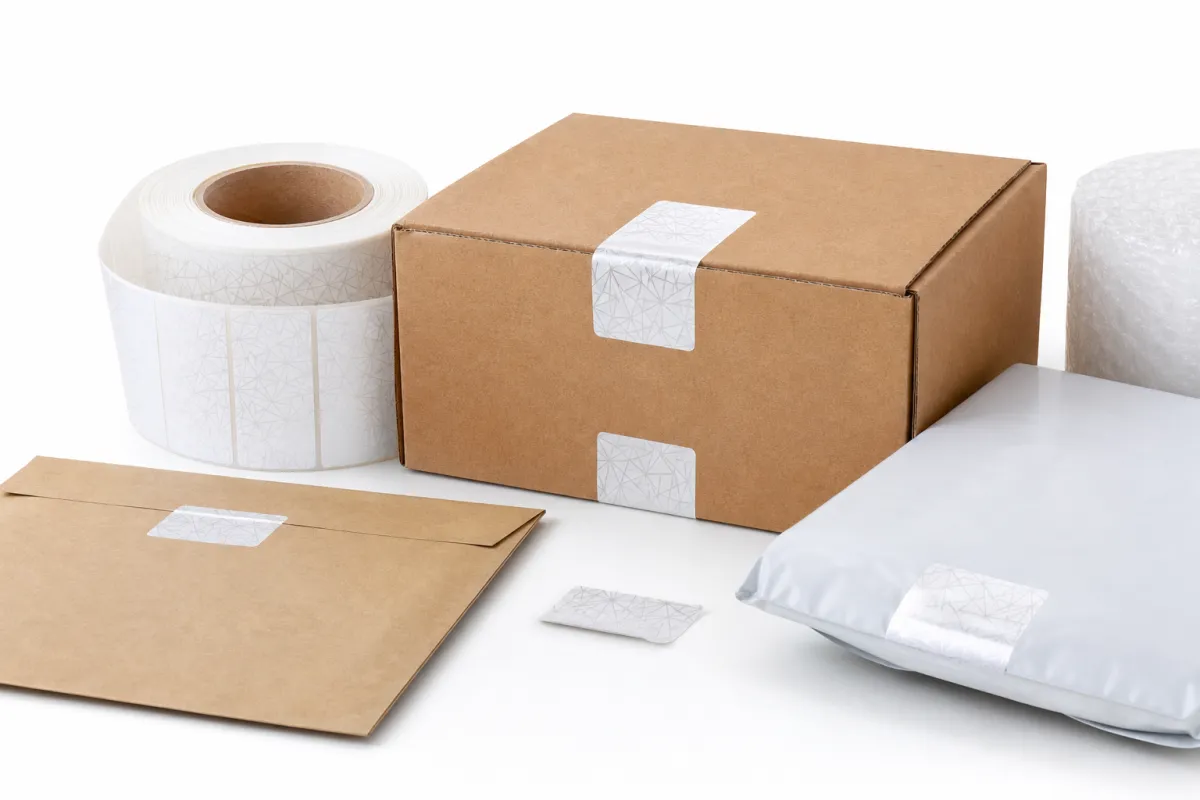
From a packaging buyer’s point of view, the case for anti tamper stickers bulk starts with volume, but it does not end there. A small shipper can get by with almost any label that sticks through the day. A larger operation cannot afford weak seals turning into refunds, service calls, repacks, and chargebacks that could have been avoided. Once order volume climbs, a label failure stops being a one-off annoyance and turns into a repeating cost that can ripple from the packing bench to customer support.
Most teams do not need a dramatic security system. They need a clear visual cue that a carton, mailer, or retail box was closed properly and stayed that way. A good tamper-evident seal gives receiving staff a fast pass-or-fail check, tells carriers that the package was meant to remain shut, and gives the customer a simple way to see whether the shipment arrived as expected. That kind of utility is not flashy, but it keeps operations calmer and keeps disputes from getting messy.
anti tamper stickers bulk also cut down on ambiguity. When a seal leaves void text, tears apart, or leaves residue behind after removal, there is less room for guessing and less room for claims built on hand-waving. Carton quality still matters. Packing discipline still matters. A security label does not replace either one. What it does provide is a custody cue that becomes genuinely useful in high-volume shipping, where nobody has time to inspect every unit by hand.
The sticker cost is rarely the real cost. A cheap seal that lifts in transit becomes expensive in a hurry because it creates returns, labor, replacement product, and customer friction. That is why it usually makes more sense to spend a few cents more on anti tamper stickers bulk that hold through cold storage, rough handling, and humid warehouse conditions than to save money on labels that fail at the exact moment they need to do their job.
“The low-cost seal is not low-cost once it peels in transit and the customer opens a claim.”
Buying should start with the risk profile. A subscription box that only needs a clear opening mark does not need the same structure as a device carton, a cosmetic kit, or a regulated product where tamper evidence carries more weight. That choice changes the material, the adhesive, the finish, and the print method. It also changes whether you should order anti tamper stickers bulk with serial numbers, security printing, or a stronger adhesive built for a difficult surface.
Teams that also need Branded Carton Labels, part numbers, or compliance tags often find it easier to keep the seal program grouped with Custom Labels & Tags. Once procurement is buying across several SKUs, bulk planning becomes a lot simpler if the label program is organized as one system instead of a pile of isolated reorders.
Anti tamper stickers bulk: what you’re actually buying
“Security sticker” sounds like one product, but it is really a family of different behaviors. That distinction matters more than the artwork. With anti tamper stickers bulk, buyers are usually choosing how the seal should behave when someone tries to remove it, and that behavior is the thing that protects the package.
Void labels leave a hidden message behind when they are lifted. The top layer may separate and reveal “VOID,” “OPENED,” or a custom warning on the carton or label surface. These work well for e-commerce boxes, sample kits, software cartons, and other packages where a visible tamper mark is enough to stop casual interference and quickly explain what happened.
Destructible labels break apart during removal. That makes reuse difficult because the seal cannot be peeled off in one clean piece. Retail cartons, electronics, asset tags, and warranty protection often use this style. If someone tries to remove it, the label fractures into pieces and the evidence is obvious, which is exactly the point.
Holographic security stickers add a more visible anti-counterfeit layer. They are not always the strongest choice for heavy transit, but they can raise the bar for brand protection and make unauthorized duplication harder. Premium packaging, diversion-prone products, and brand-sensitive goods often use them because they give an immediate security impression. They also show up often in anti tamper stickers bulk orders because the visual effect is easy to spot at a glance.
Residue-leaving seals are simple and direct. When removed, they leave a trace of adhesive or a clear tamper mark behind. These are practical for cartons, envelopes, and some cold-chain applications where the buyer wants an unmistakable signal rather than a more elaborate printed response. The appeal is not polish. The appeal is certainty.
The real question is not what looks secure on a mockup. It is what the package is supposed to do. A subscription box does not need the same level of security as a pharmaceutical carton. A small accessory pack does not need the same seal behavior as a high-value device. The best anti tamper stickers bulk order fits the package surface, the handling environment, and the amount of traceability the program actually requires.
Customization usually matters too. Buyers often need more than a generic shape and a logo. Common requests include:
- Custom sizes and die-cuts that fit the seal area without covering important copy or folds.
- Matte or gloss finish options that match the packaging look and the handling conditions.
- Barcode or QR placement for inventory control, traceability, or brand authentication.
- Serial numbers or variable data for lot control, audit trails, and anti-diversion tracking.
- Warning copy such as “Do Not Accept If Seal Is Broken” or a brand-specific tamper message.
A decorative label is not the same thing as a tamper-evident seal. That sounds obvious, yet the market still gets loose with wording. If the adhesive is weak, if the film can be lifted cleanly, or if the print has no tamper behavior at all, the product is not truly tamper evident. It is just a sticker with a secure-looking design. Logistics teams notice that difference immediately when the first shipment fails.
Good anti tamper stickers bulk orders are built around one clear outcome: the right seal on the right package, with the right visual response if someone tampers with it. Spec control matters more than exaggerated claims, because shipping environments punish anything vague.
Materials, adhesives, and security specifications that matter
Material choice is where many buyers get burned. The proof looks fine on screen, the sample looks fine in the office, and then the cartons hit a humid warehouse or a coated surface and the adhesive starts to fail. The issue gets blamed on “shipping conditions,” though the spec never matched the real environment in the first place. That is why anti tamper stickers bulk should be selected by substrate, adhesive, and finish, not by appearance alone.
Paper is the simplest option. It is affordable, easy to print, and practical for many dry indoor shipments. That said, paper is usually a poor fit for wet shipping, condensation-heavy storage, freezer environments, or rough handling. It can scuff, absorb moisture, and lose its clean look faster than many teams expect. If the seal has to survive friction and moisture, paper is often not the right choice.
BOPP is a strong option for many parcel and retail uses. It resists moisture better than paper and handles print work cleanly. PET is tougher still and is often chosen where durability and dimensional stability matter more. Destructible vinyl is useful when the label itself must fail if someone tries to lift it. Each material has a job. None of them is universally right.
Adhesive matters just as much as the face stock. A permanent adhesive is the usual baseline for carton seals. High-tack adhesive is a better match for rough, textured, recycled, or low-energy surfaces where the seal needs stronger initial grab. Freezer-safe adhesive becomes important for cold-chain shipments, chilled storage, and product movement where condensation is part of the process. Removable adhesive rarely belongs in a real tamper-evident program, because removable means someone can take it off cleanly. That is not a security feature. That is the opposite of one.
Finish changes durability and appearance. Matte hides handling marks better and tends to look calmer on functional packaging. Gloss can make colors pop and increase shelf presence. Lamination can improve scratch resistance, but it can also add cost and change how a label behaves during removal. UV-resistant inks help in exposed shipping lanes or on products that sit near light for long periods. None of this is decorative trivia. If the label needs to stay readable and intentional through storage and transit, the finish spec matters.
Security specs should also account for how the sticker behaves on different surfaces:
- Corrugated cardboard: the most common use, though texture and recycled fiber content can alter adhesion.
- Plastic mailers and pouches: smooth surfaces often need the right adhesive family to avoid edge lift.
- Coated paperboard: common in retail packaging, but coatings and inks can affect bond strength.
- Cold-chain packaging: needs adhesive performance that survives chill, moisture, and handling after temperature changes.
Testing is where the spec gets real. Buyers should ask for peel-strength guidance, residue behavior, and application notes. If the order is going into distribution, it should be tested on the actual packaging surface, not only on a sample sheet. For transit validation, many teams reference ISTA procedures, since vibration, drop, and compression testing are part of package reality, not theory. If the label has to survive a shipping cycle, the label spec deserves the same discipline as the carton and the tape.
Some buyers care deeply about paper sourcing and environmental claims as well. If that is part of the brand brief, ask about FSC-certified stock or other responsible sourcing options. The goal is not to load the order with buzzwords. The goal is to make sure the seal supports the packaging program instead of complicating it.
In practice, the best anti tamper stickers bulk specification is the one that survives the worst realistic case: a warm warehouse, a rough conveyor, a cold box, a damp loading dock, or a carton made with recycled fibers that never quite behave the same twice. Fancy is optional. Reliable is not.
Anti tamper stickers bulk pricing, MOQ, and budget rules
Money matters, and it helps to talk about it plainly. anti tamper stickers bulk pricing is driven by material, size, print coverage, security behavior, and the amount of setup required for the job. Add serial numbers, custom dies, specialty adhesives, or elaborate finishing, and the price moves up. Keep the spec standard and the quote usually comes down. Manufacturing is not mysterious; it is mostly the sum of material cost, machine time, and setup effort.
For many custom runs, the entry point sits in the low hundreds to low thousands, depending on the construction. Standard shapes and digital printing can start lower. Specialty materials, high-security effects, and custom die-cuts usually push the minimum upward. That is normal. A small run with a complex build still has to pay for tooling, file prep, proofing, and the rest of the work that makes the order real.
Unit pricing usually drops as volume rises, but only if the spec stays stable. Change the size, change the artwork, or switch adhesives on every reorder and the savings disappear into proofing, waste, and production rework. Buyers who want the best pricing on anti tamper stickers bulk usually lock the spec first, then compare quotes against the same exact build.
A practical budget framework looks like this:
- Price the label by the 1,000-unit band, not only by the full order total.
- Include waste and overage for setup, testing, and line start-up.
- Compare the label cost against the cost of a failed seal, not against a plain sticker.
- Ask for tiered quotes so the break point between 1,000, 5,000, and 10,000 pieces is visible.
- Check whether serial numbering, specialty inks, or custom die-cutting are adding cost in places that do not help the job.
Below is a simple comparison buyers can use when reviewing anti tamper stickers bulk options. Real quotes vary by artwork, size, and print coverage, but the ranges help with planning.
| Option | Best Use | Typical Budget Range | Practical Notes |
|---|---|---|---|
| Paper void labels | Dry cartons, basic carton seals, light-duty e-commerce | $12-$25 per 1,000 | Lowest entry cost, but weaker in moisture and abrasion |
| BOPP tamper labels | Parcel shipping, retail cartons, general fulfillment | $18-$35 per 1,000 | Good balance of moisture resistance and print quality |
| Destructible vinyl seals | Asset control, electronics, warranty protection | $22-$40 per 1,000 | Harder to remove cleanly; better for anti-reuse applications |
| Holographic security stickers | Brand protection, premium goods, diversion control | $28-$60 per 1,000 | Higher visual security, but more setup and finish cost |
| Specialty cold-chain seals | Chilled storage, pharma-adjacent, condensation-heavy lines | $30-$65 per 1,000 | Adhesive performance matters more than print decoration |
If a quote lands far below those bands, ask what was left out. Is the adhesive weak? Is the print minimal? Is the label size tiny? Is the security behavior only cosmetic? Low price only matters if the sticker still performs after shipment.
anti tamper stickers bulk orders also need room for rework. If the job includes strict colors, barcodes, or variable data, budget for proof iterations. A clean proof saves money. A rushed approval saves a few minutes and can cost days later if the labels need correction.
One more detail pays off quickly: ask about reprint pricing before you place the first order. A stable SKU should have a stable reorder path. The best bulk programs make the second and third order easier than the first, which is how procurement teams avoid wasting time on avoidable setup work.
Anti tamper stickers bulk production timeline and ordering process
The order process for anti tamper stickers bulk should feel boring in the best possible way. Inquiry, artwork review, proof approval, production, inspection, shipping. If any step gets muddy, the job gets more expensive and more stressful. A good supplier keeps the path visible and points out delays before they become your problem.
A practical timeline often looks like this: artwork review in one to two business days, proofing in one to three business days, production in seven to twelve business days for straightforward orders, and shipping after that depending on location and freight method. More complex jobs can take longer. Custom die-cuts, variable data, specialty stock, or tight color matching can extend the schedule. That is not failure. That is manufacturing with actual variables.
The most common delay is not the press. It is the file. Missing dimensions, low-resolution art, unclear barcode data, or no confirmation on adhesive type can stall the order before production even starts. If you want anti tamper stickers bulk to move quickly, send usable files the first time. Vector artwork is better than a flattened image. Exact dimensions beat “roughly this size.” Pantone references help when color control matters. If serial numbers are needed, send the sequence format before production begins.
File prep should include:
- Final artwork in vector format, usually AI, EPS, or PDF.
- Exact label size and shape, including corner radius if the seal is die-cut.
- Barcode or QR data in a clean spreadsheet or text file.
- Pantone or color references if the brand color has to be controlled.
- Notes on where the label will be applied: carton seam, pouch flap, outer carton, or product box.
Rush orders can make sense, but not every order deserves one. If the job is simple, the quantity is moderate, and the artwork is already final, a rush may be worth it. If the spec is still changing, rushing only makes it easier to pay extra for mistakes. One more day spent getting the proof right usually costs far less than pushing a bad spec through production and hoping nobody notices later.
Packaging buyers also need to think about logistics, not only print. How many cartons will the order ship in? Does the order need palletization? Are there storage limits at receiving? Will the label rolls or sheets fit the line setup? If the answer is “we’ll figure it out later,” that usually means extra handling fees and more back-and-forth than anyone wants.
For repeat anti tamper stickers bulk orders, the smartest move is to lock the approved spec and keep the files archived. Save the final artwork, the die line, the adhesive notes, and the approved sample. Then reorders become a simple procurement task rather than a reconstruction project. Teams that buy regularly through Wholesale Programs usually care less about a pretty proof and more about a repeatable system that lands on time and works the same way every run.
A clean input leads to a clean output. Complete files shorten proof cycles and help production hold the schedule. That is how anti tamper stickers bulk stops feeling like a one-time custom job and starts working like a dependable supply line.
Why choose us for anti tamper stickers bulk orders
Buyers do not need poetry here. They need a supplier that understands what fails in transit and what keeps working after a carton has been handled by more than one person. That is the real value behind anti tamper stickers bulk: spec control, print consistency, and repeatability. If the first batch and the third batch behave the same way, the program works. If they do not, somebody ends up babysitting a label issue that should have been solved once and left alone.
At Custom Logo Things, the practical focus stays on the parts that actually matter to shipping teams: the right adhesive, the right substrate, the right seal behavior, and a proof that shows weak spots instead of hiding them. If a requested spec looks risky, the right move is not to smile and produce something that will fail later. The right move is to explain what will happen on corrugated board, plastic film, cold storage, or a coated carton and let the buyer make a real decision with real information.
I have seen too many label programs go off course because someone approved a seal from a screen mockup and never tested it on the actual box. That is usually where the trouble starts. The print looks polished, the shape feels right, and then the adhesive lifts on recycled board or the void message does not show cleanly after removal. A quick sample test can save a lot of arguing later, and honestly, it keeps everybody sane.
That kind of support is what logistics buyers keep coming back for. They want stable pricing, predictable lead times, and less drama on reorder. They want anti tamper stickers bulk that arrive in packaging-friendly counts, with numbering or variable data if needed, and with artwork that does not need to be rebuilt every time. The best suppliers make repeat work boring. Boring is efficient. Efficient is profitable.
There is also real value in supporting both security and branding at the same time. Some buyers need plain, functional seals. Others need a custom print that does three jobs at once: secure the carton, reinforce the brand, and carry traceability data. That is where the right anti tamper stickers bulk setup saves time in a way that shows up on the balance sheet. You are not buying a random sticker. You are building a packaging control point.
What separates a good order from a messy one is often small on paper: custom sizing, variable data printing, carton quantities matched to the packing line, and proofing that catches spacing problems before production starts. Small details. Large consequences. That is packaging work in a nutshell.
anti tamper stickers bulk should also come with direct answers about compliance and test references. If the supply chain wants a more formal validation path, ask for guidance on transit testing and material options. If the team wants a paper stock with an environmental claim, ask about sourcing. If the brand wants a stronger visual security layer, ask whether holographic or destructible structures fit the package. The goal is not to sell the same label to everyone. The goal is to match the label to the job.
For a broader view of packaging categories and industry context, packaging.org is a useful reference point. It is not a substitute for a spec sheet, obviously. It does remind buyers that packaging is a system, not a single item. The seal, the carton, the tape, the transit route, and the receiving process all work together, and the tamper label needs to fit that whole chain.
My honest take is simple: if a supplier cannot explain why one seal fails and another survives, they are selling noise. Good anti tamper stickers bulk support comes from knowing the failure modes and respecting the fact that not every package behaves the same way.
Next steps for ordering anti tamper stickers bulk
If you are ready to order anti tamper stickers bulk, start with the package rather than the artwork. Choose the surface first: corrugated carton, coated box, plastic mailer, pouch, or cold-chain pack. Then decide what tamper evidence should look like. Do you need a visible void message, a destructive tear, a residue trace, or a more premium security look? Once that is clear, the rest of the spec gets much easier to define.
The checklist below is the one I would use before requesting a quote:
- Confirm the packaging surface and where the sticker will sit.
- Decide the security behavior you want from the seal.
- Measure the available seal area in millimeters or inches.
- Estimate monthly usage so the order size makes sense.
- Prepare artwork, barcode data, or serial number ranges if needed.
- Set a target delivery date and leave room for proof time.
Ask for a sample or spec sheet before you place a large run, especially if the job involves rough handling, chilled storage, or higher-value shipments. A small test batch can reveal whether the adhesive is too weak, the print rubs too easily, or the destructible layer behaves the way it should. That is a cheap test compared with a bad pallet of labels sitting in receiving.
Reordering should be part of the plan from day one. Save the approved artwork, lock the adhesive choice, store the die line, and define a reorder threshold. If monthly use is steady, trigger the next order when inventory reaches roughly six weeks of supply. That is not exciting. It is also how you avoid panic buying and expensive express freight.
If you need a broader buying plan, combine anti tamper stickers bulk with your other label needs so procurement can quote the full program together. That often reduces admin work and makes the spending pattern easier to manage. The fewer isolated orders you create, the fewer chances the process has to drift.
For many teams, the real question is not “Which sticker is cheapest?” It is “Which sticker will still do the job after a rough shipment, a quick receiving check, and a customer who knows what a broken seal looks like?” That is the standard. Everything else is noise. Build the order around that standard and anti tamper stickers bulk becomes a practical control, not a gamble.
Send the surface, size, quantity, artwork, and target timeline, and the quote gets cleaner fast. That is the fastest path to buying anti tamper stickers bulk without turning a straightforward security label into a long back-and-forth.
FAQ
What is the minimum order for anti tamper stickers bulk?
MOQ usually depends on material, size, and print method, but many custom runs start in the low hundreds to low thousands. Standard shapes and simpler print often lower the entry point. Specialty adhesives, serial numbers, or custom die-cuts usually push the minimum higher. That is normal for anti tamper stickers bulk because setup costs have to be spread across the run.
Are anti tamper stickers bulk orders waterproof?
They can be, if you choose a film like BOPP or PET with the right adhesive and finish. Paper labels are usually the wrong choice for wet shipping, chilled storage, or condensation-heavy packing lines. For anti tamper stickers bulk that face moisture, ask for the exact surface recommendation instead of assuming any label will hold up.
How do anti tamper stickers show if a package has been opened?
Common security behaviors include a void message, destructive tearing, or adhesive residue left behind on the carton. The best option depends on whether you want visible damage, hidden void text, or a seal that cannot be removed cleanly. In real shipping work, the signal has to be obvious enough that nobody needs a manual to understand it.
Can anti tamper stickers bulk include barcodes or serial numbers?
Yes, variable data is common for traceability, inventory control, and anti-diversion use. You should confirm scan requirements, data format, and whether each sticker needs unique numbering before production. For anti tamper stickers bulk, the data file matters just as much as the artwork.
How long do anti tamper stickers bulk orders usually take?
A normal schedule often includes artwork approval, proofing, production, and shipping, with timing driven by complexity. Straightforward anti tamper stickers bulk orders can move in about two to three weeks from clean approval to delivery, while more complex specs may take longer. The fastest jobs are the ones with final artwork, exact sizing, and a clear quantity before the quote is approved.

