What really drives unit cost on performance golf caps
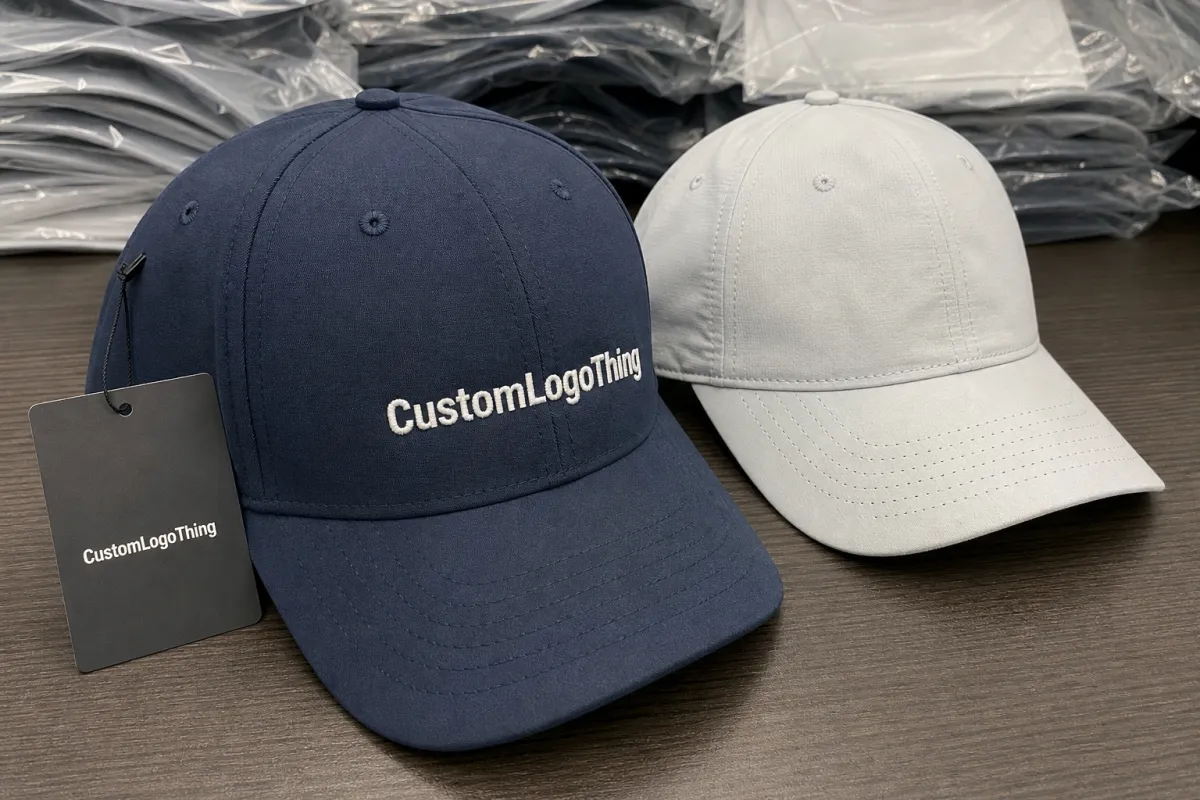
Two caps can look almost identical in a product photo and still come back at very different prices once the spec is fixed. The real cost usually shows up in the crown build, fabric, trim, closure, decoration, and packing request. A cap that looks simple from the outside can still take more sewing, more setup, or more inspection than the buyer expects.
The cleanest way to think about unit cost is as a spec question, not just a quantity question. Panel count, crown depth, sweatband type, logo placement, and whether the cap uses stock parts or custom components all matter. A 300-piece order with one logo on a standard body behaves very differently from a 3,000-piece program with multiple decoration spots, exact color matching, and retail labeling.
Decoration method changes the math too. A heat-applied patch or flat embroidery can look close to a premium cap at a glance, but the production work behind it is not the same. Dense embroidery, raised logos, and custom badges add handling, tooling, or both. None of that is a problem on its own. It just needs to be part of the budget before the quote gets treated like a locked number.
Practical rule: once a cap depends on custom decoration, special trim, and tight brand matching, a rough quote stops being very useful and a full spec sheet starts paying for itself.
Fixed costs matter as well. Digitizing, sample approvals, machine setup, thread changes, and carton labeling do not vanish at higher volume. At low volume, they show up clearly in the unit price. At scale, they spread out and get easier to absorb. That is why a quote that feels high at 250 pieces can look normal at 2,500.
Fabric, structure, and trim choices that change the cap
Most Performance Golf Caps start with polyester, recycled polyester, or a stretch blend. Standard polyester is usually the safest choice when the buyer wants shape retention and consistent repeat orders. Recycled polyester can support sustainability goals, but it still makes sense to ask about certification and lot consistency instead of assuming the label covers everything. Stretch fabrics improve comfort and fit, though they can make sourcing and decoration more finicky because the crown, seams, and logo all have to work together.
Structured and unstructured crowns are not a small detail. A structured cap holds the front panel up and usually gives logos a cleaner face. An unstructured cap feels softer and more relaxed, but it will not always hold shape the same way after repeated wear. Side by side, the difference is easy to feel.
Brim shape changes both the look and the use. A pre-curved brim feels familiar and arrives ready to wear. A flatter bill reads more modern, which some sports brands prefer for retail lines. Ventilation matters too. Laser-cut holes, mesh side panels, and perforated fabric improve airflow, but each one adds cutting, sewing, or alignment work. If the cap is meant for hot-weather events or long rounds, those details may be worth it. If it is a short-run giveaway, they may just inflate the price.
Sweatband construction is another place where costs hide. A standard sewn-in band is efficient and works for a lot of orders. A moisture-wicking band, anti-odor treatment, or softer interior finish adds material cost and may need a different supplier. Those upgrades make sense for golf, where comfort matters for hours at a time, but they still have to fit the target price.
Closure choice affects both feel and production. Snapbacks are familiar and straightforward. Hook-and-loop is easy to use and usually easy to source, though some premium programs skip it because the finish looks less refined. Fitted caps give a cleaner silhouette, but sizing gets more complicated and inventory risk goes up. Metal clips, low-profile buckles, and custom back tabs improve the look, but they also add assembly steps and can affect pack-out.
The better question is not “which version looks nicest?” It is “which version fits the use case without wasting money?” That keeps the spec honest and avoids building a cap that needed to do less.
Decoration that stays clean on the course
Decoration is where the brand shows up, and it is often the biggest swing factor in the quote. Flat embroidery is still the workhorse because it reads well, lasts, and is familiar to production teams. It handles simple logos cleanly and usually holds up across repeated wear. 3D embroidery gives a more elevated look, especially on bold lettering, but it does not forgive tiny details.
Woven patches make more sense when the logo has small text, sharp edges, or several shapes that would blur in thread. Silicone badges give a clean athletic finish and can feel more premium than a stitched mark, but custom shapes may need tooling and extra approval time. Heat transfers work well for graphic-heavy art or low-profile branding, though not every transfer holds up equally under sun, abrasion, or rough handling.
Stitch count pushes price faster than most buyers expect. A compact logo with moderate density can be efficient. A large front hit with heavy fills and several thread changes takes longer. Add a side logo or back hit, and the labor picture changes again. That is why decoration should always be quoted by position. One bundled number hides too much.
Small type is where a lot of cap programs go sideways. A logo that looks sharp on a screen can fall apart at cap size if the lettering is too tight or the stroke weight is too thin. Golf caps are not the place for overly intricate artwork unless the decoration method is chosen for that job. Dense embroidery can also pull on lightweight fabric, especially if the crown is soft or unstructured.
Here is a practical comparison that helps buyers judge decoration tradeoffs without guessing:
| Decoration method | Best use | Typical cost impact | Notes |
|---|---|---|---|
| Flat embroidery | Clean logos, club branding, team wear | Lowest to moderate | Reliable choice; stitch count and logo size still matter. |
| 3D embroidery | Bold front hits, premium lettering | Moderate to higher | Strong retail presence, but fine detail is harder to preserve. |
| Woven patch | Fine lines, sharp edges, detailed emblems | Moderate | Often easier to control than dense embroidery for complex art. |
| Silicone badge | Modern sports look, durable branding | Moderate to higher | Custom shapes may require tooling; finish is clean and tactile. |
| Heat transfer | Graphic-heavy or low-profile branding | Lowest to moderate | Good for simple art; durability expectations should be clear. |
If the logo is still changing, ask for a placement proof before production starts. It catches scale issues, seam interference, and awkward alignment while fixes are still cheap. Once the run is moving, every correction costs more.
Sizing, color matching, and brand consistency
A golf cap has to fit well enough that people stop thinking about it. That sounds easy until the cap is tried across a group with different head shapes and preferences. Crown depth, panel shape, and closure range all affect comfort. A cap may be “one size fits most” and still sit too high, pinch at the back, or feel loose after a few hours. The sample stage is where that gets caught.
Color matching deserves the same level of attention. PMS references help, but they do not override material reality. Fabric dye lots, thread lots, and trim lots can vary a little even with solid controls in place. Navy fabric, navy embroidery thread, and navy patch material may all be close and still read differently in bright outdoor light. That is normal, and it is why buyers should review samples in the conditions where the cap will actually be worn.
Brand consistency also depends on how many parts of the cap are being controlled. A single logo on the front is easier to manage than a program that includes contrast stitching, custom back tabs, branded sweatbands, and matching retail packaging. Every added touch gives the brand more control, but it also gives the supplier more ways to miss the target if the spec is vague.
When brand color really matters, it helps to send physical references, not just digital files. A printed swatch, a previous product, or a known-good sample gives the factory something real to compare against. That is often more useful than a long note saying the color should be “a little deeper” or “closer to the old version.”
For teams, clubs, and retail programs, consistency is usually worth more than chasing a perfect one-off sample. The cap that arrives late or varies from piece to piece creates more pain than the one that is slightly less dramatic but repeats cleanly.
Pricing, MOQ, and quote details buyers should confirm
MOQ is not just a factory rule. It reflects how much setup work the order needs and how many pieces it takes to spread that work out. A basic cap body with one decoration position can support a lower MOQ than a fully customized style with special trim, branded closures, and retail packaging. The more unique the build, the more the minimum usually climbs.
Buyers should also make sure the quote shows what is actually included. Some quotes only cover the cap itself. Others include decoration, labeling, cartons, master packing, and shipping support. Those differences can make two quotes look comparable when they are not. The cheapest line on the page is not always the cheaper order.
These are the details worth confirming before anyone treats the price as final:
Decoration - Ask whether setup, digitizing, patch tooling, and repeat fees are included.
Packaging - Check whether individual polybags, hangtags, barcode stickers, and carton marks are part of the quote.
Sampling - Confirm if proto samples, pre-production samples, and revision samples are charged separately.
Freight - Make sure the quote says whether shipping is included, estimated, or not covered at all.
Overrun and underrun - Ask how much quantity variance is allowed, especially on custom programs.
Lead time - Get the production window in writing, not just a best-case estimate.
Price also changes with order shape. A single-color run with one logo position is simpler than a mix of sizes, colors, or decoration locations. If the order needs split shipments, retail prep, or delivery by store, those instructions should be on the quote before the job starts. No one likes discovering that “simple” meant something different on the supplier side.
Process, timeline, and production steps from art to delivery
The smoothest cap orders usually follow the same basic path: art review, spec confirmation, sample, approval, production, inspection, and shipment. Skipping one of those steps tends to create delay later. A quick yes at the beginning can turn into a slow fix after production has already started.
Start with art that is realistic for the decoration method. If the logo has tiny lettering or thin strokes, ask whether it needs simplification. That is better than discovering the problem after the proof comes back. Once the art is locked, the factory can move to digitizing, patch prep, or transfer setup depending on the build.
Sampling is the point where most issues should be found. That includes color mismatch, crown shape, decoration placement, and closure feel. It is also where the buyer should check how the cap wears, not just how it looks on a table. A style can pass a photo review and still feel wrong once it is on head.
Bulk production should not begin until the sample is signed off. After that, the factory usually moves through cutting, sewing, decoration, finishing, and packing. The exact order depends on the cap type, but the idea is the same: lock the approved sample, then repeat it as consistently as possible.
Inspection and packing are easy to ignore and expensive to skip. Loose threads, uneven embroidery, crooked patches, and wrong labels are all easier to fix before cartons leave the factory. If the order is going into retail or event distribution, packing instructions need to be explicit. Otherwise, the final mile becomes a cleanup job.
Timeline depends on complexity, not just quantity. A clean stock-body order can move fast. A custom program with special trim, matching fabric, and multiple proof rounds will take longer no matter how urgent the calendar feels. The most honest schedules build in enough time for one round of correction.
Frequently Asked Questions
What makes Performance Golf Caps different from regular baseball caps?
Performance golf caps usually lean on lighter fabrics, better airflow, and finishes that handle sun and sweat more comfortably. They are built to stay wearable through a round, not just to look good in a drawer.
Is embroidered branding always the best choice?
No. Embroidery is durable and common, but woven patches, silicone badges, and transfers can be better when the logo is detailed or the brand wants a cleaner retail look.
Can recycled polyester perform as well as standard polyester?
Yes, as long as the fabric spec is right. The bigger question is consistency from lot to lot and whether the supplier can support the finish, fit, and decoration the program needs.
Why does the quote change so much between suppliers?
Usually because the quotes do not include the same thing. Decoration setup, sampling, packaging, freight, and trim details are often handled differently, so the first step is to compare the spec line by line.
What should buyers send to get a useful quote?
Send the cap style, fabric preference, closure type, logo artwork, decoration placement, target quantity, packaging needs, and delivery timing. The more of that is clear upfront, the less back-and-forth it takes to price it properly.


