A custom apparel bag order can sit untouched for three days over one missing measurement. Not because the job is complicated. Because nobody can price, proof, or schedule a bag that has not been defined.
That is why apparel poly bags Lead Time and MOQ should be handled before the order becomes urgent. Size, closure, print, gauge, material, and quantity all affect the unit cost and the production calendar. Change one of them late and the quote may need to be rebuilt.
Custom Logo Things works with buyers sourcing garment bags for folded tees, woven shirts, uniforms, outerwear, activewear, samples, retail sets, and ecommerce returns. The fastest quote usually comes from a boringly complete spec: finished bag size, folded garment size, film type, gauge, closure, print requirements, quantity, and target delivery date. Boring is good here. Boring ships.
Why apparel bag orders stall over one missing spec
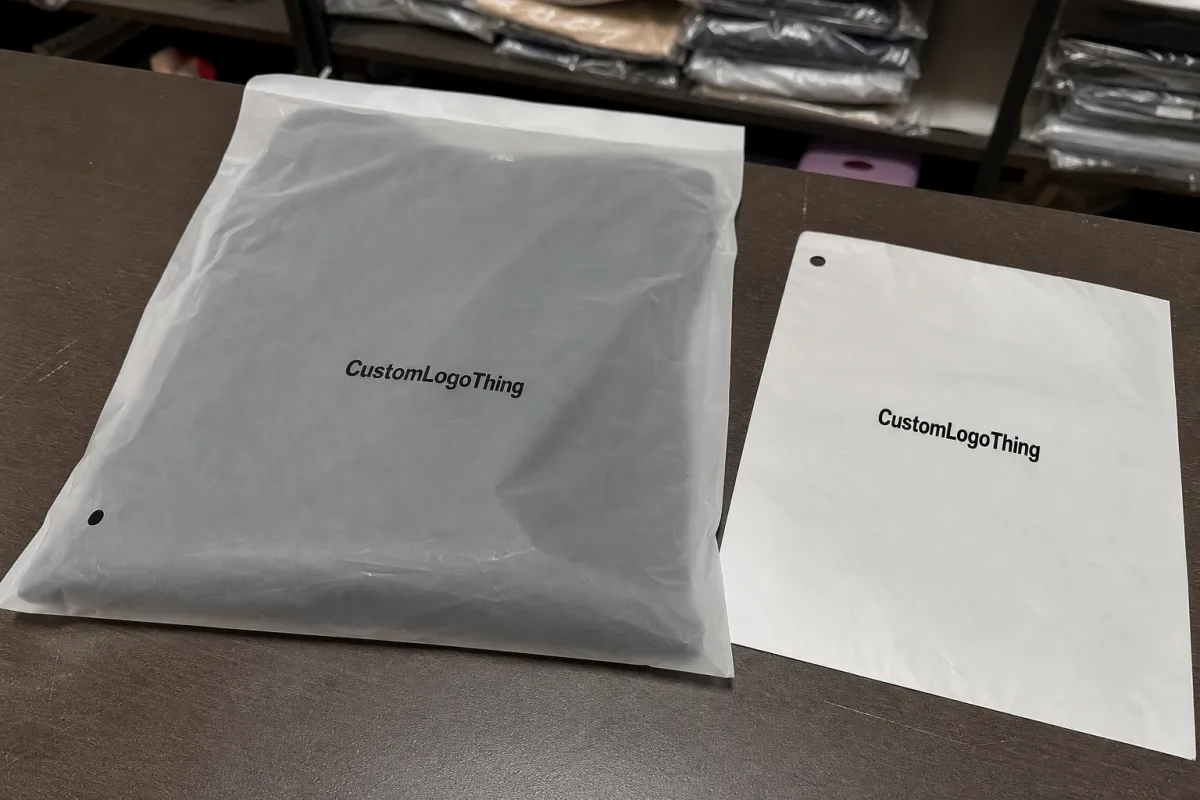
Most apparel poly bag orders do not slow down because polyethylene film is mysterious. They slow down because the request is vague. A “standard shirt bag” could mean a slim tee, a folded dress shirt with collar support, a thick fleece pullover, or a retail pack with inserts. Those do not need the same mouth opening, seal placement, venting, or closure.
Folded garment dimensions matter more than the garment name. A tee folded to 9 inches wide by 12 inches tall may fit neatly in a 10 inch by 14 inch lip-and-tape bag. A hoodie with the same flat width may need a 13 inch by 16 inch bag, a side-gusset format, or a heavier film if the fabric has bulk. That extra film area affects cost per piece, carton count, and sometimes the production minimum.
The use case matters too. Retail-ready shirts usually need a clear front face, tidy closure, consistent print placement, and suffocation warning copy if the opening size triggers child-safety labeling concerns. Ecommerce returns may need a resealable strip, stronger film, or a write-on zone for warehouse handling. Bulk pack-out for a 3PL may care less about polish and more about how fast operators can load the bags without fighting static or weak seals.
A useful first quote should include the working spec: material, gauge, finished size, closure, print colors, MOQ, proof timing, setup charges if any, and a realistic ship window after proof approval.
Here is the trap: buyers often ask for a unit price before the bag has a spec. That makes comparison almost useless. One supplier may price 1.5 mil clear LDPE with one-color print. Another may price 2.5 mil frosted film with a resealable closure, vent holes, and heavy ink coverage. Both are “custom apparel bags.” They are not the same product.
Bag styles, closures, and print choices for apparel packing
Flat poly bags are the simplest option for many garments. They work well for tees, lightweight knits, socks, accessories, and folded items that do not need extra depth. Plain stock sizes may be available at lower minimums. Custom sizes and printed versions need more setup and usually require higher quantities.
Lip-and-tape bags are common for folded retail apparel because the adhesive flap gives a clean, closed finish. They are also familiar to packing teams, which matters. A clever closure is not clever if it slows the table down.
Side-gusset bags help with bulkier apparel. The gusset expands instead of forcing the garment to push against the face of the bag. For sweaters, robes, outerwear, and thick uniforms, that can make packing faster and presentation cleaner. Unit cost may be higher than a flat bag, but labor savings can offset some of it on larger pack-outs.
Resealable zip bags are useful for returns, samples, premium sets, replacement parts, and products that may be opened more than once before final use. They usually cost more than lip-and-tape bags and may require a heavier film to feel right. For a single-use folded tee program, a zipper can be overkill. Expensive overkill, which is still overkill.
Wicketed bags are built for speed on packing lines. The bags are held together on a wicket so the operator can open and load each piece quickly. They make sense where volume is high and the product dimensions are consistent. For mixed small batches, they can be less practical.
Print choices affect timing and MOQ. Clear film with one-color logo print is usually straightforward. Frosted film, large ink coverage, tight registration, multiple colors, barcode windows, recycling marks, hang holes, vent holes, and warning panels add setup or inspection steps. None of those are a problem if they are known early. They become a problem when they appear after the quote.
| Bag Format | Typical Apparel Use | Common Gauge Range | Buying Note |
|---|---|---|---|
| Flat poly bag | Tees, lightweight shirts, accessories | 1.2-2.0 mil | Often the lowest cost per piece for simple folded goods |
| Lip-and-tape bag | Retail folded apparel | 1.5-2.5 mil | Clean closure and good presentation for branded packing |
| Resealable zip bag | Returns, samples, premium sets | 2.0-3.0 mil | Higher cost, but useful when the bag is opened repeatedly |
| Side-gusset bag | Hoodies, outerwear, bulky garments | 1.8-3.0 mil | Improves fit where flat bags create too much tension |
| Wicketed bag | High-volume line packing | 1.25-2.5 mil | Can reduce packing labor for repetitive SKUs |
The best style is not always the fanciest one. Match the bag to the handling path: how the garment is folded, who packs it, whether it goes to a retail shelf or a parcel shipment, and how many touches it sees before the customer opens it.
Film gauge, bag size, and performance specs buyers should lock in
Bag sizing starts with the folded garment, not the flat pattern on a tech pack. Measure folded width, folded height, and compressed thickness. Then leave enough room for easy insertion without creating a loose, sloppy pack. A common allowance is 0.5 to 1 inch on width and 1 to 2 inches on height. Bulky garments may need more.
Gauge is film thickness, usually shown in mils in the U.S. apparel market. A 1.2 mil to 1.5 mil bag can be fine for lightweight goods with low abuse risk. A 2.0 mil bag gives a stronger hand-feel for many retail apparel programs. A 2.5 mil to 3.0 mil bag may make sense for heavier garments, returns, or repeated handling.
Thicker is not automatically better. If the product only needs dust protection inside a carton, a heavy film may add cost, weight, storage volume, and freight expense without improving the customer experience. It can also make the pack feel stiff, especially on small garments.
Performance shows up on the packing floor. Seal strength matters when cartons are stacked or squeezed. Slip matters because bags that are too grabby slow loading and can scuff against each other. Static control matters with lightweight film, especially in dry warehouse air. Opening ease matters because even a good-looking bag becomes a nuisance if operators have to separate and pry open every piece.
Buyers should also check venting. Small vent holes help release trapped air during packing and carton compression. Without them, filled bags can pillow, stack poorly, or resist carton closing. Too much venting can reduce protection from dust or moisture. There is no magic universal pattern. The right choice depends on the garment, carton pack, and handling conditions.
Some apparel programs need broader distribution testing. Poly bags are often one part of an outbound package, so carton compression, parcel drop risk, and vibration may be evaluated under programs from organizations such as ISTA. If the packaging system includes paper inserts, hangtags, belly bands, or cartons, buyers may also reference sourcing standards from FSC for paper-based components.
Pricing, MOQ, and unit cost drivers on custom apparel poly bags
Pricing for custom apparel poly bags comes from plain inputs: size, film type, gauge, closure, print colors, ink coverage, carton configuration, and quantity. A small 10 inch by 14 inch clear 1.5 mil lip-and-tape bag with one-color logo print will not price like a 14 inch by 18 inch frosted 2.5 mil resealable bag with warning copy and heavy coverage.
For planning, simple custom-printed apparel bags may land around $0.08-$0.18 per unit at higher quantities. Heavier resealable or specialty printed bags can run $0.18-$0.35 or more per unit, depending on the final spec and order size. Smaller runs carry more pressure from setup charges, tooling, proofing, and material setup. A 5,000-piece order usually has a higher unit cost than a 25,000-piece order. That is not a pricing mystery. Setup has to be spread across fewer bags.
MOQ changes with the bag. Plain stock bags may be available in lower quantities. Custom printed bags often need a larger minimum because press setup, ink preparation, plate or screen work, and production scheduling must be spread across enough units. Specialty closures, nonstandard sizes, frosted film, high-gauge material, post-consumer recycled content, or multi-color artwork can push the minimum higher.
Recycled content deserves a practical note. Buyers may ask for recyclable PE film, recycled-content film, or specific compliance language. Those requests can affect price and availability. The terms are not interchangeable. A recyclable polyethylene bag is not automatically made with recycled content, and recycled-content film may have different clarity, strength, or lead time depending on the resin source.
Bulk pricing helps only if it fits the inventory plan. Ordering 50,000 bags may lower unit cost by several cents, but it also ties up cash and shelf space. Seasonal apparel brands should be careful. If the size range, branding, warning copy, country-of-origin handling, or garment mix changes before the bags are used, the cheapest bag on paper becomes leftover inventory.
| Quantity | Example Spec | Estimated Cost Per Piece | Best Fit |
|---|---|---|---|
| 2,500-5,000 | Clear flat or lip-and-tape, one-color print | $0.14-$0.28 | Small launches, test runs, limited SKU programs |
| 10,000-25,000 | Custom size, one or two print colors | $0.09-$0.20 | Regular apparel packing with predictable demand |
| 50,000+ | Repeat spec, steady artwork, standard film | $0.06-$0.16 | High-volume programs with storage space and stable branding |
Ask for tiered quotes. A clean request for 5,000, 10,000, and 25,000 pieces shows the real breakpoints without guessing. Custom Logo Things can also help compare related options through Custom Packaging Products if the apparel program includes mailers, labels, tissue, inserts, or retail cartons.
Apparel poly bags lead time and MOQ from quote to ship
Lead time starts after specs and artwork are approved. Not before. A quote request sent on Monday does not put an order into production if the bag size is still undecided, the logo is a low-resolution screenshot, or the closure has not been confirmed.
A typical custom apparel poly bag order follows a direct sequence: spec review, formal quote, artwork check, digital proof, buyer approval, production, quality check, packing, and shipment. For standard custom printed bags, a realistic production window may be 12-20 business days after proof approval. Rush options depend on material availability, print method, press capacity, and whether the requested quantity fits the open schedule.
More complex orders can take longer. Multiple bag sizes, tight PMS color matching, unusual film, frosted finishes, heavy ink coverage, special hole placement, zipper closures, or late artwork changes can all stretch the timeline. Even a small logo revision can matter if plates, screens, or production files have already been prepared. That is not supplier drama. It is how production queues stay controlled.
MOQs are tied to the same reality. A supplier may be able to run a lower minimum for a standard clear stock size with simple print. A custom size on specialty film may need a larger run because the material setup and machine time do not make sense below a certain quantity. Buyers tend to hate that answer because it is less tidy than “MOQ is 1,000.” Unfortunately, production does not care about tidy.
To move faster, send vector artwork such as AI, EPS, or print-ready PDF. Confirm folded garment size. Choose standard clear LDPE or a suitable recyclable PE film when it works for the product. Respond to proofs the same business day if the schedule is tight. Give the supplier a real delivery target, not just “ASAP,” because shipment method, transit time, and receiving dock timing affect the plan.
For apparel brands shipping Direct To Consumer, garment bags may sit inside a mailer. If you are pairing inner apparel bags with outer shipping bags, review compatible options such as Custom Poly Mailers so the packaging works together without extra bulk, trapped air, or awkward carton counts.
How a packaging supplier keeps apparel orders moving predictably
A strong packaging supplier does not win by saying yes to every date. They win by explaining what the date depends on. If artwork is ready, film is standard, and the quantity fits the normal production queue, the ship window can be planned with confidence. If one input is loose, the supplier should say so before the purchase order is placed.
Garment packaging experience matters because apparel bags have to do several jobs at once. They keep folded goods clean, support a neat presentation, protect against light abrasion, help warehouse staff identify SKUs, and reduce handling damage before the customer sees the product. A bag can look fine on a sample table and still fail in production if it slows packing by 20 seconds per unit across a 6,000-piece run.
Quality checks should cover more than the logo. Size tolerance, film gauge, seal integrity, print placement, closure function, hole placement, carton labeling, and count accuracy all matter. For repeat orders, the prior spec should be referenced so the new run matches the old one unless a change has been approved.
Carton configuration also deserves attention. Bags may be bulk packed, counted into inner bundles, packed by SKU, or labeled for warehouse routing. If receiving needs pallet details, carton dimensions, gross weight, or case count, ask before production closes. Scrambling for that information after shipment is a fun little way to annoy everyone involved.
Consistent communication is a process advantage. Fewer handoffs mean fewer surprises between quote and shipment. If a buyer needs several SKUs with different folded dimensions, it helps to build a size chart and quote each bag against the garment group it serves. That keeps lead time and MOQ from being recalculated from scratch every time a reorder comes up.
For routine questions about ordering, artwork, proofs, and shipping details, the FAQ is a useful starting point. A production-ready quote still depends on the exact bag spec.
Common ordering mistakes that raise cost or extend delivery
The biggest quote-comparison mistake is comparing prices without matching the full spec. One quote might include 2.0 mil film, one-color print, suffocation warning copy, and carton labeling. Another might price 1.25 mil plain bags with no print and no special packing. The cheaper number may not stay cheaper after the missing items are added.
Artwork revisions after proof approval are another reliable delay. If the production slot is booked and the buyer changes logo size, ink color, barcode placement, or warning text, the order may need a new proof. That can create extra charges and push the run behind jobs already approved.
Carton planning gets ignored until it bites. A 25,000-piece order may sound simple until receiving realizes it arrives in more cartons than expected, or the cartons are too heavy for the storage setup. Ask for approximate carton count, carton dimensions, gross weight, and pallet configuration if the warehouse needs to schedule labor or reserve space.
Wrong film thickness creates hidden costs. Too thin, and bags may tear during insertion or distribution. Too thick, and the pack may feel stiff, cost more, and take more room in cartons. Wrong closure choice has the same problem. A zip bag can be excellent for returns but unnecessary for a folded tee program where lip-and-tape is faster and cheaper.
Another mistake is waiting until inventory is nearly gone. Reorders are faster than first orders only if the previous spec, artwork, and quantity are available. If the old bag was sourced without a clean record of gauge, finished dimensions, print file, closure details, and carton pack, the reorder can turn into a new development job.
What to send before you request a quote or reorder
A complete quote request does not need to be fancy. It needs to be specific. Send the garment type, folded dimensions, desired bag size if known, film preference, gauge target, closure style, print colors, quantity, packing format, and target delivery date. If a sample bag worked before, include photos with a ruler or caliper reading if available.
- Garment details: tee, woven shirt, hoodie, leggings, outerwear, uniform, accessory, or mixed SKU group.
- Folded dimensions: width, height, and thickness after the garment is folded for packing.
- Bag construction: flat, gusseted, lip-and-tape, resealable zip, wicketed, vented, or hang-hole style.
- Material and gauge: clear LDPE, recyclable PE, recycled-content film if required, frosted film, and target thickness in mils.
- Print requirements: logo file, print colors, warning copy, barcode space, recycling marks, and ink coverage area.
- Order details: target quantity, delivery deadline, ship-to location, carton needs, and whether this is a new order or reorder.
Ask for the same decision set every time so apparel poly bags lead time and MOQ can be quoted accurately without a long back-and-forth chain. If the request is for plain stock bags, say that. If it is for printed bags, send art. If the brand needs a sample run before bulk production, say that too, because sampling, production, and full-order scheduling are different paths.
The ordering sequence should stay simple: confirm the spec, review the quote, approve the digital proof, place the order, and schedule receiving before the production slot is lost. Good packaging is not just a bag. It is a controlled process that protects margin, presentation, and delivery timing.
For a faster quote from Custom Logo Things, send the details in one message and ask for tiered quantities. The cleanest answers come when the bag size, artwork, quantity, material, and delivery target are clear before pricing begins.
FAQ
What affects apparel poly bag lead time the most?
Artwork approval often matters more than the run itself because production cannot start until the final proof is approved. Film availability, print complexity, quantity, specialty sizing, closure style, and late revisions can also move the schedule.
What is a realistic MOQ for custom apparel poly bags?
MOQ depends on bag size, film type, print method, closure, and material setup. Standard clear bags often have lower minimums than custom-printed, heavier-gauge, frosted, recycled-content, or resealable options, so the exact spec should be quoted before inventory planning.
How can I lower unit cost without hurting bag quality?
Use the smallest bag size that fits the folded garment cleanly, and avoid thicker film unless the product needs it. Standard materials, fewer print colors, practical ink coverage, and larger quantity breaks usually lower cost without reducing useful performance.
How do I speed up a reorder for apparel poly bags?
Send the previous spec, artwork file, target quantity, and carton requirements together. If nothing has changed, ask for a reorder quote and current lead time before the old inventory runs low, because repeat work still needs scheduling and material confirmation.
What should I include in a quote request for apparel poly bags?
Include garment type, folded dimensions, desired bag size, material preference, gauge, closure style, print needs, quantity, and delivery deadline. A complete request makes it easier to return accurate price, MOQ, and schedule information on the first response.


