Most buyers expect recycled packaging to be a tradeoff. Higher cost. Longer lead time. More back-and-forth. In practice, Recycled Poly Mailers lead time and moq are usually more manageable than the quote sheet makes them look. The delay is rarely the resin. It is incomplete artwork, a vague size request, or someone trying to force one mailer to cover every product in the catalog.
That is the useful place to start. Recycled Poly Mailers fit lightweight apparel, soft goods, subscription kits, and low-damage items that do not need rigid protection. If that matches the shipping profile, the numbers can work well: less packout weight, lower freight cost, and no void fill chewing up labor. If you need the rest of the packaging program to stay aligned, keep the mailer spec in step with the broader lineup through Custom Packaging Products and the bag category at Custom Poly Mailers.
A pretty mockup does not make a bag stronger. For mailers, the spec is the product.
Why Recycled Poly Mailers Can Beat Carton Costs Fast
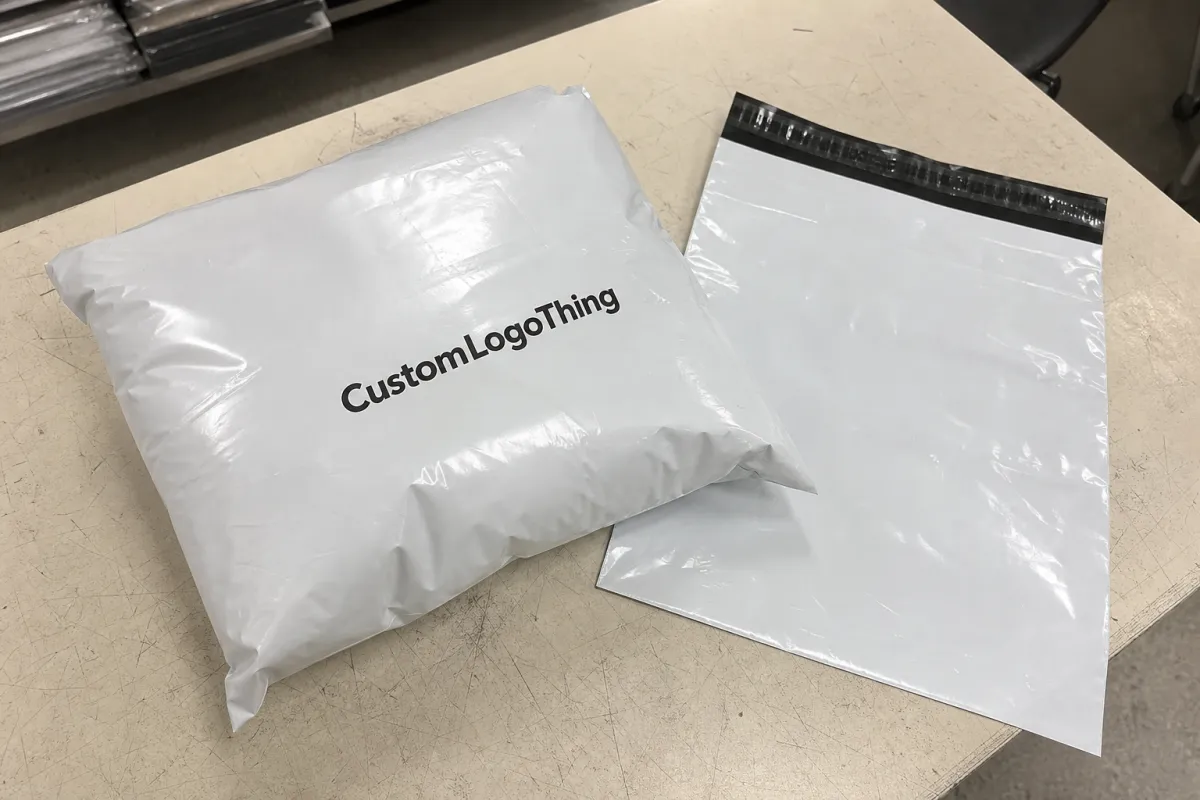
From a packaging buyer's view, the appeal is simple. Recycled Poly Mailers can reduce material spend and outbound shipping weight in one move. A corrugated carton usually needs more board, more tape, and often filler. A mailer is one flexible format that goes straight from packing table to parcel label. For apparel brands, DTC subscription programs, and replacement-part teams, that matters because fulfillment speed and parcel cost usually show up on the same spreadsheet sooner or later.
The catch is obvious. The product still has to fit. A recycled mailer is not a magic shield, and nobody serious should pretend it is. If the item has sharp corners, heavy hardware, or crush-sensitive components, a carton can still be the better choice. For tees, knits, cosmetics kits, accessories, and many folded soft goods, the landed cost usually looks better in a mailer. Lower dimensional weight helps too. Once parcel rates climb, that detail stops being minor.
There is also a terminology trap. "Recycled" can mean post-consumer recycled content, post-industrial recycled content, or a blend. Those are not interchangeable labels. The build matters because resin source affects opacity, seal behavior, stiffness, and how clean the film prints. If a supplier cannot explain the film structure clearly, keep asking until the answer is specific enough to compare with another quote.
The EPA's recycling basics page is a useful reality check on recycled-content claims and material handling: EPA recycling basics and benefits. That is a good reminder for buyers to ask what is actually in the film and what claim can be supported on the finished bag. Loose language sells presentations. Clear specs keep orders defensible.
I keep seeing the same mistake: buyers chase the sustainability message first and the shipping math second. That order gets expensive. Start with product fit, shipping method, and repeatability. Then look at recycled content, brand story, and end-of-life claims. That is the clean way to buy, and it keeps recycled poly mailers Lead Time and MOQ from turning into a moving target.
Material Builds, Sizes, and Closure Options That Fit the Ship Method
The film build is where the decision gets real. Recycled Poly Mailers are usually made with a blend that includes post-consumer or post-industrial recycled resin, then extruded into a co-extruded structure for puncture resistance and print performance. In practice, buyers often see recycled content ranges from 30% to 80%, though the usable number depends on the opacity target, seal strength, and how the supplier balances stiffness against flexibility. Higher recycled content is not automatically better if the bag turns brittle or seals poorly.
Thickness matters just as much. A light apparel program may sit comfortably in the 2.5 to 3 mil range. Heavier or rougher ship profiles often need 3.5 to 4 mil. That is not a hard rule, but it is a sensible starting point. Too thin and the bag tears, stretches, or telegraphs every edge inside. Too thick and the bag gets expensive, harder to fold, and less pleasant to run at scale. Buyers sometimes over-spec film thickness because they are nervous. That is understandable. It is also a fast way to pay for protection the product does not need.
Size selection should be boring. Boring is good. Standard dimensions like 10 x 13, 14.5 x 19, and 19 x 24 cover a lot of routine apparel orders, but custom dimensions make sense once the pack count, fold pattern, or accessory bundle starts drifting. The goal is not to create a giant empty sleeve that looks wasteful and raises shipping volume. The goal is enough room for a clean fold and a reliable seal. Overstuffing is a classic failure mode. It weakens the flap seal and makes the finish look rushed.
Closure choice should match the ship method. A self-seal adhesive strip works for most outbound orders. A stronger permanent seal is better for single-use shipments where tamper evidence matters. For return-ready programs, a dual-adhesive flap or extra-tough closure can save the buyer from needing a second packaging format later. Small details like an opaque film, tear strip, or print-safe outer surface are easy to ignore on a proof and very obvious on the packing line.
A practical sizing rule is still the best one: measure the product, add room for a fold and a little cushion, then choose the smallest mailer that closes cleanly. That keeps cost per piece lower and usually shortens approval because the bag is not trying to do too much. A mailer that fits well ships faster, stacks better, and gets fewer complaints from the warehouse team. They notice. Usually before anyone in purchasing does.
Print, Branding, and Performance Specs Buyers Should Lock First
Print choices affect cost and speed more than most buyers expect. A one-color logo usually moves faster than a full-coverage graphic because the press setup is simpler and registration is less fussy. Tight linework, tiny type, and gradient-heavy artwork do not usually age well on flexible film either. A mailer gets handled, stacked, and dragged across conveyor belts. Fancy artwork is great until it rubs off, shifts on press, or gets muddy on a recycled film that does not hold ink the way a rigid substrate does.
The specs worth locking first are film thickness, opacity, seal strength, and the print-safe zone. If those are stable, the visual work is easier. For most brands, a bold logo, short line of text, and one strong brand color is enough. You do not need to turn a shipping bag into a billboard. The bag has one job: protect the order and arrive looking clean enough that the customer does not feel like they received a compromise.
Artwork approval is where projects either stay calm or become annoying. Final dieline, approved artwork, Pantone references if color accuracy matters, pack count, and ship-to details should all be in the same proof cycle. Send vector files, not a flattened screenshot dressed up as a logo. Suppliers can fix plenty of things, but they should not have to rebuild a brand from a JPEG. If the artwork changes after proof approval, expect the clock to move. That is not drama. That is production.
There is another practical point buyers miss: recycled film can have more variation than virgin film because the feedstock is less uniform. That does not make it bad. It means the proof stage matters more, not less. A good supplier will flag anything that threatens legibility, color contrast, or seal performance before the job starts. A bad one will shrug and hope the warehouse does not notice.
For buyers comparing formats, the fastest path is usually the simplest one. Keep the logo bold. Keep the message short. Keep the spec repeatable. That does more for production speed than a complicated design ever will. A good mailer is not about showing off. It is about shipping cleanly at scale and keeping the reorder path painless.
Pricing, MOQ, and Unit Cost Drivers
Pricing on recycled poly mailers comes down to a few predictable levers: size, film thickness, recycled content level, print coverage, number of colors, and whether the tooling already exists. That is the honest answer. A supplier may dress it up with sales language, but the bill still follows those inputs. If you are comparing quotes, look at the landed number, not just the bag price. Freight, setup charges, and any tooling fees can move the actual spend more than a buyer wants to admit.
For MOQ, stock mailers can start low, but custom printed recycled mailers usually land in the 5,000 to 10,000 unit range. That is not a fantasy number; it is the practical zone where setup costs stop crushing the unit price. Smaller runs are possible, especially if you accept a stock size and a simple logo hit, but the unit cost climbs quickly as the fixed cost is spread across fewer bags. A low quote on a tiny run is not a bargain if the cost per piece ends up ugly.
Here is the way I usually frame the pricing tradeoff: the lower the run, the more the bag price is carrying setup. The larger the run, the more inventory risk enters the picture. If you order six months of packaging because the per-piece cost looked beautiful, you did not really save money. You parked cash in a warehouse. That matters even more for brands with changing collections or seasonal art.
| Option | Typical MOQ | Approx. Unit Cost Pressure | Best Fit |
|---|---|---|---|
| Stock unprinted recycled mailers | 500 to 1,000+ | Lowest setup burden; often low tens of cents or less at volume | Fast replacement orders, test runs, and low-complexity programs |
| Stock size with one-color print | 3,000 to 5,000 | Moderate setup; usually a bit higher than unprinted stock | Growing brands that want branding without a heavy spend |
| Fully custom printed recycled mailers | 5,000 to 10,000+ | Higher setup; best pricing once quantity spreads the fixed cost | Repeat programs and stable packaging specs |
Tooling fees are the part buyers forget to budget for until the quote lands. Flexo plates, cylinders, and similar setup items can add a few hundred dollars per color depending on the process and artwork complexity. Some suppliers roll setup into the unit price. Others separate it. Neither approach is wrong. The real issue is whether you know what is included before you approve the order.
Ballpark price ranges also move with resin markets, freight conditions, and print complexity. A plain stock recycled mailer can sit much lower than a fully printed custom bag, and a large run can drop below a small run by a noticeable margin. If two quotes are close, ask what changed: film thickness, recycled content, closure style, or freight mode. One of those usually explains the difference.
Recycled Poly Mailers Lead Time and MOQ: Production Steps and Timeline
The production path is straightforward once the inputs are clean. Quote review comes first, then artwork check, proof approval, material scheduling, film conversion, printing, cutting, packing, and outbound freight. That is the whole chain. Recycled poly mailers lead time and moq only get messy when one of those steps stalls because someone forgot a size, changed a logo after approval, or sent an incomplete ship-to record.
For a straightforward run, standard jobs often move in about 10 to 20 business days after final proof approval. New setups take longer. If tooling has to be created or if the material build is unusual, add several business days before production even starts. That is not a delay. It is the calendar doing what calendars do. The mistake is to confuse approval time with production time. They are not the same thing, and they should never be treated as the same promise.
The cleanest way to think about schedule risk is to split it into four buckets: approval window, production window, cartonization, and transit time. Buyers who lump all four into one "lead time" number usually get surprised later. Buyers who separate them usually do not. If your in-hands date is fixed, tell the supplier upfront and ask for a schedule that includes freight time. One question early beats three apologies later.
Repeat specs change the timeline more than most people expect. When the die, artwork, and film build are already locked, a reorder can move much faster than a fresh job. That is why recurring packaging programs reward consistency. The fewer variables you change, the less chance the order will stretch beyond what you planned.
A practical way to compare timelines is to look at the order type, not just the promised ship date:
| Order Type | Common Lead Time After Approval | What Usually Slows It Down |
|---|---|---|
| Stock unprinted | 3 to 7 business days plus transit | Freight booking and warehouse congestion |
| Stock size with simple print | 10 to 15 business days | Artwork revisions and proof changes |
| Custom size or custom print build | 15 to 25 business days | Tooling, material sourcing, and color approval |
If the job needs to arrive by a hard date, the useful question is not "How fast can you make it?" It is "How fast can you make it after approval, and what does transit add?" That distinction saves more schedules than any optimistic estimate ever will.
If you want a benchmark for real package performance, not just a pretty spec sheet, ISTA's testing standards are worth referencing: ISTA package testing standards. A shipping bag does not need every lab test under the sun, but it should survive distribution handling, abrasion, and normal parcel abuse. A supplier that can explain how the bag performs under those conditions is usually safer to work with than one selling vibes.
Quality Checks That Prevent Reprints, Delays, and Returns
Quality control is not a luxury on a mailer order. It is the cheapest way to avoid reprints and rush freight later. The first checks should happen before the line runs: sample verification, seal testing, print alignment, and size confirmation. If the proof says one thing and the sample shows another, stop there. Do not ask production to "just make it work." That phrase is how people end up paying for inventory they cannot use.
Once the bags are in motion, the useful tests are practical, not theatrical. Tear resistance, puncture resistance, adhesive hold, and moisture tolerance matter because parcels get thrown, stacked, and exposed to messy conditions. A mailer that looks fine in a mockup can still fail if the film is too thin or the closure is weak. The surface might carry the logo perfectly and still split on the way to the customer. That is a bad kind of surprise.
The most useful checks are also the least glamorous. Confirm the gauge with a micrometer or supplier cert, verify seal width, inspect print registration at the edges, and make sure the adhesive strip releases and reseals the way the program needs. If the bag is supposed to be opaque, hold it to light. If the product has sharp corners, put one in the bag and squeeze the edge lines. Simple checks catch more problems than fancy language ever will.
Ask for a production reference tied to the reorder, plus the approved proof and final spec sheet. Those documents save time later because they remove guesswork. If the supplier has to hunt through email threads for the old dieline, your reorder is already slower than it should be. Good documentation is not paperwork for its own sake. It is a defense against the dumbest delays in the entire process.
Quality also affects cost. One missed check can add days, burn freight money, and create avoidable setup charges if the job needs to be rerun. That is why experienced buyers treat quality as a timeline issue, not just a product issue. If the bag does not pass on the front end, the schedule is already leaking.
Why Repeat Buyers Stick With One Mailer Spec
Stable specs make the whole operation easier. Same size, same film, same print setup, same closure. That sounds boring because it is boring, and boring is what makes reorders faster and less risky. Once the bag is proven, the buyer can forecast inventory, time promotions, and keep emergency purchasing off the calendar.
The planning advantage is bigger than most people realize. A brand that knows its reorder point can line up packaging with seasonal drops instead of scrambling after stock gets low. That matters for cash flow too. If you know your order cycle, you can compare quotes apples-to-apples instead of starting from zero every time. The supplier does not need to relearn the spec. You do not need to renegotiate basic facts. Everyone saves time.
There is also a quiet service advantage. Reliable suppliers keep approvals, artwork history, and production notes organized so repeat orders do not become a scavenger hunt. That means fewer mistakes on the bag, fewer surprises on the invoice, and fewer back-and-forth emails asking who changed what. A clean reorder history is worth real money because it protects unit cost over time.
If your packaging program includes more than one format, keep the family consistent. Recycled mailers, inserts, cartons, and labels should all feel like they belong together. That is easier to manage through a single spec discipline and a common sourcing rhythm than by chasing a new idea every quarter. Packaging buyers do not get paid for inventing drama.
What to Send for a Fast Quote and First Order
A fast quote starts with complete inputs. Send the bag size, film thickness, recycled content target, print colors, closure type, quantity, and the date you need the mailers in hand. If any one of those is missing, the supplier has to guess, and guesses are expensive. The more precise the ask, the closer the first quote will be to the final invoice.
The file side matters just as much. Send a vector logo, Pantone references if color accuracy matters, and any copy that absolutely has to stay on the bag. If the artwork affects the dieline or the safe print zone, say so upfront. You can also ask for two quote paths in one round: one lower-MOQ version and one better-unit-cost version. That makes the tradeoff obvious instead of hiding it under sales language.
Do not bury shipping details. Include the destination ZIP or port, the delivery window, and whether partial shipments are acceptable. If the order needs to split across multiple locations, say that before approval. A supplier cannot plan transit correctly if the delivery map shows up late. That is how good production schedules get wrecked by bad admin.
One more practical thing: send a reference image or an old sample if you have one. Not because the supplier cannot read a spec sheet, but because packaging memory is full of little exceptions. A photo of the previous bag, a short note about the zipper or adhesive behavior, or a callout about how the product folds can save a round of clarifying email. The cleanest first order is the one that answers questions before they start.
If the first order is built on clear inputs, recycled poly mailers lead time and moq become manageable, predictable, and a lot less annoying than most buyers expect. That is the real win. Not perfection. Just fewer surprises.
What is the typical MOQ for recycled poly mailers with custom printing?
Custom printed orders often start around 5,000 to 10,000 units, depending on size, print coverage, and how the supplier handles setup. Stock or unprinted options can go lower, but the per-unit price usually climbs as the run gets smaller. If you need a lower MOQ, ask for a stock size with a simple logo hit instead of a full custom build.
How long is the lead time after proof approval?
A straightforward run may move in about 10 to 20 business days after final approval, but new setups can take longer. Artwork changes, missing specs, and material sourcing issues are the usual reasons timelines slip. Add freight time separately so you do not mistake production time for total delivery time.
Do recycled poly mailers cost more than standard poly mailers?
Usually yes, but not always by much. The difference depends on recycled content level, film thickness, and quantity. Higher volumes reduce the gap because setup costs spread out over more bags. The real comparison should be landed cost, not just the bag price.
What details do you need for an accurate quote on recycled poly mailers?
Send bag size, thickness, color, print count, closure style, and exact quantity. Include your artwork file and the date you need the mailers in hand. If you are unsure, ask for two quote paths so you can compare price against lead time.
Can I speed up lead time and MOQ on a repeat order?
Yes. Repeat orders move faster when the size, print, and material spec stay unchanged. Keeping the approved proof and order history on file cuts down on back-and-forth. The fastest orders are the ones where the buyer sends one clean spec and does not keep moving the target.
In the end, the best recycled mailer program is the one that fits the product, prints cleanly, and reorders without drama. Keep the film spec honest, keep the artwork simple enough to survive production, and keep the quantity aligned with actual usage. That is how you get predictable pricing, manageable MOQ, and a lead time that does not keep changing every time someone opens the email thread.