If you are sourcing an Apparel Swing Tags Supplier china factory, the first thing to understand is that a swing tag is not just a price card hanging from a string. It is often the first tactile brand contact after the garment itself, and it has to do several jobs at once: communicate the brand, support compliance, and survive handling on the sales floor without looking tired before the shirt even sells.
That is why buyers who understand paper stock, finishing, and production flow usually make cleaner decisions and fewer revisions. They also tend to compare quotes more intelligently, which matters when one supplier is quoting a 350gsm C1S tag with matte lamination and another is quoting a lighter recycled stock with no coating at all.
There is a commercial reason for this scrutiny. Packaging looks small on a spreadsheet, yet the wrong tag spec can create extra approvals, reprints, or delayed goods. Those costs rarely show up in the first quote.
What an apparel swing tag does at shelf level
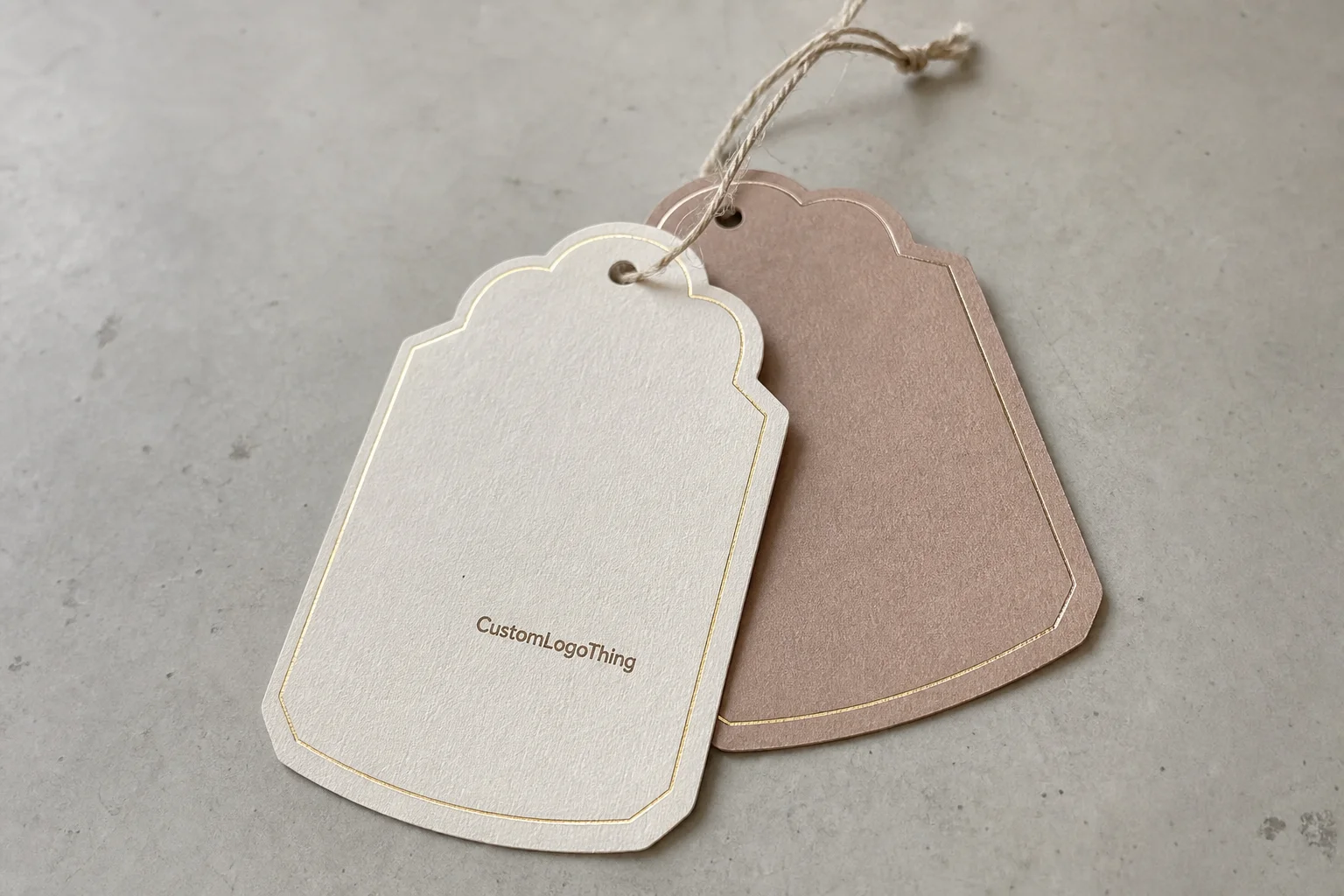
On a garment, the tag has a practical job first. It gives the customer the first visual read on the brand, but it also carries the product details retail staff need to scan, stock, and sell the item properly. A good tag usually includes the front logo or collection name, the back-of-tag size or product copy, barcode, pricing area, care cues, and an attachment method that suits the garment without damaging it.
Most buyers think first about the front side, which is understandable, but the back side is where a lot of the retail function lives. In practice, the layout needs enough space for a barcode, SKU, fiber content, country of origin, or other compliance information, depending on the market and channel. If the tag feels beautiful but cannot hold the necessary data cleanly, it is not doing its full job.
Material choice changes the whole personality of the tag. Coated paper board gives crisp print and cleaner image reproduction. Uncoated kraft feels more natural and works well for brands that want a grounded, recycled look. Textured specialty stock can make even a simple layout feel more considered, while laminated or spot-UV finishes can add polish without turning the tag into something flashy.
Common tag stocks sit in a fairly narrow practical range. For fashion basics and mid-market retail, 300gsm to 400gsm paper board is common because it balances stiffness, print quality, and cost. Heavier boards feel more substantial, but once you go too thick, folding, hole punching, and stringing can become less tidy. That is not a branding issue alone; it is a production issue.
There is a reason many buyers source through an Apparel Swing Tags Supplier china factory rather than piecing together multiple vendors. China factories can usually support larger volumes, a wider range of print and finishing methods, and more consistent retail presentation across a long run. If you are launching into multiple stores or coordinating with seasonal apparel deliveries, that consistency matters more than people sometimes expect.
Good swing tags should feel like part of the garment system, not an afterthought. If the tag stock, print, string, and packing method all match the brand level, the customer notices that harmony even if they never say it out loud.
For brands building out their accessory system, it helps to keep the tag design aligned with broader packaging components such as Custom Labels & Tags and other garment identification pieces. The strongest programs tend to use one visual language across the whole line, not a different look for every product family.
How tag production works from file to carton
The production path is more structured than many first-time buyers expect. A solid factory process usually starts with a brief, then a review of artwork, material selection, prepress, proofing, printing, die-cutting, finishing, hole punching, stringing or fastening, and finally packing into cartons or inner bags. Each step can affect the final look, the schedule, or both.
The proofing stage deserves special attention. A digital proof confirms layout, copy placement, and general color direction, but it does not prove how the physical stock will feel in the hand. A physical sample, on the other hand, shows material texture, actual print density, hole position, fold behavior, and how a finish like matte varnish or foil stamping behaves on the real substrate. Production should not begin until the buyer knows which kind of proof has been approved.
Special finishing options bring more setup. Foil stamping, embossing, debossing, rounded corners, soft-touch lamination, spot UV, and complex die lines all add time because they require tooling, setup checks, or additional curing and inspection. None of these are inherently difficult, but they do introduce more points where a factory has to control consistency.
A well-run apparel swing tags supplier china factory typically manages several of those steps in-house or through closely controlled partner operations. That matters because it reduces handoff errors. One team controls the print registration, another controls the die-cut, and the final packing team checks quantity, string attachment, and carton labeling before shipment.
Here is the basic flow most buyers should expect:
- Brief and quote based on size, stock, quantity, and finish.
- Artwork review to check bleed, safe area, barcode size, and resolution.
- Proof or sample for color, texture, and construction verification.
- Production with printing, cutting, finishing, and attachment.
- Packing and shipment according to carton count and freight method.
One buyer mistake is assuming that every tag design can move through the same production path. A single-color kraft tag with a punched hole is a straightforward job. A layered tag with foil, embossing, and a custom cotton loop needs more setup, more inspection, and a better-defined approval process. The gap between those two jobs is larger than the artwork alone suggests.
Key specs that shape cost, pricing, and MOQ
Pricing for swing tags is driven by a handful of clear variables, and once you know those variables, quotes become much easier to compare. The biggest ones are stock thickness, size, print sides, color count, finishing, attachment string type, and how the tags are packed for delivery. A simple 300gsm uncoated tag with one-sided print is a very different job from a double-sided, foil-stamped tag on 400gsm textured stock with black cotton string.
MOQ usually follows the production method. Digital printing can often support smaller runs, sometimes as low as a few hundred pieces, while offset jobs usually make more sense at larger quantities because the setup is spread across more units. That said, smaller quantities almost always carry a higher unit cost. It is not a penalty; it is just how press setup works.
When brands ask for custom shapes, the die-cut becomes a real cost driver. A standard rectangle with rounded corners is simple. A custom silhouette, window cut, or layered tag with multiple pieces raises both tooling and labor. Premium finishes also move the price upward because they add handling, setup, and quality control time. I have seen brands save a meaningful amount simply by changing from a complex shape to a cleaner, brand-appropriate rectangle with one good finish.
Attachment choices matter more than many teams expect. Cotton string gives a softer, more natural presentation, while elastic loops and plastic fasteners are often faster to apply at scale. A waxed cord or branded knot can look better in premium retail, but it also increases packing time and can affect per-unit cost. The best choice depends on how the garment will be folded, hung, bagged, or displayed.
For a buyer, the trick is to compare quotes on the exact same spec sheet. Otherwise, you end up comparing one factory’s 350gsm artboard with matte lamination to another factory’s 250gsm stock with no coating and no string attached. That is not a fair comparison, and it leads to bad decisions.
| Spec choice | Typical effect on unit cost | Typical effect on MOQ | Best fit |
|---|---|---|---|
| Digital print, simple rectangle, no lamination | Lower setup cost, often higher unit cost at very small runs | Flexible, sometimes 300-1,000 pcs | Launches, samples, short seasonal drops |
| Offset print, 350gsm stock, matte lamination | Better unit economics at scale | Often 1,000-5,000+ pcs | Mainline retail programs |
| Foil, embossing, specialty stock, custom die-cut | Higher due to tooling and finishing | Usually higher than standard jobs | Premium fashion, gift apparel, brand refresh |
| Kraft paper, one-color print, cotton string | Moderate, depending on texture and string choice | Often accessible for medium runs | Eco-forward and natural brand positioning |
As a practical range, a standard tag order might land around $0.08-$0.18 per unit at larger volumes for simple specs, while more premium builds with foil, special stock, or complex attachment details can move into $0.20-$0.45 per unit or more. Those numbers vary by quantity, print coverage, and freight terms, so they are only useful if the spec is clearly defined. Small quantities can price much higher, especially if the order needs setup for special finishes.
For buyers who care about compliance and sustainable sourcing, it is also worth asking whether the paper stock is FSC-certified or if recycled content is available. FSC information is widely recognized in packaging circles, and the FSC site is a useful reference if your brand needs to support a certified paper claim. If you are checking packaging material guidance more broadly, the EPA recycling resources are a helpful place to ground expectations around recyclability and material choices.
Process and turnaround: what to expect before you order
Good timing starts with good file readiness. If your artwork is complete, your barcode is sized correctly, and your material choice is settled, a straightforward tag order can move quickly through proofing and production. If the file is still changing, the schedule stretches. That sounds obvious, but it is one of the main reasons apparel programs miss their packaging windows.
A realistic timeline often looks like this: 1 to 3 business days for quote and artwork review, 1 to 3 days for proofing or sample preparation, 5 to 12 business days for production on a standard job, and then freight time on top of that. If the order uses foil stamping, embossing, custom die-cutting, or specialty stringing, the production window can lengthen because those steps need extra setup and inspection.
Simple paper tags usually move faster than highly finished tags. A clean, one-color tag with a standard hole punch is straightforward. A tag with multiple finishes, a custom fold, and a cotton loop with a branded knot takes more handling, more checks, and more care from the line team. None of that is a problem if the schedule allows for it.
Freight deserves separate planning. Air shipping is faster but more expensive, which can make sense for short runs, urgent replenishment, or launch dates that will not move. Ocean freight is slower, but on larger orders it often makes the numbers work better. If your swing tags are tied to apparel production and inbound warehouse planning, the freight choice should be part of the package from the start, not an afterthought.
For sourcing teams that use an apparel swing tags supplier china factory, the best approach is to confirm production lead time and shipping lead time separately. That one habit prevents a lot of confusion. A factory might finish the tags on time, but if the freight plan was not set early, the delivery can still miss the retail window.
Packaging condition matters too. If tags are packed too loosely, the corners can curl. If cartons are overfilled, the edges may scuff. If humidity control is poor, uncoated stock can pick up waves or slight warping. Those are small issues on paper, but in retail they are visible the moment the first carton is opened.
How to choose a factory partner that fits your brand
The best supplier is not always the one with the longest materials list. It is the one that can reproduce your tag consistently, communicate clearly, and help you move from concept to a manufacturable spec without turning every question into a delay. For branded apparel, that difference matters.
Start with samples. Look closely at print consistency, edge trimming, hole placement, finish quality, and how the string or fastener is attached. If the sample shows smudging, rough cut edges, color mismatch, or weak attachment, the production job will probably carry some version of that problem unless it is corrected before release.
Capability is just as important as price. Ask whether the factory can handle offset and digital printing, hot stamping, kitting, packing by SKU, and retail-ready carton labeling. If a supplier only does one part well and outsources the rest casually, control becomes harder. A capable apparel swing tags supplier china factory should be able to discuss the whole build, not just the print side.
Good communication is another signal. A solid factory will ask for the right things up front: exact size, quantity, paper thickness, finish, attachment style, Pantone references, and the packing method you want. If the supplier can translate a mood board or a garment reference into a clear tag spec, that is usually a strong sign they understand production, not just quoting.
Brands often underestimate how helpful that translation step can be. A creative team might say “elevated but natural,” and an experienced packaging partner will turn that into a sensible combination like 400gsm kraft board, one-color black print, soft matte varnish, and black cotton string. That is where practical expertise shows up.
Ask for defect handling terms as well. If the first mass production run includes off-center holes, dull foil, or a noticeable color shift, you need to know whether the factory will remake, repair, or re-inspect the batch. A clear policy here is worth more than a polished sales deck.
If your team is also building out broader packaging assets, it can help to align the tag with other components from Custom Labels & Tags so the tactile and visual language stays consistent across the product line.
Common ordering mistakes that cause delays and reprints
Most reprints start with small details that were never fully locked. Low-resolution artwork is one of the most common problems. Another is leaving bleed, safe margins, or barcode sizing unresolved until the factory asks for clarification. Once artwork is already in prepress, every round of correction adds time.
Vague spec language causes trouble too. “Premium paper” can mean almost anything. So can “matte finish.” A factory needs specifics such as 350gsm C1S artboard, 2-sided print, matte lamination, or uncoated 300gsm recycled stock with no coating. The more exact the brief, the less room there is for mismatch.
Skipping a physical sample is risky when the tag includes tactile finishes, unusual color standards, or folding features. A digital proof will not tell you how embossing feels, how foil catches light, or whether a textured stock makes your logo less crisp than expected. Sometimes a sample is the only sensible way to avoid an expensive disappointment.
Attachment mistakes also happen more often than buyers expect. A string that is too long can make the garment look messy on rack display. A fastener that is too bulky can interfere with folding or polybag packing. Even the wrong knot color can make a product feel slightly off-brand, especially in premium retail. Those details sound minor until you see them multiplied across thousands of units.
Another common issue is ignoring the retail environment where the tag will live. A delicate uncoated stock may look excellent in a showroom, but if the garments are handled often, folded tightly, or shipped in humid conditions, the tag can age badly before the customer ever sees it. Matching stock choice to use case avoids a lot of unnecessary disappointment.
For standards-minded teams, packaging quality is not just visual. It is also about handling and shipping integrity. If tags are packed loosely, creased in cartons, or exposed to moisture risk, the whole order suffers. This is where general packaging guidance from organizations like ISTA can be useful, especially if your labels and tags travel with other retail components in larger shipments.
Next steps for getting a clean, accurate quote
If you want a quote that is actually useful, give the supplier a complete spec set. That means size, material, print sides, quantity, finish, attachment style, and packaging requirements. If you already know the garment type, include that too, because a tag for a heavy coat does not always behave the same way as one for a lightweight tee.
Before you request pricing, prepare your brand files, barcode data, Pantone references, and a reference image or sample if you have one. Even a simple photo can help the factory understand the visual direction and avoid chasing the wrong style. If the target is eco-friendly presentation, say so directly; the supplier can then suggest recycled stock, kraft board, or FSC-style paper options that still look premium rather than cheap.
It is smart to ask for two versions of the quote: a standard option and an upgraded option. That gives you a better sense of value. Sometimes the cost difference between a basic matte finish and a more polished stock is smaller than expected, and sometimes the premium version is clearly the wrong place to spend. You will not know until both are laid out side by side.
Budget planning should also include sample fees, plate or die charges, and freight. Those are not always large individually, but they can distort a price comparison if they are hidden inside one quote and separated in another. A clean quote makes every line item visible.
A final check should cover sample approval, lead time, and shipping plan before you release the order. That one step protects the full packaging schedule. If you are working with an apparel swing tags supplier china factory, the best results usually come from a clear brief, a realistic production window, and a freight choice that matches the launch date rather than the lowest headline cost.
What should I ask an apparel swing tags supplier China factory before ordering?
Ask for confirmed material options, print method, finishing choices, MOQ, sample cost, production lead time, and freight options. Request a written spec sheet so both sides agree on size, thickness, and attachment details before production starts.
How do I compare pricing for custom swing tags without getting confused?
Compare quotes only when the spec is identical: same paper stock, size, print coverage, finish, quantity, and string or fastener type. Watch for hidden differences such as packing format, sample charges, plate or die fees, and shipping method.
What is the usual MOQ for apparel swing tags from China?
MOQ depends on printing method, size, and finish, but simpler paper tags often allow lower quantities than specialty finishes. A factory may offer different tiers for digital versus offset production, so it is worth asking for options if you need a smaller run.
How long does production usually take for custom swing tags?
Simple tags can move through proofing and production relatively quickly, while specialty finishes and sample approvals add time. Shipping choice also affects total delivery time, so production lead time and transit time should be reviewed separately.
Can I get eco-friendly apparel swing tags without making them look cheap?
Yes, recycled or FSC-style paper stocks can still look premium when paired with thoughtful typography, clean layouts, and careful print control. Uncoated kraft, textured stock, and restrained finishes often create a natural, high-end look when the design is disciplined.