bakery cuffed knit beanies Bulk Order Planning works best when the decision starts with the job, not the merch photo. A bakery crew loading vans at dawn, a counter team greeting customers in a drafty storefront, and a pop-up staff working winter markets all need the same basic thing: warmth that stays put, a cuff that holds decoration clearly, and a fit that does not turn fussy after a few hours of wear.
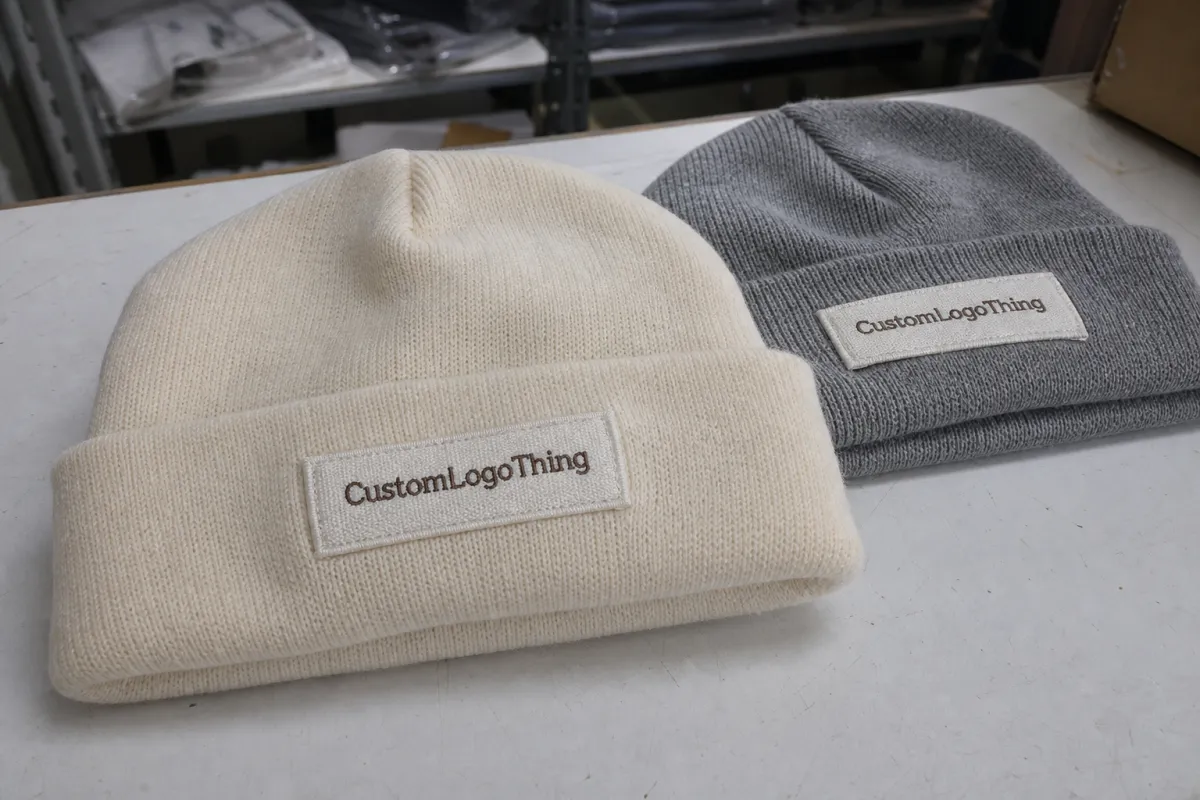
The cuff is doing more work here than many buyers expect. It creates a flatter, more predictable decoration zone than a slouchy cap, which is why small embroidery, a woven patch, or a simple woven label often reads better on a knit beanie than on other cold-weather headwear. In bulk programs, clarity beats novelty. A logo that looks calm and legible from ten feet away is usually a better purchase than a bigger design fighting the texture of the knit.
Buyers also tend to underestimate how much production detail is hidden inside a simple beanie order. Yarn content, cuff depth, knit density, thread color, and delivery timing all affect the final result. The cleanest orders are the ones where those details are set early, because the sample process gets shorter, the quote gets tighter, and the risk of a mismatch drops fast.
The cheapest beanie is not the cheapest order if the cuff folds wrong, the logo sits too high, or the shipment lands after the event.
That is why the most useful planning conversation stays grounded in four things: who is wearing the beanies, how the logo will be applied, how much control the buyer needs over color and fit, and how much time is left before delivery. Once those are clear, the rest of the order becomes a sequence of decisions instead of a guessing game.
Bulk planning for bakery cuffed knit beanies in real-world giveaways
For a bakery, a beanie is not just seasonal apparel. It sits between uniform and giveaway, which makes the buy more practical than decorative. Staff wear it on early shifts, customers may receive it in a holiday bundle, and market teams often use it as a visible branding piece when the weather turns. That mix of uses is why the order should be planned around function first. A beanie that survives one cold-weather promotion but looks awkward on the team is not a good bulk purchase.
Start with the environment. Bakery workers move between heat, humidity, loading areas, and outdoor air, so the headwear needs to stay comfortable without turning bulky or too loose. A tight knit helps the shape hold. A cuff gives the logo a stable surface. A classic fit usually performs better for staff programs than a fashion-driven silhouette, because it stays predictable across a range of head sizes and does not require much adjustment during a shift.
There is also a visibility issue that changes how the order should be built. Branded bakery items often need to be read quickly, sometimes in poor lighting or across a counter. A logo that is clean, centered, and sized to the cuff will usually outperform a more elaborate design with too many colors. Practical buyers tend to notice that the small details matter more than the mockup suggests: the fold height, the thread contrast, the finish at the seam, and how the logo reads once the cuff is worn instead of laid flat.
If the beanie is part of a staff uniform, consistency matters more than trend. If it is a promotional gift, comfort and perceived value matter more than strict uniformity. The same product can serve both roles, but the buyer needs to decide which role leads the decision. That single choice affects the yarn, the decoration method, the color, and even the quantity split if the order is being used across several teams or locations.
Choose the right knit, cuff, and fit for bakery use
Material choice is where a lot of orders either get easier or become expensive. Acrylic knit is still the most common bulk option because it is durable, color-stable, and generally friendly to embroidery. It does not absorb moisture the way some natural fibers do, and it holds shape better through repeated wear and packing. For buyers trying to keep unit cost down without making the product feel flimsy, acrylic often gives the most practical balance.
Blends can improve hand feel. Acrylic with polyester can feel smoother and a little more polished, while wool blends add warmth and a more premium touch. That said, wool content usually raises the price and can make care more complicated. It can also introduce more variation if the buyer is trying to keep every reorder close to the original sample. For most bakery programs, a modest blend is usually enough. Heavy wool content makes more sense for retail merchandise than for a working uniform set.
Gauge and knit density matter just as much as fiber content. A tighter knit tends to make the beanie look cleaner and can keep the embroidery from sinking into the fabric. A looser knit may feel softer and more casual, but it can also show more texture, which can interfere with small text or fine linework. If the logo is simple, tighter is usually safer. If the decoration is just a small wordmark or icon, the fabric should help it read, not compete with it.
The cuff deserves close attention. A cuff that is too shallow leaves little room for decoration. Too wide, and the beanie can look top-heavy or pull the logo too low on the forehead. For many bulk orders, a cuff in the 2.5 to 3.5 inch range is enough to create a stable decoration zone without crowding the wearer. The final fold position should be tested on a real head, not only on a flat mockup, because folded knit can shift a logo by more than the art file suggests.
Fit is the last piece of the structure, and it affects both comfort and appearance. A classic cuffed knit beanie is usually the safest choice for staff use. It sits close, stays in place, and handles a broad range of head sizes without looking oversized. A shallower fit may appear more current, but it can ride up or feel too tight after several hours. A slouchier version can work for retail merch, though it tends to look less crisp in a uniform context. The right answer depends less on trend and more on whether the buyer wants a work item or a gift item.
- Acrylic knit: best for budget control, repeat orders, and consistent decoration.
- Blended yarn: better hand feel and a slightly more premium finish.
- Tighter knit: cleaner logo presentation and better support for small detail.
- Shallow cuff: less room for decoration and a higher chance of logo crowding.
- Classic fit: the most dependable option for bakery staff and giveaway sets.
Specs that actually matter before you approve samples
Sample approval goes more smoothly when the spec sheet is written like a production document instead of a sales note. The useful details are simple: yarn content, cuff depth, finished body length, knit density, decoration method, and the expected stretch range. If those are missing, the supplier has to guess at the look and the fit. Guessing is how beanie orders drift away from the original idea.
Decoration choice changes the result as much as the yarn does. Embroidery remains the default for most bakery programs because it is durable and does not depend on a complex background image. It works well for simple logos, initials, and compact wordmarks. A woven patch usually gives a better result when the artwork has tiny type, multiple color shifts, or crisp linework that would blur in thread. Sewn labels and small woven tabs are useful when the brand wants a subtler finish or when the goal is a retail-ready look rather than a high-contrast uniform mark.
Approving the sample means checking more than the front-facing logo. The cuff fold should be evaluated in the worn position, not only on a flat table. Stitch density should be tight enough that the logo keeps its edges, but not so dense that the knit puckers around the decoration. Thread color should be compared against a real brand reference, not just a screen image, because monitors can flatten the difference between warm black, charcoal, and deep navy.
The construction details matter too. Look at the seam where the cuff joins the body. Check whether the beanie rebounds after stretching, because a cap that stays distorted after handling will not age well in a busy kitchen or retail setting. If packaging is part of the order, confirm carton labeling, folded count, and whether each piece is polybagged or shipped in bulk. For retail gift sets, buyers sometimes want packaging that meets a sustainability standard, and FSC-certified paper through fsc.org can be a useful reference if hang tags or inserts are included.
The most common sample problems are usually avoidable:
- Low-resolution artwork that turns the proof into a cleanup project.
- Color instructions based on a name instead of a reference code or physical sample.
- Approval of a cuff height before checking how the logo lands after folding.
- Ignoring stitch density, which can make the logo look heavier or blurrier than expected.
A good sample answers questions the quote cannot. If the buyer can approve the fit, the fold, and the decoration from one sample or one accurate pre-production proof, the bulk run is much less likely to produce surprises.
Cost, pricing, and MOQ factors that change the quote
Price in this category moves in predictable ways. Quantity is the biggest driver, followed by decoration complexity, yarn choice, packaging, and transit method. A larger run lowers unit cost because setup is spread across more pieces. A more detailed logo costs more because digitizing, patch building, or thread changes require extra labor. Custom color matching almost always adds cost because the mill or factory has to hold tighter control over the yarn lot.
MOQ, or minimum order quantity, is not just a supplier preference. It reflects how the production line is built. A 100-piece order can carry a much higher per-unit cost than a 500-piece run because the setup, material handling, proofing, and QC time do not scale down linearly. Buyers often discover that the price curve is steep at the low end and flattens once the run gets larger. That is why a small test order can feel expensive even when the product itself is simple.
There is a practical way to keep the quote under control without making the beanie look cheap: simplify the order before the factory simplifies it for you. One logo location is cheaper than two. A stock color is cheaper than a custom dye lot. One decoration method is cheaper than a mix of patch and embroidery. Final artwork before proof approval is also cheaper than repeated changes after the sample has already been built.
| Option | Typical MOQ | Approx. unit cost | Best use | Notes |
|---|---|---|---|---|
| Stock acrylic knit, one-color embroidery | 100-250 pieces | $2.40-$3.60 | Staff giveaways and seasonal promos | Fastest route and easiest to keep on budget |
| Blended yarn, woven patch | 150-300 pieces | $3.50-$5.25 | More polished bakery merch | Better for tiny text and sharper logo detail |
| Tighter knit, custom color match | 250-500 pieces | $4.80-$7.20 | Retail-style gifting or recurring uniforms | Longer lead time and stronger brand control |
Those numbers are directional, not fixed. Artwork cleanup, hang tags, carton labeling, polybagging, split shipments, and rush production can shift the final number. Freight can also move the budget more than buyers expect, especially if the order is broken across several store locations. A unit price that looks attractive on paper can become less appealing once shipping and packaging are added back in.
A clean budget usually separates the order into four lines: the beanie itself, the decoration, the sample or proof stage, and freight. If the team is ordering for a multi-location rollout, add a small allowance for replacement units or new hires. That extra cushion is cheaper than placing a second emergency order later.
Process, timeline, and production steps from artwork to delivery
The production path is not complicated, but it does have choke points. The brief goes to quote, the quote goes to artwork, the artwork goes to approval, the approval goes to production, the production goes to QC, and QC goes to shipping. The knitting itself is rarely the bottleneck. Delays usually happen when artwork is incomplete, the sample feedback arrives late, or the buyer changes quantity after the proof has already been signed off.
- Brief and quote: 1-2 business days if quantity and artwork are clear.
- Artwork review: 1-3 business days for a simple logo or patch layout.
- Sample or mockup: 3-7 business days, longer if custom yarn or dye matching is involved.
- Production: often 12-20 business days after approval, depending on quantity and decoration.
- Quality check and packing: usually 1-2 days for counting, folding, and carton labeling.
- Transit: domestic freight can take a few days; ocean freight often runs 3-5 weeks.
That timeline gives buyers a realistic planning frame. It separates approval time from manufacturing time and shipping time, which matters when the beanies are tied to a store opening, holiday market, or staff rollout. If the deadline is fixed, the buyer should work backward from the in-hand date, not forward from the quote date. That simple shift catches most schedule problems before they become expensive.
QC also deserves a more exact look than many buyers give it. A useful inspection pass checks stitch consistency, logo alignment, fold position, thread tension, and count accuracy. If the order is large enough, the buyer should also ask how carton labels are verified and whether random samples are pulled from several cartons rather than only from the top layer. Knit headwear can hide subtle variation, and a fast visual check does not always catch it.
For shipping, transit method matters as much as production time. Beanies are compact, but carton size, destination, and customs handling can still affect cost and lead time. Buyers planning a multi-location bakery program should confirm whether cartons will be split at origin or re-shipped after arrival, because that decision changes both the timing and the final freight bill.
For packaging and transport expectations, ISTA guidance is a sensible reference point for drop-test and handling assumptions. It is not a decoration rule, but it helps frame how goods should survive the route from warehouse to store.
Why repeat bakery buyers stick with a supplier that protects color and fit
Repeat orders are where discipline pays off. Once a beanie has been approved, the supplier should retain the reference points that made it work: yarn content, color code, logo placement, cuff height, packaging count, and any notes on fit. Without that record, a reorder starts from scratch and the new run can drift away from the original. With it, the buyer gets a much faster path back to a known result.
Color is usually the first thing to drift. Knit yarn can vary by dye lot, and a small change that looks harmless in the factory can look obvious when old and new pieces sit side by side in a staff line-up. That is why repeat buyers should ask whether the next run is being matched to a stored sample, a stock yarn, or a custom lot. If the color is a brand-critical shade, the reference needs to be explicit instead of implied.
Fit can drift in the same way. A slight adjustment to cuff depth or body length might not matter to one buyer, but it can change how the beanie sits on the head and how the logo reads. Repeat buyers usually care less about novelty and more about the order arriving the same way each time. That consistency saves review time, reduces back-and-forth, and keeps the team from rechecking a problem that was already solved on the first run.
A strong reorder feels quiet: the same fold, the same mark, the same color range, and no need to re-explain what already worked.
That is the practical value of a supplier that keeps records well. The buyer spends less time fixing details and more time using the product. For a bakery with seasonal drops or ongoing staff needs, that kind of control is usually more valuable than shaving a small amount off the first quote.
What to confirm before you approve the quote and place the order
Before the order moves into production, run one last check with no assumptions. Confirm quantity, color, decoration method, logo file type, delivery address, and target in-hand date. If the order is split across locations, list the piece count for each destination. If replacement units are needed for new hires or lost items, include them in the first pass. Small details become costly only after the order is locked.
- Quantity by size or color if the order is split.
- Final logo file in vector format or a clean high-resolution equivalent.
- Decoration location, logo width, and cuff fold height.
- Sample photo or mockup approval before mass production starts.
- Target in-hand date, not only the ship date.
- Freight plan for one store, multiple stores, or an event site.
Review the proof like a production file, not a marketing graphic. Check the logo proportion against the cuff. Check whether the thread color keeps enough contrast against the chosen yarn. Check spelling, spacing, and the direction of the fold. A quick approval can be useful, but a careful approval prevents the most common avoidable rework.
For bakery cuffed knit beanies Bulk Order Planning, the strongest orders are the most ordinary ones: a clear wearer profile, a known cuff depth, one decoration method, a confirmed quantity, and a delivery date that leaves room for transit. Once those are in place, the order stops behaving like a seasonal guess and starts behaving like a controlled purchase. That is the point where the product can do its job without creating extra work for the buyer.
Frequently Asked Questions
How many bakery cuffed knit beanies should I order for a 20-person staff?
Start with one per wearer, then add a small buffer for replacements, new hires, or sample holds. A 10-15 percent cushion is common for daily-use programs because knit headwear tends to be lost, borrowed, or damaged over time.
What decoration method works best for bakery cuffed knit beanies in bulk?
Embroidery is the most common choice because it is durable and usually looks clean on a cuff. A woven or sewn patch can be better if the logo has tiny text, fine lines, or multiple color transitions that would blur in thread.
What do I need ready to get an accurate bulk quote?
Have the quantity, color preference, logo file, target delivery date, and shipping destination ready. If you need split shipments, multiple logo placements, or special packaging, mention that early because those details affect setup and freight.
How long does production usually take after artwork approval?
A common window is 12-20 business days after approval, plus transit time. The exact schedule depends on quantity, decoration method, and whether the yarn is stocked or custom matched.
Can I mix colors or sizes in one bakery cuffed knit beanies bulk order?
Sometimes yes, but the mix can change MOQ, pricing, and production planning. Confirm any split before approval so the quote reflects the real order structure and the supplier can stage the correct materials.