Buyer Fit Snapshot
| Best fit | custom kraft pillow box branding options compared for packaging buyers comparing material specs, print proof, MOQ, unit cost, freight, and repeat-order risk where brand print, material, artwork control, and repeat-order consistency matter. |
|---|---|
| Quote inputs | Share finished size, material target, print colors, finish, packing count, annual reorder estimate, and delivery region. |
| Proofing check | Approve dieline scale, logo placement, barcode or warning zones, color tolerance, and any recyclable or compostable wording before bulk production. |
| Main risk | Vague material claims, crowded artwork, or missing packing details can create delays even when the unit price looks attractive. |
Fast answer: Custom Kraft Pillow Box Branding Options Compared: Dieline, Finish, Proof, and Buyer Review should be specified like a repeatable production item. The safest quote includes material, print method, finish, artwork proof, carton packing, and reorder notes in one written spec.
What to confirm before approving the packaging proof
Check the product dimensions against the actual filled item, not only the sales mockup. Ask for tolerance on folds, seals, hang holes, label areas, and retail display edges. If the package carries a logo, QR code, warning copy, or legal claim, reserve that space before decorative graphics fill the panel.
How to compare quotes without losing quality
Compare board or film grade, print process, finish, sampling route, tooling charges, carton quantity, and freight assumptions side by side. A lower quote is only useful if the supplier can repeat the same color, closure quality, and packing count on the next order.
For best custom kraft pillow box branding, the smartest move is usually the quietest one: a clean logo, disciplined spacing, and a finish that respects the paper instead of burying it. On natural kraft, restraint often looks richer than a flood of ink. The fibers, the tone, and the slight surface texture start doing branding work of their own, which is exactly why these boxes can feel more memorable than packaging that spent a lot more to say a lot less.
I have seen pillow box samples that looked polished on a monitor and awkward in hand. The winners almost always had three things in common: readable type, strong folds, and a material choice that matched the brand story instead of forcing one. That matters whether the package is sitting in a boutique display, moving through a warehouse, or being opened at a kitchen table where no one is pretending to be impressed.
If the product is light, giftable, and meant to feel thoughtful rather than overbuilt, custom kraft pillow boxes can carry a surprising amount of brand identity without demanding a lot of material. The real question is not whether to print more graphics. The real question is whether best custom kraft pillow box branding means a single-color mark, a subtle foil hit, an embossed monogram, or a die-cut window that lets the product speak for itself.
What Is the Best Custom Kraft Pillow Box Branding at a Glance?
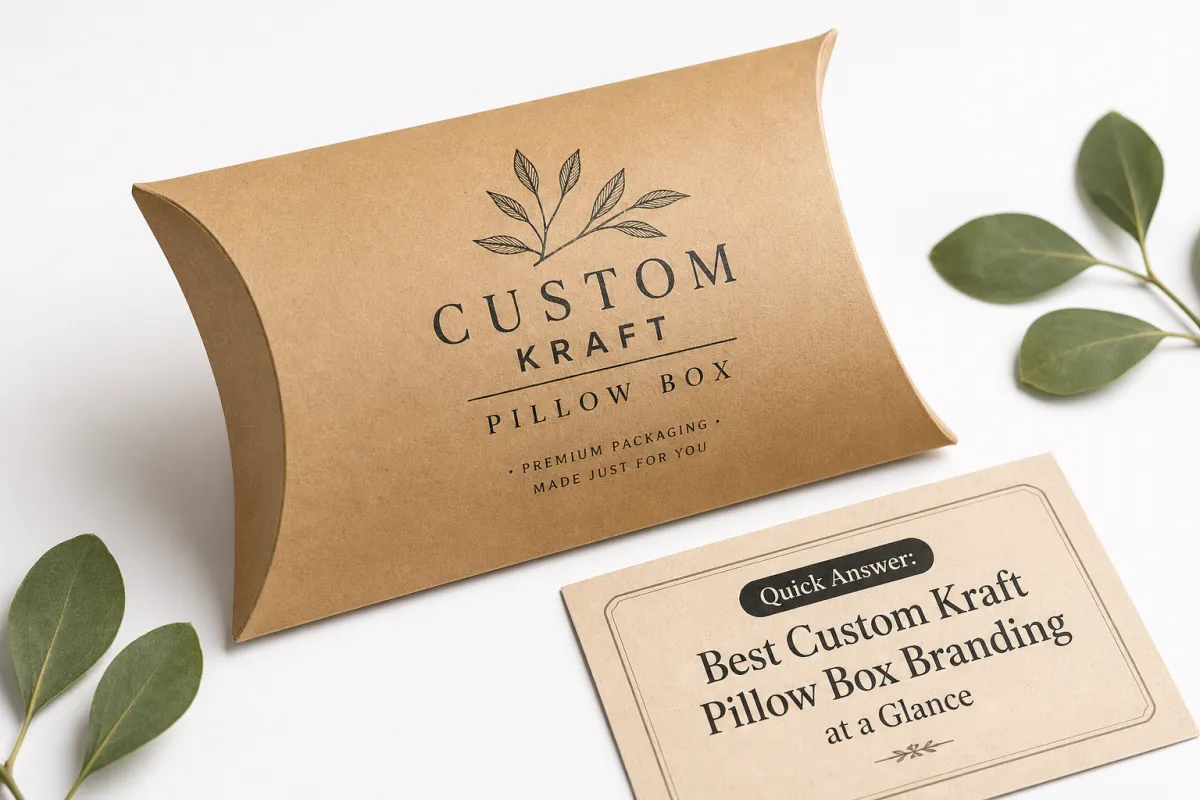
The short answer: for most small brands, the best custom kraft pillow box branding is a one- or two-color logo on uncoated kraft, paired with one restrained accent if the package needs more shelf presence. That combination keeps the artwork legible, keeps production predictable, and lets the kraft stock signal warmth, tactility, and a more natural product story.
A lot of buyers overestimate how much artwork a pillow box can hold. The format is curved, compact, and often handled quickly at packing tables or retail counters, so the design has to work in a glance. Fine lines, pale colors, and logos pushed too close to the closure seam tend to disappear once the box is formed. Packaging does not get a second chance to be understood.
There are clear moments where a little more finish earns its place. Jewelry, cosmetics, wedding favors, small gift sets, and sample kits often benefit from foil stamping, blind embossing, or a small die-cut window because those products need a stronger signal of value. In those cases, best custom kraft pillow box branding is not about crowding the face panel. It is about choosing one premium cue that feels deliberate.
From a packaging buyer’s point of view, the best kraft pillow box is rarely the busiest one; it is the one where the print, the fold, and the stock all agree with each other.
When I evaluate samples, I focus on five things: legibility, durability, packing speed, cost efficiency, and whether the box feels true to the brand voice. That lens works whether the order is 250 pieces for a product launch or 5,000 pieces for ongoing retail use. In packaging, scale changes the math, but it does not change the basic test: does the box earn its place?
- Best default: one-color logo on natural kraft with matte or no coating.
- Best premium cue: foil accent or emboss on a simple layout.
- Best for visibility: two-color brand system with disciplined spacing.
- Best for product display: small window patch when the item itself helps sell the box.
- Best for speed: short-run digital print with minimal coverage.
Top Options Compared for Kraft Pillow Box Branding
Several routes can deliver strong kraft pillow box branding, and the right one depends on the product, the budget, and how much visual weight the box has to carry on shelf or in a mailer. A pillow box is not a rigid carton. The artwork has to move with the curve instead of pretending the surface is a flat billboard.
Logo-only printing is the calmest option, and often the smartest. It leaves most of the kraft visible, which gives the package a grounded, confident feel. Strong typography can make this approach look more refined than a dense layout, especially on uncoated stock where the ink sits a touch softer and the paper texture stays present. For many brands, this is the baseline for best custom kraft pillow box branding.
One-color pattern work is the next step up. Repeating icons, line art, or a narrow border can make a pillow box feel considered without turning loud. The danger is overprinting. Kraft already brings character, so a pattern that is too dense starts fighting the stock instead of supporting it.
Two-color systems help when the logo alone feels too quiet. They separate the brand mark from supporting copy, or create contrast with a darker ink and a warmer accent. The tradeoff is registration. The more layers you add, the more careful the press work has to be, because folding and seam placement can make a neat layout look slightly off if the dieline is not planned with care.
Full-color graphics suit playful consumer products, yet they are the hardest to keep elegant on kraft. Pale gradients and delicate tones lose strength against a brown background faster than many teams expect. Bold shapes, solid type, and a tighter visual field usually hold up better. That is one reason the most reliable packaging choices stay close to restraint, and honestly, they usually age better too.
Foil accents and embossing sit in the premium tier. Foil can give a logo or monogram a sharp flash of contrast, while embossing adds tactile depth without visual clutter. Those finishes work especially well for giftable packaging, but they need breathing room. Put them on an overcrowded panel and the effect collapses into noise. Premium finishes are most persuasive when they have space to matter.
Windowed designs are practical when the product itself helps sell the box. A small die-cut opening with a clear patch can show color, texture, or quantity, which is useful for soaps, confections, tea, and sample kits. The tradeoff is protection and labor. Every extra cut, patch, and insert adds cost and introduces another point where production consistency has to be exact.
| Branding method | Best use case | Look on kraft | Typical cost pressure | Lead time impact |
|---|---|---|---|---|
| Logo-only print | Small brands, short runs, simple retail packaging | Clean, understated, highly readable | Low | Low |
| One-color pattern | Handmade, artisanal, gift-ready presentation | Decorative without feeling crowded | Low to moderate | Low to moderate |
| Two-color system | Brands with a stronger identity system | More contrast, better shelf presence | Moderate | Moderate |
| Foil or emboss | Jewelry, premium cosmetics, gifting | Distinctive and tactile | Moderate to high | Moderate to high |
| Windowed design | Products that sell through visibility | Open, honest, display-friendly | Moderate | Moderate |
The biggest tradeoff many buyers miss is consistency. As the visual system gets more complex, production has to control color registration, kraft shade variation, and seam placement on the dieline with much tighter discipline. Simpler layouts are not a lack of ambition; they are often the surest path to better branding because they leave less room for error.
Detailed Reviews: Printing, Coatings, and Structure
The substrate matters before anything else. Natural brown kraft gives the most honest, handmade look, but it also changes how ink reads, especially with low-contrast colors. Bleached kraft or lighter recycled stock gives more brightness for print, yet it gives up some of the earthy character that makes best custom kraft pillow box branding so appealing in the first place.
Stock weight changes the feel in hand. A lighter board around 250-300gsm can work for very small items, but it can feel flimsy if the box is opened and reclosed several times. Moving to 350gsm or a similarly sturdy kraft board gives better crease definition and a more confident snap when the ends close. That matters because a pillow box with weak folds looks tired quickly, even if the artwork is strong.
Digital print works well for short runs and custom versions because setup is faster and changeovers are easier. Offset gives cleaner color control and better repeatability when the artwork includes solid fills or small type. Flexographic printing can suit larger repeat jobs where the design stays simple and the same packaging runs again and again. Each method can support kraft pillow box branding, but each has its own comfort zone.
Foil stamping and embossing deserve closer attention. Foil creates crisp highlights, but only if the artwork is bold enough and the stock is smooth enough to hold detail. Embossing feels especially good on kraft because the natural texture gives the impression more depth. Very fine shapes can disappear if the die is too small. Blind emboss can be a strong fit for minimal brands that want a quiet luxury cue instead of a louder shine.
Coatings need careful thought. Matte aqueous can calm the surface and improve rub resistance without making the box look glossy. A no-coating finish preserves the raw paper feel, which many brands prefer for artisanal or eco-forward packaging. Gloss coatings usually work against the kraft aesthetic unless the brand identity truly depends on a polished presentation. For most buyers, the best outcome does not need a shiny surface to feel finished.
Structure matters more than people expect. If the dieline places the logo over a seam, the artwork may break visually when the ends curl. If the tuck closure lands too close to an important line of copy, the box can read as crowded once assembled. A physical sample clears this up fast, because the difference between a decent proof and a good box often shows up only in the fold behavior.
Parcel handling deserves attention too. Packaging that ships flat and survives sorting, stacking, and repeated handling has to do more than look nice on a desk. The ISTA test methods are a useful reference point for performance, even for projects that are not going through formal certification. For recycled board and FSC claims, the chain of custody matters; the FSC site gives enough detail for buyers to ask sharper questions before approving artwork.
I also look at the box under real lighting. Retail packaging that looks balanced under studio lights can go dull under warm store LEDs, and kraft can shift from rich brown to flat tan if the ink is too thin. That is why a sample matters more than a screen mockup on serious jobs. Branding should hold up in the hand, in the aisle, and in a photograph.
For broader packaging planning, the articles and resources collected by the packaging industry organization at packaging.org can help when you are comparing materials, structures, and production expectations before placing an order.
Price Comparison: What Custom Kraft Pillow Boxes Really Cost
Pricing gets messy quickly. Two quotes can look similar on paper, then drift apart once tooling, proofs, freight, or specialty finishes enter the job. For best custom kraft pillow box branding, the real question is not just unit price. It is the total landed cost across the run, plus the risk of rework if the first sample misses the mark.
Die setup is one of the first real costs. Once the structure is locked, that setup is spread across the order. Add more print colors and the job usually consumes more time and material. Specialty finishing changes the math fast. Foil, embossing, and window patching are all valid choices, but none of them should be treated like minor add-ons. They affect both cost and production rhythm.
Here is a practical way to think about typical pricing ranges for custom kraft pillow boxes. These numbers are directional rather than absolute, because board selection, coverage, and supplier location all influence the final quote. Even so, they help place best custom kraft pillow box branding into a real budget frame.
| Run size | Logo-only print | One- or two-color print | Foil/emboss or windowed design | What usually drives the price |
|---|---|---|---|---|
| 250-500 units | $0.65-$1.25 each | $0.78-$1.40 each | $1.10-$2.10 each | Setup, proofing, small-run labor |
| 1,000-2,500 units | $0.28-$0.55 each | $0.34-$0.68 each | $0.58-$1.10 each | Color count, coating, finishing method |
| 5,000+ units | $0.14-$0.28 each | $0.18-$0.36 each | $0.34-$0.72 each | Material choice, machine efficiency, freight |
Those ranges assume a fairly standard pillow box size for light products. If the item is heavy, oddly shaped, or needs an insert, costs can climb quickly. That is why I advise brands to compare identical specs before judging quotes. Same size, same quantity, same print method, same finish, same freight terms. Without that discipline, the quotes are not truly comparable.
The easiest savings usually come from reducing ink coverage and keeping the layout simple. A one-color logo on natural kraft can look more premium than a full flood design, and it usually costs less because the press work stays straightforward. If the goal is best custom kraft pillow box branding, do not spend money where the customer will not feel the difference.
There is also an operations angle that gets overlooked. A box that ships flat, folds cleanly, and stacks without damage saves labor downstream. Even a small difference in assembly time matters if your team packs hundreds of units each week. Ten extra seconds per box can erase the savings from a low quote surprisingly fast.
Where brands usually overspend is in design ambition rather than material quality. They add three inks, a foil hit, a spot coating, and a window, then wonder why the unit price jumps. A cleaner plan often delivers a stronger result, which is why the strongest packaging strategy usually starts by cutting clutter instead of adding it.
How to Choose the Right Method for Kraft Pillow Box Branding
Choosing the Right method starts with the product, not the artwork. A small luxury item, a wedding favor, and a subscription sample all ask different things of the package. One needs elegance. Another needs charm. Another needs speed and durability. That is the real test of best custom kraft pillow box branding.
A simple checklist keeps the decision grounded:
- Product size and weight: light items can use thinner board, but heavier contents need more stiffness.
- Protection: if the contents move around, add an insert or rethink the structure.
- Brand personality: rustic, artisanal, premium, playful, or eco-forward all point to different layouts.
- Packing speed: complicated closures slow assembly and create labor cost.
- Retail environment: bright shelves, warm lighting, or e-commerce photography each affect color perception.
- First touch: the unboxing experience should match the promise on the front panel.
For artisanal brands, a single logo with open space can be enough. For beauty products, a tighter system with a foil accent may feel more credible. For gift sets, a small window or emboss can add the tactile cue that makes someone pause. In each case, the best result is the version that supports the product instead of competing with it.
Proofing deserves real attention. Kraft is honest, but it is unforgiving. A pale gray that looked fine on-screen may vanish on brown stock. A serif font that looked delicate may clog slightly in print. A border that seemed safe may creep too close to the edge once the box is folded. That is why a physical sample is worth the extra step whenever the budget allows it.
It also helps to compare package branding against the rest of the line. If the outer box stays simple, more detail can move to a label, hang tag, or insert card. That is where Custom Labels & Tags can complement the pillow box without forcing every brand cue onto one small surface. If you are building a broader packaging system, browsing Custom Packaging Products can help you match the box to other formats instead of designing each piece in isolation.
One mistake keeps showing up in eco-forward packaging: assuming natural-looking material has to equal visual plainness. It does not. It means the material story should be credible. If the board is recycled or FSC-certified, say so only when the supply chain supports it. If the inks and adhesives are standard, do not overclaim. Honest packaging usually performs better than a crowded green message, and it is easier to defend when a buyer asks hard questions.
For more examples of how packaging decisions play out in practice, the project photos and notes in the Case Studies section are useful for comparing how finish, structure, and artwork change the final impression without changing the basic box format.
My practical recommendation is simple: choose the least complicated version that still feels like your brand. That is where the strongest packaging usually lives. When the design is confident, the kraft texture does a lot of the work.
Process, Timeline, and Next Steps
The production process is straightforward, but each step matters. It usually starts with a dieline review, because the box shape decides where the logo can sit, how the seam will land, and which areas should stay clear. From there, artwork is prepared in the correct file format, proofs are checked, and a sample is approved before the full order moves into production. That workflow matters because best custom kraft pillow box branding depends on print and structure agreeing with each other.
Simple artwork on a standard size can move quickly, especially when the order does not involve special finishes or a custom insert. Once foil, embossing, windows, or multiple revision rounds enter the picture, timing stretches. A realistic planning window for standard jobs is often 12-15 business days after proof approval, though that can grow if the art is complex or the production queue is full. If the launch date is fixed, lock the structure early.
A good timeline matters more than a low quote. If the box arrives late, the savings vanish. If the sample is rushed, the package may look fine on screen but behave poorly in hand. That is the part many first-time buyers underestimate. The best process is not the fastest one; it is the one that leaves enough time for the sample to tell the truth.
Here is the action list I would give any brand that wants to move from idea to order without chaos:
- Confirm the product dimensions and weight.
- Decide whether the box is for retail display, gifting, or shipping.
- Gather logo files in vector format if possible.
- Choose the print count and finish level before requesting quotes.
- Ask for the same quantity and freight terms from every vendor.
- Request a sample or proof if the design uses fine type, foil, or windows.
When vendors quote, compare like with like. A cheaper price may exclude proofing or shipping. A more expensive quote may include better board, tighter ink control, and fewer surprises after approval. I would rather pay a little more for stable output than gamble on an order of boxes that looks good in theory but fails once folded and packed. That caution matters especially in retail packaging, where presentation is part of the sale.
There is a useful rule of thumb here: start with the simplest version that still feels like your brand, then scale up only after the sample proves the look. That approach saves money, protects launch timing, and keeps the design honest. It also makes it easier to expand later into related formats such as labels, inserts, or other Custom Printed Boxes without rebuilding the visual system from scratch.
In the end, the strongest best custom kraft pillow box branding is the one that reads clearly at arm’s length, folds cleanly on the line, and still feels good when a customer opens and closes it. Get that balance right and the box does its job: it supports the product, reflects the brand identity, and leaves the customer with a better memory of the purchase.
The practical takeaway is simple: pick the lightest design that still tells the right story, test it on actual kraft, and only add finishes after the sample proves they earn their cost. That is the path to packaging that looks thoughtful, holds up in production, and does not try too hard.
What is the best custom kraft pillow box branding for a small run?
A one-color logo on natural kraft is usually the safest and most cost-effective choice for short runs. It keeps setup simple, avoids heavy coverage issues, and still looks deliberate in hand. If the product is giftable, add one premium detail such as embossing or a foil accent instead of increasing the whole design complexity. For many small brands, that is the most practical version of best custom kraft pillow box branding.
Which finish works best for kraft pillow box branding on retail shelves?
A matte or no-coating finish usually performs best because it preserves the raw kraft look and reduces glare under store lighting. Use selective accents only if they improve readability or create a stronger premium cue. Avoid finishes that fight the paper texture unless the brand identity truly depends on a polished look. That balance is central to strong kraft pillow box branding in retail packaging.
How do I compare pricing for the best custom kraft pillow box branding?
Compare quotes using the same size, quantity, print colors, and finishing details so the numbers are truly like for like. Ask whether tooling, proofs, sample costs, and freight are included before you judge a quote. Check how the unit price changes at higher quantities, because setup costs can make low runs look much more expensive. If the numbers are not aligned, you are not comparing the same best custom kraft pillow box branding option.
Is the best custom kraft pillow box branding always eco-friendly?
Not automatically; the box material may be kraft, but the full packaging system depends on inks, coatings, adhesives, and inserts. Ask for recycled content details and confirm whether any special finish changes the environmental profile. The most credible eco presentation is usually a simple design with clear material choices rather than a crowded green claim. That honesty matters just as much as the look of best custom kraft pillow box branding.
How long does the process take for custom kraft pillow box branding?
Simple jobs can move quickly, but artwork setup, proof approval, and sampling often add the most time. Allow extra time if the design uses foil, embossing, windows, or multiple revisions. If you have a launch date, lock the dieline and artwork early so production can stay on schedule. That planning discipline is part of getting custom kraft pillow box branding right the first time.

