Buyer Fit Snapshot
| Best fit | custom label materials for outdoors tested for packaging buyers comparing material specs, print proof, MOQ, unit cost, freight, and repeat-order risk where brand print, material, artwork control, and repeat-order consistency matter. |
|---|---|
| Quote inputs | Share finished size, material target, print colors, finish, packing count, annual reorder estimate, and delivery region. |
| Proofing check | Approve dieline scale, logo placement, barcode or warning zones, color tolerance, and any recyclable or compostable wording before bulk production. |
| Main risk | Vague material claims, crowded artwork, or missing packing details can create delays even when the unit price looks attractive. |
Fast answer: Custom Label Materials for Outdoors Tested: Material, Print, MOQ, and Cost should be specified like a repeatable production item. The safest quote includes material, print method, finish, artwork proof, carton packing, and reorder notes in one written spec.
What to confirm before approving the packaging proof
Check the product dimensions against the actual filled item, not only the sales mockup. Ask for tolerance on folds, seals, hang holes, label areas, and retail display edges. If the package carries a logo, QR code, warning copy, or legal claim, reserve that space before decorative graphics fill the panel.
How to compare quotes without losing quality
Compare board or film grade, print process, finish, sampling route, tooling charges, carton quantity, and freight assumptions side by side. A lower quote is only useful if the supplier can repeat the same color, closure quality, and packing count on the next order.
Best Custom Label Materials for Outdoors: Tested Picks
If a label has to survive rain, UV, and handling, the real question is not which spec sheet looks prettiest. It is which of the best custom label materials for outdoors will still hold at the adhesive line after a week on a dock, a month on a nursery pot, or a season on an equipment tag. In real life, the print often outlasts the bond. That is the part people miss. And it is usually the expensive part to learn the hard way.
Quick Answer: Best Custom Label Materials for Outdoors
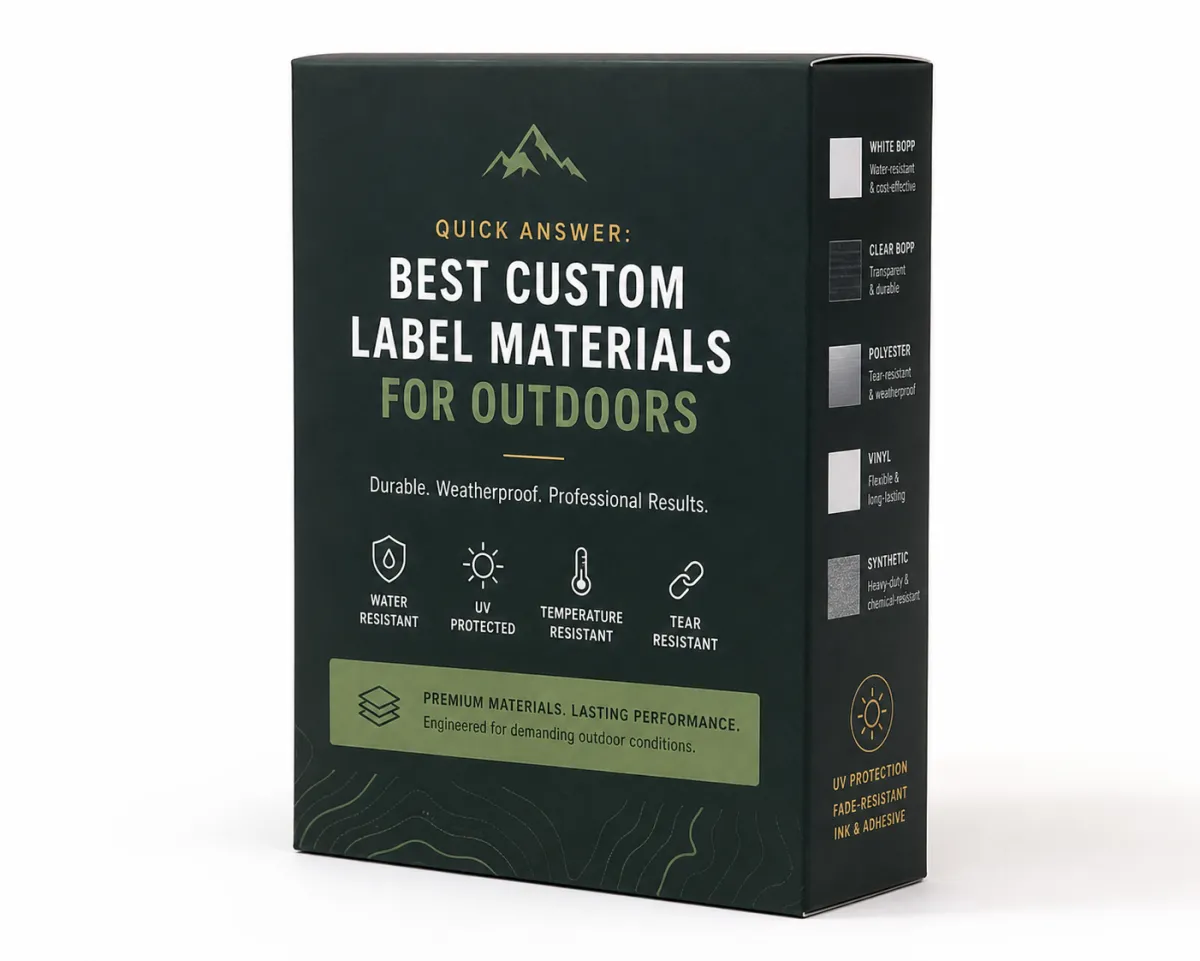
The hard truth: most outdoor label failures start at the adhesive line, not the print face. Heat, humidity, UV, and hand contact show up together, and the weakest link usually quits first. That is why the best custom label materials for outdoors are not simply the thickest or the shiniest. They are the ones matched to the exposure, the surface, and the job. Otherwise you are just paying extra to watch a label peel off in the sun.
If you want the short verdict, it is this: polyester is the safest choice for harsh exposure, BOPP is the best value for moderate outdoor use, and vinyl is the smart pick for curved or flexible surfaces. Paper can look premium in retail packaging, but for real outdoor duty it is usually the wrong starting point unless the label is short-term or heavily sheltered. A nice-looking label on kraft paper or corrugated cardboard does not help if rain turns it into mush.
Think about the application, not just the product. A yard bin in a residential setting. Nursery pots sitting in full sun. Cold-chain totes moving from refrigerated storage to a wet loading area. Equipment tags on painted metal that gets washed down. In each case, the best custom label materials for outdoors solve a different problem. For a tote that sees splashes and abrasion, BOPP may be enough. For a machine plate or long-life asset tag, polyester usually earns its keep. For a curved bottle, jug, or flexible container, vinyl often beats a stiff film. That is not glamorous, but it works.
Here is the pattern I see most often in packaging design and branded packaging work:
- The buyer starts with print quality, but durability really depends on adhesive match and substrate prep.
- The label spec looks fine on paper, then the first hot week exposes edge lift.
- The field cost is not the label alone; it is the rework, the replacement labor, and the brand damage on product packaging.
For outdoor use, the decision factors that matter most are exposure length, surface texture, temperature swing, and budget. Direct sun changes the game fast. So does condensation. So does an oily or low-energy surface like some plastics and powder-coated finishes. If the label has to stay readable for barcodes, lot codes, safety text, or regulatory copy, you need more than a material that simply “sticks.” You need the best custom label materials for outdoors for that exact environment.
“The label usually fails because the environment was never defined tightly enough. Once the exposure profile is clear, the material choice gets easier.”
Top Custom Label Materials for Outdoors Compared
Before choosing a stock, compare the real tradeoffs. Buyers often ask for the strongest film, but strength is not one thing. Water resistance, UV stability, abrasion resistance, chemical resistance, print quality, and cost all pull in different directions. That is why the best custom label materials for outdoors should be evaluated as a system: face stock, adhesive, finish, and the surface it will touch. Skip one of those pieces and the whole spec gets shaky.
The table below gives a practical buying view. The scores are relative, not lab-certified claims. They are meant to show what usually happens in typical outdoor packaging and labeling work.
| Material | Water Resistance | UV Stability | Abrasion Resistance | Surface Fit | Typical 5,000-Unit Cost | Best Use |
|---|---|---|---|---|---|---|
| BOPP | High | Medium | Medium | Good on flat surfaces | $0.08-$0.18 per label | Value-driven outdoor packaging |
| Polyester | High | High | High | Best on flat, rigid surfaces | $0.12-$0.28 per label | Equipment, asset, and long-life labels |
| Vinyl | High | Medium to High | High | Excellent on curves and flexing surfaces | $0.14-$0.32 per label | Curved containers and flexible products |
| Laminated paper | Low to Medium | Low to Medium | Low to Medium | Good on clean flat stock | $0.05-$0.14 per label | Short-term sheltered use |
| Clear or silver specialty stock | High | Medium to High | Medium to High | Depends on adhesive and finish | $0.15-$0.35 per label | Premium branding and high-visibility assets |
The biggest mistake is comparing face stocks without checking adhesive behavior. A strong film with the wrong glue still fails. I have seen labels lift from condensation on cold-chain packaging even though the material itself was technically fine. I have also seen a simpler BOPP label outperform a more expensive stock because the adhesive matched the substrate better. That is why the best custom label materials for outdoors are never just about the front face. The back matters too, annoying as that sounds.
Finish matters too. Matte reduces glare and helps legibility in direct sun, which is useful for barcodes and instructions. Gloss sharpens color and can improve retail packaging presentation, but it may flash under bright outdoor light. Clear labels are useful when the package branding needs the container to show through. Silver labels can look sharp on equipment or premium product packaging, especially when you need a durable metallic effect without printing heavy backgrounds.
If you need a practical ranking, it usually looks like this:
- Polyester for the toughest conditions and the longest service life.
- BOPP for strong water resistance at a lower cost.
- Vinyl for curved, flexing, or awkward surfaces.
- Laminated paper only for sheltered, short-duration jobs.
That ranking changes if the substrate is unusual, if the label needs to be removable, or if the package faces repeated wash-downs. Still, it is a useful starting point for anyone comparing the best custom label materials for outdoors against budget and real-world wear. No one likes surprises after production starts.
Detailed Reviews of BOPP, Polyester, Vinyl, and Paper
The tradeoffs get clearer once you stop treating all films like they are interchangeable. The best custom label materials for outdoors are not one-size-fits-all, and a buyer who understands the differences can save real money later. The right choice depends on whether the label is expected to survive rain, sunlight, rubbing, cleaning, or constant flexing. Sometimes all of the above, which is where projects get weird.
BOPP: the value leader
BOPP is often the sweet spot for outdoor packaging that needs to stay presentable without pushing the budget too far. It resists water well, handles condensation better than paper, and prints cleanly in digital and flexographic workflows. For many brands, BOPP is the entry point into the best custom label materials for outdoors because it delivers a strong visual result at a moderate price.
I like BOPP for things such as nursery pots, yard-sale bins, outdoor retail packaging, and cold-storage totes that do not live in direct sun all day. The label can survive splashes, light abrasion, and general handling if the adhesive is chosen correctly. A high-tack permanent acrylic adhesive is usually the safest place to start. If the package sits in sunlight for long periods, though, BOPP can show its limits faster than polyester.
Verdict: Choose BOPP for strong performance and lower cost. Skip it if the label must remain readable and intact through heavy weather, repeated scrubbing, or long sun exposure.
Polyester: the durability leader
Polyester is the stock I reach for when the label has a serious job. It handles heat, UV, and abrasion better than most common films, and it holds up well on equipment, tools, asset tags, and industrial product packaging. If the label needs to survive for a long time, polyester is usually one of the best custom label materials for outdoors to test first.
It also plays well with high-resolution print and small type. That matters if the label carries serial numbers, safety copy, or dense regulatory data. On rigid surfaces, the performance is strong. On rough or low-energy surfaces, however, the adhesive still decides whether the label stays put. Polyester is not magic; it is just more forgiving under stress than cheaper alternatives. For buyers comparing package branding against actual field life, that distinction matters.
Verdict: Pick polyester for harsh weather, repeated handling, and long service life. It costs more, but it often lowers the replacement rate enough to justify the spread.
Vinyl: the conformable option
Vinyl is useful when the label has to wrap around a curve, flex with the product, or cling to an uneven surface. That makes it valuable for bottles, jugs, reusable containers, and some outdoor retail packaging formats. Among the best custom label materials for outdoors, vinyl is the one I think of when the surface itself creates the challenge.
Because vinyl conforms well, edge lift can be reduced on rounded items if the adhesive is chosen properly. That said, not every vinyl behaves the same. Thickness, plasticizer content, and finish affect both print quality and long-term durability. On a clean metal surface, vinyl can perform very well. On dusty, oily, or textured plastic, the result depends heavily on prep. The material helps, but it does not fix a sloppy application.
Verdict: Use vinyl for curves, flexing surfaces, or awkward geometries. Do not assume it is automatically the most weatherproof option simply because it conforms better.
Weatherproof paper: limited use only
Paper still has a place in packaging design, but not as a default outdoor answer. A laminated paper label can look attractive on branded packaging, especially if the surface is sheltered or the exposure window is short. For kraft paper wraps, corrugated cardboard shippers, and premium retail packaging that only spends brief periods outside, paper may be acceptable. For true outdoor duty, it usually turns into a replacement problem.
I would not use paper for yard bins, permanent outdoor signage, or anything that faces full rain and sun. It can swell, curl, and lose adhesion quickly. That is why paper is usually absent from the list of the best custom label materials for outdoors unless the use case is temporary or protected by design. If you need paper for a visual effect, choose a coated or laminated version, and be honest about the exposure window. A little honesty beats a lot of apologies.
If sustainability is part of the brief, FSC-certified paper can be a useful option for sheltered applications. The FSC system is a credible reference point for sourcing decisions, but certification does not change the physics of rain and UV. A responsibly sourced label can still fail outdoors if the material choice is wrong.
Specialty notes: clear and silver stocks
Clear labels work well when the container needs to show through, which is common in premium product packaging and some retail packaging programs. Silver polyester is often chosen for asset tags and machinery because it gives a clean, technical look while adding another layer of durability. These specialty options belong in the conversation about the best custom label materials for outdoors, but they are usually selected for appearance plus performance, not cost.
Overlamination can help too. A clear laminate can improve abrasion resistance and help preserve color in high-traffic environments. It adds cost and can create glare, so it is not a universal fix. Still, on labels that face scrubbing or rough handling, lamination can move a good spec closer to the best custom label materials for outdoors result.
Process and Timeline: From Spec Sheet to Field Test
The cleanest labels on earth are useless if the spec sheet does not match the environment. Start with the conditions, not the artwork. That is the difference between a decent proof and the best custom label materials for outdoors working in the field. Write down the exposure first: sun, moisture, abrasion, chemicals, temperature swing, and the exact surface the label must bond to. If you skip that step, you are guessing.
Then define the substrate. Is it corrugated cardboard, powder-coated metal, glass, polypropylene, polyethylene, or a textured container? Each one behaves differently. If the label has to live on Custom Printed Boxes or corrugated cardboard for a brief outside hold, the adhesive challenge is different from a metal tool tag that gets wiped down every day. Surface prep is part of the spec, not an afterthought.
A practical project flow usually looks like this:
- Sample request: Ask for two or three material builds, not just one.
- Proof review: Check color, barcode contrast, and legibility under glare.
- Adhesive match: Confirm the exact surface and the application temperature.
- Production setup: Approve die lines, stock, and finish.
- Field test: Run the label in the real environment before full volume.
- Reorder lock: Save the final spec so future runs do not restart from zero.
Delays usually happen in the same places: die changes, color matching, adhesive selection, and last-minute substrate changes. A buyer may choose one of the best custom label materials for outdoors and still lose time if the container changes from painted metal to textured plastic. That is why the first sample round should be tied to the exact surface, not a substitute.
A simple field test can reveal a lot. I like a three-step check: overnight moisture exposure, a 72-hour cure, then at least one week outdoors if the schedule allows. Watch for corner curl, edge lift, barcode scanability, residue on removal, and print fade. If the label passes in a lab and fails in the yard, the yard wins. Field reality always wins. That is just how it goes.
For transit-heavy projects, the packaging and distribution side matters too. The ISTA test framework is a useful reference for shipment abuse and handling stress. It is not a label-only standard, but it gives teams a better way to think about vibration, drops, compression, and temperature swings that can expose weak adhesive performance.
“If the label has to survive the route, the dock, and the customer’s hands, then the test needs to simulate all three. A clean lab result alone is not enough.”
One more practical detail: build the reorder note now. Record the face stock, adhesive, finish, application surface, and the result of the field trial. That makes the next run faster, and it prevents a well-performing label from being swapped out for a cheaper lookalike that is not part of the best custom label materials for outdoors shortlist.
Price Comparison: What Outdoor Labels Really Cost
Outdoor-ready labels cost more than basic indoor labels for a reason. The substrate is stronger, the adhesive is better, and the print protection often goes further. That said, the difference in unit price can be much smaller than the cost of one failed rollout. For many buyers, the best custom label materials for outdoors save money by reducing reprints, labor, and customer complaints.
Price is driven by six variables: substrate, adhesive, coating or lamination, print method, quantity, and die-cut complexity. A simple 2-inch by 3-inch BOPP label at 5,000 pieces can land around $0.08-$0.18 per unit depending on coverage and finish. Polyester might move into the $0.12-$0.28 range. Vinyl and specialty clear or silver options usually climb higher, especially if you add lamination or multiple versions.
| Build | Typical Cost Range | Protection Level | Best Fit |
|---|---|---|---|
| Paper, no laminate | $0.04-$0.10 | Low | Short-term sheltered use only |
| Paper with laminate | $0.05-$0.14 | Low to medium | Light moisture, brief exposure |
| BOPP | $0.08-$0.18 | Medium to high | General outdoor packaging |
| Polyester | $0.12-$0.28 | High | Long-life and equipment labels |
| Vinyl | $0.14-$0.32 | High | Curved or flexible surfaces |
| Polyester with overlaminate | $0.16-$0.35+ | Very high | Rough handling, wash-down, direct sun |
Minimum order quantities and setup charges matter more than many buyers expect. A version change, a new die, or a new laminate can push the quote up more than the material itself. That is especially true in smaller runs for branded packaging, where the visual requirement is high but the volume is not. The cheapest-looking quote can become the most expensive one after delays and reprints. I have watched that happen more than once, and it is not a fun meeting.
It helps to think in total cost of ownership. If a $0.12 polyester label prevents one field replacement cycle, one labor visit, or one customer return, it may be the cheaper option. This is where the best custom label materials for outdoors outperform the budget pick. They reduce hidden costs: repackaging, relabeling, lost shelf appeal, and lost trust.
Use this rule of thumb:
- Spend less on sheltered, temporary, or promotional outdoor use.
- Spend more on direct sun, wash-downs, refrigeration, or rough handling.
- Do not save money by downgrading the adhesive if the environment is harsh.
That final point is huge. I have seen teams specify a durable film, then pair it with a generic adhesive that cannot handle the actual substrate. The quote looked good. The field result did not. If the label is part of package branding or product packaging, failure hurts twice: once in operations and once in perception. The best custom label materials for outdoors are the ones that survive both bills.
How to Choose the Right Material for Your Conditions
Start with the exposure profile. Full sun, standing water, abrasion, oil contact, and temperature swings each push the choice in a different direction. A label that works on a shaded porch may fail on an exposed dock. That is why the best custom label materials for outdoors are selected by conditions, not by habit. No secret sauce. Just matching the spec to the environment.
Then match the adhesive to the surface. Corrugated cardboard behaves differently from powder-coated metal. Glass is different from textured plastic. Low-energy plastics such as polyethylene and polypropylene can be especially tricky. If the label will face a rough surface, a damp surface, or a surface that sheds dust, ask for a sample test before committing. That one step prevents a lot of expensive guessing.
Consider the label’s physical behavior too. Does it need to flex, wrap, or resist repeated handling without curling or splitting? Vinyl is often better on curves. Polyester stays flatter and is more stable for technical labels. BOPP lands in the middle for many outdoor packaging jobs. Those are the kinds of details that separate decent labels from the best custom label materials for outdoors.
Finish should be chosen for readability, not just appearance. Matte reduces glare in bright daylight and can improve scanability. Gloss boosts color and works well for retail packaging that needs a polished look. Clear labels are useful when the container itself is part of the design. Silver stock adds a premium technical feel. None of those choices are automatically better; they solve different problems in packaging design.
Here is a simple way to narrow the field:
- Moderate exposure: BOPP is usually the most efficient starting point.
- Harsh exposure: Polyester is usually the safer long-life choice.
- Curved or flexible surfaces: Vinyl is often the better fit.
- Sheltered short-term use: Laminated paper can work if expectations are honest.
Barcodes, lot codes, safety warnings, and regulatory copy add another layer. If that information has to stay legible after weathering and cleaning, the material and print method need to be chosen together. A durable face stock without durable ink is still a weak spec. The best custom label materials for outdoors protect the message, not just the shape of the label.
For buyers balancing retail packaging, custom printed boxes, and outdoor display time, the practical answer is often a tiered system. Use BOPP for the bulk of outdoor packaging, step up to polyester for mission-critical items, and reserve vinyl for curved surfaces. That gives you a cleaner path than trying to force one label build into every scenario. And if you need a broader set of formats, compare options through Custom Labels & Tags alongside Custom Packaging Products so the label spec fits the whole package, not just the front panel.
Our Recommendation: Best Custom Label Materials for Outdoors
If I had to rank the best custom label materials for outdoors by use case, the order would be simple. BOPP for value-driven outdoor packaging. Polyester for the toughest conditions. Vinyl for curved or flexible surfaces. Paper only for short-term or sheltered jobs. That is the honest answer, and it holds up across a lot of buyer scenarios. It is also the answer that causes the fewest headaches later.
For a brand that wants good package branding without overpaying, BOPP is usually the first sample I would request. It gives a clean print surface, strong water resistance, and a more comfortable price point. For equipment labels, asset tags, and anything that sits in sun or gets wiped down, polyester is the safer call. For a bottle, jug, or flexible container, vinyl is often the most practical choice because it can conform without fighting the shape.
My strongest advice is to order at least two builds and test them on the real surface. Compare face stock and adhesive side by side. Leave them outside. Wipe them down. Put them in moisture. Check the corners. Scan the barcode. That small pilot tells you more than a polished sample pack ever will, and it is the quickest way to confirm the best custom label materials for outdoors for your application.
Once you have a winner, lock the spec with the details that matter:
- Face stock type and thickness
- Adhesive type and application temperature
- Finish: matte, gloss, clear, or overlaminated
- The exact substrate it was tested on
- The field results: moisture, UV, abrasion, and scanability
That record saves time on the next reorder and keeps future production from drifting. It also protects consistency in branded packaging, where even a small change in sheen or adhesion can make a run look off. Most packaging problems do not start with a bad idea. They start with a vague spec.
Honestly, the best decision is often boring: choose the material that fits the environment and spend the extra hour on testing. That is how the best custom label materials for outdoors earn their place. Not by sounding premium. By still looking right after the weather gets involved. That is the whole trick, and it is not exactly glamorous.
What is the best custom label material for outdoors?
Polyester is the safest choice for long-term outdoor use because it handles sun, moisture, and abrasion better than most alternatives. BOPP is often the best value when exposure is moderate and the goal is solid weather resistance without paying for the toughest stock. Vinyl is the better call when the label needs to conform to a curved or flexible surface. If you are comparing the best custom label materials for outdoors, start with those three.
Are BOPP labels good for outdoor packaging?
Yes, BOPP is a strong option for rain, splashes, and short-to-medium outdoor exposure. It is usually a better buy than paper, but direct sun and heavy abrasion can push it beyond its comfort zone. If the label must survive harsh weather, pair BOPP with the right adhesive and verify performance in a field test. That is the practical way to judge the best custom label materials for outdoors instead of relying on a spec sheet alone.
How long do outdoor custom labels last?
Lifespan depends on the environment, not just the material. Sun, cleaning, handling, and temperature swings all affect durability. Sheltered applications can last far longer than labels exposed to full sun and frequent moisture. For critical uses, test the label on the actual surface before assuming the printed spec will match real-world wear. In other words, the best custom label materials for outdoors still need a real-world trial.
What adhesive works best on rough or wet outdoor surfaces?
A high-tack permanent adhesive is usually the starting point for rough, textured, or slightly damp surfaces. The best adhesive still needs the right prep, including cleaning the surface and applying within the recommended temperature range. If the surface is unusually low-energy or heavily textured, request a sample test instead of guessing. Even the best custom label materials for outdoors will fail if the adhesive cannot wet out properly.
How much do outdoor-ready label materials cost?
Outdoor-ready labels usually cost more than basic paper labels because the material, adhesive, and print protection are better. The final price depends on quantity, material choice, finish, and whether the design needs a custom die or lamination. Compare price against replacement labor and reprint risk, because the cheapest label often becomes the most expensive one. That is the real lens for buying the best custom label materials for outdoors.
For most buyers, the answer stays consistent: match the stock to the exposure, match the adhesive to the surface, and test the label before volume. Do that, and the best custom label materials for outdoors stop being a gamble and start acting like a controlled purchase decision. That is the part worth acting on first.

