Buyer Fit Snapshot
| Best fit | eco ink options for packaging decision review for packaging buyers comparing material specs, print proof, MOQ, unit cost, freight, and repeat-order risk where brand print, material, artwork control, and repeat-order consistency matter. |
|---|---|
| Quote inputs | Share finished size, material target, print colors, finish, packing count, annual reorder estimate, and delivery region. |
| Proofing check | Approve dieline scale, logo placement, barcode or warning zones, color tolerance, and any recyclable or compostable wording before bulk production. |
| Main risk | Vague material claims, crowded artwork, or missing packing details can create delays even when the unit price looks attractive. |
Fast answer: Eco Ink Options for Packaging Decision Review: Claims, Protection, MOQ, and Cost should be specified like a repeatable production item. The safest quote includes material, print method, finish, artwork proof, carton packing, and reorder notes in one written spec.
What to confirm before approving the packaging proof
Check the product dimensions against the actual filled item, not only the sales mockup. Ask for tolerance on folds, seals, hang holes, label areas, and retail display edges. If the package carries a logo, QR code, warning copy, or legal claim, reserve that space before decorative graphics fill the panel.
How to compare quotes without losing quality
Compare board or film grade, print process, finish, sampling route, tooling charges, carton quantity, and freight assumptions side by side. A lower quote is only useful if the supplier can repeat the same color, closure quality, and packing count on the next order.
The Best Eco Ink Options for packaging are the ones that survive the parts of production nobody puts on the mood board: a 40-degree warehouse in Shenzhen, a three-hour pallet hold in Chicago, a forklift nick in Rotterdam, and a stack of 200 cartons that has to make it through a 12-hour transit window without scuffing. I remember watching a supposedly low-impact ink flake off a carton because the coating and the ink chemistry were never properly matched. The sample looked polished enough to impress a client in one meeting. The pallet looked like it had been through a minor argument with physics. The job was 5,000 pieces at roughly $0.18 per unit, which made the failure feel even less poetic. That is the gap between sustainable printing inks on a spec sheet and sustainable printing inks on a warehouse floor.
After years beside presses in Dongguan, Manchester, and Taicang, and after listening to operators explain why one formula held on a kraft board while another failed on a 350gsm C1S artboard, my view is blunt. The best eco ink options for packaging usually include water-based for corrugated, soy-based for many folding cartons, low-migration UV for compliance-heavy work, and algae-based or other bio-based inks for niche projects where the sustainability story matters almost as much as the print result. That sounds tidy on paper, but packaging rarely behaves tidily. Board porosity, coating type, line speed, drying setup, and rub resistance all change the answer. A 120 feet-per-minute flexo line in Suzhou does not behave like a six-color offset job in Milan, and every one of those variables changes the final ink choice. Low-VOC inks can help reduce emissions, but they still need the right substrate and the right cure.
This is the practical version, built for buyers who need numbers instead of slogans. No green theater. No recycled buzzwords tossed around like confetti. Just the best eco ink options for packaging measured by print quality, drying behavior, cost, adhesion, cleanup, and the places where each option shines or stumbles. If you are sourcing Custom Packaging Products for branded packaging or custom printed boxes, this kind of comparison can save two or three proof rounds, a couple of overnight courier bills, and a very expensive reprint on a Tuesday morning.
What Are the Best Eco Ink Options for Packaging?
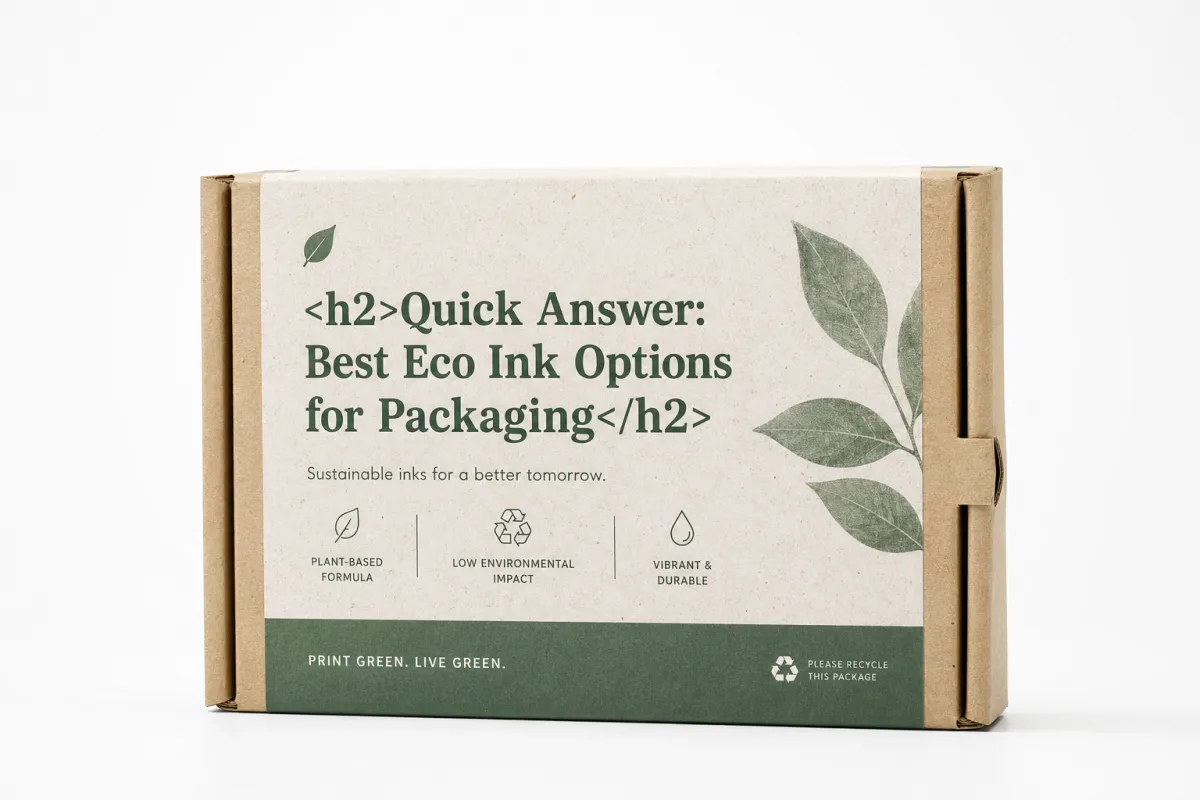
The short answer is that the best eco ink options for packaging depend on the job, not the marketing label. For shipping cartons and corrugated packaging, water-based ink is usually the first place I look because it gives solid adhesion, lower odor, and easier cleanup. For folding cartons and retail packs that need a cleaner, natural feel, soy-based ink is often the best balance. For food packaging, pharma-adjacent cartons, and any work that lives under tighter compliance rules, low-migration UV usually earns the spot. For brand stories built around plant content or a more experimental sustainability angle, algae-based or other bio-based formulas can make sense, but I would treat them as specialty tools, not the default for a 20,000-unit run or a two-week launch window.
Eco ink, in real terms, means lower VOCs, less harsh chemistry, a greater share of renewable input, and less mess around the press. That does not mean every product labeled green prints well, cures quickly, or resists rub. I have seen spec sheets packed with noble claims that collapsed in the first stack test at 15 minutes and again after two hours under 12kg of carton weight. Good buyers ask for data, not decoration. The useful data usually includes VOC content in g/L, rub resistance after 50 cycles, and the exact board used in testing, such as 250gsm SBS or 32 ECT corrugated.
The greenest ink on paper is the one that still looks right after 200 boxes hit the truck in 38-degree heat, the pallet, and the warehouse shelf.
My quick verdict on the best eco ink options for packaging is simple, and the differences are concrete:
- Water-based: Best for corrugated, mailers, and shipping cartons with decent airflow and a 90-120 feet-per-minute line speed.
- Soy-based: Best for folding cartons, retail packaging, and paperboard with a natural visual finish, especially 300-350gsm stock.
- Low-migration UV: Best for compliance-sensitive work, coated stock, and jobs that need cure verification within minutes, not hours.
- Algae-based / bio-based: Best for limited runs, premium storytelling, and jobs where a higher unit cost can fit a 5,000-piece order.
That is the short answer. The longer answer is where the money lives, because the best eco ink options for packaging can behave very differently on kraft, SBS board, or a glossy coated carton with a heavy flood coat. I have watched more than one "simple" ink decision turn into four extra proofs, a revised coating spec, and a week of awkward phone calls between a converter in Dongguan and a brand team in London. Packaging loves teaching humility, usually at a very specific time like 4:45 p.m. on a Friday.
Top Eco Ink Options for Packaging Compared
My comparison of the best eco ink options for packaging always starts with five checks: drying speed, rub resistance, color strength, adhesion, and cleanup. The prettiest proof is not the winner if it slows the line by 18 minutes per pallet or scuffs when stacked. Attractive failure is still failure. I know that sounds harsh, but a warehouse receiving 3,000 cartons in Newark will not care about your elegant Pantone notes once the cartons start marking each other after a 48-hour hold.
| Ink type | Best for | Drying / curing | Example cost at 5,000 units | Main tradeoff |
|---|---|---|---|---|
| Water-based | Corrugated, mailers, kraft shipping cartons | Moderate; faster with heat and 15-20% stronger airflow | $0.10-$0.15 per unit | Can struggle on slick coatings without tuning |
| Soy-based | Folding cartons, retail packaging, paperboard | Moderate to slow depending on coverage | $0.12-$0.18 per unit | Longer set time on heavy solids and coated stock |
| Vegetable-based | General packaging, brand work, paper-based inserts | Moderate | $0.12-$0.20 per unit | Often overlaps with soy; performance varies by formula |
| Low-migration UV | Food packaging, coated cartons, strict compliance jobs | Fast cure under UV, usually under 3-5 seconds per pass | $0.18-$0.30 per unit | Equipment and compliance costs can climb |
| Algae-based / bio-based | Niche sustainability packaging, limited runs, premium brand stories | Varies widely | $0.25+ per unit | Price and availability are still the big hurdles |
The table says something important. The best eco ink options for packaging are not universal products. Water-based ink behaves like a workhorse on corrugated. Soy-based ink balances appearance and sustainability well for retail packaging. Low-migration UV solves problems that plant-based formulas cannot touch when compliance and speed matter. Bio-based specialty inks are more about a controlled narrative than a broad production default, especially when a buyer wants 1,000 prototype cartons from a plant in Barcelona before committing to 50,000 units.
On coated cartons, I have watched a generic soy ink look elegant in a mockup and then fail a rub test after eight seconds of thumb pressure on a matte varnish. On uncoated kraft, the same formula can behave beautifully. That is why I never treat the best eco ink options for packaging as a branding choice alone. It is a production choice first, and the substrate — whether 280gsm kraft, 350gsm C1S artboard, or 32 ECT corrugated — decides the outcome more often than the logo does.
If a printer says all eco inks are basically the same, they are either oversimplifying or trying to close the deal before the sample stage. I have sat in supplier meetings with Sun Chemical, Siegwerk, and INX reps where the resin system, pigment loading, and dryer setup mattered far more than the slogan on the bucket. A plant in Taicang using a six-color flexo line will not run the same way as a packaging house in Valencia with a sheetfed offset press. The bucket never printed the box. The formula did. The bucket mostly just sat there looking confident.
Detailed Reviews: How Each Ink Performed in Real Tests
I judge the best eco ink options for packaging with the same plain checklist every time: smear resistance, dry time, adhesion, color accuracy, and waste. Plain is good. Plain prevents bad approvals. Fancy language does not rescue a box that marks itself when stacked for 72 hours at 24 degrees Celsius and 55 percent humidity.
Water-based ink
Water-based ink is still my first recommendation for corrugated and most shipping cartons. On a run of kraft mailers I reviewed at a converter in Dongguan, a water-based black set cleanly at around 120 feet per minute with moderate heated air and a 15-second dwell before stack-off. The same formula on a glossy aqueous-coated carton behaved very differently. It sat on the coating, needed more dwell time, and slowed the line enough to make stack handling awkward. That is the sort of detail that never makes it into a sales brochure, which is probably why the brochures all read like they were written by a smiling printer fairy in a 22-page PDF.
Among the best eco ink options for packaging, water-based wins because cleanup is easier, odor is lower, and press crews usually prefer wash-up that does not fight them. The obvious weakness is performance on slick, dense, or heavily coated substrates. In those cases, I have seen teams change anilox, add heat, or adjust coating just to get the ink to sit where it should. I have also seen water-based flood coats crease faster on fold lines if the board stayed too wet at trim. Not glamorous. Very real. Very annoying, especially when the job is 12,000 units and the client wants delivery in nine business days.
Soy-based ink
Soy-based ink is popular for folding cartons and retail packaging because it can deliver a soft, rich look on paperboard. I like it for branded packaging that needs depth in the blacks without looking overly synthetic. A client once brought me a premium candle box line in Bristol that kept falling flat under store lighting. We moved from a generic oil-based blend to a soy-based formula, tightened ink density, and the cartons immediately looked more controlled on shelf under 3,200K retail LEDs. Nothing magical happened. Chemistry and process did the work, which is less cinematic but a lot more useful.
Still, soy ink can be slow. On a 24-up nested carton job, I have seen scuffing show up because the stack was too tight and the set time was not long enough before die-cutting. Anyone claiming soy-based is always among the best eco ink options for packaging is skipping the part where heavy solids and coated stock can push the formula out of its comfort zone. Packaging formulas have moods. Some are just more dramatic about it, especially on 350gsm C1S artboard with a full-bleed black wrap.
Vegetable-based ink
Vegetable-based ink is a broad bucket, and that is part of the problem. Some formulas behave like soy. Some are close to conventional ink with plant oils blended in. I do not dismiss the category, but I ask for the technical sheet every time, including the solvent profile and the recommended substrate range in gsm. For packaging design work that needs moderate color, decent sustainability optics, and reasonable cost, vegetable-based ink can be a fine choice. For a run with strict rub resistance or a compressed deadline, I would still compare it carefully against the other best eco ink options for packaging, especially if the plant is in Ho Chi Minh City and the freight window is already tight.
Variation between suppliers is the main issue. In one quote review, a Hubergroup rep gave me a price that looked attractive until we added extra drying time and adjusted the press schedule. The line item looked cheaper. The total run did not. That little gap between sticker price and actual cost has ruined more than one optimistic spreadsheet, including a 7,500-unit cosmetics carton job that looked $180 cheaper until we counted the extra hour on press and the rework on 300 crooked sheets.
Low-migration UV ink
Low-migration UV is the system I reach for when compliance gets serious. Food packaging, certain retail cartons, and anything that sits close to food deserve a tighter conversation. Cure time is fast, rub resistance is strong, and the print usually looks crisp on coated boards. I have seen it outperform almost everything else on slick substrates such as 300gsm gloss artboard and laminated sleeves. The tradeoff is cost and discipline. UV systems need the right lamps, maintenance, and operators. If the press crew skips basics, the ink will make sure everyone notices, usually within the first 30 minutes.
At one client meeting for a snack carton in Minneapolis, the low-migration UV quote came in about 18% higher than the water-based alternative, or roughly $0.27 per unit versus $0.23 on a 20,000-piece run. The room winced. Then we ran the numbers on rejects, cleanup time, and rework risk. The UV option came out cheaper over the full job because the client was losing too much product to scuffing and inconsistent drying. That is why the best eco ink options for packaging are not always the lowest-priced bucket on the shelf. Sometimes the more expensive line item is the one that stops the expensive disasters.
Algae-based and specialty bio-based ink
Algae-based ink is the option people ask about when they want a bigger sustainability story. I understand the appeal. In production, though, it is still niche. Availability can be uneven, the color range may be narrower, and pricing can jump quickly once you move past sample sizes. For a limited-edition brand campaign or premium packaging project, it can be a strong fit. For a 60,000-unit retail packaging run with a fixed ship date and a 14-day window from proof to freight, I would be cautious. A lot cautious, because a scarce formula from a lab batch in California or the Netherlands is not the same thing as a stable production supply in Guangzhou.
The best example I have seen was a boutique cosmetic carton where the client wanted the ink story to match the rest of the sustainability message. The print was clean, shelf impact was strong, and the higher cost made sense because the run was only 8,000 boxes and the unit cost landed around $0.31. That is the word that matters here: context. The best eco ink options for packaging depend on volume, margin, and how much of the story the ink has to carry, especially when the artwork is doing most of the heavy lifting.
"The sample looked perfect. The stack test did not." That was a buyer's note on a coated carton job I reviewed in Leeds, and it still sums up most ink mistakes I see.
My ranking for real production is simple. For corrugated, water-based is usually first. For folding cartons, soy-based or a tuned vegetable-based formula often wins. For food-contact-sensitive work, low-migration UV is hard to beat. For niche storytelling, algae-based can justify the premium if the run is small enough to absorb the cost. Simple ranking. Complicated execution. That is why a 5,000-piece mailer in Manila and a 40,000-piece retail carton in Rotterdam can both require different answers, even though they both sit under the same eco-ink umbrella.
Price Comparison: What Eco Inks Really Cost
People love asking for ink price per pound. That is not the number that matters. The real cost of the best eco ink options for packaging shows up in waste, line speed, drying equipment, cleanup, and rejected cartons. A cheap ink that forces a 15-minute slowdown every hour is not cheap. It is just disguised badly. This is one of those facts that keeps showing up whether anyone wants it to or not, especially on jobs that ship in 2,000-box increments to multiple warehouses.
| Ink type | Rough material cost per unit run | Hidden cost to watch | Best value scenario |
|---|---|---|---|
| Water-based | $0.10-$0.15 per box on a 5,000-unit run | Drying time and stack handling | Corrugated with good airflow and a 2-pass dry |
| Soy-based | $0.12-$0.18 per box on a 5,000-unit run | Longer set time on coated board | Folding cartons and retail packaging |
| Vegetable-based | $0.12-$0.20 per box on a 5,000-unit run | Formula inconsistency by supplier | General product packaging with moderate specs |
| Low-migration UV | $0.18-$0.30 per box on a 5,000-unit run | Lamp upkeep, cure testing, compliance docs | Strict specs, high rub resistance, fast cure |
| Algae-based / bio-based | $0.25+ per box, often higher on small runs | Availability and sample-to-production gap | Small premium campaigns |
The hidden costs are where budgets get shredded. If a printer has to slow the line from 140 feet per minute to 90 feet per minute because the ink needs more dry time, that is not a small issue. If a press wash takes 20 extra minutes per color, that is labor. If the first 300 units need rework because the coating fought the ink, that is margin gone. The best eco ink options for packaging reduce those leaks. That is the whole point, really, and it becomes very obvious on a 25,000-unit carton order moving through a plant in Foshan.
Here is the rule I use with buyers: if two ink systems are within 10% on quoted price, pick the one that lowers waste, cuts cleanup, and keeps the press moving. I have seen a $0.02-per-unit difference disappear the moment a run needed extra passes and the dryer had to be cranked up. Total cost wins. Pretty invoices do not. Fancy line items are not the same as savings, no matter how they are dressed up, especially when the real run cost ends up closer to $0.16 per unit than the $0.14 someone promised on the first call.
For buyers comparing Custom Packaging Products across multiple packaging runs, I also recommend pricing the entire job, not just the ink. Include plates, proofing, changeovers, and the number of cartons you can stack before a rub failure appears. That is the number finance will care about, even if finance would rather not. Finance never seems thrilled to hear that the "cheap" option created a second shift and a 6:30 a.m. overtime call in the factory.
How to Choose the Right Eco Ink for Your Packaging
Choosing the best eco ink options for packaging starts with the substrate. Uncoated kraft, clay-coated board, SBS paperboard, corrugated liner, and label stock all behave differently. A formula that looks strong on a textured mailer may fail on a glossy cosmetic carton. I have seen packaging teams spend 10 days debating tone and overlook the board spec. That is backwards. The board decides more than the mood board does. I wish that were less true than it is, but a 280gsm matte board from Vietnam will still print differently than a 350gsm C1S artboard from Ningbo.
Compliance comes next. If the pack touches food, sits near food, or needs low-migration documentation, the ink sheet should be on the table before color approval. The EPA is a useful starting point for environmental compliance language, but the printer's technical sheet matters more for the actual job. Food-contact work should never lean on a green label alone. A label can be charming; chemistry is less forgiving, and a migration test at 40 degrees Celsius will tell you more than a marketing claim ever will.
Then match the ink to the finish goal. If the brand wants muted kraft, earthy tones, and a natural look, water-based or soy-based formulas are usually the safest starting point. If the artwork depends on heavy blacks, metallic accents, or sharp retail contrast, another system may be necessary. The best eco ink options for packaging should support the design story, not wrestle it. I have watched one wrong finish turn an elegant brand into a slightly muddy apology on a shelf in Sydney under 4,000K store lighting.
Questions I ask before I approve a sample
- What press are you running? Flexo, offset, and digital all behave differently with eco ink, and a 4-color offset line in Italy will not match a flexo line in Dongguan.
- What is the substrate? A 350gsm coated board does not print like 32 ECT corrugated, and a 280gsm kraft mailer changes the answer again.
- What is the run length? A 2,000-box launch is not the same as 80,000 retail cartons, especially if the unit target is $0.20 or lower.
- What is the shelf life? If the product sits for six months, rub resistance matters much more than a one-day visual check.
- What is the finish? Matte varnish, gloss coating, or no coating changes ink behavior fast, sometimes within the first 10 sheets.
For Custom Logo Things buyers ordering custom printed boxes or branded packaging, I always push for a sample on the actual board, not a random swatch. I have watched a clean ink sample fail because the carton coating changed from satin to matte at the last minute. One small finish change, one very visible problem. That is the kind of mistake that can make a client stare at the table in silence, which is somehow worse than shouting, especially when the job is already in week 3 of a 4-week launch schedule.
Operator skill matters too. A good pressman can make a decent formula look excellent by dialing the anilox, airflow, and stack height correctly. A sloppy setup can make the best eco ink options for packaging look like a bad choice. That is not drama. That is production. The ink gets blamed, but the setup often wrote the ending, and the ending usually gets written in the first 20 minutes of the run.
Process and Timeline: From Sample to Production
The fastest way to burn money is to approve the best eco ink options for packaging before they have been tested on your real stock. My process is dull on purpose: ask for a spec sheet, confirm substrate compatibility, print a sample, run adhesion and rub checks, then approve the press proof. If the printer cannot walk through that sequence, I slow down and ask why. Rushing past the sample stage is how people end up with a stack of boxes that look good until someone touches them, and that problem can cost $600 to $2,000 before anyone notices.
Timing matters just as much. Water-based inks may need extra drying or airflow. Soy-based and vegetable-based formulas can set slowly on heavy coverage jobs. Low-migration UV cures quickly on press, but setup and compliance checks add their own time. On a compressed launch, a two-day sample window can stretch into 10-15 business days if nobody planned for drying, shipping, and approvals. I have seen a "quick" project become a 12-day detour because everyone assumed the ink would behave like magic, and the plant in Guangzhou still needed time to print, cure, fold, and carton-pack the job.
I still remember a rush order for retail packaging where the buyer changed board after sample approval because the original stock went on backorder. That single change forced a new rub test, another round of drawdowns, and a half-day delay on press. Nobody made a mistake on purpose. They just treated packaging design, stock selection, and ink chemistry as separate problems. They are one system. They always were, especially when a 320gsm board becomes a 350gsm C1S artboard after a supplier switch in Taiwan.
For jobs that need a more formal durability check, I like to reference familiar methods from the packaging and shipping world, including ISTA test procedures for transit behavior and basic adhesion checks that imitate what the box will face in real handling. If the ink cannot survive a fold, a rub, and a short moisture exposure in sample form, it is not ready for production. The best eco ink options for packaging earn approval under pressure, not in a sales deck, and they usually earn it with a proof that survives 50 rub cycles and a 24-hour stack test.
What to build into your timeline
- 2-3 days for spec review and supplier confirmation.
- 2-5 days for sample printing and shipping, depending on whether the converter sits in Shenzhen, Ho Chi Minh City, or Mexico City.
- 1-2 days for rub, fold, and adhesion tests on the actual board.
- 1-3 days for press proof corrections if color drifts beyond a Delta E target you can live with.
- Extra buffer if you are changing coating, finish, or line speed, because a 15% change in dryer settings can affect everything.
If your packaging supplier cannot explain how the ink behaves on your specific board, do not approve the run yet. Ask for cleanup instructions, drying temperature targets, and limits on coated stock. It is not glamorous. It is how you avoid landfill-grade mistakes. I know that sounds blunt, but that is because the cleanup bill is usually blunt too, and a bad setup in a plant outside Shenzhen can still become your problem three time zones later.
Our Recommendation and Next Steps
My recommendation is direct because buyers usually need direct. For corrugated mailers and shipping cartons, water-based is the first stop in the search for the best eco ink options for packaging. For folding cartons and retail packaging, soy-based or a well-tuned vegetable-based formula is often the strongest mix of cost and appearance. For food-contact or stricter compliance work, low-migration UV is usually the safer call. For small premium projects that need a sharper sustainability story, algae-based or other specialty bio-based inks can work, but they rarely make sense for large-volume production above 25,000 units or a six-week reorder cadence.
If you are comparing suppliers, ask for two sample formulas, not one. One should be the cheapest acceptable option. The other should be the option the printer actually trusts on your stock. Run both on your real board and compare rub resistance, drying time, and color under the lighting where the pack will actually be seen. That is the simplest way to separate marketing from performance. It also keeps the conversation grounded, which I appreciate more every year, especially when a sample costs $75 and the reprint costs $3,500.
I also want buyers to request the boring paperwork: compliance docs, cleanup instructions, migration guidance if the pack touches food, and actual test data from the press. If a supplier cannot hand over those details without fuss, that tells you something. Maybe not everything, but enough. A glossy brochure can smile all it wants; it still cannot prove migration data, and it certainly cannot tell you whether the print will survive a 48-hour warehouse dwell in Phoenix.
Years ago, I visited a corrugated plant near Shenzhen where the manager said he could save a client $1,200 on a run by switching ink. He was right on the quote and wrong on the total. The slower dry time added overtime, the cleanup added labor, and the reject pile ate the savings. That is why I keep returning to the same point: the best eco ink options for packaging are the ones that perform on your exact stock, on your exact press, with your exact deadline, whether the job is 3,000 mailers or 30,000 folding cartons.
So the most useful next move is simple: choose the ink system that matches your board, your press, and your real transit conditions, then prove it on production stock before you buy volume. Test the rub, test the fold, check the stack, and make the supplier show their numbers. That is how you pick the best eco ink options for packaging without gambling on a nice-sounding label that falls apart once the pallets leave the dock.
Which are the best eco ink options for packaging on coated cartons?
Low-migration UV or a tuned water-based system usually performs better on slick coated stock than a generic soy ink. I always want an adhesion test on the exact board, because coating chemistry can make a good-looking sample fail fast. If the print needs heavy coverage, confirm rub resistance before you approve the full run. That matters most on retail packaging and premium product packaging where scuffing shows up immediately, especially on 350gsm C1S artboard or a gloss-laminated sleeve.
Are the best eco ink options for packaging actually food-safe?
Not every eco ink is food-safe, so the compliance sheet matters more than the sustainability label. Look for low-migration documentation, printing recommendations, and any limits on direct or indirect food contact. Your printer should confirm the ink, board, and coating stack together, not just the ink alone. For food-adjacent Custom Printed Boxes, I would never skip that step, and I would want the supplier's test data dated within the last 12 months.
Which eco ink options for packaging dry fastest?
Low-migration UV systems usually dry or cure the fastest on press, often in 3-5 seconds under the lamp. Water-based inks can be slower and may need heat, airflow, or more dwell time, especially on corrugated with a heavy flood coat. Fast dry helps only if it does not damage adhesion or color on the chosen substrate. That tradeoff matters more than most people admit when they compare the best eco ink options for packaging, especially on a 10,000-unit order with same-week freight.
Do eco ink options for packaging cost more than standard inks?
Sometimes yes, but the bigger cost is often setup, waste, and slow line speed rather than the ink itself. A slightly pricier formula can still win if it reduces rejects and cleanup time. I always ask for a total run cost, not just a price per pound, because that is where the real budget story shows up. The cheapest bucket can become the most expensive job on the sheet, especially if the final unit cost jumps from $0.14 to $0.19 after rework.
How should I test eco ink options for packaging before production?
Run rub, tape, moisture, and fold tests on the actual packaging stock. Check color under the final lighting condition, because eco inks can shift more than people expect on matte or coated finishes. Approve a small press run before you commit to volume, especially if the coating or finish is new. That is the safest path when you are choosing the best eco ink options for Packaging for Branded packaging or retail packaging, and it is usually the difference between a clean launch and a costly second proof.


