Buyer Fit Snapshot
| Best fit | MOQ Packaging for Ecommerce projects where brand print, material claims, artwork control, MOQ, and repeat-order consistency need to be specified before quoting. |
|---|---|
| Quote inputs | Share finished size, material target, print colors, finish, packing count, annual reorder estimate, ship-to region, and any compliance wording. |
| Proofing check | Approve dieline scale, logo placement, barcode or warning zones, color tolerance, closure strength, and carton packing before bulk production. |
| Main risk | Vague material claims, crowded artwork, missing packing details, or unclear freight terms can make a low unit price expensive after revisions. |
Fast answer: MOQ Packaging for Ecommerce: Production Review should be specified like a repeatable production item. The safest quote records material, print method, finish, artwork proof, packing count, and reorder notes in one written spec.
Production checks before approval
Compare the actual filled-product size with the drawing, then confirm tolerance on folds, seals, hang holes, label areas, and retail display edges. Reserve space for logos, QR codes, warning copy, and material claims before decorative graphics fill the panel.
Quote comparison points
Review material grade, print process, finish, sampling route, tooling charges, carton quantity, and freight assumptions side by side. A quote is only useful when the supplier can repeat the same color, closure quality, and packing count on the next order.
MOQ Packaging for Ecommerce: Low-Run Options That Work
I still remember one launch where a brand saved more money by moving a fold line 2.5 mm than by shaving cents off print coverage. That is the part people miss about moq packaging for ecommerce: tiny production decisions can move unit cost by $0.08 to $0.22, while the flashy choices often do nothing except look expensive on a PDF. A prettier box that ships badly is just a more expensive apology.
Honestly, I think a lot of founders treat packaging like a branding exercise first and a supply-chain decision second. I have seen that mistake turn into pallets of 10,000 cartons sitting in a 3PL in Dallas, and I have also seen the opposite: a plain but well-built carton that cut $0.38 per unit on a 1,000-piece order and kept a launch alive through its first 60 days. If your goal is branded packaging without getting stuck with inventory before the product has earned its keep, moq packaging for ecommerce is the practical route. It is also where Custom Ecommerce Packaging starts to make sense, because the package has to earn its place in the margin model before it earns praise from the design team.
MOQ Packaging for Ecommerce: Why Low Runs Matter
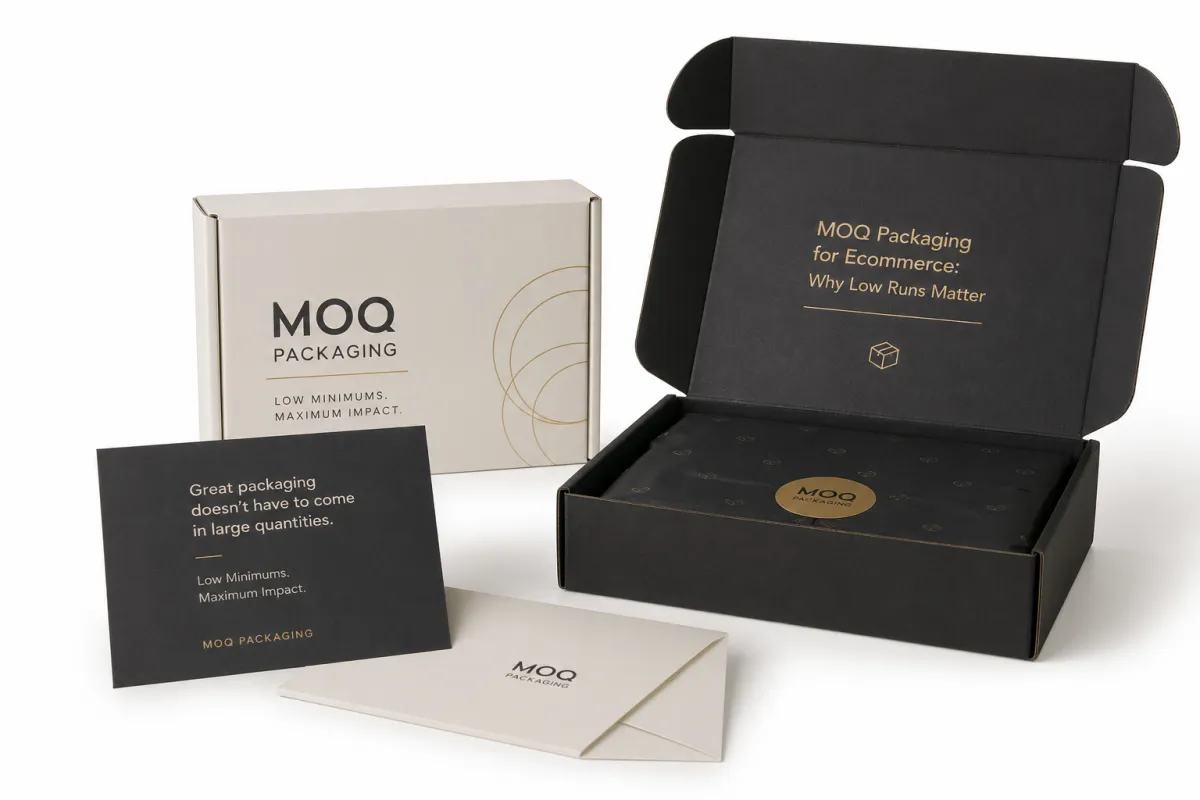
Low-run packaging matters because ecommerce inventory is not a museum exhibit. It has to move, change, and sometimes get replaced before the first month is over. If a startup locks $4,500 into 8,000 folding cartons at launch, that cash sits on a pallet while the store is still figuring out conversion rate, bundle size, and returns. With moq packaging for ecommerce, the smarter move is often a $700 to $2,000 run that leaves room to adjust after the first sales cycle instead of gambling on a box spec that only looks good in a deck.
I still remember a skincare client in Shenzhen who wanted to argue about 100% ink coverage on a kraft mailer. We changed the layout, reduced the flood area by 18%, and kept the order at 500 units instead of forcing a retool. The client saved $260 in print waste and, more important, avoided a three-week delay. That is the plain truth about moq packaging for ecommerce: the dieline, board grade, and sheet yield usually matter more than the finish everyone wants to talk about first.
Another case came out of a Dongguan plant on a humid August week. A buyer insisted on a rigid box because it looked expensive in the presentation. The factory manager ran the numbers on a 1,000-piece order and the unit cost jumped from $1.12 to $3.84 once laminated wrap, EVA insert, and hand assembly entered the picture. We switched to a folding carton with a paperboard insert, and the launch still looked polished. I have a lot of respect for premium presentation, but I also respect math. That is why I push moq packaging for ecommerce toward the structure that fits the product instead of the ego attached to the mockup.
“I do not need the fanciest box. I need a box that survives a 3-foot drop, fits my warehouse shelf in Atlanta, and does not eat margin.” A candle founder in Ningbo said that to me after her first 400 orders, and she was right in the most inconvenient way possible.
Lower MOQ changes the economics in four ways that show up fast on a spreadsheet: less cash tied up, less storage pressure, faster design changes, and an easier path to testing a new SKU or seasonal bundle. A 300-piece run on moq packaging for ecommerce can be the difference between launching this month and waiting until the next purchase order clears. I have watched brands recover from a weak first launch simply because they did not bury themselves in 12 pallets of the wrong carton in a warehouse outside Phoenix.
The cash-flow angle gets ignored too often. If your packaging budget lands at $1.25 per unit across 2,000 boxes, you are spending $2,500 before freight, duties, and local delivery. That is not pocket change if you are still testing product-market fit. moq packaging for ecommerce should help you validate demand, not trap working capital in inventory that has not earned its keep. I get slightly stubborn about this because I have seen too many founders confuse “bulk buy” with “smart buy,” and the warehouse bill in Long Beach does not care how exciting the launch email was.
There is also a timing effect people forget. If your packaging needs a revision after the first 500 orders, a lower MOQ means the next iteration is not a year away. It is a normal business decision, not a crisis. That matters for seasonal products, limited editions, and brands still learning which offer actually converts. A good moq packaging for ecommerce setup gives you room to learn without paying tuition in dead stock. That is the quiet advantage of low Minimum Order Quantity: it lets a brand learn from real orders instead of from a slide deck full of hopeful assumptions.
What Should You Check Before Ordering MOQ Packaging for Ecommerce?
Before you place an order, check the product dimensions, the material, the print method, the shipping route, and the target quantity. Those five details decide whether moq packaging for ecommerce comes back cleanly priced or turns into a round of revisions that eats time. If the product is fragile, humid-sensitive, or meant for retail shelf display, say that before sampling starts. A box designed for a candle shipping in winter will not behave the same way as a carton built for skincare going through summer parcel handling in Texas.
I usually tell brands to think in terms of function first, then finish. A strong custom ecommerce packaging plan starts with protection and pack-out, not with foil, embossing, or a heavy lamination everyone notices for five seconds. If the structure passes the drop test, the fit is accurate, and the board stock suits the product weight, the rest becomes a design decision instead of a repair bill. That is the difference between packaging that looks impressive and packaging that quietly performs.
One useful shortcut: ask whether the packaging needs to ship flat, stack in a warehouse, open for a premium unboxing, or do all three. Very few formats do all three equally well. That is why moq packaging for ecommerce almost always benefits from a quick decision tree before quoting. When the use case is clear, the MOQ, unit price, and lead time all become easier to predict.
Product Details: What MOQ Packaging for Ecommerce Can Include
moq packaging for ecommerce covers more than one box style. The most common formats I quote are corrugated mailer boxes, folding cartons, rigid gift boxes, poly mailers, labels, product inserts, and molded protection. A 200 x 150 x 60 mm mailer for apparel behaves very differently from a 90 x 90 x 40 mm carton for a candle, and the MOQ changes with structure, board, and print method. That sounds obvious until you sit in a sourcing call in Guangzhou and someone says, very earnestly, that a “small box is a small box.” I usually have to bite my tongue.
For subscription kits, I usually start with corrugated mailer boxes because they stack, ship, and print well at 500 to 1,000 units. DTC skincare often performs better with folding cartons in 300gsm to 400gsm SBS or C1S stock, especially when the bottle already has a secondary seal. Supplements usually need moisture resistance and a tighter fit around blister packs or jars, often with 12 pt C1S plus a PET inner liner if the ship lane is humid. That is where moq packaging for ecommerce stops being theory and turns into production math, which is a much less glamorous phrase and a much better business outcome.
Apparel brands tend to overspend on packaging. A 1,000-piece order of a branded poly mailer or a simple mailer box usually does the job if the garment is already protected in a polybag. Candles and ceramics need more internal support, so I look at paper pulp, corrugated inserts, or die-cut card cradles before I suggest a prettier outer box. I have learned the hard way that “beautiful” means nothing if the product arrives looking like it lost a fight with a parcel sorter in Indianapolis. A good moq packaging for ecommerce quote respects the product’s actual fragility, not the mood board.
Customization is where buyers can get carried away. You do not need six print hits and three foils on a 700-unit run. A matte lamination with one spot-color logo can look sharp, and a kraft board with black ink often beats an overfinished box that burns budget. I have also seen a simple tuck-end carton with interior printing outperform a far more expensive rigid box because the customer actually opened it, used it, and reordered the product. That is moq packaging for ecommerce doing its job: it supports the sale without pretending it is the sale.
Here is a quick way I break the options down for ecommerce clients:
- Corrugated mailer boxes: best for 500 to 2,000 units, strong for shipping, easy to print.
- Folding cartons: best for retail packaging and shelf display, usually lower unit cost at 1,000+ units.
- Rigid gift boxes: best for premium unboxing, but labor and setup push the MOQ higher.
- Poly mailers: best for apparel and soft goods, with very low unit cost at higher quantities.
- Inserts and molded protection: best for fragile products, but fit accuracy matters more than looks.
On one Ningbo production line, the biggest quality issue in a cosmetics run was not print registration. It was the insert. The product had a 1.5 mm wobble inside the carton, and that tiny gap led to scuffed caps and a repacking bill of $190 for just 800 units. moq packaging for ecommerce has to protect the product without overbuilding the package, because overbuilding usually means more labor, more freight, and more waste. I have watched a “premium” spec quietly turn into a repair bill, and that always feels like buying a headache in a nicer font.
If you want to browse practical options before you request a quote, our Custom Packaging Products page shows the main structures we handle for ecommerce brands. It is a more useful starting point than asking for “something premium” and hoping the factory can read your mind in Foshan (I wish they could, but so far no one has cracked that technology).
Specifications That Keep Orders Clean
The fastest way to ruin moq packaging for ecommerce is to quote before the specs are real. I need exact outer dimensions, material thickness, print sides, finish, and closure style before I trust a price. A mailer listed as 8 x 6 x 2 inches on paper but measured at 204 x 152 x 58 mm in the warehouse can cause a chain of problems if the insert is only built to one version. That kind of mismatch is how people end up paying for a second sample, a revised dieline, and an extra round of “oops, that was the wrong file.”
Tolerance matters more on small runs because there is less room to hide mistakes. On a 500-piece order, a 2 mm variance in board cut or insert height can turn a clean pack-out into hand-rework at the line, and hand-rework is where margins go to die. I have seen teams spend $180 extra on labor because the sample sign-off ignored one shelf-fit measurement in a Chicago fulfillment center. That is a classic moq packaging for ecommerce mistake, and it is usually preventable if someone checks the numbers instead of staring at the render and saying “looks good enough.”
Artwork setup can make or break the order as well. I want vector logo files, a dieline in AI or PDF, bleed at 3 mm, safe zones at least 5 mm from the edge, and Pantone targets if the brand color is non-negotiable. If the file is a low-resolution JPG with no dieline, the prepress round drags. For moq packaging for ecommerce, bad files often cost more than material upgrades because every clarification adds time, and time is what small-batch launches have the least of.
Here is the short checklist I use before I send anything to sampling:
- Product sample in hand, not a guess from a spec sheet.
- Exact dimensions in millimeters, including caps, pumps, and handles.
- Target quantity, because 300, 500, and 1,500 units quote very differently.
- Shipping destination and delivery method, since freight changes landed cost.
- Label placement or barcode position if retail packaging needs scan compliance.
Material choice needs an early decision too. A 350gsm C1S artboard gives a very different feel from 300gsm kraft, and a 1.5 mm rigid board changes the whole cost structure. If the packaging touches food, needs moisture resistance, or must survive cold-chain handling, that should be stated up front. moq packaging for ecommerce is much easier to quote cleanly when the material is not still a debate inside your Slack channel. I have seen a brand argue for three days about “more natural” paper tones while the actual stock spec was still missing. That is not strategy. That is theater.
For shipping performance, I prefer reference points that are grounded in standards rather than instinct. ISTA drop and vibration protocols are a sensible place to start for parcel behavior, and the standards are public enough to keep everyone honest: ISTA. If a structure is moving toward FSC-certified board, I also check chain-of-custody documentation through FSC, because missing paperwork is a ridiculous reason to delay production. That level of detail keeps moq packaging for ecommerce from turning into a reprint story, and reprints are the sort of “surprise” nobody wants in their month-end report.
Pricing and MOQ for MOQ Packaging for Ecommerce
The number you get for moq packaging for ecommerce is built from five levers: material choice, structure, print complexity, finish, and quantity tier. A clean one-color kraft mailer at 1,000 units can sit under $0.70 per piece. The same size with full-coverage CMYK, matte lamination, and foil can climb past $1.40 per unit before freight. That spread is why smart buyers ask for options instead of a single quote. One quote tells you a price. Three quotes tell you what is actually driving it.
MOQ is not a random punishment from a factory. It usually reflects setup time, sheet yield, press efficiency, tooling, and packing labor. On a small carton run, the factory still has to set plates, calibrate color, and cut the job from the board. That setup cost gets spread across the run. If you want lower MOQ packaging for ecommerce, you usually accept either a higher unit cost or a simpler spec. Physics and payroll do not care about your launch deck, which is rude but consistent.
Here is the pricing pattern I see most often when brands compare structures for moq packaging for ecommerce:
| Format | Typical MOQ | Typical Unit Cost | Best For | Main Tradeoff |
|---|---|---|---|---|
| Corrugated mailer box | 500 to 1,000 units | $0.48 to $1.10 | Shipping, subscription kits, DTC bundles | Higher freight volume than a carton |
| Folding carton | 1,000 to 3,000 units | $0.18 to $0.44 | Skincare, supplements, candles, retail packaging | Less crush resistance than corrugated |
| Rigid gift box | 300 to 1,000 units | $2.20 to $6.50 | Luxury kits, PR boxes, premium unboxing | Labor and assembly raise cost fast |
| Poly mailer | 1,000 to 5,000 units | $0.09 to $0.28 | Apparel, soft goods, low-weight shipments | Weak structure for fragile items |
| Die-cut insert or molded tray | 1,000 to 2,000 units | $0.22 to $0.95 | Fragile products, multi-piece sets | Fit accuracy matters more than print quality |
Those numbers are ranges, not promises. They are what I expect when a quote is built properly and the spec is not missing three critical details. Freight, duty, and local delivery can shift landed cost by another 8% to 20%, depending on where the cartons are shipping from and where they land. If a supplier gives you only a unit price and ignores transport, you do not have a real comparison yet. That is especially true with moq packaging for ecommerce, where one clean quote can still hide a messy landed cost.
One of the easiest ways to control unit cost is to cut finish complexity. A 1-color logo on natural kraft may look simpler than a four-color full bleed, but for a 600-unit order it often prints cleaner and costs less. I have saved clients $0.31 per box by removing soft-touch lamination that no customer could tell apart from matte in a 20-second unboxing video. That kind of change makes moq packaging for ecommerce actually useful for launch budgets instead of just photogenic.
Another practical move is split-quantity pricing. If you want two sizes of the same folding carton, I can often quote the shared board and print setup separately so you can see whether one combined run beats two smaller runs. Sometimes it does. Sometimes it does not. Honest moq packaging for ecommerce quoting should show both paths instead of pretending every structure is interchangeable. I trust the quote more when it admits the tradeoff instead of dressing it up with cheerful language and a bad assumption.
For buyers who want more background on packaging categories and industry basics, the trade association at Packaging School / PMMI resources is a useful place to understand format differences, testing, and the language suppliers use. It will not replace a factory quote, but it will keep you from paying $1.80 per unit for a carton that should have been $0.90. That is a real-money gap in moq packaging for ecommerce, and I have seen it show up often enough to be mildly annoyed on your behalf.
Process and Timeline: From Quote to Delivery
A clean moq packaging for ecommerce project usually moves through eight steps: brief, spec review, quote, sample, revision, approval, production, inspection, then shipment. The fastest projects are the ones where the product sample and artwork arrive together. The slowest projects are the ones where three people approve the same carton on different days and each person asks for a different Pantone. I wish I were joking, but that has happened more than once on orders routed through Hong Kong and Orange County.
For a standard folding carton or mailer, I expect 3 to 5 business days for quoting, 5 to 7 business days for sampling, and 12 to 15 business days from proof approval to production completion if the structure is straightforward. Rigid boxes, special inserts, or foil and embossing will add time. If someone promises a custom structure with hand assembly in 6 days, I usually smile and ask what they are leaving out. That is part of buying moq packaging for ecommerce without getting burned, because the missing line item always shows up somewhere else.
Delays almost always come from the same four places: missing dimensions, late artwork, endless sample revisions, and unclear approval ownership. I once had a client in Los Angeles send five different logo files across two email threads, including one named final-final-v7. The factory made the sample to the wrong version, and everyone acted surprised, which was my least favorite kind of Tuesday. One decision-maker, one file owner, one sample round. That is the shortest path for moq packaging for ecommerce.
If the order needs parcel performance testing, I look at drop height, carton crush resistance, and transit abuse before production starts. If it is moving through a retail channel, I look at shelf presence, barcode clarity, and sleeve fit. The point is simple: shipping packaging and retail packaging do not always want the same spec, and pretending they do is how you end up with a pretty carton that fails in a warehouse. Good moq packaging for ecommerce respects the route the product actually takes, not the mood of the design review.
Storage and packing line reality matter too. If your warehouse uses 24-inch shelving and the cartons arrive flat-packed, I need the box size to fold cleanly into that environment. If the package is too tall or too wide, your team spends extra minutes per unit during pack-out. On a 1,000-unit month, that becomes a real labor bill. Small-batch moq packaging for ecommerce is supposed to remove friction, not invent new costs at the fulfillment desk. I have seen teams save pennies on carton cost and lose dollars in packing time, which is a bizarre way to lose money but a very common one.
For brands that want a faster answer from support, our FAQ page covers common file, sample, and timeline questions before the quote even starts. That saves back-and-forth on the 10th email, which is usually the point where packaging projects begin leaking time like a faucet with a loose washer.
Why Choose Us for MOQ Packaging for Ecommerce
At Custom Logo Things, I treat moq packaging for ecommerce like a production decision, not a brochure exercise. I would rather give you the right 700-unit carton than sell you an oversized 5,000-piece run that looks impressive in a folder and sits in a warehouse for 11 months. That is not a virtue signal. That is how I have seen brands keep margin intact while everyone else is busy pretending inventory is harmless.
When I am on a floor in Dongguan or Ningbo, I care about board stock, die-cut accuracy, glue line consistency, and lead time. Empty promises do not help when a corner crushes on the last 50 units of a run. The factory manager does not care about your mood board. He cares whether the 350gsm sheet holds its crease and whether the insert keeps the product from rattling. Practical moq packaging for ecommerce depends on those details, and those details usually determine whether the shipment feels premium or just looks premium in one photo.
I have negotiated paper upgrades where a supplier wanted to add $0.07 per unit for a minor board change that did not improve the pack. I pushed back, kept the original spec, and the client saved $350 on a 5,000-unit order. That is the sort of small victory that matters. Most people never notice it, which is fine. Their margin notices. So does the finance team. Good moq packaging for ecommerce is often invisible because it works, and I have always preferred invisible competence to loud self-congratulation.
We also keep the conversation honest about packaging design. If a Custom Printed Box needs a foil stamp, I will say so. If a mailer box can look better with stronger logo placement and one fewer ink pass, I will say that too. Clients do not need a supplier to tell them everything is premium. They need a partner who knows when a lower-cost structure still delivers strong package branding and a clean unboxing. That is where moq packaging for ecommerce becomes smart, not flashy, and frankly that is where most good brands eventually land after they stop chasing every shiny finish in sight.
For buyers who want a broader view of what we build, the main categories on Custom Packaging Products show the structures we most often quote. If you need a simple carton, a printed mailer, or a kit with inserts, I can usually narrow the field fast once I have the sample and quantity. Fast is nice. Accurate is better.
I also like to be direct about standards and sustainability. If a brand wants FSC paperboard, I ask for the chain-of-custody details. If the package is going through parcel networks, I think about drop performance and compression, not just print color. That honesty matters. It keeps moq packaging for ecommerce from turning into a game of who can sound most confident while guessing. I have sat through enough supplier meetings to know that guessing is expensive, and confidence without proof is just a nicer suit on a bad number.
Next Steps: How to Start a Small-Batch Order
If you want to move forward with moq packaging for ecommerce, start with the product itself. Measure the item in millimeters, weigh it, note the closure style, and decide whether the packaging needs to ship flat or assembled. A 180 x 120 x 45 mm serum set does not need the same structure as a 310 mm apparel bundle, and the quote changes fast when those details are clear. A lot of delays vanish the moment people stop saying “roughly that size” and send the actual numbers.
Then send the useful files: logo artwork, dieline if you have one, a reference sample if you are matching an existing box, and the shipping destination. If you know your target quantity, say it plainly: 300, 500, 1,000, or 3,000 pieces. If you do not know the finish level yet, tell me whether you want kraft, matte, gloss, foil, or no coating. That is enough to get a real moq packaging for ecommerce conversation started. The more direct you are, the fewer rounds of “just one more clarification” you will need later.
My advice is simple. Approve one structure first, then one material, then one print approach. Do not try to solve every version of the brand at the prototype stage. I have watched launches stall for 19 days because three people wanted to “just see one more option.” Choose the cleanest path, get the sample, and adjust after the first sell-through. That is how moq packaging for ecommerce stays lean, and lean is usually what survives the quarter.
If you are ready to price a small-batch order, send the product dimensions, estimated quantity, artwork files, and delivery city. If you are still unsure, send a rough sketch and a photo of the product next to a ruler. I can work from that. If you want the practical version of moq packaging for ecommerce, not the glossy nonsense, that is exactly what we do best. I would rather have a clear spec and a slightly imperfect first version than a perfect-looking pitch and a box that misses the shelf by 4 mm.
What is MOQ packaging for ecommerce, and why does it matter?
It is custom packaging ordered at the smallest quantity a factory will produce efficiently, often 300, 500, or 1,000 units depending on the structure. It matters because ecommerce brands need branded packaging without locking too much cash into inventory they may not move. The right MOQ helps you test a launch, protect margins, and avoid a warehouse full of boxes that do not match demand. I have seen that warehouse problem up close in Tacoma and Savannah, and it is not charming.
How low can MOQ packaging for ecommerce usually go?
It depends on the structure. Simple mailers and folding cartons can often run lower than rigid boxes or complex insert systems. Print method, board choice, and finish all affect the minimum because setup costs need to be spread across the run, and a very small order usually means higher unit cost. If a quote seems suspiciously low, I always ask what got trimmed to get there, because a $0.15-per-unit promise on 5,000 pieces usually has a catch hidden in the freight or the board spec.
What files do you need for a custom ecommerce packaging quote?
Start with product dimensions, target quantity, material preference, and shipping destination. Send print-ready artwork if you have it, plus a dieline, logo files, and any Pantone or brand color references. If the file is not ready, a reference sample and a rough spec sheet still help speed up quoting. Half the battle is getting everyone to look at the same version of the truth, especially when the product is moving between Seattle, Shenzhen, and a 3PL in New Jersey.
Can I mix sizes or designs in one MOQ packaging order?
Sometimes, yes, but mixed SKUs usually increase setup and packing complexity. If the structures are similar, a factory may combine them more easily than if the shapes are completely different. Ask for a split-quantity quote so you can compare the cost against separate runs before you decide. I like seeing the options side by side because the “obvious” answer is often wrong once the setup fee lands at $240 to $600.
How long does MOQ packaging for ecommerce take from sample to delivery?
Simple packaging can move quickly if the artwork is final and the structure is standard, often within 12 to 15 business days after proof approval. Custom shapes, specialty finishes, and inserts add time because approvals and tooling need to be handled carefully. The fastest projects are the ones with one decision-maker and clean files from day one. The rest turn into a very expensive game of telephone, usually with one person in Miami and another in Guangzhou answering from different time zones.
moq packaging for ecommerce works best when the quote, structure, and timeline are clear from the start. Get those three things right, and you stop buying packaging like a guess and start buying it like a tool. That shift sounds small, but it changes everything from cash flow to repeat orders, especially on a 500- or 1,000-unit launch where every $0.10 matters.


