Buyer Fit Snapshot
| Best fit | recycled shipping cartons hold up for packaging buyers comparing material specs, print proof, MOQ, unit cost, freight, and repeat-order risk where brand print, material, artwork control, and repeat-order consistency matter. |
|---|---|
| Quote inputs | Share finished size, material target, print colors, finish, packing count, annual reorder estimate, and delivery region. |
| Proofing check | Approve dieline scale, logo placement, barcode or warning zones, color tolerance, and any recyclable or compostable wording before bulk production. |
| Main risk | Vague material claims, crowded artwork, or missing packing details can create delays even when the unit price looks attractive. |
Fast answer: Recycled Shipping Cartons Hold Up: Claims, Protection, MOQ, and Cost should be specified like a repeatable production item. The safest quote includes material, print method, finish, artwork proof, carton packing, and reorder notes in one written spec.
What to confirm before approving the packaging proof
Check the product dimensions against the actual filled item, not only the sales mockup. Ask for tolerance on folds, seals, hang holes, label areas, and retail display edges. If the package carries a logo, QR code, warning copy, or legal claim, reserve that space before decorative graphics fill the panel.
How to compare quotes without losing quality
Compare board or film grade, print process, finish, sampling route, tooling charges, carton quantity, and freight assumptions side by side. A lower quote is only useful if the supplier can repeat the same color, closure quality, and packing count on the next order.
Best Recycled Shipping Cartons: Honest Picks That Hold Up
I still remember the morning a pallet of "eco" boxes sagged at the dock after a 12-minute rain delay in Columbus, Ohio. Wet corrugate, soft corners, a warehouse manager muttering under his breath, and me standing there with that familiar little stomach-drop that says the day is already trying me. That mess is why I never trust recycled content by itself, and why the best recycled shipping cartons have to prove themselves with board strength, clean sizing, and glue lines that do not quit when humidity climbs to 78%. Pretty claims fail fast once the shrink wrap comes off, usually before the first pallet even clears the receiving lane.
My rule is blunt: the best recycled shipping cartons are the ones that survive transit, keep the unboxing tidy, and do not force you into mountains of void fill just to protect a $24 serum bottle or a $68 candle set. For most brands, that means 32 ECT or 44 ECT corrugated board, die cuts accurate within 1/16 inch, and recycled fiber documentation that is more than a logo on a spec sheet. If a supplier cannot tell you the flute profile, the recycled content mix, and the compression target, I treat the quote like a sample that has already failed. A good converter in Dongguan, Guangdong, or Kalamazoo, Michigan should be able to answer those questions before lunch.
I approach packaging the same way I brief clients on fulfillment: product weight first, drop risk second, price third. Not the other way around. That order matters more than people admit. If you need a broader packaging stack, I usually pair carton specs with Custom Packaging Products so inserts, labels, and secondary packaging all come from the same production run, often on a 10 to 15 business day schedule after proof approval. Lightweight SKUs can still work in Custom Poly Mailers, but they do not replace a real carton for fragile goods or anything with hard edges. And if the outer shipper needs structure, Custom Shipping Boxes are where that work lives, whether the factory is in Ningbo, Zhejiang, or Monterrey, Nuevo Leon.
What Are the Best Recycled Shipping Cartons?
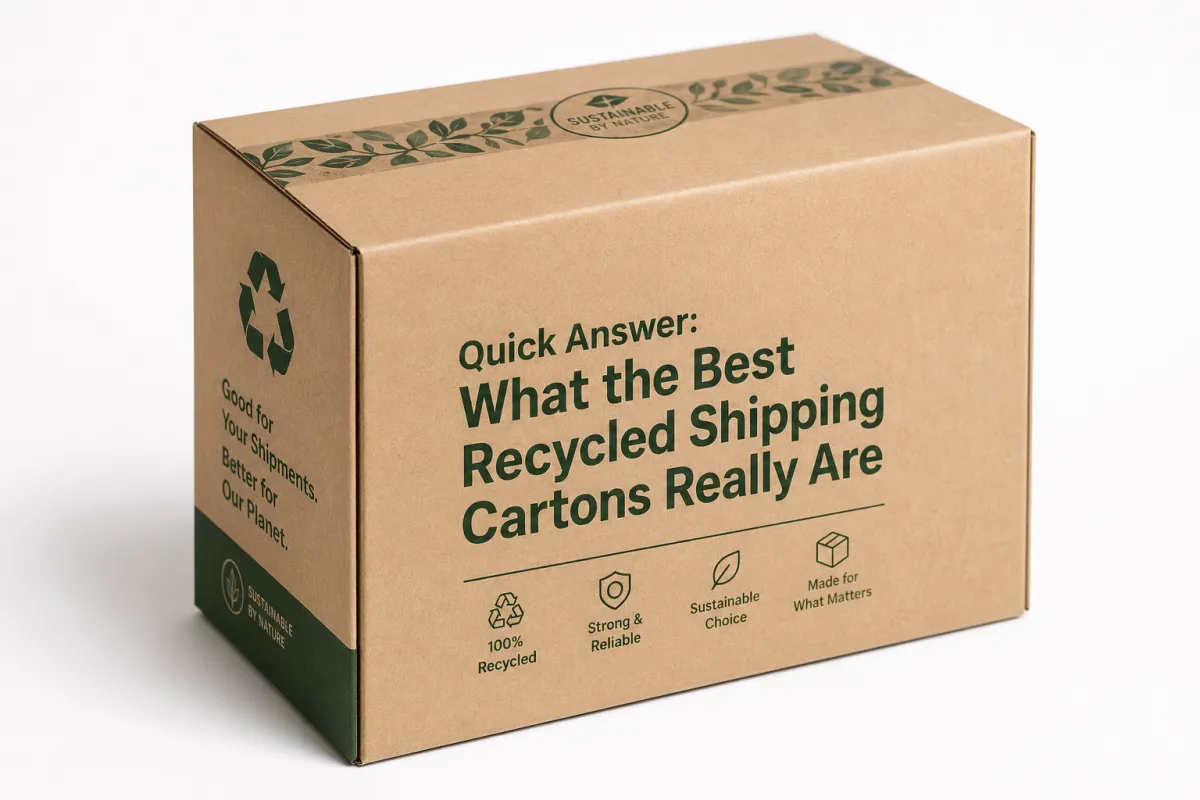
Short answer: the best recycled shipping cartons for most ecommerce brands are single-wall B-flute or C-flute corrugated boxes made with 60% to 90% recycled fiber, usually 32 ECT or stronger, with sizing tight enough that your product does not rattle around like a loose bolt in a delivery van. If your items are under 8 pounds, that spec is usually enough for ecommerce shipping without dragging dimensional weight into nonsense territory. I wish more buyers cared about that before ordering boxes the size of a microwave for a hand cream tube.
I watched a beverage client lose an entire Friday because a cheap recycled carton bowed under 18 pounds of glass bottles on a humid receiving dock in Atlanta. The board looked fine on the sample sheet, then the first wet pallet run exposed every weak point. That is why I keep saying the best recycled shipping cartons are not the ones with the prettiest sustainability badge. They are the ones that survive humidity, tape pull, and a careless drop from waist height. Or, to put it less politely, the boxes that do not fold up like a cheap lawn chair.
Here is the practical verdict I give buyers: if you want the best recycled shipping cartons for the widest range of products, choose a box with consistent caliper, a clean die cut, and a board spec that matches your actual load, not the optimistic load your sales team wrote in the pitch deck. Recycled fiber is good. Recycled fiber plus structure is better. Recycled fiber plus structure plus honest testing is the version that keeps chargebacks and reshipments down, especially for lanes that run from Dallas to Phoenix in summer heat.
"We stopped buying the cheapest carton and started asking for 32 ECT with a real compression target. Damage claims dropped, and nobody missed the extra six cents." That came from a skincare client after we fixed their shipper for 240-unit weekly volume in Nashville.
I use three filters before I call anything one of the best recycled shipping cartons: first, it must pass a basic drop test from 24 to 30 inches with the product packed as sold; second, it must stack at least 6 high on a pallet without edge collapse; third, the supplier must give me a recycled content claim I can actually verify. For shipping validation, I still lean on the drop and vibration framework from the ISTA protocols, and I ask for FSC chain-of-custody documents before I pay for any fiber claim. That may sound fussy, but packaging has a way of exposing wishful thinking very quickly, usually after the second truck linehaul.
Top Options Compared: Best Recycled Shipping Cartons at a Glance
The best recycled shipping cartons are not all built for the same job. A subscription kit, a heavy hardware order, and a fragile candle set all need different board strengths, different closure styles, and different cost tolerances. I have seen brands burn $0.22 per unit on oversized premium boxes they did not need, then spend another $1.40 per order on filler because the interior fit was sloppy. Brilliant budgeting, obviously. I still shake my head at that one, especially when the warehouse was in Riverside, California and the freight bill was already ugly.
| Carton Type | Best Use | Typical Strength | Recycled Fiber Content | Typical Price Range | Setup Speed |
|---|---|---|---|---|---|
| Regular slotted carton | General ecommerce shipping, apparel, light accessories | 32 ECT to 44 ECT | 60% to 90% | $0.42 to $1.10/unit | Fast, 7 to 12 business days |
| Self-locking carton | Subscription kits, presentation-heavy unboxing | 32 ECT to 44 ECT | 50% to 85% | $0.58 to $1.35/unit | Medium, 10 to 15 business days |
| Mailer-style box | Small DTC orders, cosmetics, gift sets | 26 ECT to 32 ECT | 70% to 100% | $0.38 to $0.95/unit | Fast, 6 to 10 business days |
| Heavy-duty corrugated carton | Fragile, dense, or bulk shipping | 44 ECT to double-wall | 50% to 90% | $1.15 to $3.20/unit | Slower, 12 to 18 business days |
| Custom printed recycled carton | Brand-forward ecommerce and retail-ready shipping | 32 ECT to 44 ECT | 60% to 100% | $0.70 to $2.50/unit | Medium, 10 to 16 business days |
If you need the simplest answer, the best recycled shipping cartons for most brands are regular slotted cartons with clean dimensions and reliable recycled content. If you want a nicer unboxing moment without overspending, self-locking and mailer-style formats do the job well for kits under 5 pounds. If your products are dense, fragile, or packed with inserts, heavy-duty corrugated wins because package protection matters more than shaving three cents off the unit price. A factory in Suzhou might quote the same structure differently than one in Tijuana, but the load test should tell you which carton actually deserves the order.
In practice, the best recycled shipping cartons also depend on the rest of the shipping materials. A good shipper with bad tape is still a bad shipper. A well-built carton with sloppy inserts is still a reshipment waiting to happen. I have seen a 40-unit order of tea tins arrive with one corner crushed because the filler was too loose and the box was oversized by 0.75 inch on every side. Nobody was thrilled. Especially not the warehouse team in Louisville that had to explain it to customer service.
Detailed Reviews of the Best Recycled Shipping Cartons
Regular slotted cartons are the workhorse version of the best recycled shipping cartons. They fold fast, stack cleanly, and keep order fulfillment sane when your team is pushing 300 to 500 units a day. I like them for apparel, supplements, and small electronics because a 12 x 9 x 6 inch RSC in 32 ECT board can take a lot more abuse than people think. The trick is not to buy the thinnest board you can find. Buy the one that survives the route you actually ship, whether that route runs from Charlotte to New Jersey or from Shenzhen to Los Angeles. That one sentence has probably saved more money than any spreadsheet ever did.
Self-locking cartons belong in the conversation because the best recycled shipping cartons are not always plain brown rectangles. On a converter floor in Dongguan, an operator showed me a self-locking dieline that saved 11 seconds per pack-out compared with tape-heavy RSC assembly. That sounds tiny until you scale it to 20,000 units a month. On subscription kits, that time saving matters. The downside is cost: you often pay $0.12 to $0.28 more per box for the structure and the better fit. Still, if your team is taping box after box before coffee, those seconds start to feel very expensive, especially at a labor rate of $19.50 an hour.
Mailer-style boxes are often the most photogenic of the best recycled shipping cartons, and customers notice. They open neatly, they feel intentional, and they work well for cosmetics, candles, and gift sets under 3 pounds. I still check the flap strength and tuck lock because pretty boxes can fail on the first corner crush if the board is too light. If a supplier offers 26 ECT mailers for a 6-pound load, I usually pass and ask for 32 ECT or a tighter product fit. Pretty is nice. Pretty plus intact is better, especially if the box is being packed in a 16-inch-deep station in Chicago.
Heavy-duty corrugated cartons are the version of the best recycled shipping cartons I recommend for dense inventory, fragile glass, or multi-item bulk orders. These are the boxes that can justify 44 ECT single-wall or even double-wall construction because the damage cost dwarfs the extra $0.40 to $1.20 per unit. I once negotiated a line for a cookware brand where the buyer wanted to save $0.07 per box. We switched to double-wall instead, and the return rate fell enough to pay for the upgrade in two weeks. That is not theory. That is math. And yes, the buyer stopped arguing after the first month's numbers came in from the Phoenix distribution center.
Custom Printed Recycled cartons round out the best recycled shipping cartons list for brands that care about the unboxing reveal as much as the transit route. A one-color logo on kraft can look sharp if the registration is clean and the board grain runs correctly. A messy print job, though, looks cheap fast. I always ask for a 1-up print proof and a production sample because a five-color mockup can hide scuffed ink, fuzzy edges, or weak score lines that only show up after the box folds 500 times on the packing line. If you have ever had a box that looked elegant online and slightly tragic in person, you know exactly what I mean. For some projects, we even pair the carton with a 350gsm C1S artboard insert card or belly band, which gives the unboxing a sharper edge without forcing the outer shipper to carry all the design weight.
One client in premium coffee sent me a carton sample that looked perfect in the boardroom and terrible under warehouse lights in Portland, Oregon. The lid bowed 2 mm, the print rubbed off at the corner, and the tuck tabs split after the third opening. We fixed it with a wider score, a better adhesive bead, and one less color pass. That is what I mean by the best recycled shipping cartons: not the prettiest spec, but the one that works after real handling, real tape, and a real delivery route.
The simplest test I use is ugly but effective. Pack one sample with your actual product, shake it for 10 seconds, drop it from 24 inches on all six faces, and check the corners. If the board frays, the print flakes, or the closure pops, it is not one of the best recycled shipping cartons for your product. It might still be fine for paper goods or light apparel, but that does not make it the right answer for your business. A carton that only survives a 6-foot shelf drop in a showroom is not a shipping carton; it is a display prop.
I also look at the carton's stacking behavior. A good recycled shipper should hold a 30-pound top load without turning into a soft cube by lunch. That is not an exotic ask. It is basic transit packaging. If your warehouse uses palletized storage, the best recycled shipping cartons need enough edge crush resistance to survive 6 to 8 high, especially if the route includes humidity, refrigerated loading, or long dwell times in trailers. I have seen a box do everything right in a sample test and then fail the moment it met a damp dock in New Orleans. Packaging, as ever, has a sense of humor.
Price Comparison: What Recycled Shipping Cartons Should Cost
The best recycled shipping cartons do not have to be expensive, but they are rarely the cheapest line item on the quote. Pricing moves with size, board grade, print coverage, recycled fiber ratio, and order volume. A tiny mailer at 5,000 units can land around $0.42 each, while a double-wall shipper with full-wrap print and inserts can climb past $2.80. Anyone telling you the price is "basically the same" across all carton types is either selling something or ignoring freight. Usually both, if I'm being honest.
| Price Tier | Example Spec | Unit Cost | What Usually Gets Missed |
|---|---|---|---|
| Budget | 32 ECT RSC, kraft outside, minimal print | $0.42 to $0.78 | Extra void fill, higher damage risk, weaker presentation |
| Mid-range | 32 ECT to 44 ECT, 1-color print, tailored fit | $0.79 to $1.45 | Tooling, freight, and storage footprint |
| Premium | Heavy-duty or custom printed recycled carton | $1.46 to $3.20 | Setup fees, plate charges, and slower lead times |
That table is why I keep telling buyers that the best recycled shipping cartons should be measured against landed cost, not just unit cost. If a box saves $0.10 but adds $0.35 in void fill, another $0.22 in tape, and one extra minute per pack-out, you are not saving money. You are donating margin to the universe. Dimensional weight matters too. A carton that is 1 inch too tall can push an order into a higher shipping tier, and that can wipe out your "cheap" box in a single shipment from Seattle to Denver.
I had a supplement brand argue with me over a $420 die fee. They wanted the cheapest possible carton because the quote looked clean. I pushed back because the oversized box would have added 0.8 lb of billed weight to every parcel and forced another $0.18 in filler. The final math favored the best recycled shipping cartons with the custom size. That decision saved them about $1,900 a month across 8,500 orders, which is a lot better than bragging about a low box price that never showed up in the profit report.
Here is the part most buyers miss: the cheapest carton can become the most expensive carton if it causes one extra damage claim per 100 shipments. If your average order value is $38 and the reshipment cost is $11.50, the hidden cost hits fast. The best recycled shipping cartons are the ones that protect the margin you already earned, not the ones that make the sourcing sheet look tidy for one afternoon. I know that sounds dull, but boring logistics often makes the best business sense, especially in high-volume lanes where 1,000 packages leave the dock every week.
How to Choose the Best Recycled Shipping Cartons for Your Product
Choosing the best recycled shipping cartons starts with three measurements: product length, width, and height, then the packed weight with inserts. I ask buyers to measure the packed unit, not the product alone, because a candle in a tray and a candle in a sleeve are two different shipping problems. Skip that step and the carton will be wrong by 0.5 to 1.0 inch, which turns into crushed corners, rattling, or a mountain of void fill. I have watched teams pay for that mistake twice: once in boxes, then again in reships.
- Measure the packed product to the nearest 1/8 inch, then round up once.
- Check the finished parcel weight, including inserts, tape, and labels.
- Decide how much package protection the route needs: local, regional, or national.
- Match the board grade to the load, then confirm the recycled content claim.
Recycled content matters, but board strength matters more. That sounds less poetic than a sustainability pitch deck, yet it is true. The best recycled shipping cartons use enough post-consumer or post-industrial fiber to support the brand story without sacrificing crush resistance. A 90% recycled board that fails in transit is worse than a 70% recycled board that arrives intact. Honest claim, honest math. If a package has to choose between looking virtuous and staying in one piece, I know which one I'm picking, and the choice usually gets clearer after one rainy day in Newark.
For ecommerce brands, I usually recommend the best recycled shipping cartons in the 32 ECT range if the order is under 8 pounds and the product already has some internal protection. For manufacturers shipping denser goods or bulk bundles, I move them toward 44 ECT or double-wall because transit packaging has to handle more abuse. Subscription businesses sit in the middle: they need structure, but they also need an opening experience that does not feel like a warehouse reject. A box for a monthly coffee kit out of Nashville is not the same box as a torque wrench kit leaving a plant in Detroit.
Print and branding deserve their own conversation. A one-color logo can be enough if the brand already has a strong insert card, sticker, or label system. If the carton is the hero of the unboxing, then the best recycled shipping cartons may justify a higher-cost print finish, but I still keep it simple. Two colors, clean registration, and a kraft base often look better than a loud print job that fights the product. If your outer box needs to do too much, you probably need a better package hierarchy, not more ink. I say that with affection, mostly because I have seen too many brands try to solve structural problems with a louder logo.
I also check how the carton sits in the rest of the shipping materials. Does it fit the shipper shelf at 10 inches deep? Does it stack on your packing station at 48 inches tall without crushing the bottom row? Does the tape strip line up with your packer's dominant hand? The best recycled shipping cartons are boring in the warehouse and smart on the invoice. That is the sweet spot. Boring, in packaging, is usually a compliment, especially when the line is running 600 units before 3 p.m.
Process and Timeline: From Sample to Shipment
The path to the best recycled shipping cartons is usually straightforward, but it is never instant. I tell clients to expect 5 to 7 business days for a plain sample, 3 to 5 more days for artwork or structure corrections, then 12 to 15 business days from proof approval for bulk production on a standard custom run. Add freight after that. If you need ocean shipping, tack on another 15 to 30 days depending on lane and customs. Packaging timelines love to pretend they are shorter than they are; they are not, especially if the cartons are coming through Yantian, Shenzhen, or Ningbo.
Here is the typical process I use with buyers who want the best recycled shipping cartons without wasting time:
First, approve the dieline and actual inside dimensions. Not the marketing dimensions. The real ones. Second, confirm board grade, flute, recycled content, and finish on one written spec sheet. Third, request a production sample or white dummy before full run approval. Fourth, test 10 to 20 units in real pack-out conditions, including tape, labels, and your normal void fill. That sequence saves more money than any "rush" fee ever will. I have yet to see a genuine emergency created by taking twenty extra minutes to check a sample, and I have seen more than one company save a $1,200 freight correction by doing so.
Delays usually come from three places: artwork corrections, structural changes, and material availability. I once had a client lose 9 days because their designer wanted to move a logo 4 mm to the left after proof signoff. That is a perfect example of why the best recycled shipping cartons still need a disciplined approval process. Pretty design and fast production can live together, but only if somebody makes a decision before the truck is on the way. Otherwise, everyone gets to enjoy a very expensive version of "almost ready," which is less funny when the launch is tied to a trade show in Chicago.
If you want the best recycled shipping cartons faster, keep the revision cycle tight. Use one contact for artwork, one contact for operations, and one written checklist for specs. Include board grade, inside dimensions, print placement, recycled content target, testing standard, and target arrival date. A five-line spec sheet beats a 40-email thread every single time. I have negotiated with converters from Shenzhen to Ohio, and the clean orders always move first, especially when the carton factory in Kunshan gets the approvals before noon.
There is also a supplier negotiation piece nobody likes to admit. The best price often appears after you remove vague language. I had a converter quote "eco mailers" at one price, then drop the unit cost by 9% when I asked for a precise 32 ECT spec, a 5,000-unit commitment, and a shipping window of 14 business days instead of "as soon as possible." The best recycled shipping cartons reward clarity. Ambiguity costs money, and "approximately sturdy" is not a spec any plant manager in Guangdong respects.
Our Recommendation: Best Recycled Shipping Cartons for Most Brands
If I had to pick one all-around winner, I would choose the best recycled shipping cartons in the regular slotted carton format, built with 32 ECT to 44 ECT board, 60% to 90% recycled fiber, and a size that matches the product with no more than 0.5 inch of slack on each side. That spec gives you the right mix of strength, price, and print flexibility for most ecommerce shipping programs. It is not flashy. It is just hard to break, and that matters more than the marketing copy, whether the order is leaving Denver, Toronto, or Austin.
Spend more if your product is heavy, fragile, or expensive to reship. Glass, ceramics, dense metal parts, and premium kits deserve the stronger version of the best recycled shipping cartons, usually 44 ECT or double-wall with a tight internal fit. Spend less if your product is light, low-risk, and already protected by a sleeve, pouch, or insert. Apparel, paper goods, and simple accessory packs often do fine in a lighter recycled carton with clean fold lines and a single-color print. A carton for a silk scarf does not need the same wall strength as one for a six-pack of glass jars.
My usual advice to brands is simple: request three samples, one budget spec, one mid-range spec, and one premium spec. Pack all three with the real product, use your actual tape, and ship one to an internal address 200 miles away. The best recycled shipping cartons will show themselves quickly. You will see which one holds corners, which one keeps the print clean, and which one gets destroyed by normal courier handling before you spend money on a 10,000-unit order. I love that test because it ends debates fast, and frankly, debates are cheaper when cardboard does the arguing.
Then test before you scale. Compare the landed unit price, the damage rate, and the labor time per pack-out. If the carton saves 30 seconds at the table and cuts damage by even 1%, that usually beats a cheaper box with weaker board. I have seen that exact switch save a client $6,000 in one quarter, and it happened because they stopped guessing and started testing. That is the difference between a decent box and the best recycled shipping cartons. The numbers are not glamorous, but they do pay for themselves.
For brands ordering through Custom Logo Things, my final recommendation is to start with a sample round, confirm the inside dimensions, and document the board spec before you approve print. If your team does that, the best recycled shipping cartons stop being a gamble and start acting like a real operations tool. That is what you want: a box that protects the product, keeps the brand clean, and does not quietly eat your margin on every shipment. It should do its job and get out of the way. A packaging miracle? No. Just competent, which is rarer than it should be.
Are the best recycled shipping cartons actually strong enough for ecommerce orders?
Yes, if the board grade and flute profile match the product weight and route. The best recycled shipping cartons can handle most ecommerce shipping under 8 pounds when you use the right ECT rating, decent glue, and a tight internal fit. Recycled content does not automatically mean weak. Construction matters more than the label on the side panel, and a 32 ECT shipper from a plant in Kansas City can outperform a flashy box with a prettier sustainability statement.
What recycled content should I look for in shipping cartons?
Look for cartons with high post-consumer or post-industrial fiber when possible, but do not chase a percentage without checking compression strength. I prefer the best recycled shipping cartons to come with a clear recycled fiber statement and a board spec that passes the route you ship. A 70% recycled carton that holds up beats a 95% carton that collapses in the lane. That trade-off is not glamorous, but it is real, especially on routes with 85% humidity or long trailer dwell times.
How much do recycled shipping cartons usually cost?
Pricing depends on size, board weight, print coverage, and quantity. In practical terms, the best recycled shipping cartons often land between $0.42 and $1.45 per unit for standard volumes, while heavier or custom printed options can move past $2.50. Freight, storage, and damage risk can change the real cost fast. A 5,000-piece run in Ohio can price very differently from a 20,000-piece run out of Guangdong, even when the carton looks identical on paper.
How long does it take to order custom recycled shipping cartons?
Sampling usually takes 5 to 7 business days, then production often runs 12 to 15 business days after proof approval for standard jobs. The best recycled shipping cartons move faster when artwork is final, dimensions are locked, and the supplier does not have to chase revisions for three rounds. International freight adds more time, so plan accordingly. If the cartons are coming by ocean from Shenzhen to Los Angeles, budget an extra 18 to 24 days on the water.
What is the best recycled shipping carton for fragile products?
Choose a stronger corrugated structure with the right internal fit, not just the highest recycled content. For fragile products, the best recycled shipping cartons are usually 44 ECT or double-wall with inserts sized to stop movement. Add void fill only where it actually protects the item. A packed sample test is non-negotiable, and I would rather see a 2-ounce heavier carton than a broken ceramic mug in a return bin.


