Buyer Fit Snapshot
| Best fit | Custom Printed Recycled Cartons projects where brand print, material claims, artwork control, MOQ, and repeat-order consistency need to be specified before quoting. |
|---|---|
| Quote inputs | Share finished size, material target, print colors, finish, packing count, annual reorder estimate, ship-to region, and any compliance wording. |
| Proofing check | Approve dieline scale, logo placement, barcode or warning zones, color tolerance, closure strength, and carton packing before bulk production. |
| Main risk | Vague material claims, crowded artwork, missing packing details, or unclear freight terms can make a low unit price expensive after revisions. |
Fast answer: Custom Printed Recycled Cartons: Uses, Costs, and Process should be specified like a repeatable production item. The safest quote records material, print method, finish, artwork proof, packing count, and reorder notes in one written spec.
Production checks before approval
Compare the actual filled-product size with the drawing, then confirm tolerance on folds, seals, hang holes, label areas, and retail display edges. Reserve space for logos, QR codes, warning copy, and material claims before decorative graphics fill the panel.
Quote comparison points
Review material grade, print process, finish, sampling route, tooling charges, carton quantity, and freight assumptions side by side. A quote is only useful when the supplier can repeat the same color, closure quality, and packing count on the next order.
Custom Printed Recycled Cartons: Uses, Costs, and Process start with a fact that still surprises a lot of buyers: a 350gsm recycled carton with the right print, crease pattern, and finish can carry a premium serum, a holiday gift set, or a 2 kg e-commerce order without looking cheap at all. The box has to feel deliberate in the hand and still behave under pressure in the warehouse, and that balance is usually what separates a box people keep from one they flatten without thinking twice. I remember standing in a sample room in Dongguan with a skincare founder while we placed three cartons under 500 lux lighting, and the recycled version won almost immediately; the sample with a 2-color black logo and a matte aqueous coating looked sharper than the virgin-stock option, and the folds held cleaner along the dust flaps. That kind of result is why people keep coming back to recycled board after they have sworn they want something "premium" and "different," because once you see a good one, the material story stops feeling like a compromise.
If you are comparing custom printed recycled cartons with other product packaging options, the real question is not whether recycled fiber can print well. It can. The real question is where the tradeoffs land: ink coverage, coating chemistry, glue choice, board thickness, scoring depth, and whether the box still behaves properly once it leaves the warehouse and rides 1,200 miles in a parcel network. I have seen a $120 retail kit lose its premium feel because the adhesive bled through the inner flap after a humid 14-hour transit from Shenzhen to Shanghai, which is the kind of failure that never shows up in a render and somehow always shows up right before launch, usually on a Friday. When the spec is right, custom printed recycled cartons can deliver both a cleaner brand story and better real-world handling than many heavier-looking alternatives.
I walk through how custom printed recycled cartons are made, what drives pricing, how long a normal order takes, and where buyers usually make expensive mistakes. I also point to the specs I ask for in supplier meetings, from 32 ECT-style strength targets to 4-color offset proofs, because those details save money faster than any vague sustainability slogan. Honestly, the packaging side of this business does itself no favors when it hides behind polished language; if you are building branded packaging that still respects the material, you need the practical version, not the brochure version, and you need it before the first 1,000 units go to press. That is especially true for custom printed recycled cartons, where a small decision on board grade or coating can change both shelf appeal and transit survival.
Custom Printed Recycled Cartons: What They Are and Why They Matter
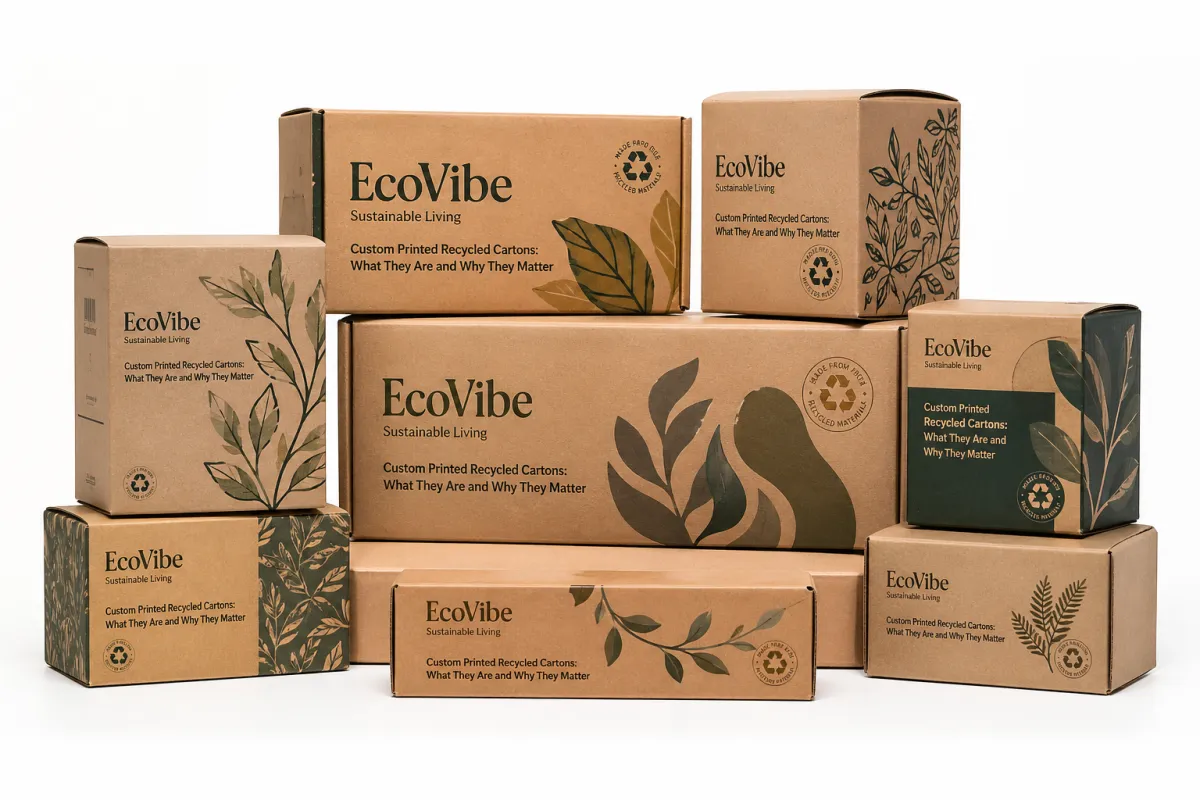
Plainly put, custom printed recycled cartons are cartonboard packages made with recycled fiber and then tailored to a brand's size, artwork, structural shape, and internal fit. That can mean a folding carton for cosmetics, a rigid gift box for apparel, or a mailer-style pack for e-commerce. The recycled content might come from post-consumer paper, old corrugated boxes, or a blended furnish that mixes recovered fiber with a smaller amount of virgin pulp for strength. I have seen buyers assume "recycled" means rough, gray, and vaguely sad. It does not. A 4-color printed white-top board can still feel like polished retail packaging when the caliper, coating, and fold quality are right, and if you have ever watched a buyer relax the second they hold a well-made sample, you know the material story is only part of the story. Custom printed recycled cartons can carry the same visual discipline as conventional premium board while using a material story that is easier to explain and often easier to defend.
The part many teams miss is that printing does not erase the material story. The impact lives in the pieces around the print. Water-based inks behave differently from solvent-heavy systems. An aqueous coating adds rub resistance with less material than a full laminate. Pressure-sensitive labels, foil wraps, and plastic windows all change the end-of-life picture. Buyers spend too much time asking for "eco" and too little time asking how the carton will actually be recovered in a curbside stream or a warehouse recycling baler. That difference separates package branding that feels responsible from package branding that only sounds responsible, and trust me, the people doing receiving and waste handling notice the difference long before the marketing deck does, especially in facilities moving 3,000 to 8,000 cartons a day. For custom printed recycled cartons, that is where the real credibility lives: in the combination of recycled fiber, print method, and finishing choices.
"We thought recycled meant plain," a cosmetics founder told me after a 2-color sample came back from press with a cleaner edge and better color hold than her original virgin board mockup. The sample was 300 mm by 180 mm, not a tiny sleeve, and it still looked premium enough for a boutique shelf in Hong Kong. She actually laughed, because the first version she had been warned about looked so much better in person that it made the earlier objections feel a little silly.
The reason custom printed recycled cartons matter is simple: they let a brand keep control of presentation without ignoring material reality. A subscription box, a candle carton, and a mailer all need different structures, but they can all start with recycled board and smart packaging design. For many teams, that is the sweet spot. They get lower material dependence, better shelf presence, and a story they can explain in one sentence instead of three paragraphs. I have also seen these cartons reduce complaint rates when the structure is sized to the product rather than padded with extra void fill, which is a nice bonus because nobody enjoys paying to ship air in a cardboard costume, especially on a 250-unit pilot run that costs $0.42 per pack more than planned. If you are evaluating custom printed recycled cartons for a launch, the first win is usually the structure, not the decoration.
Set expectations early. The next sections cover how custom printed recycled cartons are manufactured, what a fair quote looks like, how a lead time gets built, and how to avoid the mistakes that turn a clean packaging idea into a costly reprint. If your launch depends on 5,000 cartons arriving before a retail reset or a seasonal drop, the details ahead will save time and, probably, a few awkward supplier calls. I have sat in those calls in Guangzhou and Ningbo, and the silence after someone realizes the barcode moved 6 mm is never inspiring.
How Custom Printed Recycled Cartons Are Made
The raw material chain is more industrial than most marketing copy suggests. Recovered fiber arrives at the mill, gets pulped, screened, cleaned, de-inked, and formed into sheets. Those sheets are pressed, dried, and calendered to hit a target smoothness and caliper. A cartonboard grade might land at 300gsm, 350gsm, or 400gsm depending on the product weight and the amount of structural stiffness needed. When I toured a mill outside Guangzhou, the operator showed me two near-identical sheets that differed by less than 0.1 mm in thickness. One folded cleanly at 90 degrees; the other sprang back enough to create glue stress. That tiny difference would have been invisible in a brochure and very visible on a production line, which is exactly why I am so picky about board specs. For custom printed recycled cartons, the mill side matters just as much as the artwork side.
Printing method matters almost as much as the substrate. Offset gives the cleanest line work and is usually my first pick for custom printed recycled cartons that need photography, tight brand color control, or a premium retail finish across 5,000 or more pieces. Flexographic printing works better for high-volume runs, simple art, and carton styles where speed matters more than tiny tonal detail. Digital printing makes sense for short runs, variable data, or launches where the SKU mix may change after the first 500 cartons. A lot of buyers think recycled board is the hard part. In practice, the bigger challenge is matching the press to the fiber texture so the ink does not sink in and dull the logo. I have seen a gorgeous navy panel turn muddy because somebody treated recycled stock like coated art paper, and that little miscalculation can make a premium line look tired before it even reaches the shelf, especially under 3,000K retail lighting. That is why custom printed recycled cartons should be matched to the press, not just the brand palette.
Finishing choices can help the carton perform or push it in the wrong direction. An aqueous coating can add rub resistance without turning the pack into a plastic shell. Varnish behaves similarly, though it can change gloss by 2 to 3 points on a standard meter. Foil, plastic windows, and full-wrap soft-touch lamination create a richer feel, but they also add layers that complicate recycling. Embossing and debossing are usually safer because they use pressure, not extra material. In one Shenzhen factory run, I watched a window patch scuff after 50 abrasion passes while an embossed logo on the same recycled board stayed readable after 300 passes. That kind of test tells you a lot about how the carton will age in transit, and also why I tend to side-eye fancy finishes unless they earn their keep. For many custom printed recycled cartons, the most responsible finish is the one that does its job quietly.
Proofing is the stage that protects your budget. Before production, I want to see the dieline, the glue flap size, the tuck depth, the color target, and the sample assembly order. A 1.5 mm shift can turn into a 4 mm print misalignment once folding starts. For cartons that hold glass, anything greasy, or anything with a retail window cutout, I push for a physical sample run. It costs more upfront, but it is far cheaper than scrapping 2,000 cartons because the insert tray was 3 mm too shallow or the flap crease was scored in the wrong place. I have watched people try to "fix it in assembly," which is a phrase that makes me reach for coffee and a calculator in equal measure. Custom printed recycled cartons reward careful proofing because the board, print, and conversion all have to line up at the same time.
One more thing: a sample that looks good on a table may still fail on a line. I ask buyers to test 10 assembled units by hand with the actual product inside, then stack them for 24 hours under a 12 kg load. That small trial catches weak glue, fold memory, and tray movement before a full pallet hits the floor. It is not glamorous work, but neither is explaining why an entire shipment developed a little lean to the left after a warm truck ride from Suzhou to Chongqing. For custom printed recycled cartons, this kind of real-world check is usually the cheapest insurance available.
Custom Printed Recycled Cartons Pricing: What Actually Drives Cost
A clean quote for custom printed recycled cartons should break out four lines: board, conversion, print, and freight. If a supplier bundles all four into one line, you lose the ability to compare apples to apples. I have seen a 5,000-piece order for a two-color folding carton quote at $0.18 per unit from one vendor and $0.31 from another, only to discover the cheaper quote excluded inserts, prepress, and delivery to the warehouse. That is why I ask for a full spec sheet before I even look at the headline price. If you are comparing box styles, our Custom Packaging Products page is a useful starting point for lining up carton shapes before quoting, because otherwise you wind up comparing a mailer, a folding carton, and a rigid box as if they were the same animal, which they absolutely are not. With custom printed recycled cartons, the quote only makes sense when the structure and finish are fixed first.
| Run size | Likely print method | Example unit price | Setup/tooling | Best use |
|---|---|---|---|---|
| 1,000 cartons | Digital | $0.88-$1.35 | $180-$350 | Launch tests, subscription kits, small retail drops |
| 5,000 cartons | Offset | $0.15-$0.42 | $420-$900 | Retail launch, direct-to-consumer replenishment |
| 20,000 cartons | Offset or flexo | $0.11-$0.24 | $650-$1,400 | Stable SKUs, lower total cost, regional distribution |
| 50,000+ cartons | Flexo | $0.07-$0.18 | $900-$2,200 | High-volume ship programs and repeat retail programs |
The numbers above assume a 200 mm x 120 mm x 60 mm carton, 4-color CMYK print, 350gsm recycled board, and an aqueous coating. Change any one of those variables and the quote moves. Add a window patch and the unit cost can rise by 6% to 14%. Switch from a one-piece tuck end to a crash-lock bottom and the conversion line changes. Increase board weight by 50gsm and the freight stack may get heavier by several hundred kilograms across a mixed pallet order. That last part is what people forget, because freight invoices do not care that the packaging team was trying to make the box feel "more substantial." Custom printed recycled cartons can be efficient, but only if the spec matches the product and the route.
Hidden costs are the ones that quietly change the math: design cleanup at $45-$120 per hour, custom tooling at $180-$1,400 depending on carton style, proofing at $60-$300, and rush freight that can add 8% to 15% to the order. Storage matters too. If you run 20,000 cartons but only ship 4,000 per month, you are paying for pallets and floor space that most buyers forget to budget. Sustainability choices also shift price. A board with 80% post-consumer fiber and FSC certification usually costs more than a commodity recycled sheet, and a heavier aqueous barrier for moisture resistance can add 3% to 7% to the carton price. None of that is bad, but it needs to be priced honestly. I would rather hear "this adds $0.03 per unit" than listen to a vague promise and then discover the invoice got creative. That is especially true for custom printed recycled cartons, where the finish and board blend can move the total more than people expect.
During one supplier negotiation, a mill in eastern China dropped a 12-ton minimum to 6 tons only because we accepted a single-color print and a 5 mm tolerance on the inner tray. The buyer saved roughly $2,100 on freight and inventory carrying cost, which mattered more than squeezing another penny off the unit price. That is the kind of tradeoff I wish more teams would discuss openly instead of chasing the lowest quote on page one. Cheap is fun until you spend three weeks untangling why the "cheap" carton needed hand correction at the pack-out station. Custom printed recycled cartons make the economics clearer once the team stops hiding the real variables.
- Board grade: 300gsm, 350gsm, or 400gsm recycled board changes stiffness and cost by a noticeable margin.
- Print coverage: One-color kraft print is cheaper than full 4-color artwork with coated backgrounds.
- Finishing: Aqueous coating is usually lighter on price than foil stamping, soft-touch lamination, or multi-stage embossing.
- Quantity: A 1,000-unit run can cost nearly double per unit compared with a 5,000-unit run because setup gets spread out.
Process and Timeline for Custom Printed Recycled Cartons
The order flow for custom printed recycled cartons is straightforward on paper: brief, design, proof, sample, approval, production, and freight. In practice, each step can stretch if the specs are fuzzy. A simple order with an existing dieline and final artwork might take 12 to 15 business days from proof approval to dispatch. A carton with a new structure, multiple print stages, or special finishing often needs 20 to 30 business days, sometimes longer if the supplier is balancing a holiday backlog. I tell clients to assume the calendar will slip by 20% unless every file is ready on day one, because optimism is lovely but presses do not run on hope. For custom printed recycled cartons, a clean timeline is usually a sign that the brief was specific enough.
- Brief and product specs: 1 business day if dimensions, weight, and product photos are ready.
- Structural design: 2 to 4 business days for a new dieline; 1 day if the die already exists.
- Artwork prep: 1 to 3 business days, depending on how many color corrections are needed.
- Proof and prepress: 2 to 5 business days for color checks and fold verification.
- Sample run: 3 to 7 business days if a physical prototype is required.
- Production: 5 to 12 business days for standard runs; more for complex finishes.
- Shipping: 4 to 10 business days by air or 20 to 35 days by ocean freight, depending on destination.
The most common delays are mundane. Missing product dimensions. Artwork sent as a low-resolution PNG instead of a proper vector file. A late change to the logo lockup because marketing wants one more line of copy. A dieline that looked fine on a laptop but failed when the product insert was actually taped into place. I once sat with a client who moved the barcode 8 mm to the left after proof sign-off. That single edit cost 9 days, not because the printer was slow, but because the new position changed the fold clearance and forced a second prepress pass. That sort of delay feels absurd in the moment, especially when everyone says, "It's a tiny change," while the calendar quietly develops a headache. For custom printed recycled cartons, the smallest revision can carry the biggest calendar penalty.
"The carton was not the problem; the revisions were," a launch manager told me after a delayed cosmetics drop in Shanghai. She was right. The board was ready. The artwork changed three times, and the third change added a foil panel that forced a fresh proof. I could almost hear the press sighing from across the warehouse.
My planning rule is simple: the more customized the carton, the more calendar buffer you need before launch. A standard recycled mailer for 5,000 units might fit into a 2-week window if artwork is locked and the die is already cut. A shaped retail carton with a window, insert, and printed interior should have 4 to 6 weeks of runway. If a seasonal drop depends on a hard ship date, build in another 7 days. That extra time protects you from freight congestion, proof delays, and the one supplier who suddenly discovers a machine maintenance shutdown and treats it like a surprise from the weather gods. For custom printed recycled cartons, that buffer is usually cheaper than expediting a rerun.
Key Factors That Decide Performance and Sustainability
Board strength starts with the product, not the packaging trend. A 180 g candle jar needs a different construction than a 900 g skin-care kit or a 2 kg e-commerce bundle. Stacking pressure, shipping method, and the number of units per case all matter. For light retail items, a 300gsm recycled folding carton may be enough. For heavier products, I usually move to 350gsm or 400gsm board, or a corrugated build such as E-flute if the carton must survive parcel handling. Custom printed recycled cartons work best when the structure is sized to the load rather than padded to look substantial, because "looks solid" is not a test method and never has been. The right board choice is often the difference between a polished opening and a crushed corner.
Moisture, grease, and abrasion are the three failure points I check first. A carton that looks fine on a desk can scuff after 30 minutes in a warehouse sorter or soften after two days in a humid dock area. Food brands need grease resistance if the pack touches oils or sauces. Cosmetics often need better abrasion resistance because the box gets handled at retail and in gift sets. If the route includes parcel carriers or mixed pallets, I ask for test data that resembles ISTA methods, not just a photo of a sample on a white background. That matters because transit damage is usually a system problem, not a print problem, and no one wants to discover that the "premium unboxing" turned into a crushed-corner unboxing after a 600 km linehaul. Custom printed recycled cartons should be judged on the route, not just the render.
Sustainability claims need to match the actual material stack. Recycled content is useful, but it is not the whole story. Recyclability depends on coatings, laminations, windows, adhesives, and local recovery rules. FSC certification can support responsible sourcing, but it does not magically make every finish recyclable. For material claims and chain-of-custody basics, the guidance at fsc.org is a good checkpoint. I have seen buyers print "eco-friendly" on a carton that used a plastic window, hot-melt glue, and foil trim. That is a credibility risk if the claim is not supported by the spec sheet, and people in procurement usually notice the discrepancy long before the brand team wants to talk about it. With custom printed recycled cartons, the claim has to match the structure and the finish, or it stops being a claim and becomes a liability.
Compliance also shifts the spec. Food packaging may need migration-safe inks and adhesives. Cosmetics sometimes need tamper evidence or a stronger tuck that survives repeated opening. Retail packaging can prioritize shelf presence, but only if it still passes drop, crush, and abrasion tests. ASTM edge crush data helps on corrugated builds; compression tests matter if cartons stack in a warehouse for 30 days. The smartest brands balance appearance with field performance instead of treating one as optional. I have seen a beautiful carton fail because a 2 mm scoring error caused the flaps to split when the case was opened with a utility knife. The box looked amazing right up until someone met it with a blade, which is a very rude way for a package to learn humility. For custom printed recycled cartons, performance and presentation should be designed together.
If the product is fragile, tell the supplier the exact failure mode you want to avoid. Glass breakage? Crushed corners? Panel rubbing? Water spotting? Those details let them Choose the Right board, insert style, and finish. A line like "needs to look nice" is not enough. A line like "must protect a 250 ml glass bottle from corner crush and label scuff during parcel shipping" is far better. Specificity feels fussy until you compare it with a reprint invoice, and then it feels like common sense. That is also why custom printed recycled cartons tend to perform best when the brief describes the route in plain language.
Common Mistakes When Ordering Recycled Cartons
The biggest mistake I see is assuming all recycled board behaves the same. It does not. A 320gsm sheet from one mill can outperform a 350gsm sheet from another if the fiber blend, moisture content, and caliper control are better. I learned that the hard way during a client visit where two samples looked identical on the table, but one carton collapsed after a 700 g load test and the other held cleanly. The supplier who won the order was not the cheapest. They were the one who could explain the board properties in numbers instead of adjectives. Custom printed recycled cartons reward that kind of specificity, and they punish vague sourcing faster than almost any other packaging format.
Overdesigning is the second trap. A lot of teams add foil, soft-touch lamination, embossed logos, and a window cutout because each feature feels premium on its own. Put them together and the carton becomes heavier, harder to recycle, and more expensive than the product can justify. I once reviewed a candle box that cost $1.12 per unit before product fill because the team wanted three finishes on a 200 mm sleeve. We stripped it back to a 2-color print, a debossed mark, and an aqueous coating. The unit cost fell to $0.46, and the shelf impact actually improved because the design stopped shouting. Honestly, the box looked calmer, and the product felt more expensive because the packaging finally knew when to stop talking. Custom printed recycled cartons often get stronger brand performance when the design is edited with restraint.
- Skipping samples: A photo proof cannot reveal tray fit, fold memory, or glue performance on a real product.
- Ignoring humidity: A carton that passes in a dry room can warp after 48 hours at 70% relative humidity.
- Changing artwork late: Moving a barcode or logo by 5 mm can trigger a second proof and a new timeline.
- Assuming price equals value: A quote that saves $0.04 per unit can still cost more if it causes 3% damage in transit.
Another mistake is treating dimension approval like a formality. It is not. A carton that is 2 mm too tight can scuff the product label or rip the dust flap after the first 100 openings. A carton that is too loose makes the package feel cheap and can create movement damage during shipping. That tiny gap is often the difference between a product that reaches a boutique shelf intact and one that gets returned before it is ever scanned. I have watched a buyer stare at a ruler like it had personally betrayed him after discovering that "close enough" was not close enough. For custom printed recycled cartons, that kind of millimeter error is rarely forgiven later.
Late-stage changes are expensive because they multiply across printing plates, folding templates, and freight plans. If the SKU has already been forecast at 8,000 units, moving the insert slot by 4 mm may mean new tooling and a new run date. The sooner you lock dimensions, the less money disappears into rework. It is not glamorous advice, but neither is explaining to finance why the packaging budget suddenly grew teeth. When the carton is custom printed recycled cartons, the tooling conversation is just part of the total cost conversation.
Expert Tips and Next Steps for Better Orders
The smartest custom printed recycled cartons order starts with a spec sheet. I want product dimensions in millimeters, target board weight, print method, finish list, quantity, budget band, sustainability requirement, and launch date. If a buyer gives me those seven items, I can usually narrow options in one conversation. If they give me a mood board and a slogan, we spend three extra rounds getting back to basics. That is not me being fussy. It is just how print and conversion work, and after enough factory visits in Guangdong and Zhejiang you start appreciating a clean brief the way some people appreciate a quiet room. Custom printed recycled cartons respond best to clarity because clarity reduces rework.
Ask for side-by-side samples before you commit. I like to compare a 300gsm recycled board, a 350gsm recycled board, and a corrugated option with the same print art and the same closure style. Put them under retail lighting. Fold them 20 times. Load them with the actual product. Then ship 5 units to an office or home address and see what comes back. One of the best decisions I ever saw came from a client who did that with a 250 ml bottle line and found that the lightest board looked fine but bowed after a 9 kg stack test. The middle-weight carton won, not because it was the prettiest, but because it survived the route. I still think about that one because the team almost chose the cheapest sample, and the cheapest sample was only cheap until gravity got involved. That is the kind of test that makes custom printed recycled cartons worth the time.
I also recommend a pilot run for any new SKU. Even 250 to 500 cartons can reveal fit issues, ink rub, and assembly time that a digital mockup will miss. If the line team needs 22 seconds to assemble one carton instead of 12, that matters at 10,000 units. If the printed black shifts by half a shade under warm store lights, that matters too. A pilot batch tells you the truth while the numbers are still manageable, which is refreshing because most packaging surprises are only charming to the person who did not approve the spec. For custom printed recycled cartons, a pilot run is often the cheapest way to buy certainty.
When you compare vendors, ask each one to quote the same spec: board grade, print count, coating, dieline, insert, MOQ, and freight term. Then compare the quote against the same custom packaging product options so you are not mixing folding cartons with mailers and rigid boxes in one spreadsheet. If you are building a broader launch, our Custom Packaging Products catalog is a good way to keep the carton, insert, and sleeve conversation grounded in real formats rather than guesswork. I prefer that kind of clarity because it prevents the classic "we thought that included everything" conversation, which has caused more headaches than any die-cut ever ever did. Custom printed recycled cartons become much easier to source once every supplier is answering the same question.
My final advice is plain: build the package around the route, not just the mockup. If the carton must survive a 1,500 km freight lane, a shelf reset, and a customer unboxing video, say that upfront. The right custom printed recycled cartons spec should protect the product, support the brand, and still make sense when the warehouse manager signs the receiving sheet. That is the standard I use, and it is the one I would want if my name were on the box. I still like seeing a carton arrive with its corners square and its print clean; it feels a little like proof that the whole process paid attention. If you remember only one thing, make it this: lock the board, route, finish, and fit before you fall in love with the artwork, because that sequence keeps the pretty box from becoming an expensive lesson.
How do custom printed recycled cartons balance sustainability and shipping strength?
Custom printed recycled cartons balance those goals by pairing the right recycled board with the right structure, print method, and finish. If the product is light, a 300gsm folding carton with aqueous coating may be enough. If the product is heavier or traveling through parcel carriers, a 350gsm or 400gsm board, or even an E-flute corrugated build, is usually smarter. The carton stays sustainable when the design avoids mixed-material extras like heavy lamination, plastic windows, and unnecessary foil, and it stays strong when the folds, glue flaps, and caliper match the load. In other words, custom printed recycled cartons work best when the structure is designed for the route first and the decoration second. That is the simplest way to keep both recovery and performance in view.
Are custom printed recycled cartons strong enough for shipping?
Yes, if the board grade, flute style, and construction match the product weight and transit conditions. A 350gsm folding carton may be enough for a 180 g item, while a 1.5 mm E-flute build is better for heavier loads or parcel networks. Ask for test samples or compression data when the carton has to stack, ship long distances, or hold fragile items. Strength depends more on the spec than on the recycled label alone, and I have seen custom printed recycled cartons outperform virgin stock more than once when the structure was better thought out.
How much do custom printed recycled cartons usually cost?
Price is driven by size, board grade, print coverage, finishing, quantity, and setup work. In my notes, a 5,000-piece run with 4-color offset on 350gsm recycled board often lands between $0.15 and $0.42 per unit, while a 1,000-piece digital run can move into the $0.88 to $1.35 range. Lower quantities usually cost more per unit because tooling and press setup are spread across fewer cartons. To compare quotes fairly, use the same dimensions, print count, and finish list for every supplier, otherwise you are comparing two completely different jobs and pretending they are cousins. That is the quickest way to misread custom printed recycled cartons pricing.
How long does a custom recycled carton order take?
Simple orders can move fast, but custom structures, multiple print stages, or complex finishes add time. A clean job with final artwork and an existing die can ship in 12 to 15 business days from proof approval, while a carton with a new insert or foil detail may need 20 to 30 business days. Artwork approval, sample sign-off, and dieline revisions are common bottlenecks. Build extra lead time if the cartons are tied to a product launch, a seasonal drop, or a retail ship date, because the calendar has a habit of becoming very honest very quickly. Custom printed recycled cartons are especially sensitive to late revisions because every small change ripples through proofing and conversion.
Can custom printed recycled cartons still be recyclable?
Often yes, but the answer depends on coatings, laminations, windows, adhesives, and local recycling rules. Water-based coatings and minimal finishing usually support better recyclability than mixed-material builds. A carton with only printed fiber and aqueous coating is much simpler to recover than one with foil, plastic film, and a window patch. Verify the full material stack before claiming recyclability on the pack, because the cardboard itself may be recyclable while one decorative choice quietly muddies the whole story. That is the point where custom printed recycled cartons either support the sustainability message or undercut it.
What should I ask before ordering custom printed recycled cartons?
Ask what recycled content is in the board, what printing method will be used, and what finish options affect recycling. Confirm minimum order quantity, lead time, sample availability, and whether freight is included in the quote. I also ask for the board weight in gsm, the target carton dimensions in mm, and the exact closure style, because those three details change cost and performance fast. Request a sample or mockup so you can test fit, print quality, and assembly before full production, and if possible, test it with the actual product instead of a stand-in that "should be close enough." That is how custom printed recycled cartons avoid expensive surprises.

