Buyer Fit Snapshot
| Best fit | shipping bags for retailers poly mailer for packaging buyers comparing material specs, print proof, MOQ, unit cost, freight, and repeat-order risk where brand print, material, artwork control, and repeat-order consistency matter. |
|---|---|
| Quote inputs | Share finished size, material target, print colors, finish, packing count, annual reorder estimate, and delivery region. |
| Proofing check | Approve dieline scale, logo placement, barcode or warning zones, color tolerance, and any recyclable or compostable wording before bulk production. |
| Main risk | Vague material claims, crowded artwork, or missing packing details can create delays even when the unit price looks attractive. |
Fast answer: Shipping Bags for Retailers Poly Mailer: Film, Closure, Print, and Fulfillment should be specified like a repeatable production item. The safest quote includes material, print method, finish, artwork proof, carton packing, and reorder notes in one written spec.
What to confirm before approving the packaging proof
Check the product dimensions against the actual filled item, not only the sales mockup. Ask for tolerance on folds, seals, hang holes, label areas, and retail display edges. If the package carries a logo, QR code, warning copy, or legal claim, reserve that space before decorative graphics fill the panel.
How to compare quotes without losing quality
Compare board or film grade, print process, finish, sampling route, tooling charges, carton quantity, and freight assumptions side by side. A lower quote is only useful if the supplier can repeat the same color, closure quality, and packing count on the next order.
Best Shipping Bags for Retailers: Quick Answer
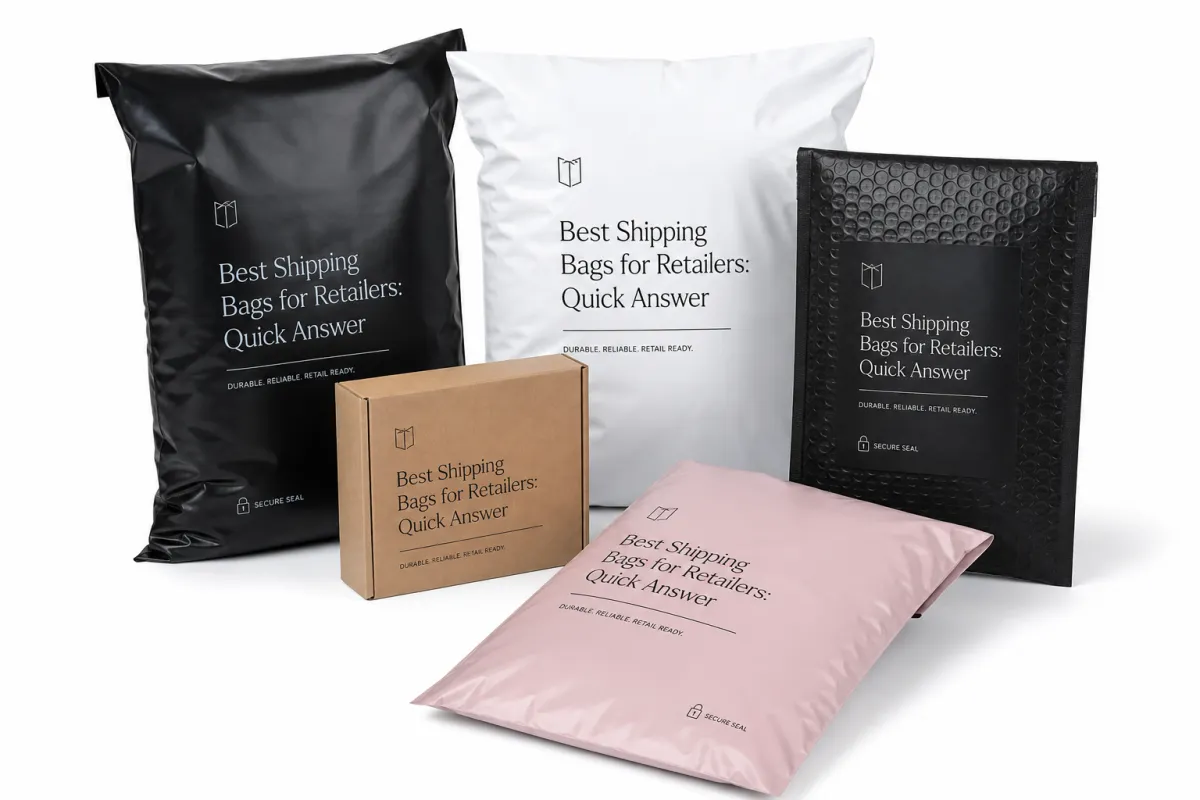
The best shipping Bags for Retailers are rarely the cheapest line item on a quote. They are the bags that keep product clean, hold a seal after rough handling, and cut down on damaged orders and re-shipments. For apparel, that usually means durable opaque poly mailers. For higher-risk items, tamper-evident security bags earn their place. Small fragile goods often do better in padded or bubble mailers. That is the short version, and it matches what I have seen across a wide spread of retail programs, not just tidy sample runs.
Packaging failures usually start at the edge of the bag, not the center. A seam splits during packing, a flap loses grip after the parcel has been stacked, or a corner rubs against a conveyor and opens a weak spot. The item may be perfectly fine on its own, yet the shipment still fails because the mailer was chosen too close to the limit. The best shipping Bags for Retailers allow for that kind of roughness without forcing the packing team to slow down.
There is no single bag that fits every retail line. Product weight, parcel handling, brand presentation, and shipping distance all push the choice in different directions. A soft sweater in a 3 mil opaque mailer has a very different risk profile from a compact beauty set or a metal accessory with sharp edges. The best shipping bags for retailers match the product, the route, and the promise the brand wants the customer to feel on delivery.
A practical starting point looks like this:
- Opaque poly mailers for apparel, soft goods, and low-fragility items that need moisture resistance and fast packing.
- Tamper-evident bags for items that need visible security, controlled handling, or protection against shrink and fraud.
- Padded or bubble mailers for compact hard goods, cosmetics, accessories, and other products that need light cushioning.
A better test than a sales sheet is simple. Ask whether the bag can move through a normal packing line, survive a carrier drop, and still look respectable at the door. The best shipping bags for retailers should make order fulfillment easier, not create a new task for the warehouse.
Best rule of thumb: if the bag cannot survive a 3-foot drop, a corner rub, and a seal check after overfilling, it is not ready for retail transit packaging.
Everything that follows takes the buyer's side of the table. Seal reliability, print quality, lead times, customer perception, and the failure points that show up after the first hundred shipments matter more than a polished product page. Strong packaging decisions tend to come from that kind of reading, not from brochure language.
Best Shipping Bags for Retailers: Top Options Compared
Retail buyers usually narrow the field to five families: opaque poly mailers, kraft-lined mailers, bubble mailers, compostable mailers, and tamper-evident security bags. Each solves a different problem and introduces a different tradeoff. The most common mistake is picking the bag that looks best on a screen. A clean photo does not tell you much about seam strength or how the material behaves after it has been tossed around in transit.
Opaque poly mailers usually win on moisture resistance, low weight, and packing speed. Bubble mailers bring more shock protection, though they can look generic unless the print and finish are handled well. Compostable mailers support a sustainability message, but transit performance varies more than many buyers expect. Tamper-evident bags matter for products where theft, swapping, or return fraud is part of the risk profile. Some assortments still need a box, and that is fine; the best shipping bags for retailers are sometimes part of a mixed packaging system rather than a universal answer.
| Bag type | Typical spec | Best use cases | Estimated unit cost | Main strengths | Main limits |
|---|---|---|---|---|---|
| Opaque poly mailer | 2.5-3.5 mil LDPE, peel-and-seal flap | Apparel, basics, soft goods, subscription inserts | $0.12-$0.28 at 5,000 units | Lightweight, moisture resistant, fast to pack, good print surface | Limited puncture resistance, not ideal for sharp edges |
| Kraft-lined mailer | Paper outer with film or fiber reinforcement | Brands that want a paper-forward look | $0.20-$0.45 at 5,000 units | Better shelf appeal, stronger brand presentation | Can cost more, may not handle wet conditions as well as poly |
| Bubble mailer | Exterior film or kraft with bubble cushioning | Cosmetics, jewelry, electronics accessories | $0.18-$0.40 at 5,000 units | Extra cushion, good for small fragile goods | Bulkier, less elegant for apparel, higher dimensional weight risk |
| Compostable mailer | Bio-based or compostable film, print-ready | Sustainability-led brands, low-abrasion items | $0.22-$0.55 at 5,000 units | Strong brand story, lower plastic message | Performance varies, can be less forgiving in transit |
| Tamper-evident security bag | Security seal, serial options, tear indicators | High-theft items, returns, cash-like goods, controlled items | $0.25-$0.70 at 5,000 units | Visible security, chain-of-custody confidence | Less consumer-friendly for everyday apparel shipping |
The bag in the customer's hand shapes the first impression more than a lot of retailers realize. A crisp flat mailer can make a simple item feel intentional and well-packed. A flimsy bag does the opposite, even if the product inside is good. The best shipping bags for retailers line up the print, the feel, and the way the package handles during packing and delivery. The parcel becomes part of the product story.
A useful check is whether the bag supports shipping protection and the brand's visual language without asking the packer to do extra work. If every order needs extra tape, extra folding, or added tissue just to make the package pass inspection, the bag is fighting the fulfillment process. The same problem shows up when the film is too light and the team has to overpack just to keep it from tearing. A stronger adhesive or a slightly heavier material usually costs less than repeated damage.
For a first pass, I usually point retailers toward custom-printed opaque poly mailers. They are easy to use, fast on the line, and cost-effective. Brands that want a paper-forward appearance can step into kraft-lined mailers. Small or brittle items move into bubble mailers. Security-sensitive products belong in tamper-evident options from the start. That is the practical path for anyone sorting through the best shipping bags for retailers.
Detailed Reviews: What Holds Up in Real Retail Shipping?
The best shipping bags for retailers hold their shape after pack-out, keep their seal under pressure, and still look clean when the customer opens the parcel. The trouble with marketing copy is that it stops at the sample stage. Real shipping adds overstuffed orders, quick handoffs, rough stacks, and weather. That is where weak bags show themselves.
Opaque poly mailers for everyday apparel
Opaque poly mailers are still the workhorse for soft goods. The better versions use a 2.5 to 3.5 mil film, a consistent adhesive strip, and enough stretch to take a folded hoodie or a pair of tees without putting stress on the corners. For apparel programs, the best shipping bags for retailers are often these mailers because they are light, private, and fast to close.
Speed is the reason they keep winning. A well-sized mailer moves through packing with almost no friction, which matters during peak season and holiday rushes when a few extra seconds on each order add up fast. Puncture resistance is the weak spot. Hardware, zippers, bulky tags, or sharp corners can force a seam open before the parcel leaves the facility. I have watched a perfectly fine hoodie fail in transit because a zipper pull sat right on the fold line. That does not mean the category is poor. It means the spec needs to match the product.
Good opaque mailers use welded side seams, a strong peel-and-seal closure, and a surface that prints cleanly without muddying the logo. If you are ordering custom versions, ask about film thickness, tensile behavior, and whether the bag has been tested against standards such as ASTM D882 for tensile properties. If the supplier says the bag passed a drop test, ask which test method they used and what the sample size was. The best shipping bags for retailers should do more than look neat in a mockup; they should stay intact after ordinary handling.
Padded and bubble mailers for small fragile goods
Bubble mailers are not especially glamorous, but they solve a clear problem. Small products with some fragility - cosmetics, accessories, chargers, compact tools - need more than a plain film bag can provide. Cushioning helps, though it is not a cure-all. Hard corners and metal edges still need smart packing. The upside is that the package feels more substantial in the customer's hand, which can lift the perceived value of the order.
Dimensional weight is the catch. Bubble mailers can raise shipping charges in ecommerce lanes where carriers price by volume as much as by weight. That is why the best shipping bags for retailers depend on the carrier mix as much as the product itself. A bag that lowers damage claims but pushes every parcel into a higher rate band only works if the tradeoff makes sense on the ledger.
A lot of buyers misread this part. They compare the bag price and stop there. A bubble mailer may cost only a little more than a flat poly mailer, yet it can behave like a larger parcel and move the shipment into a pricier tier. Over time, that difference becomes visible in the monthly shipping bill. The savings can disappear in a hurry if the package size crosses a carrier threshold.
Tamper-evident bags for higher-risk items
Tamper-evident bags belong in the mix whenever the product has theft risk, return risk, or chain-of-custody sensitivity. Retailers use them for high-value accessories, certain beauty items, and limited drops where the package itself needs to carry proof of integrity. The signal is straightforward: if the bag has been opened, it will show.
These bags are not designed to be soft or decorative. Their value is security. A good security bag uses a strong closure, clear tear evidence, and enough stiffness to keep contents from shifting around in transit. If the product category calls for it, security should sit high on the list of priorities in the best shipping bags for retailers.
They matter most where a retailer needs to document handoff, handle returns carefully, or keep items from being swapped without notice. The tradeoff is presentation. For brands that rely on warmth, softness, or a premium unboxing feel, security bags make more sense for specific SKUs than for the entire order stream.
Compostable mailers and paper-forward options
Compostable mailers get attention because they reduce the plastic message attached to the parcel. That can fit a brand beautifully, but the performance range is wider than most buyers expect. Some films are well made. Others are more sensitive to heat, seam stress, or rough handling than standard poly. The best shipping bags for retailers in this category combine a credible sustainability story with real transit durability.
If sustainability is central to the brand, the sourcing claims deserve careful checking. Fiber-based materials should line up with FSC expectations, and broader packaging guidance from groups like FSC can help validate what a supplier says about paper content and chain of custody. For shipping performance, I also like to cross-check packaging guidance from ISTA when the bag has to survive a harder transit profile.
I would not choose compostable mailers only because they sound cleaner. Use them when the brand message is clear, the transit path is manageable, and the customer base will notice and value the change. If those pieces are not in place, the best shipping bags for retailers may be the plain opaque poly option that performs better and costs less. That is kinda the whole point of buying packaging with your eyes open.
What most retailers get wrong: they buy to the bag spec, not to the failure mode. A seam split, a moisture issue, or a theft problem tells you more than a pretty product page ever will.
Across every category, the strongest options balance protection, packing speed, and presentation. Weak options usually do one thing well and fail somewhere obvious. The best shipping bags for retailers sit in the narrow band where the product survives, the line keeps moving, and the customer feels good about the package.
Pricing, MOQ, and Unit Cost: What Retailers Really Pay
Price is where a lot of buyers get pulled off track. A quote arrives, the bag looks affordable, and the order feels easy to approve. Then the rest of the bill shows up in freight, storage, packing labor, damage replacement, and re-ships. The best shipping bags for retailers should be judged on landed cost, not just the printed unit price.
Unit cost moves with size, thickness, print coverage, material choice, and order volume. A standard opaque poly mailer at a few thousand pieces may land around $0.12-$0.28 depending on dimensions and print coverage. Add custom colors, heavier film, or more complex print coverage and the price climbs. Tamper-evident security bags and higher-spec compostable options can sit higher still. The real question is not whether the bag is cheap. The real question is whether it lowers the cost per shipped order.
Use this framework before approving a quote for the best shipping bags for retailers:
- Bag cost: compare the actual unit price at each volume tier, not just the first number on the sheet.
- Freight: lighter bags can reduce inbound charges, especially on large programs.
- Packing labor: a simple seal and a forgiving shape save time on the line.
- Damage rate: even a small drop in tears or leaks can justify a better bag.
- Replacement shipments: one avoided re-ship can erase a long run of small unit savings.
A retailer shipping 10,000 units a month may find that paying three or four cents more per bag saves enough in claims and labor to pay for itself. That is especially true in categories with rough handling or a steady return stream. The best shipping bags for retailers often look modest on the invoice but expensive in the complaints they prevent.
MOQ matters too. Stock bags usually have a lower entry point, while custom printing raises the minimum because of setup, ink, and production economics. The gap can be meaningful. If you are testing a new SKU or a seasonal design, start with stock or short-run custom before locking into a large order. That keeps the risk low while still giving you real field data.
| Buying path | Typical MOQ | Lead time | Best for | Cost profile |
|---|---|---|---|---|
| Stock poly mailers | Low to moderate | Fastest | Testing, replenishment, basic apparel | Lowest entry cost |
| Custom printed mailers | Moderate to high | Longer | Branding, repeat programs, launch kits | Better branding economics at scale |
| Specialty security bags | Moderate | Moderate | High-risk items, controlled handling | Higher unit cost, lower shrink risk |
| Compostable mailers | Moderate | Moderate to longer | Sustainability-led retail programs | Premium pricing, brand-driven value |
The best shipping bags for retailers often save money in places that are easy to miss. A stronger adhesive strip can cut repack labor. A thicker film can lower damage claims. A cleaner print surface can raise perceived quality without adding inserts or extra layers. Bags that look slightly expensive up front sometimes end up cheaper once the whole process is measured.
Dimensional weight deserves attention too. A bag that carries too much bulk can be priced by carriers as though it were much larger than its contents. That can wipe out the savings from a low unit price. In ecommerce shipping, the smartest buy is not always the lightest bag. It is the one that produces the lowest all-in cost per delivered order.
Process and Timeline: From Sample to Shelf
Buying the best shipping bags for retailers is less about the final approval and more about the path that gets you there. The process usually starts with spec selection, moves into artwork proofing, then samples, production, and freight. If any step is vague, the timeline slips. Delays are often small, ordinary, and expensive rather than dramatic.
A clean process usually follows this path:
- Define the use case: product weight, size, fragility, and whether the bag is for direct-to-consumer or in-store fulfillment.
- Choose the material: poly, bubble, kraft-lined, compostable, or security-focused.
- Confirm sizing: leave enough room for a clean pack without overfilling the seam.
- Review artwork: check logos, bleed, pantone targets, and barcode placement if needed.
- Approve a sample: evaluate seal strength, fit, print accuracy, and handling feel.
- Run production: lock the spec so there are no mid-run surprises.
- Plan freight and receiving: schedule delivery around the replenishment cycle.
Artwork is usually the slowest part. A file that looks clean on a screen can reveal weak contrast, low-resolution details, or color drift once it is printed on film. That is why sample review matters. A physical sample tells you more about the best shipping bags for retailers than a PDF ever will. It shows whether the adhesive grabs correctly, whether the print lands where it should, and whether the material feels premium or just acceptable.
Lead time depends on stock versus custom. Stock orders move faster. Custom orders take longer because the supplier needs proof approval, material scheduling, and production time. A realistic custom timeline often lands around 12-15 business days after proof approval, and longer if the size is unusual or the print coverage is complex. Freight adds another layer. Retail buyers should keep buffer in the calendar, especially when launch dates are fixed.
Supplier questions should be specific. Ask about film thickness, seal type, whether the adhesive is pressure-sensitive or heat-sealed, and whether the bag has been tested for common transit abuse. If the supplier cannot explain the likely failure mode, they may not be the right partner for the best shipping bags for retailers. Details matter more than slogans.
A sample run can save a large amount of money. I would rather see a retailer spend a little on samples and discover the gusset is too tight than learn that lesson after thousands of units are already in the warehouse. Samples also give the packing team a voice, and the people on the line often spot usability problems before the buyers do.
How to Choose the Best Shipping Bags for Retailers
The best shipping bags for retailers are chosen by matching the bag to the product, not by forcing one format to carry every SKU. That sounds obvious, yet plenty of assortments still try to use one mailer for knitwear, cosmetics, and hard goods. The result is either wasted money or avoidable damage.
Start with the product profile. Weight, dimensions, fragility, and shape all matter. A soft sweatshirt and a rigid skincare bottle do not need the same transit packaging. They also do not create the same customer expectation. One should feel light and efficient. The other may need cushioning, a stronger closure, or a shift to a box.
Use this checklist while comparing the best shipping bags for retailers:
- Product weight: heavier items need thicker film or more structure.
- Sharp edges: hardware, zippers, and corners can tear weaker bags.
- Shipping distance: longer lanes bring more handling and more risk.
- Brand presentation: the bag should support the message the retailer wants to send.
- Security needs: tamper evidence matters for some categories and not others.
- Return rate: high-return categories need packaging that survives outbound and inbound movement.
Thickness is not the only variable, but it matters. A thicker poly film can improve tear resistance, though going too thick can make the bag less flexible and add cost without much practical gain. For soft goods, 2.5 to 3.0 mil often makes sense. For rougher handling or sharper contents, 3.5 mil or a reinforced construction may be the better fit. The best shipping bags for retailers are thick enough to survive, but not so thick that they become awkward or expensive.
Closure quality matters too. A weak flap can ruin an otherwise good bag. Seal reliability is one of the clearest signs of real-world quality because it affects both pack speed and customer confidence. If the closure is inconsistent, the whole program turns into a labor problem. Omnichannel retailers feel that pressure quickly because store transfers and ecommerce orders may share the same material pool.
Appearance deserves attention as well. Matte, glossy, and printed finishes all send different signals. A matte black mailer can feel crisp and premium. A glossy finish can read more promotional. Custom print can reinforce the brand story without adding inserts. If the parcel matters to your brand, the best shipping bags for retailers should be chosen with the unboxing moment in mind, not only the warehouse checklist.
There is also a category boundary worth respecting. Not every SKU belongs in a bag. Fragile, stacked, or unusually shaped products are often better protected in boxes. If you need to compare that path, start with Custom Shipping Boxes and weigh them against bag-based formats. In plenty of programs, the right answer is a mixed system rather than one universal pack style.
For buyers building out a broader assortment, it helps to pair the mailer program with Custom Poly Mailers and then expand into other Custom Packaging Products as the brand and SKU mix grows. That gives the packaging system room to scale instead of forcing every item through one narrow spec.
The final rule stays simple. Match the bag to the product risk, the shipping lane, and the customer expectation. Do that well, and the best shipping bags for retailers become a practical tool instead of an afterthought.
Our Recommendation and Next Steps for Retail Buyers
For most brands, the safest starting point is still a durable opaque poly mailer. It covers a wide range of soft goods, keeps costs under control, and usually offers a strong mix of speed and presentation. If the product is fragile or oddly shaped, move into a padded format. If the item faces theft or tampering risk, use security packaging. The best shipping bags for retailers are not the fanciest ones. They are the ones that fit the actual problem in front of the business.
If I were ranking starting points by use case, I would put them like this:
- Apparel and soft goods: opaque poly mailers first.
- Small fragile items: padded or bubble mailers first.
- Higher-risk goods: tamper-evident bags first.
- Sustainability-led programs: compostable or paper-forward mailers, but only after careful performance testing.
The next move is testing, not ordering at scale. Request samples, check seal strength, compare print quality, and run the bag through a real packing line. Ask the packers whether it slows them down. Ask customer service whether damage complaints have shifted. Ask finance whether replacements and freight are moving in the right direction. That is how the best shipping bags for retailers become a measurable improvement rather than a marketing claim.
A short internal scorecard can help before you commit to volume. Score each option on damage rate, labor time, customer presentation, and cost per delivered order. A bag that appears a little more expensive on paper can win once it saves time and reduces claims. Experienced buyers usually separate themselves from impulse buyers at this stage.
Practical takeaway: buy the bag that reduces friction across the whole shipment cycle, not the one that only looks good at the purchasing stage.
That is the real path behind the best shipping bags for retailers. Start with a durable opaque poly mailer for soft goods, then add specialty formats where the product demands it. Test the seal, confirm the fit, check the customer touchpoint, and compare a few quotes before you scale. Done that way, the best shipping bags for retailers become a measurable improvement in package protection, order fulfillment, and customer satisfaction.
What are the best shipping bags for retailers selling apparel?
Opaque poly mailers are usually the best shipping bags for retailers in apparel because they are lightweight, moisture-resistant, and fast to pack. Choose a thicker film if the garments have hardware, sharp tags, or multiple folded layers that can stress the seam. Add custom printing if the unboxing experience matters as much as the shipping protection.
How do I compare the best shipping bags for retailers on price?
Look beyond unit price and compare the full landed cost, including freight, storage, packing labor, and damage replacement. A slightly more expensive bag can be cheaper overall if it reduces tears, returns, or re-ships. Request quotes at multiple volume tiers so you can see where the price break actually starts.
Are compostable poly mailers worth it for retailers?
They can be worthwhile if sustainability claims are part of the brand message and customers expect lower-plastic packaging. Check real performance carefully because some compostable films are less forgiving in rough transit than standard poly. Use them when the brand benefit is clear, not just because they sound better on paper.
What MOQ should retailers expect for custom shipping bags?
MOQ varies by supplier, material, and print setup, but custom runs are usually higher than stock orders. Retailers should ask whether different sizes can be combined in one order or if each SKU has its own minimum. If you are testing a new bag style, start with samples or a short run before committing to a large MOQ.
How long does it take to produce custom retail shipping bags?
Lead time depends on artwork approval, material availability, and whether the bag is stock or fully custom. Simple orders move faster; custom print, special finishes, and new sizes add time. Build in extra buffer if your launch date is fixed, because proofing and freight can extend the schedule.

