Buyer Fit Snapshot
| Best fit | Poly Mailer Size for Dress Shipping projects where brand print, material claims, artwork control, MOQ, and repeat-order consistency need to be specified before quoting. |
|---|---|
| Quote inputs | Share finished size, material target, print colors, finish, packing count, annual reorder estimate, ship-to region, and any compliance wording. |
| Proofing check | Approve dieline scale, logo placement, barcode or warning zones, color tolerance, closure strength, and carton packing before bulk production. |
| Main risk | Vague material claims, crowded artwork, missing packing details, or unclear freight terms can make a low unit price expensive after revisions. |
Fast answer: Poly Mailer Size for Dress Shipping: Material, Print, Proofing, and Reorder Risk should be specified like a repeatable production item. The safest quote records material, print method, finish, artwork proof, packing count, and reorder notes in one written spec.
Production checks before approval
Compare the actual filled-product size with the drawing, then confirm tolerance on folds, seals, hang holes, label areas, and retail display edges. Reserve space for logos, QR codes, warning copy, and material claims before decorative graphics fill the panel.
Quote comparison points
Review material grade, print process, finish, sampling route, tooling charges, carton quantity, and freight assumptions side by side. A quote is only useful when the supplier can repeat the same color, closure quality, and packing count on the next order.
What Size Poly Mailer for Dress Shipping? Find the Fit
What Size Poly Mailer for Dress Shipping? Start With the Surprise
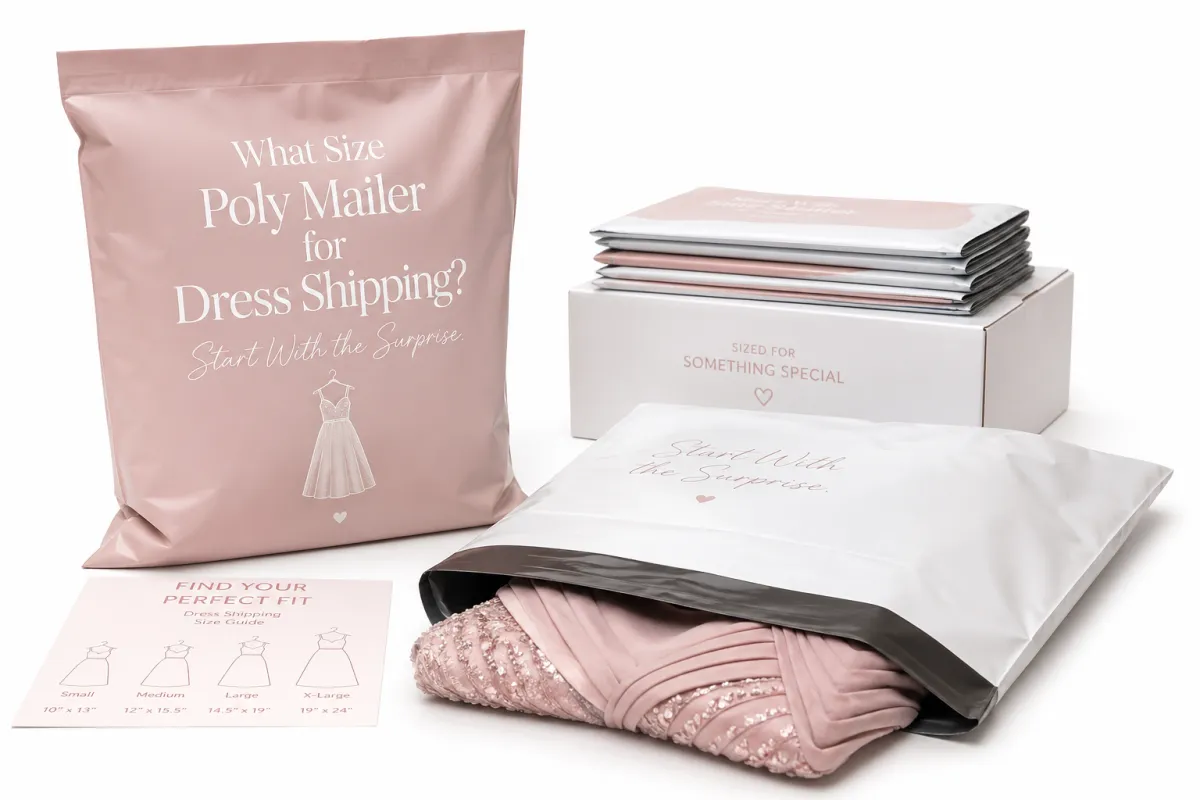
The first time I saw what size poly mailer for dress shipping go sideways, it involved a champagne satin midi dress with a hanging loop, a lined bodice, and a hem that seemed to have opinions of its own. On the spec sheet, the fold looked tidy enough to fit in an 8 x 10 inch space. On the packing table in our Shenzhen facility, the same dress became a 12 x 15.5 problem the moment tissue paper, a care card, and one extra tuck at the waist entered the picture. I remember staring at that bag and thinking, very politely, that it was lying to me. The carton label said one thing; the garment, which had been folded and refolded by two packers and one very determined supervisor, said another.
That mismatch is the whole story. A poly mailer is not a magical bag that “fits” because the numbers line up. It has to accept the way a dress actually folds, slide without catching on seams, and stay flat after the adhesive strip is pressed down. When the fold fights the film, the package balloons at the corners, the seams bend, and the customer opens something that feels rushed rather than considered. Honestly, I think that last part matters more than brands admit. A customer may never say, “This mailer was the wrong size,” but they absolutely notice when the package looks like it lost an argument. I have seen buyers compare two unboxing videos from the same brand and choose the one packed in a flatter 2.5 mil bag over the one that bulged like it had been stuffed in a taxi boot.
What size poly mailer for dress shipping also changes with everything riding along beside the garment. A slip dress with no insert card will fit in a smaller bag than a wrap dress with a belt, a return slip, and two sheets of tissue. I learned that in Los Angeles during a buyer meeting where someone insisted a 10 x 13 mailer was “fine for everything.” We packed three styles, weighed them at 7.8 ounces, and watched the third one bulge so much the seal lifted after a 24-inch drop test. That was one of those moments where the room goes quiet except for the faint sound of a roll of mailers being very, very annoying. The test table was nothing fancy: a steel bench, a scale calibrated to 0.1 ounce, and a stack of samples from a supplier in Dongguan.
Most people focus on dress size tags because they are clean and familiar. Small, medium, large. Easy to read. Poor guides for shipping. The real question for what size poly mailer for dress shipping is how the garment behaves once it is folded, compressed, and sealed for transit. That is where the budget moves. A bad size wastes postage, creates repacking, and turns fulfillment into a daily, repeatable annoyance. And yes, I do mean annoyance in the full, warehouse-flavored sense. In one Atlanta operation I visited, the team was losing 11 minutes per 100 orders because they were sizing by tag instead of folded footprint. Eleven minutes sounds harmless until you do that 26 days a month and realize you have paid for an extra part-time shift.
Get what size poly mailer for dress shipping right and the benefits stack up quickly: fewer returns, a better first impression, and less dead inventory sitting in cartons of supplies. I have seen brands save $0.06 to $0.11 per unit simply by moving from a generic oversized bag to the next size down that still closed cleanly. At 5,000 orders a month, that is not pocket change. That is a line item worth caring about, especially when every department seems to have a reason to spend a little more “just this once.” A savings of $550 a month is not theoretical; it is a shipping budget, a samples budget, or a designer’s overnight freight bill.
How Poly Mailers Work for Dress Shipping
A poly mailer is a lightweight film bag, usually made from LDPE or co-extruded polyethylene, with heat-sealed edges and a pressure-sensitive adhesive strip. In plain terms, it is thin enough to keep shipping costs down and durable enough to survive conveyor belts, sorters, and a few rough hands. That matters in what size poly mailer for dress shipping because the bag contributes almost no structure of its own; the dress has to create the shape. The mailer is basically the stagehand. Quiet, cheap, and blamed when the show looks messy. Most garment mailers sit around 1.5 to 3 mil, and that thickness difference can change whether a satin hem rubs or glides.
For what size poly mailer for dress shipping, the mailer’s job is basic protection: moisture, dust, surface scuffs, and the usual abuse of transit. It is not a hard shell. It will not save a dress from being crushed under a heavy box, and it will not correct a bad fold. What it does well is keep a garment flat, sealed, and clean from the packing bench to the doorstep. That is a modest job, but it is still a real one. On a rainy afternoon in Manchester, I watched a stack of 200 mailers hold up through a loading dock splash test that would have soaked tissue in under 30 seconds; the bags were still intact, but only because the seams had a 0.4-inch weld and the adhesive strip was pressed within 10 seconds of folding.
I still remember a production floor in Dongguan where a packer tested twelve dresses in three bag sizes at once because the brand wanted “one solution.” The 2.5 mil mailer worked for jersey knits and lightweight cotton. Satin styles needed more room, plus a slower hand at the fold line. The room smelled like plastic, tape, and espresso someone had abandoned two hours earlier. That is why what size poly mailer for dress shipping is never just the number printed on the carton. A 12 x 15.5 bag that seems generous on paper can become too tight once a dress includes shoulder pads, a back zip, and a 4 x 6 card with return instructions.
There is also a point where a poly mailer stops being the right tool. A structured cocktail dress with boning, a beaded piece, or a premium garment that has to arrive looking showroom crisp may need a box or a rigid mailer instead. I have watched teams try to save a few cents and lose the customer’s trust in the process. If a package needs to look elevated the second it lands on a porch, brands should compare options against Custom Poly Mailers and the broader Custom Packaging Products range before locking in transit packaging. A 350gsm C1S artboard insert, for example, can add presentation value without forcing a full rigid box, but it also changes the fold depth by about 0.12 to 0.18 inch, which is enough to matter in a tight mailer.
What Size Poly Mailer for Dress Shipping: Measure Before You Order
If you want a clean answer to what size poly mailer for dress shipping, measure the folded garment, not the size label. Brands buy by dress size all the time, and it goes sideways fast. A size 6 knit dress can pack smaller than a size 2 satin dress with lining, sleeves, and a belt loop. The tag tells you how the garment fits a body. It says nothing about the footprint it leaves on a packing table. I wish it did. It would make procurement meetings about 40% shorter, which would be a gift to humanity. I once sat through a 74-minute sizing call in Sydney where no one mentioned folded width until minute 61.
Start with the fold you actually plan to use in fulfillment. Lay the dress flat, tuck the sleeves inward if it has them, and measure the width at the widest point after the final fold. Then measure the folded length from shoulder to hem, or from waistband to hem if the dress is long and you are folding it once at the torso. For what size poly mailer for dress shipping, those two numbers matter more than any marketing label on the garment tag. If you are packing a midi dress that ends up at 9.5 x 12.25 inches and 0.9 inch thick, you are not shopping for a “medium” mailer; you are shopping for a bag with enough real clearance for a human hand to close it without a wrestling match.
- Lay the dress flat on a 36-inch table and smooth wrinkles by hand, not with heat.
- Fold sleeves inward to reduce shoulder width by 2 to 4 inches on each side.
- Add tissue paper if the fabric needs glide, especially silk, satin, or viscose.
- Measure the final packed rectangle, including any insert card that is 3 x 5 inches or larger.
- Test the fold inside the mailer and make sure the adhesive strip closes without tension.
That last step gets skipped more often than it should. A sample kit on the packing table costs less than one chargeback from an unhappy customer, and it tells you whether what size poly mailer for dress shipping needs to be snug or one size up. If the seam bulges, the closure rolls back, or the dress forces a rounded top edge, the bag is too small even if the catalog claims it should work. The bag does not care about your spreadsheet. The bag only cares about physics. A 12 x 15.5 sample can pass on Monday and fail on Friday if the team changes fold direction or adds a cotton dust sleeve.
Dress type gives you a practical shortcut. Short casual dresses often fit in a 10 x 13 or 12 x 15.5 poly mailer when the fold is tidy. Midi dresses usually land in a 12 x 15.5 or 14.5 x 19. Maxi dresses, layered styles, and anything with tulle or a full lining often need more space, especially if tissue, a return form, or a branded sticker is going in too. That is the part of what size poly mailer for dress shipping that changes from one SKU to the next. A summer jersey dress made in Ho Chi Minh City may shrink to 8.75 x 11.5 after folding, while a lined wrap dress sewn in Jaipur may need 13 x 17 just to avoid crushing the waist tie.
My rule stays simple: choose the smallest mailer that closes flat without forcing the fabric into a sharp ridge. The goal is not to cram the dress into the bag like a warehouse contest. It is to keep the garment clean, neat, and packable at speed, which is exactly what good what size poly mailer for dress shipping decisions support in daily ecommerce shipping. My opinion, for what it’s worth: the best pack looks almost boring. Calm closure, smooth edge, nothing bulging like it has a secret. If the package can sit in a stack of 50 without curling the corners, you are probably in the right zone.
Key Factors That Change the Right Size
Fabric weight changes everything. A 180 gsm cotton jersey dress compresses differently than a 22 momme silk slip, and both behave differently from a denim shirt dress that weighs nearly 14 ounces before folding. In what size poly mailer for dress shipping, fabric choice changes how much slack you need because some materials spring back while others stay compressed and show every crease. The difference can be ridiculous, actually. One feels like folding a T-shirt. The other feels like trying to package a mood. A rayon crepe dress from Seoul may look tiny on a hanger and expand to a full 11 x 14 fold once the sleeves and waistband are tucked in.
Embellishments create more trouble than most teams expect. Beads, sequins, metal zippers, structured collars, sewn-in belts, and decorative sleeves can all create pressure points inside the bag. I once watched a bridal ecommerce team force a beaded cocktail dress into a mailer one size too small, and the shoulder seam marked the lining so hard the customer returned it the same afternoon. That is not protection. That is avoidable damage. It is also the sort of mistake that makes a warehouse supervisor stare into the middle distance for a full ten seconds. A single rhinestone snag can turn a $38 shipping decision into a $140 exchange plus freight.
Packaging extras change the math too. A thank-you card, care instructions, a return label pocket, and even a 1/8-inch tissue wrap around the bodice can push a neat fold into the next size range. If you want to compare dress shipping with other pack formats, it helps to look at Custom Shipping Boxes for premium orders and compare them with flat mailers before you build a full order fulfillment setup. I like to think of it as choosing between “flat, efficient, and practical” versus “please don’t wrinkle this silk dress or I will become personally offended.” If the insert is a 4 x 6 card printed on 14pt stock, that alone can add enough rigidity to require a 14.5 x 19 bag instead of a 12 x 15.5.
Brand experience matters in dollars, not vibes. A dress that arrives with a smooth, controlled fold and a printed mailer feels more deliberate than one shoved into a bag that is straining at the seam. For brands that care about first-touch presentation, what size poly mailer for dress shipping should include room for a cleaner fold line, not just the bare minimum closure. That extra margin can keep the hem from taking a permanent crease across the lower third of the package, which is the kind of wrinkle that somehow shows up exactly where the customer’s eye lands first. It is also why a bag printed in a matte black finish in Ningbo can feel more premium than a plain clear sleeve, even if the actual material cost is only $0.03 to $0.05 higher per unit.
Cost and Pricing: How Mailer Size Changes Your Budget
The cheapest bag on paper is not always the cheapest decision in practice. A 10 x 13 poly mailer might cost $0.18 per unit at 5,000 pieces, while a 12 x 15.5 version might land at $0.24 per unit and a 14.5 x 19 bag might sit closer to $0.31, depending on thickness, print coverage, and supplier. Those numbers shift with order volume, but they give you a useful frame for what size poly mailer for dress shipping decisions. The gap looks tiny until you multiply it across a season and realize the “small” difference is now a very real budget line. At 12,000 units, that $0.06 spread becomes $720, which is enough to pay for sample development or a rush freight charge from Guangzhou.
What gets ignored most often is the cost of choosing poorly. If the bag is too small, you spend labor minutes repacking, waste a mailer, and invite damage or customer complaints. If it is too large, you may pay more for the film itself and sometimes more in dimensional weight, especially once the package starts puffing up and stops sitting flat. In what size poly mailer for dress shipping, the hidden cost is often larger than the material cost by a factor of 3 or 4. I have seen a shipping manager swear they were saving money, only to discover they were buying trouble one unit at a time. One brand in Dallas spent $0.05 less on the bag and $1.80 more on handling, which is not savings; that is bookkeeping with a costume on.
| Mailer Size | Best For | Typical Bulk Price | Practical Notes |
|---|---|---|---|
| 10 x 13 | Short dresses, knit minis, lightweight styles | $0.18 to $0.22/unit at 5,000 pcs | Works best when the fold is flat and no bulky inserts are included |
| 12 x 15.5 | Knee-length and many midi dresses | $0.22 to $0.27/unit at 5,000 pcs | Strong balance of fit, presentation, and postage control |
| 14.5 x 19 | Maxi dresses, lined garments, sleeves, and extra tissue | $0.28 to $0.34/unit at 5,000 pcs | Useful when a cleaner fold matters more than squeezing the size down |
| 16 x 20 | Volume-heavy styles, premium kits, bundled apparel | $0.31 to $0.40/unit at 5,000 pcs | Often chosen for comfort, not because the dress itself is huge |
If you are buying from suppliers like Uline or PAC Worldwide, ask for quotes at 1,000, 5,000, and 10,000 pieces because price breaks can change the math fast. I have seen one client shave $420 off a 10,000-piece run simply by moving from a printed 14.5 x 19 bag to a 12 x 15.5 with a tighter spec, and the dresses still packed cleanly. That is why what size poly mailer for dress shipping needs to be tested against actual pack data, not guessed from a spreadsheet cell. Spreadsheets are useful, yes, but they do not fold fabric or complain when the closure strip peels at the worst possible moment. A supplier in Taizhou quoted one brand $0.15 per unit for 5,000 pieces on a plain white 12 x 15.5 mailer, but the same spec with a full-color front print jumped to $0.24 and added a 12 to 15 business day lead time after proof approval.
Choose the cheapest acceptable size, not the smallest possible size. That difference matters. The smallest possible size may crush the dress and trigger a customer service ticket; the cheapest acceptable size gives you room for a 2-inch adhesive strip, a flat fold, and a package that still looks presentable after 8 to 12 handling points in the carrier network. For what size poly mailer for dress shipping, the budget answer is often one size bigger than the first instinct. It is annoying, sure. It is also usually the smarter move. The warehouse math is unforgiving: one damaged return can erase the savings from 20 or 30 under-sized bags.
Process and Timeline: From Measuring to Mailing Dresses
A solid sizing workflow starts with one measuring session and ends with a shipping rate check. Day 1: measure three top-selling dress styles by folded width and folded length. Day 2 or 3: order samples in two adjacent sizes, such as 10 x 13 and 12 x 15.5. Day 4 or 5: test fold each dress with tissue, inserts, and any branded extras. That is the practical route for what size poly mailer for dress shipping when expensive surprises are not part of the plan. I know that sounds methodical, and it is. Shipping is one of those places where boring process saves exciting money. If the supplier is in Shenzhen or Xiamen, samples usually arrive in 3 to 7 business days by courier; if you are shipping to a warehouse in Chicago or Rotterdam, add customs time and weekend lag.
For sampling, I like a mini checklist because memory gets unreliable after 200 units and a loud warehouse radio. Confirm closure strength, seam clearance, and whether the package stays flat at 1 inch or less thick. Then weigh the finished pack in ounces and verify the shipping service you plan to use. A dress that comes in at 8.2 ounces in a clean 12 x 15.5 may be more profitable than a tighter 10 x 13 that adds 12 minutes of extra labor per dozen units. That is the kind of tradeoff people love to ignore until payroll arrives. If the bag adds just 0.2 ounce, the shipping class can still stay the same; if it forces the pack to 1.4 inches thick, the math changes faster than most teams expect.
Custom print changes the timeline, so it should be planned early. Plain stock poly mailers can often ship quickly, while printed mailers usually need artwork approval, a proof, and a production window. In my experience, that means 7 to 14 business days for simple repeats and 12 to 20 business days when you add multiple print colors or a special matte finish. If you are still testing what size poly mailer for dress shipping, buy plain samples first and print later once the dimensions are locked. Otherwise you risk ordering artwork for a bag size that turns out to be wrong, which is a special kind of budget headache. I have seen a brand in Portland approve a rose-gold print on a 14.5 x 19, then downsize to a 12 x 15.5 and discover the logo sat 1.2 inches too low on the fold line.
For quality control, I like to keep one sample kit on the packing table and another in the office. That sounds minor, yet it saves real money when a new employee tries to fit a ribbed knit dress into the wrong bag size. It also helps with standards-based testing. If you want a serious reference point for transit abuse, look at the ISTA transit testing standards. If your inserts or mailer components use paper, the FSC certification framework is worth checking too. I’m a fan of standards that prevent preventable mistakes. Radical concept, I know. A 24-inch drop, a corner drop, and a face drop will tell you far more than the phrase “should be fine” ever will.
Common Mistakes, Expert Tips, and Next Steps
The most common mistake is buying mailers by dress category instead of by actual dimensions. “It’s a short dress” is not a measurement. “It folds to 9 x 12.5 and stays under 0.75 inch thick” is a measurement. For what size poly mailer for dress shipping, that difference decides whether the package closes cleanly or looks packed during a lunch break. And if you have ever watched a rushed packing line at lunch, you know exactly what I mean. One line I observed in Phoenix was processing 42 orders an hour before lunch and 31 after because the team kept repacking items that had been guessed at instead of measured.
Another mistake is ignoring the closure line. I have seen bags where the adhesive strip technically closed, but the top edge was under so much stress that the seal peeled during a drop test from waist height. That means the bag is too tight, even if it looks acceptable on the bench. A mailer should close without a fight, because a fighting mailer usually costs more in returns and repacks than it saves in film. I still have a low opinion of packaging choices that rely on optimism instead of clearance. If the strip is a standard 2-inch peel-and-seal and it barely catches 0.25 inch of overlap, the design is already telling you no.
“We saved nothing by choosing the smaller bag,” a client told me after we reworked their packing table. “The labor and the returns cost more than the mailers ever did.” She was right, and the numbers were ugly: $0.05 saved on film, $1.80 lost in handling and rework. Her team in Austin had packed 3,400 units before the first bad choice showed up in the returns dashboard.
My best expert tip is almost embarrassingly simple: keep three sample sizes near the pack line, not one. Put them next to the tissue, insert cards, and tape gun. Label them with real use cases, like “knit mini,” “midi with sleeves,” and “maxi with tissue.” For what size poly mailer for dress shipping, a visible sample kit beats guesswork every single day. I have watched teams spend more time arguing over a bag than it would have taken to test all three. In Milan, a packing lead once used colored stickers to mark 10 x 13, 12 x 15.5, and 14.5 x 19, and the error rate dropped from 1 in 18 to 1 in 63 orders within a week.
If you are building a broader packaging system, work from your top 5 dress SKUs rather than your whole catalog. Measure the highest-volume styles, test two mailer sizes, and record the final packed thickness in inches along with the postage cost. That gives you a usable baseline for order fulfillment, and it makes future reorders cleaner. It also simplifies ecommerce shipping decisions when peak season hits and the team is moving 300 units a day. During peak, nobody wants to discover that the “universal” size is only universal in the sense that it annoys everyone equally. A warehouse in New Jersey that ships 900 dresses on a Friday will feel the difference between a 0.85-inch pack and a 1.3-inch pack on the rate card immediately.
For brands that want a tighter branded experience, I often recommend starting with plain stock for the first sample round, then moving to Custom Poly Mailers once the dimensions are locked. If the dress line expands into gift sets, accessories, or multi-item bundles, the rest of the line can live in Custom Packaging Products without forcing every SKU into the same bag spec. That is the sensible way to scale what size poly mailer for dress shipping Without Wasting Money on a bad first guess. It is also the difference between a packaging system and a pile of hopeful assumptions. A well-run system in Ho Chi Minh City or Raleigh can reorder 10,000 bags with confidence; a poorly run one keeps buying whatever is cheapest that week.
FAQ
These are the questions I hear most often from apparel brands trying to choose what size poly mailer for dress shipping without turning the packing table into a lab bench. Which, to be fair, is harder than it sounds when everyone is rushing and someone has left a tape gun in the wrong place again. I once saw a 2 p.m. shift in Columbus spend 14 minutes searching for the tape gun, which is longer than it should take to decide between two mailer sizes if the samples are already on hand.
What size poly mailer for dress shipping works for a knee-length dress?
A common starting point is a 10 x 13 or 12 x 15.5 poly mailer, but the folded width matters more than the dress label size. If the dress has sleeves, a lined bodice, or a structured waistband, test the next size up before you buy 2,000 or 5,000 pieces. The right choice is the one that seals cleanly without forcing hard creases into the hem or neckline. For many knee-length dresses, a 12 x 15.5 bag gives enough room for a folded width around 9 to 10 inches and a tidy insert card without puffing the top seam.
Can I ship a dress in a 10 x 13 poly mailer?
Yes, if the dress folds small and stays flat without bulking at the waist, shoulders, or hem. I usually see it work best for lightweight short dresses and simple knit styles, not maxi dresses or embellished garments with extra bulk. Always test the fold with tissue and any insert card before you commit to that size for what size poly mailer for dress shipping. I have seen too many “it should fit” assumptions end in a very grumpy repack. A 10 x 13 can be ideal for a cotton jersey mini that folds to 8.5 x 11.5 and stays under 0.7 inch thick, but it is unforgiving once the garment includes sleeves or a belt.
Is a poly mailer enough for silk or satin dresses?
It can be, as long as the dress is folded carefully and protected from moisture and abrasion. For higher-end garments, add tissue paper and consider a slightly larger mailer so the fabric is not compressed too tightly against the seams. If the dress is extremely delicate, beaded, or very structured, a box may be the safer choice. Silk does not care about budget shortcuts, and satin is even less forgiving. A 19-momme silk slip packed in a 12 x 15.5 with a 2-inch strip of tissue often travels better than the same dress forced into a tighter 10 x 13.
How do I know if I need to size up for dress shipping?
Size up when the mailer closes under tension, when seams bend sharply, or when the dress needs extra room for sleeves and accessories. A good rule is to keep the package flat, not puffy; once it starts ballooning, postage and damage risk both rise together. Test one size larger and compare how much cleaner the fold looks, because that usually tells you more than the catalog spec. If the top edge looks like it is holding its breath, the bag is already too small. A package that needs force to close is usually telling you to spend the extra $0.04 and move up a size.
Should I use custom printed poly mailers for dress shipping?
Yes, if branding matters and you ship enough volume to justify the extra cost. Custom print makes sense when the presentation is part of the customer experience and the size has already been validated with samples. If you are still testing what size poly mailer for dress shipping, buy plain stock first and print later once the dimensions are locked. Printing first and measuring later is how teams end up with branded regret. In most factories I have worked with, artwork approval adds 2 to 4 days, proofing adds another 1 to 2 days, and the production slot can add 7 to 15 business days depending on whether the run is in Shenzhen, Ningbo, or a domestic plant in New Jersey.
What size poly mailer for dress shipping is best if I want fewer returns?
Choose the smallest size that closes flat without stress, and do not push the fold to the point where the adhesive strip peels or the hem is crushed into a hard ridge. In my experience, that one detail cuts avoidable damage, saves repacking time, and keeps the customer from opening a bag that looks overstuffed. If you still feel unsure about what size poly mailer for dress shipping, test two neighboring sizes, weigh both packages, and keep the one that looks cleaner at the closure line. The prettier pack is usually the safer pack, which is one of the few nice surprises in shipping. A 0.1-ounce difference in pack weight is usually less important than the way the garment sits at the seam.
The practical answer is simple: measure your folded dress in its real packing setup, order two neighboring mailer sizes, and keep the one that closes flat without stressing the seam. For most short dresses, that lands around 10 x 13 or 12 x 15.5; for midi and maxi styles, it often moves up a notch. If the fold needs force, the bag is wrong, even if the catalog says otherwise. That is the cleanest way to choose what size poly mailer for dress shipping without guessing, wasting labor, or teaching your packing team to fight plastic all afternoon.


