Buyer Fit Snapshot
| Best fit | Compare Corrugated Pallet Collars vs Wraps projects where brand print, material claims, artwork control, MOQ, and repeat-order consistency need to be specified before quoting. |
|---|---|
| Quote inputs | Share finished size, material target, print colors, finish, packing count, annual reorder estimate, ship-to region, and any compliance wording. |
| Proofing check | Approve dieline scale, logo placement, barcode or warning zones, color tolerance, closure strength, and carton packing before bulk production. |
| Main risk | Vague material claims, crowded artwork, missing packing details, or unclear freight terms can make a low unit price expensive after revisions. |
Fast answer: Compare Corrugated Pallet Collars vs Wraps: Material, Print, Proofing, and Reorder Risk should be specified like a repeatable production item. The safest quote records material, print method, finish, artwork proof, packing count, and reorder notes in one written spec.
Production checks before approval
Compare the actual filled-product size with the drawing, then confirm tolerance on folds, seals, hang holes, label areas, and retail display edges. Reserve space for logos, QR codes, warning copy, and material claims before decorative graphics fill the panel.
Quote comparison points
Review material grade, print process, finish, sampling route, tooling charges, carton quantity, and freight assumptions side by side. A quote is only useful when the supplier can repeat the same color, closure quality, and packing count on the next order.
Quick Answer: Compare Corrugated Pallet Collars vs Wraps
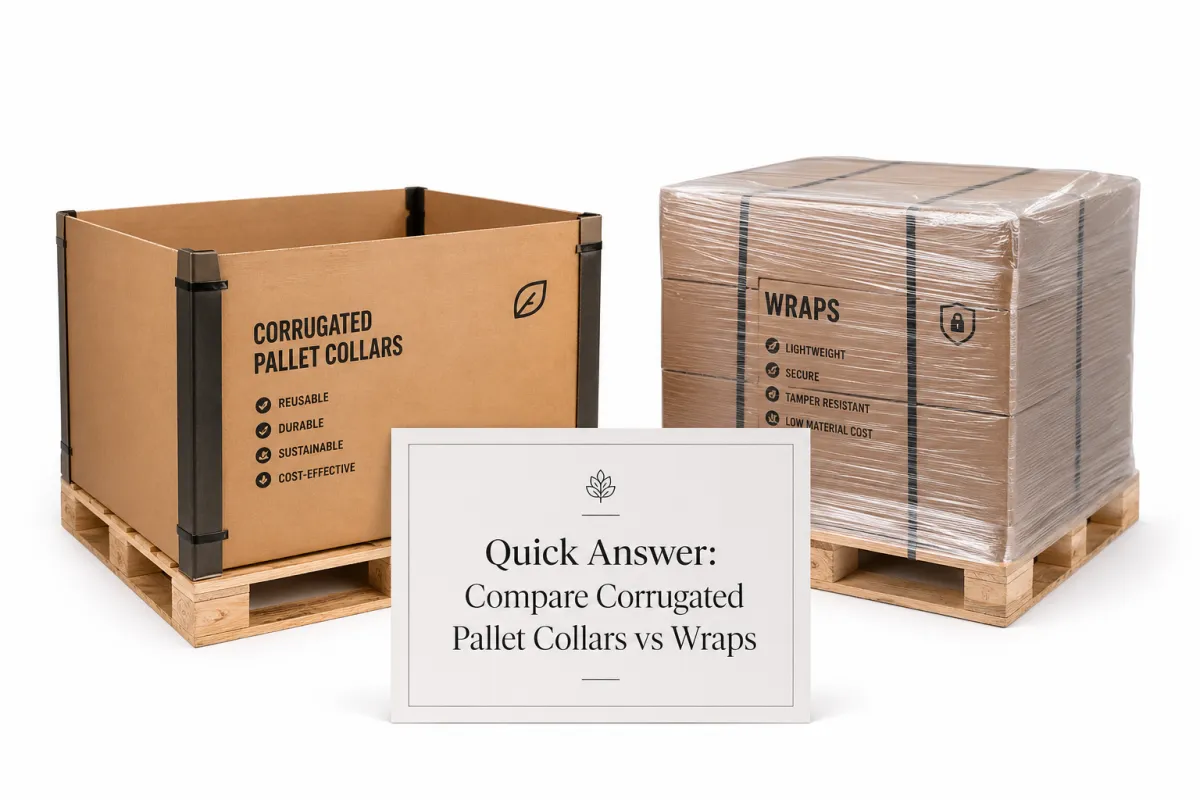
When I compare corrugated pallet collars vs wraps on an actual dock in Louisville, Kentucky, the low-cost option often stops looking cheap after the third truck rolls out. I watched that happen on a mixed-SKU line where a wrap quoted at $1.35 per unit seemed sensible on paper, then the crew spent 14 extra minutes per pallet fixing crushed corners, re-stretching loose loads, and reworking 2 damaged pallets out of every 100 on a 48 x 40 inch footprint. The invoice stayed small. The hidden costs did not. That part still bugs me a little, because the spreadsheet usually looks so confident right up until freight starts moving through a humid trailer at 92 degrees Fahrenheit.
My blunt verdict is simple: corrugated pallet collars usually win for reusable, mixed-SKU, or high-value loads. Wraps tend to win for low-cost, one-way, fast-turn shipments where the product is predictable and nobody expects the pallet to be opened and closed again. If you compare corrugated pallet collars vs wraps only by unit price, you miss the part that actually shapes margin: total cost per trip, load stability, and how fast the system can be built by a tired shift at 5:30 a.m. in a 3-shift warehouse. In practice, a collar built from 32 ECT single-wall board or 275# double-wall often behaves very differently from a thin wrap built for a 900- to 1,200-pound load.
I have watched buying teams fixate on a quote sheet with 2 columns and ignore 3 other costs that matter more: training time, damage claims, and storage cube. That is why the real way to compare corrugated pallet collars vs wraps is not theory. It is a dock-floor test with the same pallet, the same route, and the same receiving team in Chicago, Rotterdam, or Monterrey. If you want a neutral benchmark, ISTA test methods are a solid place to start, especially if your freight sees vibration, compression, or multiple handoffs over a 400-mile lane.
Here is the cleanest decision frame I use after 20-plus packaging reviews: if the load changes height often, if the product mix shifts by order, or if the pallet may cycle back through the building, collars usually make more sense. If the shipment is one-way, low-value, and packed to a standard cube, wraps often stay ahead on simplicity. Either way, compare corrugated pallet collars vs wraps by asking one question: which system costs less per successful trip, not per piece on the invoice? On a 5,000-piece order, that question can separate a $4,500 monthly line item from a $3,200 one, especially once damaged freight is counted. That is the difference between a tidy quote and a freight program that actually holds.
"The cheapest packout is the one that survives the lane without forcing a second touch." That line came from a distribution manager in Dallas who had just lost 6 pallets to corner crush on a 42-mile transfer route, and he was right.
Top Options to Compare Corrugated Pallet Collars vs Wraps
To compare corrugated pallet collars vs wraps properly, you need to separate the formats, because not all collars behave the same way and not all wraps are built for the same abuse. I have seen buyers lump every corrugated sleeve into one bucket, then wonder why one version holds 4 high and another caves in after the second stack. The details matter: flute structure, wall count, score pattern, moisture treatment, and whether the load has to be reopened in transit. Packaging is annoyingly physical like that; it refuses to care about procurement jargon or a tidy SKU sheet exported from SAP.
Common collar options usually fall into 3 groups. Standard single-wall collars are the lightest and cheapest, and they work well for internal moves or short lanes with low compression, especially if the board spec is 32 ECT or 200# test. Reinforced double-wall collars are the middle ground when stacks are higher, transit is rougher, or the load will sit for 48 hours before unloading; in practice, that often means 275# test BC flute or a 48 x 40 x 12 inch build with a 4-sided lock. Branded or custom-printed collars add visibility and can improve line-side identification, which matters more than people admit when a warehouse runs 60 to 90 active SKUs on the same shift. If the packaging has to support a branded unboxing or retail-facing handoff, I often pair it with custom shipping boxes sized to the pallet footprint so the outer pack and pallet system feel like one designed set, not 2 unrelated parts.
Common wrap options include corrugated wraps, pallet skirts, strap wraps, and hybrid systems that combine wraps with top caps or edge boards. A plain corrugated wrap is quick to form, easy to store flat, and low risk on a simple, one-way lane. Pallet skirts can improve presentation and keep dust off the lower carton row. Strap wraps are faster still, but they depend on a disciplined line team and a predictable carton footprint. Hybrid systems sit in the middle; they are often the right answer when a shipper needs more containment than a bare wrap but cannot justify a full collar program. For example, a shipper in Puebla running a 1,200-unit daily line may specify a 350gsm C1S artboard insert for instruction panels while keeping the outer wrap thin enough to store 500 flat sets per skid.
In a factory visit near Shenzhen, Guangdong, I watched 2 packers build 28 pallets of detergent cartons with collars and top caps in 41 minutes. The same team had tried wraps the week before and spent more time re-centering overhang than actually closing the load. I remember standing there thinking, "Well, that solves that," which is not a technical term, but it was accurate. To compare corrugated pallet collars vs wraps honestly, ask where each one fails first: at the corner, at the top layer, at the pallet edge, or at the receiving dock where the load is opened and resealed. On a wet monsoon day in southern China, that answer can change in 15 minutes. It can also change the labor plan for the whole shift.
Here is the short version I give procurement teams:
- Standard collars fit internal transfers, mixed cartons, and loads that change height by 6 to 12 inches.
- Double-wall collars fit heavier products, stacked storage, and return loops where the same unit should survive 3 to 5 cycles.
- Printed collars fit customer-facing shipments, promotional kits, and branded distribution programs.
- Corrugated wraps fit simple, low-cost, one-way moves with steady carton dimensions.
- Strap and skirt systems fit lines that value speed above reusability.
- Hybrid builds fit shippers that need extra security without moving to a fully rigid container.
One supplier negotiation still sticks with me. A converter in Dongguan quoted me $2.95 per single-wall collar at 3,000 units, then jumped to $4.60 for a printed double-wall spec with moisture resistance and a 2-color logo. That quote looked expensive until we modeled a 4-cycle return loop and found the higher-spec collar paid back after the second reuse. I was skeptical at first, which is my default setting with packaging claims, but the numbers kept insisting on the same answer. That is why I compare corrugated pallet collars vs wraps with a cycle count, not a quote sheet alone. In a returnable packaging program, the cycle count is usually where the truth hides.
Detailed Reviews: Where Each System Actually Wins
When I compare corrugated pallet collars vs wraps on structure, collars win the rigidity contest almost every time. The side walls create a box-like frame that helps the load stay square, which is useful when cartons are 12 inches one day and 18 inches the next. That flexibility is not cosmetic. It means the same pallet footprint can support different order mixes without forcing the warehouse to redesign the packout for every SKU swap. In a mixed-case beverage program I reviewed in Columbus, Ohio, the team cut rework by 18 percent simply because the collar height could be adjusted in 2-inch increments instead of forcing a full rebuild.
Wraps win somewhere else: speed. A trained operator can set a standard wrap faster than building a 4-sided collar, especially when the carton footprint is already clean and the route is short. If the product is dense, well packed, and unlikely to shift, a wrap can be enough, kinda the packaging equivalent of a simple answer That Actually Works. I saw this on a seasonal dry-goods lane in Atlanta where 96 percent of the pallets moved within 8 hours of build time. The team wanted low complexity, and the wrap system delivered that with very little training friction. Frankly, nobody was trying to win an award for artisanal pallet building on a Friday night shift.
The failure modes tell the real story. Collars usually fail when the board is under-specified, when moisture enters the lane, or when the corner scores are too shallow and the wall buckles under side pressure. Wraps usually fail when the load is a little too tall, the top layer is uneven, or the pallet gets handled more than once before delivery. That difference matters because most shipping damage does not happen in a dramatic crash. It shows up in small, repeated abuses: a forklift nudge, a staging delay, a humid dock at 78 percent relative humidity, or a second stack placed 3 inches off center during a shift change.
I also look at how easy each system is to train. Collars are usually more intuitive for new staff because the load reads like a box. Wraps can be faster, but they depend more heavily on the person doing the build. A 20-year veteran can make a wrap look perfect in 25 seconds. A new hire may need 25 minutes to figure out where the corners should land and which flap should sit on the 40-inch side. That is a hidden cost. If turnover is high, compare corrugated pallet collars vs wraps through the lens of training, not just packaging performance. A 14-day onboarding cycle in a warehouse with 40 new hires per quarter changes the math fast, and it changes the claims picture too.
For mixed or fragile programs, I often recommend a hybrid setup. A collar plus a top cap can deliver better vertical support without overbuilding the whole unit. A wrap plus edge protection can work on a lane where speed matters but side crush has been a recurring claim. I have used that approach for retail display replenishment in Minneapolis, and it solved a problem that 3 prior packaging changes had not fixed. The trick is to treat the hybrid as a system, not a patch, and to confirm that the top cap is cut from the right board, such as 350gsm C1S artboard for print-heavy messaging or 275# single-wall corrugated for simple warning labels.
If you are tracking standards, this is where a second reference point helps. The FSC-certified paper supply chain matters when you want corrugated components that fit recycled-content targets or customer sustainability rules. I have had buyers ask for that spec specifically because one retail account in Toronto required documented fiber sourcing on any outer packaging that touched consumer-facing freight. In one audit, the buyer wanted the chain-of-custody paperwork within 24 hours, not next week, so the paper mill in Quebec had to be named on the first submittal.
Many teams overrate disposable simplicity. A wrap looks easy on day one, then gets complicated the moment the lane changes. A collar looks more involved at first, then often becomes the calmer option once the team repeats the same 5-step build 50 times. That is why I compare corrugated pallet collars vs wraps by workflow stability as much as by protection. If the dock is already noisy, with 2 scanners missing and 1 printer jammed, you do not want a packaging format that adds extra drama at 6:45 a.m. You want the lane to stay predictable enough that the crew can keep moving.
Price Comparison: Compare Corrugated Pallet Collars vs Wraps on Total Cost
If you compare corrugated pallet collars vs wraps on sticker price alone, wraps usually look cheaper. That is the easy answer, and it is why a lot of buying teams stop too early. On a 5,000-piece order, I have seen plain wraps quoted at $1.20 to $1.85 each, while standard collars sat around $3.10 to $4.80 depending on wall count, print coverage, and board grade. Those numbers are real enough to matter, but they are not the whole story. Material price is only one line in the ledger, and sometimes not even the biggest one if the freight lane runs 3 days through a wet Gulf Coast corridor.
The better math includes labor minutes per pallet, training time, error rate, storage cube, and the cost of damage or rework. In one review of a regional distribution lane out of St. Louis, collars added about 2.5 minutes of build time per pallet on the first run, but the team reused the same units 4 times and reduced corner damage by 11 percent. The wrap system saved 90 seconds per pallet but created enough slippage and crushed lower corners to erase the savings after the second week. I compare corrugated pallet collars vs wraps by asking whether the slower unit is actually cheaper after 100 shipments, not after 1. The first pallet is usually the liar, and the 100th is the one that tells the truth. That is the difference between a quote and a cost model.
Reuse changes the math more than most buyers expect. A collar that costs $4.20 and survives 5 cycles has a material cost of $0.84 per trip before labor. A wrap that costs $1.50 but is thrown out every time stays at $1.50 per trip before labor. If the collar also saves 30 seconds of rework per pallet on return, the gap can close fast. If the wrap is part of a one-way program with no return loop, the lower upfront cost may still win. That is why I always ask about cycle count, not just unit count. A return path through a regional hub in New Jersey can turn a slightly higher material cost into the better operating choice within 2 billing cycles. If your team tracks returnable packaging, this is the line item that usually shifts the decision.
Here is the framework I use when I compare corrugated pallet collars vs wraps for a buyer:
| Cost Factor | Corrugated Pallet Collars | Wraps |
|---|---|---|
| Unit price at 5,000 | $3.10-$4.80 | $1.20-$1.85 |
| Typical setup time | 2.5-4.0 minutes | 1.0-2.5 minutes |
| Reuse potential | 3-6 cycles if kept dry | 1-2 cycles in many lanes |
| Damage risk on mixed loads | Lower | Moderate to higher |
| Best economics | Returnable and mixed-SKU programs | One-way and low-value shipments |
The table is useful, but I would still caution against pretending the numbers are universal. A humid lane can cut reuse life by half. A rough conveyor in a 300,000-square-foot plant can turn a wrap into a maintenance headache. A warehouse with 3 shifts and high turnover may value the simpler build more than the cheaper cycle cost. That is why I compare corrugated pallet collars vs wraps against the full operating picture: material, labor, storage cube, loss rate, and the chance that the customer will reject the pallet for cosmetic damage. One ugly corner can cost far more than people want to admit, especially if the consignee charges a $65 rework fee per pallet.
One of my more memorable pricing meetings happened at a supplier table in Mexico City where the sales rep had a clean price card and the operations lead had a stack of damaged returns from a 60-mile route. The rep argued that the wrap saved $1.90 per pallet. The operations lead answered with a photo log showing 17 crushed corners and 6 reworked pallets over 2 lanes. We ran the math again, and the "cheaper" option stopped being cheaper the moment the third touch was included. That is the moment buyers usually miss, and it is usually the moment the finance team starts asking harder questions.
For buyers who want a custom outer pack that matches the pallet system, I often suggest pairing the pallet decision with Custom Shipping Boxes so the footprint, print, and handling method align. That way the cost model is not split across 2 unrelated specs. It becomes one packaging system with one performance target, like a 48 x 40 inch shipper designed to sit cleanly on a standard GMA pallet without 1 inch of overhang on any side.
How Do You Compare Corrugated Pallet Collars vs Wraps?
The fastest way to compare corrugated pallet collars vs wraps is to run your own decision matrix on 1 lane, 1 pallet footprint, and 1 receiving point. Start with the product mix. If the pallet holds 6 SKUs, each with different carton heights, collars are usually the safer bet. If the lane carries a single SKU, a standard footprint, and a 1-day transit window, wraps may be enough. That simple split explains more real-world outcomes than most sales decks do in 20 slides, especially on a route moving 180 pallets a day.
Next, look at shipment frequency. High-frequency lanes reward systems that stay consistent under pressure. If your team builds 80 pallets per shift, a 30-second savings per pallet can add up to 40 minutes a day. If your team only ships 12 pallets, the focus should move to protection and reusability. I compare corrugated pallet collars vs wraps differently depending on that volume gap because labor economics change fast between a high-volume dock and a low-volume fulfillment room in places like Reno, Nevada or Allentown, Pennsylvania.
Height variability is another major clue. Collars shine when the pallet height shifts by 4, 6, or even 10 inches across orders. A wrap can handle some variation, but not as gracefully. Once the top row starts wandering, the wrap stops being a neat solution and becomes a compromise. On one retail replenishment program, we solved that by using 2 collar heights instead of 1, which cut overpack waste by 14 percent and reduced the number of awkward mixed stacks that had to be rebuilt. The warehouse also reduced re-labeling by 9 minutes per 10 pallets because the top line stopped wandering off spec.
Return logistics matter too. If the pallet or collar comes back through the building, the case for collars gets stronger. If the packaging is one-way and the consignee discards everything, wraps can keep the system simple. I have watched companies pay for reusability they never actually used. I have also watched teams burn money on disposable packaging because nobody wanted to do the return accounting. The answer is not ideological. It is operational, and occasionally it is just a conversation nobody wanted to have before lunch in a conference room with 2 cold coffees and a missing dock report.
Before you compare corrugated pallet collars vs wraps with a supplier, check these 6 items:
- Pallet footprint, especially whether it is truly 48 x 40 or something close to it.
- Carton overhang, including the worst case by 1 inch on each side.
- Moisture exposure, from dock humidity to trailer condensation.
- Storage space, including whether flat packs or nested units fit better in the warehouse.
- Return rate, measured as actual cycles per unit, not hoped-for cycles.
- Handling steps, from initial build to receiving and any partial reopen.
If you want a short rule from someone who has made both systems work, here it is: collars are for control, wraps are for speed. That does not mean one is always superior. It means the more variable, valuable, or reusable your pallet is, the more likely collars will justify their higher upfront cost. The flatter, lighter, and more disposable the lane, the more attractive wraps become. On a 2-day lane with a clean carton footprint and a 32 ECT box spec, wraps may be entirely enough.
I also like to sanity-check sustainability claims. Less waste matters, but so does actual reuse. A collar that survives 4 trips often beats a wrap that is tossed after 1, especially if the board is sourced well and the return path is real. If your team has corporate targets around fiber sourcing or circularity, ask for documentation and not just marketing copy. That is where FSC-certified paper options can become a practical part of the decision instead of a logo on a slide. A plant in Wisconsin or Ontario can usually supply the paperwork in the same day if the chain-of-custody file is already set up.
And yes, I compare corrugated pallet collars vs wraps with the receiving dock in mind. If the consignee needs to open, inspect, and close the load again, collars are usually easier to live with. That one detail has saved more claims than any glossy packaging mockup I have seen, including the 6 claims a month that vanished after one 275# double-wall redesign on a 1,000-pound mixed-SKU route. It also makes the reverse flow less painful for the receiving crew.
Process and Timeline: From Spec Sheet to First Shipment
Most delays happen before production starts, not inside the plant. When I compare corrugated pallet collars vs wraps on a live project, the process usually begins with a discovery call, then measurements, then samples, then artwork approval, then fit testing, then a pilot shipment, and only after that does full production make sense. If any one of those steps is vague, the schedule slips. In my experience, missing pallet dimensions causes more trouble than the manufacturing run itself. A plant can recover from a lot; a bad dimension can haunt the job for weeks, especially if the pallet actually measures 48.25 x 40.5 inches and the spec sheet says 48 x 40.
For wraps, timelines can move faster because the geometry is simpler. A basic corrugated wrap may be ready sooner if the print is minimal and the spec is straightforward. Collars often take longer because the scoring, depth, wall height, and print placement need to line up with the real pallet. A custom collar with moisture resistance and 2-color branding can easily need more back-and-forth than a plain wrap, especially if the buyer wants to test stackability under load before approving the run. A factory in Dongguan or Foshan can usually quote a sample in 3 to 5 business days and a production run in 12 to 15 business days from proof approval if the board grade is already locked.
Here is the information that speeds up approvals the most: pallet dimensions to the nearest 1/8 inch, target stack height, product weight, transit mode, and photos of the current packout from 3 angles. I also ask for the worst-case load, not just the ideal one. If the tallest carton in the mix is 18.5 inches, I want to know that, because a 17-inch spec may fail on the second shift. That is why I compare corrugated pallet collars vs wraps with real photos, not just a drawing from procurement. The camera does not lie, which is a refreshing change from some product briefs that leave out the top-load weight and the heel overhang.
One client meeting in the Midwest taught me this the hard way. The buyer sent a neat spec sheet, but the actual pallet had 3 inches of overhang on one lane and 2 different carton heights on another. The wrap quote looked perfect on paper and failed in the pilot. The collar revision took 2 sample rounds, but once it was right, the line stopped arguing about rebuilds. Nobody talks about the value of fewer arguments, but the operations manager absolutely notices it. So does the crew, who would really prefer not to play packaging detective at the end of a 10-hour shift.
Timing also depends on print and sourcing. If the collar or wrap needs branding, order numbers, or handling icons, the artwork proof can add a few days. If you need recycled fiber or certified sourcing, ask about supply availability early. That is where a vendor with documented paper channels helps. I have seen a 9-day delay turn into a 2-day delay simply because the buyer approved the print path and the board grade in the first email instead of the fourth. A supplier in Ontario, Canada or Richmond, Virginia can usually move much faster if the BOM is complete on day 1.
For teams building a branded outer pack, I sometimes coordinate the pallet system with Custom Shipping Boxes so the outer carton and the pallet collar use the same visual language. It reduces mistakes on the floor and helps receiving teams spot the right SKU faster. When the box art and pallet spec speak the same language, the whole lane becomes easier to audit, especially if the carton uses a 350gsm C1S artboard insert or a 32 ECT outer shipper with the same lot code.
My warning is plain: vague specs create slow projects. If a supplier has to ask for missing dimensions 3 times, the lead time stretches, and the pilot gets pushed into a later truck slot. That is not manufacturing failure; that is process failure. I compare corrugated pallet collars vs wraps based on how much of that process the team can control before the first sample ever ships. A clear spec can shorten a launch by 1 to 2 weeks, which matters a lot if the first shipment is tied to a retailer reset date.
Our Recommendation: What to Use Next
If you need the short answer after all this, here it is. I recommend collars for reusable or mixed-load systems, wraps for simple low-complexity one-way moves, and hybrids for high-risk shipments that need more security than a bare wrap can offer. I compare corrugated pallet collars vs wraps that way because the best solution is usually the one that fits the lane, not the one that wins a spreadsheet in isolation. A 2,500-case promotional run in Phoenix does not need the same packaging logic as a returnable parts loop in Detroit.
For reusable distribution loops, collars are usually the smarter investment. They give you adjustable height, better side-wall support, and a stronger case for repeated use. For short-run promotions, seasonal spikes, and low-value freight, wraps can keep the operation moving without tying up budget in reusable components you may never recover. If the load is customer-facing and the brand matters, collars can also present better, especially when paired with a printed outer carton or a simple custom-marked shipper. A 2-color collar printed in Chicago or a 4-color sleeve made in Monterrey can change how the load reads the moment it rolls off the trailer.
My practical recommendation is to run one side-by-side pilot before you buy anything at scale. Pick 1 shipping lane, measure 1 real pallet, and test both systems on the same product mix. Track 5 things: assembly time, damage rate, cube utilization, labor effort, and how easy the load is to open and close at receiving. Those 5 numbers will tell you more than a dozen sales claims. I compare corrugated pallet collars vs wraps with that pilot data because dock-floor truth tends to be less polite, and more useful, than marketing language. Honestly, I trust a battered pallet more than a polished slide deck with a perfect bar chart.
The best packaging decisions I have seen were not made in conference rooms. They were made after 20 pallets, 2 damaged corners, 1 confused receiver, and a clear comparison of what actually happened. That is the standard I would use here as well. If the wrap saves 90 seconds but creates 3 extra touch points downstream, it loses. If the collar costs more upfront but survives 4 cycles and keeps the load square, it wins. A small difference in board grade, like moving from 32 ECT to 275# double-wall, can decide the whole program.
Use the lane you already have, not the lane you wish you had. Measure the pallet, note the overhang, photograph the current packout, and ask your supplier for a sample that can be tested under actual handling conditions. If you do that, you will not just compare corrugated pallet collars vs wraps. You will choose the one that makes your dock quieter, your claims lower, and your shipping line easier to run. In a 3-shift operation in Cleveland or Guadalajara, that can save real hours every week.
Final take: compare corrugated pallet collars vs wraps on real dock data, not assumptions, because the system that looks cheaper on paper is not always the one that costs less per shipment. A $0.15 per unit printed insert, a 12- to 15-business-day production window, and a 275# board spec can change the answer more than a glossy quote ever will. If the lane is reusable or mixed, start with a collar pilot; if it is one-way and predictable, test a wrap first. That single choice can decide whether the pallet survives the trip or turns into a claim on a Monday morning.
Are corrugated pallet collars better than wraps for mixed-SKU pallets?
Usually yes. If you compare corrugated pallet collars vs wraps on mixed-SKU pallets, collars give adjustable height and better containment when carton sizes change from pallet to pallet, especially on 48 x 40 inch footprints with 2 to 4 different case heights. They are also easier to reopen and restack if the pallet needs partial access during storage or distribution. Wraps are better only when the load is already uniform, the carton weight stays near 20 to 35 pounds per case, and the workflow prioritizes speed over flexibility.
Which is cheaper: corrugated pallet collars or wraps?
Wraps often cost less upfront, but collars can be cheaper over time if they are reused multiple times. Total cost should include labor, damage claims, storage space, and the number of trips each unit survives. A lower material price does not always mean a lower cost per shipment. For example, a wrap at $1.35 and a collar at $4.20 can reverse after 4 or 5 cycles if the collar stays dry and avoids corner crush.
How long does it take to set up collars compared with wraps?
Wraps are usually faster to place when the load is simple and standardized. Collars may take a little longer on the first run, but training becomes easier once the packout is repeated. For many operations, the deciding factor is whether setup time stays consistent under peak volume. A good benchmark is 12 to 15 seconds per flap for a wrap and 2 to 4 minutes for a 4-sided collar on the first pass.
Do pallet collars protect freight better than wraps?
Collars generally offer better rigidity and side-wall support, which helps when pallets are stacked or handled multiple times. Wraps can protect adequately for lighter, shorter, or less fragile loads, especially in controlled lanes. The better choice depends on how much compression, vibration, and handling the shipment will face. On a lane with a 500-mile truck run and 2 warehouse touches, a 275# double-wall collar often outperforms a thin wrap.
Can I reuse corrugated pallet collars more than wraps?
Yes. Reuse is one of the biggest advantages of collars when the material stays dry and the folds stay intact. Wraps are more often treated as single-use or limited-use packaging because they lose structure sooner. If your lane supports returns, collars usually have the stronger business case. In a 4-cycle return loop, a collar can drop to about $0.84 per trip if the original unit cost is $4.20.