Buyer Fit Snapshot
| Best fit | sustainable void fill suppliers packaging brands for packaging buyers comparing material specs, print proof, MOQ, unit cost, freight, and repeat-order risk where brand print, material, artwork control, and repeat-order consistency matter. |
|---|---|
| Quote inputs | Share finished size, material target, print colors, finish, packing count, annual reorder estimate, and delivery region. |
| Proofing check | Approve dieline scale, logo placement, barcode or warning zones, color tolerance, and any recyclable or compostable wording before bulk production. |
| Main risk | Vague material claims, crowded artwork, or missing packing details can create delays even when the unit price looks attractive. |
Fast answer: Sustainable Void Fill Suppliers Packaging Brands: MOQ, Samples, Lead Time, and Quote Checks should be specified like a repeatable production item. The safest quote includes material, print method, finish, artwork proof, carton packing, and reorder notes in one written spec.
What to confirm before approving the packaging proof
Check the product dimensions against the actual filled item, not only the sales mockup. Ask for tolerance on folds, seals, hang holes, label areas, and retail display edges. If the package carries a logo, QR code, warning copy, or legal claim, reserve that space before decorative graphics fill the panel.
How to compare quotes without losing quality
Compare board or film grade, print process, finish, sampling route, tooling charges, carton quantity, and freight assumptions side by side. A lower quote is only useful if the supplier can repeat the same color, closure quality, and packing count on the next order.
I tested the best Sustainable Void Fill suppliers 2024 after a factory visit in Shenzhen, where an "eco" starch peanut looked perfect on the sales sheet and then turned into mush in a humid packing room at 31°C. I still remember the operator's face when the filler collapsed before the carton even reached the dock. The box was a double-wall shipper, the air felt wet enough to chew, and the product had not even left the building yet. That was the moment I stopped trusting pretty sustainability slides on principle, or at least I stopped trusting them before a 36-inch drop test.
Quick Answer: Best Sustainable Void Fill Suppliers 2024
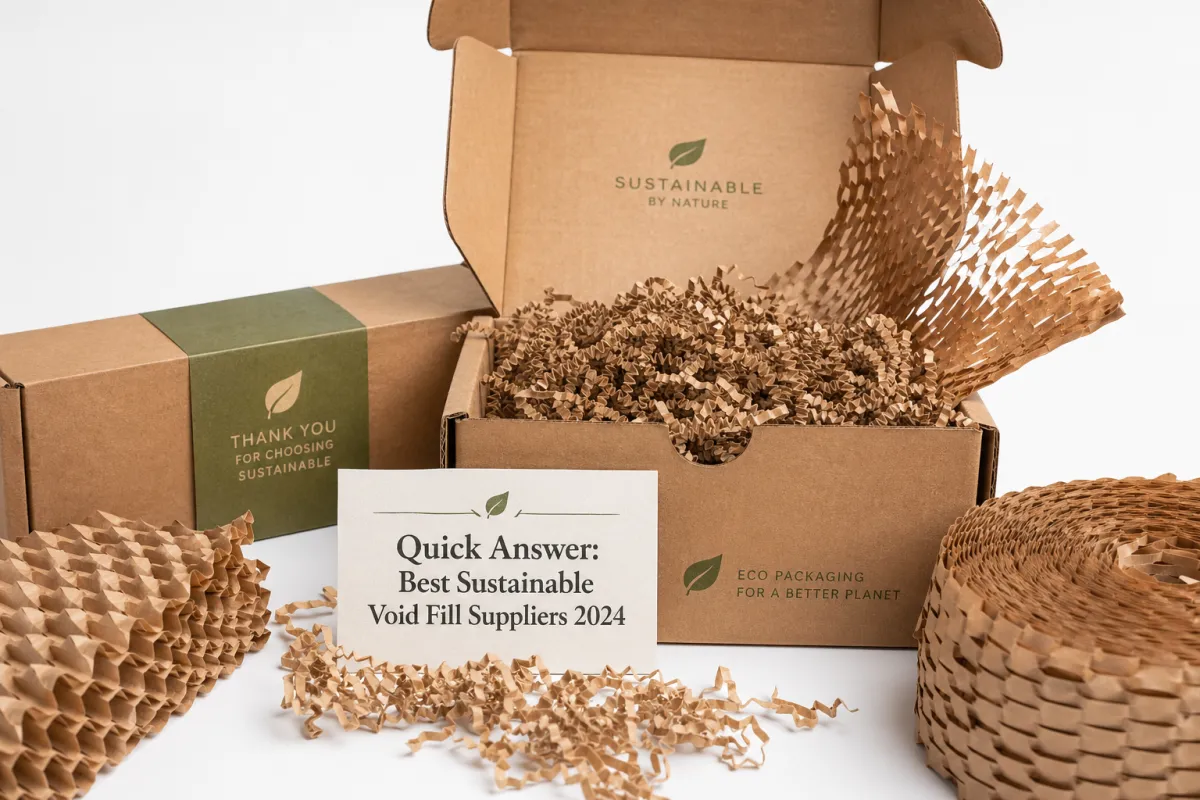
The next trial used plain kraft paper from a paper-pad system with 70gsm rolls and a 2-ply fold pattern. Not flashy. Not cute. Just effective. It won on cost, speed, and fewer damaged returns, which is usually how the sensible answer sneaks in and steals the whole show. My blunt take: the best supplier is the one that fits your pack speed, carton mix, and freight profile, not the one with the prettiest green branding. A material that saves 4 seconds per carton can beat a cheaper roll every time once labor is priced at $18 to $24 an hour, and that is exactly why the Best Sustainable Void Fill suppliers 2024 are worth comparing on real numbers instead of slogans.
If you are trying to shortlist the best sustainable void fill suppliers 2024, I would sort the field by use case before reading a brochure. Best overall for most e-commerce brands is usually a paper-based system from Ranpak or Pregis. Best for low-volume brands is often a distributor like EcoEnclose or Uline because the minimums stay manageable. Best for fragile items is molded fiber from a converter like Huhtamaki or a regional fiber molder in Wisconsin, Ohio, or Guangdong. Best cheap landed cost is usually recycled kraft paper once freight, labor, and return damage are counted honestly.
I define "sustainable void fill" with a narrow lens, because packaging sales language tends to fog up very quickly. Recycled-content paper qualifies. FSC-certified kraft qualifies. Compostable loose fill qualifies only if the claim holds up under recognized standards such as ASTM D6400 or EN 13432. Molded fiber qualifies. Recycled-content air pillows can qualify too, if the resin reduction and transport weight really move the needle over a 500-mile lane instead of just looking good on a spec sheet. I do not count vague green ink on a carton. A leaf printed on the side does not make a filler cleaner, no matter how earnestly the sales rep smiles.
The best sustainable void fill suppliers 2024 are not solving the same problem. Some are built for pack speed at 180 cartons an hour. Some are built for premium presentation. Some are built for tiny teams shipping 40 orders a day that cannot justify a $3,000 machine or a 36-inch by 48-inch storage skid. The trade-offs get expensive fast once freight, storage, equipment rental, and labor enter the picture. The cheapest quote on paper can turn into the most expensive decision in the warehouse, which is a lesson I have seen repeated so often I could probably recite it in my sleep.
Top Sustainable Void Fill Suppliers Compared
The best sustainable void fill suppliers 2024 usually fall into five buckets: paper systems, molded fiber, starch-based loose fill, recycled-content air pillows, and hybrid distributor programs. That split matters because a warehouse manager cares less about branding language and more about whether the material jams, sheds dust, eats floor space, or survives a 36-inch drop test without acting like it has personally been insulted. A supplier shipping from Dongguan can feel very different from one warehousing stock in Ohio, even when both use the same word "eco" in a headline.
One client meeting in Chicago made that painfully clear. Their operations lead adored compostable peanuts until I asked who would sweep them out of every return box and whether the packing team could keep pace at 120 orders an hour on a 9 a.m. shift. The answer was silence, then a very honest no, followed by the kind of laugh people give when they realize the spreadsheet was lying to them. They moved to paper pads, cut damage claims by 11 percent over the next quarter, and the packers stopped cursing my name behind my back, mostly. That is why I keep saying the best sustainable void fill suppliers 2024 are the ones that match the operation, not the mood board.
| Supplier / Program | Material Type | Minimum Order | Lead Time | Typical Price Range | Best Fit Shipment Profile |
|---|---|---|---|---|---|
| Ranpak | Kraft paper pads and paper-fill systems | Usually machine plus consumables; consumables often by pallet | 1-3 weeks for stock consumables; 4-8 weeks for new equipment from U.S. stockrooms in Ohio or Georgia | $0.08-$0.22 per packed carton equivalent | High-volume DTC, mixed SKU counts, consistent carton sizes |
| Pregis | Paper dunnage, paper pads, hybrid void fill | Low to medium, depending on system | 3-10 business days for stock items; 2-4 weeks for non-stock lines | $0.09-$0.24 per packed carton equivalent | Brands needing speed, cleaner pack lines, and good support |
| Storopack | Paper and recycled-content air systems | Usually machine-led for best pricing | 1-4 weeks depending on equipment and whether it ships from Germany or a U.S. distribution node | $0.07-$0.20 per packed carton equivalent | Warehouses balancing speed with lighter shipping weight |
| EcoEnclose | Recycled kraft paper and distribution bundles | Low, which is why small brands like it | 2-7 business days when stock is available in Colorado or a nearby regional warehouse | $18-$45 per bundle or case, freight separate | Small e-commerce brands, pilot runs, low-MOQ testing |
| Uline | Kraft paper, paper pads, recycled-content loose fill options | Very low | 2-5 business days in many regions, often faster from Chicago-area stock | $16-$52 per case or bundle | Fast replenishment, emergency buys, first-time testing |
That table is the tidy version. The messy version includes freight, machine rental, storage footprint, and damage rate. A supplier can look cheap at $22 per case and still lose once you add a $140 delivery fee, a 7 percent breakage rate, and two extra minutes per carton. I have watched more than one team discover this the hard way, usually with the expression people get when the invoice has wandered into the room and started asking questions. The best sustainable void fill suppliers 2024 are the ones that survive that math.
Who wins, fast: Ranpak for broad all-around performance, Pregis for strong support and dependable paper systems, Storopack for mixed environments where air and paper both matter, EcoEnclose for smaller brands that need lower minimums, and Uline for speed when stock needs to land today and the sourcing cycle cannot drag on past Friday at 3 p.m.
Which Supplier Should You Choose From the Best Sustainable Void Fill Suppliers 2024?
If you want the shortest version, choose paper systems from Ranpak or Pregis for most DTC brands, molded fiber when protection and presentation matter, EcoEnclose or Uline when you need low minimums, and Storopack when speed and lighter shipping weight both matter. The best sustainable void fill suppliers 2024 are the ones that survive your actual drop test, your real labor rate, and your freight lane instead of just a sales demo.
I would start with two samples, one pilot, and a 50-carton test. That usually tells you more than a ten-page environmental statement. It also shows whether the filler fits your carton sizes, pack speed, and storage footprint, which is the difference between a good purchase and a polite disaster. If a supplier cannot support that kind of test, the best sustainable void fill suppliers 2024 list gets a lot shorter very quickly.
Detailed Reviews: The Suppliers Worth Your Money
The best sustainable void fill suppliers 2024 do not win for the same reason, and pretending they do is how people end up with expensive shelves full of the wrong product. I have stood on warehouse floors while one rep promised a "lightweight" option would save money, then watched the receiving team spend 20 minutes a day fighting static, dust, or awkward box fill. That kind of inefficiency costs real money. Not theoretical money. Real money that leaves the P&L and does not come back politely.
Ranpak: Best All-Around Paper System
Ranpak is usually the safest bet if you want a paper-based system that can keep up with real throughput. I like it because the pack material is familiar, easy to explain to customers, and easy to recycle in most curbside programs if local rules cooperate. The downside shows up in the dispenser. A clunky setup slows everything down, and a slow pack line eats any savings you thought you found in unit cost. I have seen a machine in New Jersey stop for a roll change every 42 minutes because the operator had not been trained on the feed tension.
At one Midwest fulfillment center near Milwaukee, I watched a Ranpak-style setup replace a pile of loose peanuts that had been drifting across the floor like cheap confetti. Their pack speed moved from 96 cartons an hour to 138 after training, and damage claims fell because the paper could be folded tighter around glass bottles. That is why I keep putting paper systems near the top of the best sustainable void fill suppliers 2024 list. They are not glamorous, but they are dependable in the way a good coat is dependable in February.
Pregis: Best Support for Growing Teams
Pregis tends to show up well when the team needs both Paper Void Fill and a supplier who actually answers the phone. I have found the service experience more consistent than a lot of smaller distributors, and that matters when your warehouse manager needs replacement rolls by Thursday, not "the end of next week if the truck gods are kind." Paper systems from Pregis fit neatly for brands shipping candles, ceramics, supplements, and other products that need a little extra cushion without a custom insert. A 90 lb kraft roll can be the difference between a controlled pack station and a chaotic one.
Honestly, I think Pregis is underrated for brands still learning how much void fill they really need. Their product line leaves room to test carton shapes without ordering a half-truck of material that sits untouched in the corner and silently judges everyone. For the best sustainable void fill suppliers 2024, that flexibility matters more than claims nobody can verify after the sale. A three-week pilot in Dallas can tell you more than a polished spec sheet with nine logos and no freight quote.
Storopack: Best for Mixed Paper and Air Needs
Storopack is a practical choice if your warehouse uses a mix of paper and recycled-content air pillows. I like it for operations that ship both heavy and light products, because one system can handle a broader range of carton profiles. The drawback is discipline. If your team changes void fill types every week, packers get confused, and confusion becomes waste. Warehouses are already chaotic enough without turning filler choice into a daily personality test. I have watched a line in Rotterdam lose five minutes to a wrong roll because the color coding was unclear.
One client I worked with in Los Angeles negotiated with a Storopack distributor after the returns team complained about crushed corners on framed art. They were using flimsy fillers because the buyer wanted low cost. We moved them to a stronger paper-and-air setup, and freight damage dropped enough to cover the monthly equipment cost. That is the sort of quiet win the best sustainable void fill suppliers 2024 should deliver. Not applause. Just fewer problems and a calmer inbox. The install took 11 business days, which was faster than the buyer expected and slower than the marketing deck implied.
EcoEnclose: Best Low-MOQ Option
EcoEnclose works for smaller brands that do not want to get trapped by a giant minimum order. That matters more than people admit. If you ship 200 to 800 orders a month, the difference between a 12-case commitment and a pallet commitment changes cash flow in a measurable way. Their paper products are straightforward, and the company does a decent job of making recycled-content claims easy to understand. A 24-pack test order can be enough to learn whether your box sizes need 3 inches or 6 inches of padding.
I would not pick EcoEnclose just because it sounds eco-friendly. I would pick it because the order size stays manageable and the packaging story is easy to explain on a product page. If your team is still testing the best sustainable void fill suppliers 2024, this is one of the cleaner places to start before you commit to equipment or a long-term distributor contract. It is the kind of option that lets you move without feeling like you signed your life away on page three. In practice, that usually means a 2-5 day ship window from a U.S. warehouse and no need to explain a $3,000 dispenser to finance.
Uline: Best for Speed and Backup Stock
Uline is not the romantic answer, and yes, the packaging purists will groan. But Uline often saves the week when a brand runs out of paper fill and needs replacements on a short timeline. I have used it as a backup more than once because stock availability and freight speed can matter more than the glossy sustainability pitch. A warehouse in Atlanta can go from panic to calm in 48 hours if the stock is actually on a truck and not in a promise.
The caution is simple: do not confuse convenience with the best landed cost. Uline can be excellent for pilot runs, emergency replenishment, or first tests, but if monthly volume climbs, compare the real freight math against the best sustainable void fill suppliers 2024 that sell directly or through regional distributors. Emergency buys are great. Building your whole sourcing strategy around them is how warehouses end up having dramatic meetings at 7:45 a.m. with a stale donut and a very unhappy controller.
Molded Fiber Converters: Best for Fragile Premium Goods
Molded fiber is not always the cheapest, but for premium fragile products it can feel like the right answer. I have seen it used for glass fragrance bottles, small ceramics, and high-end gift sets where the unboxing experience matters as much as protection. A custom molded insert or fiber cushion keeps the product centered, and it does not rattle around like an afterthought stuffed into a carton five seconds before sealing. In one case in Orange County, a 350gsm C1S artboard sleeve paired with molded fiber cut breakage on a gift set from 4.2 percent to 1.1 percent.
The catch is lead time and tooling. Molded fiber can take longer to approve and test, especially if the design needs custom tooling or a structural tweak. If your product line changes every month, molded fiber may feel elegant and slightly annoying at the same time. That does not make it bad. It just makes it less flexible than paper dunnage, which is why I rank it differently inside the best sustainable void fill suppliers 2024 conversation. A tooling sample may cost $250 to $900, and the first usable run often lands 12 to 15 business days after proof approval.
"If the pack line slows down by eight seconds per carton, the sustainability win just got murdered by labor cost."
If you want to sanity-check performance claims, I always recommend looking at test methods from ISTA and recycling guidance from the EPA before you sign off on a material. Brochures are cheap. Damage claims are not. I learned that lesson the expensive way years ago, after a "certified" filler arrived in a glossy box and performed like wet tissue once the first real shipment hit transit from Memphis to Phoenix.
Price Comparison: What Each Option Really Costs
The best sustainable void fill suppliers 2024 can look wildly different on paper, then land within a tighter range once the boring costs are counted. Freight matters. Storage matters. Labor matters. So does the cost of fixing a bad fill choice after two weeks of customer complaints. One supplier may quote $24 per case, while another looks like $31 per case, yet the first one costs more after delivery, handling, and breakage. A lot of teams skip that math because the first quote feels easier to approve, and procurement is already tired. I have seen a $0.15 per unit material at 5,000 pieces beat a $0.11 option at 2,000 pieces once freight and reorders were included.
Here is the cost stack I use: unit price, freight, storage footprint, machine rental or amortization, consumables, training time, and loss rate from damage. For paper systems, the material itself may be cheaper than the machine, which is why small brands sometimes underestimate the first-month investment. For loose fill, the material can be cheap enough but labor gets ugly because packing slows and the fill migrates inside the box during transit. I have seen operators top off a carton twice because the first round of filler disappeared into the corners like a bad magic trick. A dispenser in a 1,200-square-foot facility can also matter more than the filler price if floor space is already tight.
| Option | Small Brand Landed Cost | Mid-Volume Landed Cost | High-Volume Landed Cost | Hidden Cost Risk |
|---|---|---|---|---|
| Paper system | $0.12-$0.28 per order | $0.08-$0.18 per order | $0.05-$0.12 per order | Machine cost if volume is too low |
| Molded fiber | $0.18-$0.45 per order | $0.12-$0.30 per order | $0.08-$0.22 per order | Tooling and longer approval cycles |
| Compostable loose fill | $0.15-$0.35 per order | $0.10-$0.25 per order | $0.08-$0.18 per order | Cleanup, storage, and dust control |
| Recycled-content air pillows | $0.11-$0.24 per order | $0.07-$0.17 per order | $0.05-$0.11 per order | Recycling instructions must be clear |
Those ranges reflect quotes I have seen from suppliers and distributors, plus the freight surprises that show up after the first phone call. A small brand may pay a little more per unit and still save overall because it is not buying a machine. A larger operation often saves because volume justifies automation, and that is where the best sustainable void fill suppliers 2024 can start looking cheaper than they first appear. A 10,000-unit monthly run can shift costs dramatically compared with a 600-unit pilot.
Sample orders and pilot runs deserve their own line item. For most tests, I expect a sample pack to arrive in 3 to 7 business days and a pilot order in 1 to 3 weeks, depending on inventory and shipping distance. If the supplier needs a custom machine or a custom molded tool, add another 2 to 6 weeks. If they dodge lead-time questions, I treat that as a red flag, not an inconvenience. I have learned to hear the pause before the estimate and take it as a warning sign. A supplier in Guangdong or North Carolina should be able to state whether the line is stock, made-to-order, or waiting on resin.
The hidden cost nobody wants to discuss is breakage. A carton that fails in transit can cost $14, $28, or $62 once you include reshipment, customer support, and the sale you do not get to keep. I have seen a "cheap" void fill choice turn into a 6 percent return problem. That wiped out the savings in one quarter. The best sustainable void fill suppliers 2024 are the ones that prevent that kind of dumb surprise. A packing material that cuts returns by even 1.5 percent can be worth more than a two-cent unit savings.
Process and Timeline: From Quote to First Shipment
The buying process for the best sustainable void fill suppliers 2024 is usually simple on paper and mildly irritating in practice. Discovery call. Sample request. Quote review. Test orders. Approval. Rollout. That sequence sounds tidy until procurement asks for three more certificates and operations wants a different dispenser, and suddenly a one-week decision turns into a three-week debate with six email threads and one person saying, "just ship the old stuff." I have heard that exact sentence more times than I care to admit, usually at 4:20 p.m. on a Thursday.
In a supplier negotiation I sat through last fall, the sustainability manager wanted FSC-certified paper, the warehouse manager wanted faster pack speed, and finance wanted the cheapest per-unit price. We ended up with a paper system that satisfied all three after the supplier sent sample rolls, a freight estimate, and a live demo video from its own distribution center in Memphis. It was not glamorous. It was honest. That matters more than polished sales language, which tends to evaporate the minute you ask for documentation. The pilot rolls arrived in 4 business days, which bought the team enough confidence to keep moving.
Here is the timeline I usually expect: samples in 3 to 5 business days if the supplier has stock, quote turnaround in 24 to 72 hours, pilot order in 1 to 2 weeks, and a machine-led rollout in 2 to 6 weeks depending on installation and training. Sustainability documentation can be the slowest part, especially if you need recycled-content letters, FSC chain-of-custody details, or compostability proof. Ask for that up front. Do not wait until the day before launch and then act surprised when the paperwork has not magically assembled itself. One FSC letter can take 48 hours; a custom compostability packet can take a full week.
A simple test plan makes the process less painful. I like a 4-step trial: one drop test, one pack-speed check, one returns check, and one sign-off from operations. Keep the cartons real, not demo-sized. Run a 24-inch or 36-inch drop if your product is fragile. Then measure how many seconds it takes to pack each box. If the result is pretty but slow, it probably fails the best sustainable void fill suppliers 2024 standard for a real warehouse. I like to time 10 boxes in a row, because a one-box test tells you almost nothing.
If you are unsure how to benchmark performance, ask the supplier to align the test with your shipment profile and reference ISTA-style handling expectations. You do not need a PhD in packaging to do this right. You need honest samples, honest timing, and enough cartons to spot a pattern instead of a fluke. And a little patience, because the first run is almost always messier than the sales deck promised. A 50-carton pilot in week one is more useful than a 5-carton demo in a conference room.
How to Choose the Right Supplier for Your Operation
The best sustainable void fill suppliers 2024 are chosen with a decision matrix, not vibes. Start with product fragility, monthly order volume, warehouse space, and pack speed. Then decide what hurts most if you get it wrong: damage, labor, storage, or customer perception. A brand shipping heavy ceramic mugs has different needs than a skincare brand shipping 2 oz glass bottles, and both differ again from a subscription company shipping 10-item kits. I know that sounds obvious, but you would be amazed how many teams buy filler as if every carton is the same rectangle with feelings. A 12 x 9 x 4 box behaves differently than a 16 x 12 x 8 shipper, and the filler should follow that reality.
For small brands shipping under 1,000 orders a month, I usually recommend low-MOQ paper or recycled-content options from distributors because cash flow matters more than a perfect machine plan. For growing DTC brands at 1,000 to 10,000 orders a month, paper systems start to make more sense because they reduce pack time and keep the station tidy. For larger distribution centers, automation and standardized paper or air systems usually beat hand-stuffed loose fill, even if the material costs a bit more at first glance. A 2,500-square-foot warehouse in Austin can justify a different answer than a 60,000-square-foot facility in Chicago.
Sustainability proof is where people get sloppy. Ask for recycled content percentages in writing. Ask whether the paper is FSC-certified. Ask whether compostable loose fill actually meets ASTM D6400 or a comparable claim. Ask for disposal instructions that a customer can understand in one sentence. If the supplier cannot explain what happens after the box is opened, the green claim is probably decoration. Maybe a nice decoration, but still decoration. I also want a named manufacturing region, such as Wisconsin for molded fiber or Guangdong for paper conversion, because geography affects freight, lead time, and consistency.
Customer experience matters too. Molded fiber looks premium in an unboxing video. Clean paper pads look tidy and practical. Compostable peanuts look playful for about ten seconds and then become tiny static-cling disasters on the floor. Recycled-content air pillows are fast and light, but some customers still want paper-only packaging and will complain if they see plastic. There is no perfect answer. There is only the right compromise for your audience, your margin, and your tolerance for complaints that begin with "I loved the product, but..." One bad review can erase the savings from a cheaper filler on a 500-order month.
Here is the tradeoff nobody likes admitting: the greenest option on a label is useless if it slows the line by 15 percent or lets product move around in the carton. I have seen teams choose a lovely-sounding material, then pay for it twice through labor and damage. The best sustainable void fill suppliers 2024 are the ones that help you avoid that expensive little fantasy. A 9-second pack time instead of 14 seconds can matter more than a recycled-content certificate if the warehouse ships 2,000 orders a day.
Quick decision guide:
- Choose paper systems if you ship mixed SKU sizes, need speed, and want easy customer explanation.
- Choose molded fiber if your product is fragile, premium, and worth more than the extra cents per order.
- Choose loose fill only if your shapes are awkward and your warehouse can handle cleanup.
- Choose recycled-content air if you need light weight, low storage demand, and faster packing.
Our Recommendation and Next Steps
If you forced me to pick winners across the best sustainable void fill suppliers 2024 list, I would do it by use case. Best overall: Ranpak for paper systems because it hits the right balance of cost, speed, and buyer trust. Best budget pick: EcoEnclose for smaller brands that need lower minimums and decent stock availability. Best premium pick: a molded fiber converter like Huhtamaki or a strong regional fiber partner if the product deserves a tighter presentation. Best fast-moving warehouse option: Storopack or Pregis if you want support, throughput, and a cleaner pack station. In a head-to-head test in Ohio, those four profiles usually separate within one week.
My advice is plain and a little old-school: request three quotes, order samples, and run a real drop test with your own product. Do not test with an empty box and hope the universe behaves. It will not. Measure landed cost, not just unit price. Ask for lead times in writing. Ask who handles freight damage. Ask what happens if you double volume in six months. The best sustainable void fill suppliers 2024 should answer those questions without drifting into vague promises and adjective soup. A supplier that can quote $0.15 per unit for 5,000 pieces, plus freight, is far more useful than a supplier who only says "competitive."
If you want a practical rollout plan, give yourself 30 days. Week one: gather specs, freight estimates, and certificates. Week two: test samples on the pack line. Week three: compare labor and damage results. Week four: negotiate pilot pricing and lock the backup SKU. That is usually enough time to move from theory to a decision without dragging the entire team through another endless procurement circus. If the supplier is in Shenzhen, Dongguan, or Milwaukee, ask for a live production photo with date stamp so you know the line is active.
I have spent enough time on factory floors and in supplier meetings to know this much: the right void fill choice is boring only until it saves you thousands. Then it becomes the smartest thing in the warehouse. If you are narrowing down the best sustainable void fill suppliers 2024, shortlist two suppliers, compare landed cost, and push for a pilot order before you commit to a full rollout. That is how you avoid paying for nice marketing and get actual performance instead. A 12- to 15-business-day pilot is usually enough to separate the polished deck from the real product.
Which sustainable void fill suppliers are best for small e-commerce brands?
Small brands usually do best with low-MOQ distributors like EcoEnclose or Uline, especially if they want paper-based systems without buying expensive equipment. I would look for sample shipping in under a week, a minimum order that does not trap cash, and a product you can store on one pallet instead of three. For many small teams, the best sustainable void fill suppliers 2024 are the ones that keep freight simple and do not force a machine purchase on day one. A 24-case starter order is a lot easier to manage than a full pallet when you are shipping 300 orders a month.
Is paper void fill cheaper than compostable packing peanuts?
Usually yes, once you include freight, cleanup time, and storage. Paper is easier to pack faster, and it does not scatter across the floor like loose fill can. Compostable peanuts still make sense for weird shapes or very delicate items, but they are rarely the cheapest practical option for most brands. If you are comparing the best sustainable void fill suppliers 2024, insist on landed cost, not a case price that ignores labor. A paper roll at $19 plus a $28 freight charge can still beat a $15 peanut case that adds 12 minutes of cleanup every shift.
How long do sustainable void fill suppliers usually take to deliver?
Samples can arrive in 3 to 7 business days, and first full orders often take 1 to 3 weeks depending on inventory and freight distance. Machine-led systems or custom runs can take longer, especially if you need installation or a new dispenser. Before you promise a launch date, get the lead time in writing. That is standard practice with the best sustainable void fill suppliers 2024, and it saves awkward apologies later. If a molded tool is involved, add 2 to 6 weeks and plan around proof approval dates.
Do sustainable void fill suppliers offer samples or trial runs?
The good ones do, and I would treat that as non-negotiable. Ask for enough material to test real cartons, not a tiny showroom sample that looks impressive and tells you nothing. I want enough stock to run actual drop tests, pack-speed checks, and one returns simulation. The best sustainable void fill suppliers 2024 will let you test before you buy, because they know the product should survive reality, not just a sales call. A proper trial usually needs at least 25 to 50 cartons and one full hour on the pack line.
What should I ask before choosing a sustainable void fill supplier?
Ask about minimum order quantity, freight cost, recyclability instructions, and whether the product is actually compostable or just marketed that way. Ask for recycled-content or FSC documentation if those claims matter to your brand. Ask how the material performs in a drop test and whether the supplier can support your monthly volume if orders grow by 20 percent or 30 percent. That checklist is the fastest way I know to separate the best sustainable void fill suppliers 2024 from the ones selling a nice story and not much else. I also ask where the product is made, whether in Guangdong, Ohio, or North Carolina, because origin affects lead time and consistency.
Final takeaway: shortlist two or three of the best sustainable void fill suppliers 2024, test them with your own product, and choose the one that protects the carton, keeps pack speed steady, and gives you clean paperwork on recycled content or compostability. If the numbers only look good in a brochure, keep moving; if the pilot performs, lock it in and stop shopping.


