Buyer Fit Snapshot
| Best fit | Order Custom Recycled Foil Labels for Sustainable Branding projects where brand print, material claims, artwork control, MOQ, and repeat-order consistency need to be specified before quoting. |
|---|---|
| Quote inputs | Share finished size, material target, print colors, finish, packing count, annual reorder estimate, ship-to region, and any compliance wording. |
| Proofing check | Approve dieline scale, logo placement, barcode or warning zones, color tolerance, closure strength, and carton packing before bulk production. |
| Main risk | Vague material claims, crowded artwork, missing packing details, or unclear freight terms can make a low unit price expensive after revisions. |
Fast answer: Order Custom Recycled Foil Labels for Sustainable Branding should be specified like a repeatable production item. The safest quote records material, print method, finish, artwork proof, packing count, and reorder notes in one written spec.
Production checks before approval
Compare the actual filled-product size with the drawing, then confirm tolerance on folds, seals, hang holes, label areas, and retail display edges. Reserve space for logos, QR codes, warning copy, and material claims before decorative graphics fill the panel.
Quote comparison points
Review material grade, print process, finish, sampling route, tooling charges, carton quantity, and freight assumptions side by side. A quote is only useful when the supplier can repeat the same color, closure quality, and packing count on the next order.
Why Brands Order Custom Recycled Foil Labels
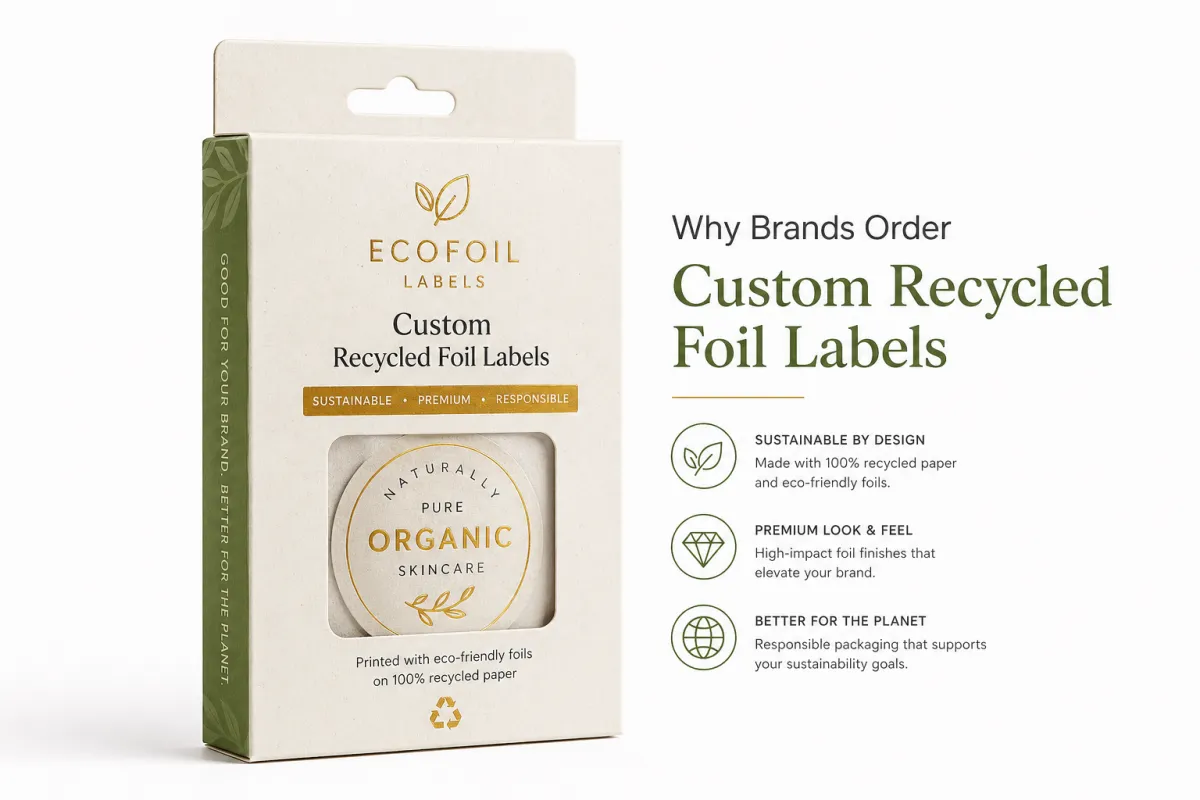
A serum launch on a 50 mL amber glass bottle still sticks in my mind. The marketing team wanted metallic impact, the sustainability lead wanted post-consumer recycled content, and the co-packer needed labels that would hold at 38% humidity on a line running 90 bottles per minute. That mix of demands is exactly why brands order custom recycled foil labels: the pack has to look expensive from four feet away, tell a cleaner materials story, and survive real production conditions without forcing a redesign. I remember thinking, "Well, that's a tidy little impossible brief." Then we solved it by specifying a recycled paper face stock, a cold-chain-safe adhesive, and a 2.5 inch round format instead of debating mood-board adjectives for half a day.
Specialty food lines face the same tension, just with a different price target. I visited a pesto producer in New Jersey using 12-ounce glass jars, kraft shippers, and a retail buyer who wanted a $9.99 shelf price to hold through the quarter. The team did not need novelty; they needed a label that could support 120 units per minute, fit a 1.75 inch wrap panel, and explain why the brand chose recycled face stock plus a permanent acrylic adhesive rated for chilled storage. That is the practical reason companies order custom recycled foil labels: shelf presence, sustainability credibility, and premium appeal without rebuilding the entire package. Honestly, it is one of those packaging decisions that looks simple until the first proof lands in your inbox at 6:14 p.m.
The word "foil" causes confusion because it sounds flashy, and flashy gets mistaken for wasteful. The material story is more technical than that. Recycled paper, recycled film, metallic effect, adhesive chemistry, liner choice, line speed, container surface, and the recycling claim all matter. Anyone who order custom recycled foil labels without thinking through those variables is not buying a style decision; they are buying a construction that can either support or weaken the whole package. I have seen brands fall in love with the shine and ignore the fact that a label still has to peel, stick, and stay put on a bottle stored at 42 degrees Fahrenheit. The mood board does not care about that part, but the warehouse absolutely does.
For brands investing in branded packaging and tighter package branding, recycled foil labels often solve a stubborn problem. A small brand can look established without jumping to a heavy carton, a laminated wrap, or a fully Custom Printed Box on every unit. Candles, vitamins, beauty oils, and small-batch sauces benefit most, because the label is carrying nearly all of the visual load while the container quietly does the rest. That contrast matters. A 2-inch label with a brushed silver accent can do the branding work of a much larger structure if the finish is disciplined and the die line is clean to within 1 mm.
Budget pressure keeps the format relevant, too. A line with six to ten SKUs needs repeatability as much as it needs a good first mockup. The teams that order custom recycled foil labels usually want the same sheen, the same die shape, the same adhesive hold, and the same finished look quarter after quarter. That is a production decision first and a design decision second. I have watched procurement teams pretend otherwise, and it usually ends the same way: somebody asks why SKU 4 from the October run looks like it came from another plant in another province.
"We did not want the jar to look cheap, and we did not want to defend a material choice that felt lazy. The recycled foil label gave us both the presentation and the talking points." That came from a procurement manager on a cosmetics run with 18,000 units packed in 6-ounce glass jars, and I have heard some version of it more than a dozen times.
What You Get When You Order Custom Recycled Foil Labels
Most builds start with a recycled paper or recycled film face stock, then add the metallic effect through foil stamping, digital foil, or a printed metallic layer depending on the press and the run size. A common entry point is 350gsm C1S artboard for cartons or heavyweight label stock for premium jars, paired with a pressure-sensitive adhesive selected for the container surface. The liner comes next; that might be glassine or PET release liner based on whether the labels will be hand-applied or run through an applicator. Rolls add another layer of detail, because core size, wound direction, and gap spacing matter just as much as the artwork when you order custom recycled foil labels. I have lost count of how many projects stalled because someone said, "We'll figure the roll format out later." That phrase usually turns into a 3 p.m. production scramble.
Finish is where the label starts to earn its keep. Bright mirror foil can make a fragrance bottle pop under retail lighting in Chicago or Singapore, while a brushed metal effect feels quieter on a craft coffee tin in Portland or Bristol. Spot foil accents are often the smartest route for brands that want to order custom recycled foil labels without blanketing the entire face in metallic coverage. I have seen spot foil used on logos, borders, and single product claims, and it usually preserves more of the recycled look while still adding lift. My bias? Spot foil often looks more expensive than full coverage, because restraint reads as confidence, especially on 4-inch oval labels.
Matte overlaminates, soft-touch coatings, and clear windows show up often in these builds. A matte finish can cut glare on dark amber bottles under a 4,000K retail light bank. A clear design window can let the recycled face stock show through in a way that feels direct rather than overworked. Compared with Custom Printed Boxes or other retail packaging elements, the label is often the quickest way to test a premium look without changing the whole pack structure. If a brand wants to test a new visual direction before committing to 20,000 cartons, the label is usually the least painful place to start.
Glass jars, aluminum tins, rigid cartons, flexible pouches, mailers, and seasonal kits tend to work best. I have seen strong results on candle jars with 3.5 inch round labels, on tincture bottles with narrow 1 inch wraps, and on holiday gift packs where a label had to do more branding work in 4 square inches than many cartons do in 40. Brands building multiple sizes can use labels to keep the family look tight while simplifying the larger product packaging system. That matters a lot in fast-growing catalogs, where consistency is doing half the selling and the other half is repeatability across 3 or 4 SKUs.
Substrate behavior gets underestimated all the time. Glass gives you a clean, stable surface. Coated cardboard behaves differently. Recycled plastic can carry light texture, and paperboard may show fiber lift or dust that affects bond strength if the adhesive is too weak. That is why it helps to order custom recycled foil labels with the actual container in mind, not just the art file. A good supplier will ask for the jar diameter, bottle curvature, container temperature, or a photo of the carton finish before recommending a construction. If they do not ask, I get suspicious. A little skepticism has saved me from a lot of ugly reprint conversations.
- Best for visual impact: mirror foil on smooth glass, 2-color art, 1 logo hit
- Best for a softer premium feel: brushed foil on recycled paper, matte overlaminate, 1 spot accent
- Best for mixed-use lines: spot foil on recycled film, permanent adhesive, roll format for applicators
Specifications That Affect Print Quality and Performance
Some projects slide forward cleanly while others stall, and the artwork is rarely the real culprit. The spec sheet usually is. Before you order custom recycled foil labels, know the finished size, corner radius, bleed, core size, roll diameter, roll direction, and whether the labels need to dispense on an applicator or peel by hand. A 2.25 inch by 3.5 inch label for a hand-applied carton is a very different job from a 1 inch by 4 inch label for a semi-automatic bottle line. I wish more teams treated specs like ingredients rather than decoration; the result would be fewer frantic emails and fewer "why does it not fit?" moments.
Adhesion needs to match the environment instead of being guessed from a catalog. Chilled products that sit at 34 to 40 degrees Fahrenheit need an adhesive proven in cold, slightly damp conditions. Hand-applied cartons that live in a dry warehouse may do fine with a standard permanent acrylic. Products that need clean removal later, such as a promotional sleeve or temporary test run, are better served by a removable adhesive. If you are going to order custom recycled foil labels for a freezer or a humid room, ask for a spec review before anyone signs off on the proof. I remember one frozen beverage run where the label looked pristine on the desk and then curled like a potato chip in the cold room at -2 degrees Celsius. Not ideal. Nobody likes discovering material science by accident.
Artwork resolution matters more than most buyers expect. I like to see 300 dpi on raster files, vector outlines for logo marks, and a foil layer separated cleanly from any printed color. If foil has to register within 0.5 mm on a narrow border, the proof should show it. Pantone matching should be listed by number, not by description, because "dark green" on one monitor rarely matches "dark green" on a press sheet from Dongguan or Guadalajara. Teams that order custom recycled foil labels without those details often discover the mismatch only after the first articles arrive. And then everyone starts speaking in that too-calm voice that means the panic is real.
Durability is another practical test. A label can look perfect in a conference room and still fail after 72 hours of ice-bucket condensation, carton rubbing in transit, or repeated handling at retail. That is where compliance standards and test protocols matter. If shipping abuse is a concern, the general principles behind ISTA package testing standards are worth reviewing; if your sustainability team wants to understand paper sourcing, FSC chain-of-custody guidance is a useful reference point. Neither one chooses your label for you, but both help you ask better questions when you order custom recycled foil labels. And better questions save money. Usually a lot of money, especially on a 10,000-piece reprint.
A 10-minute proof review can save a 10,000-piece correction. I have watched a cosmetics brand lose three days because the roll wound direction was reversed for the applicator head, and I have seen a sauce company catch a foil alignment issue because the proof showed the cap line crossing the logo by 1.5 mm. Good spec discipline protects both the label and the launch schedule. It also protects sanity, which deserves a line item of its own if you ask me, right next to shipping and VAT.
For a wider packaging system, it helps to compare the label with other package elements such as Custom Labels & Tags and Custom Packaging Products. That broader view matters when the label sits inside a larger branding packaging program that includes outer cartons, inserts, and shipper graphics. If the label is doing all the work while the rest of the system tells a different story, the whole thing feels off. Customers may not say that out loud, but they feel it the moment they put a 6-ounce bottle next to a 500 mL carton on the shelf.
Pricing, MOQ, and What Changes the Quote
Price is where buyers tend to overcomplicate the conversation or flatten it until the details disappear. When you order custom recycled foil labels, the quote is usually driven by five main variables: size, stock, foil coverage, color count, and finishing complexity. A 2 inch circular label on recycled paper with a single foil logo is not priced the same as a 4 inch die-cut label with full-bleed metallic accents, a soft-touch laminate, and a special varnish pass. That sounds obvious, yet I still see teams compare quotes as if all labels were made by the same machine under the same moonlight.
Minimum order quantity depends on setup time, press efficiency, and material yield. A short run of 1,000 pieces makes sense for a launch sample or a limited holiday drop, but the unit cost climbs because the die, plates, proofing, and finishing steps are spread across fewer pieces. Once the order reaches 5,000 or 10,000 pieces, the economics usually improve enough to justify a more durable stock. That is why many buyers order custom recycled foil labels first as a test run and then scale into a larger reorder once the container and artwork are locked. In my experience, the smartest teams treat MOQ like a risk tool, not a punishment.
To make the price structure easier to read, I usually break it into practical tiers instead of vague language. The numbers below reflect common production scenarios, and actual quotes will shift with the exact spec, but they give you a grounded starting point before you order custom recycled foil labels. For a standard 2.5 inch round recycled paper label with one foil logo and permanent adhesive, a quote of $0.15 per unit for 5,000 pieces is realistic in many production regions, while a 10,000-piece reorder can dip closer to $0.11 per unit if the artwork and die stay unchanged.
| Option | Typical Use | Example Unit Price at 5,000 | Notes |
|---|---|---|---|
| Recycled paper + single foil accent | Candles, wellness jars, specialty food | $0.15 to $0.22 | Common on 2.5 inch or 3 inch labels with one metallic logo hit |
| Recycled paper + full foil coverage | Gift sets, premium seasonal runs | $0.23 to $0.35 | Higher foil coverage increases material and finishing cost by 18% to 30% |
| Recycled film + spot foil | Moisture-prone bottles, bath products | $0.21 to $0.30 | Better for humidity, with PET or recycled film face stock for wash-down areas |
| Matte laminate + foil detail | Retail packaging, premium e-commerce packs | $0.25 to $0.38 | Extra finishing step improves scuff resistance during transit on 1,500 to 3,000 mile shipments |
Hidden costs catch procurement teams off guard. A custom die may add a one-time charge of $65 to $180, and intricate shapes often take longer to approve. Special proofing, split shipments, warehouse labeling, kitting into 50-piece bundles, and rush production can all move the number. I have seen a buyer obsess over a low piece price, then spend more on logistics than on the labels themselves because the shipment had to be split into three drops across two fulfillment centers in Ohio and Nevada. That is why I always ask about the full order picture before someone decides to order custom recycled foil labels. It is not glamorous work, but it beats the alternative.
The cheapest quote is not always the best quote. If one supplier is 12% lower but cannot hold foil registration within 1 mm, the savings disappear the moment 300 labels need to be scrapped. A slightly higher quote with clear material notes, a clean proof, and a line-item explanation is easier to trust than a vague number that turns into change orders. I would rather pay a little more up front than explain a reprint to a sales team that already promised launch photos to a retailer in Atlanta or Toronto.
Order Custom Recycled Foil Labels: Process and Timeline
The process often starts with a quote request, but the best projects begin with a complete spec packet. When you order custom recycled foil labels, send the label size, quantity, container material, desired finish, adhesive preference, and target delivery date. If the labels will be machine-applied, include the applicator model or at least the roll core and unwind direction. That single detail has saved me from two production delays in the past year alone. I know that sounds dramatic for a label detail, but production is full of tiny traps dressed up as minor clerical issues.
From there, the supplier should recommend a construction and issue a proof. That proof should do more than confirm spelling. Check the dieline placement, the foil mask, the artwork safe zone, the barcode if there is one, and the roll orientation if the job will run on a labeler. I have seen a buyer approve a proof after checking only color, then discover that the logo sat too close to the seam line on a tapered bottle. If you order custom recycled foil labels for a tapered or curved surface, the proof is where that problem gets caught, not the warehouse. Once it reaches the warehouse, the mood shifts from "review" to "why is everyone so quiet?"
Typical timing runs 12 to 15 business days from proof approval for a standard job, with rush work sometimes moving in 7 to 9 business days if the materials are in stock and the artwork is clean. That window stretches when the project needs a custom die, a specialty foil, or a new adhesive that has to be tested. In practice, artwork is usually the fastest part, while approval loops slow the schedule. Brands that order custom recycled foil labels successfully usually keep one person responsible for final signoff so the project does not bounce between marketing, compliance, and operations for a week. I have seen a single missing signature turn into a week-long scavenger hunt, and frankly, no one needs that sort of excitement.
Quality control should not be vague. A solid production run includes registration checks, adhesive pull tests, roll winding inspection, and a final packout review before shipment. If the order is going to a filler in another state or a co-packer in another country, ask for photos of the finished rolls or cartons before they leave the facility. I once saw a rush order from our Shenzhen facility held for 48 hours because the packout team found a winding issue on the third roll, and fixing it on the floor was far cheaper than fixing it at the customer site. That is the kind of detail that matters when you order custom recycled foil labels. It is also the sort of unglamorous fix that saves everyone from a very public headache.
A simple timeline model helps most buyers:
- Day 1-2: Send specs, artwork, and reference samples.
- Day 3-4: Receive quote and construction recommendation.
- Day 5-7: Review proof, adjust copy, confirm finishes.
- Day 8-15: Production, inspection, and packout.
- Day 16+: Transit, receiving, and line-ready storage.
Why Choose Us for Sustainable Packaging Labels
Most buyers want more than print capacity. They want a partner who understands how a label behaves on a filling line, in a warehouse, and in a buyer presentation. Our experience with recycled stocks, foil effects, and adhesive selection matters because those choices affect performance. If you need to order custom recycled foil labels, we help match the material to the container, the surface energy, and the application method so you do not end up with a label that looks good in a PDF and fails on glass at 90 bottles per minute. That mismatch happens more often than people admit, and it is usually avoidable.
Consistency matters just as much as the first run. I have stood on enough packaging floors to know that a strong sample means very little if the second lot drifts in color or the foil tone shifts from warm silver to cool silver. Brands that reorder often need lot-to-lot repeatability, especially if the same label runs across three facilities or multiple co-packers in Michigan, Texas, and North Carolina. That is why we keep a tight handle on material specs, run notes, and finishing details when customers order custom recycled foil labels for ongoing programs. It is not fancy, just disciplined. And disciplined packaging usually wins over flashy packaging that misbehaves.
Documentation saves time in places buyers do not always expect. Procurement teams, sustainability managers, and compliance reviewers ask different questions, and those questions are easier to answer when the label spec is clear. If your brand needs to explain recycled content, adhesive choice, or FSC-related paper sourcing, we can help you assemble the facts in a practical way instead of a promotional one. If your broader rollout includes boxes, mailers, or inserts, our Custom Packaging Products page is a useful place to compare the rest of the system, and our Wholesale Programs can support higher-volume branded packaging needs with batch sizes of 2,500 units or more.
Speed matters too. When a customer sends us a dieline, a quantity, and one sample photo, we can usually spot problems before they turn into corrections. That lowers risk on the front end and shortens the path from sample to production for both smaller launches and established brands that want to order custom recycled foil labels on a repeat schedule. I would rather answer three practical questions early than fix one expensive mistake later. That is not just a preference; it is a survival strategy for packaging launches that can move from signoff to ship date in 15 business days.
For brands building wider shelf presence, label work should fit with custom printed boxes, shipper graphics, and insertion cards instead of fighting them. Strong retail packaging systems feel aligned: the label, the box, and the outer carton all speak the same visual language, even when each piece uses different materials. That kind of coordination is where technical packaging guidance pays off, because you are not just buying a label; you are shaping how the whole product line shows up in market. I think that distinction matters more than agencies like to admit, especially when the launch includes a 48-unit counter display and a 500-piece online drop.
"The sample looked sharp, but the real value was how quickly the team flagged the right adhesive for our chilled bottles." That came from a specialty beverage buyer who had already burned two weeks on a label that curled in a cold case at 36 degrees Fahrenheit.
How Do You Order Custom Recycled Foil Labels?
If you are ready to move, the cleanest path is direct: gather the label size, container surface, quantity, finish preference, adhesive need, application method, and target delivery date. With those seven items, a supplier can usually quote accurately on the first pass. If you want to order custom recycled foil labels for a jar, bottle, carton, or pouch, include the actual substrate too, because recycled paperboard, clear PET, amber glass, and coated kraft each behave differently under pressure-sensitive adhesive. The material is not a footnote. It is the job, and it changes whether the label should use a 350gsm C1S artboard face or a thinner recycled film.
It also helps to send artwork, dieline, and reference samples together instead of in separate emails. I have watched projects lose two or three days because the shape drawing was in one inbox thread, the logo files were in another, and the brand manager was waiting on a CFO approval for the quantity. When everything arrives in one packet, the quote, proof, and production notes can move together. If you want a quick refresher on common ordering questions, our FAQ is a useful starting point before you order custom recycled foil labels. It is not thrilling reading, but neither is a launch delay, especially when the transit window to New York or Vancouver is only 4 business days.
Choose between a sample, a short production run, or a full reorder based on launch risk rather than ego. A 1,000-piece pilot is smart if the container is new or the retail timing is uncertain. A 5,000 to 10,000 piece order makes more sense if the line is locked and the reorder schedule is already set. I have seen brands save real money by doing one modest trial, then scaling once they know the label holds through condensation, shipment, and shelf handling. That is the practical way to order custom recycled foil labels without guessing. Guessing is expensive. Guessing with foil and a new adhesive is even more expensive.
If you want a broader view of what we can support around branded packaging, take a look at our Custom Labels & Tags page for more label formats. Some customers pair recycled foil labels with accessory tags, case labels, or promo stickers so the entire kit feels consistent from the shelf to the shipping carton. That is often the right move when the label is part of a larger package branding rollout. Small details stack up fast; packaging is basically that in physical form, from a 2-inch cap seal to a 12-inch shipper panel.
My advice is straightforward: send the spec sheet, a vector art file, and one photo of the actual container first. If you have a target price, include that too. The more concrete the brief, the more accurate the quote. If you are balancing premium presentation with a cleaner materials story, the smartest next step is to order custom recycled foil labels with a spec review that checks finish, adhesive, and run format before production starts. That saves the kind of back-and-forth that nobody wants, and it keeps the launch grounded in the real package, not the PDF fantasy.
FAQ
Can I order custom recycled foil labels for food or cosmetic packaging?
Yes, but the label build should match the product surface, storage conditions, and any regulatory requirements for the package. Cosmetics jars and bottles usually need strong adhesion and a clean premium finish; food packaging brings its own demands because the material, handling environment, and distribution chain all affect performance. Ask for a spec review before production so the adhesive, stock, and finish work together on the final container. If you plan to order custom recycled foil labels for either category, a two-minute container check often prevents a two-week correction on a 5,000-piece run.
What is the minimum quantity when I order custom recycled foil labels?
MOQ depends on the print method, material, foil coverage, and whether a custom die is needed. Short runs are often possible, but the per-label price rises when setup and finishing costs are spread across fewer pieces. If you expect to reorder, ask for tiered pricing so you can compare test quantities against a production run. That lets you order custom recycled foil labels at 1,000 pieces for validation, then decide whether 5,000 or 10,000 makes better sense for unit economics. On a standard recycled paper build, 5,000 pieces may price at $0.15 to $0.22 per label depending on foil coverage and die complexity.
Are recycled foil labels actually recyclable?
Not always. Recyclability depends on the face stock, metallic effect construction, adhesive, liner, and the local recycling stream. Some recycled components improve the material story even if the finished label is not curbside recyclable in every market. If recyclability is a priority, ask for a material review before you place the order so expectations stay realistic. That is the honest answer I give whenever someone wants to order custom recycled foil labels and also make a strong recycling claim. A PET liner and metallic finish can change the answer as much as the paper choice does.
How long does it take to order custom recycled foil labels and receive them?
Timing depends on file readiness, proof approval, and whether the materials are in stock. A clean file and a standard spec can move quickly, while custom foils, special adhesives, or complex finishing steps may extend the schedule. Build in time for proof review so you do not lose days correcting dielines or artwork placement after the order is placed. In many cases, brands can order custom recycled foil labels and receive them in about 12 to 15 business days after proof approval if everything is ready on day one, with rush jobs sometimes landing in 7 to 9 business days.
What should I send when I order custom recycled foil labels?
Send the dieline, finished size, quantity, substrate type, adhesive preference, and the container or package surface the label will touch. Include artwork files, any foil or color references, and the application method if the labels will be machine-applied. The more complete the spec sheet, the faster you can get an accurate quote and a proof that is ready for production. If you want the smoothest path to order custom recycled foil labels, one file package with specs, art, and a photo of the container is the best place to start, especially if the job needs a 3-inch roll core or a specific unwind direction.

