Buyer Fit Snapshot
| Best fit | valentines day box art designs sell for packaging buyers comparing material specs, print proof, MOQ, unit cost, freight, and repeat-order risk where brand print, material, artwork control, and repeat-order consistency matter. |
|---|---|
| Quote inputs | Share finished size, material target, print colors, finish, packing count, annual reorder estimate, and delivery region. |
| Proofing check | Approve dieline scale, logo placement, barcode or warning zones, color tolerance, and any recyclable or compostable wording before bulk production. |
| Main risk | Vague material claims, crowded artwork, or missing packing details can create delays even when the unit price looks attractive. |
Fast answer: Valentines Day Box Art Designs Sell: Dieline, Finish, Proof, and Buyer Review should be specified like a repeatable production item. The safest quote includes material, print method, finish, artwork proof, carton packing, and reorder notes in one written spec.
What to confirm before approving the packaging proof
Check the product dimensions against the actual filled item, not only the sales mockup. Ask for tolerance on folds, seals, hang holes, label areas, and retail display edges. If the package carries a logo, QR code, warning copy, or legal claim, reserve that space before decorative graphics fill the panel.
How to compare quotes without losing quality
Compare board or film grade, print process, finish, sampling route, tooling charges, carton quantity, and freight assumptions side by side. A lower quote is only useful if the supplier can repeat the same color, closure quality, and packing count on the next order.
Best Valentine's Day Box Art: Top Designs That Sell
I still remember a run in a candy plant outside Chicago, Illinois, where the truffle formula was dialed in, the ganache cut clean, and the sales team was still nervous the SKU would sit in inventory through a 21-day Valentine’s window. We swapped a plain carton for what I’d call the best valentine's day box art direction I’ve seen for mass gifting: a deep crimson field, copper foil on the logo, and a soft-touch coat that felt expensive the second you picked it up. The chocolate didn’t change one bit, but the reorder rate did, and that’s exactly why the best valentine's day box art and broader Valentine’s Day packaging can do so much heavy lifting for a seasonal program.
If you’re comparing the best valentine's day box art options for chocolates, truffles, cookies, jewelry, bath sets, or subscription gifts, the real question is not just, “What looks pretty?” It’s, “What closes the sale in three seconds, survives shipment in a 200-pound crush test, and still leaves room for a healthy margin?” I’ve seen watercolor florals win in boutique shops in Portland, Oregon, rigid foil boxes outperform everything on premium counters in Manhattan, kraft cartons move well for eco-minded buyers in Seattle, and windowed packs do excellent work when the product itself has visual charm, like heart-shaped caramels or layered cookies with raspberry filling. That balance between emotion and logistics is not glamorous, but it’s usually where the money lives.
In my experience, the best valentine's day box art is the design that does four jobs at once: it catches the eye from six feet away, signals gift value fast, fits the product weight, and stays inside a unit cost your finance team can live with. For a 5,000-piece run, that often means balancing one hero visual, one finish that carries the mood, and one structure that is easy to assemble on a line running 800 to 1,200 boxes per hour. I have watched beautiful ideas fall apart because they needed a hand-fold the co-packer in New Jersey could not keep up with, and yes, that kind of thing makes everyone stare at the floor for a second.
What Is the Best Valentine's Day Box Art for Your Product?
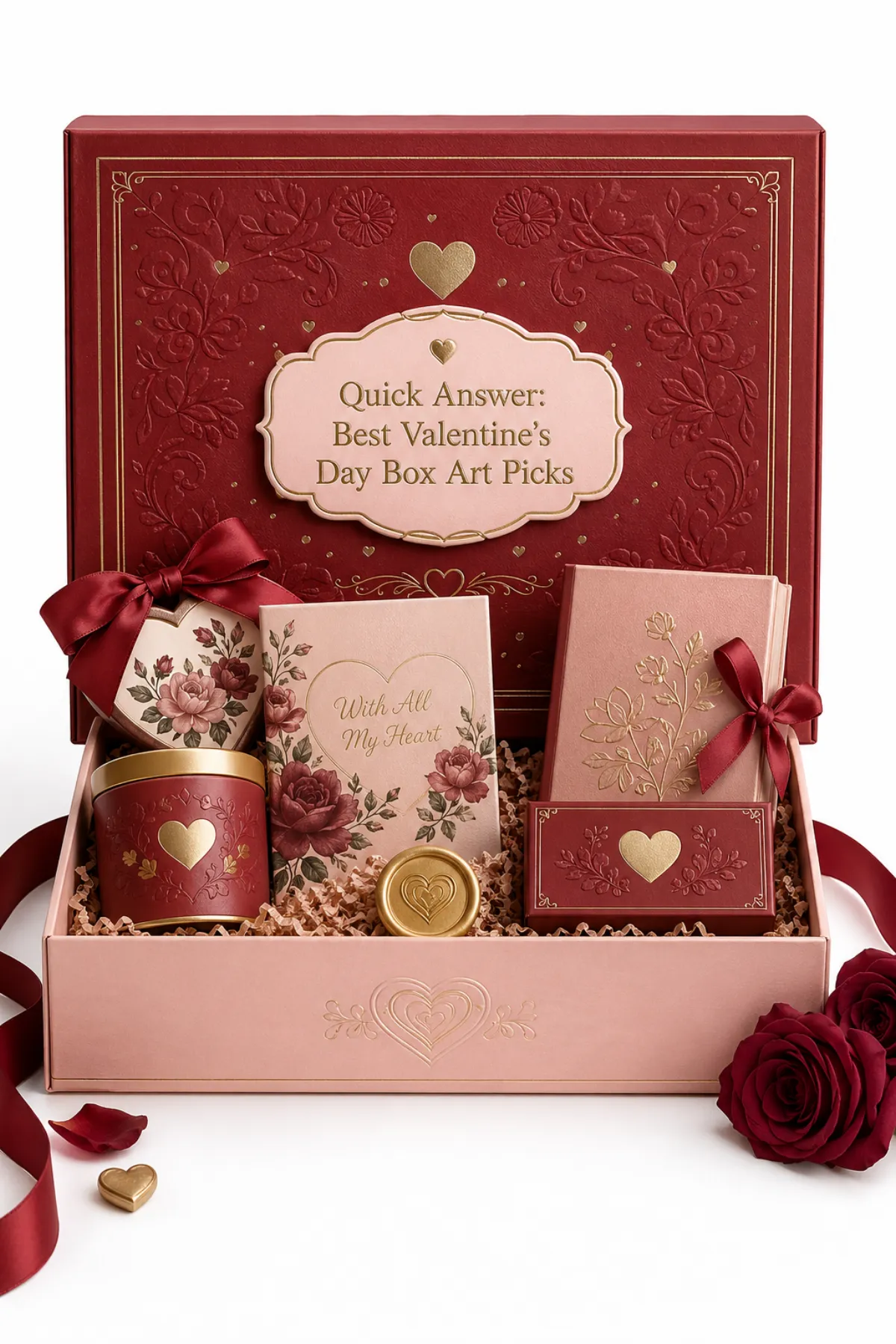
The best answer depends on what the box needs to do in the real world. For a chocolatier, the best valentine's day box art may be a romantic illustration on a folding carton with strong shelf contrast. For a jewelry brand, it may be a foil-stamped rigid box that feels like a keepsake. For an eco-minded food brand, a minimalist kraft structure with restrained ink coverage can be the smartest move. In other words, the best Valentine's Day box art is the one that fits your product, your price point, and your channel, not just the one that looks attractive on a mood board.
Quick Answer: Best Valentine's Day Box Art Picks
If you need the short version, the best valentine's day box art choices I trust most are romantic illustration, luxury foil-stamped rigid boxes, minimalist kraft, and windowed cartons. I’ve watched those four styles sell across very different channels, from a 48-count chocolate assortment in a supermarket endcap in Dallas to a 6-piece truffle gift box sold in a florist’s checkout lane in Boston. I remember one buyer saying the “pretty box” was doing more selling than the promo sign, which, frankly, was the nicest way anyone has ever told me the sign was useless.
Romantic illustration works best when the buyer wants warmth and sentiment, especially for chocolate, cookies, and bath gift sets. Luxury foil-stamped rigid boxes are the strongest premium signal for jewelry, high-end confectionery, and corporate gifting, particularly when the box uses 1200gsm grayboard and a wrap paper with a 157gsm liner. Minimalist kraft is the quiet winner for eco-conscious brands that want honesty over decoration, and windowed cartons are the smartest choice when the product itself has visual charm, like molded pralines or color-sorted macarons stacked in a 12-piece tray.
The best valentine's day box art also depends on what matters most to your buyer. Shelf impact matters in retail, giftability matters in direct-to-consumer unboxing, unit cost matters to every buyer, and turnaround time becomes decisive the moment you are inside a holiday production window. I have seen brands lose a full season because they chased a beautiful render while ignoring a 28-day foil tooling lead or a 15-business-day proof cycle. That sort of delay has a way of turning a cheerful marketing meeting into a very quiet one.
“We thought the truffles were the hero,” a buyer at a specialty gift chain in Minneapolis told me after a 3-piece rigid box test, “but the box art did the selling before anyone read the flavor card.”
My honest verdict is simple: if you need broad appeal and fast acceptance, start with romantic illustration on a folding carton. If you need premium positioning, choose foil-stamped rigid packaging with controlled coverage and a clean logo field. If your audience values restraint and recycled content, go kraft with one strong color and minimal ink coverage. If the product is visually strong, a window can outperform heavier decoration because it gives shoppers proof instead of promise, and that is often the best valentine's day box art move on a crowded shelf.
Top Options Compared for Best Valentine's Day Box Art
Below is the comparison I use with brand teams, and it reflects what actually happens on press and in stores, not just what looks nice in a mockup. The best valentine's day box art usually lands where aesthetics, price, and manufacturing reality meet, which is why I compare style, finish, product fit, and lead time together instead of isolating one variable. I learned that the hard way after approving a gorgeous carton that looked amazing until the die line folded right through the main floral cluster. Stunning on screen. A little tragic in the carton plant.
| Style | Best For | Visual Effect | Typical Unit Cost | Typical Lead Time |
|---|---|---|---|---|
| Romantic watercolor | Chocolates, cookies, bath gifts | Soft, emotional, handcrafted | $0.28-$0.62 at 5,000 units | 12-18 business days |
| Bold typography | DTC gifts, modern confectionery | Clean, high-contrast, retail-friendly | $0.22-$0.48 at 5,000 units | 10-16 business days |
| Luxury foil-stamped rigid | Jewelry, premium chocolates, corporate gifts | Rich, reflective, high perceived value | $1.20-$2.40 at 3,000 units | 18-30 business days |
| Minimalist kraft | Eco brands, artisanal food, refill sets | Natural, understated, honest | $0.24-$0.55 at 5,000 units | 10-15 business days |
| Windowed carton | Visually strong products | Transparent, practical, sales-driven | $0.32-$0.78 at 5,000 units | 12-18 business days |
| Playful illustration | Family gifts, novelty treats, subscription sets | Friendly, colorful, impulse-friendly | $0.26-$0.60 at 5,000 units | 12-17 business days |
Those numbers move with substrate, ink coverage, and order quantity, but the ranking stays fairly steady. The best valentine's day box art for a 2,000-unit boutique run is rarely the same as the best option for a 25,000-unit grocery program, because digital print, offset print, and rigid box assembly all behave differently once you start paying for labor, finishing, and freight. The number that matters is not just unit cost; it is the total cost after the job gets packed, palletized, and shipped out of a plant in Ohio or a converter in Guangdong on a cold Friday afternoon.
Finishes change the mood more than most teams expect. A matte soft-touch coat can make a simple design feel like a velvet-lined gift, gloss varnish can push reds and pinks harder under fluorescent retail lighting, foil creates a premium flash that buyers notice in two seconds, and spot UV can call out a logo without making the art feel busy. I have seen a red-and-rose illustration fail with too much gloss because it looked syrupy, then work beautifully after we switched to a restrained satin finish on SBS board. Sometimes the finish is the difference between “romantic” and “why does this look like dessert glaze?”
One more practical point: the best valentine's day box art is not always the most ornate. A clean box with a good silhouette, strong hierarchy, and a single elegant foil line can beat a crowded design covered in hearts, ribbons, and script fonts that blur together at arm’s length. Retail buyers look at a display from five to eight feet away; they are not inspecting it like a museum print. They are moving fast, probably holding coffee, and they want the box to do its job without a lecture.
Detailed Reviews of the Strongest Box Art Styles
I’ve tested enough samples to know that mockups can lie in very specific ways. The best valentine's day box art on a screen can flatten into something muddy on press, and a Design That Feels charming in Figma can become unreadable once it is shrunk to a 140 mm front panel with a barcode, legal copy, and flavor callouts fighting for space. I still wince a little when I see gorgeous type pushed too close to a fold line; it has the same energy as wearing a tuxedo jacket with one button hanging by a thread.
Romantic watercolor
Romantic watercolor is the safest emotional play, especially for confectionery and bath gift sets. The colors feel handmade, the brushwork suggests care, and the style usually pairs well with cream, blush, berry red, and dusty gold. I’ve seen it work on 350gsm C1S artboard with aqueous coating in a plant near Toronto, but it needs enough contrast; pale pink petals on a pale pink background disappear under store lighting faster than most designers expect. That’s one of those issues that sounds minor until the sales floor turns your elegant artwork into “some faint warm-colored thing.”
The one thing people get wrong is detail level. Fine line petals, tiny hearts, and handwritten scripts can vanish at small scale, particularly on a folding carton with a tight dieline fold on the front panel. For the best valentine's day box art in this style, keep the illustration broad, keep the type legible at 9 pt or above, and do not let the artwork fight the product name. I like this style best when it feels like a florist’s bouquet from Brooklyn or Bath, not a scrapbook explosion.
Bold typography
Bold typography is my favorite option for brands that want a modern, confident look without paying for heavy finishing. A strong sans serif in high contrast red, cream, and black can look expensive if the hierarchy is disciplined and the stock is good. In a factory meeting in New Jersey, I watched a simple type-led carton outsell a more decorative competitor because the shelf read was cleaner from eight feet away. That meeting was half design review, half argument about ink density, and the type won anyway.
This style does not hide weak copy. If your wording is clumsy or your logo proportions are off, big type will expose it. Still, for the best valentine's day box art in a DTC or mass-premium setting, bold typography often gives the best margin because you can spend more on structure or inserts and less on decoration. It is also merciful when the budget is already in a bad mood and the final quote comes back 8 percent over target.
Luxury foil-stamped rigid boxes
Luxury foil-stamped rigid boxes are where perceived value jumps sharply. The board might be 1200gsm grayboard wrapped in printed art paper with a 157gsm liner, and the foil can be gold, rose gold, copper, or a deep silver that catches light without looking brassy. I stood beside a foil press in Shenzhen, China, while a supplier argued for a wider die line because the border was too thin to register cleanly; that extra 1.5 mm saved the job. I still think about that sample every time someone says, “Can we just make the line a little thinner?” with the confidence of a person who will not be there at press check.
The downside is cost and discipline. If the foil area is too large, the design can turn loud, and if the registration is off by even 0.5 mm on a small logo, it looks sloppy immediately. Still, for premium gifting, the best valentine's day box art often lives here because the box itself becomes part of the gift experience, not just the container. You are selling the moment when someone opens the lid, sees a custom insert, and pauses for a second before touching the product.
Minimalist kraft
Minimalist kraft is a strong fit for brands selling organic truffles, handmade cookies, or refillable gift sets. The recycled look feels honest, and buyers who care about material sourcing usually trust it faster than highly decorated packaging. If you want the eco story to feel real, use uncoated kraft, soy or water-based inks, and a restrained palette of one to three colors. I like kraft because it does not pretend to be anything else, which is refreshing in a category that can get a little too romantic for its own good.
The tradeoff is color behavior. Reds can mute on kraft, and delicate pinks may read brownish unless they are adjusted for the substrate. I have had a buyer in Portland ask for a “soft romantic kraft” look, and the printed sample looked better after we darkened the pink by 18 percent and moved the type to charcoal. That kind of adjustment is often what makes the best valentine's day box art feel intentional instead of accidental. Small color corrections can save an entire mood.
Windowed cartons
Windowed cartons are the most practical option for products with visual variety. If the product inside has color, shape, or texture, the window does part of the selling for you. For chocolates with molded tops, cookie assortments, or layered confectionery, a clear PET or cellulose window can outperform an ornate printed face because shoppers see the actual product before they commit. That visibility is useful, and it also removes some guesswork from the buyer, which is always nice.
There is a catch: the window must be positioned carefully so it does not weaken the panel or expose a messy inner tray. A sloppy window cut line can make the structure feel cheap. The best valentine's day box art with a window usually combines a restrained printed exterior, a properly sized opening, and a clean tray layout that keeps the visible product aligned and attractive. I have seen a beautiful window box undermined by one crooked candy piece, which is the packaging equivalent of a tie worn half an inch off center.
Across all styles, line weight and scuff resistance matter more than designers admit. Dark reds show edge wear fast, metallic inks can scuff during cartoning, and very fine scripts lose clarity after a single rub test. That’s why I always ask for a live sample or at least a printed proof on the actual board, not just a PDF on a bright monitor. A PDF can lie to your face and smile while doing it.
Price Comparison: What Best Valentine's Day Box Art Really Costs
Price is where romantic ideas meet factory reality. The best valentine's day box art can still fail commercially if the unit cost blows past your target margin, especially in seasonal programs where the sell-through window is short and there is no time to recover from slow-moving inventory. I have watched more than one gorgeous box get cut from a program because the math got rude at the last minute.
For a folding carton, the biggest cost drivers are substrate, print method, number of colors, coatings, and any special finishing. For a rigid box, add grayboard thickness, wrap paper, hand assembly, foil tooling, and the labor that goes into set-up and packing. I have seen a 6-piece chocolate box move from $0.44 to $0.91 just by adding a window patch, embossing, and a heavier insert. That is why packaging budgets deserve a calculator, not just a mood board.
| Program Type | Typical Quantity | Price Range per Unit | Cost Drivers | Notes |
|---|---|---|---|---|
| Digital folding carton | 500-3,000 | $0.32-$0.78 | Short-run print, die cutting, basic coating | Best for fast launches and testing art variations |
| Offset folding carton | 5,000-25,000 | $0.18-$0.42 | Plate setup, color matching, volume efficiency | Usually the sweet spot for seasonal rollouts |
| Rigid gift box | 1,000-10,000 | $1.20-$2.40 | Grayboard, wrap paper, hand labor, foil | High perceived value, slower and more expensive |
| Windowed carton | 3,000-15,000 | $0.32-$0.78 | Window patch, die cut accuracy, tray fit | Good for products that sell through visually |
| Premium finish add-ons | Any quantity | $0.03-$0.22 extra | Foil, embossing, spot UV, soft-touch | These add perceived value fast if used carefully |
Minimum order quantity changes the math a lot. A 1,500-unit digital run may cost more per box than a 10,000-unit offset run, but it can still be the better decision if you are launching a new SKU or if your retail partners have not confirmed volume. The best valentine's day box art for a small brand is often the one that reduces risk, even if the unit cost is a few cents higher. I would rather see a brand print slightly fewer boxes and sell out cleanly than gamble on a giant run and spend March staring at inventory reports from a warehouse in Ohio.
Watch for hidden costs. Dieline setup can add $50 to $150, prepress corrections can add time and labor, freight can swing by hundreds of dollars depending on pallet count and destination, and rework becomes expensive fast if a pink shifts toward orange or your foil plate misses registration by a millimeter. I always tell clients to budget one physical proof, one color-adjustment loop, and a freight buffer before they approve the full run. If you have ever watched a production manager mutter at a sample under bad fluorescent light, you know exactly why that buffer matters.
If you’re aiming for a premium finish, it helps to compare against standards and transit realities instead of just spec sheets. For packaging design and sustainability context, I often point teams to the Packaging School and packaging industry resources, and for parcel testing I still look at ISTA guidance because a beautiful box that crushes in transit is a wasted print run.
Process and Timeline: From Concept to Press-Ready Box Art
The production path for the best valentine's day box art should be treated like a controlled sequence, not a creative free-for-all. The teams that stay on schedule usually brief the project clearly, lock the dieline early, and approve a physical sample before the full order goes live. I know that sounds basic, but basic is what keeps February from turning into a sprint with missing shoes.
- Brief: define target audience, box size, unit budget, finish limits, and launch date.
- Dieline: confirm panel dimensions, bleed, safe zones, glue tabs, and window placement.
- Concept design: build 2-3 directions with one hero visual and one dominant finish.
- Prepress: check overprint, trapping, image resolution, and Pantone targets.
- Proofing: review digital or physical proofs against product samples and lighting conditions.
- Print and finishing: run offset, digital, foil, emboss, varnish, or lamination as needed.
- Converting: die cut, glue, fold, insert, and pack to ship.
- Freight: palletize, protect edges, and allow time for seasonal congestion.
Most delays happen in three places: approval cycles, foil tooling, and material availability. A Pantone correction that takes two hours in the office can cost three days on the floor if the press has already been booked. I remember one holiday job where a rose-gold foil sample came back too bright under warehouse LEDs in Atlanta, and we had to switch the foil stock after the first proof; that added five business days, but it saved the entire brand impression. That was one of those moments where everyone complained, then quietly thanked the decision two weeks later.
The timeline varies by structure. Digital folding carton programs can often move in 10 to 16 business days after approval, offset jobs usually need 14 to 24 business days, and rigid boxes often require 18 to 30 business days or more once hand assembly is included. If you are near peak holiday season, add 4 to 7 business days for freight and workload congestion, because that is where the calendar starts to bite.
“The box does not miss Valentine’s Day in the design room,” a production manager in Los Angeles told me during a late-night press check, “it misses it in approvals and freight.”
To keep the schedule clean, lock copy early and avoid midstream changes to flavor names, ingredient statements, or barcode placement. Keep bleed at the printer’s specified margin, usually 0.125 in to 0.25 in depending on format, and verify the safe zone so the heart motif does not get sliced off by a fold. For shipping tests, ask whether the packaging should meet an ISTA-style parcel test profile, because the best valentine's day box art still needs to arrive looking like the proof sheet. I have seen too many lovely boxes arrive with a corner bruise that made them look like they had been in a minor argument with a forklift.
A physical sample is worth more than a dozen screen mockups. I have seen a black matte finish look elegant in design review and arrive with fingerprint issues so obvious that a buyer could spot them from six feet away. A one-piece sample run lets you test not just color, but scuff resistance, glue performance, tray fit, and how the box behaves after it spends 24 hours in a warm distribution room. Packaging always has a personality once it leaves the screen, and occasionally that personality is rude.
How to Choose the Best Valentine's Day Box Art for Your Brand
The strongest choice is the one that matches your audience instead of flattering your mood board. The best valentine's day box art for a luxury chocolatier in a hotel lobby in Miami is not the same as the best choice for a DTC cookie brand shipping 2-day parcels in corrugated mailers from Nashville. I have seen brands fall in love with a design that belonged to another category entirely, and then wonder why it underperformed. The box looked good. It just looked good for someone else.
I like to use a simple filter with clients, because it keeps the decision grounded in numbers and use case rather than taste alone:
- Shelf impact: can shoppers identify the gift in three seconds from five feet away?
- Perceived value: does the structure and finish justify the price point?
- Shipping durability: will the art survive parcel handling, stacking, and cold-chain or warm-chain exposure?
- Sustainability: can you support recycled content, FSC-certified paper, or reduced plastic use without overclaiming?
- Assembly speed: can your line or co-packer build it without slowing the outbound schedule?
If sustainability matters, source paper and board carefully and keep your claims precise. I have had better results with FSC-certified paperboard and simple water-based coatings than with flashy eco language that is hard to defend. If you need a reference point, the FSC standards and certification resources are a practical place to check what your supplier is actually allowed to claim. Greenwashing is easy to spot, and customers in California, British Columbia, and the UK have gotten much better at sniffing it out.
For the best valentine's day box art, I recommend one hero visual, one supporting finish, and one structural format that suits the product weight. That might mean a watercolor bouquet with a satin varnish and a tuck-end carton for a 4-piece confection, or a rigid drawer box with copper foil and a paperboard insert for a 9-piece jewelry set. The key is restraint: too many effects start fighting each other, and the box loses focus. A design can absolutely get too enthusiastic, and I have done it myself; the sample was not flattering.
Also check the design under the same lighting your customer will see. Warm boutique lighting, cool warehouse LEDs, and daylight from a front window all shift pinks, reds, and metallics differently. I once approved a blush-toned carton in a design studio in Chicago, only to watch it go salmon under a big-box retailer’s fluorescent aisle in Phoenix; we rescued it by deepening the red by 12 percent and reducing the gloss on the typography. That little shift saved the whole look from becoming unintentionally tropical.
If you are choosing between styles, think in pairs. Romantic illustration pairs well with gift baskets and confectionery, bold typography pairs well with modern eCommerce, minimalist kraft pairs well with artisanal or sustainable positioning, and windowed cartons pair well with products that already look good on their own. That is the practical version of the best valentine's day box art decision, and it usually produces fewer regrets six weeks later.
Our Recommendation and Next Steps
If you want the fastest path to a good decision, here is my blunt recommendation. For value, choose a bold printed folding carton with a satin finish. For premium gifting, choose a foil-stamped rigid box with controlled accent coverage. For eco-friendly positioning, go with minimalist kraft and keep the ink palette narrow. For speed, choose digital print and avoid any finish that needs custom tooling.
That recommendation comes from factory-floor reality, not taste. I have seen the best valentine's day box art for a mid-market chocolatier in St. Louis turn into a stronger seller simply because we dropped one unnecessary embellishment and used the saved budget on a cleaner insert and better tray alignment. The customer noticed the product, the retailer noticed the shelf presence, and the accountant noticed the margin. That is a rare and beautiful little triangle of agreement.
Before you place a full order, ask for three things: a printed sample, a color proof against the actual product, and a one-page spec sheet that lists dimensions, board grade, finish, color targets, and approved copy. That sheet should also spell out whether the job is digital, offset, or rigid, because vendors quote differently when they are comparing 2,000 units to 20,000 units. If a supplier cannot explain the difference without sounding vague, I would be cautious.
If you need a practical next move, build a short checklist with your designer and supplier: confirm dieline, confirm foil or varnish placement, approve language, approve barcode location, and lock freight timing. That sounds basic, but basic discipline is what keeps holiday packaging from turning into a rescue job. I have spent enough evenings untangling “quick tweaks” to know that the humble checklist is not glamorous, but it is undefeated.
My final take is straightforward: the best valentine's day box art is the one that sells the gift before the customer opens it, survives the trip from plant to shelf, and still makes financial sense after the last box ships. If you are choosing today, pick one direction, request samples, compare them against your real product, and place the order only after the proof looks right in hand. That last step matters more than the mood board, more than the mockup, and definitely more than the one person in the room who says, “I just feel like it needs more sparkle.”
What makes the best Valentine's Day box art sell better than average packaging?
It creates instant gift value with strong hierarchy, a clear focal point, and a finish that feels special in the hand. The best valentine's day box art also fits the product category, so a chocolate box does not look like a jewelry box and a jewelry box does not look like a snack carton. If shoppers understand the gift in a glance, you are already ahead, especially when the box is sitting on a retail shelf at eye level for 6 to 8 seconds.
Is foil stamping worth it for Valentine's Day box art?
Yes, if you need a premium signal and your budget can support tooling and finishing costs. Foil works best on logos, borders, and small accents, and it is often smarter to use it sparingly than to cover half the panel with reflective areas that look noisy under retail lights. I like foil most when it behaves like jewelry, not a disco ball, and when the tooling lead time of 20 to 28 business days fits the launch calendar.
How much should I budget for custom Valentine's Day box art?
Budget by structure first, then add print and finishing. A folding carton can live under a dollar per unit in many runs, while a rigid box can move into the $1.20-$2.40 range depending on board, wrap, foil, and assembly, so the best valentine's day box art decision always starts with the container type. If the budget is tight, spend for clarity before you spend for flair, and keep a 10 percent contingency for proofs, freight, and last-minute color corrections.
How long does production usually take for Valentine's Day box art?
Digital work moves the fastest, offset takes longer, and rigid box programs take the most time because of setup, proofing, and hand assembly. Approval delays are the biggest risk, so if your launch date matters, lock the artwork early and leave freight buffer in the schedule. I have never once heard someone say, “We gave ourselves too much time” and then regret it, especially when the job includes foil or a window patch.
What files should I send for Valentine's Day box art design?
Send print-ready artwork on the correct dieline with outlined fonts, linked images, bleed, and safe zones. Include notes for foil, emboss, varnish, and any special placement details, because the best valentine's day box art only stays accurate when the prepress team has the full spec from the start. The cleaner the handoff, the fewer late-night emails everyone has to read, and the fewer surprises show up at a proofing table in week three.