Buyer Fit Snapshot
| Best fit | Subscription Insert Branding Work projects where brand print, material claims, artwork control, MOQ, and repeat-order consistency need to be specified before quoting. |
|---|---|
| Quote inputs | Share finished size, material target, print colors, finish, packing count, annual reorder estimate, ship-to region, and any compliance wording. |
| Proofing check | Approve dieline scale, logo placement, barcode or warning zones, color tolerance, closure strength, and carton packing before bulk production. |
| Main risk | Vague material claims, crowded artwork, missing packing details, or unclear freight terms can make a low unit price expensive after revisions. |
Fast answer: Subscription Insert Branding Work: Material, Print, Proofing, and Reorder Risk should be specified like a repeatable production item. The safest quote records material, print method, finish, artwork proof, packing count, and reorder notes in one written spec.
Production checks before approval
Compare the actual filled-product size with the drawing, then confirm tolerance on folds, seals, hang holes, label areas, and retail display edges. Reserve space for logos, QR codes, warning copy, and material claims before decorative graphics fill the panel.
Quote comparison points
Review material grade, print process, finish, sampling route, tooling charges, carton quantity, and freight assumptions side by side. A quote is only useful when the supplier can repeat the same color, closure quality, and packing count on the next order.
Tips for subscription insert branding That Actually Work start with a memory I still carry from a factory floor in Shenzhen, where I stood beside a packing station at 7:30 a.m. and watched 18,000 mailer cartons move through a line that was already warm from the August humidity. I remember one client insisting the insert needed to “feel premium,” which usually means five different things to five different people, and that phrase causes more trouble than it solves. A $0.12 insert can outperform a glossy brochure if it feels native to the unboxing and not like stray paper somebody forgot to remove. I watched one brand’s plain thank-you card beat a folded sales sheet by 2.4x in QR scans because the card matched the mailer, the tissue, and the brand voice instead of shouting over them. That is the real shape of tips for subscription insert branding: small, deliberate choices that feel like they belong, from the 350gsm C1S artboard to the 3.5 x 5.5 trim size, and from the first fold to the final touchpoint in the box. The customer is gonna notice the difference even if they never say it out loud.
Most brands treat the insert like a tiny bonus. I do not. In practice, it is one of the few pieces of packaging customers actually hold, set on a kitchen counter in Austin or Brooklyn, tuck into a drawer in a one-bedroom apartment, or come back to later when they need to reorder. That makes tips for subscription insert branding a retention decision, not just a print-buy decision. If the insert strengthens brand identity, sharpens brand recognition, and fits the unboxing experience, it earns its place fast. If it does not, it becomes expensive confetti, and nobody needs more of that, especially when 10,000 boxes are going out of a fulfillment center in Reno or Columbus.
I have seen the gap play out in a client meeting where a candle brand in Portland asked for “something cute” in every box. Cute was not the problem. The real question was whether the card would improve customer perception and repeat order rate by even 3% on a 10,000-order monthly base. A better brief asked how the insert could reinforce brand consistency across the carton, tissue, product label, and follow-up email. That is where tips for subscription insert branding become useful instead of vague. I always tell teams that if the insert could survive a random shuffle with the rest of the package and still feel like the same brand, they are on the right track, whether the stock is 16pt C2S or a matte 300gsm recycled sheet.
What are the best tips for subscription insert branding?
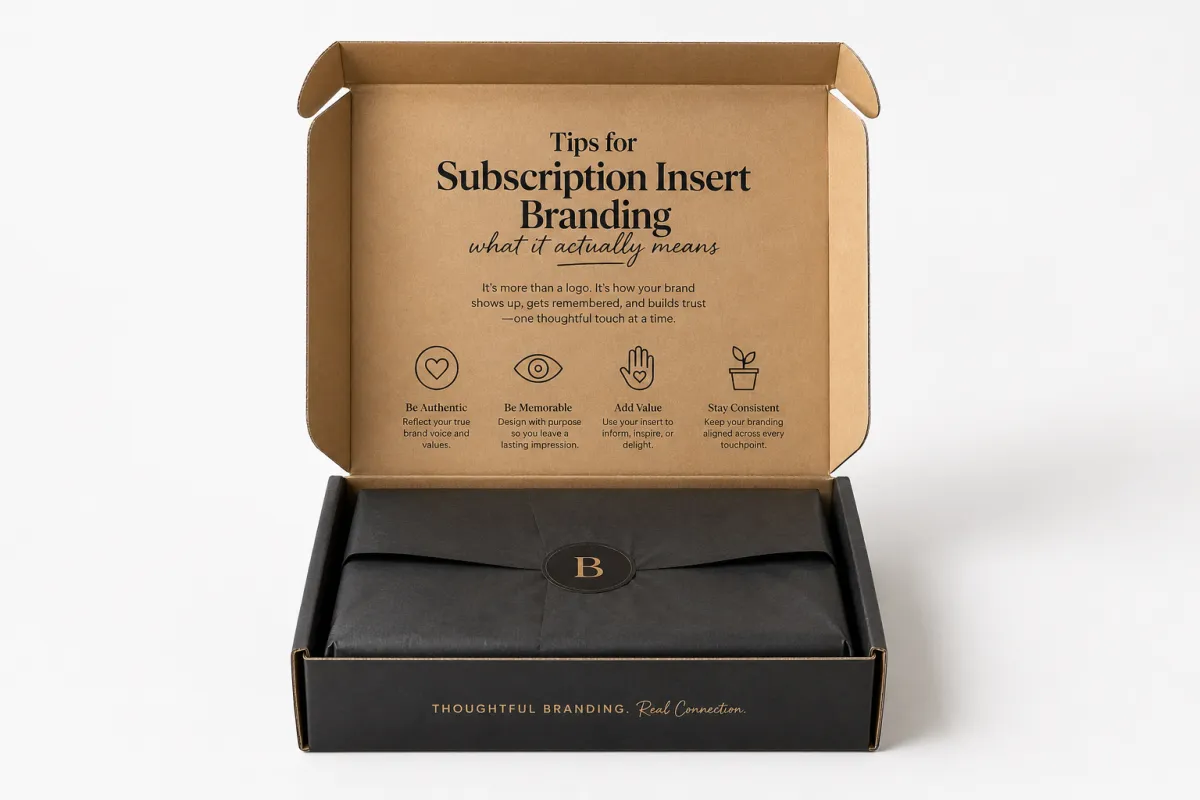
Tips for subscription insert branding means using cards, offers, thank-you notes, sample slips, QR codes, and care guides as one coordinated brand touchpoint. A loose printed sheet is just paper. A branded insert system is a small, disciplined story: who you are, why the customer should stay, and what action belongs next. When I say system, I mean a three-card set with one message on each piece, not a 12-line manifesto squeezed into a 4 x 6 postcard because somebody in marketing got overexcited on a Monday morning at 9:10 a.m.
Here is the part many teams miss. An insert does not need to sell loudly to sell well. In a subscription box, the customer already paid once and is waiting for the brand to prove itself again. A note that says “thanks for being here” can outperform a 20% discount if the timing is right and the visual branding feels intentional. That is why tips for subscription insert branding should focus on message clarity, not copy volume. I have a strong opinion about this: the quieter, cleaner insert usually does more work than the one trying to win a shouting match with the rest of the carton, especially when the print run is 5,000 pieces at $0.15 per unit or 25,000 pieces at $0.06 per unit.
I once negotiated with a supplier in Dongguan who wanted to charge extra for “premium marketing inserts” that were really just 157gsm coated sheets with a glossy flood varnish. The client assumed premium meant louder. It usually means more coherent. A clean insert printed on 14pt C1S or 16pt C2S with a single hero message often does more for brand consistency than a busy folded booklet with six different calls to action fighting for space. And yes, I have seen those booklets. They tend to look like they were designed by committee in three time zones, which is never a compliment.
“We kept the card because it felt like the brand, not an ad.” A skincare customer in San Diego said that after a reorder cycle, and that one sentence carries a lot of weight in any discussion of tips for subscription insert branding. I remember reading that note and thinking, finally, proof that restraint can be memorable when the insert is a 4 x 6 card on 350gsm C1S artboard with a soft-touch coat on the front only.
In practical terms, I treat subscription inserts as one of six jobs: welcome, educate, cross-sell, refer, reactivate, or thank. If you try to do all six on one piece, the result usually looks like a discount flyer that ended up in the wrong carton. The strongest tips for subscription insert branding begin with one job and one audience, then build from there. My rule is simple: if the insert needs a paragraph to explain itself, it probably needs another round of editing, especially before a 12- to 15-business-day print window closes in Suzhou or Los Angeles.
If you want a real-world comparison, our Case Studies page shows how different insert styles changed redemption rates and repeat orders across several packouts, including a bath brand that moved from a 1.8% scan rate to 4.9% with a simpler QR layout. I also tell clients to pair inserts with smaller finishing touches like Custom Labels & Tags when the packaging needs one more branded layer without adding much labor. Sometimes a tag or label does more for perceived care than a printed message ever could, which is mildly annoying for people who love big print pieces, but the data from a 20,000-unit run in Nashville does not care about pride.
In my work, the best inserts feel built into the box architecture. The reader should notice the paper stock, the trim size, the brand tone, and the QR destination in about 5 seconds. If they need a long explanation, the insert is already losing. Good tips for subscription insert branding respect that short attention window and make every inch count. I like to ask, “If somebody is opening this box while half-distracted and holding a coffee in the other hand, does the insert still make sense?” That answer tells me a lot, especially for a brand shipping 40,000 units a month out of a facility in Charlotte or Toronto.
Tips for subscription insert branding in the unboxing flow
The strongest tips for subscription insert branding map the customer journey, not just the print file. A subscriber usually moves through four moments: discovery, first unboxing, repeat order, and reactivation. Each one deserves a different message. The welcome card in a first box should feel warm and useful. A repeat-order insert can push a loyalty code or review prompt. A reactivation card can ask a direct question like “Want us to pick your next restock?” with a short URL or QR code. I remember testing a reactivation version that was too cute by half, and it failed for the exact reason I feared: people do not need poetry when they are trying to decide whether to reorder toothpaste from a $28 monthly plan.
Think of the insert as a bridge between the carton and the next purchase. It sits with the mailer, tissue, filler, and product itself, so the job is to support the flow rather than interrupt it. If the outer packaging is soft-touch black and gold, a neon insert on thin 80gsm paper will look like a mistake. Better tips for subscription insert branding keep the whole unboxing experience aligned so the insert matches the tactile and visual rhythm of the box. I have seen a beautiful package lose its footing because the insert looked like it belonged to a different company entirely, usually because one team approved a sample in Chicago and another finished the print file in Guangzhou.
Design hierarchy matters more than most teams admit. I like the headline first, proof second, action third. A strong insert might say, “Your next refill is on us,” then explain the rule in one line, then place the QR code in the lower-right corner. That structure works because the eye reads it in under 3 seconds. If the customer has to hunt for the point, the budget is already working too hard. Honestly, I think clarity is underrated because it does not look fancy in a mockup, but it performs in the box, especially on a 4 x 6 postcard printed in 4/4 color.
Here are the insert types I see most often:
- Welcome card for first-time subscribers, usually 4 x 6 inches on 16pt C2S with a warm note and one QR code.
- Cross-sell card for related products, often useful when the customer already knows the brand and the item retails above $32.
- Referral offer with a short code, ideally tied to a tracked reward like $10 off, free shipping, or a 15% bonus on the next order.
- Loyalty note that rewards the third or fourth order with a perk that feels earned, such as a sample vial or a $5 add-on credit.
- Care guide for cosmetics, candles, supplements, or apparel, where usage matters as much as promotion.
- Sample sheet that introduces one or two SKUs without turning the box into a trade-show booth or adding more than 20 seconds of packout labor.
Tips for subscription insert branding also need measurement. QR scans, referral clicks, email signups, and code redemptions tell you whether the insert actually did something. I prefer one KPI per insert. If the goal is repeat purchases, do not overload the card with three tracking methods and hope the reporting sorts itself out later. It will not. I have lived through enough messy dashboards to know that “we’ll clean it up after launch” is a sentence that usually ends with someone muttering into a spreadsheet at 9 p.m. on a Thursday.
The customer journey changes by order count too. A first box may be 70% education and 30% promotion. A third box may flip to 20% education and 80% retention strategy. A reactivation mailer should feel more direct because the customer already knows the product. That is why tips for subscription insert branding are not static. They should change with the order cycle, season, and customer segment. If your insert looks identical for month one and month six, you are probably leaving money on the table, especially if you ship 12,000 orders in a seasonal spike between October and December.
One skincare brand I worked with used a small foldout insert to move customers from trial to routine. It included a 3-step use guide, a before-and-after timeline, and a QR code to a replenishment page. Their repeat rate rose by 14% across the next 8,000 orders. Not magic. Just clean sequencing and brand consistency. I still remember the moment the client realized the “boring” educational card was the one doing the heavy lifting, printed on a 157gsm matte stock in a plant outside Xiamen and folded to 4 x 3. That always makes me smile a little.
For material sourcing and transit testing, I often point clients to the guidance from ISTA and the certification standards published by FSC. If you are asking for recycled stock, certified sourcing, or a cleaner paper trail, those references help keep the conversation honest. I like having neutral standards in the mix because clients sometimes need something firmer than a mood board when the quote already sits at $8,500 for 50,000 pieces.
Key factors that decide whether an insert gets kept
Not every insert survives the trash bin. The ones that get kept usually pass four tests: clear message, visual restraint, tactile quality, and usefulness. Tips for subscription insert branding should start with clarity. One goal per insert beats a card that tries to sell, educate, collect emails, and push a referral all at once. That kind of clutter feels desperate, and customers can smell desperation from across the room. I say that with affection, but still. Nobody wants to open a box and immediately feel like they are being cornered by a flyer printed on 80gsm paper to save $0.01.
Visual branding is the next filter. If the insert looks like it came from a different company than the box, the customer notices immediately. Fonts, color palette, icon style, and spacing all need to match the package and the email templates. I have sat in meetings where the brand team spent $8,000 on a website redesign and then sent me an insert with three different blues. That is not brand consistency. That is a design disagreement with no referee. And yes, everybody in the room pretended not to notice until the proof arrived from a printer in Minneapolis.
Paper stock changes how the customer reads value. A 14pt uncoated card feels earthy and direct. A 16pt C2S sheet with matte coating feels cleaner and more premium. A soft-touch lamination can make a simple welcome card feel more considered, but it also adds cost and can show fingerprints if handling is rough. Good tips for subscription insert branding treat paper as part of the message, not just the substrate. I have a personal bias toward stock that feels sturdy in the hand, because flimsy paper can make a thoughtfully built brand feel like it cut a corner, especially when the insert is boxed with a $42 product. You can kinda feel the difference before you can explain it.
Size matters too. A postcard is fast. A folded insert has room for education. A mini zine can build a richer story, but it also increases labor and print complexity. I have seen a 6-page insert booklet work well for a meal-kit brand because it fit the cadence of weekly use. I have also seen a 12-panel brochure get ignored because the customer just wanted to open the candle, light it, and move on. Different products, different patience levels, very different outcomes, and very different print quotes, from $0.05 per piece to $0.48 per piece.
Personalization is the quiet multiplier. A note that says “Thanks for your second order” feels different from a generic thank-you. So does a segment-specific insert that changes based on SKU, order number, or customer tier. If someone just bought a refill pack, sending them a sample insert for an unrelated product can waste the moment. Better tips for subscription insert branding use data to match the message to the buyer, even if that means three versions instead of one. I know that sounds like extra work. It is. That is also why it works, particularly for brands shipping from Atlanta, Montreal, or Dallas.
I also care about timing. A referral card inside the first order may be too early. A loyalty offer inside the third box can feel earned. A reactivation insert for lapsed subscribers should be shorter, more direct, and usually less cute. That is not me being picky. That is me watching thousands of cartons move through a fulfillment line in Ningbo and seeing which inserts get retained, folded, or tossed on sight. A good insert respects the moment it arrives in, whether the box is being packed on a Monday morning or a Saturday overtime shift.
If you need a quick rule, use this: make the insert useful enough to keep for 24 hours. A care guide, a reorder reminder, or a restock code often does that better than a coupon with a deadline buried in fine print. Tips for subscription insert branding work best when the customer feels helped before they feel sold to. I cannot stress that enough. Helpful first, promotional second. That order matters, and the difference can show up in a 2% repeat lift on a 15,000-order program.
Cost and pricing realities for branded inserts
Money matters, because pretty cards are not free. The biggest cost drivers in tips for subscription insert branding are quantity, size, color coverage, stock, finishing, and how much handwork the fulfillment team needs to do. A single 4 x 6 postcard on 14pt C2S with 4/4 color can be very cheap at scale, but add a fold, a soft-touch finish, or variable data, and the quote changes fast. I have watched “just one more enhancement” turn a tidy estimate into a budget meeting that nobody enjoyed, especially when the supplier was quoting out of Shenzhen and the fulfillment team was in Louisville.
At 50,000 units, I have seen a simple 4 x 6 insert land around $0.04 to $0.06 per piece on offset. At 5,000 units, that same format can be $0.10 to $0.18 per piece on digital, depending on paper and finishing. A two-panel folded insert with matte lamination might jump to $0.22 to $0.35 per piece at modest volume. The lesson is plain and stubborn: higher quantity lowers unit cost, but inventory risk goes up with it. I have had clients fall in love with a gorgeous run quantity, then regret the storage bill three months later when 12 pallets arrived in a warehouse outside Phoenix.
| Insert Type | Typical Specs | Estimated Unit Cost | Best Use |
|---|---|---|---|
| Postcard | 4 x 6, 14pt C2S, 4/4 color | $0.04 - $0.18 | Welcome notes, quick offers, QR scans |
| Folded Card | 4 x 6 folded to 4 x 3, 16pt stock | $0.12 - $0.28 | Education, care tips, loyalty messages |
| Mini Booklet | 6 to 8 pages, stitched or folded | $0.25 - $0.60 | Deep storytelling, usage instructions |
| Special Finish Card | Soft-touch, foil, spot UV, or emboss | $0.20 - $0.75 | Premium launches, limited releases |
Hidden costs matter just as much. Proofing can run a few hundred dollars if you are doing multiple rounds. Setup fees for offset can add $150 to $400 depending on the printer. Inventory storage becomes real once you print 25,000 or 50,000 pieces and do not have enough fulfillment-center space to keep them dry and organized. Then there is kitting labor, which can add $0.03 to $0.12 per order if the insert needs sorting, folding, or hand insertion. Here is where a lot of teams get surprised, and not in a fun way, especially if the assembly line is already set for a 90-second pack cycle.
I once helped a DTC tea brand in Minneapolis shave $2,700 off a quarter by dropping embossed foil on the back side of an insert nobody ever saw. The front stayed premium. The back went simple. Same customer impression, lower spend. That is the kind of decision good tips for subscription insert branding make possible: one premium detail, not five expensive habits. I love those moments because they prove restraint can be smarter than flair, especially when the print spec already includes a 350gsm C1S cover and a 157gsm insert.
Digital printing makes sense for shorter runs, frequent seasonal swaps, and segmented offers. Offset makes sense when the volume is steady and the design is locked. If you are testing two versions of a card at 3,000 pieces each, digital is usually the cleaner move. If you are printing 40,000 identical inserts for three months of fulfillment, offset usually wins on price. The smartest tips for subscription insert branding match the print method to the business rhythm, not the other way around. That sounds obvious, but I promise it is not how every team operates, especially when approvals are split between New York, Los Angeles, and a warehouse in Ohio.
Material choices should also reflect sustainability goals. FSC-certified stocks are a strong signal if your brand talks about responsible sourcing, and many buyers notice that detail. If the insert is going into a premium unboxing experience, a recycled uncoated sheet can still look sharp if the typography is tight. I have seen brands spend an extra $0.08 on a special coating when a better paper choice would have delivered more perceived value for less money. That happens all the time, and it makes me mildly grumpy every time, especially when the better option was a 100% recycled 120gsm offset sheet from a mill in Quebec.
Tips for subscription insert branding also include being honest about return on spend. A $0.14 insert that lifts repeat orders by 2% on a $36 subscription can pay back quickly. A $0.42 insert that looks beautiful but never gets scanned is expensive wall art. Measure it against margin, not just the print quote. Printers love “premium.” Finance loves math. I tend to side with the spreadsheet once the novelty wears off, particularly when the payback period is under 60 days and the retention lift is visible in the April cohort.
The right question is not “How cheap can this insert be?” It is “Which part of the insert deserves the money?” Sometimes the answer is heavier stock. Sometimes it is a better QR landing page. Sometimes it is a cleaner headline. I have seen a $0.03 design improvement do more than a $0.30 finish upgrade, and yes, that annoyed the people who sell finishes. I still remember one sales rep in Atlanta staring at the mockup like it had personally insulted him after we removed a spot UV panel no one would ever see.
Step-by-step process and timeline from concept to carton
A good insert project follows a simple path, and tips for subscription insert branding should make that path obvious. Start with the brief: what is the insert supposed to do, who is seeing it, and what metric proves it worked? Then move to copy, design, proofing, sampling, print, kitting, and shipment. If you skip one step, the bottleneck usually shows up at fulfillment, right when the line is already booked. That is when everybody suddenly becomes very interested in the word “urgent,” usually at 4:30 p.m. on a Thursday.
Here is a realistic timeline for a straightforward project. Brief and copy might take 1 to 3 days if the marketing team is responsive. Design can take 2 to 5 business days depending on revisions. Proofing often needs 2 to 4 days. Production can take 5 to 10 business days on digital or 10 to 15 business days on offset, then kitting and delivery can add another 3 to 7 days. That puts many jobs in the 2 to 3 week range from approval to carton, sometimes longer if freight decides to slow down. Freight, as usual, has no concern for your launch calendar or your Shopify pre-order date.
Delays usually come from the same three places: late copy changes, missing dielines, and approvals that arrive on Friday at 4:55 p.m. I have watched a client approve a strong-looking insert, then ask for a new promo code after the plates were already queued. That tiny change added 4 days and a lot of groaning from everybody involved. Better tips for subscription insert branding include building one clean approval window and protecting it like inventory. It sounds strict because it is. But strictness saves money, and a 48-hour delay can easily push a 20,000-piece run into the next truck window.
Coordination matters with printers and fulfillment teams. The insert has to land in the right carton, at the right count, with the right SKU. If your subscription program has 12 variants, the pack plan needs to say exactly which insert goes with which box. A simple mistake there can put a welcome card inside a reactivation order, which is an expensive way to confuse people. I have seen it. Nobody laughs the second time. The first time, maybe a little, because panic often hides behind a nervous smile in a plant outside St. Louis.
Quality control should follow the same standards you would use for any packaging component. For transit-heavy programs, I like to think in the spirit of ISTA testing and basic packout discipline, especially when inserts share space with heavier items. The insert may not be load-bearing, but the process around it should still be verified. That habit prevents wrinkled cards, crushed corners, and mismatched versions from slipping into circulation. I am a believer in boring checks because boring checks keep the brand from looking sloppy, and a 1 mm trim drift can be visible on a 4 x 6 card.
Before launch, use a checklist like this:
- Confirm the insert objective in one sentence.
- Check the final size, paper stock, and finish against the carton dimensions.
- Verify the QR code, landing page, promo code, and expiration date.
- Match the insert version to each customer segment and SKU.
- Approve one physical sample under actual lighting, not on a laptop screen.
- Confirm the fulfillment team has the right count, box label, and pack order.
One of my favorite factory-floor memories was watching a line supervisor in our Shenzhen facility stop a shipment because the insert paper was 128gsm instead of 157gsm. That seems small until you see 30,000 cards buckle slightly in a humid warehouse. The supervisor was right, and the client avoided a headache that would have cost far more than the paper upgrade. Good tips for subscription insert branding respect those small physical details. Paper weight, humidity, trim tolerance, ink density - they sound minor until they are the reason a box feels polished or cheap, especially when the cartons are stacked three pallets high.
If you need a simple rule for timelines, assume every approval takes one more round than the team thinks it will. That is not pessimism. That is experience. It keeps the insert project from colliding with launch day, and launch day is busy enough already without a missing pack insert at the finish line. I have never once had a team say, “We had too much buffer.” Never. A 2-day buffer in proofing and a 3-day buffer in freight can save a lot of pain.
Common mistakes that make inserts feel disposable
The fastest way to ruin tips for subscription insert branding is to treat the insert like a junk drawer. Too many messages, too many hashtags, too many discount codes, too many claims. I have opened boxes that looked like five departments each added one line and nobody checked whether the card still made sense. The result is predictable: the customer reads none of it. If the card feels like a meeting transcript, it is already too much, whether it is printed on 80gsm uncoated stock or a budget 128gsm sheet.
Generic design is another killer. If the insert could belong to any brand in your category, it probably belongs to no one. I do not care if the art is “clean” if it has no personality. A subscription box is a recurring relationship, so the visual branding should feel like the same voice the customer saw on the website and in the email. Weak tips for subscription insert branding ignore that continuity and lose brand recognition the moment the box is opened. Honestly, I think bland design is often more expensive than bold design because it forces the brand to spend more later just to be remembered, especially when the pack runs across two facilities in Denver and Atlanta.
Weak offers waste real money. A vague “shop now” message or a buried 10% code does not move action if the customer does not understand why they should care. Better to tie the insert to a concrete behavior: reorder by the 15th, refer a friend for $15, or scan for a refill reminder. I have seen inserts with a nice illustration and a terrible CTA burn through 20,000 units and generate almost nothing. That is a painful way to learn that attractive does not equal effective, especially when each piece cost $0.17 instead of $0.07.
Material mismatch is another obvious mistake. A flimsy 80gsm sheet inside a premium subscription box makes the whole package feel cheaper. A thick coated card in a minimalist eco brand can feel tone-deaf if the rest of the packaging uses recycled kraft and soy ink. Good tips for subscription insert branding make the material choice match the promise. If the box says “thoughtful,” the insert should not scream “budget flyer.” I know that sounds obvious, but the number of times I have seen it anyway would test anyone’s patience, especially in brands shipping from Portland or Copenhagen.
Operational mistakes can be worse than design mistakes. Wrong version, stale promo date, missing QR destination, or a code that expired 2 weeks before the box landed. I once saw a team print 18,000 inserts with a referral link that redirected to an old campaign page. They caught it after 2,100 boxes had already shipped. That cleanup cost more than the insert run itself. Not a great morning. The ops manager told me, with the flat stare of a person who had already run out of coffee, that they would “absolutely never” want to relive that week, especially after paying overnight freight from a plant in Ontario.
There is also the classic mistake of failing to track results. If you do not know which insert version went to which segment, your data is noise. If you cannot separate first-order cards from reactivation cards, you will not know what improved retention. That is why tips for subscription insert branding must include version control, naming conventions, and a real reporting plan. Otherwise the card becomes a guess with print ink on it. I have a low tolerance for guessing once there is a print budget involved, particularly if the campaign costs more than $12,000 across three SKUs.
Finally, do not forget the customer’s desk, kitchen counter, or drawer. The insert is not always read in the box. Sometimes it is read two days later, after the customer has already thrown out the filler. That means the message needs to survive being separated from the product. A good insert can do that. A disposable one cannot. The best pieces feel like they still have a job even after the box is gone, even if the customer only saw it for 8 seconds while unpacking a shipment in a cramped apartment in Brooklyn.
Honestly, I think most brands overestimate how much decoration matters and underestimate how much clarity matters. A strong headline, one image, one benefit, and one action will usually beat a crowded layout with fancy borders. That is one of the oldest tips for subscription insert branding, and it still works because human attention has not become more patient. It has only become more easily annoyed, which is a separate problem entirely, and no amount of metallic foil on a 350gsm card fixes that.
Expert tips and next steps for your next insert run
Here is the short version I would give a founder over coffee: start with one primary goal, one visual hero, and one action per insert. That is the cleanest form of tips for subscription insert branding. If the goal is repeat purchase, make the card about repeat purchase. If the goal is QR engagement, make the card about the scan. Do not bury the lead under a pile of cute copy. Cute can live on the back if it must, but the front should do the real work, especially if the insert is only 4 x 6 inches and the product ships from a warehouse in Phoenix or Nashville.
I also recommend running two versions at once whenever the budget allows. Version A might be a simple postcard with a direct offer. Version B might be the same message with a softer visual treatment or a different paper finish. Compare scan rate, redemption, or retention lift over 1,000 to 5,000 orders per version. If you are not testing, you are just decorating. That is fine for birthdays, not for subscription commerce. I say that as someone who likes pretty things, but likes proof more, especially when a split test can be printed in 12 business days from proof approval.
Small changes can produce real differences. A matte finish can outperform gloss because it feels more deliberate. A larger QR code can improve scans by 15% to 20%. A shorter URL can reduce typing errors if people do not scan. A reordered headline can lift engagement because the first 7 words are clearer. The best tips for subscription insert branding are often about removing friction, not adding flair. Fewer distractions, clearer action, better results. That is the formula I keep coming back to, whether the insert is a 157gsm sheet or a 16pt soft-touch card.
One client in apparel was stuck on a referral insert that nobody used. We changed the front to a single line, “Give $15, Get $15,” enlarged the code, and printed it on a thicker 16pt stock. Redemption jumped enough to justify the extra 2 cents per piece. Not because the art got prettier. Because the action got obvious. I remember the client saying, with a very relieved laugh, “So the problem was we made them think.” Exactly, and the fix came from a 5-minute headline edit rather than a $4,000 redesign.
If you are starting from zero, do this next:
- Audit your current inserts and count how many different goals each one tries to serve.
- Pick one KPI, such as QR scans, repeat orders, or referral clicks.
- Request a sample pack with at least 3 stock options and 2 finish options.
- Brief your printer with exact size, trim, stock, ink coverage, and quantity.
- Confirm how the fulfillment center will separate, store, and pack the inserts.
- Launch with one test version and one control version so you can compare results cleanly.
If you want to tie the insert closer to product presentation, think about pairing it with a label or tag system so the whole box feels intentional from the first touch to the last. That is where brand consistency shows up in a very practical way. The box, the insert, the label, and the email should all sound like the same brand speaking at slightly different volumes. I love that kind of detail because it makes the whole experience feel considered instead of assembled, whether the brand is shipping from Milan, Toronto, or Austin.
I have negotiated enough print quotes to know where the waste hides. It is usually in the wrong finish, the extra panel nobody reads, or the promo message that changes every 10 days. The brands that win with tips for subscription insert branding are the ones that stay disciplined, test carefully, and print only what they can actually use. A little restraint here saves a lot of grumbling later, and trust me, every production schedule has enough grumbling already, especially when a 30,000-piece reprint has to ship overnight.
So here is my final take: treat tips for subscription insert branding like a retention tool with a physical footprint. Keep the message tight, the stock deliberate, the timing smart, and the tracking clean. Before you approve the next run, lock one goal, one KPI, one stock choice, and one segment map; if those four things are clear, the insert usually earns its keep. That is the whole point, and it is a satisfying point when the numbers finally prove what your gut already suspected, whether the cards came off a press in Guangzhou or a digital line in Chicago.
FAQ
What are the best tips for subscription insert branding if my budget is small?
Start with one goal, not four. If your budget only supports 2,000 to 5,000 pieces, use a simple 4 x 6 postcard or a half-sheet card and put the money into the headline, the offer, and the QR landing page. A clean, low-cost format can still do serious work if the message is sharp and the brand identity matches the rest of the box. I would rather see one clear card than three cramped ideas fighting each other for space, especially if the unit cost stays under $0.16 and the print run leaves room for a test batch in 500-piece increments. Those are the kinds of tips for subscription insert branding that keep a small program practical and measurable.
How much does subscription insert branding usually cost per order?
For basic runs, I have seen inserts land in the $0.04 to $0.18 range per piece depending on quantity, stock, and print method. Add folds, coatings, or special finishes and the price climbs fast. The real comparison is not paper cost alone; it is how much repeat revenue or referral activity the insert helps create. A slightly higher unit cost is easier to stomach if it consistently drives behavior, like a $0.15 insert on 5,000 pieces that lifts repeat orders by 1.5% over 60 days. That is one reason tips for subscription insert branding should always include a margin check, not just a print quote.
How long does a subscription insert branding project take?
A straightforward insert can move from brief to print in a few days if the copy and dielines are ready. Add 1 to 3 weeks for proofing, production, kitting, and shipment, especially if the fulfillment team needs a revised pack plan. Late approvals and missing assets are the usual reasons timelines slip. I have seen a one-line copy change add days to a schedule because the revision landed too late in the production cycle, and a 12-business-day promise turned into 17 days before cartons left the dock. Smart tips for subscription insert branding build in review time so the timeline does not slip at the last minute.
What size works best for subscription insert branding?
The best size is the smallest one that still carries one clear message and one action. Postcards work well for quick offers and QR scans. Folded pieces fit care guides or education content. If the insert is too large for the mailer, it adds labor, bends more easily, and feels harder to keep. I usually start small and only go larger if the content truly needs the room, such as a 6-page booklet for a meal-kit brand or a 5 x 7 folded guide for a candle line with four scent notes. Choosing the Right format is one of the simplest tips for subscription insert branding to get right early.
How do I know if my subscription insert branding is working?
Track one or two metrics, such as QR scans, redemption codes, repeat purchases, or referral clicks. Compare results by version, customer segment, and order cycle so you can see which insert actually moved behavior. If customers keep the card, mention it, or use the code, the branding is doing its job. If not, the design may look nice, but nice does not pay the bills. A good benchmark is a 10% scan rate on a welcome card or a 2% redemption lift on a reactivation offer. Those numbers make the best tips for subscription insert branding easy to judge without guessing.


