Buyer Fit Snapshot
| Best fit | Biodegradable Garment Bags Manufacturer projects where brand print, material claims, artwork control, MOQ, and repeat-order consistency need to be specified before quoting. |
|---|---|
| Quote inputs | Share finished size, material target, print colors, finish, packing count, annual reorder estimate, ship-to region, and any compliance wording. |
| Proofing check | Approve dieline scale, logo placement, barcode or warning zones, color tolerance, closure strength, and carton packing before bulk production. |
| Main risk | Vague material claims, crowded artwork, missing packing details, or unclear freight terms can make a low unit price expensive after revisions. |
Fast answer: Biodegradable Garment Bags Manufacturer: Film, Print, MOQ, and Carton Packing should be specified like a repeatable production item. The safest quote records material, print method, finish, artwork proof, packing count, and reorder notes in one written spec.
Production checks before approval
Compare the actual filled-product size with the drawing, then confirm tolerance on folds, seals, hang holes, label areas, and retail display edges. Reserve space for logos, QR codes, warning copy, and material claims before decorative graphics fill the panel.
Quote comparison points
Review material grade, print process, finish, sampling route, tooling charges, carton quantity, and freight assumptions side by side. A quote is only useful when the supplier can repeat the same color, closure quality, and packing count on the next order.
Biodegradable Garment Bags Manufacturer: What to Know
A biodegradable garment bags manufacturer can produce a bag that looks clean and premium on the shelf, then quietly fall apart in storage if the resin choice, seal quality, or storage guidance is off by even a little. I have seen that happen more than once in packaging work: the sample looks polished, the artwork looks right, and then a warm stockroom or a long transit cycle exposes the weak point. The bag is supposed to protect the garment, not create a new problem for the warehouse team.
For apparel brands, retailers, and private-label buyers, the real job is not chasing the greenest sounding claim. It is finding a biodegradable garment bags manufacturer that can balance protection, shelf life, disposal expectations, and branding without pretending those needs all point in the same direction. If you want a broader sense of how we approach custom packaging and print, see About Custom Logo Things.
The useful questions are plain ones. What is the film made of? How long will it stay stable? What proof supports the compostability or biodegradability claim? And what happens if the bags sit in inventory longer than planned? Those are not glamorous questions, but they decide whether the order performs in the real world.
Biodegradable Garment Bags Manufacturer: Why Cheap Bags Fail
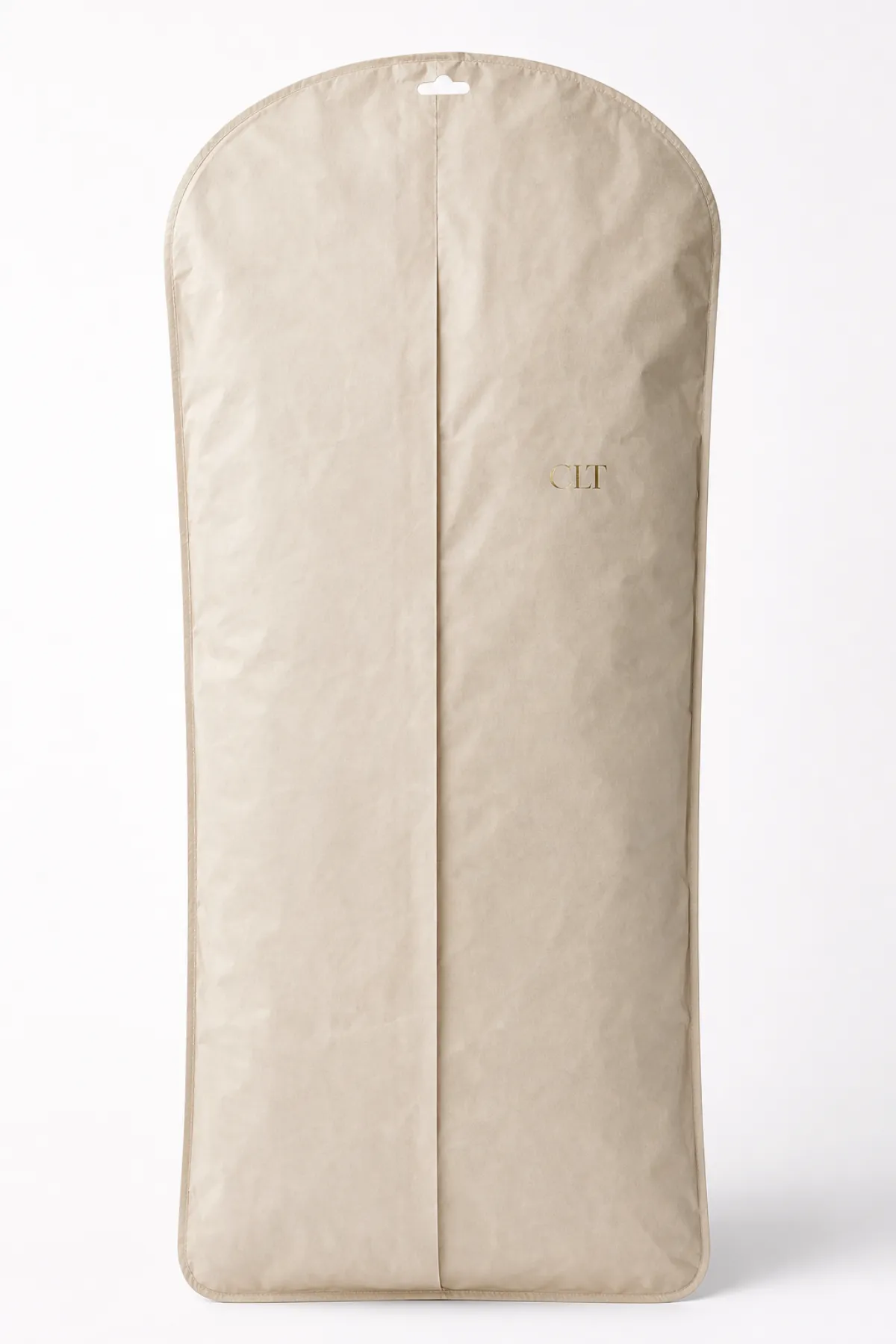
The lowest biodegradable garment bags manufacturer quote can look appealing until the missing details show up. No clear certification. No film specification. No seal-strength data. A vague description that could mean two or three different materials. Cheap pricing tends to hide uncertainty, and uncertainty gets expensive once the bags are already in motion.
A common retail failure looks like this. A garment ships in a bag that looks glossy and tidy. A few weeks later, the film feels dry and a little brittle. The print scuffs where cartons were stacked. By the time the customer opens the parcel, the garment may still be fine, but the packaging looks tired and neglected. That small visual miss changes the whole brand impression. A capable biodegradable garment bags manufacturer should know how to avoid that kind of slow failure.
The promise behind a biodegradable garment bag is not magic. It is controlled breakdown under defined conditions. That only matters if the resin, additives, thickness, seal design, and storage guidance all fit the way the bag will actually be used. A bag meant for short retail display is not the same thing as a bag that needs to sit in a warehouse for months before it reaches the customer.
Some buyers assume “biodegradable” means the bag can survive anything and then disappear later like it never existed. That is not how the material behaves. It still has to handle packing, transit, stacking, dust, ordinary garment movement, and the occasional rough touch from a busy picker or store associate. The right biodegradable garment bags manufacturer treats performance and end-of-life as linked requirements, not as separate sales talking points.
“A green claim means very little if the bag turns brittle before the garment leaves the stockroom.”
That line gets to the point. No one is buying a philosophy here. The product is a protective sleeve for apparel, and it has to do that job first. If it cannot hold up through ordinary handling, the sustainability story becomes decoration instead of function.
How a Biodegradable Garment Bags Manufacturer Builds the Bag
A good biodegradable garment bags manufacturer starts with the material, not the artwork. Production usually begins with raw resin or a blended compound, then moves through film extrusion, cooling, bag forming, sealing, cutting, and finally printing or labeling. Each step leaves a mark on the final result. If the gauge is uneven or the seal temperature drifts, the bag shows it later, sometimes in ways that are easy to miss during sampling.
Film extrusion is where much of the performance story begins. The manufacturer sets the thickness, clarity, and consistency of the film before the bag reaches the cutting stage. For garment bags, buyers often look at 20 to 40 microns for lighter retail use, then move into the 40 to 60 micron range when the bag needs more structure or a longer storage window. Thicker is not automatically better, and thinner is not automatically more sustainable. The right point sits in the middle, based on use case.
Material families behave differently. Compostable blends are designed to meet specific compostability standards. Bio-based content means part of the material comes from renewable sources, which does not automatically mean the bag will break down the way a buyer expects. Additive-assisted biodegradable films can help speed breakdown in certain environments, but the formula and disposal setting still control the real outcome. A serious biodegradable garment bags manufacturer should explain those differences in plain language, not hide behind broad claims.
Sealing is where weak bags reveal themselves quickly. A film that looks good on the roll can still split at the seam if the sealing line is uneven, the heat is inconsistent, or the cut edge is rough. Good manufacturers watch seal width, temperature control, edge curling, static buildup, haze, and odor. Odor matters too. Packaging should not smell sharp or chemical-heavy after a warm truck ride, and if it does, somebody in production missed something.
Printing has its own demands. Ink adhesion needs to survive rubbing, stacking, and light moisture exposure. If the design includes a logo, care symbols, size marks, or disposal instructions, the print has to stay readable. A biodegradable garment bags manufacturer with real printing discipline should be able to show rub-test results instead of relying on a sample that only looks perfect because it was photographed in ideal light.
Quality control is not a vague promise. It usually includes gauge checks, sealing checks, batch sampling, print inspection, and visual review for contamination or film inconsistency. If a supplier cannot describe how each run is checked, that tells you something useful, even if it is not the answer you hoped for.
For buyers who want a wider view of packaging testing, the ISTA test protocols are worth reviewing because transit abuse is where packaging claims get challenged fast. A bag that fails ordinary handling is not useful packaging, no matter how polished the sustainability language sounds.
Key Factors That Decide Performance, Shelf Life, and Compostability
Buyers comparing a biodegradable garment bags manufacturer quote often focus on price and print first. That leaves out the parts that decide whether the order works in real use. Film thickness, tensile strength, seal quality, transparency, anti-static behavior, storage stability, and the disposal standard all matter more than a polished sample alone.
Thickness and strength come first. A bag can feel substantial in hand and still perform poorly if the film structure is weak. Tensile strength and elongation show whether the material can flex without tearing. For apparel, especially hanging garments or folded premium pieces, the bag needs enough strength to handle movement, stacking, and repeated handling without turning fragile.
Shelf life is where the tradeoff becomes obvious. A biodegradable garment bags manufacturer may formulate a bag to break down under composting conditions, but the bag still has to stay stable in a warehouse, showroom, or fulfillment center. If heat, humidity, or long storage begin the degradation process before the bag is used, the packaging fails the first job it was built for. That is why storage guidance should never be treated as a footnote.
The disposal claim and the storage claim should be discussed together. Industrial composting, home composting, landfill behavior, and marine-degradation claims are not interchangeable. Buyers should ask what standard the bag is meant to meet and what environment actually triggers breakdown. The EPA offers useful public information on composting and waste handling, and it is a reminder that disposal systems vary widely by region and by municipal program.
A good biodegradable garment bags manufacturer should also provide documentation. Look for test references tied to standards such as ASTM D6400, ASTM D6868, EN 13432, or ISO 17088 where they apply. If a supplier points at a certificate but cannot explain what it covers, treat that as a warning sign rather than reassurance.
Transparency matters more than many buyers admit. Some brands want a crystal-clear bag because it feels premium on the rack. Others prefer a soft-matte look because it hides wrinkles and fingerprints better. Either way, the optical finish should match the garment presentation. Clarity that looks great in a sample can turn hazy if the film formula is off, especially after heat exposure.
Anti-static behavior is another practical detail that affects day-to-day use. Garment bags that cling, trap dust, or make sleeves bunch up create annoyance for warehouse teams and store associates. That is not a glamorous spec, but a solid biodegradable garment bags manufacturer will know how to reduce that problem without weakening the film structure.
Before requesting samples, buyers can use a simple comparison like this:
| Option | Typical Use | Common Price Range | Strength Profile | Risk Level |
|---|---|---|---|---|
| Stock biodegradable bag | Basic retail packing and quick launches | $0.08-$0.16 per unit at higher volumes | Moderate, depends on film blend | Lower if the fit is close enough |
| Custom printed bag | Branded apparel programs | $0.14-$0.32 per unit depending on coverage | Moderate to good if sealing is consistent | Medium if artwork and specs are clear |
| Certified compostable bag | Brands with formal sustainability claims | $0.18-$0.40 per unit, sometimes more for lower MOQ | Good when the material is matched to the use case | Higher if the disposal path is misunderstood |
| Heavy-gauge custom bag | Longer storage, premium garments, shipping protection | $0.22-$0.48 per unit | Higher stiffness and tear resistance | Medium, because thicker is not always greener |
The table is only a starting point. It does not replace samples or real use testing. A biodegradable garment bags manufacturer can quote any of these options, but the right one depends on garment weight, storage time, and the disposal outcome you actually need.
Biodegradable Garment Bags Manufacturer Process and Timeline
A reliable biodegradable garment bags manufacturer should follow a sequence that feels almost dull, because dull is often what keeps orders from going sideways. The usual flow is inquiry, material recommendation, sizing, artwork confirmation, sampling, pre-production approval, mass production, packing, and shipping. Skipping half of that usually means skipping quality too.
At the start, the buyer should provide garment dimensions, packaging goals, print needs, storage conditions, and the expected disposal route. That is not overkill. It is the difference between getting a bag that fits the job and getting one that looks fine in a quote but fails on the floor. A good biodegradable garment bags manufacturer will ask for those details before they give you a firm number.
Sampling usually takes 5 to 10 business days for a straightforward bag, with longer timelines for custom structures or more involved printing. If the supplier needs to source a special film or align certification paperwork, the schedule stretches. That is normal. Material sourcing takes time, and pretending otherwise does not help anyone.
Production lead time commonly lands in the 12 to 20 business day range after sample approval for standard custom orders, though larger or more complex runs can take longer. Full-color printing, special finishes, or unusual dimensions can extend that window. A biodegradable garment bags manufacturer should give you a real schedule, not a hopeful estimate dressed up as certainty.
Most delays happen in the familiar places: artwork revisions, unclear logo files, sample feedback that arrives late, color matching on the film, or waiting for approval on a detail that seemed minor until it affected the whole run. Clean vector artwork, exact dimensions, and a clear approval chain shorten the path more than any urgent email ever will.
Packaging near the end of the process matters too. Bags can be folded, stacked, packed in inner sleeves, or boxed in bulk depending on handling needs. That choice affects freight efficiency and final presentation. A biodegradable garment bags manufacturer with experience should be able to recommend a packing method that avoids crush damage and moisture problems during transit.
The fastest route is not usually the wisest one. A better approach leaves room for one sample revision and one artwork correction, because both happen often enough to plan for. If everything works on the first try, that is a pleasant surprise. If it does not, the schedule still has some breathing room, and that can save a project from getting messy.
Biodegradable Garment Bags Manufacturer Cost, Pricing, MOQ, and Quote Basics
Price is where many buyers get careless. A biodegradable garment bags manufacturer quote can look inexpensive until you discover it excludes plates, packaging, freight, certification costs, or a special bag size. Once the landed cost is added in, the “cheap” option can become the expensive one because the first quote was never complete.
Several factors drive cost. Material type is the biggest one, followed by bag size, thickness, seal style, print coverage, and order volume. Certification requirements add cost because documentation and testing are not free. Multiple ink colors or large print coverage push the unit price higher again. Low MOQ also raises cost, since setup has to be recovered across fewer pieces. None of that is unusual; it is just how the math works.
MOQ needs a plain explanation. Minimum order quantity is the smallest run a supplier will produce at the quoted price. Lower MOQ helps when you want to test the market, but it usually raises unit cost. Larger MOQ lowers the per-piece price and ties up more cash and storage space. A sensible biodegradable garment bags manufacturer should explain that tradeoff without acting as though the math is a nuisance.
For many buyers, a small test run makes sense at 1,000 to 3,000 pieces if the design is simple. Larger programs often start at 5,000 or 10,000 pieces to reach a better unit price. Those ranges are not fixed rules. They are the practical zone where pricing starts to work for both sides. The real goal is to match volume to risk, which is a lot more useful than chasing the lowest number on a quote sheet.
Quotes should be compared carefully. Ask whether the price includes tooling, printing plates, sample fees, freight, packaging style, and tax or duty assumptions. Ask whether the quotation is based on EXW, FOB, or door delivery. A biodegradable garment bags manufacturer that hides those details is making comparison harder on purpose, and that is never a good sign.
Use a quote-check list like this before choosing a supplier:
- Material: compostable blend, bio-based film, or additive-assisted biodegradable film
- Thickness: exact micron or mil spec, not “standard”
- Print: number of colors, coverage area, and whether ink adhesion is tested
- MOQ: piece count by size and by artwork version
- Lead time: sampling, production, packing, and shipping windows
- Compliance: what standard the bag claims to meet and what proof is available
If the quote includes paper inserts or outer cartons, ask whether those components are FSC-certified where that matters. FSC can matter when the sustainability message extends beyond the bag itself. A supplier should know whether those paper elements are part of the claim or just supporting material.
A practical biodegradable garment bags manufacturer does not just send a number. They help you understand what that number buys. If the price is 20 percent lower but the film is thinner, the print is weaker, and the MOQ hides extra setup charges, then the quote is not actually cheaper. It is only dressed that way.
Common Mistakes When Buying Biodegradable Garment Bags
The biggest mistake is assuming every green claim means the same thing. A biodegradable garment bags manufacturer may offer a film that is partly bio-based, fully compostable under industrial conditions, or only degradable under a specific environment. Those are not the same material story. They do not behave the same, and they do not fail the same way either.
Another common error is buying only on price or thickness. A bag can be thick and still seal badly. It can be clear and still craze under humidity. It can be branded cleanly and still split along the edge fold. Skipping samples means gambling that a brochure is more truthful than the production line. That is not a smart bet, and I would not recommend it to anyone who needs the bags to work in real operations.
Storage conditions are often ignored until something goes wrong. Heat, UV exposure, humidity, and long warehouse dwell times can all affect biodegradable films. If inventory cycles slowly, the bag has to tolerate that reality. A capable biodegradable garment bags manufacturer should ask about storage and shipment conditions before choosing the material, not after a complaint lands.
Print durability gets overlooked too. If the logo rubs off when cartons are moved, the bag starts to look cheap even when the garment inside is perfect. That matters more in premium retail and gift-ready packaging, where presentation is part of the product. Print testing should be part of the decision, not a bonus feature somebody remembers at the last minute.
Branding mismatch creates another problem. A company may make sustainability claims on the website but choose a bag that cannot support those claims with documentation. That invites awkward questions from retail partners and, worse, from customers. The right biodegradable garment bags manufacturer helps you stay aligned with what you can prove, not just what sounds nice in a pitch deck.
Real-use testing is the piece buyers underestimate most. A sample on a desk is not the same as a bag holding a heavy coat, sliding across a packing table, getting stuffed into an outer mailer, and sitting in a hot depot for two days. That kind of test surfaces weak spots quickly. If you want packaging that earns trust, test it the way it will actually live.
Expert Tips and Next Steps for Sourcing the Right Bag
If you are serious about sourcing, treat a biodegradable garment bags manufacturer like a technical partner, not a catalog page. Start with a shortlist of two or three suppliers, then request the same spec sheet from each one. That keeps the comparison clean and shows who is guessing versus who has actually built similar products before.
Use a simple validation checklist before placing a larger order:
- Load test: put the actual garment weight in the bag and check for strain.
- Seal test: inspect corners, edges, and closure strength after handling.
- Shelf test: store samples under your real conditions for at least 2 to 4 weeks.
- Print rub test: rub the logo and text against a similar surface.
- Fit test: confirm the bag dimensions work with your packaging workflow.
The checklist sounds basic because it is basic. Basic is good. A biodegradable garment bags manufacturer that passes these checks is far more likely to save you from a bad batch, a customer complaint, or a reprint later.
Define your disposal goal Before You Buy. Do you need industrial compostability, bio-based content, or a lower-plastic-footprint option without a compost claim? The answer changes the material, the documentation, and the price. If the disposal goal stays fuzzy, the supplier is forced to guess. Guessing is how weak packaging specs get created, and then everyone spends more time fixing the order than they would have spent specifying it properly in the first place.
From a buyer’s point of view, the smartest order is the one that balances use case and proof. Ask for certifications, ask for technical data, ask for samples, and ask the supplier to explain the limits in plain language. A good biodegradable garment bags manufacturer will answer those questions directly, without hiding behind buzzwords or a too-perfect sample photo.
If you want to move from research to action, define four items first: bag size, target MOQ, print requirements, and disposal standard. Then approach a biodegradable garment bags manufacturer with those specifics. The conversation gets faster, clearer, and a lot less expensive when both sides start from the same facts.
That is the practical way to buy packaging that does its job and still supports your sustainability message. A biodegradable garment bags manufacturer should help you protect the garment, protect the brand, and avoid the common trap of paying more for a greener claim that cannot survive real-world use. If you are building a spec this week, lock down the material family, the storage window, the proof standard, and the print method before you ask for price. That one step keeps the whole project grounded.
FAQ
How do I verify a biodegradable garment bags manufacturer is legit?
Ask for material specs, test reports, and certification details instead of trusting marketing language. Request samples and check seal strength, clarity, and storage stability in your own warehouse conditions. A legit biodegradable garment bags manufacturer should also explain the disposal standard the bag is designed to meet without dodging the question.
What is the usual MOQ for biodegradable garment bags?
MOQ depends on size, print complexity, and whether the bag is stock or fully custom. Lower MOQs usually cost more per unit, while larger orders reduce unit cost but increase inventory risk. Always ask whether MOQ changes when you add custom printing or special certification requirements, because a biodegradable garment bags manufacturer may price those separately.
How long does production usually take?
Timing varies by customization level, sampling revisions, and material availability. Simple stock-style orders move faster than custom sizes, specialty prints, or certified material runs. Ask for a realistic lead time that includes approval, production, packing, and freight booking, because a biodegradable garment bags manufacturer with a real schedule is easier to work with than one selling optimism.
Are biodegradable garment bags waterproof or strong enough for shipping?
Most are moisture-resistant to a practical degree, but they are not all meant for harsh wet conditions. Strength depends on film thickness, seal quality, and how much load the bag carries. If the bag must survive shipping abuse, test it with the actual garment weight and handling pattern. A competent biodegradable garment bags manufacturer will not overpromise here.
Why does one biodegradable garment bags quote cost so much more?
The price can jump because of better material, thicker film, larger size, or stricter certification needs. Print coverage, custom packaging, and low order volume also push unit cost up fast. Compare what is included in the quote before deciding one supplier is overpriced, because a careful biodegradable garment bags manufacturer may simply be quoting the real cost instead of the convenient one.

