Buyer Fit Snapshot
| Best fit | Biodegradable Packaging Supplier for projects where brand print, material claims, artwork control, MOQ, and repeat-order consistency need to be specified before quoting. |
|---|---|
| Quote inputs | Share finished size, material target, print colors, finish, packing count, annual reorder estimate, ship-to region, and any compliance wording. |
| Proofing check | Approve dieline scale, logo placement, barcode or warning zones, color tolerance, closure strength, and carton packing before bulk production. |
| Main risk | Vague material claims, crowded artwork, missing packing details, or unclear freight terms can make a low unit price expensive after revisions. |
Fast answer: Biodegradable Packaging Supplier for: Material, Print, Proofing, and Reorder Risk should be specified like a repeatable production item. The safest quote records material, print method, finish, artwork proof, packing count, and reorder notes in one written spec.
Production checks before approval
Compare the actual filled-product size with the drawing, then confirm tolerance on folds, seals, hang holes, label areas, and retail display edges. Reserve space for logos, QR codes, warning copy, and material claims before decorative graphics fill the panel.
Quote comparison points
Review material grade, print process, finish, sampling route, tooling charges, carton quantity, and freight assumptions side by side. A quote is only useful when the supplier can repeat the same color, closure quality, and packing count on the next order.
Biodegradable Packaging Supplier Guide for Smart Buyers
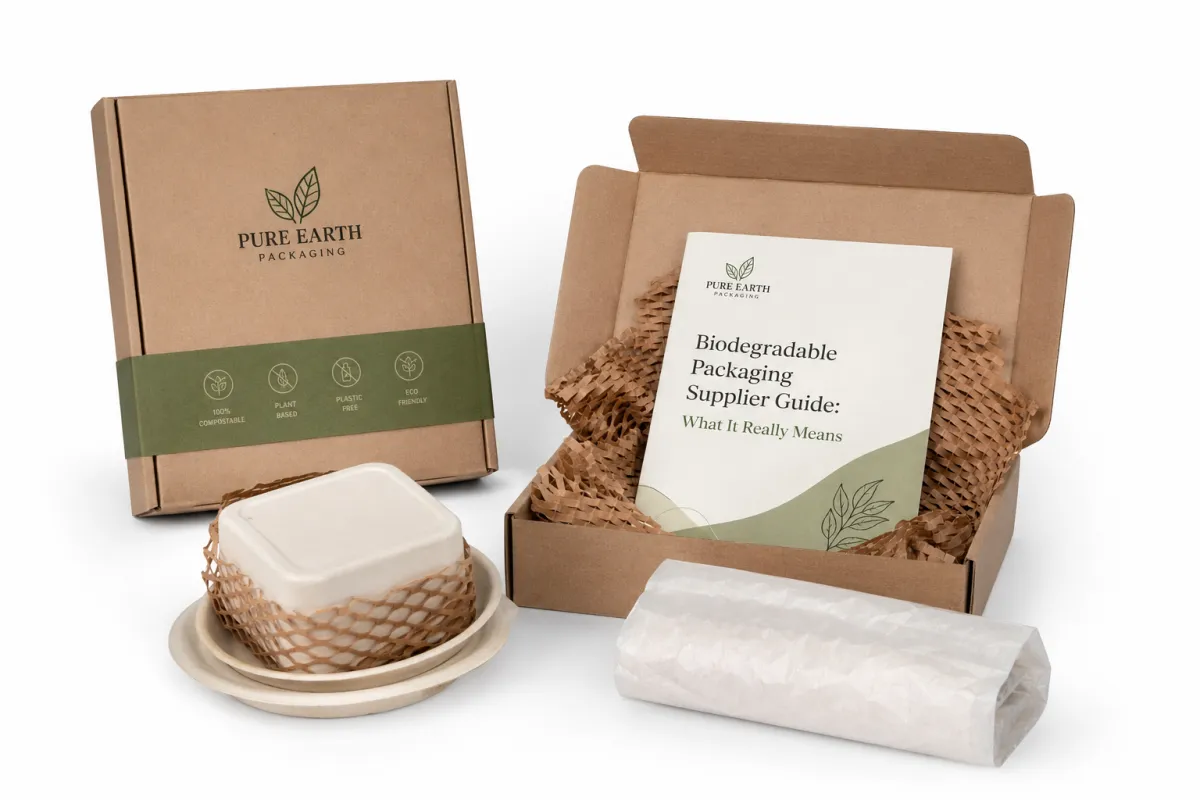
A bold “biodegradable” label can feel reassuring right up until the carton spends five humid days in transit, gets compressed under heavier freight, and arrives looking tired before the customer even opens it. That kind of mismatch is exactly why a biodegradable packaging supplier guide matters. The job is not to admire the green language; it is to pick the material, supplier, and production method that survive real shipping, real storage, and real scrutiny.
Packaging buyers usually get caught in the same trap. They treat eco language like a shortcut instead of a specification. In practice, a biodegradable packaging supplier guide means asking harder questions: What happens under heat swings, pressure, grease, long storage, and repeated handling? Can the supplier explain disposal routes without hiding behind glossy copy? Are the test results complete enough to audit and repeat? A credible supplier of sustainable packaging should answer those questions plainly, not with a bundle of vague promises.
Ignore those details and the package can fail before it ever reaches the end user. I have seen teams lose a launch week because a “compostable” sleeve curled after warehouse moisture exposure and printed beautifully, but only on paper. That is why this biodegradable packaging supplier guide matters more than any badge printed in a corner. It gives you a way to judge suppliers on product packaging reliability, commercial fit, and sustainability claims that still make sense outside the lab.
Biodegradable Packaging Supplier Guide: What It Really Means
Biodegradable is not automatic. It is conditional.
The biodegradable packaging supplier guide has to start with an inconvenient fact: biodegradable means a material can break down through biological activity, but only under defined conditions. Remove those conditions and decomposition can slow to a crawl. That distinction matters more than the label on the front panel, because customers live in warehouses, trucks, stores, and kitchens, not inside ideal test chambers.
The definitions need to stay separate. Biodegradable means a material can decompose, though the speed and completeness vary widely. Compostable is narrower and usually means breakdown in compost conditions into stable end products. Recyclable means the item can be recovered through the correct stream, even if it does not degrade quickly. Bio-based means the feedstock may be renewable, while the final product may still resist composting or biodegradation. The words sound related. The compliance burden is not. The distinction matters for eco-friendly packaging claims too, because the market often treats those words as interchangeable when they are not.
That difference shows up immediately on cartons, mailers, sleeves, and inserts used for branded packaging and Custom Printed Boxes. A structure can be bio-based and still carry coatings that do not break down. A box can be labeled biodegradable and still miss the disposal stream your customers actually use. The label is only the opening statement, not the proof.
In a supplier conversation, demand process language
That is why this biodegradable packaging supplier guide pushes the conversation toward process rather than slogans. Ask for handling data: humidity exposure, stack-load resistance, shelf life, and expected behavior after storage. If a supplier jumps straight to a one-line green claim and avoids conditions, that should slow the deal down. A good supplier will usually talk about the weak spots first, which is kinda refreshing in a market full of polished half-answers.
From experience, buyers move faster once they force every spec to carry two lives at once: an environmental profile and a performance profile. A food-contact sleeve can satisfy compostability language and still fail grease resistance in retail packaging tests. A transit tray can look strong in a dry warehouse and then fail after 10 days in tropical logistics. Nature is not neat about these things. Industrial composting conditions are not forgiving either, which is why exact test language matters more than optimism.
What this guide helps you evaluate
This biodegradable packaging supplier guide helps you compare five areas: material choice, performance tradeoffs, pricing behavior, claims verification, and production lead time. Run every supplier against the same checklist. Then decide whether your use case needs faster breakdown, better shelf support, premium print quality, or a lower-carbon balance that still behaves properly in shipping.
For teams working on retail packaging and e-commerce fulfillment, add one more column: storage path. Long warehousing in warm, humid conditions changes the answer quickly. Same-day delivery in a local market changes it in a different direction. A supplier who understands your operation will usually beat one who only understands presentation.
Use this biodegradable packaging supplier guide like a production sheet, not a brochure: “Can it pass stacking, moisture, printing, handling, and disposal tests in my environment?” If the answer is clear and documented, the decision is close.
How Biodegradable Packaging Works in Real Conditions
Environment drives behavior: heat, moisture, oxygen, microbes, and time
Warehouses are not gentle. Heat and moisture move faster than most procurement calendars. At higher humidity, starch-containing materials can soften and lose stiffness. PLA films may hold shape in dry conditions, then deform once humidity rises. Oxygen-starved environments also change decomposition speed. A package that looks promising in a lab can sit almost unchanged in an oxygen-poor commercial dumpster.
Breakdown requires microbial activity plus heat and moisture inside predictable ranges. In practical audits, many teams notice visible performance changes when ambient humidity stays above 60% for several days, especially with thin bio-based films. Dry, cool storage can preserve appearance, but it often slows breakdown. In a biodegradable packaging supplier guide, that tradeoff is not an exception. It is the baseline.
Timing matters too. Some claims say “up to 6 months,” others say “within 12 months.” Without a named test method and disposal pathway, those numbers do very little work. Treat any claim as incomplete unless it identifies condition, standard, and sample thickness. Otherwise, you are buying a sentence, not a performance standard.
Material families and where they perform best
How biodegradable packaging works in real conditions depends heavily on the substrate. Three common families show up again and again in commercial quotes:
- Molded fiber (often wood-fiber based): strong rigidity and cushioning for one-time mailers and inserts, though repeated wet cycles can weaken it fast.
- Kraft paper and corrugated cardboard structures: reliable rigidity for product packaging and shipping, but moisture-barrier coatings can slow biodegradation.
- PLA blends and starch-based films: lightweight, printable, and useful for flexible wraps, though heat resistance and cold brittleness vary more than buyers expect.
If the package will touch wet food residue, do not assume fiber is the correct answer. Starch-rich systems can absorb moisture and soften sooner than expected. In grocery and meal-kit flows, a PLA-based barrier film with a compost-certified coating can outperform on shelf stability. For dry but heavy loads, kraft paper with a controlled water-based barrier often handles better than a flashy alternative that looks sustainable but tears early.
Multilayer designs change end-of-life outcomes
One of the easiest details to miss in this biodegradable packaging supplier guide is the behavior of multi-material stacks. A base layer can be compostable while the coatings, adhesives, labels, and inks are not. A small solvent-based hot-melt layer can interrupt the breakdown pathway and keep the package intact long after the rest should have softened.
For packaging design teams, test the stack architecture as one system: wall construction, sealant layer, print ink, glue line, and anti-tamper strip. Even a thin clear PVC laminate can ruin a waste-stream strategy built with care. If a supplier cannot explain what each layer does, the “sustainable” claim is still unfinished.
Verification signals and marketing traps
Ask for concrete references: ASTM, EN 13432, and ISTA methods, internal lab reports, and disposal instructions that match your market. If a supplier says “industrial compostable,” ask for the process temperature, load, and retention time. Vague answers usually mean the supplier is selling confidence before they have evidence.
Authority matters here, but it should be used as a benchmark rather than a shield. Official references such as Packaging and Packaging Professionals help frame the terminology, while EPA plastic waste guidance helps ground disposal expectations. The strongest signal remains supplier transparency: full composition, layer stack, and the limitations that come with both. If the supplier is honest about where the material underperforms, that usually beats a slick pitch deck every time.
Key Factors for Choosing a Biodegradable Packaging Supplier
Check substrate quality, strength, barrier, and print in one decision
A biodegradable packaging supplier choice cannot be based on sustainability alone. Substrate quality, structural strength, barrier behavior, and print compatibility belong in the same review. A package can look polished in a sample room and still fail on your distribution line if edge crush strength is low or if ink adhesion drops after humidity exposure.
Take a common example. A sheet at 350gsm C1S with a moderate water-based matte coating can support clean package branding for premium retail packaging. If the die setup is off by ±0.8 mm, assembly tolerances start slipping and rejects begin at cartonization. The box may still look good in photos. It will not look good in a returns report, and the operations team will not be amused.
The same pressure applies to Custom Printed Boxes, where color quality influences brand confidence. Heavy ink coverage can hide micro-porosity, but some matte varnishes reduce biodegradation speed unless the system is certified end to end. Ask for the packaging design compatibility matrix. Know where it passes, where it struggles, and where a lighter print load is the safer call.
Match the supplier to the application stress
Reality checks pay for themselves. Does the package sit on wet pallets? Does it hold fatty products? Is stacking weight above 15kg? How long does it live in a garage, stockroom, or back office? Those questions separate a credible supplier from a brochure vendor. A low-weight mailer for 200g accessories is not the same thing as a box built for a 1.5kg heavy component.
Plant-floor experience is often where buyers learn this lesson the hard way. A supplier may promise excellent sustainability while your stack height and humidity profile require a different core structure. If you need anti-fog windows, high abrasion resistance, or peelable seals for longer shelf life, bring those requirements into the first round of discussion rather than the third revision. That saves a lot of back-and-forth, and honestly, a lot of bad coffee.
Look for compliance readiness and traceability
Ask for disclosures early: layer-by-layer composition, migration statements where required, and handling instructions by territory. In many categories, customers ask for evidence tied to standards such as FSC chain-of-custody for paper content and ASTM or equivalent compostability declarations for films. Retailers and marketplaces are pushing for the same thing from different angles: proof, not poetry.
“Show me the document number and revision date” is a small question with a large effect. A supplier who hesitates there can create a long week later. Good suppliers answer retailer questionnaires quickly because they keep QA files linked to each production run. That habit is worth more than a flashy pitch deck.
Customization depth and repeatability
For repeat launches, ask whether the supplier can reproduce the exact spec across the second, third, and fifth run. Tooling limits, color drift, and coating variation can create small changes that look harmless until consistency falls apart in custom printed boxes programs.
Minimum order quantity, color matching tolerance, and tooling reuse terms deserve the same scrutiny as biodegradation claims. A supplier with clear repeatability terms is usually the better long-term partner. In this biodegradable packaging supplier guide, repeatability belongs beside novelty, not behind it.
How Do You Choose the Right Biodegradable Packaging Supplier?
The fastest answer is also the safest one: choose the supplier that can prove fit across materials, testing, lead time, and end-of-life assumptions. A good biodegradable packaging supplier guide should narrow the field to three things you can verify: documented performance, clear disposal language, and repeatable production. If any one of those is missing, the package may still look good, but the risk stays in the file.
For a practical decision, compare the sample under the same load, the same climate, and the same print spec you will use at scale. Ask how the product behaves after 72 hours, after humidity exposure, and after a simulated transit cycle. A supplier who knows the limits of compostable packaging and bioplastic packaging is usually the one who can keep surprises out of production.
One extra safeguard: ask what the supplier would not recommend. Honest vendors will say, “I would not use this in a hot-fill application,” or “I’d avoid this for greasy takeaway lids.” That answer matters. It shows they have seen the material fail, not just win in a presentation.
Biodegradable Packaging Supplier Guide: Cost and Pricing Factors
How the final price is built
Buyers often see a green quote and assume price comes from material alone. That rarely holds. Landed cost is a stack:
- Raw materials: resin blends, fiber blends, adhesives, coatings.
- Conversion complexity: die-cutting, scoring, creasing, forming, lamination.
- Print coverage: solid dark inks can add 15% to 30% over light spot-color jobs.
- Finishing: coatings, soft-touch, foiling, embossing, perforation.
- Tooling: steel-rule dies, plates, and dies; hard-tool charges can reappear.
- Freight: especially when the package is volumetrically heavy.
- Quality checks: sample batches, pre-shipment tests, and hold testing.
That is why the biodegradable packaging supplier guide should compare cost drivers, not just headline unit pricing. A base film can look cheap until it needs a costly coating to meet moisture resistance. The same pattern shows up with glossy UV finishes and premium graphics. The quote changes once reality gets involved.
Realistic option ranges for planning
| Material family | Typical use case | Unit cost estimate (5,000 pcs) | Unit cost estimate (20,000 pcs) | Typical caveat |
|---|---|---|---|---|
| Molded fiber sleeve | Protective inserts, rigid mailers | $0.42 – $0.78 | $0.32 – $0.55 | Needs moisture-resistant topcoat in humid routes |
| Kraft paperboard carton | General branded packaging, retail branding | $0.28 – $0.46 | $0.20 – $0.34 | Layered coatings may affect decomposition claims |
| PLA + water-based barrier film | Flexible wraps, light pouches | $0.16 – $0.29 | $0.11 – $0.21 | Higher performance at specific temperature windows |
| Starch-based coated sheet | Small retail packs, inserts | $0.22 – $0.39 | $0.17 – $0.30 | More testing needed for cold-weather transport |
| Corrugated-cardboard structure | Heavy loads, distribution-ready shipping | $0.31 – $0.60 | $0.24 – $0.44 | Flame treatment and coating choices drive variation |
These ranges are planning ranges, not fixed quotes. They move with print method, finish, size, and supplier geography. A 120x180 cm sheet in short-run form costs differently than a compact 100x140 mm insert at the same material spec, and freight on cube can erase margin if the dimensions are too large for the job.
For this biodegradable packaging supplier guide, track hidden post-quote moves as carefully as the headline number. A supplier may quote $0.18 for 5,000 pieces and then add setup for die revisions, reruns, or extra QC when the launch date is already packed. That is not always bad faith, but it does need to be visible early.
Why a higher price can still be right
Biodegradable options may look expensive at first glance, yet a better package can reduce damage, simplify compliance, and lower returns enough to offset the difference over a quarter. A strong supplier can trim waste through better design intent while keeping package branding steady and customer confidence intact.
I will say this plainly: lower price is not always better. In jobs with strict brand presentation, moisture control, or long shelf windows, the cheaper route can lose value the moment breakage and rework begin. Unit price is only half the decision in this biodegradable packaging supplier guide.
Questions that should never be skipped
Before approval, ask five concrete things: what changes at 10,000, 20,000, and 50,000 volumes; what exactly is included in the quote; whether color and finishing stay stable; how long pricing remains valid; and what happens if raw material costs rise by 10%. If the quote only holds for a week in a volatile market, the risk is already part of the price.
Step-by-Step Supplier Evaluation and Timeline
From inquiry to approved design: a practical sequence
The workflow that holds up in commercial settings starts with a one-line definition of the application: dimensions, target unit load, expected humidity, channel, and shelf life. Add your existing dieline if you have one, then include distribution assumptions. Clarity at the front end saves time later, which is where most projects leak it.
Request samples from at least three suppliers using the same product spec. The biodegradable packaging supplier guide should function as the standard reference file: same size, same material basis weight range, same print colors, same finish, same disposal language. If the inputs differ, the comparison stops being useful.
Next, compare data sheets and ask for missing lab references. When two suppliers offer similar graphics but only one provides method notes, the one with documentation usually wins on execution reliability. Narrow the field to two or three, then run a controlled comparison before scaling up.
Typical timeline for custom work
A common timeline for custom biodegradable projects looks like this:
- Day 1–3: inquiry intake, technical brief, and first cost pass.
- Day 4–10: sample build, material checks, and first revision review.
- Day 11–16: proof corrections, test samples, and compliance documentation requests.
- Day 17–24: pre-production approval, final artwork lock, production planning.
- Day 25–40: first production lot and inspection.
Simple stock-based orders can move much faster. Complex custom structures with multiple test requirements can stretch the calendar. A claim like “we can do it in 10 days” needs a closer look at what is included and what is excluded. If the supplier avoids timing details, assume friction is hiding in the gaps.
Where delays usually appear
Delays usually appear in four places: artwork approval, missing technical data, tooling revisions, and late discovery of performance issues. Any one of those can add 3 to 8 business days. In a high-volume release cycle, that can cost the entire sales window.
Frequent failure points include underestimated moisture-barrier targets, unapproved varnish systems, and vague disposal instructions. If a supplier cannot explain disposal in clear language, escalate the question early. That is exactly where this biodegradable packaging supplier guide pays back the time spent reading it.
Simple evaluation matrix you can apply
Use a weighted scorecard; here is a practical format:
- Performance and durability (30%)
- Material claim credibility and documentation (20%)
- Price and total cost clarity (20%)
- Response speed and communication quality (15%)
- Delivery reliability and tooling readiness (15%)
Score only what is evidenced. If two suppliers tie on cost, choose the one that explains assumptions and testing in plain language rather than in polished fragments.
Common Mistakes When Vetting Biodegradable Suppliers
Assuming biodegradability means universal breakdown
One serious mistake is treating every biodegradable claim as if it leads to the same result. It does not. Disposal behavior is constrained by environment. A claim that works in industrial composting may fail in home bins or mixed-waste systems. That mismatch creates confusion for customers and invites reputational damage for the brand.
Buying on lowest price without proving functionality
The cheapest option often fails in the place that matters most: transit integrity. A thin biopolymer mailer may survive a shelf display and then collapse under stacked truck loads. A seal that looks clean in a sample room can fail under humidity and stain the product or release odor.
In this biodegradable packaging supplier guide, the lesson is blunt. Ask for stress, barrier, and storage verification using the actual use case. If a supplier says, “usually passes,” ask “under what conditions, and with what test data?”
Skipping real-world performance tests
Many teams skip the practical checks: stack compression, seal retention after 72 hours, and color hold after transport simulation. They skip high-ratio sample tests on edge wear too. Those are the failure modes that trigger returns and emergency reprints. A glossy brochure without field-relevant evidence is not a substitute for a test plan.
Treating certification language as marketing filler
Vague claims still show up everywhere. “Biodegradable,” “environmentally friendly,” and “plant-based” are broad phrases. If the supplier cannot name the test standard, compost condition, and caveats, treat the claim as unfinished rather than impressive.
Trust is built in a straight line: specific answer, specific number, specific condition. That is not paperwork for its own sake. It is operational control.
Biodegradable Packaging Supplier Guide: Expert Tips and Next Steps
Build a tight comparison process
Execution comes next. Identify two or three suppliers, then request matched proposals against one spec packet. Keep packaging dimensions, artwork, finish, and test requirements identical. If one quote uses 150gsm and another uses 190gsm without calling it out, the comparison is already distorted.
Use your biodegradable packaging supplier guide as a living review document during quote analysis. It saves more than time. It cuts the chances of emotional decision-making, which tends to rise when the launch clock gets loud. In this format, every buyer can explain why supplier A, B, or C wins before production approval.
Create a short approval checklist
Build a one-page checklist covering material makeup, performance behavior, price, lead time, documentation, and disposal guidance. Assign owners: technical, quality, sustainability, and procurement. In the biodegradable packaging supplier guide workflow, every field should be filled before a purchase order moves forward.
Ask for samples that reflect actual handling. For custom packaging, run a humidity-chamber hold if your climate profile is heavy. Confirm whether labels remain bonded after moisture sweeps. Confirm whether your colors still carry brand intent in the finished product, not only in the monitor proof. That is where package branding can drift without warning.
Pilot before scale, especially for complex structures
If the run matters, pilot 500 to 1,000 units before full approval. A pilot catches hidden issues cheaply: coating lift, die-line creep, and seam stress in transit. Once the supplier proves repeatability, scale in matched lots with confidence.
For teams buying branded packaging, pilot data can also support packaging design and sales collateral. You can show the exact package behavior to procurement and marketing instead of waiting for a complaint cycle. If performance holds, the matched-spec matrix makes scale decisions much easier.
If you are evaluating materials for more than one customer market, keep procurement files clean: one spec sheet per market, one lab request per candidate, one version log for every update. That discipline builds long-term control and reduces surprise when the market shifts under you.
Practical rule: choose the supplier that can explain failures before success, because that person also knows how to prevent your first production incident.
This biodegradable packaging supplier guide works best as a decision tool rather than a glossary. Compare suppliers on concrete outcomes, not ad language, and validate claims against your actual retail packaging reality. You can review materials in your Custom Packaging Products library, and if technical alignment is still fuzzy, your team should request a direct feasibility call through supplier consultation before committing.
One final point from the field: a supplier who can describe the failure mode before the sample arrives usually saves you more money than the lowest bid ever will. Keep this biodegradable packaging supplier guide close during review, and use it to protect the brand promise from the factory floor to customer handoff.
FAQ
How do I know if a biodegradable packaging supplier is credible?
Ask for material declarations, test reports, and certification identifiers first. A credible supplier should explain disposal conditions in practical terms: temperature, humidity, bin type, and time. Ask how they control repeatability across runs, especially for custom printed boxes. If the answer is precise and consistent, that is a good sign. If it changes every time, keep looking.
What should I compare when reviewing biodegradable packaging supplier quotes?
Compare substrate type, print coverage, finishing, minimum order quantity, tooling, sampling fees, and freight on the same basis. Ask for every hidden charge before approval: extra coating, revised die, sample revisions, and special QA holds. Confirm how long the quote remains valid and at what volume threshold. A quote with missing assumptions is not really a quote; it is a guess with a logo on it.
How long does it usually take to source biodegradable packaging from a supplier?
Stock items can move quickly, but custom packaging usually needs sampling, technical review, and approval. In many projects, inquiry to pilot approval takes 3 to 6 weeks depending on artwork readiness and required testing. Add time if barrier or transport testing is mandatory. The timeline gets longer when the brief is fuzzy, so the cleanest path is to define the spec before the first sample request.
Can biodegradable packaging also be cost-effective for my business?
Yes, if it prevents damage, lowers returns, and supports long-term positioning. The best value appears when the material fits the actual use case. Do not overbuild the structure; a precise fit often costs less than broad over-specification. Sometimes the smarter spend is the material that performs exactly well enough, not the one with the loudest sustainability claim.
What should I ask before switching to a biodegradable packaging supplier?
Ask where the package is meant to be disposed of, which standards and certifications are referenced, and what practical limits apply. Confirm behavior in your real climate and transport route, then request matched samples tested under those same conditions. A strong biodegradable packaging supplier guide should always lead back to evidence, not assumptions. If the supplier can walk you through the tradeoffs without flinching, you are in better shape than most buyers.


