Buyer Fit Snapshot
| Best fit | biodegradable paper bags for retail for packaging buyers comparing material specs, print proof, MOQ, unit cost, freight, and repeat-order risk where brand print, material, artwork control, and repeat-order consistency matter. |
|---|---|
| Quote inputs | Share finished size, material target, print colors, finish, packing count, annual reorder estimate, and delivery region. |
| Proofing check | Approve dieline scale, logo placement, barcode or warning zones, color tolerance, and any recyclable or compostable wording before bulk production. |
| Main risk | Vague material claims, crowded artwork, or missing packing details can create delays even when the unit price looks attractive. |
Fast answer: Biodegradable Paper Bags for Retail: What Actually Matters should be specified like a repeatable production item. The safest quote includes material, print method, finish, artwork proof, carton packing, and reorder notes in one written spec.
What to confirm before approving the packaging proof
Check the product dimensions against the actual filled item, not only the sales mockup. Ask for tolerance on folds, seals, hang holes, label areas, and retail display edges. If the package carries a logo, QR code, warning copy, or legal claim, reserve that space before decorative graphics fill the panel.
How to compare quotes without losing quality
Compare board or film grade, print process, finish, sampling route, tooling charges, carton quantity, and freight assumptions side by side. A lower quote is only useful if the supplier can repeat the same color, closure quality, and packing count on the next order.
Biodegradable Paper Bags for Retail can look simple on a screen and still fall apart in the real world, which is usually where the trouble starts. I have seen bags split at the door, wrinkle in humid stockrooms, and arrive with a finish that looked polished in the proof but tired by the time it reached the customer’s hand. A green label does not rescue a weak build. If the bag fails during checkout or on the short walk to the car, the packaging decision was off no matter how nice the mockup looked.
From a buyer’s point of view, biodegradable paper bags for retail need to do three jobs at once: protect the product, support the brand, and leave a disposal story that makes sense in the market where the bag will actually be used. Miss one of those, and the order can feel expensive even when the unit price looked friendly. Pretty on the shelf, weak in the hand. That happens more often than teams like to admit, and it is usually because the spec got less attention than the label.
Biodegradable paper bags for retail: what they are and why stores switch
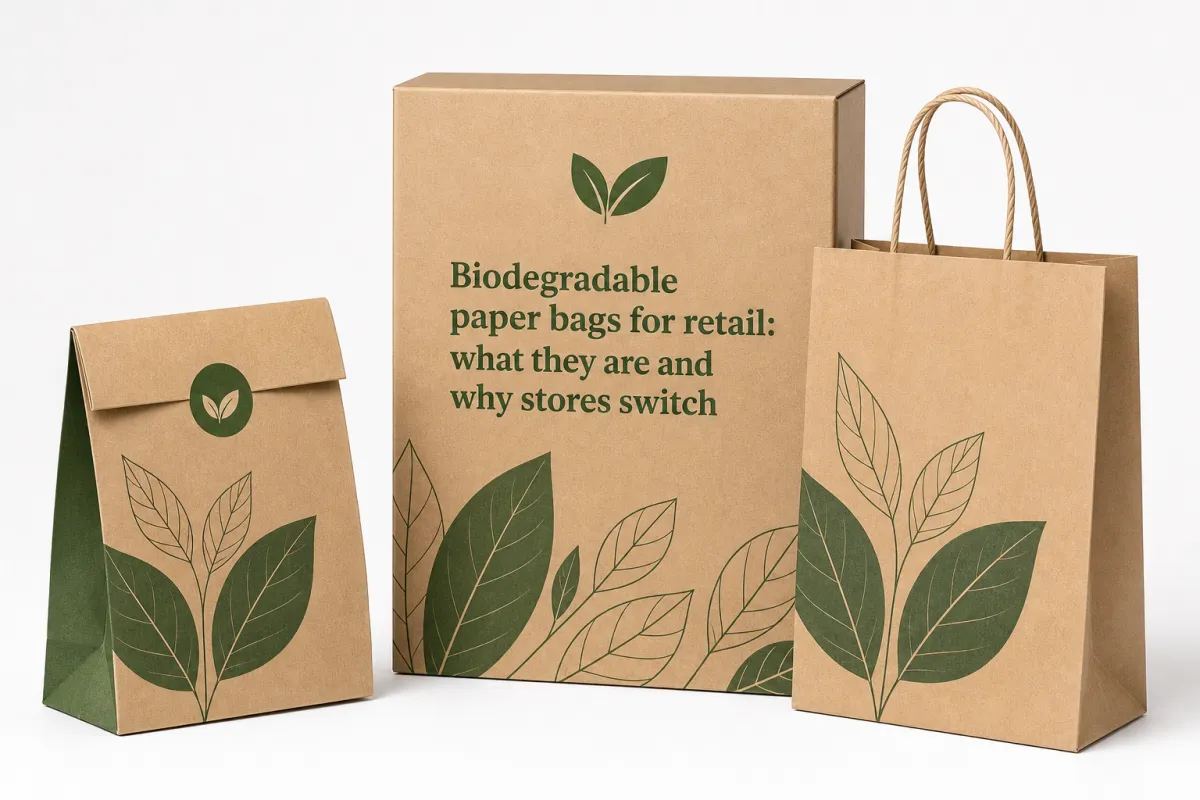
Biodegradable paper bags for retail are paper bags made from fiber and related materials that can break down through biological activity over time. In plain English, microorganisms can consume the material when the conditions are right. The paper itself is only part of the story, though. Adhesives, inks, coatings, handles, and reinforcement patches all affect what happens after the bag leaves the store. A bag that looks like clean kraft packaging may still have treatments that change its end-of-life behavior.
Most retailers switch for practical reasons first. Gift shops want a cleaner look than plastic. Apparel stores want packaging that feels calmer and more premium than a thin carrier bag. Cafes want takeaway packaging that does not look careless. Boutiques want a bag that supports the brand without turning every handoff into a tiny environmental speech. Biodegradable paper bags for retail sit in that middle space nicely when the structure is right and the finish does not overreach.
The messy part is that biodegradable, compostable, recyclable, and recycled-content are different claims. A bag can be biodegradable and still not fit a local composting stream. It can be recyclable and still fail when it gets wet. It can include recycled content and still tear too easily if the paper weight is too light. Buyers mix those up all the time, then wonder why operations push back after the order is placed.
For biodegradable paper bags for retail, the real question is whether the bag matches the actual use case. Will it hold a candle, a folded sweater, a pastry box, a fragile gift, or a stack of cosmetics? Will it survive a rainy sidewalk, a humid stockroom, or a holiday queue that stretches down the aisle? A bag is not a virtue signal. It is packaging. If it does not work, the sustainability story does not help much.
Most stores that move to biodegradable paper bags for retail are trying to balance appearance and performance. They want the customer to feel the packaging was chosen with care, not pulled from the cheapest line item in the spreadsheet. That instinct is sound. The mistake is stopping at the word “biodegradable” and ignoring the spec sheet, where the real decisions live.
A bag that survives checkout, transport, and a damp sidewalk usually beats one that only photographs well. Packaging has to travel. If it falls apart in the first five minutes, the label did not rescue it.
One practical way to think about biodegradable paper bags for retail is this: the bag should match the product, the store environment, and the disposal path. If those three do not line up, the bag may still look nice, but it will not be a smart purchase. That is the kind of detail that saves a re-order later.
How biodegradable paper bags for retail break down in real life
Biodegradable paper bags for retail do not disappear just because a spec sheet says “eco-friendly.” Breakdown depends on the material stack and the environment around it. Kraft fiber is usually the main body material, but the seam adhesive, the print ink, the handle attachment, and any surface treatment all change how the bag behaves over time. A plain kraft bag with water-based ink behaves very differently from a heavy printed bag with a barrier coating and reinforced handles.
In real life, decomposition depends on heat, moisture, oxygen, microbes, and time. Put the same bag in a dry warehouse, a damp curbside bin, and an active composting system, and the outcome changes each time. That is why biodegradable paper bags for retail should never be sold as if they vanish in a dry storage room by Tuesday afternoon. If the environment is wrong, breakdown slows down a lot. Packaging does not care about our optimism, which is a little rude but true.
There is also a difference between paper that biodegrades and paper that composts under defined conditions. Compostable claims usually need a specific test path and often an industrial composting environment. Biodegradable is broader, but broader does not mean better. If a supplier cannot explain the claim in one clear sentence, the environmental story is probably thinner than the bag.
Barrier treatments need extra attention. A grease-resistant or moisture-resistant coating can make biodegradable paper bags for retail much more useful for cafes or food counters, but that same layer may slow decomposition or complicate disposal claims. Sometimes that tradeoff makes sense. Sometimes it does not. The buyer has to decide whether product protection matters more than a cleaner end-of-life story.
If you want a quick sanity check, ask three questions: What is the fiber source? What holds the structure together? What happens to the finish after disposal? That last one matters more than most people think. A bag can be made from paper and still carry chemistry that changes its fate. For a broader view of waste and recycling behavior, the EPA recycling guidance is a useful reference point.
Biodegradable paper bags for retail usually fit best when the disposal path is straightforward and the bag does not need aggressive barrier performance. They are less useful when the product is wet, oily, very heavy, or expected to survive repeated handling. That is not a moral failure. It is packaging reality.
If a supplier can describe the material stack cleanly, that is usually a good sign. Example: “120gsm kraft, water-based ink, twisted paper handle, no plastic lamination.” That is a real sentence. It tells you something. A vague answer like “premium sustainable bag solution” tells you almost nothing.
Cost, pricing, and MOQ: what actually changes the quote
Price is where biodegradable paper bags for retail get misunderstood quickly. Buyers see a unit quote and think they know the total. They do not. The final number moves with size, paper weight, handle style, print coverage, coating, reinforcement, packaging method, and the order quantity. If someone calls the price “competitive” without explaining those factors, I usually assume the real tradeoff is being hidden somewhere.
MOQ matters because setup cost has to be spread across the order. Small runs usually carry higher overhead per bag, while larger orders can bring the unit cost down sharply. For many custom retail jobs, a simple build might start around 1,000 to 3,000 bags, while more complex printed work often makes better sense at 5,000 pieces or more. The quote curve is not linear. It rarely is. A jump from 2,000 to 5,000 bags can change the per-unit price more than buyers expect.
Here is the part people skip: quote components. Material is only one line. Printing plates or setup, cutting dies, handle assembly, folding labor, carton packing, freight, and testing all matter. For biodegradable paper bags for retail, compliance or certification work may also add cost if the buyer needs FSC documentation or third-party support. That is normal. The cheap quote that leaves out half the process is not cheap. It is incomplete.
| Option | Typical Spec | Indicative Unit Price at 5,000 pcs | Best For | Tradeoff |
|---|---|---|---|---|
| Basic kraft retail bag | 120-140gsm kraft, twisted handles, 1-color print | $0.18-$0.30 | Gift shops, small boutiques, general counter use | Lower finish quality; fewer premium cues |
| Mid-range custom bag | 140-170gsm kraft, reinforced bottom, 1-2 color print | $0.28-$0.48 | Fashion, cafes, branded retail chains | Better structure, but print coverage adds cost |
| Heavy-duty retail build | 170gsm+, reinforced handles, specialty finish | $0.45-$0.90 | Heavier products, premium presentation | Highest cost and more disposal complexity |
Those ranges are not promises. Freight, region, and paper market swings can move them. They still help because they show the spread. A buyer comparing biodegradable paper bags for retail needs to see the difference between “cheap enough” and “cheap enough to survive the floor.” That gap is real.
The best way to judge value is landed cost, not unit price alone. If a supplier offers a low piece price but the bags arrive in poor cartons, need repacking, or fail basic carry tests, the real cost climbs fast. I would rather see a slightly higher quote that includes clean packing, clear specs, and fewer surprises than a bargain quote that creates three more problems downstream.
If you are comparing suppliers, ask for the same spec on every quote. Same paper weight, same handle type, same print coverage, same carton count, same freight basis. Otherwise you are not comparing prices. You are comparing fiction. That sounds blunt, but it saves a lot of bad decisions.
Process and timeline: from sample to shipment
Biodegradable paper bags for retail usually move through a familiar path: brief, quote, artwork review, sample or proof, production, quality check, packing, and freight. The sequence is simple. The delays are not. Most schedules slip because the brief was vague, the artwork was not print-ready, or the buyer changed something after approval. Manufacturing is not psychic.
For a simple custom order, a realistic range is often 10 to 18 business days after proof approval for production, plus transit time. Heavier print coverage, special finishes, or larger quantities can push that longer. If the supplier is also preparing pre-production samples, add time for that. If the season is busy, add more. If you need biodegradable paper bags for retail for a launch date, build in buffer instead of pretending the factory can ignore physics.
Samples matter because a screen image cannot tell you how a bag folds, creases, feels, or carries weight. A flat digital proof only proves the artwork can be placed on the layout. It does not prove the bag works. Test the sample with the actual product, not a generic box from the back shelf. Biodegradable paper bags for retail can look fine in a PDF and still fail when a customer loads a sharp-edged item or a damp takeaway container.
Here is a practical timeline that works for a lot of retail buyers:
- Day 1-2: Share dimensions, artwork, quantity, and target disposal or certification needs.
- Day 3-5: Review the quote and confirm the exact spec sheet.
- Day 5-10: Check digital proof or physical sample.
- Day 11-25: Production, inspection, and packing.
- After production: Freight, customs if needed, and final receiving.
That schedule is not fancy. It is useful. A lot of packaging trouble comes from people treating the bag order like a coffee order. It is not. Biodegradable paper bags for retail need real sign-off, especially if the bag will sit front-facing in the store and be handled by every customer all day.
For buyers managing sustainability claims or fiber sourcing, FSC paperwork can be part of the review. The FSC site is a sensible place to understand what certification does and does not mean. The key point is simple: a certificate is not a substitute for a working bag, and a working bag is not a substitute for the right paperwork.
Key factors that decide strength, print quality, and shelf life
Strength starts with paper weight and fiber quality. A lighter kraft bag might be perfectly fine for jewelry, a folded T-shirt, or a small takeaway item. Push that same spec into a heavy product, and you get handle stress, bottom distortion, and a bag that feels flimsy before the customer even leaves the counter. Biodegradable paper bags for retail need to match the load, not the catalog photo.
Handle style and bottom construction matter more than many first-time buyers expect. Twisted paper handles usually give a cleaner retail look and a decent load path, while flat handles can be more economical on lighter bags. Die-cut handles work for certain premium looks but do not suit every product weight. A reinforced bottom adds confidence, especially for boxed goods or multiple items. If the bag has to stand up in a display, the base is doing more work than anyone wants to admit.
Print quality is another major variable. Deep solids, fine logos, and detailed type need the right paper surface and ink behavior. Heavy ink coverage can make biodegradable paper bags for retail look sharp, but too much ink on light paper can cause curling or a dull finish. Water-based inks usually fit the sustainability story better than aggressive coatings, but they still need proper drying and color control. That part is boring until it goes wrong, and then it becomes everyone’s favorite topic.
Shelf life is less glamorous and far more important than people think. Humidity, stack pressure, and warehouse temperature can change a bag before it ever reaches the store. If the cartons sit too long in damp storage, handles can weaken and paper edges can lose their crispness. For retail operations, that means the packaging spec has to cover not just appearance, but storage behavior too.
The balancing act is easy to describe and annoying to get right: enough structure to protect the product, but not so much treatment that the bag becomes overbuilt for no reason. Biodegradable paper bags for retail should feel honest. If the product is light, do not spec a bag like it is carrying bricks. If the product is heavy, do not save ten cents and hope customers do not notice the split bottom.
One practical test is the hand-carry test. Load the bag with the real item, walk a short route, set it down, pick it up again, and inspect the corners and handles. Then repeat after the bag has sat for a while in a warm or humid room. That small test catches more issues than a glossy quote ever will.
Retail buyers also need to think about presentation after purchase. A good bag should still look clean after the customer has carried it, folded it, or set it in a car seat. Biodegradable paper bags for retail are part of the brand experience. If they arrive wrinkled or sagging, customers notice. Customers notice everything, unfortunately.
Step-by-step guide to choosing the right retail bag spec
Start with the product, not the bag. Measure width, height, depth, weight, and any problem points like moisture, sharp edges, or awkward shapes. A candle box behaves differently from folded apparel. A pastry container behaves differently from a rigid cosmetic set. Biodegradable paper bags for retail should be chosen after the product spec is understood, not before. That sounds obvious, but it is still where buyers get tripped up.
Next, decide on the bag structure. Flat handle, twisted handle, rope handle, or die-cut? The answer depends on how the customer will carry the item and how the store packs the bag. If the bag is mostly for quick counter use, a simpler handle may be enough. If the store wants a more premium feel, twisted handles or reinforced constructions can lift the presentation. Structure comes first because it controls the rest of the build.
Then choose print and finish. Not the other way around. Too many orders start with “we want a beautiful finish” and end with a bag that costs too much and performs too little. Keep the branding honest. If you only need a logo and one accent color, do that well. If you want a fuller brand story, make sure the paper and ink system can support it without warping the bag. Biodegradable paper bags for retail are not a canvas for every idea in the room.
Here is a simple order of operations that saves time:
- Confirm the product dimensions and load weight.
- Pick the bag style and handle type.
- Set paper weight and reinforcement needs.
- Define print area, colors, and finish.
- Request a sample or proof.
- Test with the real product in the real workflow.
- Approve only after the bag survives the test.
Sampling is not a luxury. It is insurance. Ask for at least one physical sample if the order is custom or if the product is heavier than a normal lightweight retail item. In some cases, two or three sample variants are better than one, especially if you are deciding between a lighter bag with a nicer look and a heavier bag with better carry strength. Compare them side by side. Put the actual product in each one. Watch the handles, bottom seam, and print rubbing. That is where the truth lives.
Only lock the spec after the sample passes. Biodegradable paper bags for retail should be selected for performance first and marketing second. That order matters. Packaging That Works earns its branding. Packaging that fails just gets blamed by everyone in the room, which is usually deserved.
Common mistakes to avoid and expert tips before you order
The biggest mistake is chasing the greenest-sounding claim without checking the disposal plan. Biodegradable paper bags for retail still need a realistic end-of-life path. If your market has no composting access, or if the bag includes treatments that complicate disposal, the claim may not deliver what the buyer expected. Do not buy a label. Buy a spec that fits the system around it.
Another common error is over-specifying the bag. Heavy coatings, oversized paper weight, extra print passes, and decorative finishes can make the bag feel premium, but they can also push cost and reduce practical usefulness. If the product inside is light, a simpler build often looks cleaner and performs better. The bag should support the sale, not swallow the margin. That is especially true for biodegradable paper bags for retail, where the sustainability story can tempt people into overengineering the job.
Skipping the sample test is the classic rookie move. A supplier spec sheet will not tell you whether the handle creaks, whether the fold sits crooked, or whether the ink scuffs against other cartons. Only a real sample can do that. Test the bag with actual staff at the register, not just someone from the office holding it for two seconds and declaring victory.
Two expert tips save a lot of trouble. First, compare two or three sample variants under the same conditions. One may be slightly lighter but better balanced. Another may cost more but survive much better in daily use. Second, build a one-page buying checklist. Include product size, weight, desired look, disposal claim, paper weight, handle style, print colors, MOQ, lead time, and landed cost. If all of that is not on one page, the order is probably not fully defined yet.
For biodegradable paper bags for retail, the smartest buyers also ask for clear documentation before they approve. They want the exact material stack, the print method, the finish, and the packing details. That level of clarity is not overkill. It is what keeps the reorder smooth later. Nothing ruins a packaging program faster than a “we think it was this spec” conversation three months after launch.
Expert tip number three: think about storage. If the bags will sit in a humid stockroom, stack near a delivery door, or travel through long freight routes, the final spec may need a little extra structure. That is not because every bag should be overbuilt. It is because real retail operations are not climate-controlled museums. They are messy. The bag needs to survive that mess without becoming a science project.
Final take
Biodegradable paper bags for retail work best when the buyer treats them like a packaging decision, not a branding slogan. The bag has to match the product, the store workflow, and the disposal story. Get those three aligned, and the result feels clean and intentional. Miss them, and the bag becomes an expensive reminder that “eco” is not a substitute for decent engineering.
That is why I keep coming back to the same advice: ask for the exact material stack, compare landed cost, test the sample with the real product, and do not approve a quote until the bag survives the floor. Biodegradable paper bags for retail can be a smart, polished choice for gift shops, boutiques, cafes, and apparel stores, but only when the spec is honest and the buyer is willing to look past the label. If you want the packaging to support the brand, start with function, then finish with presentation. That order is gonna save you a lot of regret later.
Are biodegradable paper bags for retail actually compostable?
Not always. Biodegradable and compostable are different claims, and people blur them constantly. Biodegradable paper bags for retail may break down over time, but compostability usually depends on a specific material stack, a defined test standard, and an industrial composting environment. Home composting is a different situation entirely. If the supplier cannot show the exact claim path, assume the answer is no until proven otherwise.
What affects the cost of biodegradable paper bags for retail the most?
Bag size, paper weight, handle type, print coverage, and finish are the main drivers. MOQ changes the unit cost fast because setup charges get spread across fewer pieces. Freight, packaging, and testing can matter more than buyers expect on smaller orders. For biodegradable paper bags for retail, the cheapest quote is only useful if it includes the full spec and still works on the floor.
How long is the lead time for custom biodegradable retail paper bags?
Simple orders can move in roughly 10 to 18 business days after proof approval, while heavier print, special coatings, or larger volumes often take longer. Add time for sampling, artwork revisions, and freight. Biodegradable paper bags for retail usually get delayed by slow approvals, not by the machine itself. The machine waits. People do not.
What paper weight should I choose for retail paper bags?
Light gift or accessory bags often work in the lower paper-weight range, while standard retail use usually needs a mid-range spec with stronger handles and a stable bottom. Heavier products should always be tested with the real item instead of guessed from a catalog. Biodegradable paper bags for retail should be chosen by load and handling, not by wishful thinking.
How do I know if a supplier gave me a good quote for biodegradable paper bags for retail?
Ask what is included: printing, tooling, packaging, freight, and testing. Compare landed cost, not just unit price. If the supplier will not share a clear spec sheet and a sample path, the quote is not as good as it looks. For biodegradable paper bags for retail, clarity is part of the product. If the quote is vague, the order probably will be too.
Before you place the order, lock the product dimensions, material stack, handle type, and disposal claim on one page, then approve only after a physical sample proves the bag can carry the real product without damage. That is the cleanest way to buy biodegradable paper bags for retail without paying for guesswork.


