Buyer Fit Snapshot
| Best fit | Biodegradable Retail Boxes with Logo projects where brand print, material claims, artwork control, MOQ, and repeat-order consistency need to be specified before quoting. |
|---|---|
| Quote inputs | Share finished size, material target, print colors, finish, packing count, annual reorder estimate, ship-to region, and any compliance wording. |
| Proofing check | Approve dieline scale, logo placement, barcode or warning zones, color tolerance, closure strength, and carton packing before bulk production. |
| Main risk | Vague material claims, crowded artwork, missing packing details, or unclear freight terms can make a low unit price expensive after revisions. |
Fast answer: Biodegradable Retail Boxes with Logo: Structure, Print Proof, Packing, and Reorder Risk should be specified like a repeatable production item. The safest quote records material, print method, finish, artwork proof, packing count, and reorder notes in one written spec.
Production checks before approval
Compare the actual filled-product size with the drawing, then confirm tolerance on folds, seals, hang holes, label areas, and retail display edges. Reserve space for logos, QR codes, warning copy, and material claims before decorative graphics fill the panel.
Quote comparison points
Review material grade, print process, finish, sampling route, tooling charges, carton quantity, and freight assumptions side by side. A quote is only useful when the supplier can repeat the same color, closure quality, and packing count on the next order.
Biodegradable Retail Boxes with Logo: Packaging That Has to Earn Its Claims
Biodegradable retail Boxes with Logo can look polished on a shelf and still fail the disposal test if the coating, adhesive, or print finish slows breakdown. That is the part many buyers only discover after artwork approval, when the launch calendar is already tight and the sample run has revealed a problem nobody budgeted for. The strongest box is rarely the most decorative one. It is the one that protects the product, carries the brand clearly, and still has a believable end-of-life path.
Packaging has three jobs at once, and they do not always pull in the same direction. It has to hold the product together in transit, convince a customer to pick it up, and answer the question most people now ask sooner than they did a few years ago: what happens to this after use? Biodegradable retail boxes with logo can support all three goals, but only if the board, ink, adhesive, and coating are chosen as one system. Split those decisions apart and the box starts behaving like a marketing promise with weak engineering underneath.
I have seen that failure mode more than once. A brand approves a natural-looking sample, then the production carton arrives with a smoother film finish than expected or a glue line that makes the fiber behave differently at the fold. The box still opens. It still carries the logo. It just does not answer the environmental question as cleanly as the sales deck implied.
Biodegradable Retail Boxes With Logo: The Shelf-Test Reality
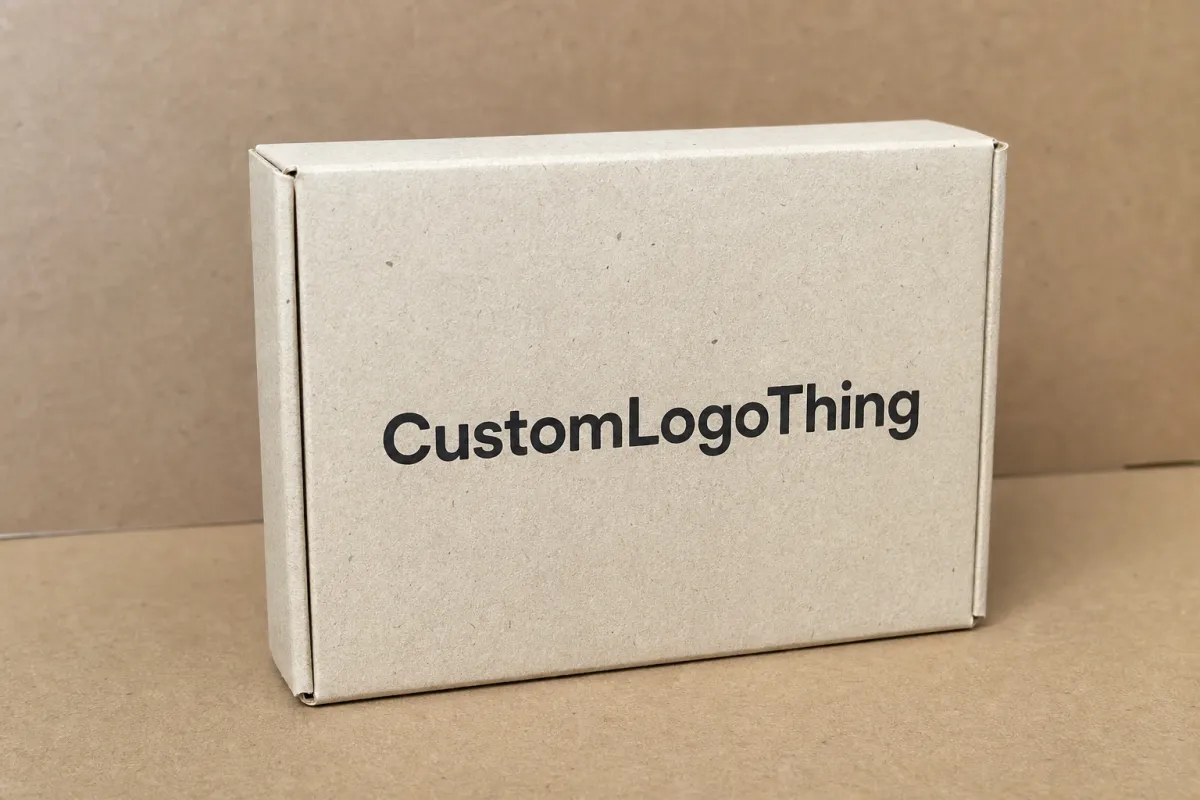
Appearance can be misleading. A kraft-colored face, a matte finish, or a soft natural texture may signal responsibility at first glance, yet the box can still hide a plastic film or a dense coating that changes the disposal story completely. Biodegradable retail boxes with logo often rely on that natural look, which is why surface treatment is not a cosmetic footnote. It is part of the claim.
People use biodegradable, compostable, recyclable, and recycled-content as if they were interchangeable. They are not. Biodegradable retail boxes with logo are designed to break down through biological activity over time, but that does not mean they belong in a home compost bin, a municipal compost facility, or a curbside recycling program. The correct path depends on the substrate, the coatings, and the local waste infrastructure that receives the package after the sale.
The logo matters more than many brands expect. A printed mark can sharpen recognition, make a carton feel trustworthy, and keep the package from looking generic. The logo still has to respect the material system. A print process that creates a barrier layer, a laminate that never really disappears, or a finish that contaminates a recycling stream can erase confidence fast. Biodegradable retail boxes with logo gain visual authority only when the branding works with the board instead of fighting it.
The best packaging does not just look responsible. It survives shipping, looks right on shelf, and withstands basic questions about what happens after use.
That is the comparison that matters. Not green against not green, but credible against convenient. Biodegradable retail boxes with logo should be judged as a package system: board, adhesive, ink, coating, structure, and disposal route. If one layer pulls in the wrong direction, the whole carton becomes harder to defend in front of customers, retail buyers, and compliance teams.
The shelf test is equally unforgiving. A flimsy carton may look eco-conscious and still crush in transit, scuff on retail shelving, or arrive at the store with worn corners that make the brand feel careless. The reverse error is common too: a premium-feeling box can rely on materials that are difficult to justify once someone asks what happens after the purchase. The most practical biodegradable retail boxes with logo manage both pressures at once.
How Biodegradable Retail Boxes With Logo Break Down
Biodegradation starts with the material source, yet the source alone does not decide the outcome. Fiber structure, additives, ink chemistry, and barrier layers all influence how fast and how completely biodegradable retail boxes with logo can break down. Clean paper fibers behave differently from board saturated with synthetic coatings, and that difference is not theoretical. It changes the end-of-life path in a very real way.
Kraft paperboard is often the first option buyers consider because it brings an earthy look and a familiar tactile feel. It works well for light to medium products, especially when the brand wants a natural tone without sounding precious. Molded fiber can be even more persuasive in some formats because it feels materially honest and can be shaped into trays or protective inserts. Coated paperboard sits in the middle. It offers strong shelf presentation, but the coating choice decides whether biodegradable retail boxes with logo remain credible or slide into a weaker claim.
The breakdown chain is straightforward once you spell it out. The board has to separate into fibers. The adhesive cannot behave like a permanent sealant. The inks need to be compatible with the substrate. Any coating has to avoid forming a plastic shell that traps the material in place far longer than the brand implied. When any of those pieces are overdesigned, biodegradable retail boxes with logo may still be recyclable in some systems, yet biodegradation becomes harder to defend honestly.
Printing is chemistry as much as branding. Water-based inks and soy-based inks are often sensible starting points because they avoid adding a heavy synthetic load to the substrate. Digital printing can work well for shorter runs and variable artwork, though the exact ink set still matters. Hot foil, metallic effects, and thick laminations can look striking, but they complicate the disposal route. For biodegradable retail boxes with logo, the safer route is usually the one with the fewest layers that still does the branding job well.
Real conditions matter more than the packaging copy suggests. Breakdown needs moisture, oxygen, microbes, and time. Without those factors, even a clean fiber board may sit longer than the label implies. That is why a claim printed on the carton is not proof by itself. If biodegradable retail boxes with logo are meant to support a composting or biodegradation narrative, the supplier should explain the environmental conditions required rather than handing over a nice sample and expecting trust.
Standards make the distinction even sharper. ASTM compostability tests are not the same thing as broad biodegradation claims, and the gap matters when the language lands on pack. Local disposal rules matter too. A box acceptable in one collection stream can be rejected in another. Brands that skip that check often discover that biodegradable retail boxes with logo are easier to sell than they are to defend.
Key Materials, Inks, and Coatings That Change the Outcome
The material choice sets the ceiling for performance and claim integrity. Virgin kraft board usually offers cleaner fiber quality and a more consistent natural appearance, while recycled board can reduce demand for new fiber and lower environmental impact in a different way. Fiber blends sit between the two. For biodegradable retail boxes with logo, the real question is not which option sounds greener. It is which one matches the product, the print plan, and the disposal route the brand is willing to stand behind.
Coatings deserve more attention than they often receive. Aqueous coatings are frequently the least troublesome option for biodegradable retail boxes with logo because they improve rub resistance without creating the same barrier issues as plastic lamination. Grease-resistant layers can help with food-adjacent products or oily items, yet some versions interfere with decomposition. Full plastic lamination is the clearest warning sign when biodegradability is the goal. It can deliver excellent scuff resistance and still turn a simple fiber box into a mixed-material package with a weaker environmental claim.
Logo finishes influence the claim as much as the substrate does. Embossing can add a premium feel without introducing much material complexity. Spot color keeps ink coverage controlled and sharp. Matte print often fits the natural look buyers expect from biodegradable retail boxes with logo, while metallic effects and dense flood coats raise the risk of overprocessing. The logo should reinforce the material story, not drown it in decoration.
If a supplier is using certified fiber, ask for chain-of-custody evidence. The FSC chain-of-custody matters because it shows the fiber source is tracked through the supply chain, which strengthens trust in the material story. That does not make a box biodegradable on its own, but it does support a more responsible claim. For brands that want biodegradable retail boxes with logo to feel credible, transparency usually says more than a pile of vague green adjectives.
Claims are where many projects get risky. A box that says biodegradable without a clear explanation can trigger skepticism from buyers and, in some markets, regulatory scrutiny. The FTC Green Guides and local environmental labeling rules are not decorative reading; they shape how packaging claims are interpreted. If the material is compostable rather than broadly biodegradable, say that. If it is recyclable with a natural kraft finish, say that too. Precision is less glamorous, but biodegradable retail boxes with logo need it.
The product itself should drive the spec. Cosmetics often need a cleaner shelf appearance and a tighter opening experience. Snacks may need a grease-tolerant surface or an inner barrier. Candles need crush resistance and sometimes a snug insert. Apparel boxes can usually prioritize print and structure over heavy protection. Lightweight accessories may offer the most flexibility. Biodegradable retail boxes with logo work best when the material is matched to the product category instead of being forced into a one-size-fits-all formula.
If you are comparing structural packaging options, it helps to review our Custom Packaging Products alongside the product requirements. A good supplier should be able to show where a lighter board is enough and where a stronger build prevents returns, damaged units, or unhappy customers.
Cost and Pricing for Biodegradable Retail Boxes With Logo
Pricing is where theory runs into procurement. Biodegradable retail boxes with logo are not always expensive, but they are almost never priced by a single factor. Board thickness, print complexity, coating choice, structure, inserts, and quantity all move the unit cost. On a larger run, setup costs spread out more efficiently. On a smaller run, the same setup can make the per-box price feel steep even when the total spend is manageable.
MOQ matters because setup work does not shrink just because the order is small. Artwork prep, dieline checks, make-ready, and press calibration all happen before the first finished box lands in a carton. A low minimum order quantity may suit a pilot launch, but it usually pushes unit cost upward. Biodegradable retail boxes with logo often sit in the range where a few hundred extra units can lower the per-piece price more than expected, even though the total invoice rises.
Hidden costs show up in the places buyers forget to ask about. Plates, prepress work, prototype rounds, freight, storage, and compliance testing can all move the landed cost. If the design needs a structural insert, that adds another layer of cost and another layer of approval. If the print uses specialty finishes, the spend rises again. Brands that budget only for the shell usually get surprised later. Biodegradable retail boxes with logo should be costed as a complete package, not as a flat carton line item.
| Build Type | Typical Unit Price at 5,000 Units | Best For | Main Tradeoff |
|---|---|---|---|
| Simple kraft board with 1-color logo | $0.18-$0.28 | Light apparel, accessories, basic retail presentation | Limited visual impact and fewer premium finish options |
| Custom printed board with aqueous coating | $0.30-$0.52 | Cosmetics, candles, gift sets, shelf-facing retail lines | Higher make-ready and stronger artwork coordination |
| Reinforced board with insert or divider | $0.48-$0.82 | Fragile products, heavier items, e-commerce plus retail use | More materials and more assembly steps |
| Premium structure with specialty finish | $0.75-$1.20+ | Flagship launches, gift packaging, higher perceived value | Greater claim complexity and higher risk of overprocessing |
The table makes the pattern obvious: price tracks complexity closely. A buyer can save money by reducing ink coverage, simplifying the structure, or removing a finish that does not protect the product. Money also disappears quickly when a team chases visual drama that adds little shelf value. Biodegradable retail boxes with logo should pay for the features that matter: protection, brand clarity, and a believable disposal path.
There is a landed-cost lesson hidden in the same chart. A slightly pricier board can reduce damage, which lowers replacements and protects the customer experience. That matters more than many spreadsheets admit. If the box prevents breakage, supports a better unboxing moment, and stays aligned with the sustainability story, the higher unit cost may be easier to justify. For many brands, the real question is not whether biodegradable retail boxes with logo are cheap. It is whether they cost less than the damage caused by a weaker alternative.
If you are narrowing down budgets, it is sensible to compare a few structural and print combinations through our custom packaging products. The best quote is not always the lowest one. The best quote is the one that survives the actual use case.
Shipping weight can move landed cost more than people expect. A lighter board can reduce freight, especially on bulk shipments, while a heavier premium build can create storage and cube-efficiency problems. Biodegradable retail boxes with logo should be priced with freight in mind, not just press-room economics.
Production Steps and Timeline: From Proof to Delivery
The production path looks simple on paper and becomes messy fast if the sequence is wrong. It starts with a brief, moves to dieline setup, then artwork, material approval, proofing, sampling, production, and shipping. Each step looks small in isolation. Together, they decide whether biodegradable retail boxes with logo arrive on time, fit correctly, and print the way the brand expects.
Artwork alignment is where a lot of timelines slip. If the logo sits too close to a fold, a crease can cut through the visual center. If special finishes need a separate pass, file setup gets more complicated. If claim language changes late in the process, proofs need to be checked again. With biodegradable retail boxes with logo, the fastest projects are usually the ones where dimensions, print method, insert design, and claim wording are locked early.
- Brief: Define product size, weight, shelf purpose, and shipping path.
- Dieline: Confirm structure before artwork begins.
- Artwork setup: Place the logo, claims, and mandatory copy with the folds in mind.
- Material approval: Sign off on board, coating, and ink system.
- Sample: Check fit, finish, and print quality.
- Production: Run the full order after approval.
- Shipping: Plan freight so the launch date does not slip.
A practical planning range helps. For standard biodegradable retail boxes with logo, 12-15 business days after proof approval is common when the structure is simple and the materials are in stock. Add 3-7 business days if sampling is required. More complex builds, specialty finishes, or custom inserts can stretch the lead time to 18-25 business days or more. Rush orders are possible in some cases, but they usually trade off against price, finish complexity, or the number of review rounds.
Testing should not be treated as optional. If the boxes will travel through a warehouse and then onto retail shelves, ask for drop, compression, and scuff checks that reflect the real journey. The transit side of the business is where an ISTA method can help. It gives the project structure. Even a simple fit-and-drop review can catch weak corners, loose inserts, or print rub before the launch date is on the line.
Good timeline planning is not about speed for its own sake. It is about fewer revisions, fewer surprises, and less risk of launching packaging that misses the marketing window. Biodegradable retail boxes with logo often do better when the team makes decisions in this order: product environment, box style, print method, claim language, and then finishing details. Reverse that order and the project usually slows down.
Common Mistakes With Biodegradable Retail Boxes With Logo
The most common mistake is assuming that a natural-looking box is automatically biodegradable. It is not. A kraft exterior can hide plastic film, heavy lamination, or mixed substrates that make the end-of-life story much less clean than the visual suggests. Biodegradable retail boxes with logo need material evidence, not just a beige color palette.
Design mistakes can be as costly as claim mistakes. Thin board crushes more easily, especially in stacked retail environments. Low-contrast logos disappear on shelf, which defeats the branding purpose. Oversized box dimensions waste material and create unnecessary freight volume. Biodegradable retail boxes with logo should be designed with line efficiency in mind, not only with aesthetics.
Vague claims create another layer of trouble. If a pack says biodegradable but does not explain the conditions or limitations, buyers may question it and regulators may, too. The wording should be specific enough to withstand basic scrutiny. Is the box fiber-based? Is the coating compatible? Is it intended for industrial composting, home composting, or simply a lower-impact alternative to a plastic-heavy pack? If the answer is unclear, the packaging invites trouble.
Operational mistakes are the quiet killers. Some teams skip the sample test and approve from a screen only. Others ignore humidity, even though moisture can affect board stiffness, print wear, and glue performance. A few approve artwork without checking how the logo behaves at the folds or across a seam. With biodegradable retail boxes with logo, those small oversights show up quickly once boxes enter the warehouse or the store.
Another common error is choosing a finish because it looks premium, then discovering that it weakens the sustainability message. Hot foil can be beautiful, but it should have a reason. The same is true for heavy coatings and specialty films. Beautiful packaging can still be the wrong decision if it creates a mismatch between logistics, claims, and customer expectations. Biodegradable retail boxes with logo need to be judged on the whole chain, not on the unboxing moment alone.
A short checklist can prevent most avoidable damage:
- Confirm the exact board, coating, adhesive, and ink specification.
- Ask how the box should be disposed of in the target market.
- Review the logo placement against folds and cuts.
- Run a physical sample through handling, stacking, and scuff checks.
- Check that the claim language matches the material reality.
Expert Tips and Next Steps for a Better Launch
Start with the product environment, not the branding mood board. Weight, moisture exposure, shipping distance, and shelf life should drive the spec. A lightweight cosmetics box has very different needs from a candle carton or an accessory sleeve. Once those conditions are clear, biodegradable retail boxes with logo become much easier to specify with confidence.
Request at least three combinations before locking the order. One should be the lowest-cost functional option, one should be the best balance of appearance and performance, and one should test a premium route with a cleaner finish or stronger structure. That side-by-side comparison makes tradeoffs visible. Biodegradable retail boxes with logo often reveal surprising differences in feel, scuff resistance, and cost once the samples sit next to each other.
Build a prototype checklist and use it every time. Fit test. Drop test. Scuff test. Humidity check if the product or route demands it. Then do a quick claim review before production begins. That sequence sounds tedious, but it saves more money than a rushed reprint ever will. The best biodegradable retail boxes with logo are usually the ones approved slowly and thoughtfully.
It also helps to write a short packaging brief that includes logo placement, sustainability goals, budget ceiling, and the target timeline. If that brief is shared early, the supplier can narrow choices faster and avoid expensive late-stage changes. If you want to compare structures or get a broader sense of what is possible, browse our Custom Packaging Products and treat the samples as decision tools, not just pretty objects.
One final recommendation: choose one use case, one box style, and one credible material path, then build outward from that test. Brands get into trouble when they try to make every carton solve every problem. Biodegradable retail boxes with logo work best when the brand is disciplined about what the package must do and honest about what it cannot do. That is where smart packaging starts, and it is also where it stays useful after the launch moment passes.
Are biodegradable retail boxes with logo the same as compostable boxes?
No. Biodegradable means a material can break down over time through biological activity, while compostable usually means it breaks down under specific composting conditions and within a defined timeframe. A box can be biodegradable and still not be suitable for home composting or curbside systems. The substrate, coating, inks, and local disposal rules all matter.
What logo printing methods work best on biodegradable retail boxes with logo?
Water-based and soy-based inks are often the first options to review because they support a lower-impact print system. Simple layouts tend to preserve the environmental story better than heavy, layered finishes. Lamination and metallic effects should be used only when the supplier can explain the end-of-life impact clearly.
How do I know if a box material is actually biodegradable?
Ask for the exact board, coating, adhesive, and ink specification. If claims are part of the packaging, request documentation or testing evidence rather than relying on a sales description. A supplier should be able to explain the disposal pathway in plain language and show how the box behaves in the intended environment.
What affects the price of biodegradable retail boxes with logo the most?
Material grade, print complexity, coatings, inserts, and order quantity are the biggest pricing levers. Lower MOQ usually raises the unit cost because setup and production overhead are spread across fewer boxes. Freight, storage, and packing efficiency can also move the final landed cost in a noticeable way.
How long does it usually take to produce biodegradable retail boxes with logo?
The timeline depends on proofing, sampling, material availability, and the finish complexity. Simple orders move faster, while custom structures and premium finishing add time. A practical planning range is often 12-15 business days after proof approval for standard builds, with extra time needed for sampling or specialty work.


