Buyer Fit Snapshot
| Best fit | Black Friday Shipping Boxes for Ecommerce projects where brand print, material claims, artwork control, MOQ, and repeat-order consistency need to be specified before quoting. |
|---|---|
| Quote inputs | Share finished size, material target, print colors, finish, packing count, annual reorder estimate, ship-to region, and any compliance wording. |
| Proofing check | Approve dieline scale, logo placement, barcode or warning zones, color tolerance, closure strength, and carton packing before bulk production. |
| Main risk | Vague material claims, crowded artwork, missing packing details, or unclear freight terms can make a low unit price expensive after revisions. |
Fast answer: Black Friday Shipping Boxes for Ecommerce: Material, Print, Proofing, and Reorder Risk should be specified like a repeatable production item. The safest quote records material, print method, finish, artwork proof, packing count, and reorder notes in one written spec.
Production checks before approval
Compare the actual filled-product size with the drawing, then confirm tolerance on folds, seals, hang holes, label areas, and retail display edges. Reserve space for logos, QR codes, warning copy, and material claims before decorative graphics fill the panel.
Quote comparison points
Review material grade, print process, finish, sampling route, tooling charges, carton quantity, and freight assumptions side by side. A quote is only useful when the supplier can repeat the same color, closure quality, and packing count on the next order.
Black Friday Shipping Boxes for Ecommerce That Sell - black friday shipping boxes for ecommerce usually do not fail because the ad campaign missed the mark or the product page was weak. They fail at the packing bench, where one flimsy carton, one awkward fold, or one box that is just a little too roomy can turn a strong promotion into damage claims, reships, and a pile of service tickets that quietly eat margin. The box is not just transit packaging; it sits inside fulfillment, package protection, and the profit math of the whole order.
Black Friday Shipping Boxes for Ecommerce: Why the Box Becomes the Bottleneck
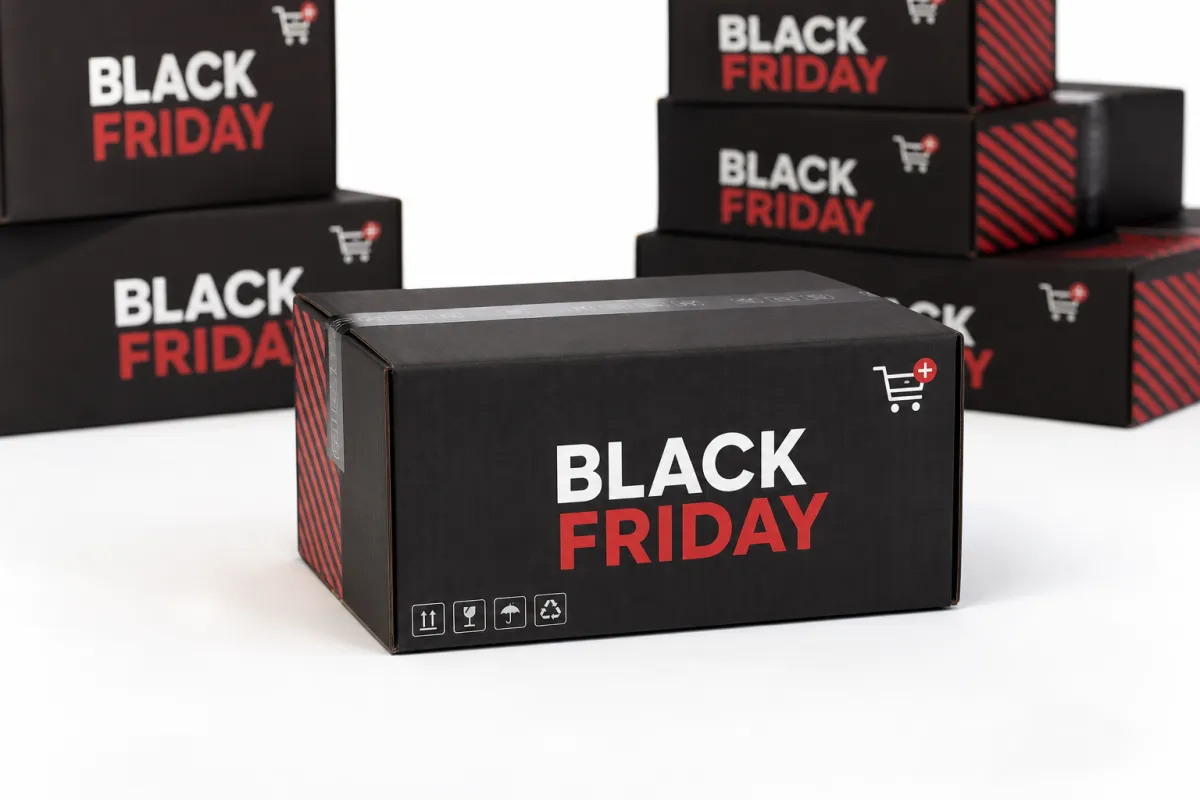
Most brands focus first on traffic, offers, and ad spend, which makes sense. Then orders spike, the warehouse gets louder, and black friday shipping Boxes for Ecommerce become the quiet bottleneck nobody planned for. A carton that is one inch too large, one grade too weak, or one fold too awkward can slow the packing line, raise damage rates, and create work that never shows up on the marketing dashboard.
The box deserves a clear definition. This is the shipping carton that moves a finished product from the warehouse to the customer, not a decorative sleeve, not the inner retail carton, and not a display pack meant for a shelf. A shipper lives a harder life. It gets stacked, dropped, squeezed in transit, and handled by people who never see the product itself. That makes package protection the first requirement, followed by speed and then brand presentation.
Black Friday changes the operating picture in a few important ways. Volume rises fast. Cart mix gets messy because bundles, gift sets, and promo add-ons start sharing the same order. Pick-and-pack speeds up, leaving less time for judgment calls. Tolerance for damage drops near zero because every replacement shipment lands during the most expensive shipping window of the season. One poor carton can trigger rework, label reprints, customer complaints, and higher carrier spend. black friday shipping boxes for ecommerce deserve the same planning energy as offer strategy or pricing.
From a buyer's perspective, the box affects far more than transit. It changes how much void fill gets used, how much tape disappears from the supply cabinet, how much dimensional weight lands on the carrier invoice, and how many seconds each order spends at the bench. Add 15 seconds per pack across 2,000 orders and you have burned more than eight labor hours. That is not an abstract figure. Good black friday shipping boxes for ecommerce lower friction in the warehouse and help protect margin before the first carrier scan ever happens.
There is another reason this choice matters. Customers judge ecommerce shipping by the package in their hands, not by the promise they saw in an ad. A crushed carton, a sloppy seam, or an oversized box packed with filler says waste and carelessness. A tight, sturdy, well-branded box says the opposite. The visual result matters, but the operational result matters more. A box that trains easily, packs quickly, and survives transit is worth more than a prettier box that slows the line.
Black Friday Shipping Boxes for Ecommerce: How the Process and Timeline Work
Choosing black friday shipping boxes for ecommerce starts with the real fulfillment path. Inventory arrives, cartons are staged near the packing area, products are picked, packed, sealed, labeled, and handed off to the carrier. Every step asks something different from the box. It has to be easy to grab from storage, quick to form at the station, strong enough to survive shipment, and consistent enough that packers do not waste time guessing which size belongs to which order.
That timeline tightens fast. Stock boxes can move quickly if the right size is already on hand, but custom sizes and printed cartons need more runway. Quoting, sampling, artwork approval, production, and freight all take time. Wait until the promotional calendar is already live and black friday shipping boxes for ecommerce stop being a planning choice. They become an emergency buy. Emergency buying usually means premium freight, fewer size options, and a long list of compromises.
In practice, the workflow should begin with dimensions, then move to a real pack test, then sample approval, then confirmation of supplier inventory or production slot, then a safety buffer. That buffer matters because demand never lands exactly on forecast. A strong estimate can still miss by 10 percent or more once gift bundles, add-on items, and flash promotions enter the picture. black friday shipping boxes for ecommerce need enough lead time to absorb that gap without forcing a temporary substitution that confuses the pack line.
Late changes hurt more than teams usually expect. A size swap after training has started creates binning confusion, forces new labels or new slot locations, and increases mispacks. Even a small shift in flute type or closure method can slow the workflow if associates need to relearn how the carton behaves. On a slow Tuesday, that is annoying. During peak ecommerce shipping, it is expensive.
Storage is part of the decision too. Boxes take cube, and cube gets scarce during peak season. A supplier may be able to deliver a strong carton, but if that carton ships flat in a large quantity, it still needs to be received, palletized, and staged. Planning for black friday shipping boxes for ecommerce means thinking beyond unit price. It means asking how much floor space the inventory will consume, how quickly the team can restock the pack station, and whether the receiving schedule lines up with peak volume.
The cleanest packaging plan is usually the one that gives the warehouse fewer decisions to make.
I have watched fulfillment teams lose more time to carton confusion than to the actual packing step. One lane uses the old size, another lane uses the new one, and somebody halfway down the line is still asking which shipper belongs to the bundle order. That kind of friction feels small in the moment, but during Black Friday it snowballs fast. The fix is boring, which is probably why people skip it: make the box system simple enough that a tired associate can run it without thinking too hard.
Key Factors That Make a Box Fast, Safe, and Brand-Friendly
Three things decide whether black friday shipping boxes for ecommerce work: strength, fit, and handling speed. Strength starts with board grade and construction. Many shippers do well with a 32 ECT single-wall carton for lighter merchandise, while heavier or more fragile items may need 44 ECT or double-wall construction. The right choice depends on product weight, stack pressure, and the kind of movement the package will see. Cartons that crush under compression create more damage than they save in unit price.
Fit matters just as much. A carton that is too large triggers more void fill, higher dimensional weight, and more movement inside the box. A carton that is too small risks damage and slows packers because they have to force the product in or stop and find a different size. For black friday shipping boxes for ecommerce, the best dimension is usually the smallest box that still leaves room for protection, inserts, and a clean seal. That is not flashy, but it is efficient.
Speed is where the spec either pays back or gets in the way. The box should fold predictably, close with standard tape, and store in a way that makes sense for the team. If the packer has to fight the carton, the box is too clever. If they need to inspect every order to know which size to use, the lineup is too broad. That is why many brands simplify shipping materials and build around a small family of cartons rather than a wide catalog of one-off sizes.
Branding still matters, but it should support the operation instead of overruling it. A clean one-color print, a restrained logo, or a recognizable inside panel can deliver a polished feel without slowing the line. If unboxing is central to the brand, use that energy where it will not disrupt throughput. The outer shipper should arrive looking intentional, not overworked. There is a real difference between memorable and fussy.
Sustainability is part of the decision for many customers, especially in ecommerce shipping where waste is visible. Recyclable corrugated, FSC-certified paper sources, and fewer unnecessary inserts all help. For paper sourcing, the Forest Stewardship Council is a practical reference point. For transit testing, the International Safe Transit Association publishes packaging test methods that many teams use to check package protection before peak season.
One detail gets overlooked often: closure method. A strong carton with a weak seal is still a weak system. Tape width, adhesive quality, and top-load pressure all affect how well black friday shipping boxes for ecommerce hold up during carrier handling. If the box needs heavy tape patterns just to stay closed, the carton spec is probably too optimistic for the product weight or the shipping route.
From a buyer's perspective, the right box also supports returns. A carton that is easy to reseal reduces reverse logistics pain and improves the customer experience after the sale. If the same box can carry the outbound shipment and survive a return, the design is doing real work. That matters in categories with higher exchange rates, such as apparel or giftable merchandise. In those cases, it may be smart to compare carton plans with Custom Poly Mailers for lighter items that do not need corrugated protection.
For teams building a broader packaging system, it helps to review the full set of Custom Packaging Products instead of treating the shipper as a standalone purchase. Boxes, mailers, inserts, labels, and tape all affect one another. A better spec in one area can expose waste in another.
There is no single corrugated answer that fits every catalog, and that is worth saying plainly. A high-value electronics kit, a stackable beauty bundle, and a soft apparel order do not ask the same thing from a carton. If someone tells you one box will handle all of it, they are probably selling simplicity a little too hard. The better move is usually a measured mix, with each format earning its place.
Cost and Pricing: What Black Friday Boxes Really Do to Margin
The box price on the quote is only the beginning. When brands evaluate black friday shipping boxes for ecommerce, they often stop at unit cost. That is the wrong math. Real cost includes freight, storage, setup, print charges, inserts, labor time, damage rate, and the hidden effect of dimensional weight. A carton that looks cheap on paper can become expensive once it reaches the shipping rate table.
The cleanest way to think about it is simple: compare total landed cost per shipped order, not just the carton line item. If a $0.12 cheaper box adds two inches of empty space, carrier billing may jump. If the carton takes 20 seconds longer to assemble, labor cost rises. If the box leads to a 1 percent increase in damage, replacement shipments can erase the original savings many times over. That is why black friday shipping boxes for ecommerce need to connect directly to margin, not vanity savings.
| Option | Typical Unit Cost | Lead Time | Best For | Watch-Outs |
|---|---|---|---|---|
| Stock corrugated box | $0.18-$0.65 each at common order volumes | 3-10 business days if in stock | Fast replenishment, simple SKUs, tight timelines | Less brand control, fit may be less precise |
| Custom-printed box | $0.45-$1.40 each, depending on size and print coverage | 15-30 business days after approval | Brand-led unboxing, fit optimization, premium presentation | Higher setup cost, slower to replenish |
| Hybrid system | $0.25-$0.90 each across a small box family | 10-20 business days depending on mix | Most ecommerce catalogs, especially mixed order profiles | Needs tighter inventory control and better forecasting |
Those ranges are not universal, and they should never be treated that way. Freight zone, print coverage, board grade, order quantity, and supplier location all shape pricing. Still, the pattern holds. Stock boxes are usually faster and cheaper to source. Custom boxes can pay back through better fit, lower void fill, and stronger brand recall. A hybrid approach often gives the best balance for black friday shipping boxes for ecommerce because it keeps the core sizes simple while allowing a premium carton for orders that justify it.
Hidden costs matter just as much. Oversized cartons consume more warehouse cube and more shipping materials. Weak cartons can generate customer service tickets, refunds, and replacement orders. Overuse of void fill adds both material cost and packing time. Extra tape sounds trivial, but in high-volume ecommerce shipping, small consumables add up quickly. A pack station that burns an extra half-roll of tape per day during peak season is not a small issue once you multiply it across multiple lanes and weeks.
Labor tells another part of the story, and finance teams sometimes miss it. A carton that is awkward to form or hard to identify slows the operator even if the box itself is inexpensive. If the team spends 10 more seconds per order on an order volume of 5,000, the result is nearly 14 extra labor hours. At peak staffing rates, that can wipe out the savings from a lower box price. black friday shipping boxes for ecommerce should make work easier, not just cheaper on the PO.
Pricing lens: calculate cost per shipped order, then compare it with damage reduction, pack speed, and freight savings. If the box reduces dimensional weight by even a small amount on a high-volume SKU, the savings can be meaningful. If it trims a few seconds from each pack, the labor gain can be just as real. That is the kind of math that separates packaging strategy from guesswork.
Step-by-Step Guide to Choosing Black Friday Shipping Boxes for Ecommerce
If the goal is to choose black friday shipping boxes for ecommerce without overbuying or under-planning, begin with the data you already have. Review top-selling SKUs, bundle behavior, average package dimensions, return rates, and any seasonal outliers from recent promotion periods. The point is not to design a box for the average order. It is to design a box system for the orders that actually drive revenue.
- Audit the order mix. Separate lightweight items from fragile items, and pull out bundles that create size inflation. A good box plan starts with the most common shipping patterns, not the rarest exceptions.
- Set a small box family. Fewer carton sizes usually means faster pick-and-pack, cleaner training, and fewer misfiles. Many operations can cover most order profiles with three to five well-chosen sizes.
- Test real pack-outs. Use live products, inserts, tape, labels, and the exact shipping materials that the warehouse will use. Watch how long a trained associate needs to complete the pack. That number matters more than a spec sheet.
- Check fit and protection. Do a simple drop test, check corner crush, and make sure the product does not slide around. If the item is fragile or high value, compare the carton against recognized test methods such as those published by ISTA.
- Lock the timing backward from launch. Count time for sampling, revisions, approval, production, transit, and receiving. If the campaign starts in the first week of peak sales, the box order should move long before that.
- Define reorder triggers. Set minimum and maximum counts for each box size, and decide who approves replenishment. A box shortage in the middle of peak season is not a purchasing problem; it becomes a fulfillment problem.
- Place the right carton at the station. Staging matters. Label bins clearly, keep popular sizes within arm's reach, and remove old versions so packers do not have to choose under pressure.
A lot of teams overcomplicate this step. They assume black friday shipping boxes for ecommerce need a fully custom carton for every SKU cluster. Many times they do not. A tight system of standard sizes, backed by good data, will outperform a sprawling catalog that looks flexible but creates chaos on the floor. The strongest operations reduce decision-making at the packing station because decision-making is exactly what slows peak throughput.
There is also a product-category question. Apparel, accessories, and soft goods may be better served by mailers or a mixed packaging system, while electronics, glass, or bundled kits may need corrugated cartons. That is why comparing Custom Shipping Boxes with lighter mailer options is worth the time. Not every order needs the same transit packaging, and forcing everything into one format often raises cost instead of lowering it.
Another useful discipline is measuring pack speed during a normal shift, not only in a controlled sample. Real order fulfillment includes interruptions, scanner checks, substitutions, and occasional rework. The box that looks fine in a sample room can underperform once the line is active. If black friday shipping boxes for ecommerce are going to carry the load, they need to work under everyday warehouse conditions, not just ideal ones.
Finally, write down the decision rule. Which orders get the hero box? Which ones get the secondary size? Which ones go in a mailer? What happens if a product is backordered and substituted into a different carton? Written rules reduce hesitation, and hesitation is expensive during ecommerce shipping peaks.
If you want the short version, here it is: pick the smallest box family that covers most orders, test it with real products, and confirm the warehouse can pack it fast without second-guessing. That single discipline does more for peak-season stability than most fancy packaging ideas ever will.
Common Mistakes That Create Damage, Delays, and Returns
The first mistake is straightforward: under-sizing or over-sizing the carton. Both cost money. An undersized box can crush the product, warp the seal, or force the team to jam in extra protection. An oversized box uses more filler, increases dimensional weight, and takes longer to pack. black friday shipping boxes for ecommerce should match the product profile, not habit.
The second mistake is waiting too long. Late ordering leaves little room for sample review or structural fixes. If the first test pack reveals a problem, there may be no time to change it before the season gets busy. That usually leads to emergency freight or temporary substitutes, both of which are more expensive than planning early. A rushed purchase also tends to create a mismatch between inventory and actual demand.
The third mistake is ignoring labor flow. A box can look excellent on a spec sheet and still fail on the line if it is hard to fold, hard to identify, or hard to store next to the station. Packers need consistency. If the box requires too much judgment, throughput suffers. black friday shipping boxes for ecommerce should reduce ambiguity, not increase it.
The fourth mistake is forgetting returns. Reverse logistics are part of the sale. If the customer cannot reseal the carton, or if the package falls apart on the way back, the brand pays again in service time and replacement materials. Some brands focus only on outbound performance and miss the fact that the same carton may need to survive a second trip. That is a missed opportunity.
The fifth mistake is overbranding and overcomplication. Too many custom sizes, too many print variations, too many insert combinations - all of that creates inventory sprawl. During a Black Friday surge, inventory sprawl becomes a warehouse problem as much as a design problem. Fewer versions usually mean better control. A small, disciplined box lineup often beats an expansive one, especially when the team is trying to move fast.
One extra box size can look harmless on a spreadsheet. On the line, it becomes another bin, another decision, and another chance for error.
The sixth mistake is treating the box as separate from the rest of the package. It is not separate. Tape, labels, inserts, dunnage, and even product assortment shape how the shipper performs. If the team changes one piece and not the others, the whole system can drift. That is why black friday shipping boxes for ecommerce need to be reviewed alongside the rest of the shipping materials.
When teams get stuck in one-size-fits-all thinking, they also miss the chance to use the right format for the right order type. A lightweight apparel order may be better in a mailer. A fragile set may need a corrugated box with a tighter insert. The best packaging managers do not force a box onto every order. They choose the format that protects the item and keeps the line moving.
One thing I have learned from watching peak season packing teams is that most problems are not dramatic. They are ordinary and repeated: a box that is a little off, a label that does not sit where it should, a carton family that grew by accident over the years. Those small misses are what make the rush feel heavier than it ought to. Fixing them rarely feels exciting, but it is usually the smartest money in the room.
Expert Tips and Next Steps for Black Friday Shipping Boxes for Ecommerce
A practical approach starts with a hero box strategy. Pick one primary carton size that handles the majority of orders, then add only a small number of exception sizes for outliers. That keeps inventory simple and helps the warehouse staff build muscle memory. For black friday shipping boxes for ecommerce, simplicity is usually a strength, not a compromise.
Build a pre-peak checklist and use it like a gate. Confirm box inventory, verify tape and label supplies, test the fold and seal, and brief the fulfillment team on any changes. If the operation uses both cartons and mailers, make sure the split is clear. The more a team has to improvise in peak season, the more likely errors become. That is why some brands pair corrugated with Custom Poly Mailers for orders that do not need the extra protection of a box.
Track three numbers during peak: damage rate, average pack time, and dimensional weight impact. Those metrics show whether the box spec is helping or hurting. A 1 percent reduction in damage may be worth far more than a small unit cost difference. A few seconds saved per pack can matter just as much if the order volume is high enough. And if dimensional weight drops because the box is better sized, the carrier savings can be immediate.
Supplier flexibility matters too. Ask about split shipments, safety stock, and reorder windows. If the vendor can hold some inventory or ship in stages, black friday shipping boxes for ecommerce are less likely to run dry when demand spikes. Supply assurance is not a luxury during peak season; it is operational insurance.
Honest advice? Do not wait for the holiday rush to test your system. Audit your top-selling SKUs, request samples, run one packing test, and lock the order schedule now. If the current setup is not supporting speed, damage control, and margin at the same time, fix the carton mix before the pressure rises. For most brands, black friday shipping boxes for ecommerce are not a decorative choice. They are a working part of the profit model.
For teams that want a cleaner starting point, review the packaging stack as a whole, then narrow to the carton family that fits the top order profiles. That is the path to better ecommerce shipping, lower waste, and more stable labor flow. And if there is one sentence to keep on hand, it is this: black friday shipping boxes for ecommerce should be ordered like inventory and measured like a cost center, because that is exactly what they are.
When the season tightens, the brands that hold up are usually the ones that made the box decision early, tested it honestly, and kept the system simple enough for a stressed packing team to run without surprises. The real takeaway is not to chase the fanciest carton; it is to choose the box setup that protects the product, keeps the line moving, and stays within the margin you can actually afford.
How far in advance should I order black friday shipping boxes for ecommerce?
Plan several weeks ahead for stock boxes and longer for custom-printed or specialty sizes so there is room for sampling, approval, transit, and a backup reorder. Build a buffer for forecast misses and damaged cartons. If your supplier can offer safety stock or split shipments, use it to protect the busiest shipping window.
What size should black friday shipping boxes for ecommerce be?
Choose the smallest box that protects the product, leaves room for any required inserts, and avoids unnecessary void fill. Standardize around a few sizes based on your top order profiles instead of creating a new carton for every SKU. Always test the fit with real products and the exact packing materials you will use.
Are custom boxes worth it for Black Friday orders?
They can be worth it if better fit, faster packing, or lower damage rates offset the higher setup and unit costs. Custom printing also helps if unboxing is part of the brand experience, but it should never slow fulfillment enough to hurt delivery speed. A hybrid approach often works best: one or two custom hero sizes plus stock cartons for everything else.
How can I reduce shipping damage without increasing box cost too much?
Match the box to the product size first, then add only the protection the item truly needs. Choose a carton strength that fits the weight and handling risk, and avoid paying for premium specs that do not solve a real problem. Run packing and drop tests so weak points are found before the holiday rush.
What is the cheapest way to prepare black friday shipping boxes for ecommerce?
Standardize on a small set of stock box sizes and order early enough to avoid rush fees and emergency freight. Reduce hidden costs by cutting oversized cartons, minimizing void fill, and speeding up pack time with a cleaner box lineup. Measure total landed cost per shipped order instead of comparing unit price alone.

