Buyer Fit Snapshot
| Best fit | Custom Shipping Boxes for Ecommerce That Build Brands projects where brand print, material claims, artwork control, MOQ, and repeat-order consistency need to be specified before quoting. |
|---|---|
| Quote inputs | Share finished size, material target, print colors, finish, packing count, annual reorder estimate, ship-to region, and any compliance wording. |
| Proofing check | Approve dieline scale, logo placement, barcode or warning zones, color tolerance, closure strength, and carton packing before bulk production. |
| Main risk | Vague material claims, crowded artwork, missing packing details, or unclear freight terms can make a low unit price expensive after revisions. |
Fast answer: Custom Shipping Boxes for Ecommerce That Build Brands should be specified like a repeatable production item. The safest quote records material, print method, finish, artwork proof, packing count, and reorder notes in one written spec.
Production checks before approval
Compare the actual filled-product size with the drawing, then confirm tolerance on folds, seals, hang holes, label areas, and retail display edges. Reserve space for logos, QR codes, warning copy, and material claims before decorative graphics fill the panel.
Quote comparison points
Review material grade, print process, finish, sampling route, tooling charges, carton quantity, and freight assumptions side by side. A quote is only useful when the supplier can repeat the same color, closure quality, and packing count on the next order.
Custom Shipping Boxes for Ecommerce That Build Brands
Most shoppers judge the brand before they ever touch the product. I've watched that happen in real fulfillment reviews more times than I can count. That is why custom Shipping Boxes for Ecommerce are part protection, part first impression, and part quiet sales pitch. A plain carton can do the job. Sure. A box that fits properly, prints cleanly, and survives transit without looking beat up does more than ship an order. It tells the customer somebody paid attention. That is not decoration. That is packaging doing its actual job.
Custom Shipping Boxes for ecommerce are not about making every parcel look fancy. That is how brands end up paying for cardboard theater. The real goal is simpler: match the box to the product, the channel, and the customer experience so fulfillment feels controlled instead of chaotic. Do that well, and damage drops, returns shrink, perceived value goes up, and repeat buying gets a little easier to earn. Also, your warehouse team stops cursing your name, which is not a small win.
What Custom Shipping Boxes For Ecommerce Actually Change
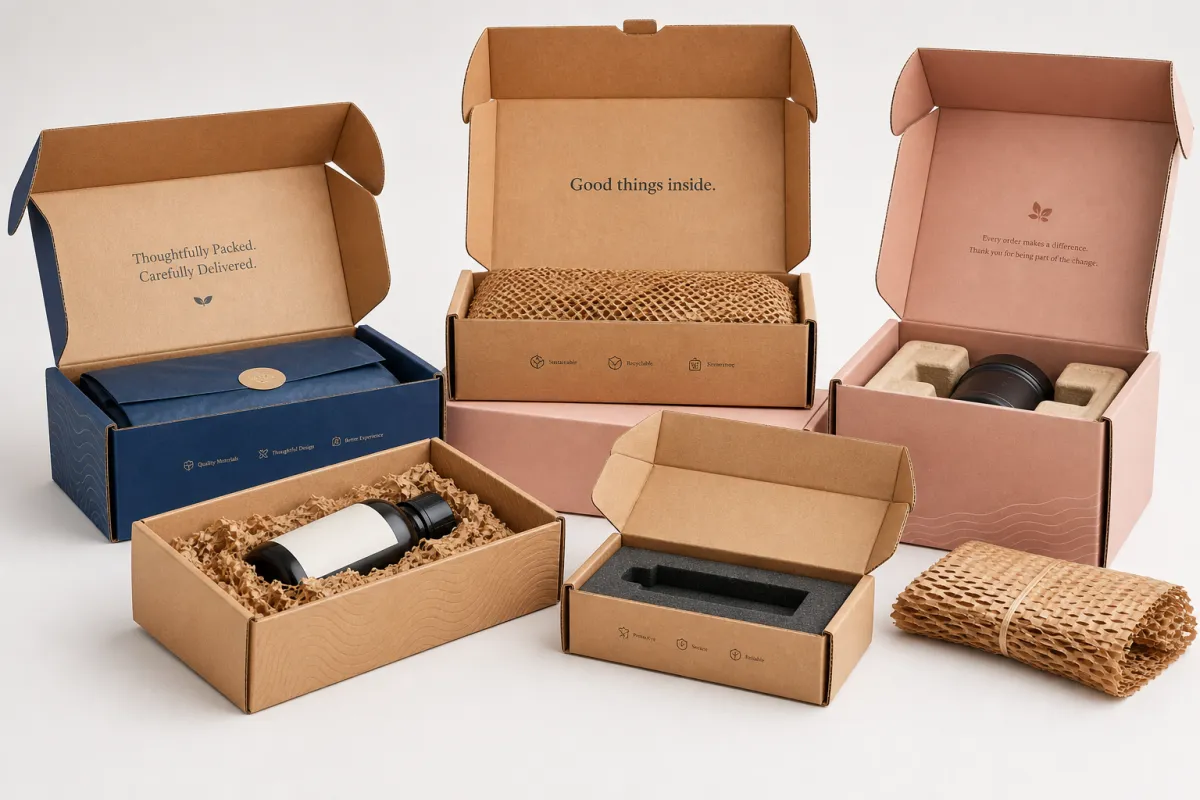
Blunt version: custom shipping boxes for ecommerce change more than the outer shell. They affect how much protection the product gets, how much the carrier charges, and what the customer assumes about the brand before the box is even opened. A tight, well-built shipper signals care. A floppy oversized carton signals guesswork. People notice the difference, even if they never say it out loud.
The box type matters. A plain corrugated shipping box is built for utility and usually arrives unprinted or with a simple mark. A branded mailer often uses lighter board and a self-locking format, which works well for apparel, accessories, and subscription kits. Fully custom-printed shippers sit in their own lane: built around your dimensions, your art, and your logistics rules. Custom shipping boxes for ecommerce can fit any of those categories, but the spec changes the outcome. A box is never just a box. Annoying, but true.
Damage rates are where the math gets real. If the product rattles around, corners crush faster. If the board is too light, the panel bows under stacking pressure. If the box is too large, void fill increases and dimensional weight goes up. That means more freight cost and more work in the warehouse. In practice, custom shipping boxes for ecommerce cut waste when they are sized correctly, and they cut returns when the package survives the trip without the item arriving scratched, dented, or broken.
Perceived value is the quiet win. A customer opening a box that looks intentional tends to treat the product differently. That does not mean every carton needs foil stamping. It means the packaging should support the brand promise. A minimalist box for a wellness product. A bold printed shipper for a direct-to-consumer label with a strong visual identity. A sturdy kraft carton for a heavy, practical item. custom shipping boxes for ecommerce should fit the brand voice, not fight it.
A box can be cheap, or it can be too expensive. If it is oversized, underprinted, or underbuilt, you pay for it somewhere else: freight, claims, or customer trust.
Repeat purchase behavior is the long game. The box is not the reason somebody buys again by itself. But consistent branded packaging makes the whole brand feel less random. That matters in crowded categories where the product is good but forgettable. If the packaging feels deliberate, the brand feels deliberate. And if the brand feels deliberate, custom shipping boxes for ecommerce help with the marketing work before the customer even lands back on your site.
How Custom Shipping Boxes For Ecommerce Work
Structure comes first. Board grade, flute type, dimensions, and closure style all affect how custom shipping boxes for ecommerce perform. Single-wall corrugated is common for lighter items and standard parcel shipping. Double-wall helps when the product is heavier or the route is rougher. E-flute is thinner and prints cleanly. B-flute gives more cushion. C-flute is stronger and more familiar for shipping cartons. If you ship glass, candles, supplements, electronics, or anything with corners that hate impact, the spec matters more than the artwork.
Board grade is not a trivia question. A 32 ECT box can be fine for many lightweight shipments, but it is not the answer for every product. Higher edge crush ratings, stronger liners, and better board construction can lower damage risk. That matters even more if the box gets stacked in a warehouse or moves through multiple touchpoints. Custom shipping boxes for ecommerce should be selected around the real abuse profile, not the most optimistic version of the shipment path. I have seen good products get crushed because the carton was chosen for price, not performance. That gets old fast.
Print method changes both the look and the budget. Flexographic printing works well for simple logos, one or two colors, and larger runs. Digital printing is easier for shorter runs and faster changes, though the unit cost tends to rise. Litho-lam gives richer graphics and crisp branding, but it is usually better for premium programs and larger quantities. If the goal is durable branded packaging that still holds up in transit, custom shipping boxes for ecommerce often do best with print that is clean, simple, and restrained. Overly busy art on corrugated usually looks chaotic instead of premium.
Finishes are useful, but not magic. Aqueous coating can help with scuff resistance. Matte finishes look more understated. Soft-touch can feel premium, though it adds cost and is not always necessary for a shipping carton. The trick is to spend on the touchpoints customers actually see and touch, not on features nobody notices. That is where a lot of packaging budgets leak. custom shipping boxes for ecommerce work best when the finish supports the shipment, not when the finish is trying to win applause.
Inserts, dividers, and void fill are part of the system, not an afterthought. If a product moves inside the box, the outer carton alone is not doing enough. Molded Pulp Inserts, corrugated dividers, foam, paper fill, and die-cut locks each solve different problems. Fragile or premium items usually need an internal restraint strategy, especially if the outer box is being used for ecommerce shipping rather than retail packaging. If you want a formal testing reference, the ISTA test library is worth a look because it gives a useful framework for transit abuse, drop testing, and vibration conditions. I usually send packaging teams there early, because it keeps the conversation grounded in actual shipping stress instead of vibes.
The production flow is straightforward once you break it down. A dieline defines the box shape and panel sizes. Artwork gets placed on that dieline. A proof confirms layout, color placement, and key copy. A sample or pre-production prototype checks fit. Then the full run moves into manufacturing, finishing, and packing for freight. Custom shipping boxes for ecommerce do not appear by accident. Somebody measures, reviews, adjusts, and approves each stage. Skip those steps and the expensive mistakes ship in bulk.
Custom Shipping Boxes For Ecommerce: Cost And Pricing Factors
Cost starts with size. Bigger boxes use more board, take up more pallet space, and tend to raise freight costs. That is why custom shipping boxes for ecommerce can look cheap on a unit basis and still wreck the shipping budget. A box that is one inch larger than needed may not sound dramatic, but across thousands of orders it can shift dimensional weight, increase dunnage use, and create more empty air that needs to be moved. Empty air is expensive cardboard cosplay.
Board thickness and construction move the price fast. A light single-wall carton costs less than a stronger double-wall box, but the cheaper option is only cheaper if it survives the route. Print coverage also matters. A small logo on one panel is far cheaper than full-coverage custom printed boxes with multiple colors and detailed artwork. Number of colors, coverage area, and registration precision all affect setup and press time. Custom shipping boxes for ecommerce are rarely priced on one variable alone. It is always a stack of small decisions.
Minimum order quantity can be the part nobody likes to discuss. Small runs cost more per box because setup, tooling, and press time get spread across fewer units. At 500 to 1,000 units, a custom run can feel expensive quickly. At 5,000 units, the unit price usually comes down. At 10,000 units and up, pricing becomes more efficient, assuming the art and structure stay stable. The tradeoff is storage. If your warehouse cannot hold the inventory, a lower unit price can turn into a warehousing headache. Custom shipping boxes for ecommerce reward sensible planning, not wishful thinking.
Here is a practical comparison. These are broad ranges, not a quote, because actual pricing depends on dimensions, board spec, print coverage, inserts, freight, and total order volume.
| Box Type | Typical Unit Cost at 5,000 Units | Best Use Case | Main Tradeoff |
|---|---|---|---|
| Plain Corrugated RSC | $0.35-$0.75 | Utility shipments, basic ecommerce fulfillment | Low branding impact |
| 1-Color Branded Box | $0.48-$0.95 | Clean package branding with simple logo placement | Limited visual complexity |
| Full-Print Custom Shipper | $0.85-$1.80 | Strong branded packaging and premium unboxing | Higher setup and print cost |
| Printed Box With Inserts | $1.10-$2.50 | Fragile, premium, or multi-item orders | More parts to manage in order fulfillment |
Hidden cost usually shows up in three places. First, wasted dunnage: too much paper, air pillows, or foam just to keep the product from sliding. Second, dimensional weight: carriers charge based on size as well as actual weight, so oversized cartons quietly eat margin. Third, damage claims: every crushed corner or broken item has a real replacement cost attached to it. Custom shipping boxes for ecommerce are supposed to reduce those leaks, not create new ones.
There are simple savings moves that actually work. Standardize box sizes around your top-selling SKUs. Keep artwork simpler unless the box is customer-facing for a premium launch. Use the smallest acceptable board grade, not the strongest one available. Spend the money where the customer notices it: print clarity, fit, and opening experience. If sustainability matters, FSC chain-of-custody certification is a useful standard to ask about, especially if your brand wants recycled content without guessing at the spec. Custom shipping boxes for ecommerce can be greener and cheaper when the box is right-sized.
Choosing The Right Specs, Materials, And Branding
Start with the product, not the artwork. Weight, fragility, shelf life, and shipping distance should drive the spec before branding even enters the conversation. A lightweight apparel box has different needs than a candle kit, and both are different from a subscription box full of glass jars. Custom shipping boxes for ecommerce should be built around the item's worst-case transit scenario, not the ideal warehouse handoff. If the product can survive drops, compression, and corner impact, the design is doing its job.
Materials can look conflicting on paper, but they do not have to be. Kraft board can feel natural and still perform well. Recycled content can still be structurally sound if the board grade is selected properly. White exterior liners print better and can look sharper, while kraft often reads more grounded and eco-conscious. The right answer depends on the brand, the product, and the audience. For many buyers, custom shipping boxes for ecommerce need to balance sustainability and strength instead of pretending those goals are mutually exclusive. They are not.
Branding hierarchy matters more than people think. The outer box should carry the main brand signal. The inner print can support the message or add a small surprise. Tape, labels, and inserts should follow the same visual language instead of fighting for attention. A loud logo on every surface can feel desperate. A clean hierarchy feels confident. That is the difference between packaging design and decoration. Custom shipping boxes for ecommerce work best when every layer does one clear job.
If you want the box to do more than ship, think in layers. The outer shipper announces the brand. The insert secures the product. The interior print reinforces the story. The label handles logistics. That is the whole system. Nobody needs a five-color opera on corrugated cardboard. The customer needs clarity, protection, and a small moment of delight. Custom shipping boxes for ecommerce do not need to shout to feel premium. Sometimes the quiet box is the one that looks more expensive.
For brands with mixed channels, the packaging stack should be consistent across ecommerce shipping and retail packaging, but not identical. A retail shelf box may need display appeal. A shipper needs stacking strength and carrier durability. The two can share graphics, materials, and brand voice while still doing different jobs. If your catalog includes lighter items, Custom Poly Mailers may make sense for some SKUs, while heavier or fragile orders move into Custom Shipping Boxes. That is normal. One size does not magically solve every fulfillment problem, no matter how much teams hope it will.
Custom Shipping Boxes For Ecommerce: Process And Timeline
The timeline starts with a brief. Good briefs list product dimensions, weights, fragility concerns, target order volumes, branding goals, and any carrier constraints. Poor briefs say, "We need a box That Feels Premium," and then act confused when the quote comes back full of questions. Custom shipping boxes for ecommerce move faster when the supplier has the facts up front. That means real measurements, not the numbers somebody copied from a product sheet six months ago.
For a straightforward box with a standard structure, artwork ready to go, and no unusual finishing, production can often run 12 to 15 business days from proof approval, plus freight. More complex builds, inserts, special coatings, and sample revisions can push that into three to five weeks or more. Custom shipping boxes for ecommerce do not usually get delayed by the machine itself. They get delayed by indecision, dimension changes, and artwork that was "almost final" three rounds ago.
Approvals are the bottleneck more often than people admit. A box size changes because one SKU was measured wrong. A color needs to be tweaked. A logo file arrives in the wrong format. A finish is added late, which means the price has to be recalculated. That is how launch calendars slip. If you are planning seasonal inventory, sample approval should happen early enough that a reprint or freight delay does not wreck the ship date. Custom shipping boxes for ecommerce are part of the launch schedule, not a side task.
Freight deserves attention too. Even a perfect run can sit if the boxes are built, packed, and waiting on transport. For domestic programs, build in buffer time for trucking. For international supply chains, add more. Customs, port congestion, and route changes can stretch the lead time in ways that no one wants to explain to marketing. The cleaner the production plan, the easier it is to keep custom shipping boxes for ecommerce from becoming the reason a launch slips.
Step-By-Step Guide To Ordering Boxes That Work
Start with a packaging audit. List every product family, the actual dimensions, the average and maximum weights, and the current pain points: breakage, oversized cartons, poor presentation, too much filler, or slow packing at the station. If the team cannot say what is broken, they will usually overbuy the wrong fix. Custom shipping boxes for ecommerce are easiest to order when the problem is specific. "Our boxes are too large for three best-selling SKUs" is specific. "We want better packaging" is not.
- Measure real products. Use the finished product, not the CAD drawing. Add anything that ships with it, including inserts, sleeves, or instructions.
- Check breakage risk. If the product is fragile, test at least a few box sizes with packing materials and actual carrier handling.
- Set the spec priority. Decide whether protection, branding, cost, or sustainability comes first. Trying to make all four the winner usually wastes time.
- Request apples-to-apples quotes. Ask for the same board grade, print method, finish, and quantity across vendors so the numbers mean something.
- Review samples. Fit, print clarity, closure strength, and packing speed all matter. A pretty sample that slows fulfillment is not a win.
- Approve final artwork and structure. Once approved, stop changing dimensions unless you enjoy paying for rework.
- Build a reorder plan. Track usage so the next buy is scheduled, not panicked.
That process sounds basic because it is. Packaging becomes complicated only when it is underplanned. A good supplier can help narrow the options, but they cannot guess your damage tolerance or warehouse constraints. If the assortment is broad, start with a small box library instead of trying to force one carton to handle everything. Custom shipping boxes for ecommerce work best as a system, not a one-off panic purchase. That is where a lot of teams stop paying for excess air.
There is also a useful cross-channel strategy. If some SKUs ship in mailers and others need corrugated, keep the visual system aligned across all packaging so the brand still feels coherent. A buyer should recognize the package whether it is a mailer, a retail-ready carton, or a shipping box. That is where Custom Packaging Products become useful as a broader toolkit rather than a single SKU decision. The packaging mix should match the product mix, which sounds obvious until you see how often it gets ignored. Custom shipping boxes for ecommerce do not live alone. They sit inside a full packaging program.
Common Mistakes And Expert Tips For Better Results
The biggest mistake is buying a box that is too large. It looks harmless on a spreadsheet and then blows up your freight bill, filler usage, and damage risk. The second mistake is using low-contrast graphics that disappear on kraft or scuff off after two warehouse touches. The third is skipping transit testing because the sample "felt fine." Feeling fine is not a test. Custom shipping boxes for ecommerce need proof, not optimism.
Overbranding can backfire too. When every panel screams for attention, the packaging stops feeling premium and starts feeling anxious. One strong logo placement, one clean supporting panel, and one thoughtful interior detail usually do more than a full wrap of visual noise. The goal is recognition, not volume. Custom shipping boxes for ecommerce should look intentional from six feet away and still feel sensible in the packing room. That balance is where good packaging lives.
Expert tips that save money and headaches:
- Keep a small box library for your top-selling dimensions instead of forcing one carton to do every job.
- Test with the same packing team that will use the boxes daily, because good specs fail fast if the station workflow is awkward.
- Allow for carrier abuse. Carriers are not gentle, and pretending otherwise is a nice way to buy replacements.
- Use simple, high-contrast art on corrugated so branding survives scuffs and warehouse handling.
- Spend extra on inserts only where the product actually needs restraint.
A box should protect the shipment first, market the brand second, and make the packing team faster if possible. If it does all three, you picked well.
One more practical tip: measure the actual cost of your current packaging before changing it. Look at damage rate, average carton size, filler cost, pack time, and freight by SKU. That gives you a baseline. Then compare it to the new spec. Otherwise, people end up arguing about unit price while the real money leaks out through oversized cartons and claims. Custom shipping boxes for ecommerce are worth the effort only when the math improves in the real world, not just in a sample room.
For teams still deciding what to change first, start small. Audit the most damaged SKU. Replace the worst oversized carton. Fix one print problem. Improve one insert. Those changes build quickly. If you need a broader package strategy, review your custom shipping boxes for ecommerce, your branded mailers, and your product packaging together instead of treating them like separate kingdoms. That is usually where the smarter spending begins.
FAQ
How much do custom shipping boxes for ecommerce usually cost?
Cost depends mostly on size, board type, print coverage, and order quantity. Small runs can land noticeably higher per box because setup costs get spread across fewer units. Larger orders lower the unit price fast, but only if you actually have the storage room and sales velocity to use them. Oversized boxes can look cheaper on paper and still cost more in shipping, filler, and damage. That is why custom shipping boxes for ecommerce should be priced as a total system, not just a carton price.
How long do custom shipping boxes for ecommerce take to produce?
Simple jobs with ready artwork and standard dimensions can move fairly quickly, often around 12 to 15 business days after proof approval, plus freight. More complex structures, special finishes, samples, and artwork revisions add time. The real delays usually come from late approvals, dimension changes, and freight bottlenecks, not the production line itself. If the launch date matters, start earlier than your most optimistic estimate. Custom shipping boxes for ecommerce rarely fail because the box is hard to make; they fail because the decision stack drifts too long.
What material is best for custom shipping boxes for ecommerce?
Corrugated board is the default for a reason: it balances cost, strength, and printability. Single-wall works for many light to medium parcels, while heavier or fragile products often need stronger board or internal protection. Kraft and white liners both have their place, depending on the look you want and how much print fidelity you need. The best choice is usually the lightest material that still survives real shipping abuse. That keeps custom shipping boxes for ecommerce efficient instead of overbuilt.
Can custom shipping boxes for ecommerce be eco-friendly?
Yes. Many corrugated boxes use recycled content and can be curbside recyclable, depending on coatings and local rules. FSC-certified fiber is a useful option if your brand wants more traceability in sourcing. Reducing box size and cutting void fill can also improve sustainability without changing the look much at all. A well-sized carton often beats a "green" box that ships a lot of empty space. For brands trying to be practical, custom shipping boxes for ecommerce can be both cleaner and better at the same time.
Do I need inserts with custom shipping boxes for ecommerce?
Use inserts when products can move, collide, or scratch during transit. Fragile items, premium kits, and multi-item orders benefit the most. If the product already fits tightly and passes ship tests without shifting, inserts may be unnecessary. The trick is not to add them automatically; it is to add them where they solve a real shipping problem. In many cases, the right insert makes custom shipping boxes for ecommerce safer, faster to pack, and easier to open without turning the box into a puzzle.
If you want packaging that actually earns its keep, start with your worst-shipping SKU, measure the real product, and size the carton to the trip, not the spreadsheet. Then choose the lightest board and simplest print that still protects the order and matches the brand. That is the real play with custom shipping boxes for ecommerce: less damage, less waste, better presentation, and fewer surprises in fulfillment. Not glamorous. Just useful. And honestly, that is the part that keeps paying back.

