A boutique buyer needs a mailer that does more than look polished in a mockup. It has to fit the product, hold up in transit, and avoid charging for empty space. The boutique buyer Custom Poly Mailer Bags material spec guide matters because dimensional weight can punish oversized packaging, while a well-sized film mailer can cut freight, speed pack-out, and keep presentation consistent.
The choice is practical, not decorative. A mailer has to protect soft goods, close cleanly on the packing line, and survive sorting centers that do not care about the artwork. For boutique brands, the best fit is usually apparel, socks, swimwear, beauty accessories, and other low-fragility items that do not need rigid corrugated board or layers of filler.
Boutique Buyer Custom Poly Mailers: What They Change
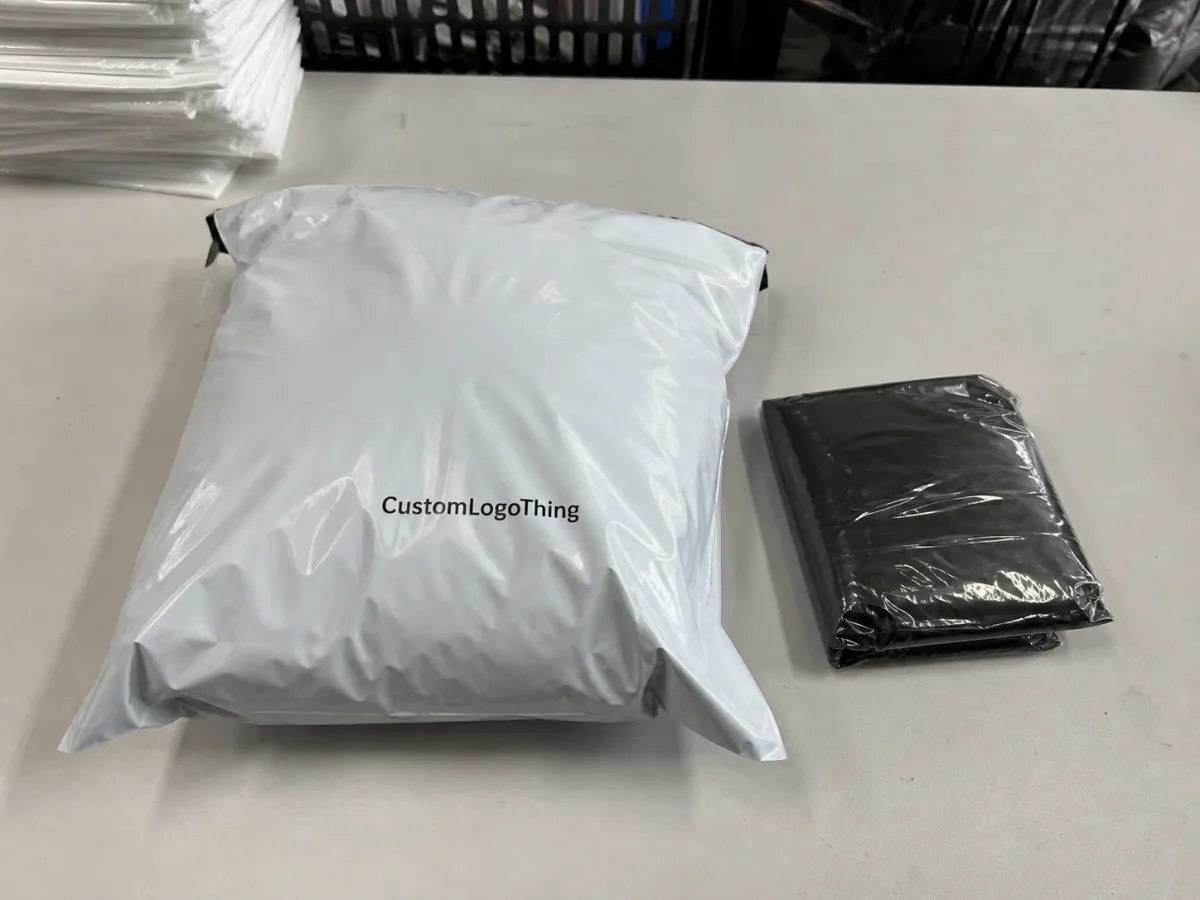
A mailer changes shipping economics fast. Once the item is soft enough and light enough, the bag can replace a carton, remove void fill, and lower the dimensional weight carriers use to price the shipment. A folded T-shirt, scarf, or cosmetic pouch often ships more efficiently in film than in a box built around empty space.
The brand side matters too. The outer package is the first thing the customer sees, and the gap between a plain carton and a printed mailer is obvious. Clean print, a neat seal, and the right opacity tell the customer the order was packed with care.
There are limits. A buyer should not choose a mailer for rigid goods, glass, or anything that can crush itself through the film. Sharp corners, metal hardware, or bulky closures raise puncture risk unless the gauge and seal are chosen carefully. A 2.5 mil or 3.0 mil bag is usually the safer starting point when the product includes zippers, rivets, or edge hardware.
Good packaging usually disappears when it works. Bad packaging is the one that calls customer service, triggers a re-ship, and turns a low-cost item into an expensive problem.
- Best fit: apparel, accessories, lightweight home goods, and soft promotional kits.
- Less suitable: glass, hard goods, heavy jars, and anything that needs crush resistance.
- Main tradeoff: lower shipping cost versus less structural protection than a carton.
Boutique Buyer Custom Poly Mailers Material Spec Guide: Film, Seal, and Print Specs
Most buyers start with artwork and then realize the bag is really a materials decision. The spec stack has four parts: film type, thickness, seal construction, and print method. Get those right and the mailer performs. Miss one, and the quote may still look fine while the production result falls short.
Film type usually starts with virgin polyethylene, recycled content, or a blend. Virgin film tends to give more consistent seal behavior, clearer color reproduction, and fewer surprises across the run. Recycled or blended resin may fit a sustainability target better, but it can bring slight color variation or a different hand feel. If a supplier says a bag contains recycled content, ask for the percentage and what type it is. Post-consumer and post-industrial feedstock are not the same thing, and recycled claims should be backed by GRS certification when the buyer wants chain-of-custody traceability.
Thickness drives much of the performance. A lighter film lowers material cost, while a heavier gauge improves puncture resistance and gives the bag a firmer feel. For soft apparel, many buyers live in the 2.0 to 2.5 mil range. If the product has zippers, buttons, metal trim, or any sharp insert, moving closer to 3.0 mil or above often makes sense. In a 500 MOQ trial, a simple custom bag often prices around $2.50-4.00 per unit depending on size, print count, and gauge, while larger or heavier builds can move well above that.
Seal construction matters more than it gets credit for. A strong side seal and bottom seal reduce split risk during transit, especially when a parcel is squeezed under load. Peel-and-seal closures help the packing team move faster, and a double adhesive strip can support returns if the bag has to be reused. Tamper-evident closures are often a better fit for beauty kits, accessories, and retail packaging that needs a clear first-open signal. Many factories use automatic bag-making machines with heat-seal bars set to keep the seal width consistent across the run.
Print comes last, but it is not the least important. One-color logos are usually cheaper and easier to hold in register. Full-coverage artwork looks stronger, but it requires better control over ink density, opacity, and shrink behavior on the film. White ink on dark film can create a premium look, though it adds setup complexity and can raise the rate. Flexographic printing is common for simpler repeat graphics, while gravure is often used for longer runs with tighter color consistency. Corona treatment before printing helps inks anchor to the film surface.
For teams that need a broader reference point, packaging trade resources from Packaging.org can help translate a brief into a useful production spec. They do not replace sample testing, but they do help make the language less vague.
Sizing, Thickness, and Closure Options to Lock In
The most common mistake is sizing by product name instead of folded dimensions. A hoodie, cardigan, and folded tee are not the same shipment, even if they live in the same collection. Start with the packed item, then add the fold, insert, barcode card, and any note that has to ride inside the bag.
Thickness and closure should be chosen together. A lighter gauge can be perfectly acceptable for soft goods, but a weak seal can cancel out the savings. Permanent seal closures are simple and low cost. Peel-and-seal closures work well for high-volume fulfillment. A double adhesive strip helps if the customer may return the item in the same bag.
Before a run is approved, these checks should be in place:
- Finished dimensions: measured against the packed product, not a catalog guess.
- Overfill allowance: enough room for the item to slide in without stretching the film.
- Print bleed: enough margin so artwork does not clip near the edge or seal.
- Closure method: permanent, peel-and-seal, double strip, or tamper-evident.
- Return flow: whether the same bag has to survive a second use.
Most boutique brands do not need the thickest bag available. They need the right one. A 2.5 mil mailer can be a good fit for a lightweight sweater, while a heavier gauge may be the smarter option for an item with hardware or a rough carton mix. Buyers who match thickness to the SKU instead of chasing the highest spec usually get better landed cost and fewer replacements.
One more practical point: the pack-out workflow matters as much as the bag itself. If the team has to twist, fold, or force the product into the mailer, the spec is off. Good sizing should feel boring at the packing station.
Cost, Pricing, MOQ, and Unit Cost Drivers
Price is driven by a small group of variables that matter more than the headline quote. Bag size, film thickness, print colors, artwork coverage, resin choice, and whether the order uses stock tooling or a fully custom structure all move the number. Quantity matters as well. A buyer comparing two quotes without matching those variables is not comparing the same product.
For a working reference, a simple custom run of 5,000 pieces may land around $0.16-0.24 per unit for a basic structure with limited print. More elaborate coverage can move the same size into the $0.28-0.55 per unit range. At lower quantities, such as a 500 MOQ pilot, pricing more commonly lands in the $2.50-4.00 per unit band because setup, color matching, and waste are spread across fewer bags. Larger bags, heavier film, white ink on dark film, special finishes, and tighter color targets all push pricing higher. Freight, duties, and spoilage allowance belong in the total as well.
| Option | Best For | Typical Cost Impact | Buyer Note |
|---|---|---|---|
| 2.0 mil light gauge | Soft apparel, low-risk shipping | Lowest unit cost | Useful if the product has no sharp edges |
| 2.5 mil standard gauge | Most boutique apparel mailings | Moderate increase | Often the best balance of feel and protection |
| 3.0 mil+ heavier gauge | Hardware, bulkier bundles, higher-value items | Higher unit cost | Worth paying for if puncture risk is real |
| Full-coverage multi-color print | Premium branding and strong shelf presence | Highest setup and press cost | Useful when package branding supports repeat purchase |
MOQ logic is straightforward. Lower quantities usually carry a higher unit cost because machine setup, color matching, plate making, and scrap are spread over fewer pieces. A stock-size mailer with a simple logo may start around 500 to 1,000 pieces. A fully custom size or structure often sits closer to 3,000 to 5,000 pieces. If the buyer needs a printed sample first, the usual path is a digital proof in 24-48 hours, then a physical pre-production sample in 7-10 business days, then mass production after signoff.
Process, Timeline, and Production Steps From Proof to Shipment
The shortest path from brief to shipment is a clean spec and a quick sample approval loop. The factory usually begins with dielines, artwork, and a size confirmation. Once those are approved, the film is made, printed, converted, and inspected before packing and shipment.
A common production flow starts with blown film extrusion or 3-layer co-extrusion to build the base PE film, followed by corona treatment for ink adhesion. After that, the web moves through flexographic or gravure printing, then slitting, sealing, and bag making on automatic conversion equipment. For recycled-content orders, the supplier should also be able to state whether the resin claim is supported by GRS documentation and whether the lot is traceable back through the chain of custody.
Typical sample and production timing looks like this:
- Artwork proof: 24-48 hours for a digital layout and size confirmation.
- Physical sample: 7-10 business days for a printed pre-production sample.
- Production run: 12-18 business days for a standard 3,000-5,000 piece order.
- Total lead time: 18-22 business days for a straightforward order after approval.
- Complex orders: 25-30 business days if the bag uses heavy film, multiple print colors, or special closures.
That timeline assumes the buyer approves artwork quickly and does not request repeat revisions. If the design depends on precise brand color matching, a printed strike-off or press sample is worth the extra day or two because it reduces the chance of a full run coming back with the wrong tone.
Quality Checks, Testing, and Risk Controls for Brand Buyers
Quality control should be specific enough that both sides know what pass and fail look like. The right checkpoints are simple: film thickness, color consistency, seal strength, print registration, closure adhesion, and final count. A basic factory audit should also verify the lot code, carton labeling, and packing method before shipment leaves the line.
For inspection, many buyers use AQL 2.5 for major defects and AQL 4.0 for minor defects. That means the sample plan is not random guesswork; it is a structured check on the run. Good inspection packages also include dimensional checks against the approved spec, tape adhesion checks for the print, and a seal peel test on a sample from the start, middle, and end of production. Color tolerance is often judged against the approved proof, with a target Delta E under 2.0 for brand-critical artwork.
Practical test points include:
- Gauge check: film thickness measured against the approved mil spec.
- Seal check: side and bottom seals inspected for uniform width and no burn-through.
- Adhesive check: peel-and-seal closure tested for consistent tack and release liner removal.
- Print check: logo sharpness, registration, and coverage verified against the proof.
- Drop test: filled bags dropped from 1 meter to confirm seam and closure durability.
- Opacity check: bag held to light to confirm contents are not visible when opacity is required.
If the order uses recycled content, ask for the GRS certificate and chain-of-custody paperwork. If the factory is making broader packaging or textile accessory items, WRAP or BSCI can support social compliance checks, and OEKO-TEX Standard 100 may be relevant for textile components such as dust bags, fabric inserts, or sewn accessories. GOTS is relevant when the scope includes organic cotton textile pieces, not standard polyethylene mailers.
One quality mistake is assuming the printed proof guarantees the production run. It does not. The proof only proves the layout and color intent. The production run still needs the line check, especially when the order mixes opaque film, white ink, and tight artwork registration.
Next Steps for a Quote That Matches Your Actual Carton Mix
The fastest way to get a useful quote is to send the packed dimensions, not just the product name. A buyer should include the folded size, target film gauge, print count, closure type, order quantity, and destination. If the shipment has multiple SKUs, send the largest folded dimension and the heaviest bundle so the supplier sizes the bag to the real worst case.
Use this checklist before requesting pricing:
- Flat size: width and length of the finished bag.
- Film spec: 2.0 mil, 2.5 mil, 3.0 mil, or heavier.
- Print spec: number of colors, white ink, or full coverage.
- Closure: permanent seal, peel-and-seal, double strip, or tamper-evident.
- Quantity: 500 MOQ, 1,000 MOQ, 3,000 MOQ, or 5,000+ MOQ.
- Compliance: GRS for recycled content, plus WRAP or BSCI if social audit documentation is required.
If the brand wants the lowest-risk path, start with a sample, confirm the packed fit, and then move to a short run before scaling up. That sequence saves more money than trying to optimize every spec up front and discovering the bag does not suit the product.
Frequently Asked Questions
What MOQ should a boutique brand expect for custom poly mailers?
Most custom runs start around 500 to 1,000 pieces for simpler printed mailers, while fully custom sizing or more complex print work often starts closer to 3,000 to 5,000 pieces.
How long does a custom order usually take?
A straightforward order usually takes 18-22 business days after artwork approval, with 24-48 hours for the proof and 7-10 business days for a physical sample if one is needed.
What certifications matter most?
For recycled-content mailers, GRS is the most relevant certification. WRAP and BSCI are useful for social compliance checks. OEKO-TEX Standard 100 and GOTS are relevant when the packaging program includes textile components rather than standard polyethylene film.
Which spec usually changes price the most?
Size, film gauge, and print complexity usually move the price most. A 2.0 mil single-color bag will usually cost less than a 3.0 mil, full-coverage, white-ink build at the same quantity.
Do poly mailers need special testing before launch?
Yes. At minimum, confirm thickness, seal strength, print registration, closure adhesion, and a drop test on filled samples. AQL 2.5 major and 4.0 minor is a common inspection framework for finished goods.

