Gift shops usually do not lose margin in one dramatic swing. It leaks out in small pieces: a parcel that ships heavier than expected, a bag that splits at a seam, a reprint caused by color drift, a packaging choice that looks polished but burns freight dollars. That is why a gift shop Custom Poly Mailer bags bulk pricing guide matters. The right mailer keeps shipping light, protects the product, and preserves the brand moment without turning packaging into a cost center.
For apparel, stationery, small gifts, and bundled sets, Custom Poly Mailers often make more sense than cartons. They store flat, pack quickly, and typically cost less per shipped order. The real decision is not whether the logo looks attractive on screen. It is whether the bag is sized and built to hold up through handling, transit, and repeated ordering without inflating the landed cost.
That distinction matters because packaging is recurring spend. A difference of a few cents per unit can become meaningful across hundreds or thousands of orders. A gift shop that understands film thickness, print setup, and freight can usually make a cleaner buying decision than one focused only on the quote headline.
Gift Shop Custom Poly Mailer Bags Bulk Pricing Guide: Where the Cost Comes From
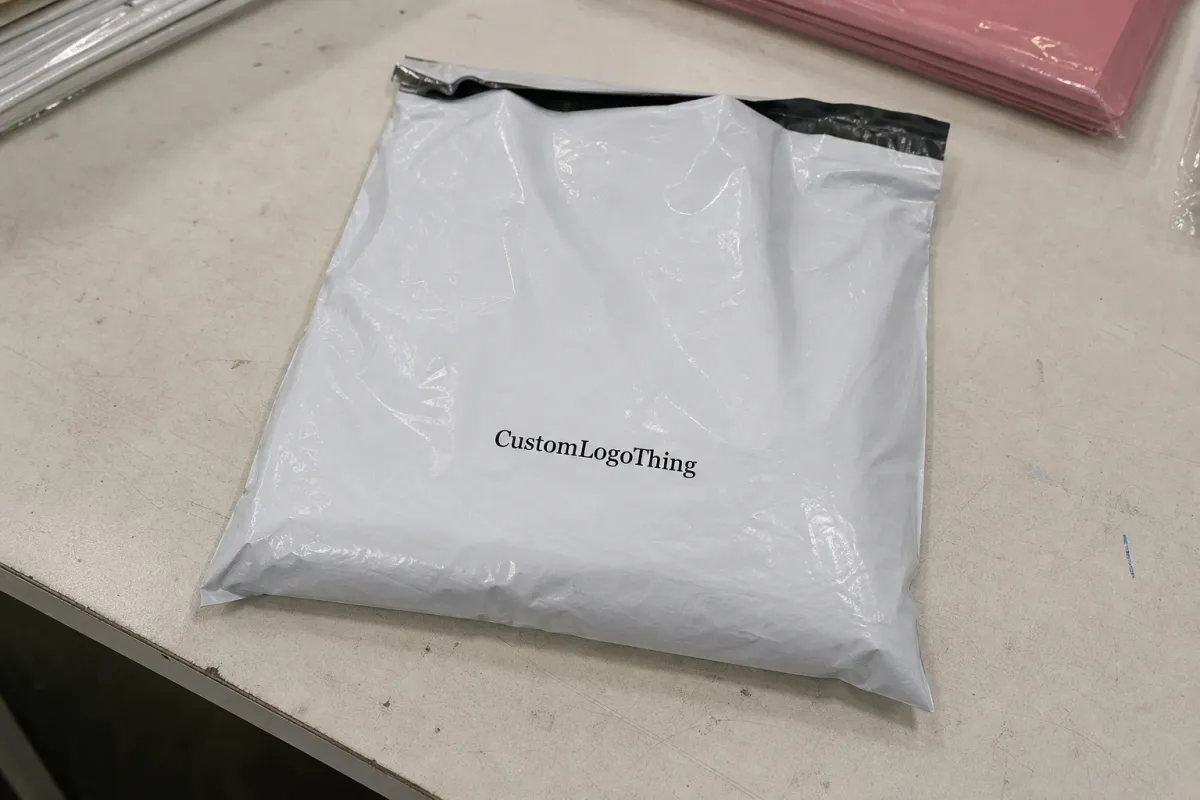
Custom Poly Mailers do more than close a shipment. They affect pack speed, freight weight, and how the customer sees the brand at delivery. For a gift shop that ships lower- to mid-value goods, those three factors can decide whether packaging supports margin or quietly erodes it.
A rigid carton may look premium, but it can add dimensional weight, increase storage demand, and slow fulfillment. A printed mailer often gives a cleaner result for soft goods and small retail items. The parcel still looks branded, but the shipping profile stays lean. That is why mailers are often treated as operational packaging first and marketing surface second.
There is also a practical brand effect. A clean printed mailer creates a recognizable arrival moment before the product is even opened. Customers notice that kind of consistency. They may not describe it in packaging terms, but they do register when a shipment arrives with a tired finish, fuzzy print, or flimsy seams.
The lowest unit price is not always the lowest total cost. Freight, remake risk, and avoidable over-specification can outweigh a small difference in print price.
Buyers looking at a gift shop custom Poly Mailer Bags bulk pricing guide should focus on landed cost and repeatability, not just the number printed on a quote. A slightly higher-priced bag that holds up in transit can be cheaper than a bargain option that triggers replacements.
Choosing the Right Poly Mailer Construction
Construction drives performance. It also shapes print clarity, which matters more than many buyers expect. A mailer that looks great in a proof can print dull, stretch unevenly, or crack at the folds if the film choice is wrong for the job.
Material options
LDPE is common because it is flexible, tough enough for many retail shipments, and easy to print on. It works well for apparel, soft accessories, and lightweight gift items. Recycled-content films can support sustainability claims, but buyers should ask for the actual percentage and the type of recycled content used. Vague language is not useful. Co-extruded mailers combine layers to improve puncture resistance and seal integrity, which can be useful when the contents have corners, edges, or a little weight.
Film thickness deserves attention. A thinner bag may save a little money, but if the product has sharp edges or the route is long, puncture risk rises. A tear along a seam can cost more than the difference between two film gauges. For gift shops that ship framed prints, boxed candles, pins, or bundled items with hard corners, the better build is often the one that reduces replacement shipments.
Finish options
Gloss tends to make colors pop. Matte usually feels more restrained and can suit boutique branding better. Opaque mailers hide contents, which is useful for apparel and for products that should not be visible during transit. Clear films are more specialized and rarely make sense for most gift retailers.
Print quality changes with finish, too. Gloss can sharpen contrast, while matte softens edges and can slightly mute dense graphics. If exact color matters, ask for a proof on the actual film rather than relying on a generic digital preview. Screen color and printed color are not the same thing, especially on a flexible substrate.
Hardware details matter more than they look on paper. Peel-and-seal closures speed packing. Tear strips help the customer open the package cleanly. Seal width, seam construction, and puncture resistance are the things that determine whether the mailer arrives intact. Those are the details that protect the order once it leaves the shop.
Specifications Buyers Should Lock In Before Quoting
Most quote delays come from incomplete information. If the supplier does not know the size, film thickness, print coverage, or destination, the price comparison is not reliable because the bids are not truly for the same item.
Before asking for numbers, lock in these details:
- Finished size - the flat dimensions and any gusset, if applicable.
- Film thickness - usually stated in mil or microns; thicker film usually means better puncture resistance and a higher unit price.
- Print method and coverage - one color, two color, full bleed, or one-sided versus two-sided print.
- Artwork format - vector files such as AI, EPS, or PDF are easier to work with than low-resolution raster files.
- Carton counts - how many mailers are packed per inner bag and outer carton.
- Retail details - barcode placement, seasonal copy, return address zones, or shipping marks that must appear on the bag.
If the mailer needs to function as both shipping packaging and shelf packaging, say so early. Some layouts can do both jobs, but the design needs enough clear space for branding, legal text, or barcode placement. Trying to force too much onto a small surface usually makes the result harder to print and harder to read.
Artwork also affects schedule. Clean vector files reduce proofing time. Pantone references reduce color confusion. Heavy ink coverage, especially edge-to-edge art or dark solid backgrounds, can increase setup time and sometimes cost. That does not mean complex graphics are a bad idea. It means they should be chosen with production realities in mind.
A good supplier should ask about destination zip code, freight method, carton counts, and whether the order needs palletizing. Those details change the landed cost. A quote that ignores them is incomplete.
Bulk Pricing, MOQ, and Unit Cost Breakpoints
Bulk pricing usually comes down to a few variables: quantity, film thickness, print complexity, number of colors, and freight. MOQ, or minimum order quantity, exists because setup costs do not disappear on small runs. They simply get divided across fewer bags.
That is why unit price falls as quantity rises. A 1,000-piece run can look expensive, while a 10,000-piece run may bring the per-bag number down enough to justify holding more inventory. The point is not to chase the cheapest quote in isolation. It is to compare the landed unit cost across realistic order sizes and reorder frequency.
| Order Size | Typical Build | Indicative Unit Price | What Usually Drives the Number |
|---|---|---|---|
| 500-1,000 bags | 1-color print, standard film, small format | $0.28-$0.55 | Setup cost, low volume, freight spread across fewer units |
| 2,500-5,000 bags | 1-2 color print, mid-gauge film | $0.16-$0.32 | Better setup amortization, better press efficiency |
| 10,000+ bags | Standard or recycled-content film, repeat artwork | $0.10-$0.24 | Volume breaks, stable production, lower handling per unit |
Those are directional ranges, not universal pricing. A thicker film, two-sided print, or full-bleed artwork can push the number upward. Freight can move it again. An overseas quote that looks low on the page may end up higher once shipping, duty, and remake risk are included.
MOQ usually starts in the few-hundred to few-thousand range, depending on the print method and construction. One-color jobs are often easier to open up. Full-color or heavily customized work tends to sit higher because the setup is more involved. If a supplier cannot explain why the MOQ exists, that is a warning sign. The reason should be concrete: plate cost, run length, press setup, or material efficiency.
For buyers comparing custom mailers with a mailer-plus-box approach, the break-even point often hides in weight and dimensional charges. A box may feel more substantial, but if the product is soft goods or a simple gift set, the mailer often wins on total shipped cost.
Production Steps and Lead Time Expectations
Most orders move through the same sequence: quote request, proof, sample or pre-production check, production, packing, and delivery. The path looks simple. The delays usually come from small things: artwork that is not final, color notes that are unclear, or a spec change made after approval.
For a standard custom mailer order, buyers often see 12-15 business days from proof approval to production completion, then transit on top of that. More complex runs, unusual sizes, custom colors, or heavier print coverage can push the schedule to 15-25 business days. Seasonal demand can stretch it further. That is normal batch production behavior, not a defect.
Lead time also depends on revision count. A shifted logo, a font correction, or a packaging note added late can each add a day or two. For holiday launches, event-driven gift shop promos, or tourist-season restocks, orders should be placed before inventory gets tight. Late orders usually cost more in rush freight or lost sales.
It helps to ask how the supplier handles quality checks during production. Some packaging teams draw on transport test thinking such as ISTA test standards, which is useful even for a simple mailer. A bag that survives proofing but fails in transit is not fit for retail shipping.
Good suppliers should be able to explain where the schedule can flex and where it cannot. That kind of clarity matters. It helps the buyer decide whether to simplify artwork, increase the reorder quantity, or split the launch into two waves instead of one rushed run.
Supplier Checks That Protect Margin and Brand Consistency
A sample is useful, but it is not enough. Buyers should ask how the supplier controls print registration, seam strength, and film consistency across the full run. Those three checks determine whether the first bag matches the last bag and whether the mailer performs after stacking, storage, and transit.
Repeatability matters most for reorders. If the same design is being purchased again and again, color drift or film variation can quietly weaken the brand presentation. Customers usually do not say, “the blue shifted on the second batch.” They just notice that the packaging feels different.
Useful questions to ask:
- What exactly is approved in the proof before production starts?
- How are seal quality and seam alignment checked during the run?
- Can the same film and print setup be repeated on reorders?
- What happens if color drifts outside tolerance?
- Can the supplier support a small test run before a larger bulk order?
That last point is easy to overlook. A supplier that can scale with the account is often more valuable than the one that merely looks cheap on the first order. If a buyer starts with a test run and later moves into bulk, the material behavior, print result, and handling assumptions should stay consistent. A change in construction can make comparisons misleading and pricing less useful than it seems.
Brand fit matters too. Some gift shops only need poly mailers. Others need a mix of inserts, labels, or occasional Custom Packaging Products. Stores with heavier gifts or boxable items may also benefit from a supplier that supports Wholesale Programs, especially when seasonal demand makes inventory planning less predictable.
The supplier should sound practical, not theatrical. Clear specifications. Clear QC. Clear reorder rules. That is what protects margin.
Artwork, Inventory, and Seasonal Ordering Strategy
Strong artwork does not need to be complicated. In fact, simpler layouts usually print better and cost less. A clean vector logo, enough white space, and a single strong color often work better than a crowded design trying to do too many things at once. If the mailer is the main branding surface, treat it as packaging design, not decoration.
Color control deserves the same discipline. Use a Pantone reference if brand accuracy matters. If not, provide one master file and one reference image so the supplier knows which details matter most. A logo that looks slightly off on a monitor can look obviously wrong on a bag.
Inventory planning should follow actual retail cycles: holidays, tourist traffic, event calendars, gift set launches, and any local shopping spike that repeats every year. A shop that doubles volume in November should not order the same way in March. That sounds obvious, yet many packaging orders still follow the last purchase instead of the next sales pattern.
Forecast by size mix as well as total quantity. Overbuying one mailer size while running short on the one that moves fastest is a common mistake. If small apparel shipments dominate, keep that size in stronger supply. If boxed candles or books are common, add a second size before expanding the artwork family. That is more efficient than using one oversized mailer for everything.
There is a small operational gain here that adds up over time. A well-matched mailer reduces excess air, cuts shipping weight, and improves first impression. It also saves staff from forcing products into the wrong size during busy periods, which is exactly when packaging friction becomes expensive.
What to Send for an Accurate Quote and Fast Start
If you want a clean number quickly, send the full brief in one message. The more complete the request, the less back-and-forth it creates. For a gift shop Custom Poly Mailer Bags bulk pricing guide request, the most useful inputs are straightforward:
- Mailer size and any acceptable size range
- Order quantity and whether this is a test run or a repeat buy
- Print colors and whether you need one side or two
- Finish preference: glossy, matte, opaque, or recycled-content film
- Destination zip code or shipping country
- Target delivery date and any launch deadline
- Artwork files, logo placement notes, and color references
- Any retail requirements such as barcodes, seasonal copy, or return-address rules
If color accuracy matters, ask for a proof or sample. If logo placement is central to the presentation, do not skip that step. A small proof delay is easier to manage than a full pallet of bags that miss the mark.
It can also help to ask whether the supplier can quote mailers alongside other packaging formats in the same review. That makes cost comparisons easier, especially when weighing custom mailers against printed boxes or a mixed packaging system. The most useful conversation is usually about reorder consistency, not just first-order pricing.
For a cleaner response, send the specs, artwork, and timeline together. Size, quantity, finish, print count, and destination are enough to start a serious quote. Anything less usually slows the process and introduces guesswork.
FAQ
What affects the price of custom poly mailer bags for a gift shop bulk order?
Quantity, film thickness, print colors, and freight are usually the main drivers. Larger orders spread setup cost across more units, which lowers the unit price. Two-sided print, full bleed art, and heavier film will usually push pricing higher.
What MOQ is typical for gift shop custom poly mailer bags?
MOQ depends on the print method and construction, but bulk orders often start in the few-hundred to few-thousand range. Ask whether the MOQ changes for one-color versus full-color printing, because the setup requirements can be very different.
Which size poly mailer should I order for gift shop products?
Choose the smallest size that fits the product and any insert or tissue without stressing the seams. Common uses include apparel, books, stationery sets, and small boxed items. A proper fit reduces wasted material and helps control shipping weight.
Can I print my logo on both sides of a bulk poly mailer order?
Yes. Two-sided printing is possible, but it usually increases cost and can add production time. If brand visibility matters most, prioritize the side customers see first in transit and at delivery.
How long does a custom poly mailer bulk order usually take?
Standard orders often run 12-15 business days after proof approval, with transit added on top. More complex jobs can take longer. Seasonal demand, artwork revisions, and freight choice all affect the final timeline.
What should I check before approving a sample?
Check color accuracy, logo placement, seal quality, seam alignment, film feel, and whether the size fits the actual product with enough room to close cleanly. A sample should be judged as a working package, not just a printed object.

