Why custom logo hang tags shape perceived value
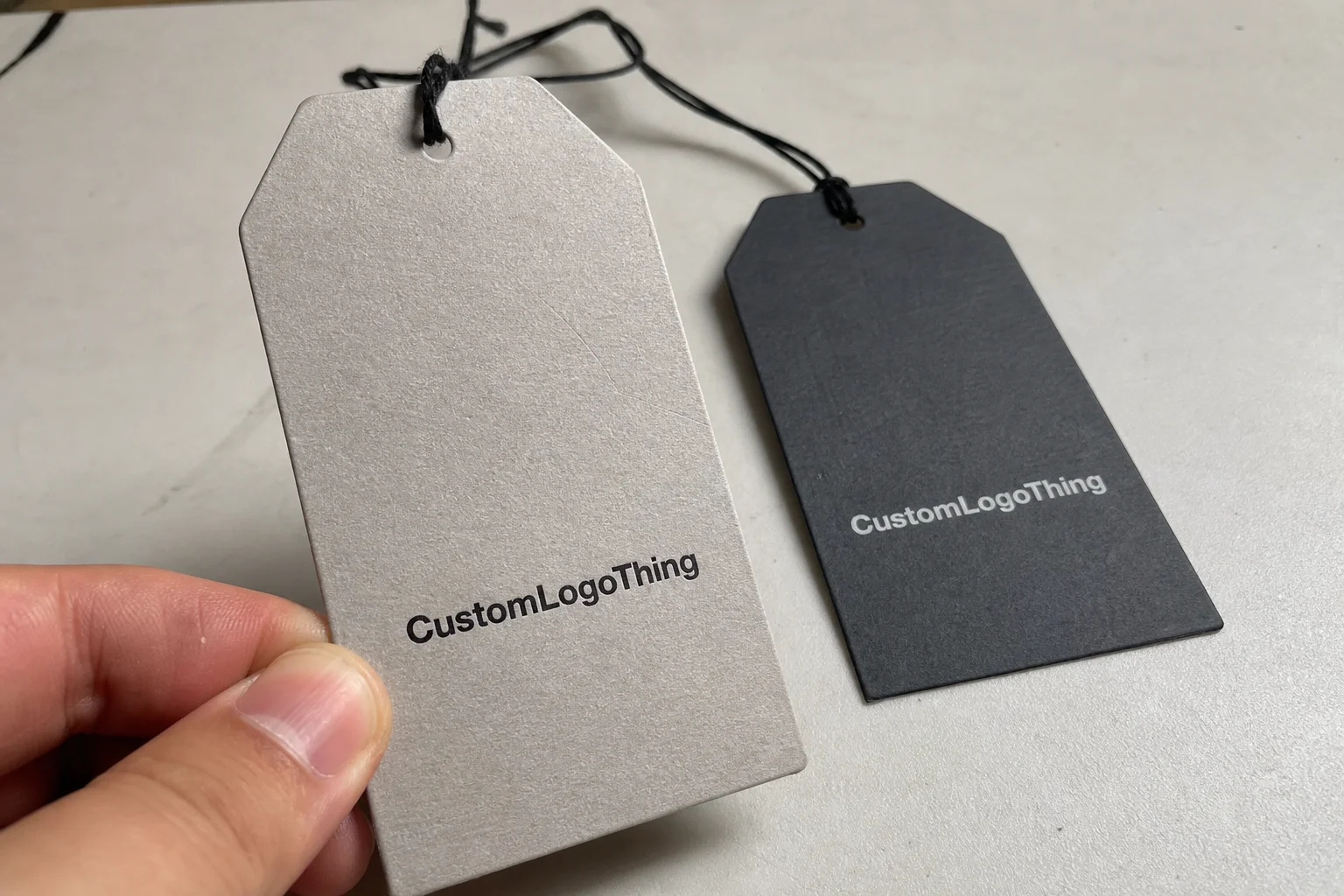
Boutique Clothing Hang Tags custom logo do a job that is easy to underestimate because the piece is so small. They create the first price signal, the first brand cue, and often the first impression of quality before a shopper touches the garment. In a boutique setting, that matters more than it does on a mass-market rack, where the brand system already carries some of the load.
A hang tag can hold a logo, size, barcode, price, care notes, country of origin, and sometimes a QR code that links to fit guidance or product registration. That is a lot of information in a small space, which is why layout matters as much as print quality. If the hierarchy is unclear, the tag feels busy. If the hierarchy is disciplined, the garment immediately feels more considered.
That perception is not abstract. Buyers and store teams handle tags all day, and they notice the same physical cues again and again: stock weight, print sharpness, edge quality, hole reinforcement, and whether the attachment looks intentional. A thin, shiny tag on a premium knit signals mismatch. A heavier matte tag with clean type usually supports the price point instead of arguing with it.
The strongest custom logo tags act like miniature storefront signs. They do not need to be loud. They need to feel deliberate. The difference between deliberate and improvised is often the difference between a brand that feels boutique and one that feels temporary.
A good hang tag is not decoration. It is a retail signal, a packaging element, and a quality check in plain view.
That is also why tag design should sit inside the wider packaging system. The best results happen when the swing tag, internal label, tissue, and outer packaging all speak the same visual language. A minimal loungewear line wants restraint. Occasionwear can handle more tactility. Denim can tolerate bolder contrast. The garment category should shape the tag, not the other way around.
Materials, finishes, and structural details that actually matter
The stock you choose changes how the brand feels in hand. A 14pt coated board and a 28pt textured art card may print the same logo, but they do not communicate the same value. One feels standard and efficient. The other feels built to be noticed. For boutique clothing Hang Tags Custom logo, that difference is often the most cost-effective way to move the perception of a line upward.
Common stock options include matte coated card, uncoated stock, kraft board, textured paper, and heavier art card. Matte coated stock gives sharper color and cleaner type, which helps when the logo is detailed or the brand relies on precise typography. Uncoated stock feels softer and more tactile, but saturated colors can look flatter on it. Kraft board suggests natural, earthy, or sustainability-focused positioning. Textured papers suit premium collections that want a slightly editorial finish. Heavy art card tends to resist curl better and usually survives retail handling more gracefully.
Finishing is where the design either gets refined or overworked. Foil stamping can add strong contrast, but it only looks premium when the layout has enough negative space. Embossing creates physical depth and can elevate even a minimal logo mark. Spot UV works best when the base is matte and the gloss is used sparingly. Soft-touch coating gives a velvety feel, though it can show rub marks if tags are packed too tightly or slide around inside cartons. Rounded corners are a small decision that pays off by reducing scuffing and making the tag feel finished.
Structure matters just as much as finish. A single-sided tag keeps the message clean and usually keeps the cost down. Double-sided printing is useful when the front carries the branding and the back carries size, price, care, or barcode information. Hole placement should leave enough material at the top so the tag does not split where the string passes through. That sounds basic, but weak hole placement causes more damage in retail than most brands expect.
Attachment style changes the customer experience too. String ties, elastic loops, plastic fasteners, and pin-style attachments all create different impressions. A soft loop often suits dresses and occasionwear better than a rigid fastener. Streetwear can handle a more utilitarian look. Knitwear needs attachment choices that avoid snagging. The attachment is part of the presentation, not a separate decision.
There is a practical side that buyers tend to learn the hard way. Light-colored stocks show fingerprints quickly. Dark backgrounds can hide edges if the print registration is loose. Soft-touch and uncoated finishes can scuff when cartons are overpacked. If the line is being positioned as sustainable, ask for FSC-certified board and confirm the chain-of-custody details rather than relying on a logo printed in the margin. The official reference point is the FSC site, not a line on a quote.
If the rest of the assortment needs sewn-in identification, pair the tag program with Custom Labels & Tags so the swing tag and internal label feel like part of one system. That keeps the brand story coherent across the garment, not just on the hanger.
- Minimal basics: uncoated or matte stock, one or two colors, restrained layout.
- Streetwear: stronger contrast, bolder type, spot color accents, or black stock with white ink.
- Occasionwear: textured paper, foil, embossing, or soft-touch to support a higher price point.
- Natural or ethical lines: kraft board, muted inks, and simpler finishing to avoid visual noise.
How the process and lead time usually work
The production flow is straightforward on paper, but each approval step affects the calendar. It usually starts with a brief, then artwork, then a digital proof or sample, then production, cutting, finishing, packing, and shipping. Boutique clothing Hang Tags Custom logo move quickly when the files are clean and the decision-making is finished. They slow down when the logo file is low-resolution, the barcode needs cleanup, or the copy changes after proofing has already started.
For a standard tag on common board stock, a realistic timeline is often 10 to 15 business days after proof approval. Add foil, embossing, custom die-cuts, or more complex packing instructions, and the schedule can stretch to 15 to 20 business days or longer. Rush service exists in some cases, but it narrows the material options and leaves less room for correction. If the tags need to arrive before a seasonal floor set, the safer strategy is to build buffer into the plan.
Lead time is not only about print speed. It also depends on material availability, machine queue position, and how many finishing passes the job needs. A square tag with straightforward trim is easier to schedule than one with a custom silhouette and metallic foil. Even carton packing affects timing. If tags must be banded by SKU or separated by size, that adds labor, and labor adds days.
Shipping conditions matter too. Loose packing can cause edge crush, corner wear, or slight curl by the time the cartons reach the warehouse. That is where packaging transit testing earns its place. The International Safe Transit Association publishes test methods that help teams assess damage risk more intelligently; see ISTA. The testing standard is aimed at broader packaging performance, but the hang tag still benefits when the carton strategy is not guessed at blindly.
The fastest file is usually the one that is already resolved: vector logo, final copy, exact quantities, and a clear spec sheet.
Suppliers move faster when they receive final artwork in vector format, Pantone references if color matching matters, and exact quantities by SKU. If the line includes multiple sizes or colorways, list them clearly. Ambiguity creates back-and-forth, and back-and-forth is what makes a simple print job feel slow. That applies to hang tags, custom printed boxes, inserts, and the rest of the branded packaging stack.
What pricing, MOQ, and unit cost really depend on
Tag pricing usually comes down to five variables: stock, size, print coverage, finishing, and packing. Shipping sits on top of that. MOQ, or minimum order quantity, exists because setup work costs money before a single sellable tag is produced. Plates, dies, color calibration, cutting, and finishing setup all have to be paid for somewhere. That is why a 500-piece run can feel expensive compared with a 5,000-piece run, even if the design itself is simple.
From a packaging buyer’s point of view, the lowest quote is not always the best value. A cheaper price can hide lighter stock, weaker print, fewer finishing steps, or looser quality control. Boutique assortments usually look better with a tag that survives handling and still looks clean after a week on the rack. If the tag collapses visually, the savings disappear on the sales floor.
| Option | Typical features | Indicative unit cost at 5,000 pieces | Best fit |
|---|---|---|---|
| Matte coated card, one-sided print | Clean type, simple logo, standard hole | $0.08-$0.16 | Elevated basics and volume-driven boutique lines |
| Uncoated or kraft stock, two-sided print | Natural texture, size and care info on back | $0.10-$0.20 | Earthy, craft-led, or sustainability-focused branding |
| Textured stock with foil or embossing | Tactile finish, premium logo treatment | $0.18-$0.35 | Occasionwear, dresses, and higher-margin collections |
| Soft-touch card with custom die-cut | Special shape, velvety coating, stronger shelf presence | $0.22-$0.45 | Limited drops and presentation-heavy boutique assortments |
The unit cost usually drops as quantity rises because setup is spread across more pieces. A 1,000-piece order often feels disproportionately expensive. A 10,000-piece order can improve the rate, but only if the spec stays stable. If the design changes from one SKU to the next, the scale advantage shrinks fast. Variable data, multiple barcodes, different sizes, and custom shapes all push the quote upward.
Ask suppliers to itemize the estimate. A useful quote should separate setup, print, finishing, packing, and shipping. That makes it easier to compare offers line by line instead of by instinct. It also reveals whether the lower quote is simply using a thinner board or skipping a finish that the line actually needs.
Step-by-step ordering guide from brief to delivery
The cleanest orders start with a tight brief. Include the brand name, product category, target retail price, logo files, color references, copy, quantity, deadline, and where the tag will attach on the garment. That last point matters more than people expect. A tag for a knit top behaves differently from a tag for a structured jacket or a delicate dress.
Next, build the layout around function first. Put the information store teams need at a glance in a readable location, then place branding, then decide whether a finish should support the message. If the tag also needs a barcode, keep the code away from the fold, the hole, and any high-gloss detail that could interfere with scanning. The best-looking tag still fails if it is hard to use at checkout.
- Gather the final artwork and any legal copy.
- Choose the stock and finish based on the garment’s price point.
- Confirm size, hole position, attachment style, and any barcode or QR code.
- Review the proof for spelling, trim lines, and color balance.
- Approve the spec sheet and lock the quantity before production starts.
- Confirm packing instructions so cartons arrive sorted by SKU, size, or colorway.
If the line also needs tissue paper, mailers, inserts, or Custom Packaging Products, coordinate those materials early. Otherwise, the swing tag can feel disconnected from the rest of the branded packaging system. A brand that invests heavily in the tag but treats the rest of the package stack as an afterthought usually ends up with mixed signals.
Think of the order as a chain of decisions rather than a single purchase. Sample or digital proof, specification approval, production, and shipment. The sequence is simple. Skipping one step usually creates rework later, and rework is expensive. A corrected proof costs far less than a corrected print run.
For boutique clothing hang tags custom logo, the smartest path is usually the least dramatic one: send clean files, ask for a proof, confirm the spec, and place the order before inventory lands. That is how brands keep the timeline under control without sacrificing quality.
Common mistakes that make boutique tags look cheap
The most common problem is overcrowding. Brands try to fit the logo, slogan, website, size, barcode, QR code, sustainability language, price, fabric details, and social handle onto one small rectangle. The result is a crowded hierarchy and tiny type that feels accidental. A better tag usually says less, but it says it more confidently.
Another issue is a mismatch between the stock and the brand promise. A luxury or elevated boutique line can look underfunded on thin glossy board. A natural collection can feel off on bright white, high-shine stock. The material should reinforce the price point. If the garment is positioned as premium but the tag feels light in the hand, shoppers notice the gap almost immediately.
Color can work against the design too. Low-contrast text disappears. Dark backgrounds make edges harder to read if print registration is loose. Certain inks shift noticeably on uncoated paper. Metallics can look flat if the layout does not leave enough space for them to breathe. This is where sample approval matters more than screen viewing. A screen is not retail lighting.
Production details matter just as much. Hole placement too close to the edge weakens the tag. Sharp corners show wear faster. Fancy finishes can crack or rub if the tags are packed too tightly. If the supplier is also producing tissue, inserts, or custom printed boxes, ask how they protect the full shipment in transit. The tag should arrive looking like a brand asset, not like leftover stock from a warehouse shelf.
- Do not hide essential information in tiny type.
- Do not choose a finish just because it looks expensive in isolation.
- Do not ignore barcode placement if the store needs it.
- Do not approve color from a screen alone.
- Do not under-spec carton packing, especially for soft-touch or dark stock.
Expert tips for a cleaner first order
Order a test run if the line includes multiple SKUs, specialty finishes, or a seasonal color change. Even a small sample order can reveal whether the stock feels right in hand, whether the color reads under retail lighting, and whether the hole placement works with the garment construction. That is cheaper than discovering the problem after the full run lands.
Match the tag to the garment story. Organic cotton basics usually need calmer cues. Denim can carry more texture and contrast. Occasionwear benefits from restraint plus one premium detail, such as foil or embossing. Accessories often work best with a tag that feels like a gift insert instead of a commodity label. That judgment is part of package branding, and it shows up on the shelf.
A strong spec sheet should include size, stock, finish, hole style, quantity, deadline, and any second-side copy. If the collection spans multiple colorways, list each one separately. Suppliers quote faster and more accurately when the data is clean. It also makes the job easier to compare against other custom packaging products in the line.
Compare physical swatches under retail lighting whenever possible. Coated white paper, natural kraft, and soft-touch finishes can look very different once they move off the screen and under fluorescent or warm LED light. That final check is where many boutique brands catch a near-miss before it becomes a costly print run.
For a polished first order, the practical sequence is simple: finalize the artwork, request a quote, review the proof carefully, approve the specification sheet, and place the order early enough for the tags to arrive before inventory lands. That is the most reliable way boutique clothing hang tags custom logo support the line instead of chasing it.
What should I include on boutique clothing hang tags custom logo for a small apparel line?
Include the brand name, logo, size, price or SKU, care details, and any barcode or QR code the store needs. Keep the layout readable at arm’s length so the tag supports the garment instead of competing with it. Add only the information that helps the shopper or store team make a faster decision.
How much do custom logo boutique clothing hang tags usually cost?
Cost depends on stock, size, print sides, finish, quantity, and whether the job uses a special shape or rush timeline. Smaller runs usually carry a higher unit cost because setup is spread across fewer pieces. The cleanest comparison is a full spec-by-spec quote, not a single headline price.
What is the typical turnaround for custom boutique hang tags?
Turnaround usually includes proofing, approval, production, finishing, and shipping, so the total timeline is longer than print time alone. Simple jobs move faster than tags with foil, embossing, custom die-cuts, or multiple revisions. Supplying final artwork early is the fastest way to protect the schedule.
How do I choose the right material for boutique apparel tags?
Choose the stock based on the garment’s price point and the feeling you want the customer to have when they pick it up. Heavier board and tactile finishes usually suit premium boutiques better than thin, glossy stock. Test the material under store lighting before approving a large run.
Can I order boutique hang tags in small quantities with a custom logo?
Yes, but the MOQ and unit cost will usually be higher than on larger orders. Small quantities make sense when you are testing a collection, launching a seasonal line, or running a limited drop. Ask for a quote that separates setup, print, and finishing so the economics are clear.
What should I do before I place the order?
Lock the artwork, confirm the stock and finish, check the proof on screen and in print if possible, and make sure the quote matches the exact spec. If those pieces are settled, boutique clothing hang tags custom logo are much less likely to drift in production and much more likely to land on time.


