For a small piece of board stock, recycled paper Hang Tags Custom logo projects carry a lot of weight. They introduce the brand, carry size and care information, support compliance, and quietly signal that the packaging decision was made with restraint rather than excess. Buyers judge retail packaging in seconds, and a hang tag is usually one of the first tactile items they touch.
That is why recycled tags punch above their weight. They are not just decoration. They sit between package branding, product information, and material choice. When the stock feels considered, the whole garment or accessory feels more intentional. When the logo is printed cleanly, the message is simple: this brand cares about details, but it is not wasting material to prove it.
Why recycled hang tags punch above their weight
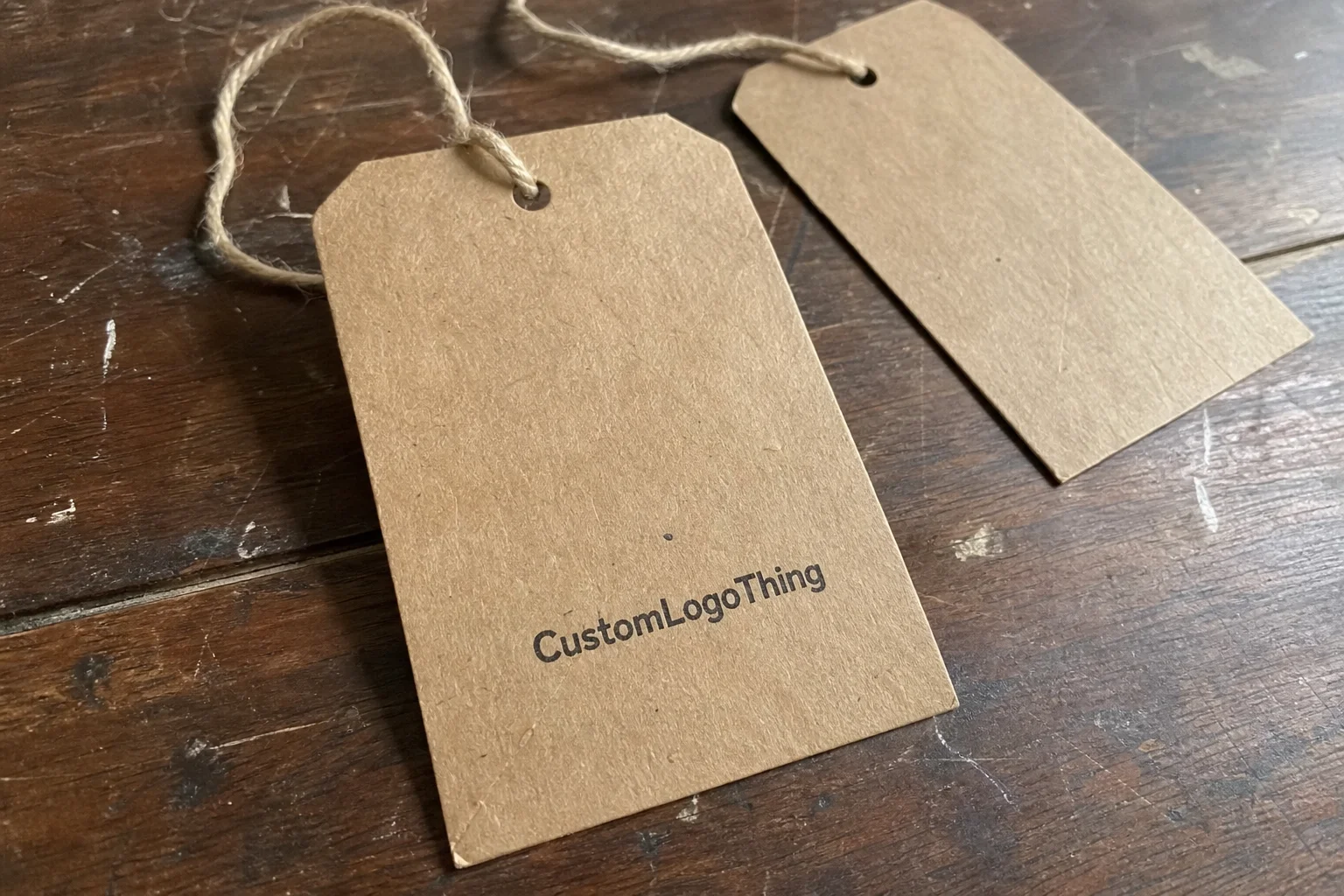
A hang tag is tiny, yet it often has to do the work of a mini brochure. It may carry the logo, SKU, price, size, fiber content, origin, care icons, and sometimes a sustainability claim. That is a lot to fit on a square of paperboard that might be only 2 x 3.5 inches or 2.5 x 4 inches.
Recycled paper Hang Tags Custom logo options change first impressions in a useful way. Recycled stock usually has a softer, more natural surface than a bright coated sheet, and that texture can read as thoughtful rather than cheap. Buyers often assume “recycled” means rough or dull. That is not always true. A 300gsm or 350gsm recycled board with a clean die-cut, a sharp logo, and a well-planned layout can feel more premium than a glossy tag that tries too hard.
Common recycled stocks include post-consumer waste paperboard, kraft-style recycled board, and lightly coated recycled sheets. Finishes can be matte, uncoated, soft-touch, or selectively enhanced with foil or embossing if the project budget allows. The point is not to hide the recycled character. The point is to make it look deliberate.
Here’s the packaging reality: a good tag supports the broader branded packaging system. It should echo the box, tissue, insert card, and label language. If the brand already uses custom printed boxes or a minimal mailer, the hang tag should feel like part of the same family, not a leftover piece from a different vendor.
“Recycled does not have to mean rustic, and rustic does not have to mean unpolished. The best tags are the ones where the material choice and the logo treatment agree with each other.”
How custom logo printing works on recycled stock
The production flow is straightforward on paper, but the details matter. It usually starts with artwork setup, then proofing, printing, cutting, punching, finishing, and final packing. If the job includes string, elastic loops, or safety pins, those are typically added near the end once the tags are inspected and counted.
Recycled fibers affect print behavior. Uncoated recycled stock absorbs more ink than a coated sheet, which can soften colors slightly and reduce razor-sharp edge contrast. That does not mean the result is poor. It just means the design needs to respect the material. A dark logo on pale recycled board often looks excellent. Very light colors on brownish kraft stock can disappear fast.
In practice, the best results usually come from simple logo forms, clear typography, and stronger contrast. Fine hairlines, tiny reversed text, and delicate gradient fills are riskier on textured paper. If the logo depends on precise color matching, ask for proofing under the final paper choice instead of assuming the screen version tells the whole story.
Print method matters too. Digital printing is often the smart choice for shorter runs, versioning, and quicker artwork adjustments. Offset printing tends to work better for larger volumes and color consistency across long runs. Specialty processes like embossing, foil stamping, or spot UV can lift a brand visually, but they add setup time and cost, and they are not always the right fit for a sustainability-led look.
For buyers who care about the technical side, think in terms of use case:
- Digital print: flexible, lower setup, often suitable for shorter runs and multiple versions.
- Offset print: efficient for higher quantities, consistent output, and tighter brand color control.
- Special finishes: best for premium retail packaging, but only when the budget and timeline support them.
If the tag is part of a broader packaging design system, it should also be visually compatible with Custom Labels & Tags and the rest of the shelf-facing materials. The strongest brands usually repeat a few cues: typeface, spacing, icon style, and paper tone.
For sustainability claims and material sourcing language, it is smart to align with recognized standards. The Forest Stewardship Council has clear guidance around responsible sourcing, and buyers can review that framework at fsc.org.
Cost, pricing, and MOQ factors that move the quote
Price is usually a function of six things: paper weight, size, print sides, number of colors, finishing, and how the tags are attached and packed. The biggest surprise for first-time buyers is that a simple design does not always mean a low price. A small run can cost more per piece than a more complex larger run because setup gets spread across fewer units.
For a practical benchmark, many recycled paper hang tag quotes fall somewhere around $0.10-$0.35 per unit at mid-volume quantities, with smaller orders often pricing higher per piece. A run of 1,000 tags might land closer to the upper end depending on size, die-cut shape, and finish, while 5,000 pieces can lower the unit cost meaningfully if the artwork stays stable. Add foil, embossing, or specialty attachment, and the number can climb quickly.
Minimum order quantity, or MOQ, changes the math. Lower MOQs are easier for testing, seasonal launches, or small-batch product lines, but they often carry a higher per-piece cost because press setup, cutting dies, and proofing do not shrink proportionally. That is true across a lot of product packaging categories, not just tags.
Here is a simple way to compare options without getting distracted by the lowest headline price:
| Option | Typical use | Relative unit cost | Brand impact |
|---|---|---|---|
| Recycled uncoated stock, one-color print | Basic apparel and accessories | Lower | Natural, restrained, practical |
| Heavier recycled board, full-color print | Fashion, premium retail, gifting | Mid-range | Sharper shelf presence |
| Recycled stock with foil or emboss | Premium collection drops | Higher | Stronger tactile signal |
| Mixed versions or variable data | SKU-heavy programs | Mid to higher | Operationally efficient, but more complex |
Where does recycled paper save money? Usually in material simplification and alignment with plain-finishing aesthetics. Where can it add cost? Heavy recycled board, unusual textures, dark coverage on rough surfaces, and eco-focused finishes that require special setup. The best quote comparison is not unit price alone. Ask whether die fees, setup charges, proofing, attachment, and shipping are included. Compare total landed cost.
One buying habit saves money over time: order enough overage. A 3% to 10% buffer is common, depending on launch risk, SKU changes, and store handling. The cost of running short is usually worse than the cost of a few extra tags.
For general packaging sustainability context, the EPA’s materials information is useful background reading: epa.gov.
Production steps and timeline: from file upload to delivery
A realistic production schedule starts with clean artwork. If the logo file is vector-based and the dimensions are clear, the job moves faster. If the file is a low-resolution screenshot or the customer is still deciding on size, the timeline usually stretches.
Typical flow:
- File upload and specification review — size, stock, print method, attachment, and quantity are confirmed.
- Prepress check — the team checks bleed, safe area, hole placement, and resolution.
- Digital proof — the customer reviews layout, spelling, and basic color expectations.
- Approval — the job moves only after the proof is signed off.
- Printing and cutting — tags are printed, die-cut, punched, and finished.
- Quality check and packing — quantities are counted, stacked, bagged, or boxed.
- Shipping — transit time depends on destination and carrier.
In many cases, production takes about 12-15 business days from proof approval for standard jobs, but that depends on the printer’s workload, quantity, and finishing complexity. Transit can add another 2-7 business days, sometimes more if the destination is remote or the shipment is split.
The slowest approvals usually come from avoidable issues: missing dielines, logos supplied only as JPGs, uncertain hole placement, late color changes, or a request to “just move things a little” after the proof has already been reviewed. Those small changes can trigger another prepress round. If the tags need to line up with a garment fold or a packaging insert, send reference measurements early.
Rush production is possible in some situations, but it depends on stock availability, press capacity, and whether the finishing is simple enough to compress. A straightforward one-color tag will move faster than a foil-stamped tag with a custom shape. Buyers planning a seasonal launch or store opening should separate production time from transit time. Those are not the same thing, and too many launch delays happen because someone confused them.
Specification checklist: size, stock, finish, and attachment
If you want recycled paper hang tags custom logo work to feel intentional, the spec sheet has to be clear. A vague request like “nice recycled tag” leaves too much open to interpretation. A better brief names the dimensions, thickness, print sides, finish, and how the tag will attach to the product.
Start with size. Common retail formats include 2 x 3.5 inches, 2.5 x 4 inches, and 3 x 4 inches, but the right size depends on the product. A jacket tag can be larger than a delicate jewelry tag because the visual and physical scale is different. Corner style matters too. Square corners feel modern and graphic. Rounded corners feel softer and are less prone to dog-earing.
Paper weight influences both appearance and durability. A 300gsm board is often a comfortable middle ground. Heavier stocks around 350gsm or above can feel more premium, but they also increase stiffness and sometimes cost. If the tag must hang cleanly without flopping, balance is more useful than sheer thickness.
Finish decisions deserve more attention than they get. Matte is usually the safest choice for a recycled look because it keeps the surface calm and easy to read. Soft-touch adds a smoother handfeel, though it may mute the eco texture. Uncoated recycled stock looks honest and tactile, while spot treatments can create visual hierarchy where the logo or a key icon needs emphasis.
Attachment is not a small detail. It affects both retail workflow and customer experience. Common options include:
- String or twine for a natural, premium feel.
- Elastic loops for quick application in high-volume packing.
- Safety pins for certain garments or accessory bundles.
- Pre-tied options for streamlined fulfillment.
Match tag weight to the product. A very light accessory can look overwhelmed by a thick board, while a heavy garment can make a flimsy tag look accidental. From a packaging buyer’s point of view, the best tag is the one that hangs well, survives handling, and still looks clean after it has been touched a few times on the sales floor.
Common mistakes that make recycled tags look generic
The most common mistake is crowding the surface. Too much copy turns a tag into a memo. A recycled tag should feel edited. If the logo, size, price, care details, and sustainability claim are all fighting for attention, nothing wins.
Weak contrast is another issue. Recycled paper is rarely a pure white canvas, so pale ink choices and thin fonts can disappear. Dark charcoal, deep green, and black often outperform lighter neutrals. The same applies to line thickness. Fine rules and tiny icons may look elegant on screen and vanish on textured paper.
Then there is the color trap. A proof viewed on a backlit monitor will not behave like the printed piece. Recycled fibers shift the final appearance, especially on uncoated stock. That is why a printed sample or physical proof can be worth the extra step if the tag is tied to a premium launch or a color-sensitive identity.
Some buyers also forget the broader story. If the tag says recycled but the rest of the packaging uses mixed materials with no clear rationale, the sustainability message gets diluted. The tag should fit the rest of the system, whether that includes custom printed boxes, paper tape, or a simple mailer.
Operational misses are just as costly:
- Ordering too few extras for replacements and QC rejects.
- Forgetting that different SKUs may need different tag content.
- Skipping a test fit on the actual garment or product.
- Approving a proof without checking hole position against the fold or seam.
Expert tips to get a sharper custom result
If the logo is intricate, simplify it for small-format print. That does not mean changing the brand. It means choosing the version of the mark that reads best at 2 inches wide, not just the one that looks best on a website header. Bold type and clean spacing almost always improve readability.
Ask for paper samples if texture matters. A recycled board can vary more than many buyers expect. One stock may read cooler and lighter; another may lean warm or brown. In real light, those differences affect the whole package branding story. If the tag has to coordinate with tissue, inserts, or custom packaging, test the materials together rather than separately.
A system mindset helps. A hang tag should echo the same visual rules used across the broader retail packaging line. That includes the tone of the copy, the spacing, the icon style, and the color contrast. If your outer boxes are minimal and your tags are overloaded, the brand feels less disciplined.
Accessibility matters too. Clear hierarchy and strong contrast help shoppers read care instructions, pricing, and brand info quickly. That is not a design nicety. It is a functional part of the packaging experience.
One more practical tip: if the job is part of a wider ordering plan, compare it against other Custom Packaging Products so the tag spec, carton spec, and insert spec support one another instead of competing for attention.
Next steps: spec, sample, and order with confidence
Before requesting a quote, gather three things: your logo files, target quantity, and the exact use case for the tag. Is it for apparel, gifts, accessories, or a limited-edition launch? That answer changes the recommended size, thickness, and finish.
If color accuracy, texture, or finish will affect the final retail presentation, order a sample or proof. It is a small cost compared with the cost of reprinting a batch that feels off in hand. When possible, compare two or three configurations: one value option, one brand-forward version, and one sustainability-led version. Seeing them side by side makes the decision easier and usually sharper.
A practical action plan is simple:
- Finalize the tag size and stock.
- Send vector artwork and any copy that must appear.
- Confirm the hole placement and attachment method.
- Review the proof carefully, especially color, spacing, and spelling.
- Build in a small overage for launch buffers and replacements.
That process is not glamorous, but it works. And for recycled paper hang tags custom logo projects, it usually gets the best tradeoff between cost, turnaround, and brand presentation. If the material is chosen honestly, the design stays clear, and the proof gets reviewed like it matters, the final tag will do exactly what it should: make the product look more considered, not more complicated.
What makes recycled paper hang tags custom logo printing look premium?
Premium feel usually comes from the right paper weight, clean typography, and strong contrast rather than from glossy finishes. A simple logo, careful layout, and a textured recycled stock often look more intentional than an overdesigned tag.
Do recycled paper hang tags custom logo orders cost more than standard stock?
Not always, but heavier recycled papers, specialty textures, and low quantities can raise unit cost. The best comparison is total quote value, including setup, finishing, and shipping.
How long does production usually take for recycled paper hang tags custom logo jobs?
Timeline depends on artwork readiness, proof approval speed, quantity, and finishing choices. Rush orders are possible in some cases, but they work best when the design is finalized and stock is available.
What file type is best for a custom logo hang tag design?
Vector files such as AI, EPS, or PDF usually work best because they stay sharp at any size. High-resolution PNG or JPG files may be accepted for simple artwork, but they are less ideal for fine details.
What should I check before approving a recycled paper hang tag proof?
Confirm logo placement, spelling, color expectations, hole position, and final dimensions. Also check whether the recycled paper tone affects the background color or contrast more than expected.