Buyer Fit Snapshot
| Best fit | Box Seal Stickers for Ecommerce projects where brand print, material claims, artwork control, MOQ, and repeat-order consistency need to be specified before quoting. |
|---|---|
| Quote inputs | Share finished size, material target, print colors, finish, packing count, annual reorder estimate, ship-to region, and any compliance wording. |
| Proofing check | Approve dieline scale, logo placement, barcode or warning zones, color tolerance, closure strength, and carton packing before bulk production. |
| Main risk | Vague material claims, crowded artwork, missing packing details, or unclear freight terms can make a low unit price expensive after revisions. |
Fast answer: Box Seal Stickers for Ecommerce: Material, Adhesive, Artwork, and MOQ should be specified like a repeatable production item. The safest quote records material, print method, finish, artwork proof, packing count, and reorder notes in one written spec.
Production checks before approval
Compare the actual filled-product size with the drawing, then confirm tolerance on folds, seals, hang holes, label areas, and retail display edges. Reserve space for logos, QR codes, warning copy, and material claims before decorative graphics fill the panel.
Quote comparison points
Review material grade, print process, finish, sampling route, tooling charges, carton quantity, and freight assumptions side by side. A quote is only useful when the supplier can repeat the same color, closure quality, and packing count on the next order.
Box Seal Stickers for Ecommerce: How to Choose and Use Them
Box seal stickers for ecommerce can look like a minor detail on a packing table, yet they often shape the first impression of a shipment long before a customer reaches the product inside. A clean seal gives a carton a more intentional look, a tighter feel, and a clearer brand presence, and box seal stickers for ecommerce earn their place when they fit the right box, adhesive, and fulfillment flow.
For many brands, box seal stickers for ecommerce do three jobs at once: they close a seam, signal tamper resistance, and replace a little bit of plain brown-box anonymity with something designed. That does not mean they should carry the burden of weak cartons or sloppy packing. They work best as a finishing piece, not a rescue step.
I have watched teams overcomplicate this and then wonder why the line slows down. Usually the fix is not more decoration; it is better fit, better pressure, and fewer hand motions. Keep the seal doing one clear job and it will usually behave.
Box Seal Stickers for Ecommerce: What They Are and Why They Matter
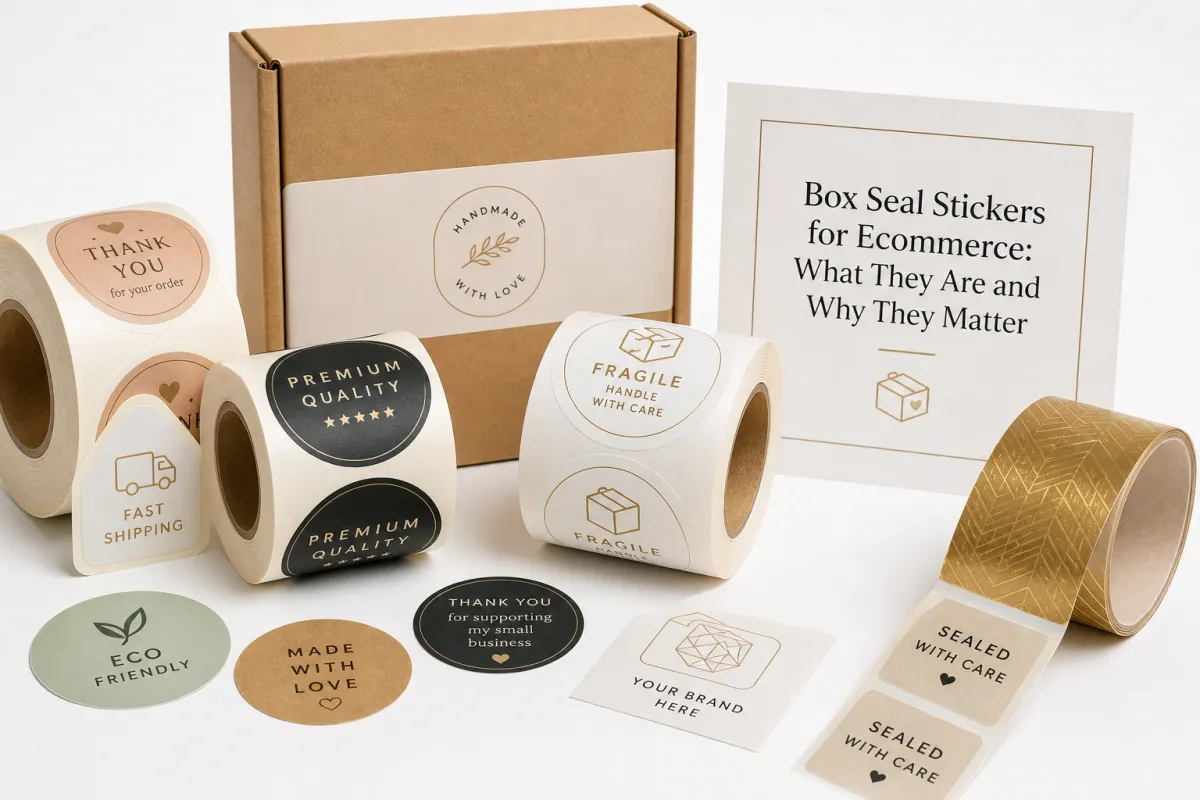
Box seal stickers for ecommerce are pressure-sensitive labels made to close a carton flap, bridge a seam, or make an opening attempt obvious. In a basic version, they are a branded seal that sits across the box closure; in more specialized versions, they use destructible stock, void patterns, or high-tack adhesives that reveal tampering the moment someone tries to peel them up. The idea is straightforward, yet the execution can vary a great deal from one shipper to another.
A decorative sticker and a true sealing label are not always the same thing. Decorative versions may exist for branding alone, which works fine if the box already has a solid closure method underneath. True box seal stickers for ecommerce are chosen for function first: they need to hold to the carton surface, stay legible through handling, and keep the seam closed long enough to survive vibration, scuffing, and stacking in transit. That difference matters more than many teams expect.
From a packaging buyer's point of view, box seal stickers for ecommerce can tighten the whole pack-out rhythm. A box closed with one well-placed seal often feels faster to assemble than a box that needs extra tape strips, label alignment, and a separate branding step. The result is not just a nicer carton. It is a more repeatable packing process, which matters when a team is trying to hit daily order counts without adding unnecessary motion at the table.
I also like that box seal stickers for ecommerce give a brand a visible handhold on presentation without forcing a full custom carton order. If you are not ready for printed boxes, a seal can still make a plain kraft mailer feel branded and deliberate. For many smaller DTC brands, that is the right balance of cost and impact, especially if the stickers are paired with Custom Labels & Tags elsewhere in the kit so colors, type, and finish stay consistent.
A seal sticker should do one job very well: close the seam cleanly on the actual carton, not just on a sample sheet.
That is why box seal stickers for ecommerce deserve a real spec discussion. They are not a cure for a weak carton, and they are not always the strongest closure method on the market. They are, though, one of the most practical ways to combine closure, branding, and handling signal in a single, low-footprint component.
One more point from the packing bench: if a seal takes too much finger pressure to apply, the crew will start rushing it, and rushed labels usually show it. In my experience, the best-performing seals are the ones that feel almost boring to apply. Boring is good here.
How Box Seal Stickers for Ecommerce Work in Daily Fulfillment
In daily fulfillment, box seal stickers for ecommerce bridge the closure point where carton flaps meet. When applied correctly, the label creates a visible seam that helps keep the box shut and gives the pack line a consistent look from order to order. The adhesive bonds to the outer liner of the carton, which may be virgin kraft, recycled kraft, white corrugated, or a coated stock with a smoother surface than people expect.
The bond is created by pressure, not heat. That sounds simple, but the surface energy of corrugated board is a real factor. A clean, dry carton is far more forgiving than a dusty, fibrous, or heavily recycled one. Box seal stickers for ecommerce tend to perform best when the carton is assembled squarely and the seal is pressed down with a firm, even motion, either by hand or with a small application tool.
Teams use them in a few different ways. Some apply them by hand to each box as part of the pack-out flow. Others use a tabletop dispenser so the label can be peeled and placed quickly without wasting motion. At higher volumes, semi-automated packaging equipment can place box seal stickers for ecommerce as part of a repeatable line, which helps keep the closure location uniform and reduces the chance of crooked placement.
- Subscription boxes: box seal stickers for ecommerce can create a steady opening moment from shipment to shipment.
- Small DTC orders: they cut down on repetitive tape steps and add branding without redesigning the carton.
- Fragile items: they can help show whether the box has been opened before delivery.
- Giftable kits: a centered seal can make the box feel more polished at the point of unboxing.
The operational upside is real, but it depends on fit. If box seal stickers for ecommerce are too small, they can float on the seam without enough grab. If they are too large, they can wrinkle on the fold or interfere with reopening. The sweet spot usually comes down to flap width, the print area you need, and the kind of closure you want. For many brands, that means testing a few widths before locking into a production run.
For shipping teams, a good seal also removes ambiguity. A worker does not need to wonder whether they should add one more strip of tape, or whether a box already looks finished. Box seal stickers for ecommerce can turn closure into a single, visual step, which is especially helpful during peak days, shift changes, or temporary labor periods when consistency matters more than ever.
There is also a customer-side effect that should not be dismissed. The first lift of the flap tells a story. If box seal stickers for ecommerce are crisp, centered, and aligned with the rest of the package design, they make the whole shipment feel more deliberate. If they are crooked or peeling, they make the box feel rushed. That is why practical testing matters long before artwork approval.
I once saw a team switch from tape to seals on a run of lightweight apparel boxes, and the first thing that changed was not the unboxing photo; it was the packing pace. The crew stopped reaching for the tape gun so often, which sounds small, but it added up over a full shift. That kind of small win is exactly why these labels keep showing up in ecommerce programs.
Choosing Materials, Adhesives, and Security Features
The material choice behind box seal stickers for ecommerce affects everything from print sharpness to how the label behaves on a dusty carton seam. Paper, BOPP, vinyl, and specialty stocks all have a place, but they do not perform the same way. Paper is often the easiest fit for a natural, kraft-friendly look. BOPP brings better moisture resistance and scuff resistance. Vinyl is more durable than many teams need, but it can help in tougher handling environments or on reusable packaging concepts.
Adhesive selection matters just as much as the face stock. Standard permanent adhesives work for many shipping cartons, especially if the board is clean and the environment is dry. For recycled cartons with a rougher surface, a higher-tack adhesive can make a visible difference. For cold-chain or refrigerated handling, the seal may need an adhesive that grabs reliably at lower temperatures. Box seal stickers for ecommerce are only as strong as the bond they create to the actual box stock, so testing on the real carton is non-negotiable.
Face Stock Choices
Paper stock gives box seal stickers for ecommerce a softer, more tactile finish, and that can be a nice match for kraft boxes or brands with a natural material story. BOPP is usually the better call if boxes may encounter humidity, friction, or a longer transit window. Specialty destructible films are the right answer when you want the seal to break apart rather than peel cleanly, because that makes any opening attempt obvious at a glance.
There is a small but important tradeoff here. Paper can look warmer and more premium in a hand, while film can stay cleaner when it gets rubbed against other cartons. If a seal is likely to touch shrink wrap, poly mailers, or a conveyor edge, I usually lean toward the tougher surface unless the brand story really wants the paper feel. That is one of those places where the photo sample does not tell the whole truth.
Security Features That Actually Help
VOID patterns, destructible materials, and tear-sensitive constructions are the features most teams ask about first. They are useful, but they should be matched to the customer promise and the carton style. A tamper-evident seal across a tuck closure can work very well. A poorly chosen seal on a box that flexes too much can split before it reaches the customer. Box seal stickers for ecommerce should support the closure, not fight the carton geometry.
Shape and finish matter too. A square or rectangular seal is easy to manufacture and place, but a custom die-cut can reinforce a logo or icon in a way that looks more intentional. Matte finishes often blend nicely with kraft board and reduce glare under warehouse lighting. Gloss can make color pop, but it may also show scuffs sooner. If the branding relies on metallic inks, embossing, or a rich spot color, box seal stickers for ecommerce can carry that detail surprisingly well on a small footprint.
Testing standards matter here, even if you are not running a formal lab. Many brands borrow thinking from ISTA transit testing methods when they evaluate handling, vibration, and drop exposure, and that is a smart habit even for smaller runs. If a seal survives a rough pack-out, a short vibration check, and a few hours in a warm truck bay without lifting, it is usually in the right zone for real fulfillment.
For sustainability-minded programs, paper selection can also tie into chain-of-custody goals. If your brand needs certified fiber, FSC-certified paper options can be part of the spec. That does not make the seal automatically better from a performance standpoint, but it can align the packaging choice with the brand story, especially when box seal stickers for ecommerce are being used on high-visibility DTC shipments.
The smartest approach is to choose materials from the box outward. Start with the carton surface, then the handling environment, then the customer experience, and only after that decide whether the seal should be paper, film, destructible, or heavily branded. That order of thinking saves a lot of trial and error later.
One honest disclaimer: no label material makes every carton fit every route. A seal that works beautifully on one corrugate style may lift on another, and the failure is often the board, not the print. If you can, test on the exact stock you plan to ship. It saves a headache later, and yeah, it saves a few gray hairs too.
Box Seal Stickers for Ecommerce Cost and Pricing Factors
Pricing for box seal stickers for ecommerce depends on more than the printed face. Material, adhesive, die-cut complexity, print method, finish, and order quantity all affect the final number. Smaller runs usually carry a higher unit price because setup and proofing are spread across fewer pieces. Larger runs lower the per-unit cost, but they also ask more of your storage planning and forecast accuracy.
For a practical reference, a simple paper seal with standard full-color print might land around $0.04-$0.08 per piece on a moderate run, while a BOPP version with stronger moisture resistance may sit closer to $0.05-$0.11 per piece. Tamper-evident or destructible constructions often move higher, sometimes $0.08-$0.18 per piece or more depending on size and print coverage. Custom die-cuts, specialty finishes, and heavier ink coverage can push box seal stickers for ecommerce into the upper end of that range. These numbers are directional rather than universal quotes; press, region, freight, and setup details can move them around quite a bit.
Those numbers are only part of the picture. A buyer should also ask what the sticker replaces. If box seal stickers for ecommerce reduce tape use, shorten application time, or eliminate a separate branding label, the true cost may be lower than the invoice suggests. I have seen teams focus only on sticker price and miss the labor savings from a cleaner pack-out sequence, which is usually the bigger win in a busy fulfillment area.
| Option | Typical Use | Approx. Unit Cost | Strengths | Tradeoffs |
|---|---|---|---|---|
| Paper seal | Light to medium cartons, natural branding | $0.04-$0.08 | Affordable, easy to print, good on kraft | Less moisture resistance |
| BOPP seal | Longer transit, scuff resistance, humidity | $0.05-$0.11 | Durable, crisp print, stronger surface protection | Can feel less paper-like |
| Destructible seal | Tamper evidence and high-trust shipments | $0.08-$0.18 | Shows opening attempts clearly | More expensive, may require testing |
| Custom die-cut seal | Premium branding or logo-focused closure | $0.10-$0.22 | Distinctive look, strong brand recall | Higher setup cost, may need more lead time |
Setup costs can surprise first-time buyers. Depending on the print method, there may be artwork prep, plate or die charges, proofing, and in some cases finishing fees for specialty shapes or coatings. If the artwork is highly detailed, the proofing cycle matters because small text, thin lines, and dense logos do not always survive a miniature format with the clarity the brand expects. Box seal stickers for ecommerce are small, but the production logic is still real print logic.
Total cost thinking works better than sticker cost thinking. Ask whether box seal stickers for ecommerce save labor, improve brand consistency, reduce damage claims, or lower reshipment risk. If the answer is yes in more than one of those categories, the sticker can justify itself even at a slightly higher price point. That is especially true for brands shipping subscription kits, giftable items, cosmetics, supplements, or carefully packed accessories where the customer experience matters as much as the product itself.
There is also a storage angle. Small labels are easy to forget until they run out, and then the packing team feels it immediately. Larger orders bring the price down, but only if you have a dry, organized place to store them and a forecast that is honest about sales volume. Box seal stickers for ecommerce should support your operating rhythm, not create a pallet of dead inventory.
One more practical point: if your box seal stickers for ecommerce are meant to replace a strip of tape, be sure the closure still passes the simple tug test. A seal can look great and still lose strength on a box that is overfilled, underfilled, or built with a weak seam. The carton always has the final say.
Step-by-Step: Ordering Box Seal Stickers for Ecommerce
The easiest way to spec box seal stickers for ecommerce is to start with the box, not the artwork. Measure the flap area, note whether the carton is kraft, white, or coated, and identify the exact spot where the seal will sit during closure. A seal that lands too close to the fold can wrinkle. A seal that sits too high may not bridge the seam well enough to matter.
From there, decide what the seal is supposed to do first. Is it mainly branding, mainly tamper evidence, or a little of both? Box seal stickers for ecommerce work best when the job is clear from the start, because that answer drives the choice of material, adhesive, and finish. A brand that wants a premium unboxing feel may lean toward paper with a soft matte finish. A brand that ships in humid or variable conditions may need BOPP with stronger staying power.
The artwork should be simple enough to survive a small format. Large logos, clear typography, and open negative space usually print better than dense, crowded layouts. If the seal is only two inches wide, a tiny web address or a thin decorative line can disappear on the line. Box seal stickers for ecommerce need to read at pack speed and still look polished in customer photos.
A good pilot run is worth the time. Test the stickers on the actual box stock, not just on a sample sheet. Check whether they lift at the edges, whether the adhesive holds to a recycled liner, and whether the label tears cleanly if you are aiming for tamper evidence. If the box is coming off a folding table at a fast pace, test that too. A seal that behaves nicely in a studio can act very differently under real fulfillment pressure.
I often recommend a small checklist before a full production order:
- Measure the seam width and flap overlap.
- Confirm the carton surface and coating level.
- Choose the closure goal: branding, security, or both.
- Request a proof with actual size and placement.
- Test box seal stickers for ecommerce on at least 10 real cartons.
- Review application speed with the people packing orders every day.
If you already have other branded components in the package, keep the visual family consistent. Matching a seal to Custom Labels & Tags can make the whole shipping kit feel more cohesive, even when the pieces are produced on different runs. A seal does not need to carry the whole identity by itself, but it should speak the same design language as the rest of the packaging.
Finally, think about removal. Box seal stickers for ecommerce are meant to be opened by customers, so the peel or tear behavior should make sense. If the box is a returnable shipper, the seal should support a reasonable opening experience without shredding the carton. If the goal is stronger tamper evidence, then a more destructive behavior may be fine. The point is to choose the open experience on purpose instead of discovering it after the order ships.
One small trick that helps a lot: place the first pilot run on the slowest, messiest shift you can find. If the seal survives that crew and that pace, it will probably do fine on the cleaner days too. That is the kind of real-world check I trust more than a perfect sample on a desk.
Process and Timeline: From Proof to Production
The typical workflow for box seal stickers for ecommerce starts with a quote, then moves to artwork review, proof approval, production, finishing, and shipment. The actual timeline depends on how much is being customized. A simple label with straightforward artwork can move faster than a custom die-cut seal with specialty film, matte varnish, or security features. Once those extras are added, the job often needs more proofing and more back-and-forth before anyone presses the green light.
From a planning standpoint, simple box seal stickers for ecommerce may be ready in a relatively short window once artwork is final, but I would still build in time for proof review, print correction, and shipping to the warehouse. More complex jobs often need extra days for color approval, finishing, or curing, depending on the print process. The practical lesson is simple: do not treat seals as an afterthought if they are tied to a launch, a subscription relaunch, or a peak season promotion.
Artwork changes are one of the biggest reasons timelines slip. A logo that looked clean on a computer screen may need line weight adjustments when reduced to a small label size. If the customer wants a richer metallic, a tighter registration, or a more exact color match, the proof cycle can stretch. Box seal stickers for ecommerce reward clear artwork discipline, because every round of revisions adds calendar time.
It helps to think backwards from the ship date. Ask yourself when the first cartons need to leave the building, then count back through proofing, production, inbound freight, and a small buffer for mistakes. If the seals are part of a launch kit, add even more cushion. I have seen teams get squeezed because they ordered the product on time and the packaging late, which is a rough place to be when the fulfillment calendar is already full.
The safest habit is to treat box seal stickers for ecommerce like any other production-critical component. Keep one person responsible for approving copy and artwork. Keep one person responsible for carton fit. Keep one person responsible for inventory timing. That sounds basic, but it prevents a lot of confusion when a label spec looks simple on paper and suddenly becomes urgent in the warehouse.
If you need a broader packaging benchmark, the packaging community has plenty of useful references through packaging.org, especially for teams comparing structure, print, and shipping presentation. Even when the final seal is small, the thinking around carton integrity and presentation still applies.
Timelines are also where honest expectations matter. If a supplier says a custom seal can move in a few days, ask what that means for proofing, freight, and revision turns. Fast is only useful if the label still lands correctly on the carton and the line can actually use it without slowing down.
Common Mistakes, Expert Tips, and Next Steps
One of the most common mistakes with box seal stickers for ecommerce is choosing the wrong adhesive for the actual carton surface. A sticker can look fine on a sample box and then start lifting on dusty recycled board, textured kraft, or a carton that was stored in a humid area. Another frequent error is using artwork that is too busy for the size. On a seal, clarity beats detail every time.
Another issue I see is people treating the seal like a standalone closure for a weak box. Box seal stickers for ecommerce can reinforce a seam, but they cannot fix an underbuilt carton or an overpacked shipper. If the carton needs a stronger board grade, more crush resistance, or a different closure style, solve that first. The seal should sit on top of a sound packaging structure, not substitute for it.
Here is the expert tip that saves the most grief: test box seal stickers for ecommerce on the exact box stock, with the actual packing crew, under the same pace they will use every day. A seal that works slowly and carefully may fail when the team is moving fast. Ask someone to apply a dozen boxes in a row and watch whether placement stays consistent, whether the peel edge is easy to grab, and whether the label slows the line. That one exercise tells you more than a polished mockup ever will.
Keep the design simple. One strong logo, one message, and enough open space usually perform better than a crowded layout with too many tiny elements. Box seal stickers for ecommerce should read instantly from a few feet away and still feel polished on close inspection. If you are chasing premium presentation, finish and placement matter almost as much as the artwork itself.
For brands that want a cleaner packaging family, box seal stickers for ecommerce can be paired with other print components so the system feels intentional. A matching label set, a coordinated tag, or even a standard color bar can pull the whole kit together. That is where Custom Labels & Tags can become part of the same conversation instead of a separate buying decision.
And yes, the small details show up in the customer experience. A centered seal makes the package look planned. A crooked seal suggests haste. A seal that tears cleanly gives the impression of a thoughtfully built carton. A seal that lifts in transit makes the box feel unreliable. Box seal stickers for ecommerce are tiny, but they are visible at exactly the moment the customer is deciding how careful the brand is.
Simple next steps:
- Measure the box seam and flap width.
- Define the seal's job before design starts.
- Choose paper, film, or security stock based on the shipping environment.
- Request a proof at actual size.
- Order a short pilot run and test it on the live packing line.
If your program needs a practical starting point, begin with a sample set of box seal stickers for ecommerce and a short test run of real cartons. That gives you a feel for adhesion, speed, and presentation before you commit to a larger order. It also keeps the conversation grounded in what the packaging actually does, which is where the best decisions are usually made.
The cleanest takeaway is this: choose box seal stickers for ecommerce only after you know the carton, the surface, and the job they need to do. If the seal is sized correctly, bonded to the right stock, and tested on the real packing line, it can save time, sharpen presentation, and give the shipment a more trustworthy finish without asking the warehouse to work harder.
Box seal stickers for ecommerce are not a flashy packaging upgrade, but they are one of those small choices that can quietly improve security, efficiency, and brand consistency all at once. When the material matches the carton, the adhesive matches the surface, and the artwork matches the job, box seal stickers for ecommerce earn their place every time a box leaves the packing table.
Are box seal stickers for ecommerce better than packing tape?
Box seal stickers for ecommerce are better when branding, cleaner presentation, and visible tamper evidence matter more than raw closure strength. Packing tape still wins on heavy cartons or shipments that take more abuse, so many brands use both together. The right answer depends on carton weight, route conditions, and how much security the package really needs.
What material is best for box seal stickers for ecommerce?
Paper is a strong choice for box seal stickers for ecommerce if you want a natural look that pairs well with kraft cartons. BOPP or vinyl is often better when moisture resistance, scuff resistance, or longer transit exposure is part of the job. Adhesive choice matters just as much as the face stock, especially on recycled or textured corrugated board.
How many box seal stickers for ecommerce should I order?
Order box seal stickers for ecommerce based on monthly pack volume, then add a buffer for growth, reprints, and unexpected campaign demand. If the seal is tied to a launch or seasonal push, plan for extra cushion so you do not run short mid-campaign. Larger quantities usually reduce unit cost, but only if you have safe storage and a realistic forecast.
Do box seal stickers for ecommerce help with tamper evidence?
Yes, box seal stickers for ecommerce can help a lot when they bridge the seam and are built to tear, split, or distort if someone tries to open the carton. They are most effective when the box style and closure method support that behavior. Customers notice the signal quickly, and that can reduce confusion during delivery disputes.
How long do custom box seal stickers for ecommerce take to produce?
Simple box seal stickers for ecommerce can move quickly once artwork is approved and the material is selected. Custom shapes, specialty finishes, and more detailed proofing add time to the schedule. The safest approach is to start early enough that there is room for testing, corrections, and shipping before the cartons need to go out.

