Buyer Fit Snapshot
| Best fit | Branded Folding Boxes with Foil projects where brand print, material claims, artwork control, MOQ, and repeat-order consistency need to be specified before quoting. |
|---|---|
| Quote inputs | Share finished size, material target, print colors, finish, packing count, annual reorder estimate, ship-to region, and any compliance wording. |
| Proofing check | Approve dieline scale, logo placement, barcode or warning zones, color tolerance, closure strength, and carton packing before bulk production. |
| Main risk | Vague material claims, crowded artwork, missing packing details, or unclear freight terms can make a low unit price expensive after revisions. |
Fast answer: Branded Folding Boxes with Foil: Design, Cost, and Fit should be specified like a repeatable production item. The safest quote records material, print method, finish, artwork proof, packing count, and reorder notes in one written spec.
Production checks before approval
Compare the actual filled-product size with the drawing, then confirm tolerance on folds, seals, hang holes, label areas, and retail display edges. Reserve space for logos, QR codes, warning copy, and material claims before decorative graphics fill the panel.
Quote comparison points
Review material grade, print process, finish, sampling route, tooling charges, carton quantity, and freight assumptions side by side. A quote is only useful when the supplier can repeat the same color, closure quality, and packing count on the next order.
Branded Folding Boxes with Foil: What They Are and Why They Sell
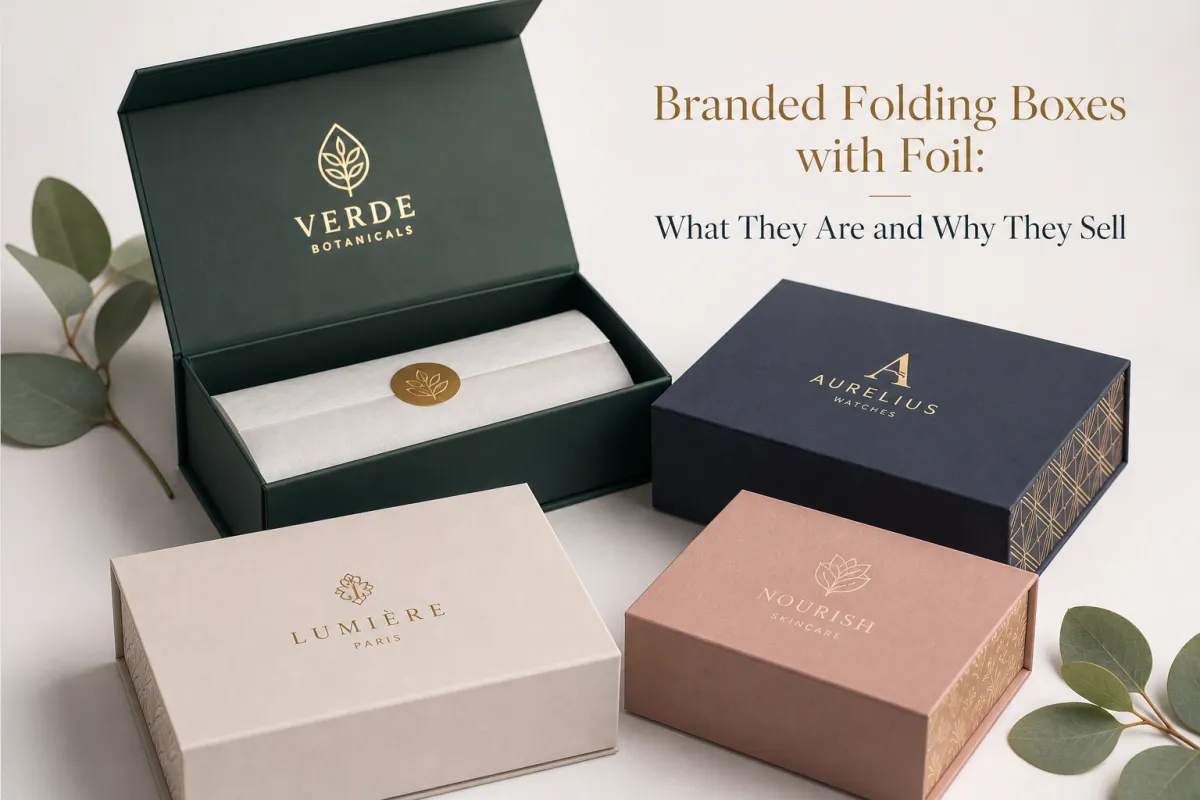
A small metallic accent can stop the eye faster than a fully shiny carton, especially on a shelf where every package is trying to win a few seconds of attention. That is one reason Branded Folding Boxes with foil keep showing up in categories that live or die by first impressions. The contrast does real work. A controlled flash of foil can make a logo, seal, or product name feel intentional, while a flat field of decoration can start to look noisy before a shopper even reads the copy.
In practical terms, branded folding boxes with foil are paperboard cartons that ship flat, fold into shape, and then receive a decorative foil element through hot foil stamping, cold foil, or a foil-like laminated effect. The structure handles the practical side: it protects the product, moves efficiently through packing, and gives the line a carton that is easy to erect, fill, and close. The foil handles the selling side: it adds visual hierarchy, creates a premium cue, and helps the brand stand out without changing the carton format itself.
You see branded folding boxes with foil in retail displays, e-commerce inserts, cosmetic launches, supplements, gifts, specialty food, and other consumer goods where the package is part of the product story. A skincare cream in a plain carton can still sell, of course, but the box has to work harder to create interest. A foil mark on the front panel or a crisp metallic border around a logo can shift the perceived value of the item before the customer ever lifts a lid or opens a tuck flap.
The point many buyers miss is that decoration and structure are separate decisions. The foldable carton shape manages packing efficiency, pallet count, and warehouse handling. The foil treatment handles emphasis, branding, and shelf storytelling. If those two parts are not planned together, the packaging can look attractive on screen and still underperform in production, on the sales floor, or in the hand.
Practical rule: the strongest foil packaging is usually the kind that looks restrained, reads quickly, and still feels expensive when you hold it.
So the real question is not whether branded folding boxes with foil look nice. They usually do. The better question is how to use them so they support the product, stay inside the budget, and run cleanly through printing, finishing, folding, and final packing. That is where the smart decisions live, and that is where the cost and shelf impact begin to make sense together.
How Branded Folding Boxes with Foil Build Shelf Impact
The eye notices foil quickly because it reacts to directional light. Even a modest highlight on a logo edge or callout panel can jump forward from a crowded shelf, especially under retail LEDs or mixed store lighting. That is why branded folding boxes with foil often outperform cartons with heavier ink coverage but no reflective detail. The foil becomes the first visual signal, and the shopper’s brain reads it as shorthand for care, finish quality, and brand confidence.
What matters next is the path the eye follows. Good branded folding boxes with foil do not just shine; they guide. A foil logo can lead to the product name, then to a benefit statement, then to the flavor, scent, or formula detail that closes the sale. In practice, that means the foil should sit where it supports reading order, not where it distracts from it. A box with a foil border around the whole front panel may look lively, but a single foil emblem plus one short metallic line often reads cleaner and more premium.
There is also a psychological piece to this. A restrained foil accent often feels more expensive than a package that shouts from every surface. Buyers tend to trust packaging that looks controlled. A carton with one strong foil hit, a matte background, and a clear logo space says the brand knows what to emphasize. That kind of control is one reason branded folding boxes with foil work so well for cosmetics, wellness products, and giftable items where perceived value matters as much as protection.
Color pairing matters too. Warm foil tones like gold and copper behave differently from cooler tones like silver or holographic effects, and both of them change again against matte black, clean white, kraft brown, or deep saturated brand colors. Soft-touch coating can make foil feel brighter because it reduces glare around the highlight. Matte aqueous can do the same in a quieter way. Gloss varnish can work, but it needs more discipline because too much shine across the rest of the panel can flatten the contrast that makes foil effective in the first place.
In shelf reviews I have sat through, the strongest cartons were rarely the loudest. They had one or two foil moments, one dominant message, and a clear path for the eye. That is the real strength of branded folding boxes with foil: they give the package a premium cue without forcing the carton to do too much at once. If the shine is doing all the talking, the design is probably trying too hard.
Key Design, Material, and Finish Choices
The board choice sets the ceiling for everything else. Most branded folding boxes with foil are built on SBS, CCNB, kraft, or specialty paperboard, and each one behaves a little differently on press and on the folder-gluer. SBS gives a clean print face and tends to support sharp detail very well. CCNB can be a practical middle ground for many consumer goods because it balances cost and print quality. Kraft communicates a more natural, recycled look, though fine foil detail can sometimes appear less crisp depending on the stock and the ink coverage. Specialty stocks can look excellent, but they need more testing because texture and coating both affect how the foil transfers.
Typical folding carton grades often sit in the 14 pt to 24 pt range, with many retail programs landing around 16 pt to 18 pt for a balance of stiffness and foldability. If the board is too light, it can feel flimsy and lose shelf presence. If it is too stiff, creasing can become less forgiving and the box may spring open during packing. For branded folding boxes with foil, that board choice also affects how much pressure the foil tool can tolerate before the line starts to look crushed or uneven.
Foil method is the next major decision. Hot foil stamping is often the best choice for crisp metallic detail, especially when the logo has small text, thin borders, or a need for very clean edges. Cold foil works better when the design wants broader coverage or a more integrated graphic appearance, because the foil is applied in line with printing rather than as a separate stamping step. Foil lamination creates a more reflective, sometimes broader effect, but it can be too much for brands that want a restrained look. The right method depends on the artwork, the board, and how much shine the brand actually wants to show.
Structure matters more than many teams expect. Die lines, creases, glue tabs, tuck flaps, and window openings all influence how polished the carton feels once it is folded. On branded folding boxes with foil, a foil element placed too close to a score line can crack or distort, while foil placed near a glue tab can create friction during folding or reduce bond strength. That is why a clean dieline review is not just a technical step; it is part of the visual design.
Finish pairings make a big difference too. Matte aqueous can soften the background and let the foil become the brightest element on the panel. Gloss varnish can sharpen contrast if the layout is simple. Soft-touch coating gives the carton a velvety hand feel that many premium brands like for cosmetics, supplements, and specialty gifts. Embossing and debossing can add dimension, but they should support the foil rather than compete with it. A raised foil logo on a smooth matte field can look elegant; a crowded front panel with several textures can start to feel overdesigned.
Brand consistency is the final piece. Foil color, logo scale, and placement should match the rest of the system, especially if the carton sits next to labels, inserts, or secondary packaging. If the brand uses a warm gold on the box and a cooler metallic on the website graphics, the mismatch will be noticeable to the buyer even if they cannot explain why. The best branded folding boxes with foil feel like a natural extension of the broader identity, not a one-off experiment.
For brands that want a better sense of structure options and print finishes, our Custom Packaging Products page is a useful place to compare carton formats before locking the artwork.
Paper sourcing also matters. If the program needs FSC-certified fiber, recycled content, or a documented chain of custody, that choice should happen early rather than being forced into a later revision. The FSC site is a good reference point for understanding those certification rules and the claims that can be used on-pack.
Production Steps and Timeline for Foil Folding Boxes
Good branded folding boxes with foil do not appear fully formed at the end of a design file. They move through a sequence: brief, dieline review, artwork setup, foil approval, print test, finishing, folding, and final packing. That sequence sounds obvious, yet it is where many schedules slip. A team may approve a beautiful comp on screen and still discover that the foil sits too close to a fold, the barcode is too small, or the board needs a different coating to hold the detail cleanly.
The approvals that matter most are the ones tied to registration. Foil position, type size, line thickness, and the alignment of any metallic element with printed graphics should all be checked before full production. Fine details can close up if the stamp is too dense, the board surface is too textured, or the artwork uses thin reversed letters inside a metallic field. On branded folding boxes with foil, a tiny change in position can make the difference between a crisp premium box and one that looks slightly off at arm’s length.
Timeline depends on how much new work the job needs. A simple reprint on existing tooling can move relatively quickly, often around 12 to 15 business days after proof approval if materials are in stock and the finishing stack is straightforward. A first-time custom run usually needs more breathing room, especially if new dies, new foil tools, or specialty coatings are involved. Once the structure gets complex, 18 to 25 business days is a more realistic planning window, and larger or highly finished jobs can stretch beyond that. That is not a delay problem; it is the normal cost of doing the details correctly.
It also helps to separate design time from factory time. A carton can look ready in the art department long before the board is sourced, the die is made, the foil block is approved, and the press setup is locked in. For branded folding boxes with foil, those steps are not administrative busywork. They protect color accuracy, folding performance, and finish consistency across the run.
If the package has to survive parcel handling or longer distribution routes, transit testing becomes part of the planning as well. Many teams use protocols aligned with ISTA methods such as ISTA 3A or similar drop and compression testing to understand how the carton behaves once it leaves the factory. You can review the testing framework at the ISTA site. That kind of testing is especially useful for e-commerce kits, gift boxes, and multi-piece sets where the outer box needs to arrive looking as good as it left the line.
One simple truth keeps showing up in production meetings: faster turnaround usually comes from simpler structures, fewer finish combinations, and early decisions. If the brand can choose the foil area, the board, the finish, and the carton style before artwork is finalized, branded folding boxes with foil become much easier to run, quote, and ship.
Cost, Pricing, and MOQ Factors for Branded Folding Boxes with Foil
Price is driven by a handful of real variables, not by a vague label like premium or affordable. For branded folding boxes with foil, the big cost drivers are board grade, box size, print colors, foil coverage, embossing or debossing, coating choice, and the complexity of the cut-and-fold structure. A large carton with multiple panels, heavy ink coverage, and a full foil pattern will cost more than a simple tuck-end carton with a clean logo stamp. That sounds obvious, yet it is easy to lose sight of once the design team starts adding attractive extras.
MOQ follows the same logic. Setup time for dies, plates, and foil tooling means very small orders can carry a high unit price, because the fixed work is spread across fewer cartons. Many buyers are surprised by that at first, but it is standard in folding carton production. A run of 1,000 may cost much more per piece than a run of 5,000 or 10,000, even if the visual design is the same. For branded folding boxes with foil, the sweet spot often appears once the tooling is amortized across a larger quantity.
Smaller foil areas can sometimes save more money than people expect. A foil logo the size of a business card may deliver a strong premium cue without creating the extra press time and material waste that comes with broad reflective coverage. That is one reason restrained branded folding boxes with foil often make better financial sense than heavily decorated cartons. The buyer still gets the metallic cue, but the factory is not fighting a large foil field across every surface.
Special finishes change the quote quickly. Add a window patch, a second foil color, a metallic laminate, or precise front-and-back registration, and the production stack becomes more complicated. Add soft-touch coating plus embossing plus foil and the job usually needs more proofing, more setup, and more hands-on quality checks. None of those choices are wrong. They just have a price attached, and that price should be compared against the actual selling benefit, not against a hope that the box will somehow pay for itself through looks alone.
Here is a practical way to compare common directions for branded folding boxes with foil:
| Configuration | Best For | Common Ballpark at 5,000 Units | Cost Pressure |
|---|---|---|---|
| SBS carton, CMYK print, spot hot foil, matte aqueous | Retail SKUs that need clean brand clarity and one strong metallic cue | $0.22-$0.38 per unit | Moderate; tooling and foil area stay controlled |
| CCNB carton, CMYK print, foil, gloss or soft-touch finish | Mid-range products balancing value, color depth, and shelf presence | $0.28-$0.45 per unit | Moderate to high; finish pairing adds setup time |
| Kraft board, one-color print, spot foil, embossing | Natural, artisanal, or sustainability-led branding | $0.30-$0.52 per unit | Moderate; texture and embossing can require extra testing |
| Specialty stock, cold foil, soft-touch, complex dieline | Prestige launches, gift sets, and high-touch presentation cartons | $0.38-$0.75 per unit | High; multiple finishing stages raise the total quote |
Those numbers are ballpark figures, not promises, and they can move with region, supplier, freight terms, board availability, and how much of the production work is bundled into the quote. A fair comparison for branded folding boxes with foil should always ask whether the price includes tooling, proofs, freight, finishing, and sample runs. Otherwise, one quote may look lower on paper while quietly leaving out the charges that make the final invoice much higher.
It also helps to ask how the supplier handles make-ready waste and whether the quote assumes a standard carton style or a custom structural change. A straightforward reverse tuck end is usually less expensive than a sleeve, crash-lock bottom, or irregular die-cut shape. If the carton needs to be packed by hand, the labor cost can matter almost as much as the board cost. That is why the cheapest-looking option is not always the cheapest actual option for branded folding boxes with foil.
If you want to understand how a packaging team handled a similar tradeoff in real work, our Case Studies page is a useful place to see how structure, finish, and quantity shape the final result.
Common Mistakes That Undercut Foil Packaging
The most common mistake is overuse. Too much foil can make branded folding boxes with foil feel busy instead of premium, and once every panel is trying to shine, nothing has hierarchy. The logo loses its edge. The product name competes with borders and seals. The shopper sees motion, but not clarity. A strong package usually needs one focal point, not a dozen reflective cues fighting for attention.
Another frequent problem is choosing a finish before testing the substrate. Some boards handle fine foil detail beautifully; others do not. Texture, coating, fiber structure, and caliper all affect how the foil transfers. If the surface is too rough, small letters can fill in or break apart. If the coating is too soft, the foil can scuff during handling. Good branded folding boxes with foil should be judged on a real sample, not only on a render.
Fine typography deserves extra caution. Thin rules, tiny type, and closely spaced reverse text can fail visually once the tooling and press conditions are set. This is especially true if the foil area sits near a fold or if the carton uses a darker background that makes any slight registration shift more visible. A box that looks perfect on a monitor can still become hard to read on press if the artwork is too delicate for the production method.
People also forget the folding and gluing stage. Foil placed too near score lines, tabs, or friction points can crack, rub, or interfere with adhesive performance. That means the design is not just a print decision; it is a mechanical decision. On branded folding boxes with foil, the artwork must respect how the carton travels through the folder-gluer and how it behaves once customers open and close it.
Good packaging test: if the box looks impressive but becomes awkward to stack, hard to open, or inconsistent across the run, the finish has not done its job.
Consistency is the last trap. A carton that varies in foil density, fold accuracy, or shade from one batch to another can damage trust fast, especially in categories where the package sits near refills, variants, or repeat purchases. That is why branded folding boxes with foil should be designed not only for the first impression but also for repeatability across production.
Packaging quality is often judged in small moments: a flap that closes squarely, a logo that catches light without blinding the eye, a stack that stays tidy in transit, and a box that opens cleanly without tearing the panel. If those details are right, the foil earns its place. If they are wrong, no amount of shine can fully hide it.
Expert Tips and Next Steps for Better Foil Packaging
A smart place to start is one hero SKU. Testing branded folding boxes with foil on a single product lets the brand see how the finish behaves in the real world without committing the whole line to a new look. That approach keeps risk manageable and gives the team better data on shelf effect, quote stability, and how the carton runs on the line. Once the first version is working, the design language can spread to other sizes or variants with much less guesswork.
Review the sample under multiple lighting conditions. Store lighting can make foil read sharp and energetic, while warehouse lighting may flatten the contrast. Natural light can reveal whether the metallic accent still feels balanced once the box leaves the retail environment. For branded folding boxes with foil, those checks matter because a finish that looks ideal in a bright design studio may feel too strong, too dim, or too reflective in actual use.
Before requesting quotes, prepare a simple decision set: target budget, preferred foil area, carton style, finish pairings, and expected order volume. That information helps a supplier recommend the right board and the right finishing path without wasting time on options that do not fit the project. The clearer the brief, the better the quote, and the easier it becomes to compare one set of branded folding boxes with foil against another on equal terms.
Ask for a blank dieline, a printed proof, and a sample whenever possible. The dieline checks structure, the proof checks color and placement, and the sample checks how the package feels in hand. Those three pieces together tell you far more than any digital mockup can. If the foil, the board, and the finish look right on a physical sample, the job is much more likely to stay on track once production starts.
For teams comparing formats, our Custom Packaging Products and Case Studies pages can help narrow the options before a formal quote request goes out. That is usually where the most useful packaging decisions happen: not in the abstract, but against a real carton style, a real budget, and a real product line.
My honest advice is simple: lock the artwork, confirm the timeline, and treat branded folding boxes with foil as a production plan, not just a visual upgrade. If you get the board, finish, and structure working together, the carton will look better, pack better, and hold up better in the hand. That is the kind of result that lasts past the first glance.
What are branded folding boxes with foil used for?
They are used for products that need protection, presentation, and stronger shelf presence in one carton. branded folding boxes with foil work especially well for retail goods, cosmetics, supplements, gifts, and premium launches where the box becomes part of the brand experience. The foil accent helps important details stand out without changing the basic folding carton structure.
Which foil finish works best for branded folding boxes with foil?
Hot foil stamping is often the best fit for sharp logos, small text, and premium metallic accents because it gives very clean edges. Cold foil can be a better match when the design needs broader coverage or a more integrated graphic look. The right choice depends on the artwork, the substrate, the budget, and how much shine the brand actually wants.
How much do branded folding boxes with foil usually cost?
Cost depends on board type, box size, print colors, foil area, finishing steps, and order quantity. Small runs usually cost more per unit because setup and tooling are spread across fewer cartons. A restrained design for branded folding boxes with foil is often more economical than broad decorative coverage, especially when the foil area stays focused.
What is the usual turnaround for branded folding boxes with foil?
Turnaround depends on whether the carton uses new tooling, special substrates, or multiple finishing steps. Simple repeat orders move faster than first-time jobs because the structure and foil details are already approved. The safest schedule leaves room for proofing, sample review, and any final artwork adjustments before production starts.
What should I prepare before ordering branded folding boxes with foil?
Have your dieline, final artwork, logo files, carton dimensions, and target quantity ready. Decide where foil should go so the finish supports the brand rather than covering every surface, and share your budget and timeline early so the supplier can recommend the best material and production path for branded folding boxes with foil.


