Buyer Fit Snapshot
| Best fit | Compostable Packaging Wholesale for Brands That Ship Well projects where brand print, material claims, artwork control, MOQ, and repeat-order consistency need to be specified before quoting. |
|---|---|
| Quote inputs | Share finished size, material target, print colors, finish, packing count, annual reorder estimate, ship-to region, and any compliance wording. |
| Proofing check | Approve dieline scale, logo placement, barcode or warning zones, color tolerance, closure strength, and carton packing before bulk production. |
| Main risk | Vague material claims, crowded artwork, missing packing details, or unclear freight terms can make a low unit price expensive after revisions. |
Fast answer: Compostable Packaging Wholesale for Brands That Ship Well should be specified like a repeatable production item. The safest quote records material, print method, finish, artwork proof, packing count, and reorder notes in one written spec.
Production checks before approval
Compare the actual filled-product size with the drawing, then confirm tolerance on folds, seals, hang holes, label areas, and retail display edges. Reserve space for logos, QR codes, warning copy, and material claims before decorative graphics fill the panel.
Quote comparison points
Review material grade, print process, finish, sampling route, tooling charges, carton quantity, and freight assumptions side by side. A quote is only useful when the supplier can repeat the same color, closure quality, and packing count on the next order.
Compostable Packaging Wholesale for Brands That Ship Well
Compostable packaging wholesale looks tidy in a pitch deck. The warehouse is a different story. A carton gets tossed onto a conveyor. A mailer takes a corner hit in transit. A pouch sits in a hot receiving bay for a week longer than planned. Suddenly the pretty sustainability story has to survive gravity, moisture, and a packing line that is not gonna slow down for anyone.
Compostable Packaging Wholesale: What Most Brands Miss
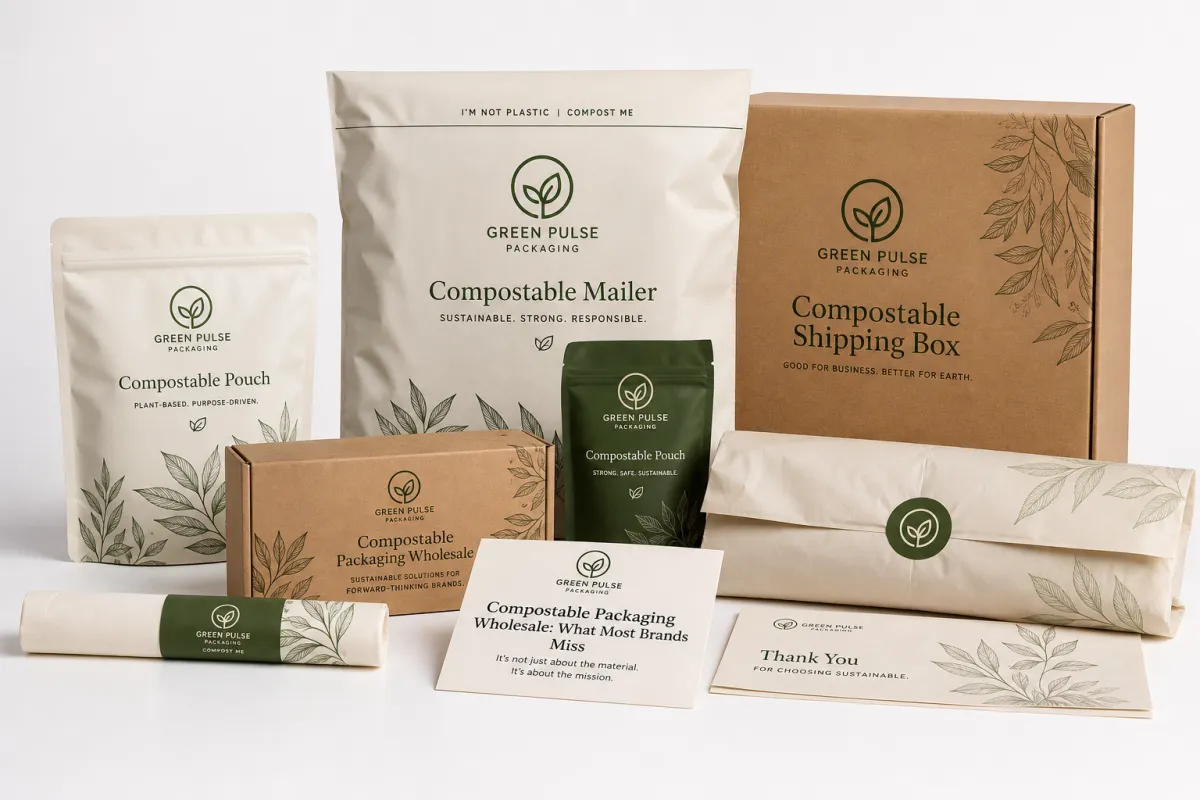
Compostable packaging wholesale is not just a material choice. It is a supply-chain decision with branding attached. That sounds clean on paper. In practice, it touches machine compatibility, shelf presentation, freight damage, fulfillment speed, and the question customers ask after opening the box: what do I actually do with this?
I have seen brands focus so hard on the word compostable that they skip the quieter details. Then the first production run exposes the weak seam, the awkward dimension, or the print system that looked great in mockup and muddy on the real substrate. The material claim is only one part of the purchase. The rest is whether the package holds up under real use.
The most common miss is assuming that a structure that is technically compostable is automatically right for the product. It is not. A mailer that works for a light apparel drop may fail for a dense accessory kit. A pouch that looks elegant on a shelf may not have enough moisture resistance for dry goods that sit in distribution for months. Compostable packaging wholesale still has to get through filling, stacking, shipping, and storage before anyone gets to disposal.
From a buyer's point of view, the goal is not to pick the greenest-looking option. The goal is to choose branded packaging that protects the product, supports the brand story, and keeps the operation moving. If a pack needs a full line change, creates frequent seal failures, or forces a redesign every reorder, the sustainability message starts costing more than it returns.
That is why I treat compostable packaging wholesale like procurement, not decoration. The right program keeps the spec stable, keeps print repeatable, and keeps the warehouse from improvising around weak corners or bad sizing. Buyers who get this right usually want three things: dependable protection, a claim that can stand up to questions, and a format that does not slow fulfillment.
If the package cannot survive filling, stacking, and freight vibration, the sustainability claim never gets a fair shot.
There is also a real difference between industrial compostability, home-compost claims, and materials that are marketed as eco-friendly packaging without much documentation behind them. Industrial compostability usually points to a controlled composting facility. Home-compost claims need stricter validation because the environment is cooler, slower, and far less consistent. That distinction matters in compostable packaging wholesale because the label has to match the disposal path, not just the copy on the sales page.
For brands building a long-term program, the safest move is to define the use case first. Is this retail packaging on a shelf, shipping mailers for direct-to-consumer orders, or a pouch for dry goods that needs to hold its seal through transport and storage? Once the use case is clear, compostable packaging wholesale becomes a practical sourcing exercise instead of a guessing game.
For teams comparing packaging suppliers, it helps to start with the product type and the order structure. Our Custom Packaging Products page is a useful place to compare formats, and our Wholesale Programs page outlines how larger runs are typically organized.
Product Details: Materials, Formats, and Print Options
Compostable packaging wholesale covers more than one material family, and each one behaves differently. Plant-based films, molded fiber, and compostable paper structures are the most common starting points. They do not act the same way on a production line or in a warehouse, which is why experienced buyers look at product packaging as a system instead of a single material decision.
Plant-based film structures are often used for flexible formats such as pouches, liners, and mailers. They can be a strong fit when the product needs a light, flexible pack with a clean brand graphic. Molded fiber works well for rigid support, trays, inserts, and protective forms where the package needs to hold shape without relying on a plastic shell. Compostable paper structures can make sense for outer cartons, wraps, and certain retail packaging applications where print quality and fiber-based presentation matter.
The best format depends on what is being packed. Apparel and soft goods usually do well in compostable mailers because the load is lighter and the shipping profile is simpler. Dry goods and powders usually point toward pouches with a reliable seal structure. Retail food-contact applications often need liners or wraps with tighter attention to barrier performance. Boxes and trays are better when the product needs rigidity, stacking strength, or a more premium unboxing experience.
Customization at the wholesale level is usually more flexible than buyers expect, but it still has limits. Tooling and production efficiency set the practical size range, so a custom printed box or pouch may need to stay inside workable dimensions instead of chasing a very unusual shape. Common customization points include gusset depth, zipper or heat-seal closure, window placement, tear notches, and print coverage. The point is not to force the material into every design idea. The point is to shape the package so the material can do its job well.
Print method matters too. Flexographic printing is often chosen for higher-volume runs and simpler color builds. Digital printing can make sense for shorter wholesale runs or artwork that changes more often. Water-based inks and compost-compatible adhesives matter because the print system should support the material rather than compromise it. Sharp line art, clean typography, and restrained color blocks usually hold up better than tiny reverse-out type or busy gradients on compostable substrates.
Here is the part many teams appreciate: the same design can behave differently on two substrates. A layout that looks crisp on coated paper may soften on a textured compostable surface. I have had samples come back looking excellent in a PDF and weirdly flat on the actual pack. That is normal. It is also why packaging should be reviewed on the real material, not only on screen. In compostable packaging wholesale, the proof is the printed sample, not the render.
| Format | Best For | Typical Wholesale Use | Main Watchout |
|---|---|---|---|
| Compostable mailers | Apparel, soft goods, subscription kits | Direct-to-consumer shipping | Check puncture resistance and seal consistency |
| Compostable pouches | Dry goods, powders, sachets | Retail packaging and e-commerce | Confirm barrier performance and closure strength |
| Molded fiber trays | Rigid products, inserts, protective nests | Shipping protection and retail presentation | Watch moisture sensitivity and stack load |
| Compostable cartons and boxes | Primary carton, secondary packaging, custom printed boxes | Branding-heavy retail or ship-ready kits | Verify board stiffness and print adhesion |
The strongest compostable packaging wholesale programs usually start with a narrow shortlist. Three formats are enough for most teams to compare feel, structure, and cost before they commit. If the package is meant for shipping, ask whether the material has been tested for abrasion, drop exposure, and vibration using methods aligned with ISTA transport testing standards. If the package is meant to support a compostability claim, the material structure should be checked against recognized certification paths rather than informal marketing language.
One more practical note: fiber-based packaging can be a strong choice for a lower carbon footprint, especially when the source fiber is documented well and the format is right-sized. But material choice still has to match the product. A beautiful eco-friendly packaging concept that crushes in transit is not a good purchase, no matter how nice it looks on a mockup.
Compostable Packaging Wholesale Specifications That Matter
Compostable packaging wholesale gets easier to buy when the spec sheet is read like a working document instead of a sales brochure. Buyers should look at thickness or basis weight first, because that usually tells you how much structure the package has before you even get into the claims. Then check seal strength, barrier performance, oxygen transmission, and moisture resistance. Those details decide whether the package is suitable for frozen items, dry goods, short-run retail display, or shipping where abrasion is a real concern.
In plain English, barrier performance tells you how well the package protects the product from what is outside it. Oxygen barrier matters for freshness and shelf life. Moisture barrier matters for powders, snacks, and anything that clumps or weakens when exposed to humidity. Seal strength matters because a weak seam can turn a compostable packaging wholesale order into a return problem. If a seller cannot explain those basics clearly, the quote is not ready yet.
Compliance details belong in the discussion from the beginning. For industrial compostability, look for recognized standards such as ASTM D6400 or comparable regional requirements where relevant. For paper-based structures, documentation around fiber sourcing and chain of custody can also matter, especially if the brand is asking for responsible sourcing in addition to compostability. If the pack carries a disposal claim, the labeling language should match the actual standard. A vague green badge is not enough.
There is a second layer that many buyers overlook: inks, coatings, and adhesives. The substrate may be compostable, but the full package only behaves properly if those supporting materials are chosen carefully. That is why print compatibility and adhesive selection should be part of the technical review. Compostable packaging wholesale should be judged as a complete structure, not a single sheet or film.
Storage and handling matter too. Compostable materials can react differently than conventional plastic in hot docks, humid warehouses, or long dwell times before packing. Paper-based structures may curl more easily. Some films may soften if the room gets too warm. If a line runs fast, the team needs to know whether the package feeds cleanly, seals predictably, and stacks without slipping. A sample that looks perfect on a conference table can behave very differently after three weeks in a warehouse.
Here is a simple way to read a spec sheet:
- Material structure: Confirms what the package is made of and whether it matches the disposal claim.
- Thickness or basis weight: Helps estimate strength, stiffness, and handling behavior.
- Barrier data: Tells you how the pack performs against oxygen and moisture.
- Closure and seal type: Shows whether the pack is made for heat seal, zipper closure, or another finish.
- Print method and ink system: Indicates how the branding will hold up on the final surface.
- Test references: Helps confirm whether the pack was validated for shipping, storage, or shelf display.
That is where compostable packaging wholesale starts to feel less risky. Once the buyer can match the spec sheet to the actual product flow, the decision becomes clearer. A frozen item needs different packaging than a dry powder. A high-touch retail item needs different surface quality than a shipper that will be opened once and discarded. In each case, the right specification is the one that supports the real use, not the idealized use.
For technical teams, it helps to compare any compostable packaging wholesale option against the same three questions every time: Can it protect the product? Can it run on the line? Can it make the disposal claim honestly? If the answer to any one of those is no, the spec needs another pass.
Pricing and MOQ for Compostable Packaging Wholesale
Compostable Packaging Wholesale Pricing is driven by more than material alone. Material cost is only one part of the quote. Print coverage, tooling or plate setup, package size, barrier level, order volume, and certification requirements all push the number up or down. Two packages that look similar can carry very different costs if one needs heavier print coverage, a stronger seal, or a more demanding substrate.
MOQs are usually tied to production efficiency rather than a random sales rule. A manufacturer wants enough volume to justify setup time, material waste, and press scheduling. That is why pouches, mailers, and boxes can all have different minimums even if they are part of the same compostable packaging wholesale program. A custom printed box might need a different run size than a plain stock mailer because the production steps are not the same.
For many brands, the useful question is not simply "What is the unit price?" The better question is "What does this cost through the full life of the order?" Freight, warehousing, spoilage risk, and reordering too late all belong in the math. If a lower-price quote ships slowly or requires a huge inventory commitment, it may cost more in practice than a quote with a slightly higher unit price and better lead time.
Here is a practical comparison framework buyers can use before they approve compostable packaging wholesale:
| Comparison Point | What to Match | Why It Matters |
|---|---|---|
| Substrate | Same compostable film, fiber, or paper structure | Different substrates can make price and performance incomparable |
| Print method | Same digital, flexo, or other process | Setup costs and color limits change the quote |
| Certification level | Same industrial or home-compost claim | Documentation requirements affect cost and lead time |
| MOQ | Same minimum production quantity | Lower MOQs often carry a higher unit price |
| Freight terms | Same shipping assumption | FOB and delivered pricing can change the real spend |
For context, many compostable packaging wholesale runs fall into broad pricing bands depending on structure and decoration. A simple printed mailer may sit in a lower per-unit range than a multi-color pouch or a custom printed box with more demanding board and finish requirements. As a planning example, some standard-volume runs can land around $0.18-$0.42 per unit for mailers, $0.22-$0.48 for pouches, and higher for rigid cartons or molded parts depending on size and print coverage. Those numbers are not universal, but they are useful enough to keep a buying conversation grounded.
MOQs often start in the low thousands for simpler formats and climb when the run involves custom print, special sizing, or more technical barrier requirements. If the project is new, ask about sample packs or a trial quantity before locking into a larger wholesale commitment. That is especially helpful when the packaging will be used across several SKUs or when the team still needs to settle on the final artwork.
A good buyer compares apples to apples. That means the same structure, the same print method, the same sizing assumptions, and the same performance requirements. If one quote is based on a lighter material and another on a stronger one, the unit price alone does not tell the story. Compostable packaging wholesale should be bought on total fit, not on the cheapest line item.
Process and Timeline: From Quote to Delivery
The cleanest compostable packaging wholesale orders usually follow a simple sequence. First, the buyer sends product dimensions, target use case, and any claim requirements. Next comes the quote with material options, MOQ, and lead time. Then the team reviews a sample or proof, approves artwork, confirms the order, and moves into production. After that, freight and receiving need their own plan so the packaging arrives before the launch window closes.
What slows the process down most often is not production itself. It is front-end clarity. If the artwork is not final, if the size is still being debated, or if the buyer has not decided between industrial compostability and home-compost claims, the timeline expands. In compostable packaging wholesale, a few extra days spent on the spec usually saves a lot more time later.
Sampling is not optional for serious orders. A flat visual proof does not tell you how the seal behaves, how the print reads on the actual surface, or whether the box fit leaves enough room for the product and inserts. A sample also shows how the material handles folds, corners, creases, and pressure points. For shipping formats, it is smart to test the finished pack with the actual product weight before moving to full production. I have seen a perfectly acceptable-looking mailer split only after a little vibration and an extra pound of product. Annoying, yes. Preventable, also yes.
Practical timelines vary, but many custom compostable packaging wholesale projects move in a range of about 12-20 business days after proof approval, depending on the complexity of the artwork, the material being sourced, and the production queue. Simple stock-based programs may move faster. Heavier customization, special certifications, or custom tooling usually add time. Freight can add a few more days depending on destination and receiving requirements.
That timeline should also include internal approvals. A marketing team may need time to confirm the package branding. Operations may need to test the line. Procurement may need to sign off on the claim language. If the product launch is seasonal, build in extra cushion. Packaging that arrives three days early is convenient. Packaging that arrives three days late can mess up the whole shipping plan.
Here are the checkpoints that help keep compostable packaging wholesale on track:
- Lock the final dimensions and fill weight before quoting.
- Confirm the disposal claim and supporting documentation early.
- Review the printed sample on the actual substrate, not just on screen.
- Test seal strength, stacking, and shipping behavior before release.
- Schedule freight with receiving windows in mind.
The brands that avoid trouble usually treat packaging as part of the product launch, not an afterthought. That matters even more with compostable packaging wholesale because some materials are less forgiving than standard plastic in certain conditions. The upside is worth it when the program is planned well: the pack ships cleanly, the claim is clearer, and the reorder cycle is easier to manage.
Why Choose Us for Compostable Packaging Wholesale
Brands come to compostable packaging wholesale with a mix of goals, and the best supplier relationship respects all of them. They want dependable materials. They want straightforward spec guidance. They want a purchase process that does not bury them in vague language. That is where the real value sits: not in hype, but in repeatable performance and clean communication.
Our approach is built around the operational side of packaging. We focus on whether the structure works on the line, whether the print can be held consistently from run to run, and whether the disposal claim is matched by the material system. That is especially helpful for buyers comparing product packaging across multiple SKUs, because consistency matters more than novelty after the first launch.
Clear communication during quoting makes a real difference. When a buyer asks about dimensions, barrier behavior, ink limits, or MOQ, the answer should be specific enough to support procurement decisions. Compostable packaging wholesale gets easier when the supplier can explain where the material is strong, where it has limits, and what the buyer should test before giving final approval. That kind of candor saves time and cuts a lot of back-and-forth.
Consistent documentation also matters. A packaging program should not require the team to rebuild the entire spec every reorder. Buyers need confidence that the next run will match the first run closely enough to protect fill speed, shelf presentation, and warehouse handling. That is especially important for brands that use custom printed boxes, branded packaging sleeves, or recurring mailer programs tied to monthly demand.
Responsible sourcing is part of the picture too. Paper-based components can support a lower carbon footprint when the fiber source is known and the design is right-sized. Some projects will need FSC-aligned paper sourcing. Others may prioritize a fully compostable film structure. There is no single best answer for every brand, which is why a practical conversation beats a one-size-fits-all pitch.
It also helps that wholesale buyers often need more than one packaging format. A brand may want one compostable mailer for direct shipping, one pouch for retail packaging, and one shipper insert for protection. Coordinating those decisions through a single process keeps the branding coherent and avoids mismatched materials across the product line. If that sounds familiar, our Wholesale Programs page is a good place to see how larger packaging programs are usually organized.
From a buyer's standpoint, the best supplier is the one that reduces friction. That means accurate sampling, honest timing, clear pricing assumptions, and packaging support that does not depend on guesswork. Compostable packaging wholesale should make the operation easier to run, not harder. If a package is eco-friendly on paper but difficult in practice, it will create more work for the team and less confidence from the customer.
For brands that want a closer look at available structures, our Custom Packaging Products page shows the range of formats that can support branded packaging, retail packaging, and direct shipping programs.
Next Steps for Compostable Packaging Wholesale Orders
The smartest compostable packaging wholesale projects start with a short checklist. Gather the product dimensions. Confirm whether the pack is for shipping, shelf display, or direct contact with the product. Decide whether the claim needs industrial compostability, home-compost approval, or a simpler fiber-based paper structure. Then note whether the package needs print or can begin as a plain sample. That small bit of preparation makes the buying process much smoother.
It also helps to request two or three material options instead of one. A side-by-side comparison often reveals differences in stiffness, surface feel, seal quality, and branding impact that are hard to judge from a PDF. If the package is part of a larger branding refresh, compare the mockups on the actual substrate so the team can see how typography, color, and layout behave in real life. Compostable packaging wholesale is easier to approve when the choices are visible, not abstract.
Before production starts, line up the internal approvals that tend to cause delays: budget, packaging claims, and warehouse handling. If the receiving team needs special storage conditions, spell that out early. If the package will move through a heat-seal line or a high-speed packing system, test it under those exact conditions. No one wants to discover a wrinkle, split seam, or adhesive issue after the order is already on the water or in the press queue.
Here is a practical order path that works well for most buyers:
- Define the use case and disposal claim.
- Share product dimensions, fill weight, and artwork needs.
- Review samples and compare material behavior side by side.
- Approve the proof only after confirming the actual substrate.
- Build in freight time and receiving time before launch.
That process keeps compostable packaging wholesale grounded in facts, not assumptions. It also protects the brand story, because the package can support the message only when it functions properly in shipping, storage, and customer use. A package that looks good but does not fit the operation usually ends up costing more than it saves.
The clearest takeaway is simple: start with the spec, not the slogan. Once the size, material, print system, and claim language are aligned, compostable packaging wholesale stops being an experiment and starts acting like a reliable part of the operation. Get that part right first, and the rest gets a lot less messy.
Frequently Asked Questions
What should I check before ordering compostable packaging wholesale?
Confirm whether the package is industrial compostable or home compostable, because those claims are not interchangeable. Ask for the exact material structure, thickness, seal method, and print compatibility before approving the run. Then verify that the size, closure, and barrier level match the product you actually ship, not just the sample on the table. That is the fastest way to avoid a compostable packaging wholesale order that looks right but performs poorly.
What is a typical MOQ for compostable packaging wholesale?
MOQ depends on the format, print method, and material, so pouches, mailers, and boxes may each have different minimums. Custom print usually raises the minimum compared with plain stock packaging because setup and production efficiency drive the run size. If you are testing a new format, ask about sample packs or short-run options before committing to a larger wholesale quantity. In many compostable packaging wholesale programs, a smaller test run is money well spent.
How long does compostable packaging wholesale production usually take?
Timelines vary based on artwork approval, material availability, and the production schedule, so quoting should include each step separately. Sampling and proof review can add time up front, but they usually prevent bigger delays later when the order is already in production. Plan extra cushion for freight and receiving, especially if the packaging must arrive before a product launch or seasonal peak. For many buyers, the safest compostable packaging wholesale timeline is the one with a little breathing room.
Can compostable packaging wholesale be custom printed?
Yes, many compostable formats support custom printing, but the print method must be matched to the substrate and finish. Artwork coverage, ink choice, and fine-detail tolerances may differ from conventional packaging, so proofing matters. Ask for print-ready templates early so your design team can avoid resizing or layout changes after approval. When the packaging is part of package branding, the print test should happen before the full run, not after.
How do I know if compostable packaging wholesale is right for my product?
Match the package to the product's weight, moisture exposure, shelf life, and shipping conditions rather than choosing by appearance alone. If the product needs a strong moisture barrier or long shelf stability, confirm that the compostable structure can actually support it. The best fit is the one that protects the product, works on your line, and supports the end-of-life claim you want to make. That is the real measure of compostable packaging wholesale value.

