Buyer Fit Snapshot
| Best fit | Branded Gummed Tape for Cartons projects where brand print, material claims, artwork control, MOQ, and repeat-order consistency need to be specified before quoting. |
|---|---|
| Quote inputs | Share finished size, material target, print colors, finish, packing count, annual reorder estimate, ship-to region, and any compliance wording. |
| Proofing check | Approve dieline scale, logo placement, barcode or warning zones, color tolerance, closure strength, and carton packing before bulk production. |
| Main risk | Vague material claims, crowded artwork, missing packing details, or unclear freight terms can make a low unit price expensive after revisions. |
Fast answer: Branded Gummed Tape for Cartons: Benefits, Use, and Fit should be specified like a repeatable production item. The safest quote records material, print method, finish, artwork proof, packing count, and reorder notes in one written spec.
Production checks before approval
Compare the actual filled-product size with the drawing, then confirm tolerance on folds, seals, hang holes, label areas, and retail display edges. Reserve space for logos, QR codes, warning copy, and material claims before decorative graphics fill the panel.
Quote comparison points
Review material grade, print process, finish, sampling route, tooling charges, carton quantity, and freight assumptions side by side. A quote is only useful when the supplier can repeat the same color, closure quality, and packing count on the next order.
Branded gummed tape for cartons does more than put a logo across a box seam. Once the adhesive is wet and pressed into place, it bites into the corrugated fibers and starts acting like part of the carton instead of a strip sitting on top of it. That difference matters in shipping. A seal that actually grabs the box surface can improve carton integrity, make tampering easier to spot, and give outbound packaging a cleaner, more deliberate finish.
Brands shipping corrugated shippers, retail mailers, subscription boxes, or bulk cartons through a warehouse line usually care about two things at once: protection and presentation. Printed water-activated tape handles both. It can replace plain plastic tape in a lot of applications, especially where the box face is part of the customer experience. For examples of how packaging choices play out in real use, our Case Studies page shows the tradeoffs buyers usually work through before they settle on a format.
There is a catch. This tape is not a fix for weak cartons, crushed flaps, or dusty seams. It performs best on standard corrugated closures with clean edges and predictable handling. When the box is in decent shape, branded gummed tape for cartons can do three jobs at once: secure the seam, reinforce the closure, and present the brand with far more intent than a generic roll of clear tape.
A good tape spec is not just about the roll. It is about the carton grade, the packing method, the environment, and how much print survives once the seam folds over an edge.
Branded gummed tape for cartons: what it is and why it stands out
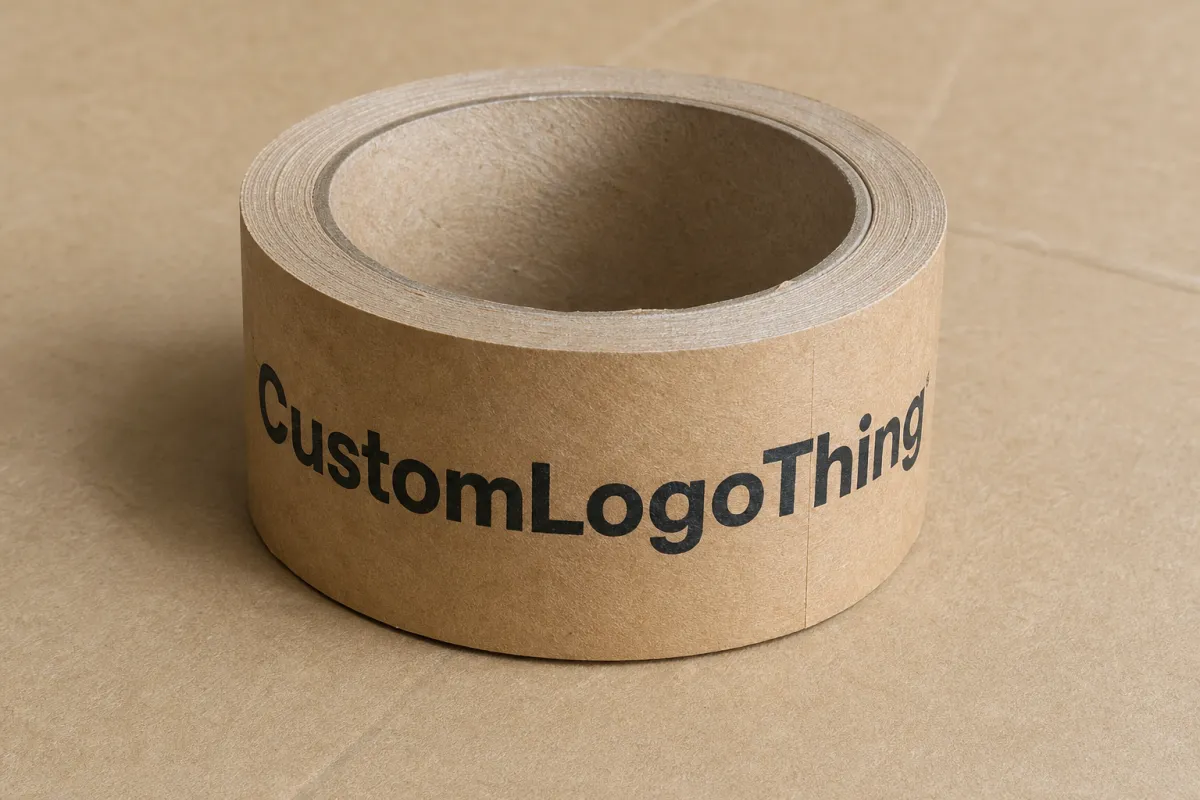
At its simplest, branded gummed tape for cartons is a kraft paper tape with a water-activated starch-based adhesive on one side and a printed brand message, logo, or handling cue on the other. The print can stay quiet and minimal, or it can carry warning copy, a pattern, a website address, or a short line that reinforces the customer experience the moment the shipment is opened.
The part that surprises a lot of buyers is the way the tape behaves once activated. You do not lay it on a carton the same way you would lay down standard pressure-sensitive tape. You wet the adhesive, place it across the seam, and press it down. As it dries, the adhesive sinks into the surface fibers of the corrugated board. That fiber bond is why the tape has a reputation for holding better on shipping cartons than a plain strip that only rests on top of the box surface.
That makes it a strong fit for corrugated shipper cartons, subscription box outer shippers, retail-ready mailers, and high-volume outbound packaging where a brand wants the package to look finished the second it leaves the packing table. It also works well where the box itself carries some of the brand burden, because the tape can tie the carton, the logo, and the handling instructions into one visible strip.
From a packaging buyer's point of view, the appeal is straightforward:
- Sealing - the tape closes the seam and helps resist peeling on corrugated board.
- Presentation - the printed face turns a plain carton into a branded shipment.
- Tamper awareness - a disturbed water-activated seal is easier to spot than a casual strip of clear tape.
- Process fit - it can support manual packing, tabletop dispensers, or automated sealing equipment.
The fit is not universal, and that is part of the honest story. Heavily damaged flaps, surfaces with excessive dust, cartons stored in poor conditions, and boxes with odd closure geometry deserve a pilot run before you buy in volume. Still, for standard Corrugated Shipping Boxes, branded gummed tape for cartons is one of the few packaging materials that can improve structure and brand presence in the same move.
How the tape bonds to cartons and creates a stronger seal
The material stack is simple enough, but the way it performs depends on the interaction between paper, adhesive, moisture, and board surface. The backing is usually kraft paper, chosen because it has enough tensile strength to bridge the seam and enough porosity to accept print cleanly. The adhesive is typically a starch-based water-activated formula that becomes tacky once wet, then sets as the moisture dissipates into the carton and the tape itself.
That application sequence matters. Under-wet adhesive may never fully activate and grab the carton fibers. Over-wet adhesive can wrinkle the tape or make positioning messy. In practice, a properly adjusted dispenser or machine lays water evenly, and the operator presses the tape so it contacts the seam with enough pressure for the adhesive to sink into the board surface. Once set, the tape is working with the carton fibers, not just sitting on them.
The seal pattern changes performance too. A center seam seal is the most common choice for standard RSC cartons that do not carry extreme weight. Heavier cartons, or cartons that see more handling abuse, often benefit from edge reinforcement or H-taping because those patterns cover more of the flap interface and improve closure security across the top of the box.
Here is a simple way to think about the options:
| Seal pattern | Best fit | Practical benefit | Tradeoff |
|---|---|---|---|
| Center seam seal | Standard corrugated shipper cartons with moderate weight | Fast to apply, clean look, efficient on packing lines | Less flap coverage than a reinforced pattern |
| Edge reinforcement | Cartons that see handling vibration or repeated transfer points | Helps protect the flap edges and reduces peel risk | Uses more material per carton |
| H-taping | Heavier cartons, fragile contents, or more security-sensitive shipments | Covers the center seam and both side seams for a stronger closure | Slower to apply by hand and raises material usage |
Compared with plastic packing tape, the difference is not just how the carton closes. It is also how the closure looks and sounds. Water-activated paper tape is quieter during application and generally gives a flatter, more deliberate finish. That matters for teams shipping retail-facing cartons or subscription boxes, where the exterior is part of the customer experience. It also matters for teams who want a more visible tamper cue. If a seal has been opened and resealed, the change is usually easier to spot than it is with clear film tape.
The seal is still only as good as the carton itself. Rough or dusty recycled board, compressed flap edges, wax-coated surfaces, and badly crushed corners can all reduce bond quality. A good rule is to test the tape on the weakest carton you expect to ship, not the best one in the stack. If it passes there, you know a lot more about real performance than any sample sheet can tell you.
For teams validating shipping performance more formally, it makes sense to compare taping results with the same distribution trials used for cartons and unit loads. The ISTA test procedures are widely used for that kind of work, and they give a practical framework for evaluating how a closure behaves under vibration, compression, drop, and handling cycles.
What to evaluate before you spec the tape
The fastest way to order the wrong tape is to start with artwork and end with the box. Better to do it the other way around: carton first, workflow second, artwork third. Once you know what carton you are sealing, how much it weighs, how it moves through the warehouse, and whether a person or a machine will apply the tape, the rest becomes much easier to specify.
Carton strength is the first filter. A heavy carton usually needs wider tape, more coverage, or a stronger seal pattern. A light mailer may only need a clean center seam. If the carton is large, the seam can take more stress during handling, especially if the box flexes when lifted. That is where H-taping or edge reinforcement can earn its keep.
Warehouse conditions come next. Humidity can affect dry-down, cold rooms can slow the set, and dusty packing areas can keep the adhesive from bonding as well as it should. Long dwell times before the carton reaches the carrier can also matter, because some adhesives need time to settle before the box gets handled hard. If your boxes sit on a staging pallet for hours, that belongs in the spec conversation.
Print choice changes both appearance and cost. A simple one-color logo on kraft tape is usually the most economical starting point and still looks far more considered than plain clear tape. Warning copy, handling text, and larger brand graphics raise the visual impact but can also increase setup complexity. If the carton is already crowded with labels and compliance markings, smaller and cleaner artwork often works better than a busy design that fights the rest of the shipping face.
Application method can be the deciding factor. Manual dispensers are easy to introduce into a low-to-moderate volume line. Water-activated machines make more sense when carton flow is steady and operator consistency matters. Semi-automatic packing lines may need a tape width and roll format matched to the box rhythm, or you end up with a spec that looks good on paper but slows the line in real use.
There is also a brand decision hiding inside the technical one. Some teams want stronger security, some want a better unboxing presentation, and many want both. A buyer who is clear about the priority can usually get to a better spec faster, because the printer can balance width, print coverage, and adhesive performance against the real job the carton needs to do.
If your company is comparing multiple packaging formats, it helps to pull the tape discussion into the same review as box style, ship method, and customer experience goals. That is often where the smartest savings hide. Our packaging Case Studies are useful for seeing how packaging decisions change once the team has to balance line speed, damage risk, and presentation at the same time.
For buyers who care about material sourcing as well as performance, FSC-certified paper options can also matter. The FSC site is a useful reference if you need to align paper-based packaging with your sustainability or procurement policy.
Cost, pricing, and MOQ factors that shape your quote
Price for branded gummed tape for cartons comes down to several moving parts, and the quote makes more sense once you know which pieces are fixed and which are variable. Paper grade, adhesive type, roll width, print coverage, and the number of ink colors all affect cost. Order size matters too. A small first run carries more setup burden per roll than a larger repeat order, which is why first-time buyers often see a noticeably different unit price than they do on reorders.
Setup costs can include artwork prep, color separations, proofing, and plate making. On a custom order, those costs may sit in the low hundreds per color depending on the print complexity and the supplier's process. A simple one-color logo is usually far easier to set up than a multi-color tape with fine text and repeated graphics across the roll. Once the art is approved and the plates are made, repeat orders usually become much more efficient.
MOQ, or minimum order quantity, depends on the converter and the roll format. For custom printed paper tape, buyers often see starting quantities somewhere in the 48-144 roll range, though that can move lower on repeat work or higher on specialty widths, premium papers, or more complex designs. Smaller runs cost more per roll because the setup is spread across fewer units. Larger runs lower the per-roll cost, but they require more storage space and a more confident forecast.
It helps to compare options by total sealing cost, not by roll price alone. A cheaper roll that tears, slips, or slows the line can cost more in labor and damage than a more consistent product with a higher sticker price. Likewise, a tape that reduces complaints, improves first-touch presentation, or lowers the chance of carton failure may pay for itself even if the roll price looks higher at first glance.
Here is a practical planning view of the market, with broad ranges that can move based on volume, artwork, and supplier:
| Option | Typical use | Planning price range | Notes |
|---|---|---|---|
| One-color kraft printed tape | Standard shipping cartons, brand logo, short handling text | About $3-$7 per roll at moderate volume | Usually the best starting point for cost and readability |
| Two-color printed tape | Retail-facing cartons or stronger brand presentation | About $5-$10 per roll | Higher setup complexity, more visual impact |
| Wide or heavy-coverage custom tape | Large cartons, reinforced seams, more security-sensitive shipments | About $7-$15+ per roll | More material usage, but often better on large or heavy boxes |
| Short first run with setup charges | Testing a new design or validating a new carton line | Higher effective unit cost on the first order | Artwork, plates, and proofing have more influence here than on reorders |
Hidden costs matter too. Dispensers, machine adjustments, operator training, freight, and early spoilage from proofing or trial runs can change the real economics. A warehouse that has to train staff on moisture control and tape placement will spend more upfront than a line that already uses water-activated tape. That is not a reason to avoid the format; it is a reason to budget honestly.
If you are comparing suppliers, ask them to quote the full picture: roll cost, setup, freight, and any repeat-order savings. That makes it easier to compare a tape that looks expensive on paper with one that looks cheaper but adds labor or yields weaker carton performance.
Production process and timeline: from artwork to arrival
A clean production run starts long before the press starts moving. The printer needs your carton dimensions, the exact imprint area you want on the tape, the roll width, the carton seam location, and the application method. If a team leaves out the carton size, it is easy to approve artwork that looks fine on a screen but disappears once it folds over a box edge or wraps around a wide seam.
Artwork proofing is the next checkpoint. This is where the supplier checks logo placement, text readability, line thickness, and the way the graphics repeat across the roll. Fine text, thin type, and intricate patterns can look sharp in a file and weak on a finished roll if they are too small for the paper surface. If the tape has a handling message, that message should still read clearly from a few feet away once the carton is sealed.
After proof approval, the production flow usually moves through plate making, coating, slitting, winding, and packing. The coating stage is where the adhesive layer is applied. Slitting turns the wide master roll into the finished widths. Winding and packing prepare the roll for shipment so it arrives clean, dry, and ready for use. If the order includes special widths or more complex print, the process can take a bit longer because alignment and quality checks become more important.
For planning, many buyers can think in terms of roughly 10-15 business days after proof approval for standard custom work, with more time needed for larger orders, multiple revisions, or unusual specs. If a supplier is working through a busy production schedule, or if the order involves a machine-compatible format that needs additional checks, that window can stretch. Reorders usually move faster because the art and tooling already exist.
A good rollout plan includes more than the shipment date. Ask for sample rolls, train the operator who will apply the tape, and run a real carton trial before the full order is deployed. That trial should use the actual box you ship, the actual packing material, and the actual environment where the boxes are sealed. A tape that looks excellent in a controlled sample test can still struggle if the carton is dusty or the seam is wider than expected.
That is why many experienced buyers treat the first order as a pilot. They are not only checking print accuracy. They are checking how the tape performs on the carton, how fast the line moves, how often operators need to re-wet or re-adjust, and whether the finished box still looks crisp after a few hours of staging.
Common mistakes when ordering branded gummed tape
The most expensive mistake is skipping the carton trial. A seller can promise strong bond and clean branding, but the real carton surface tells the truth. Recycled board, dusty edges, cold storage, and rough handling all affect the result. If you do not test on the actual box, you can miss the very thing that makes or breaks the tape in daily use.
Another common error is designing graphics that are too small or too busy. Once the tape crosses a seam and bends over a box edge, fine detail can disappear. Short, bold copy usually reads better than long sentences. A logo with enough contrast will outperform a crowded design every time, especially on kraft paper where the print and the natural paper tone need to work together instead of fight each other.
Width and dispenser fit cause more headaches than many buyers expect. A roll that is perfect for a 6-inch carton may be awkward on a 20-inch shipping box. The same is true for line speed. A manual dispenser may be fine for a small fulfillment desk, but a busy packing station can bog down if the applicator is slow or the moisture system is inconsistent. The product may be excellent and still fail the workflow test.
Storage mistakes are easy to avoid and surprisingly common. Rolls should be kept dry, out of heat, and protected from crush damage. If the paper edge gets dented or exposed to moisture before use, the tape can behave unpredictably. Good storage discipline keeps the adhesive and the paper backing consistent from the first roll to the last.
Waiting too long to reorder is another problem that shows up all the time. A team sees inventory falling, then rushes the next proof, which raises the chance of a typo, a color mismatch, or a freight surcharge. A better practice is to set a reorder point based on average monthly use plus a cushion for production and transit. That small buffer gives you room to fix art or adjust the carton spec without panic.
- Test first - use real cartons, not sample board only.
- Keep artwork simple - readability beats decoration on a seam.
- Match the line - manual, semi-automatic, and machine application are not interchangeable.
- Store properly - dry, cool, and protected from crushing.
- Plan reorders early - avoid rush fees and rushed approvals.
If your packaging team already tracks damage claims or line interruptions, tie the tape review to those records. That is often where the real lesson sits: not in the roll sample, but in the count of damaged cartons, slow stations, or awkward rework steps after the tape is introduced.
Expert tips and next steps for a smoother rollout
Start with the carton you ship most often. That sounds basic, but it saves a lot of guesswork. A tape spec built around the box that leaves the warehouse every day will usually outperform a spec built around a perfect carton that only appears occasionally. If your most common box is a recycled corrugated shipper with a certain seam width and a moderate load, design for that real use case first.
Ask for sample rolls and inspect three things: logo contrast, seam coverage, and bond quality after a short ship test. Do the test after the carton has gone through a normal handling cycle, not only while it is sitting on a table. The point is to learn how the tape behaves after the box has been stacked, shifted, and lifted the way it will be in production.
Set a reorder point that reflects your actual usage and your lead time buffer. A lot of teams base the reorder on an optimistic month, then regret it when order volume spikes or a proof revision adds a few days. A more durable approach is to calculate average monthly consumption, add a safety margin for seasonal lift, and trigger replenishment before the last few cases are in the rack.
It also helps to put the approval steps in writing. A short checklist can cover print layout, width, dispenser fit, carton performance, and storage requirements. That keeps the next reorder consistent even if staff changes or the order shifts to a different buyer. Consistency matters in packaging because a small change in tape width or paper grade can alter the look of the finished carton enough to be noticed.
For brands that care about how their cartons behave in transit, there is real value in lining up the tape trial with standard packaging evaluation methods. That may mean a distribution test, a carton compression review, or simply a controlled line trial with photo documentation. It does not need to be elaborate to be useful. It just has to be tied to the actual shipper, the actual flow, and the actual handling your boxes will see.
Here is a practical rollout sequence that keeps the process grounded:
- Gather carton samples, dimensions, and weight ranges.
- Decide whether the main goal is stronger sealing, better branding, or both.
- Request a quote with width, print count, and expected monthly usage.
- Review a proof and confirm the artwork still reads across the seam.
- Run a pilot on the real packing line with the real carton.
- Approve the spec only after the trial shows clean bond, readable branding, and stable workflow.
If you want to see how these decisions translate into finished packaging programs, the Case Studies section is a useful place to compare formats, finishes, and real packing tradeoffs without having to guess how a material will behave once it reaches the warehouse floor.
For teams that want a carton closure that looks deliberate, seals securely, and supports the brand without adding unnecessary clutter, branded gummed tape for cartons is often a practical place to start. The best results usually come from matching the tape to the carton, the line, and the artwork rather than chasing the cheapest roll or the busiest print. Get those three pieces aligned, and branded gummed tape for cartons can become one of the simplest upgrades in the whole outbound packaging process.
Frequently asked questions
What is branded gummed tape for cartons used for?
It is used to seal corrugated cartons with a printed, water-activated paper tape that bonds into the box surface. That gives the carton a cleaner branded look, helps reinforce the seam, and can make tampering easier to spot on shipping boxes, e-commerce cartons, and retail-facing mailers.
Is branded gummed tape for cartons better than plastic packing tape?
Often, yes, on corrugated boxes. Because the adhesive activates with water and grips the carton fibers, the tape can create a stronger fiber bond than a typical pressure-sensitive film tape. It also tends to look more deliberate and gives the box a more finished appearance. Plastic tape still has its place, so the right answer depends on carton type, line speed, and the presentation you want.
Will branded gummed tape for cartons work on recycled or rough boxes?
It usually will, as long as the carton is structurally sound and the surface is not heavily dusty, crushed, or contaminated. Heavier recycled board may need a wider tape, a different seal pattern, or a short pilot run before full rollout. If your cartons vary a lot, test the weakest one in the mix, not the best one.
How long does branded gummed tape for cartons take to produce?
The first order usually takes longer because artwork review, proofing, and production setup all need approval. Color count, roll width, order size, and revision cycles can all affect turnaround. Reorders are usually faster because the setup work is already in place and the supplier can move from approval to shipment more quickly.
What do I need before requesting a branded gummed tape for cartons quote?
Have your carton dimensions, expected monthly usage, preferred tape width, and print colors ready. Send your logo files, any handling copy, and note whether the tape will be applied manually or with a dispenser. It also helps to include your target timeline and ask for a sample or proof so you can verify fit before production starts.