Why shipping destroys more hang tags than the shelf display
A hang tag can look perfect in a pre-production photo and still arrive at a retailer’s distribution center with scuffed corners, a curled edge, or a torn punch hole after several handoffs. That gap between “looks premium” and “survives transit” is why Branded Hang Tags for skincare launches Shipping Durability Checklist planning deserves real attention. The shelf is rarely the problem; the route to the shelf is.
Skincare packaging creates a strange mix of stresses. You often have lightweight cartons beside heavy glass bottles, pump closures that shift under vibration, bundled kits tied with ribbon, and shrink-wrapped sets that flex in transit. A small tag can get pinched between components, rubbed against a bottle neck, or bent flat inside a master carton. Even a well-printed piece starts to look tired fast if the package architecture is working against it.
That matters because hang tags do more than decorate. They identify SKU, shade, variant, or scent; they carry launch messaging and care cues; they help a product feel complete before the consumer ever opens the box. If the tag arrives damaged, the package can read as rushed even when the formula, carton, and outer shipper are strong. That is a packaging credibility problem, not just a cosmetic one.
One common mistake is treating the tag as a finishing touch that can be specified late. In practice, it should be considered part of the package structure. The material, shape, attachment, and print finish all affect how the tag behaves under vibration, compression, humidity, and repeated handling. Once the first sample is printed, some changes become expensive. Better to design for shipping stress from the beginning than to discover the weakness after a launch delay.
How durable hang tag construction works
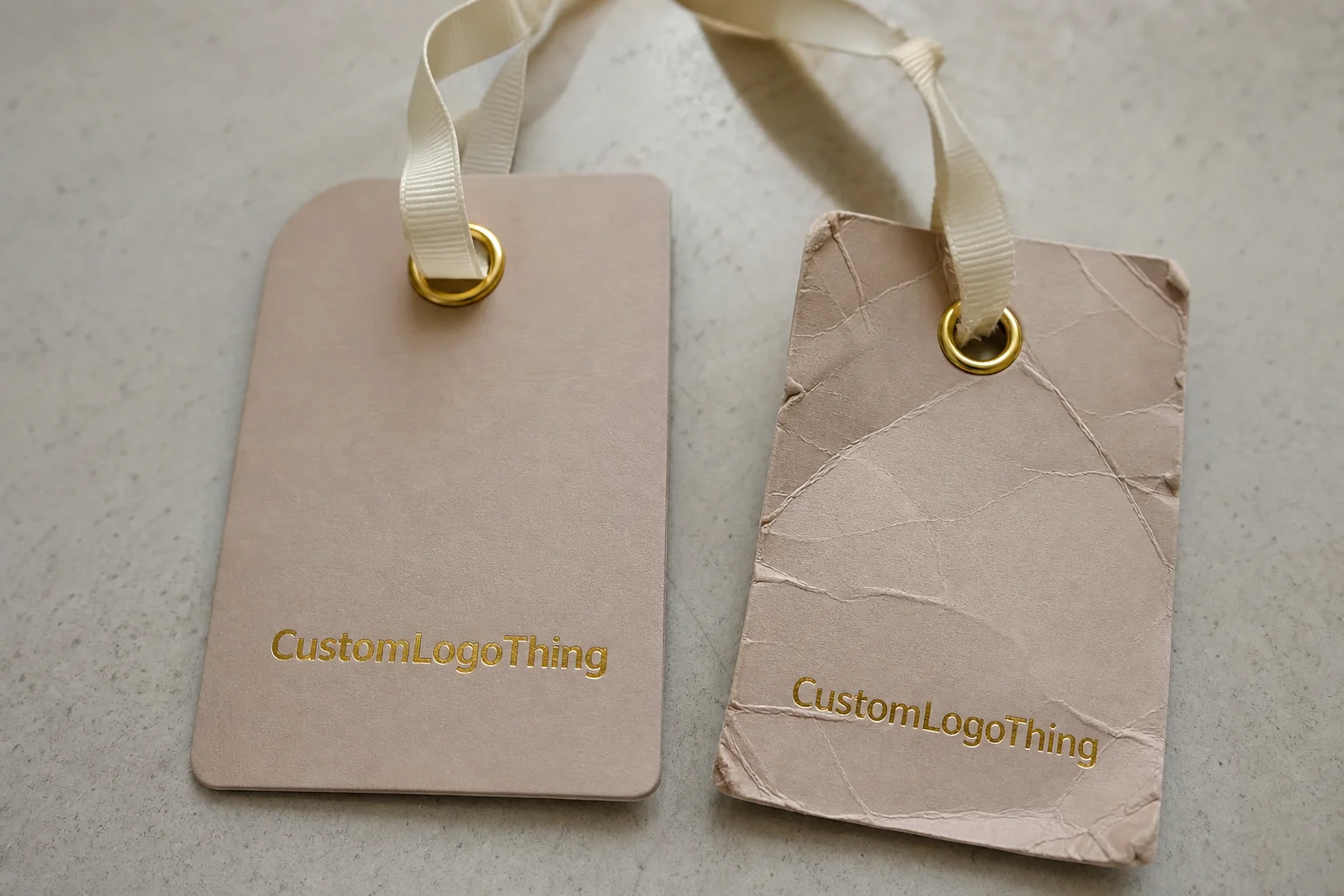
Durability starts with the build, not just the artwork. A hang tag usually combines a substrate, printed graphics, cut shape, hole or slot, and an attachment method such as string, ribbon, elastic loop, or a fastener. Premium skincare may also add lamination, aqueous coating, foil, embossing, or soft-touch finish. Each choice changes how the piece handles friction and moisture.
Stock thickness is one of the first decisions that affects transit performance. A 16 pt or 18 pt cover stock generally holds up better than a thinner text paper when tags are packed tightly or stacked with heavier components. Synthetic substrates such as polypropylene or PET-based stocks offer stronger tear resistance and moisture protection, which can matter for shower-adjacent products, humid storage, or long ecommerce routes. They also cost more and may not match every brand’s visual language.
Structural durability and appearance durability are not identical. A tag can feel luxurious because it has a matte coating or soft-touch surface, yet still fail if the hole is too close to the edge or the stock is too weak. A sturdier tag with a simpler finish may survive shipping beautifully but fail to support the brand image if the print feels flat or the surface looks cheap. The strongest spec balances both sides.
The main forces that damage tags in transit are familiar once you have seen enough packing lines:
- Vibration from trucks and sortation systems, which loosens attachments and rubs surfaces.
- Compression from carton stacking, pallet pressure, and tight master packing.
- Abrasion from contact with bottles, cartons, dividers, and neighboring tags.
- Humidity and condensation, which can warp paper stock or soften certain coatings.
- Temperature swings that change how paper fibers, adhesives, and finishes behave.
The practical question is simple: what is the worst thing the tag will encounter before the consumer opens the box? If the answer is repeated rubbing against glass or damp storage before retail intake, the spec needs to reflect that reality rather than an ideal display setting.
Key material and finish factors that affect cost and durability
Material choice determines both shelf appeal and transit survival. Uncoated stocks can feel natural and ingredient-forward, which works well for botanical or minimalist skincare lines, but they mark more easily and absorb moisture. Coated cover stocks, especially C1S or C2S, give sharper print and better scuff resistance. Synthetic options cost more, yet they hold up far better against water, tearing, and rough handling.
Finish selection matters just as much. A soft-touch coating can make a tag feel expensive in the hand, but it needs testing because some soft-touch surfaces show rub marks sooner than buyers expect. Aqueous coating is often a practical middle ground: it adds protection, keeps costs controlled, and works for many skincare launch specs. Matte lamination improves abrasion resistance further, though it adds cost and slightly changes the tactile feel of the tag.
Attachment hardware and hole reinforcement deserve real scrutiny. A plain punched hole is fine for light tags, but on heavier stock or any tag hanging from a bottle neck, reinforced punches, eyelets, or grommets can reduce tear-out. Cotton string gives a softer, more natural look. Elastic loops suit short-neck bottles or quick assembly. Ribbon can feel more premium, but it adds labor and can catch during packing if the length is not controlled.
| Option | Typical durability | Approximate cost impact | Best use case |
|---|---|---|---|
| Uncoated cover stock | Moderate; can scuff and absorb moisture | Lowest | Dry, low-abrasion retail packs |
| Coated cover stock with aqueous coating | Good balance of scuff resistance and price | Low to moderate | Most skincare launches |
| Soft-touch laminated cover | Very good against handling, but surface can show wear if not tested | Moderate to higher | Premium launch kits and hero SKUs |
| Synthetic stock | Excellent moisture and tear resistance | Higher | Humid storage, long transit, bath and body adjacency |
Cost is shaped by a few repeating variables: color count, ink coverage, special finishes, foil, embossing, fold or score complexity, custom dies, and tolerance requirements. A simple one-color tag on standard cover stock might land around $0.18-$0.28 per unit at 5,000 pieces. A premium multi-color tag with soft-touch lamination and foil can run meaningfully higher, especially when setup, finishing, and inspection steps are added. Quantity changes the math, but not enough to ignore the effect of added complexity.
For broader context on how finishes and formats behave across a packaging system, related Custom Packaging Products can show how a tag spec fits alongside labels, inserts, and outer packaging. If you want to compare presentation across formats, the Case Studies page gives a more grounded view of how one material or finish choice performs in different applications.
Shipping durability is often discussed using established test methods. Packaging teams commonly reference ISTA protocols for distribution testing, and paper sourcing may also involve FSC-certified options when recycled content or responsible sourcing is part of the brief. Those standards do not choose the best tag for you, but they give useful language for defining what “durable” should mean before production starts.
Process and timeline: from artwork proof to shipment-ready tags
Most tag projects move through the same sequence: file review, dieline setup, proofing, material selection, print approval, finishing, die cutting, inspection, packing, and freight readiness. The order looks straightforward. The timing rarely is.
Launch teams are often balancing formula approvals, claims language, ingredient updates, carton copy, and compliance review at the same time. That creates a fragile approval chain. Missing bleed, low-resolution logos, late copy edits, and finish changes are frequent causes of delay, and the delay often shows up right when the launch calendar has the least slack. If the tag includes a barcode or QR code, scan quality should be checked before production, not after samples arrive.
Typical timelines vary by complexity, but a straightforward custom tag often takes 12-15 business days from proof approval to completion. Special finishes, custom shapes, extra inspection, or new tooling can extend that. A screen proof helps with layout, but it does not tell you how the stock feels, whether the hole tears cleanly, or whether the finish survives rub testing. A physical sample is the better checkpoint, especially for branded Hang Tags for Skincare launches shipping durability checklist work.
A sensible production schedule leaves room for the following steps:
- Artwork cleanup and dieline confirmation.
- Material and finish selection.
- Proof review and revision.
- Short-run sample or press proof, if needed.
- Durability testing inside real cartons, kits, or bottles.
- Final approval, print, inspection, and packing.
If the timeline is compressed, the temptation is to skip sample testing. That is usually the wrong trade. A day saved at approval can become a week lost if the first shipment arrives with bent corners or unreadable marks.
Step-by-step durability checklist before you approve production
A checklist keeps a beautiful tag from turning into a warehouse problem. Start with the package shape itself. Does the tag hang from a round bottle, square carton, pump neck, or bundled set? If it swings into an abrasion zone, it needs either a different size, a different attachment, or a stronger material. Placement is often more important than decoration.
Step 1: Confirm fit. The tag should work with the bottle neck diameter, carton footprint, or bundle arrangement without dangling into corners or edges that will rub during shipping. A tag that looks elegant on a merchandised shelf can crease quickly inside a tight master carton.
Step 2: Choose stock for the worst-case environment. Do not spec for the display table. Spec for the warehouse, the truck, and the bathroom shelf. If humidity or condensation is likely, use coated stock or a synthetic substrate instead of plain uncoated paper.
Step 3: Inspect geometry. Hole position, corner radius, and string length all affect tear resistance. A hole too close to the edge is a classic failure point. Sharp corners catch on neighboring packs. A few millimeters of adjustment can improve survival dramatically.
Step 4: Ask for a physical test sample. Rub it, bend it, and place it inside the actual carton, mailer, or kit. If the product ships through ecommerce, do a basic drop and vibration check before sign-off. Formal validation can follow ISTA-style methods, but a simple in-hand test already reveals a lot.
Step 5: Confirm readability after handling. The logo, launch name, usage note, and any barcode or QR code must remain legible after minor wear. If one area fails visually, the whole piece feels weaker. Dark artwork tends to show scuffs sooner, so color choice matters more than some teams expect.
Step 6: Check pack-out behavior. A tag should not slow the line or snag during assembly. If workers need to straighten it repeatedly, the attachment or size is probably wrong. Labor friction is a real cost, even when it never appears on the quote.
A final question helps clarify the spec: if this tag sat in storage for a few weeks after bulk shipment, would it still look intentional when the box is opened? If the answer is uncertain, the design needs another review.
Common mistakes that make skincare hang tags fail in transit
The first mistake is choosing a thin, uncoated stock because it looked elegant in a sample book. Thin stock can work for protected inserts, but it often underperforms once tags are packed in bulk, stacked on pallets, and handled several times before retail. For shipping durability planning, that shortcut usually costs more later than it saves upfront.
The second mistake is placing the hole too close to the edge. Tear-out is common when a tag swings against a bottle or carton under vibration. Once the fibers start to split, the damage spreads quickly. Heavy tags and rigid string tension make the problem worse.
The third mistake is selecting a delicate finish without a rub test. Foil, specialty coatings, and some soft-touch surfaces can look excellent, but they need handling validation. Dark artwork shows wear faster than lighter tones. A small scuff on a black tag can be obvious from arm’s length.
Moisture is another quiet risk. Skincare spends time near sinks, showers, and humid storage areas, so the tag can be exposed to condensation or damp handling. Paper fibers can curl, corners can lift, and some coatings show marks when damp. That is why material choice should match the actual route and storage conditions, not just the sample room.
Overloading the layout causes trouble too. When too much copy or too many graphical elements are crammed onto the tag, the piece becomes harder to inspect and easier to mar visually if one area smears. Simpler hierarchy usually holds up better in transit and also reads better once the package is opened.
One more issue shows up in the rush to save on unit cost: using one tag spec for every SKU, regardless of package geometry. A serum bottle, a holiday kit, and a refill carton rarely have identical stress points. Standardizing the size can reduce complexity, but only if the fit is genuinely appropriate for each pack type.
Expert tips for buying the right quantity without overspending
Quantity planning is where budgets often drift. Start by separating hero products, sets, and seasonal launches rather than forcing one tag to do everything. A face serum, a sampler kit, and a refill bottle may belong to the same brand family, but they do not always need the same structural spec.
Ask for pricing at several quantity breakpoints. On a custom print run, unit cost can drop enough to justify a modest increase in order quantity, but only if storage and sell-through are realistic. Overbuying is not a savings strategy. It just moves the cost into inventory.
Confirm the minimum order quantity, spoilage allowance, and whether artwork changes trigger new setup fees. Those details often affect the total more than the headline unit price. A revised dieline, a switch from aqueous coating to lamination, or a change in attachment method can alter lead time and cost in ways that are easy to miss during early quoting.
If budget is tight, standard sizes and common material/finish combinations usually cost less than custom dies and specialty substrates. That does not mean the tag feels generic. It means the money goes where shoppers notice it: print quality, tactile feel, and clean finishing. Below is a simple buyer comparison that usually helps:
| Buying approach | Cost control | Inventory risk | Best fit |
|---|---|---|---|
| Single tag style for all SKUs | Strong upfront control | Higher risk if one launch changes | Small lines with stable packaging |
| SKU-specific tag sizing | Moderate | Lower fit risk, more complexity | Multi-product skincare launches |
| Standard size with variable print | Strong | Lower than fully custom dies | Fast-moving ecommerce brands |
It also helps to build a small safety stock only if the campaign is likely to extend. Otherwise, you are paying to store packaging that may age out before it is used. A disciplined purchase plan keeps packaging cost aligned with actual demand rather than optimism.
Next steps for a launch-ready tag specification
If the goal is a tag that survives shipping and still feels premium at unboxing, gather the package dimensions, target quantity, artwork files, and any compliance text before requesting a quote. The clearer the brief, the easier it is to recommend the right stock, finish, and attachment method without dragging the process out.
Set the priorities in order. Do you need moisture resistance, a soft tactile feel, recycled content, or the lowest unit cost? Pick the top priority first, then balance the rest around it. A tag can be luxurious, exceptionally durable, or very economical. Two of those are sometimes possible together. All three is less common than many launch decks imply.
Ask for a sample plan that names the proof type, test criteria, and approval deadline. That keeps the launch calendar honest and gives internal teams a clearer way to compare options for finish quality, production timing, and package protection before sign-off.
For brands coordinating multiple packaging components, Custom Labels & Tags is a practical starting point alongside broader Custom Poly Mailers and Custom Shipping Boxes if the launch package needs to work as one system. The tag should fit the box, mailer, fill, and closure method rather than fight them.
Before approval, use a final review for color accuracy, hole strength, scuff resistance, attachment method, and pack-out behavior. Sign off only after the tag survives handling, packing, and a realistic transit test. That is the real lesson behind branded Hang Tags for Skincare launches shipping durability checklist planning: the strongest tag is not the prettiest sample on day one, but the one that still looks intentional when the box is opened days or weeks later.
FAQ
What makes branded hang tags for skincare launches more durable in shipping?
A sturdier stock, reinforced hole placement, and a finish that resists scuffs usually make the biggest difference. The tag also needs to match the package shape so it does not rub, crease, or tear during transit. For many launches, that means choosing a coated cover stock or synthetic option instead of a thin uncoated sheet.
Which finish is best for shipping durability on skincare hang tags?
Aqueous coating or matte lamination often gives a strong balance of protection and cost. Soft-touch can feel premium, but it should be tested for rub resistance before large production runs, especially if the tag will be handled during ecommerce shipping or palletized distribution.
How does hang tag pricing change for a skincare launch?
Price changes with stock thickness, print coverage, special finishes, die complexity, and quantity. Higher quantities usually lower unit cost, but custom shapes or premium materials can still raise the overall budget. If you want tighter control, ask for pricing at several quantity breakpoints before final approval.
What is the best lead time for custom skincare hang tags?
Build in time for artwork review, proofing, production, and sample testing before the launch date. If the tag needs special finishes or a new die, add extra buffer for approvals and transit tests. A simple run may move faster, but a launch schedule should always leave space for revisions.
Can hang tags survive humidity in skincare shipping and storage?
Yes, if you Choose the Right material and finish, such as coated stock or a synthetic substrate. Testing in the same storage and shipping conditions your product will face is the safest way to confirm performance. For products used in bathrooms or shipped through humid regions, that step is especially helpful.