Buyer Fit Snapshot
| Best fit | Branded Kraft Bags Bulk projects where brand print, material claims, artwork control, MOQ, and repeat-order consistency need to be specified before quoting. |
|---|---|
| Quote inputs | Share finished size, material target, print colors, finish, packing count, annual reorder estimate, ship-to region, and any compliance wording. |
| Proofing check | Approve dieline scale, logo placement, barcode or warning zones, color tolerance, closure strength, and carton packing before bulk production. |
| Main risk | Vague material claims, crowded artwork, missing packing details, or unclear freight terms can make a low unit price expensive after revisions. |
Fast answer: Branded Kraft Bags Bulk: Specs, Pricing, and Orders should be specified like a repeatable production item. The safest quote records material, print method, finish, artwork proof, packing count, and reorder notes in one written spec.
Production checks before approval
Compare the actual filled-product size with the drawing, then confirm tolerance on folds, seals, hang holes, label areas, and retail display edges. Reserve space for logos, QR codes, warning copy, and material claims before decorative graphics fill the panel.
Quote comparison points
Review material grade, print process, finish, sampling route, tooling charges, carton quantity, and freight assumptions side by side. A quote is only useful when the supplier can repeat the same color, closure quality, and packing count on the next order.
A packaging change can cost more in labor than in paper. That is the part people miss while they argue about print finishes. A smart branded kraft bags bulk order pays off in packing speed, fewer mistakes at the bench, and cleaner handoffs from warehouse to customer. Pretty simple. Also easy to overlook.
For a packaging buyer, a kraft bag is not decoration. It is part of the workflow. The right branded kraft bags bulk program can standardize fulfillment, reduce the number of loose decisions a packer has to make, and keep each shipment looking deliberate without adding extra steps. The wrong spec does the opposite. It creates rework, slows the line, and turns a cheap-looking bag into an expensive problem.
If the goal is efficient movement of product, the real questions are dimensions, paper weight, print method, and order volume. That is the test. Not hype. Not vague sustainability language. Not a glossy mockup that falls apart as soon as the cartons hit the dock. A bag has to work in actual shipping and retail conditions, with enough room in the spec to avoid surprise failures when volume climbs.
Why Branded Kraft Bags Bulk Makes Sense for Shipping
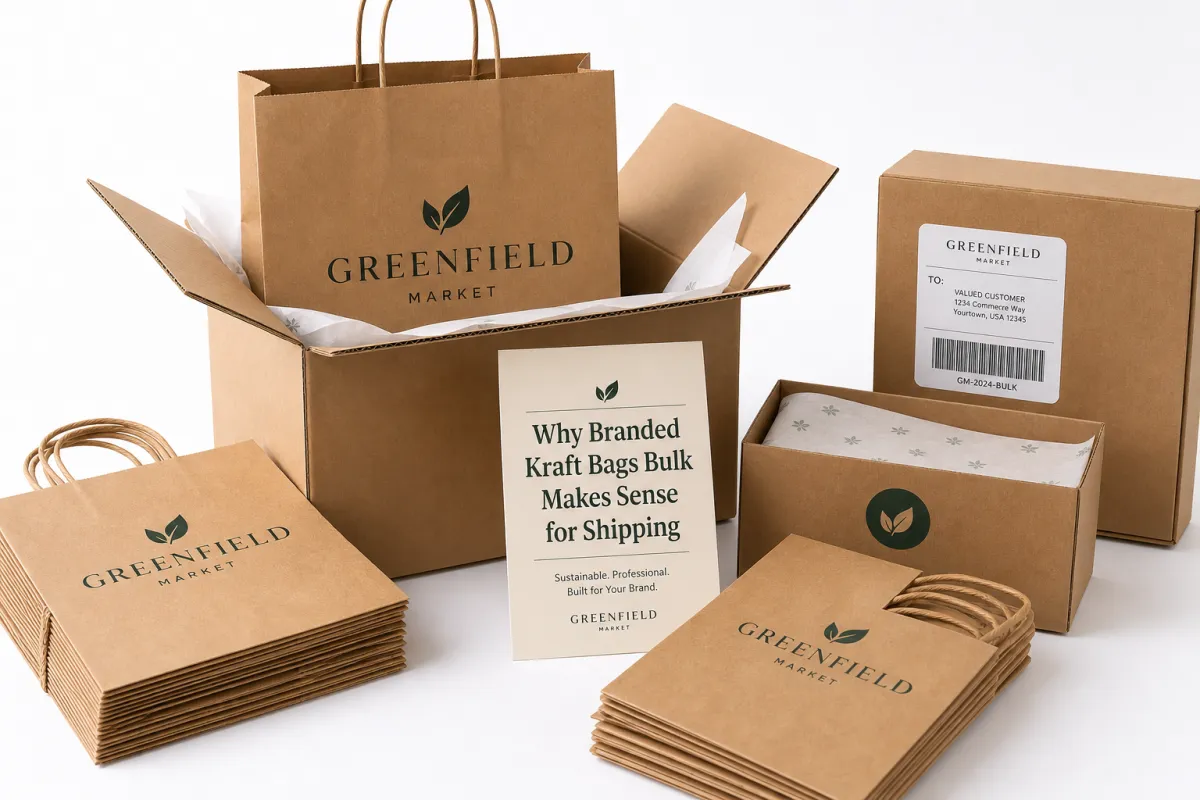
The operational math is not glamorous, but it is hard to argue with. Packaging changes often cost more in labor and rework than the bag itself. A few extra seconds per order looks harmless until the count reaches hundreds or thousands of shipments. That is where branded kraft bags bulk starts to make sense. One standardized bag cuts down on guesswork, trims the number of SKUs on the shelf, and makes the pack-out path easier to predict.
In practice, a kraft bag is a logistics tool first and a brand surface second. If the same bag can support carryout, a secondary package, or an insert bundle, the warehouse team moves faster and sees fewer exceptions. One format also makes vendor ordering easier. Instead of splitting purchases across several styles, you buy one spec, hold one inventory position, and replenish without making accounting more annoying than it already is. That matters.
Branded kraft bags bulk works best in repeat environments. Ship-from-store programs, subscription kits, regional fulfillment centers, retail carryouts, and event packs all benefit from the same thing: consistency. When the bag is standardized, packers do not have to decide which size fits which order. Managers get cleaner forecasts. The operation uses less mental energy, which is not a line item, but it should be.
There is a brand angle too, but it should stay in its lane. Kraft finish reads as practical and grounded. It feels less flashy than high-gloss alternatives, which can be exactly right when the package needs to look trustworthy instead of loud. Still, the bag has to earn its place. A logo on a bag that tears, buckles, or slows packing is not branding. It is bad math with ink on it.
Good buyers think in workflow terms. How many units leave each week? Does the team need a flat bag, a block-bottom bag, or a handled retail bag? How much storage room exists before replenishment? Those questions matter more than art direction. A good branded kraft bags bulk program supports the operation instead of forcing the operation to adapt to the bag.
I have seen teams get burned by a bag that looked great in a mockup and then caused problems on the line. The handle spacing was off by a few millimeters, or the gusset was a touch too shallow, and suddenly everyone was slowing down to make the bag behave. That kind of thing is boring until it costs money. Then it is very interesting.
For teams comparing recurring supply programs, our Wholesale Programs page is a useful reference point. It frames bulk purchasing as a replenishment strategy, not a one-time design splurge. That mindset usually leads to better spec decisions and fewer rushed reorders later.
Product Details: What Counts as a Branded Kraft Bag?
The phrase “kraft bag” covers several different products. At one end, you have flat paper bags with little structure beyond folds and glue. They are useful for lightweight inserts, apparel, literature, or simple shipping kits. At the other end, you have premium retail kraft bags with reinforced tops, twisted handles, or rope handles built for customer-facing carryout and a more polished presentation. Branded kraft bags bulk can mean any of these, which is why the spec matters more than the label.
The common formats are flat paper bags, SOS block-bottom bags, merchandise Bags with Handles, and reinforced retail kraft bags. Flat bags are compact and easy to store. SOS bags stand upright and handle more volume with a stable base. Handle bags feel more retail-ready and are easier to carry, but they usually add cost and manufacturing complexity. Each format shifts the economics of branded kraft bags bulk, so the intended use should drive the choice.
Branding can stay minimal or go further. Many buyers choose a one-color logo on the front panel because it gives the cleanest production path and the least setup drama. Others want repeat patterns, multiple panels, or multi-color artwork. Those options are real, but they affect registration, proofing, and minimum order quantities. For most bulk runs, a clean print layout gets the best balance of quality and price.
Paper stock also changes the outcome. A light kraft bag may use paper in the 60-90 gsm range, which works for low-load applications and inserts. Medium-duty bags often sit closer to 100-120 gsm, while more durable handled bags can go higher depending on construction. Thicker is not always better. Too much paper can make folding stiff, increase freight cost, and eat up storage space. The right choice matches the load instead of trying to win a weightlifting contest.
Sustainability claims need a close read. Kraft paper may include recycled content, may be recyclable, and may be FSC-certified depending on the supplier and material chain. Those are not the same claim. If the team needs documentation, ask for it directly rather than assuming the appearance of kraft tells the whole story. For general references on material standards and certification language, resources from packaging.org and fsc.org are useful starting points.
Appearance and performance are different jobs. A bag can look polished on a product page and still fail in transit if the handles are weak, the folds are sloppy, or the glue line is inconsistent. That is why branded kraft bags bulk should be treated like a working package. The goal is a bag that survives handling, storage, and delivery without becoming a new problem for the pack line.
For buyers who want proof that packaging is doing real work, our Case Studies page can help frame what practical performance looks like. The best examples usually show a small spec change that improved packing consistency or reduced damage, not a pile of words about brand vibes.
Specification Checklist for Bulk Orders
Before anyone asks for a quote, define the bag in measurable terms. Width, gusset, height, handle drop, and usable imprint area are the basics. Leave one dimension out and the quote will either be wrong or padded enough to waste money. Buyers who come prepared usually get cleaner proposals faster. That is one of the few business rules that never gets old.
Paper weight should be stated plainly, not dressed up as a quality claim. A lighter kraft bag can be perfect for secondary packaging or low-load retail use, while a heavier bag makes sense for customer-facing carryout and denser contents. The real question is whether the bag needs to stand upright, carry weight, or simply hold a branded bundle. Once that is clear, the paper spec gets a lot easier to choose. In many programs, the difference between overbuilt and well-matched paper is where the savings live.
Print details affect both quality and price. Number of ink colors, PMS matching, bleed area, registration tolerance, and minimum line thickness should all be confirmed early. A simple one-color logo is usually the most efficient choice for branded kraft bags bulk because it reduces setup variables and keeps cost under control. Multi-color art can work, but it needs more proofing discipline. Fine lines, gradients, and tiny reversed text are the first things to misbehave on kraft substrates.
Structural details matter more than most marketing teams expect. Twisted paper handles are common for retail bags and give a good mix of cost and carry comfort. Flat handles are simpler. Reinforced tops help when the bag gets handled repeatedly, stacked, or used for denser contents. Fold quality matters too, because a neat fold packs better into cartons and stores more efficiently on shelves. Those small details are the difference between a bag people tolerate and a bag they ask about in the break room.
Compliance checks are not optional on serious bulk orders. If the bag will touch food or be used in a retail environment with special handling requirements, ask about food-contact suitability and the supplier’s documentation process. For recycled content or forest stewardship claims, ask for proof rather than trusting a sales line that sounds reassuring. Sample approval is another line of defense. A physical sample catches issues that artwork proofs cannot, like awkward proportions, weak handles, or a logo that suddenly looks too small once printed.
On transit-heavy programs, it helps to think like a shipping engineer. If the bag will ride inside a parcel network, a supplier who understands ISTA testing logic can help avoid mistakes that only show up after boxes start moving. The package does not need to be lab-perfect, but it should survive reasonable compression, vibration, and handling. That is why branded kraft bags bulk works better as a specification exercise than a branding exercise.
- Dimensions: confirm width, gusset, height, and handle drop.
- Artwork: send vector files, exact logo placement, and PMS references.
- Construction: choose flat, block-bottom, handled, or reinforced based on the load.
- Documentation: request recycled-content, FSC, or food-contact details if needed.
- Sampling: approve a physical sample before the full run when the bag is customer-facing or transit-sensitive.
Branded Kraft Bags Bulk Pricing, MOQ, and Savings
Pricing is driven by a handful of variables, and most of them are predictable. Bag size, paper weight, handle style, number of print colors, and order volume shape the quote far more than the logo itself. Setup charges and proofing fees can also show up, especially on custom sizes or more complex art. That is why branded kraft bags bulk should be compared on matched specs, not on headline price alone.
MOQ exists because production has fixed costs before the first finished bag rolls off the line. Simple one-color runs often allow smaller minimums, while custom-size, multi-color, or reinforced bags usually push the minimum higher. A buyer ordering 1,000 units is paying more of the setup burden than a buyer ordering 10,000. That does not make the smaller order wrong. It just means the economics are different, and the quote should be read with that in mind.
For budget planning, these are reasonable working ranges for custom orders, assuming standard artwork and typical production conditions:
| Bag Type | Typical MOQ | Budgetary Unit Range | Best Use | Practical Note |
|---|---|---|---|---|
| Flat kraft bag | 1,000-3,000 | $0.10-$0.22 | Inserts, literature, lightweight kits | Lowest structure, fastest to store and stack |
| SOS block-bottom bag | 2,500-5,000 | $0.14-$0.28 | Retail carryout, medium-load packaging | Good volume, stable base, solid for repeat use |
| Twisted-handle merchandise bag | 3,000-5,000 | $0.18-$0.38 | Events, apparel, branded handoff packs | More premium feel, higher freight due to bulk |
| Reinforced premium kraft bag | 5,000+ | $0.28-$0.60 | High-touch retail and customer-facing shipping | Better presentation, but verify storage and carry load |
Those figures are planning numbers, not promises. A 1-color print on a standard size may land near the lower end, while full-coverage artwork, heavier paper, or specialty handles can move the quote up fast. Freight matters too. A paper bag is light, but it is still bulky, which means landed cost can change a lot if the ship method, carton count, or delivery location changes. In bulk programs, freight belongs in the quote from the start.
“The cheapest bag is rarely the cheapest order if it slows the pack line by even a few seconds per unit.”
That point gets obvious in high-volume operations. If a bag takes longer to fold, loads awkwardly, or arrives in cartons that are a pain to stage, the labor hit can wipe out the price difference between two suppliers. This is where branded kraft bags bulk either creates value or quietly drains it. Buyers should ask for apples-to-apples quotes with identical dimensions, finish, print count, and delivery terms. Anything less is a comparison built on vibes.
There is also a stock strategy angle. A larger run can improve unit pricing enough to justify holding deeper inventory, especially if the bag is used every week. Stock only helps if the spec is stable and the design is unlikely to change. If the logo may shift, or if the packaging program is still being tested, a smaller first run with a tighter proofing cycle is the safer move. It is better to order intelligently than to sit on 20,000 bags that no longer fit the program.
One practical tip from the buying side: ask for a quote split between product cost, print setup, and freight. That makes it easier to see where the money is going. Sometimes the bag itself is fairly priced, but the freight or carton configuration is the real culprit. That detail saves time, and honestly, it saves a few headaches too.
Production Process and Timeline
The production workflow is straightforward when the buyer comes prepared. It usually starts with spec confirmation, then artwork review, then a digital proof, then approval, then production, then quality check, then shipment. If any one of those steps gets delayed, the schedule slips. That is why branded kraft bags bulk orders move fastest when dimensions, print count, and logo files are settled before the quote is finalized.
Timelines vary by complexity. A standard one-color bag with ready-to-print art can often move through production in about 12-15 business days after proof approval. More complex work, such as custom sizes, multi-color print, special handles, or reinforced construction, often lands closer to 18-25 business days. Rush production may be possible in some cases, but it usually raises cost and trims flexibility. Buyers should treat rush service as a controlled exception, not a default plan.
The most common delay is not manufacturing. It is revision. Late artwork changes, missing PMS references, unclear dimensions, and slow proof approval can stall even a simple order. That problem is easy to underestimate because it feels administrative, not operational. In reality, a few days lost in the proof stage can wipe out any advantage from choosing a faster plant. For branded kraft bags bulk, the schedule is often won or lost before production starts.
To protect the timeline, send final artwork in vector format, identify logo placement clearly, and confirm whether the print should be centered, offset, or repeated. If the bag needs to match an existing retail line, provide a sample or a precise spec sheet. If the order will support shipping, include the weight of the packed contents and any inserts that will ride inside the bag. That information helps the supplier recommend a construction that will not need to be corrected later.
Sampling is worth the time when the bag is customer-facing or part of a recurring program. A digital proof can confirm art placement, but it cannot tell you how the bag feels in the hand, whether it stands properly, or whether the fold opens the way the team expects. A pre-production sample or approved reference piece can save a full re-run. That is a tiny insurance policy compared with replacing a bad bulk order.
Good production partners ask the right questions early. They want the use case, the load, the brand color target, and the delivery deadline before they promise anything. That is a good sign. It means the supplier is planning for repeatability instead of just chasing the order. In the long run, that is what makes branded kraft bags bulk dependable rather than merely nice-looking.
Why Choose Us for Shipping & Logistics Orders
For shipping and logistics programs, consistency is the real value. A supplier should be able to repeat dimensions, keep print sharp across the run, and ship bags that fit the packing workflow instead of fighting it. That is the standard that matters. Branded kraft bags bulk is not just a retail aesthetic choice; it is a replenishment decision that affects labor, storage, and customer experience.
What buyers need most is a supplier that understands bulk operations, not just shelf appeal. A good packaging partner knows that a 5 mm difference in gusset or a slightly stiff fold can matter when an order is packed hundreds of times a day. They also know freight, carton count, and storage density are part of the economic picture. In other words, the right partner sees the bag as a functional unit in the order chain. That perspective saves money in ways that do not show up on the first line of the quote.
Quality control is another separator. A well-run bulk program should include sample checks, print verification, and dimension control before the order ships. If a supplier cannot explain how they verify color, alignment, and handle attachment, that is a warning sign. Missed details become obvious fast once the bags hit the packing bench. By contrast, a disciplined approach to branded kraft bags bulk lowers the odds of cartons that need to be sorted, rechecked, or partially rejected.
There is also a hidden cost in over-specifying the bag. Some buyers default to a heavier paper weight or a premium handle because it sounds safer. Sometimes that is correct. Often it is not. If the bag is only holding a folded apparel item or a light secondary kit, extra paper adds cost, bulk, and freight without adding much value. A strong supplier helps right-size the spec, which is usually better than upselling a bag that exceeds the job.
That practical mindset is one reason our Wholesale Programs approach works well for recurring users. It is built around repeatable orders, clear pricing, and specs that support replenishment rather than one-off experimentation. For teams that need dependable restocks, that structure is usually more useful than chasing a tiny first-run discount.
We also encourage buyers to review prior packaging programs before committing to a new one. The best clues are not flashy. They are things like consistent print across multiple cartons, stable lead times, and bags that arrive ready for the floor or the pack station. Our Case Studies page shows how those details affect real operations. That is where branded kraft bags bulk becomes a measurable business decision instead of a design preference.
Measured value is the point. Clear quotes. Responsive proofing. Stable dimensions. Packaging That Works from warehouse to customer. Those are not luxury features. They are the basics that protect margin when order volume rises. If a supplier can deliver all of that, the branding almost takes care of itself.
Next Steps to Order the Right Bulk Run
The fastest way to get a clean quote is to make three decisions first: intended use, target dimensions, and expected monthly or quarterly volume. Once those are set, the rest of the conversation becomes much easier. You can then decide whether the bag needs to be flat, block-bottom, handled, or reinforced. That sequence cuts down on back-and-forth and keeps branded kraft bags bulk tied to the actual workflow.
Next, gather the artwork. Send the logo in vector format if possible, along with any PMS color references, copy placement notes, and brand guidelines. If the bag must match a current retail line or shipping kit, include a sample photo or an existing reference piece. That helps the supplier quote the right construction the first time. It also lowers the chance of a proof that looks technically fine but misses the real brief.
If the bag will touch customers directly, order a sample or request a pre-production proof. That is especially useful for handled retail bags and customer-facing shipping programs where the bag becomes part of the brand impression. A sample shows how the paper feels, how the logo reads at distance, and whether the structure is stable enough for the contents. In bulk packaging, one small problem repeated 10,000 times is no longer small.
Then compare vendors on the full landed cost, not just the unit price. Check MOQ, freight, turnaround, print allowances, and any setup or proof fees. Ask whether the quote includes the same bag size, same paper weight, same handle style, and same delivery terms. Without that discipline, a lower quote may simply hide a lighter spec or a narrower service scope. That is a rough trade for a business that depends on reliable output.
If the project is still in the testing phase, start with a smaller bulk run and a locked spec. If the bag will be used continuously and the design is stable, a larger order may produce better unit economics. Either way, the final order should match the workflow, the budget, and the replenishment plan. That is the cleanest way to buy branded kraft bags bulk without guesswork.
For most buyers, the best next move is simple: finalize the spec sheet, confirm the artwork, and request matched quotes from suppliers who understand practical packaging requirements. Do that before negotiating price. The result is usually better value, fewer revisions, and a bag that actually supports shipping, retail, or logistics work. If the bag does all three well, branded kraft bags bulk stops being a purchase and starts becoming part of the system.
What is the typical MOQ for branded kraft bags bulk orders?
MOQ usually depends on bag size, paper weight, and print complexity rather than a single universal number. Simple one-color runs often allow lower minimums than custom-size or multi-color bags. Ask for tiered pricing so you can see the cost impact of moving above the minimum.
How long do branded kraft bags bulk orders usually take?
Lead time depends on proof approval, artwork readiness, and whether the bag is a standard or custom size. Straightforward print jobs generally move faster than complex multi-color projects. The best way to protect the schedule is to approve proofs quickly and send final artwork up front.
Which size works best for shipping and logistics use?
Choose size based on the item dimensions, not just the logo placement. Leave enough gusset depth for packing materials, inserts, or folded apparel. When in doubt, test a sample with the exact product mix before placing the full bulk order.
Can branded kraft bags bulk orders be made with recycled paper?
Yes, many kraft bag options use recycled content, but the percentage varies by supplier and construction. If sustainability claims matter, ask for documentation rather than relying on appearance alone. Confirm whether the paper is recyclable, FSC-certified, or suitable for your customer requirements.
What print method is best for branded kraft bags bulk?
For most shipping and retail uses, a simple one- or two-color print is the most cost-efficient choice. More colors and full-coverage artwork increase setup complexity and can affect MOQ. Match the print method to the brand goal: clarity, durability, and repeatability usually matter more than decoration.
Actionable takeaway: before you place a branded kraft bags bulk order, lock the dimensions, paper weight, print count, and freight terms into one spec sheet, then approve a physical sample if the bag will be handled by customers or moved through a parcel network. That one step catches most expensive mistakes before they turn into a pile of unusable bags.


