Buyer Fit Snapshot
| Best fit | Branded Mailer Boxes MOQ projects where brand print, material claims, artwork control, MOQ, and repeat-order consistency need to be specified before quoting. |
|---|---|
| Quote inputs | Share finished size, material target, print colors, finish, packing count, annual reorder estimate, ship-to region, and any compliance wording. |
| Proofing check | Approve dieline scale, logo placement, barcode or warning zones, color tolerance, closure strength, and carton packing before bulk production. |
| Main risk | Vague material claims, crowded artwork, missing packing details, or unclear freight terms can make a low unit price expensive after revisions. |
Fast answer: Branded Mailer Boxes MOQ: Pricing, Specs, and Process should be specified like a repeatable production item. The safest quote records material, print method, finish, artwork proof, packing count, and reorder notes in one written spec.
Production checks before approval
Compare the actual filled-product size with the drawing, then confirm tolerance on folds, seals, hang holes, label areas, and retail display edges. Reserve space for logos, QR codes, warning copy, and material claims before decorative graphics fill the panel.
Quote comparison points
Review material grade, print process, finish, sampling route, tooling charges, carton quantity, and freight assumptions side by side. A quote is only useful when the supplier can repeat the same color, closure quality, and packing count on the next order.
Branded mailer boxes MOQ is the number that tells you whether a packaging quote is practical or just politely misleading. A small run can look attractive on paper, yet the real cost picture changes once setup, tooling, freight, and the next reorder are all counted together. For many brands, the cheapest-looking option is not the one that supports the business best. The right minimum sits at the point where the economics start to work and the box still fits the job.
A subscription brand, a DTC launch, or a limited seasonal set all need the same thing from their packaging: a carton That Ships Well, stacks cleanly, and still feels like part of the brand when the customer opens it. That is why branded mailer boxes MOQ carries more weight than buyers sometimes expect. The minimum is not just a factory preference. It reflects the setup work, the print prep, the board commitment, and the production rhythm needed to make the order efficient.
Inventory matters too. A low minimum can leave you scrambling for a second order before the first one is gone. A higher minimum can tie up cash and eat warehouse space if the forecast is soft. A well-chosen branded mailer boxes MOQ gives you steadier replenishment, more predictable pricing, and a cleaner path from approval to reorder. If you are comparing formats while you plan, our Custom Packaging Products page is a practical place to start, and our Case Studies show how different structures behave in real shipping programs.
Branded Mailer Boxes MOQ: What the Number Really Means
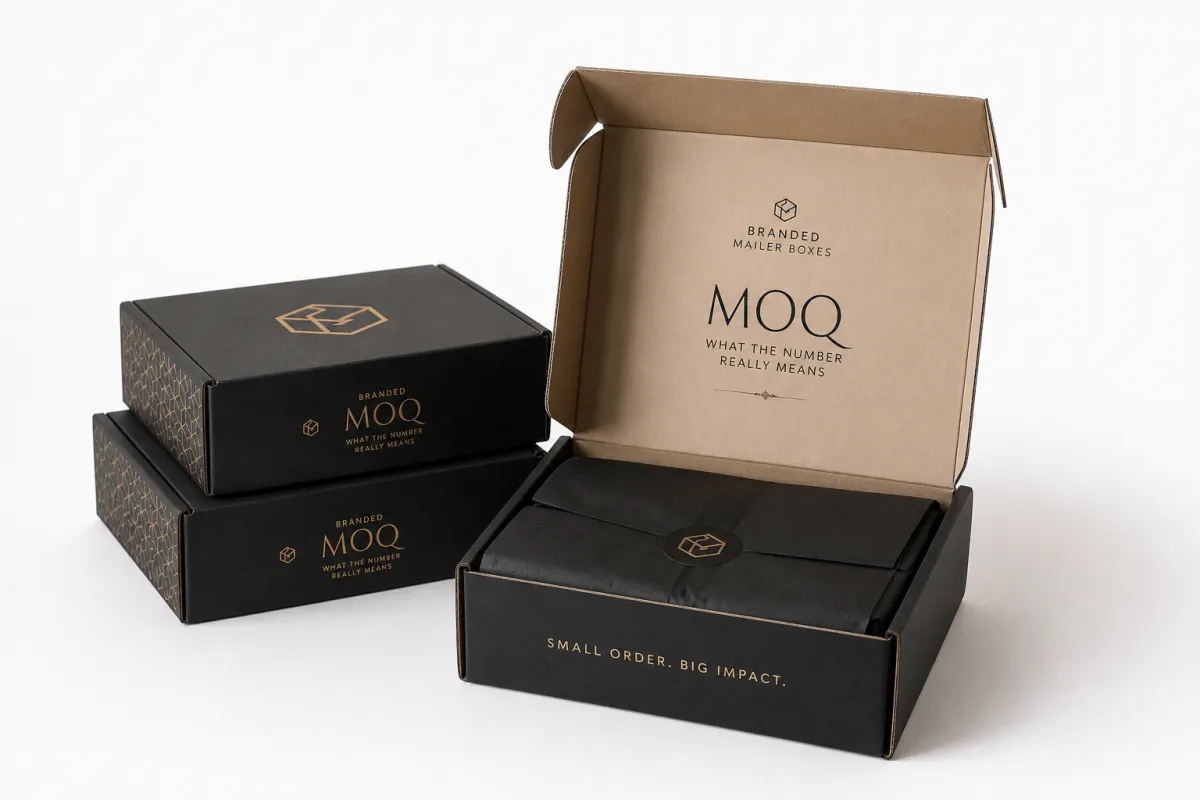
MOQ often gets treated like a hard wall. It is closer to a cost threshold. Branded mailer boxes MOQ covers the setup work the supplier has to complete, the board that has to be reserved, and the production time needed to make the job run efficiently. Tiny orders tend to absorb the fixed costs all at once, which pushes the unit price up. Larger orders spread those same costs across more cartons, and the cost per piece usually settles into a better range.
The pattern is familiar. A buyer asks for 250 mailer boxes to keep spending low. The supplier quotes 500 pieces at a noticeably better unit price. The larger number feels harder to approve, so the conversation pauses. Yet the landed cost may be lower on the bigger run once setup charges, freight, and the next reorder are included. That is why branded mailer boxes MOQ should be judged against the full packaging plan, not just the first invoice.
Shipping cartons also live a rougher life than display packaging. A folding carton that sits on a boutique shelf does not face the same handling as a mailer moving through a fulfillment line, a parcel sorter, a delivery truck, and a front porch. For that reason, branded mailer boxes MOQ is tied to transit performance as much as print convenience. Buyers need a carton that closes properly, resists crushing, and still opens with a clean feel. If the box fails in transit, any savings from a smaller order can disappear fast.
A sound MOQ protects both sides: the supplier covers setup work fairly, and the buyer avoids expensive stockouts, reprints, and rushed freight.
That balance matters because packaging is rarely a one-time purchase. It becomes part of a repeat cycle. Once a brand settles on a workable size and structure, reorders become easier to plan and easier to forecast. Viewed that way, branded mailer boxes MOQ is not just a pricing line. It is a planning tool that shows how much volume is needed before the run becomes efficient, and how much stock can be held without creating waste.
Predictability deserves its own mention. A clear MOQ helps a team schedule launches, campaign drops, and replenishment windows with less guesswork. Ecommerce teams that ship every week feel that difference quickly. A sensible branded mailer boxes MOQ keeps production aligned with monthly shipment volume instead of forcing the business to buy too early or too often.
In packaging reviews I have sat through, the same issue comes up again and again: a buyer wants the lowest possible minimum, then ends up placing a second order before the first carton run is even fully unpacked. That is not a moral failure; it is just what happens when the math is based on a single purchase instead of the whole cycle. A better MOQ makes room for reality, which is kinda the whole point.
Mailer Box Construction and Branding Options
Strength starts with structure. Most branded mailers use corrugated board, and the choice of flute and liner changes crush resistance, print quality, and pack-out speed. Lightweight goods can often ride in an E-flute or a thinner B-flute. Heavier kits ask for better edge strength and more careful board selection. That is one place where branded mailer boxes MOQ and design choices meet; a stronger structure can raise the minimum, but it can also reduce damage claims and the cost of replacements.
Closure style matters as much as board. A standard tuck mailer folds quickly and suits routine fulfillment. An interlock or crash-lock style can offer more security, though it may add hand labor. Brands often want a premium unboxing moment, but the pack line still needs a carton that folds flat, stacks well, and assembles without a fight. From a packaging buyer’s view, branded mailer boxes MOQ should support the visual story and the daily workflow at the same time.
Branding options usually fall into a few practical buckets: one-color print, full-color CMYK, exterior-only branding, and inside print. Each choice changes the quote. A single-color logo on kraft board is often the most economical route and usually gives the lowest unit cost. Full-color artwork across the exterior raises print prep and can move the order into a different production method. Inside print adds another layer of setup, so it makes sense only when the reveal contributes something real to the customer experience. The question is not whether the effect can be printed. The question is whether it earns its place in the box.
Finishing carries its own price logic. Matte aqueous coating creates a clean, practical surface and usually keeps the package easy to handle. Gloss can make color feel brighter, though it can also show scuffs more readily during transit. Soft-touch lamination feels premium, yet it adds cost and is not always the right fit for a shipping carton that spends time in warehouses. Uncoated kraft brings a natural look and suits earthy or minimal brands beautifully. The right finish depends on the product, the shipping route, and the brand promise.
Any sustainability claim should be backed by clear documentation. FSC-certified board is a common request, and a supplier should be able to explain the chain-of-custody status plainly. If that claim matters to your market, verify it instead of assuming it. The FSC reference point is useful here: FSC certification information helps buyers understand what certified sourcing is meant to mean in practice.
Practical rule: choose the print and finish combination that supports the shipping task first, then add visual upgrades only where they create real value. That approach usually beats asking for every premium detail at a low branded mailer boxes MOQ.
Size, Materials, and Insert Specifications
Dimensions are where many packaging quotes go off track. Buyers naturally think in product size, while the supplier has to think in internal carton dimensions. Length, width, and depth need to work from the inside of the box, not the outside. A carton that measures 10 x 8 x 3 inches externally can still be too tight for a product measuring 9.5 x 7.5 x 2.8 inches once inserts, tissue, or a sleeve are included. With branded mailer boxes MOQ, small sizing errors can create waste that looks minor in the quote and costly in the warehouse.
Board selection should match the payload. A lightweight candle, a small apparel bundle, or a sample kit may do fine in a modest single-wall mailer. Heavier sets, bottle packs, or mixed-product shipments usually need stronger board or a better flute choice. A simple rule helps here: the more the carton has to hold its shape under stacking pressure, the more attention you should give to ECT rating and overall caliper. Many shipping teams still look to common transit expectations, and standards such as ISTA test methods can help define how much handling abuse a carton should survive.
For typical ecommerce mailers, a 32 ECT board may be enough for lighter shipments, while 44 ECT or a stronger construction can make sense for denser kits and longer routes. That is not a universal rule. Product weight, distribution path, and how long the packaging needs to hold up all matter. Even so, having a target range makes quoting faster. It also helps a buyer judge whether the quoted branded mailer boxes MOQ actually fits the product or simply fits the supplier’s easiest format.
Insert choice is another quiet cost driver. Some orders need no insert at all. Others work better with a paperboard insert, a corrugated divider, or a custom-fit structure that keeps movement under control. Bottles, candles, and fragile accessories usually benefit from a more deliberate insert. The outer box may not look radically different, but the pack-out changes a lot. A well-made insert reduces filler, keeps products centered, and shortens packing time. That is not decoration. It is part of the operating system.
Before quoting, a buyer should gather a concise spec sheet with these details:
- Product dimensions with exact tolerances when the item is irregular.
- Product weight so the board strength can be matched correctly.
- Shipping method such as parcel, courier, or mixed freight.
- Branding coverage including outside, inside, or both.
- Insert requirement including none, standard, or custom fit.
- Flat-shipped expectation if warehouse efficiency matters.
That list looks basic, yet it prevents a surprising number of delays. Vague specs slow proof cycles and make it easier for mistakes to slip through. If keeping branded mailer boxes MOQ under control matters, accurate sizing is one of the fastest ways to protect the budget.
There is also a freight angle. A box that is too large can increase shipping charges even when the carton price looks reasonable. Dimensional weight, void-fill, and warehouse handling all add up. A slightly tighter, better-sized mailer can reduce total freight cost and cut wasted material at the same time. Packaging engineers tend to optimize the full supply chain for exactly that reason, not just the purchase order.
Branded Mailer Boxes MOQ and Pricing Breakdown
Most buyers want the number first: what does it cost? The honest answer is that branded mailer boxes MOQ pricing depends on quantity, board grade, print coverage, color count, finish, inserts, and shipping destination. That is a wide set of variables, but it is the right set. A simple one-color kraft mailer is not priced the same way as a full-color, soft-touch, insert-ready carton for a premium kit.
Below is a practical comparison for a common ecommerce mailer, roughly in the 9 x 6 x 3 inch range, with standard artwork and no unusual structural changes. These are working ranges, not fixed promises. They are useful because they show how branded mailer boxes MOQ changes the economics.
| Run Size | Typical Unit Price | Setup Impact | Best Fit | Buying Note |
|---|---|---|---|---|
| 250 pieces | $1.20-$2.10 | High on a per-piece basis | Samples, launches, narrow tests | Good for speed, weak on bulk pricing |
| 500 pieces | $0.85-$1.55 | Moderate | Small DTC replenishment | Often the first efficient branded mailer boxes MOQ |
| 1,000 pieces | $0.55-$1.05 | Better spread of setup charges | Steady monthly shipping volume | Usually a strong balance of unit cost and storage |
| 2,500 pieces | $0.38-$0.82 | Low per unit | Established programs and repeat orders | Best when inventory space is available |
Those ranges only help if the comparison is fair. A lower quote that uses thinner board, lighter print coverage, or a simpler finish is not directly comparable to a more durable spec. When reviewing branded mailer boxes MOQ quotes, compare like for like: same dimensions, same board, same print method, same insert, and same delivery terms. Without that side-by-side consistency, the “lowest price” can become the most expensive option after damage, spoilage, or rework.
Tooling fees and setup charges deserve close attention as well. Some packaging vendors list die costs, plate charges, and prepress work separately. Others fold those items into one price. Neither structure is automatically better. Clarity matters more. If a quote hides a $180 setup fee inside a low carton price, the true economics become hard to read. If the supplier explains the setup path clearly, the buyer can make a clean decision. At that point, branded mailer boxes MOQ becomes a procurement decision as much as a design one.
Higher quantities usually lower the unit price because the fixed costs are spread across more cartons. That trend does not continue forever. Past a certain point, storage, cash flow, and design changes can outweigh the savings. Buyers often ask for two or three levels: the preferred branded mailer boxes MOQ, a higher tier, and sometimes a stretch volume that shows the break point. That side-by-side view makes the decision much easier to defend.
Simplifying artwork can also move the cost in a useful direction. Reducing the number of print areas or shifting from full coverage to exterior-only branding can cut cost without making the box feel bland. Standardizing a single hero size across a product family helps too. One size with insert variations is usually easier to manage than three nearly identical cartons. The savings show up in production, storage, and reorder planning, not just in the unit price.
If you are calculating landing cost, do not stop at the box price. Freight to the warehouse or 3PL, inbound receiving, storage, and packing labor all belong in the math. A carton that looks inexpensive at the quotation stage can become costly per order if it is oversized or difficult to assemble. That is especially true when repeated branded mailer boxes MOQ orders are planned for the same SKU.
I have seen teams get distracted by a few cents on the carton itself, only to discover later that the packing line is slower, the insert is fiddly, or the freight bill has crept up because the box was just a bit too large. Those little gaps add up. Packaging budgets rarely break in one dramatic moment; they usually drift off course one small decision at a time.
Production Process, Proofing, and Timeline
A well-run order follows a clear path: brief, quote, dieline, artwork review, proof approval, production, finishing, packing, and shipment. The process only feels slow when one of those steps is unclear. The fastest way to protect a branded mailer boxes MOQ timeline is to lock the specs early and keep the artwork organized.
Most delays come from the same few issues: missing logo files, incomplete dimensions, unclear insert details, or late proof feedback. If the artwork is still being revised after the quote goes out, the schedule can slip quickly. Proof approval should act as a gate. Once the proof is approved, the factory can move forward with confidence. Before approval, even a small change can cause rework.
For a straightforward mailer with standard print, a lead time of about 12 to 15 business days after proof approval is a reasonable planning range. More complex jobs can take longer, especially when custom inserts, specialty coatings, or new structural tooling are involved. Rush orders do happen, but they depend on ready files, locked specs, and enough room in the production calendar. If any of those pieces are loose, the risk rises quickly. That remains true even with a modest branded mailer boxes MOQ.
Proofing should be practical rather than dramatic. The buyer checks dimensions, artwork placement, color intent, fold lines, and insert fit. The supplier checks the dieline, bleed, and any obvious structural conflicts. A good proof cycle settles those details before the first sheet is printed. A rushed one tends to move problems downstream, where they cost more.
Some brands ask whether transit testing is worth the extra effort. For products with higher value, delicate surfaces, or long shipping routes, the answer is usually yes. A carton that passes a relevant distribution test is easier to trust at scale. That is why many teams reference standards such as ISTA 3A or broader distribution guidance rather than guessing at board strength. The point is not to overbuild every order. It is to avoid underbuilding a box that has to survive real handling.
Practical timeline view: when artwork is ready and the box spec is stable, the order can move without much drama. When the team is still deciding on structure, insert style, or finish, the schedule becomes less reliable. A clear branded mailer boxes MOQ order moves through production with far fewer surprises than a speculative one.
Why Choose Us for Branded Mailer Boxes MOQ
Packaging buyers need more than cartons. They need answers that reduce guesswork. That is the real value of working with a supplier that explains the minimum, the print path, and the cost structure clearly. For branded mailer boxes MOQ, transparency matters because a small misunderstanding can turn into a storage problem, a reprint, or a missed launch date. Clear numbers are more useful than vague promises every time.
Our approach is built around repeatability. Once the board grade is confirmed, the artwork is approved, and the dieline is fixed, reorders stay consistent. Fulfillment teams notice that quickly because a carton that assembles the same way every time is faster to pack and easier to train around. Consistency is not flashy. It is valuable. It reduces handling errors, supports better bulk pricing over time, and makes the next branded mailer boxes MOQ order easier to forecast.
We also focus on the details that matter after the quote is signed. That includes dieline support, print file review, material recommendations, and making sure the carton spec suits the product weight. Plenty of suppliers can sell a box. Fewer will help a buyer avoid hidden costs before production starts. The difference shows up in the warehouse: fewer damaged shipments, faster packing, less void fill, and better repeatability on reorders.
Brands comparing options often find that generic packaging vendors create a chain of handoffs. One team handles quoting, another handles art, and a third handles production. Every handoff gives a small mistake more room to grow. A cleaner process keeps the job tighter from start to finish. That helps even more when you are also sourcing adjacent items like Custom Poly Mailers or building a broader packaging system that needs a matching look and load behavior.
If you want a quick reference for common buyer questions, the FAQ is useful. If you want to see how other brands handled structure, print coverage, and repeat orders, the Case Studies page gives a more grounded view than a generic catalog ever will. The goal is simple: make the branded mailer boxes MOQ process easier to approve internally and easier to run after launch.
What buyers usually value most:
- Clear minimums with no hidden surprises.
- Detailed pricing logic that shows where unit cost changes.
- Practical spec support so the box fits the product and the pack line.
- Reliable repeatability on reorders and new batches.
That mix turns a packaging quote into a manageable program. For branded mailer boxes MOQ, program thinking almost always beats one-off thinking.
Next Steps for Your Branded Mailer Boxes MOQ Order
If you are ready to move, start with the facts. Confirm the box dimensions, estimate monthly volume, decide on print coverage, and note whether inserts are required. That short list is enough to begin a serious quote. The more precise the information, the more useful the number will be. A vague request tends to lead to a vague answer, and that slows down the branded mailer boxes MOQ decision.
Then gather the details that make the quote accurate: editable artwork files, product weight, shipping method, delivery zip code, and a target launch date. If the product is fragile or oddly shaped, include photos and a sketch if needed. Those details help the supplier judge board strength and packing behavior. They also reduce proof edits later.
It is smart to ask for two options in one request. Ask for the preferred branded mailer boxes MOQ and a higher-volume tier. That side-by-side view often reveals the real break point between acceptable cost and genuinely efficient bulk pricing. Sometimes the larger tier is only a little more expensive in total but much better on a per-piece basis. Other times the smaller order is the correct move because storage is tight or artwork may change soon.
Use a simple decision rule: choose the option that balances unit cost, storage space, and replenishment speed. If a larger MOQ saves a few cents but fills the warehouse, it is not the best choice. If a tiny order creates constant reordering and higher freight, it is not the best choice either. The right number sits in the middle, where the economics and the operating schedule both make sense.
If you need help narrowing the spec, ask for a dieline review before committing. A quick review can catch sizing issues, closure conflicts, or insert problems that would be expensive to fix later. That one step can save more than the packaging itself, especially when the same branded mailer boxes MOQ is meant to support an ongoing program.
For most brands, the best move is not chasing the smallest minimum. It is choosing the minimum that supports the product, the brand, and the fulfillment model without waste. That is the practical way to buy branded mailer boxes MOQ with confidence.
What is the typical branded mailer boxes MOQ for custom shipping boxes?
MOQ usually depends on print complexity, box size, and board type, so the minimum can be lower for simple single-color runs and higher for full-color jobs. In practice, many buyers see the most useful branded mailer boxes MOQ in the 250 to 1,000 piece range, but the exact number changes with the specification. The best comparison is total landed cost at your target quantity, not the lowest starting number.
How does mailer box MOQ change the unit price?
Higher quantities usually lower the per-box price because prepress, tooling fees, and setup charges are spread across more units. Very low quantities often look cheaper upfront but can carry a higher unit cost once freight and production overhead are included. A good quote should show where the break-even point sits so you can choose the most efficient branded mailer boxes MOQ for your volume.
Can I order different sizes under one branded mailer boxes MOQ?
Usually each size or dieline has its own setup, so mixed sizes are often quoted separately rather than pooled into one minimum. Some suppliers may allow a family of similar sizes if the print setup is shared, but that depends on the production method. If you need multiple sizes, ask for a side-by-side quote so you can compare one standard size versus several formats under your branded mailer boxes MOQ plan.
What files do you need before quoting branded mailer boxes MOQ?
Provide the box dimensions, product weight, print intent, and any insert requirements first. Artwork files should be editable and high resolution, and a logo file with clear brand colors helps avoid proof delays. A shipping destination and target delivery date make the quote more accurate because freight and scheduling affect the final branded mailer boxes MOQ cost.
How long does production take after proof approval?
Timeline depends on order size, print method, finish, and factory capacity, so the calendar starts after the proof is approved. Simple runs move faster than complex multi-step jobs with inserts or specialty coatings. The safest plan is to finalize specs early, approve proofs quickly, and build buffer time before a launch or replenishment date tied to your branded mailer boxes MOQ.
Branded mailer boxes MOQ is more than a procurement number. It acts as a planning signal, a cost lever, and a quality checkpoint at the same time. Chosen carefully, the box does its work quietly: it protects the product, supports the brand, and keeps fulfillment moving. Chosen poorly, the problems show up later as damaged goods, bloated inventory, or rushed reorders. For a packaging program that needs to perform, the smarter move is to evaluate branded mailer boxes MOQ against the whole operating picture, confirm the spec before you approve the quote, and pick the quantity that fits your product flow rather than just the first invoice.